Reviews


REVIEWED BY JONATHAN LEWIS:


TEN SECONDS TO HELL. Hammer Films, 1959. Jack Palance, Jeff Chandler, Martine Carol, Robert Cornthwaite, Dave Willock. Sreenplay by Robert Aldrich and Teddi Sherman, based on the novel The Phoenix by Lawrence P. Bachmann. Director: Robert Aldrich.

   Three years after Jeff Chandler portrayed a heroic U.S. Navy captain in Away All Boats (1956), he would co-star with Jack Palance in the stunningly well photographed drama, Ten Seconds To Hell (1959). Based on Lawrence P. Bachmann’s book The Phoenix, the plot follows a German bomb disposal unit tasked with dismantling unexploded ordinances in post-war Berlin. They are a coterie of men whose work would allow the German capital to rise, like a phoenix, from the ashes.

   Directed by Robert Aldrich, who had worked with Palance in The Big Knife (1955) and Attack (1956), Ten Seconds to Hell was a Hammer Films Production/Seven Arts Pictures feature and was the auteur’s only film to feature Chandler as an actor. Aldrich made apt use of not only both men’s acting skills, but also their imposing physicality, as both Chandler and Palance were tall men. In Ten Seconds To Hell, a sublimely claustrophobic film, they portrayed men locked in a peculiar existential struggle, who both literally and figuratively, towered over the other men in their unit. Although Chandler and Palance had appeared together as opponents in Douglas Sirk’s Sign of the Pagan (1954), that mediocre costumer failed to fully utilize either man’s talents in portraying strong men locked in battle.

   At the time of the theatrical release of Ten Seconds To Hell, the New York Times recognized the impact that Aldrich’s direction had on eliciting strong performances from the two male leads, noting that Aldrich “has drawn from Jack Palance a performance that is perhaps the finest of the actor’s career” and that he “has deftly maneuvered Jeff Chandler as [Palance’s] evil alter-ego.” It is also the case that the characters portrayed by Palance and Chandler, much like the actors’ performances, are best understood primarily within the context of their antagonistic relationship and the period of time in which both men live.

   Ten Seconds To Hell takes place at the end of the Second World War, but it still can be considered central to the World War II War film genre. Set in the ruins of Berlin, the film tells the story of a bomb disposal unit who work at the behest of Major Haven (Richard Wattis), a British officer working in the Allied-occupied city. The unit consists of six men, with Erich Koertner (Palance), a former architect, and the nasty, sarcastic Karl Wirtz (Chandler) as the two primary characters.

   Their distinct worldviews and opposing personalities create exacerbate the already existing tension of working as bomb disposal technicians. The other four men, Franz Loeffler (Robert Cornthwaite), Peter Tillig (Dave Willock), Wolfgang Sulke (Wes Addy), and Hans Globke (Jimmy Goodwin), are less prominently featured in the story, but serve to further highlight the antagonism between the more introspective Koertner (Palance) and the fatalist Wirtz (Chandler).

   What unites these men is their status as History’s losers. In their study of Robert Aldrich, Alain Silver and James Ursini note that the “men of the bomb disposal unit “. . . are defeated. They are literally so, as soldiers on a losing side. They are figuratively so as well, for when they return to Berlin at the beginning of the film, they are carrying that defeat as an emotional burden.” Indeed, none of the men, with the exception of Solke, has a wife or a child to return to.

   The movie opens with a camera shot of a train pulling into a rather dismal looking Berlin station. On board are soldiers, defeated men from the losing side of the cataclysmic war that left German cities in ruins. The first person off the train is Wirtz (Chandler), signifying the pivotal role he is to play in the movie’s narrative. But, as it turns out, he will not be the film’s protagonist. That role is reserved for Koertner (Palance), the soldier to immediately follow him off the train.

   Voice over narrative, conducted in semi-documentary style, tells the viewer that Wirtz is concerned primarily with his own survival and that he plays for “high stakes” and deals “from the bottom of the deck.” It’s a blunt characterization and is designed to intrigue the viewer into wanting to know more.

   The first speaking part for Chandler occurs soon thereafter. Wirtz, Koertner, and the other four men are meeting with Major Haven, their British liaison. Wirtz takes control of the salary negotiations, forcing Haven to provide the men with a higher salary than originally suggested. Soon, the discussion among the unit turns antagonistic, as Wirtz (Chandler) challenges Koertner (Palance) to a bet that he will outlive him.

   The stakes are high. As bomb disposal technicians, the men know that one false move can mean sudden death. But they agree to Wirtz’s bet, pooling half their salaries into a pool for the winner of this morbid game. It is here that we learn just how smug, arrogant, and selfish Wirtz truly is. He knows exactly how to taunt, how to push people’s buttons. Chandler is able to convey Wirtz’s ruthlessness not merely with words, but also with a smirk, body language, and posture. It is not so much that Chandler portrays Wirtz as vicious, as it is that he is able to instill a sense of what could only be best described as creepiness into Wirtz’s persona.

   Living in the ruins of Berlin, Wirtz and Koertner share a boardinghouse run by Margot Hoefler (Martine Carole), a Frenchwoman who married a German soldier during wartime. Margot is now both a widow and a societal outcast in Berlin. Carole, the French actress who had starred as the eponymous lead character in Max Ophüls’ Lola Montès (1955), portrays Margot in a rather subdued, although occasionally too melodramatic, manner. Like Koertner and Wirtz, she too is defeated, her status as a German war bride having left her a perpetual outsider, alienated from mainstream society.

   It does not take long for Wirtz, a man without shame, to make unwanted romantic advances on Margot. One evening he comes back to the boardinghouse inebriated. His loud voice wakes up Koertner, as the former attempts to seduce an unwilling Margot. Chandler portrays Wirtz in this scene with understated ferocity, in some ways similar to the character of Luke Darcy he portrayed in The Jayhawkers (1959).

   Wirtz is a man who utilizes pitiful attempts at humor to mask his rage, telling Margot that, “biology used to be [his] best subject.” and “Why not take Dr. Wirtz’s introductory course?” Koertner, awakened by Wirtz’s booming voice, rushes into Margot’s room and stops him from going any further. This scene fuels the increasing tension between the two primary characters and serves to delineate the men’s differing attitudes toward women. While Wirtz is a man who seeks conquest, Koertner is a man who seeks companionship.

   Koertner will go on to develop a romantic relationship with Margot, although this will not cause the ultimate rupture with Wirtz. Rather, it will be the discovery of the British thousand-pounder, a type of unexploded ordinance with which the team was unfamiliar. Not only does this type of bomb cause the death of team members, it plays a pivotal role in furthering the antagonism between Koertner, the brooding outsider and Wirtz, the dissolute cynic.

   When Koertner suggests that they call off the bet, Wirtz refuses, leading to a verbal confrontation between the two men. A distraught Koertner tells Wirtz that he would like to see him dead and blasted to hell. It is then that Koertner realizes that there is something bigger at stake in this dispute than just money. He tells Margot that it is a “battle for survival between the Karls of the world and the me’s of the world.” Koerner’s revelation stems, to a large degree, from his reaction to Wirtz’s radical selfishness, a particularly chilling worldview that he learned from his uncle.

   [PLOT WARNING] Ultimately, it is Koertner who survives the bet and who is freed from the shackles of Wirtz’s cynicism. In the film’s final sequence, we see Wirtz (Chandler) deep in rubble, defusing a bomb. With jazz music playing on the soundtrack, Koertner walks out of the abandoned building where Wirtz is working. Seconds thereafter, the bomb explodes, killing him. Koertner is now free, liberated from the bet and his existential struggle against Wirtz.

   But it’s not a joyous or celebratory victory, for Koertner still, in both a literally and metaphorical sense, walks alone. While the film ends with optimistic voice over narration and positive imagery of rebuilt Berlin, one cannot help escape the theme of post-war alienation just below the surface.

   Ten Seconds to Hell is closest thing to an “art house” film that Jeff Chandler ever starred in. Indeed, Aldrich, who had caught the eye of French critics well before he became widely known in the United States, allowed Chandler to take on a role quite distinct from many of his previous films. His character, Wirtz, is not so much a villain as a spiritually defeated man tasked with a dangerous and dirty job. He is a man who has irreparably lost a moral compass – his center, as it were – in a chaotic, tumultuous society, a claustrophobic world in which the concrete possibility of an inadvertent horrific death looms large. He is most certainly not a hero.

   Andrew Sarris, longtime film critic for The Village Voice and a leading proponent of the auteur theory, has noted that Aldrich’s “films are invariably troubled by intimations of decadence and disorder.” When applied to Ten Seconds To Hell, Sarris’s observation seems particularly apt. Filmed in the ruins of Berlin, physical decay is visually omnipresent throughout the movie.

   But it is the theme of moral decay, however, that propels the narrative. It is largely Chandler’s alternatingly subdued and overpowering portrayal of the decadent Wirtz that propels the narrative forward to its simultaneously tragic (for Wirtz) and liberating (for Koertner) conclusion.
JUSTIFIED “Fire in the Hole.” Season One, Episode One. FX, 16 March 2010. Timothy Olyphant, Walton Goggins, Joelle Carter, Nick Searcy, Erica Tazel, Natalie Zea. Based on a short story by Elmore Leonard (ebook, 2001). Series developer: Graham Yost. Director: Michael Dinner.

   The story that Elmore Leonard wrote, a 60 page novella, one source says, really had some legs to it. Few cable TV series last as long as Justified did: It was on for six seasons and 78 episodes. (If anyone knows if I am correct in saying that the story first appeared as an ebook — and if so, why — let me know, or correct me if I am wrong.)

   This, the first episode, seems to follow the story closely, but in truth this is hearsay only. I have not read the story, one in which Deputy U.S. Marshal Raylan Givens (Olyphant) kills a Miami gangster before the latter could pull his own gun and fire, even though he made his move first.

   Even though the killing was “justified,” Givens is reassigned to the area of home state of Kentucky where he grew up, and his past quickly fills his life again. In particular, his partner in the coal mines, Boyd Crowder (Walton Goggins), when they were both 19-year-olds, is now a local criminal hiding behind a facade of Bible-thumping white supremacy. The two meet again after Crowder’s brother is killed by his wife (Joelle Carter) after years of abuse, and an almost deadly shootout ends this first installment of the six-season series.

   I do not know where the story goes from here, but there is plenty of potential, with Givens’ ex-wife part of it, I am sure, as well as the fellow officers in his new place of work.

   I am also sure that more characters will be introduced as time goes one, but it’s rather obvious that the relationship with Givens and Crowder will be the major one that will continue to develop and be explored.

   The cast and production values are all excellent. You spend money on a TV series, and it shows. I don’t know how involved I want to be in watching the rest of the story, but if I start, I am sure it will be addictive.

   One small caveat, as far as I am concerned. Olyphant’s character, very well established from the get-go, is awfully cocksure of himself, and so far, through episode one, always has the right quip at the right time. I imagine (hope) the producers of the show will have him show some human failings, too. (The final scene suggests anger issues.)

REVIEWED BY BARRY GARDNER:


TONY DUNBAR – Crooked Man. [Tubby Dubonnet #1.] G.P. Putnam’s Sons, hardcover, 1994. Berkley, paperback, 1996.

   This came out back in January [of 1994], and I missed it completely. I don’t believe I ever even saw a copy. Dunbar us a New Orleans lawyer, and has written four non-fiction books; this is his first novel.

   Tubby Dubonnet is a successful though not overly affluent New Orleans lawyer who has an ex-wife, three daughters, and a varied and odd group of clients. Among them are a doctor who refers his own malpractice patient to Tubby, a flamboyant wrecker operator who has problems with insurance, a buxom blonde who doesn’t pay bills, and a club owner who deals in a few drugs.

   The latter is the one who, as you might suspect, is destined to cause him major problems. Before it’s over Tubby has run afoul of crooked cops and rich drug bankrollers, and seen more dead bodies than he wanted to.

   I enjoyed this. Dunbar knows New Orleans, and while he doesn’t overpower you with atmosphere, the city definitely comes alive. The prose is low key and straightforward, and the characters are interesting. Dunbar tells the story effectively through shifting third-person viewpoints, though Tubby is the predominant focus.

   It isn’t and doesn’t attempt to be a Big Novel, but it is a well told story about some engaging and mostly amiable characters. I liked them, and I wouldn’t mind seeing some more of Tubby and the Big Easy.

— Reprinted from Ah Sweet Mysteries #15, September 1994.


       The Tubby Dubonnet series —

1. Crooked Man (1994)
2. City of Beads (1996)
3. Trick Question (1997)
4. Shelter from the Storm (1997)
5. The Crime Czar (1998)
6. Lucky Man (1999)
7. Tubby Meets Katrina (2005)
8. Night Watchman (2015)
9. Fat Man Blues (2016)
10. Flag Boy (2017)

REVIEWED BY DAN STUMPF:


GILDERSLEEVE’S GHOST. RKO, 1944. Harold Peary, Marion Martin, Richard LeGrand, Frank Reicher, Amelita Ward, Freddie Mercer, Margie Stewart, Emory Parnell, Jack Norton as the Drunk and Charles Gemora as the Gorilla. Screenwriter: Robert E. Kent, based on characters appearing on the long-running radio program, The Great Gildersleeve (1941-1958). Director: Gordon Douglas.

   Some folks think it kinky of me, others merely shrug and roll their eyes, and a few have damned me from the pulpit for it, but I always thought Harold Peary was funny. Just something about that chuckle of his and the trademark hem-and-hawing, always gets a laugh out of me.

   So I’m tempted to give Gildersleeve’s Ghost much more praise than it deserves from a discerning critic like myself. I can’t honestly recommend it to any serious movie buff either. But damitall, this movie has everything: ghosts, an old dark house, a mad doctor with a sinister assistant, an invisible woman, insulting comic relief, and an escaped gorilla. Who — I ask you WHO? — could ask for anything more?

   Peary skips through it with his usual aplomb, and Gordon Douglas, whose career included Rio Conchos, Tony Rome, and Sincerely Yours, directs with the flippancy it deserves. I should also mention writer Robert Kent, who went on to a long and bizarre career with Sam Katzman, writing things like Hootenanny Hoot and The Fastest Guitar Alive.

   As for Gildersleeve’s Ghost, it’s fast, light, and outrageous enough to keep you saying “Whuzza?” even if you don’t find it funny. Catch it if you can.

IT IS PURELY MY OPINION
Reviews by L. J. Roberts


CHRIS KNOPF – Tango Down. PI Sam Acquillo #8. The Permanent Press, hardcover, December 2017. Setting: Long island NY (The Hamptons).

First Sentence:   I was trying to maneuver my way across the muddy construction site when Frank Entwhistle ran up to my old Jeep Cherokee and slapped on the windshield.

   Sam Acquillo has been building cabinets for the new home of wealthy New Yorker Victor Bollings. When Bollings’ body is found on the job site, Colombian illegal Ernesto Mazzoti, a finish carpenter and Sam’s friend, is arrested as the obvious suspect. The murder weapon contains Ernesto’s fingerprints, but Sam isn’t buying it. With the help of Jackie Swaitkowski, a defense attorney who, courtesy of billionaire Burton Lewis, takes the cases of those who can’t afford to pay, Sam works to prove Ernesto innocent.

   It is nice when an author starts straight in with the crime. Sam is a great character with a fascinating background and unexpected skills. Just when his machismo starts becoming a bit strong, it is tempered by his caring for others. His lover, Amada, and dog, Eddie Van Halen, round out the character nicely. It is also nice that Knopf’s writing is wonderfully intelligent and that he provides a good sense of Eastern Long Island with its marked contrast between the extremely wealthy, primarily summer people, and the working-class people who live there year-round.

   A well-done metaphor is always a pleasure to read— “Then I used a few other traditional calibrating tools to reset the table saw. … The result was perfect and true, like the heart of a young lover before disappointment upends her soul.”

   The story line of undocumented workers couldn’t be more timely or accurate. That the investigation involves multiple agencies, and a jaunt to the Virgin Islands adds dimensions to the story. So too is that of the issue with which Amanda is dealing which is emotional and adds yet another layer to the plot as well as the characters.

   Tango Down is intelligent, complex, multi-layered, and has a realistic ending. It is also really, really good; it is always surprising that Knopf is not more widely known and read.

— For more of LJ’s reviews, check out her blog at : https://booksaremagic.blogspot.com/.


The Sam Acquillo series —

1. The Last Refuge (2005)

2. Two Time (2005)
3. Head Wounds (2008)
4. Hardstop (2009)

5. Black Swan (2011)
6. Cop Job (2015)
7. Back Lash (2016)
8. Tango Down (2017)

Note:   Attorney Jackie Swaitkowski has her own series of books (so far) as does another of Knopf’s series characters, Arthur Cathcart, “market researcher and occasional finder of missing persons”

K. K. BECK – The Body in the Volvo. Walker, hardcover, 198. Ballantine/Ivy, paperback, August 1989.

    When a young professor at the University of Washington (in what department I don’t think it’s ever said) is unjustly denied tenure. he’s forced to look for work in the real world. Luckily his Uncle Cosmo has just won the lottery, and he helps his nephew out.

   With full custody of his auto-repair shop. It’s hardly the gold mine of opportunity he envisioned, as you can imagine, and when the body of his former department chairman is found on the premises, it turns into outright disaster.

   Not a major work, but one that’s both funny and well-plotted.

— Reprinted and very slightly revised from Mystery*File #21, April 1990.

SNOWBOUND. RKO Radio Pictures, UK, 1948. Universal Pictures, US, 1949. Robert Newton, Dennis Price, Stanley Holloway, Herbert Lom, Marcel Dalio, Mila Parely. Based on the novel The Lonely Skier, by Hammond Innes. (US title: Fire in the Snow. Harper, 1947.) Director: David Macdonald.

   There are some interesting aspects to this post-war spy-adventure film set in the Italian Alps, but unfortunately there are not enough of them for me to give it more than a half-hearted recommendation.

   It may be (a) it follows the book too closely, or (b) not closely enough. Without ever having read the book, I’m inclined to go with (a), as the first half of the film simply meanders here and there far too much, without anything of interest happening. Under the circumstances, of course, you can take my inclination and store it in you sock drawer for the next rainy day when you feel you need one.

   In any case, here’s the basic story line. Robert Newton, now a film director in England, recruits a former soldier under his command (Dennis Price) to go to an isolated ski cottage in the Alps and report back to him everything that he finds going on there.

   And what’s going on is the arrival of several other characters, including one self-described contessa (Mila Parely) who all act in mysterious ways and all of whom seem to know each other, but seem disinclined to admit it. There is also not much doubt that these not nice people. Price’s bumbling inquiries fail to elicit much in the way of information, but on the plus side, he finds himself being more and more attracted to the mysterious contessa.

   Every review I’ve read of the movie comes right out and explains what’s going on, but I’ve decided not to. Suffice it to say that Robert Newton, who doesn’t turn up again after the first ten minutes until the movie is well over halfway over, and not till then does it get out of first gear. Herbert Lom makes for a great villain in the meantime, though — not surprisingly — even though we the viewer have no idea what it is that prompts such glowering looks.

   The finale, when it finally arrives, is a good one, but all in all, it’s not good enough to make up for a weak opening half lasting nearly sixty minutes or so.

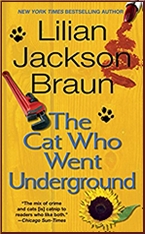
LILIAN JACKSON BRAUN – The Cat Who Went Underground. Jim Qwilleran #9. Putnam, hardcover, 1989. Jove, paperback, September 1989.

   I like cats all right, and I’ve even discovered I can put up with them in detective stories. This is the first of the adventures of semi-retired Jim Qwilleran and his two Siamese pets (Koko and Yum Yum) I’ve read, and while I’m not sure I’m totally converted, it was amusing.

   Braun’s style is a combination of breathless exclamation points with a rural folksiness of a northern Michigan sort that also manages not to be condescending. I do wish, however, that she’d allowed more than the last 40 pages for the detective work to take place.

   To wit. While there are lots of hints concerning some sort of mysterious activity that is taking place, sometimes through the astrology columns in the newspaper, sometimes through a fortune-teller friend, Qwilleran does not find the body of the first known murder victim (under the floor of his cabin on the lake) until page 161.

   Until then, what we’re given is a more-or-less hilarious account of the vicissitudes of a city man trying to cope with life in the “wild” — toilets that don’t flush, water heaters that don’t heat, coons in the chimney, and so on. (I guess I’ll probably stay where I am.)

— Reprinted and somewhat revised from Mystery*File #21, April 1990.


Bibliographic Notes:   The first three books in Braun’s “Cat” series were published between 1966 and 1968. There was then a gap of 18 years before the fourth one came out, when the author was 75, and something strange happened. It became an overnight success and sold a ton of copies.

   So successful that there were 25 more, with the last one, The Cat Who Had 60 Whiskers, appearing in 2007, when Braun was 94. She died in 2011 at the grand old age of 98.

REVIEWED BY DAN STUMPF:


HARRY BROWN – The Stars in Their Courses. Knopf, hardcover, 1960; Bantam, paperback, 19??

EL DORADO. Paramount, 1967. John Wayne, Robert Mitchum, James Caan, Charlene Holt, Arthur Hunnicutt, Ed Asner, Michele Carey, Christopher George and Olaf Wieghorst. Screenplay by Leigh Brackett, based on the novel The Stars in Their Courses, by Harry Brown. Directed by Howard Hawks.

   The other day I re-read The Stars in Their Courses by Harry Brown, which I hadn’t touched in 30 years, and it spurred me to re-watch a film I haven’t seen in almost as long, El Dorado.

   Stars tells the Trojan War legend reframed as a Western: Arch Eastmere (think Achilles) is a skillful gunfighter with a bad heart and worse luck, who returns to his home town to find that the small ranchers (to whom he owes money) are getting fed up with the local Big Rancher, Percy Randal. When Percy’s younger son rides off with the abused wife of one of the small ranchers, they’re ready to fight. Arch likes the Randals, and was a close friend of Percy’s tough older son Hallock (think Hector) but he owes a debt to the opposition….

   It’s all a bit contrived and pretentious, but somehow fitting. The ancient heroes were to the Greeks as cowboys were to us when I was a kid, and it’s fascinating to see Brown set these leathery westerners to reenacting a legend, with splendid prose, fast action, and characters at once larger than life and all too human.

   This was almost filmed by Howard Hawks as El Dorado. Hawks lost faith in the script half-way through and decided to just re-make Rio Bravo. If you watch Dorado you may notice the earlier scenes shot outdoors tend toward the grim side, but the later parts (done in the studio to save time & money) just earnestly copy Rio Bravo.

   The wonder is that it all works so splendidly. Hawks’ gift for vivid action and his knack of making his actors look like they’re actually talking to each other were never displayed to better effect.

   He’s helped considerably by a remarkable cast. Charlene Holt plays the local shady lady with a tender toughness that becomes really moving at times, and Michele Carey projects an untamed sexuality that smacks up agreeably against James Caan’s virile neophyte. Paul Fix and R.G. Armstrong lend their typecast western authority to the proceedings, and Christopher George recalls the amiable lethality of John Ireland in Red River, as a man who will share drink with someone or gun him down just as easily. Best of all, Arthur Hunnicutt positively shines as the Ultimate Comical Sidekick, a character so funny and bizarre that only he could do it justice.

   And then there are the top-liners: John Wayne and Robert Mitchum playing the heroes of the piece with rueful maturity. Mitchum gets a showy part as the sheriff-turned-drunk, by turns comic and harrowing, and he makes it one of the best performances of a remarkable career. Wayne’s role as Mitchum’s gunfighter-buddy plagued by a debilitating wound is just as fine, his toughness crumbling with startling poignancy that somehow reveals the inner strength.

   Hawks’ skill as a director has been duly celebrated in classics like To Have and Have Not, The Thing from Another World and Bringing Up Baby, but he was never better than in this broken-backed western.

   By the way, El Dorado opens with the title credits over some fine Western paintings. They are the work of artist Olaf Wieghorst, who also plays the Swedish gunsmith with the great line, “He shoot the piano player, and they hang him.”


REVIEWED BY JONATHAN LEWIS:


LAWMAN. United Artists, 1971. Burt Lancaster, Robert Ryan, Lee J. Cobb, Robert Duvall, Sheree North, Albert Salmi, Richard Jordan, John McGiver, Ralph Waite. Director: Michael Winner.

   Brutal and cynical, Lawman certainly isn’t a genial Western where the good guy takes on a villainous cattle baron, wins the love of a beautiful girl, and restores the equilibrium of the world to be on the side of justice. Rather, this Michael Winner film is a character study of an aging, brooding lawman so obsessively committed to his personal code of honor that all he is able to do is bring death and misery to all those he encounters.

   Burt Lancaster, in a role that allows little for his personal charm to shine, portrays Jared Maddox. Sporting a black leather vest and a holster, Maddox rides into the town of Sabbath. We learn through a conversation that he has with the town’s marshal Cotton Ryan (Robert Ryan) that he has come to Sabbath for a very specific reason.

   Several months ago, cowhands working for the stoical cattle baron Vincent Bronson (Lee J. Cobb) had ridden into a town by the name of Bannock and shot up the place. Although they were drunk and merely looking to blow off steam, an old man died at the hands of one of their bullets. And Maddox intends to bring the men back to Bannock to face trial.

   This sets in motion a series of violent confrontations between Maddox and the wanted men, as well as anyone who dares stand in his way. Maddox is so tied to the cause of “justice” – indeed, to his very identity as a “lawman” – that he’s increasingly blind to how much unnecessary death and misery he is bringing in his refusal to budge even slightly from his personal code.

   In that sense, Lawman stands in the tradition of those tragic Westerns in which a protagonist has outlived his time. Maddox belongs to an earlier era, in which the law was good and the outlaw was bad. Such binary demarcations are outdated in Braddock. Even the “bad” cattle baron seems to have more insight and compassion than Maddox.

   But does this mean we are supposed to not root for Maddox? Or are we supposed to be somewhat detached spectators watching Maddox make one bad decision after another? Unlike Paul Kersey (Charles Bronson) in Death Wish (1974), a film Winner directed several years after Lawman, we never get to see how or why Maddox was forged into a stone cold killer.

   It’s the absence of a backstory that makes Lawman a far less compelling character study than it could have been. By the end of the film (SPOILER ALERT), when Maddox shoots a man in the back, we finally get the message. Maddox is as much a villain as a hero. And the real lawman in the film, the one we should admire is the quiet, thoughtful Cotton Ryan.

« Previous PageNext Page »