Reviews


REVIEWED BY MICHAEL SHONK:


HIGH TIDE. Syndicated, 1994-1997. ACI -Franklin/Waterman 2. Cast: Rick Springfield as Mick Barrett and Yannick Bisson as Joey Barrett. Supporting Cast: Season One: George Segal as Gordon, and Diana Frank or Cay Helmich as Fritz. Season Two: Julie Cialini as Annie. Season Three: Deborah Shelton as Grace Warner and David Graf as Jay Cassidy. Created by Jeff Franklin and Steve Waterman.

   With the increasing popularity of cable in the 1990s, there was a growing number of syndicated programs to fill the content needs of the new cable stations. The cheesy action comedy was one of the more common genres. This type of series often featured beautiful locations and gorgeous half-naked men and women, action but limited violence, and scripts filled with endless TV tropes.

   High Tide was such a series. It survived three seasons with a slightly different premise and location each season.

   Season One was filmed in New Zealand. Mick is an ex-cop who blames himself for his partner’s death. He and his not too bright, impulsive younger brother Joey live the life of surf bums.
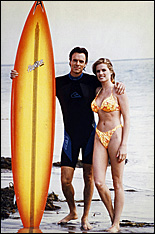
   Interrupting the brothers’ life of bikini watching and surfing was Gordon, an ex-CIA agent now L.A. restaurateur who constantly gets the boys involved in helping one of his many gorgeous young goddaughters. Conveniently the young ladies usually get in trouble where there is surfing nearby. As to be expected with a TV series devoted to using as many TV tropes as possible, Gordon’s assistant is the young beautiful Fritz (played by Diana Frank or Cay Helmich).

   A note about the cast. Both Rick Springfield and George Segal are well enough known stars of TV and films without listing their credits. However it should be mentioned that Yannick Bisson played Joey the younger brother. Today Bisson can be seen as the star of the long running Canadian hit series Murdoch Mysteries.

   Some may notice the name of Tim Minear in the behind the line credits such as writer, story editor, or co-producer. Minear has become one of Hollywood’s top critically acclaimed TV producers today with series such as Terriers (2010), American Horror Show (2012-17) and Feud (2017-18).


REVENGE IS SWEET. November 26, 1994. Written by Martin Cutler and Tim Minear. Directed by Catherine Millar. Guest Cast: Kenneth McGregor and John Dybuig. *** Someone from Mick’s past wants him dead.

   A break from Mick and Joey’s weekly rescue of a beautiful woman in trouble, this episode focuses on Mick’s backstory. Rarely rising above clichés, it lacks suspense and fails to make us care. As a typical syndicated series of the time, it is a mindless, but not the worst, way to kill an hour of your life.

   Mick’s beloved Mustang is impounded for failure to pay parking tickets. A cop with a grudge against Mick since Mick’s police academy days arrests Mick. Revealed to be a computer glitch, Mick is let go only to be unable to find his car.

   Mysteriously his car is returned, but it has a warning from someone who threatens to kill Mick. Mick is then framed for murder. Mick finds himself on the run from the cops while trying to find out who wants him dead.


   Season Two had the production company leave New Zealand for San Diego. Story-wise the brothers leave Los Angeles and Gordon and Fritz behind to open a surf shop in San Diego called High Tide. There, Mick and Joey spend more time rescuing old friends and strangers than actually running the shop.

   Annie the High Tide employee was played by Playboy Playmate of 1995 Julie Cialini. During the second season the series hired Playboy models for minor roles and background.

   The second season aired in 80% of the country or 90 markets including all Top 25 markets. The ratings in United States were low but better overseas (Broadcasting, July 17, 1995).


CODE NAME: SCORPION. March 4, 1996. Written by Chris Baena. Directed by John Grant Weil. Guest Cast: Chip Mayer, Josie Davis, and Donna D’Errico. *** Mick reunites with his goddaughter whose ex-CIA agent father died years ago. She is a champion Pro beach volleyball player on tour. She is staying with the brothers when she is kidnapped.

   The second season increases the close-ups of female butts and boobs. Predictable with clumsy writing and weak acting, the series continues to rely on visual scenery and the brothers’ relationship to keep the viewers from changing channels.


   In Season Three the production moves again, this time to Ventura CA. Mick and Joey have sold their failed surf shop High Tide. Mick wishes to live the life of the surf bum, but Joey wants to find a paying job of adventure.

   Continuing its theme of teen male wish fulfillment, the third and final season has Grace, a gorgeous rich woman offering the brothers her luxurious guest beach house in Santa Barbara as a place to stay rent free.

   Mick and Joey decide to become full time PIs. Jay, an ex-cop friend of Mick’s who sells real estate and is a bails bondsman, offers the brothers assignments to track down bail jumpers.

STARTING OVER. September 22, 1996: Written by Chris Baena. Directed by Chris O’Neil. Guest Cast: Rob Farrior and Lyman Ward. *** A rich powerful man’s spoiled son beats a man to death. When he skips bail the brothers are hired to find him and bring him back.


   High Tide was an average harmless syndicated action series meant to appeal to teen boys and those viewers seeking to abandon their brains for sixty minutes. Nice to look at and at times fun to watch, the series never rose above cotton candy for the eyes.

BLACKMAIL. MGM, 1939. Edward G. Robinson, Ruth Hussey, Gene Lockhart, Bobs Watson, Guinn Williams. Director: H. C. Potter.

   In a typically strong but not entirely successful performance from him, Edward G. Robinson plays John Ingram, a successful oil-field firefighter — the best there is for miles around, as a matter of fact — but even with a wife and young son now, he has a secret from his past that he does not want known, and that is where the title comes in. Someone from his previous life (a perniciously loathsome Gene Lockhart) knows that secret, that several years before he had been unjustly convicted of robbery but had managed to escape from the chain gang he was on.

   And as Lockhart manages to work it, not only does Robinson end up back on the chain gang, but he (Lockhart) gets control of the oil well his victim has been hoping would come in. The only thing on Robinson’s mind — well, two — are escape and revenge.

   This was, of course, MGM’s belated answer to I Was A Fugitive from A Chain Gang, which was released by Warner Brothers in 1932. It tries to be as gritty as he earlier film, but it just doesn’t make it. As good as Edward G. Robinson was in almost everything he did, watching his not so lean wiry body sloshing through the swamp surrounding the prison farm he escapes from a second time is a cinematic image that will stay with me for a long time, and not for the right reason.

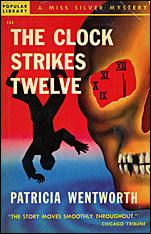
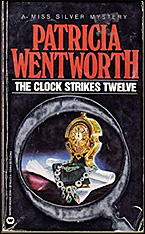
PATRICIA WENTWORTH – The Clock Strikes Twelve. Miss Silver #7. J. B. Lippincott, US, hardcover, 1944. Hodder & Stoughton, UK, hardcover, 1945. Reprinted several times, including Popular Library #131, US, paperback, 1947; Warner, US, paperback, 1984.

   There are situations in which fictional murder victims simply set themselves up for disaster, and such is the case in The Clock Strikes Twelve. When businessman James Paradine discovers some crucial wartime blueprints have gone missing, he knows that the only one who could have taken them is among those attending a New Year’s Even dinner party at his home that evening.

   At the end of the meal he makes an announcement to that effect, that a family member has betrayed him, but without saying what the crime is. But if the guilty party comes to his room before midnight to confess, he will be there waiting for him or her.

   Is it any wonder that his body is found dead the next morning below the balcony of his study? Someone in his family has done more than betray him, but as the police begin their investigation, it is not at all clear what secret failing that each of the ten possible suspects seems to have was the motive for the crime.

   Miss Silver, who looks like everyone’s idea of the perfect nanny, is not called in as a private investigator until about halfway through, and that’s when the detective work begins in earnest. Behind the her outer facade of a children’s governess and her iniquitous knitting needles, she has a sharp mind, indeed.

   Besides the stolen plans, there are a couple of romances that have been thwarted until now, and a small fortune in diamonds may also be involved. This is a mystery that is strong in well-drawn characters as well as actual down-to-earth deductive reasoning. My only wish is that in the end the actions of one of the suspects had been more clearly described than it was.

   And with as many possible suspect as there are in this book, there is also a lot to explain in the finale, much of it extraneous and including at least loose end that is not completely tied up. Otherwise I’d give this at least a two thumbs-up recommendation for those of you who love Golden Age puzzle mysteries. Small quibbles aside, this is still one of the better ones.

REVIEWED BY BARRY GARDNER:

   
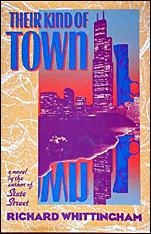
RICHARD WHITTINGHAM – Their Kind of Town. Joe Morrison #2. Donald J. Fine, hardcover, 1994. Avon, paperback, 1996.

   Whittingham’s first book, in which Joe Morrison also played a part and which I missed, was State Street (1991). He’s also written non-fiction books about the NFL draft and the life of a street cop.

   What we have here is Chicago. Though there’s much more to be said about the real city, for our purposes Chicago means cops and gangs of both the street and organized crime variety, and violence. Very soon after the book opens, a semi-independent criminal is executed for showing poor judgment in who he robbed. One witness to the killing, a young black gang member, was also killed — but one wasn’t. The story deals with how both the police and the gang bosses attempt to deal with the potentially disastrous situation.

   Their Kind of Town was a pleasant surprise. Prose, plot, and people all well above average. The story is told from multiple viewpoints, and Morrison is really no more the focus than several others on both sides of the law.

   I thought the dialogue for the various and sharply differing characters was excellent, and that each of the major players came to life very nicely. Though there was a fair amount of bloodshed, this isn’t an action-packed book in its feel; the pace is steady rather than frenetic. It’s one of the best gritty city cop novels I’ve read in a long while, and I’ll definitely find and read the first in the series.

— Reprinted from Ah Sweet Mysteries #14, August 1994.

Bibliographic Note:   The two Joe Morrison books are the only two listed for Richard Whittingham in Al Hubin’s Crime Fiction IV.

Reviewed by MIKE TOONEY:

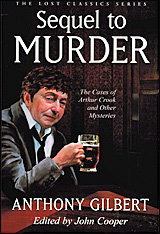
ANTHONY GILBERT – Sequel to Murder: The Cases of Arthur Crook and Other Mysteries. Edited and with an introduction by John Cooper. Crippen & Landru, hardcover/trade paperback, September 2017. Collection: 18 stories.

   Anthony Gilbert (Lucy Beatrice Malleson, 1899-1973) was a woman who shared with other successful female crime writers a combination of writing talent and clever plotting skills necessary to make it in detective fiction’s Golden Age. Even after the GA’s decline, however, she retained a high profile on the mystery scene for several decades; novels, short stories, original radio plays, and TV adaptations made her a multimedia presence well into the hippie era, and in fact, the tales in this collection date from as early as 1927 and as late as 1972.

   In his informative Introduction, editor John Cooper fills us in on her writing career, including why she chose “Anthony” instead of “Tony” and “Gilbert” for her nom de plume, and her series characters. Arthur Crook wasn’t the only one, although most readers think of the devious barrister when discussing Gilbert’s work:

    “The author’s most famous detective was the suitably named Arthur Crook,” writes Cooper, describing him as “big, red-haired, slow speaking, beer swilling, pot-bellied, middle-aged,” distinguishable by his “great, circular red face and a crafty eye” and who, if necessary, was willing to go “to unprofessional lengths to clear his clients.” Gilbert reserved Crook primarily for her novels (fifty-one of ’em!), but she did write five short works with him; they’re all in this collection, amounting to roughly half of the page count:

(1) “You Can’t Hang Twice” (1946): If you’ve committed a murder and there’s a witness still running around, what better place to dispose of the problem than a thick, nearly impenetrable London fog? Crookism: “Murderers get caught because they’re yellow. The minute they’ve socked their man they start feverishly buildin’ a little tent to hide in, and presently some chap comes along, who might never have noticed them, but gets curious about the little tent.”

(2) “Once Is Once Too Many” (1955): Climbing a mountain is hazardous enough without somebody waiting nearby to give that little shove that unmistakably says I hate you. Crookism: “They get careless and forget murder’s a game two can play.”

(3) “A Nice Little Mare Called Murder” (1964): The gallows loom large for a man whose only alibi just lost a race at the track—and he doesn’t even play the ponies. Crookism: “When a chap’s paying me to act for him he’s always innocent.”

(4) “Give Me a Ring” (1955): A wrong turn in the fog, a mix-up about a Christmas gift, a needle in the arm—Alice never had it like this in Wonderland. Crookism: “Don’t know what they teach ’em at these posh schools.”

(5) “The Black Hat” (1942): A blackmailer gets his in a blackout; there’s universal agreement that he deserved it, but the man they’ve arrested doesn’t. Crookism: “If I thought you were going to have another chance of killing a chap I’d warn you—never re-visit the scene of the crime.”

   The rest of the stories fall into the miscellaneous category, most of them involving blackmail (evidently her favorite theme): Surprising developments at “The Reading of the Will” … A lawyer’s dilemma in “Curtains for Me” … Spinsters in jeopardy in “Point of No Return” … Double murders in a “Cul-De-Sac” … Inspector Field’s eerie tale of the “Following Feet” … “Three Living … and One Dead”—and one’s a murderer … Knifed in a taxi cab by “The Man with the Chestnut Beard” … There’ll be wedding bells “Over My Dead Body” … The king of the beasts attends “The Funeral of Dendy Watt” … To Inspector Field, there’s no such thing as “Horseshoes for Luck” … Life was looking grand until “He Found Out Too Late How Good an Artist Mabel Was” … Spouse killers in love in “A Day of Encounters” … and a newspaper dated the day of a murder becomes a “Sequel to Murder” (which, says our editor, Gilbert considered “as her best short story”).

   Anthony Gilbert’s short fiction is as durable as her novel work, and the stories in Sequel to Murder are well worth spending time with; the author knew how to write and, an important consideration in mysteries, how to plot. Along with Agatha Christie, she had a talent to deceive.

REVIEWED BY DAVID VINEYARD:


EDGAR WALLACE – The Tomb of Ts’in. Ward Lock, UK, hardcover, 1916. Hutchinson Library Service, UK, abridged/revised, 1972. CreateSpace, US, softcover, 2015. Available online here.

   It concerns the tomb of the Great Emperor—the first Emperor of the Chinese, who died two centuries before the birth of Christ; it concerns that extraordinary genius and adventurer, Captain Ted Talham—surely the most talkative man in the world; it concerns, too, that remarkable woman, Yvonne Yale, and last but not least, The Society of Joyful Intention—the most bloodthirsty organisation the world has known. It concerns Tillizinni also, for Scotland Yard placed him on his mettle, set him a challenging task, which threatened at one time to bring ruin to the greatest detective in Europe.

   That it likewise brought him within an ace of losing his life, I should not think it worth while mentioning at this stage, but for the fact that scoffers might suppose that he held life dearer than fame.

   Nice of Edgar Wallace to summarize the plot so neatly for me in the Introduction don’t you think? Saves a critic oh so much effort.

   And we are off into the land of Yellow Peril, but in the sure hands of Edgar Wallace, who does nothing by half, and here out-Sax’s Sax Rohmer in this tale which features a brilliant Italian sleuth, Tillzinni, and the stalwart Captain Talham, a beautiful and strong minded young girl, and at least one well trained and murderous python among other ’orrors of the East.

   Yes, racist no doubt, though Wallace is too good simply to indulge in evil Asians, and he grants his villain a certain amount of the gravitas that allows some Asian literary scholars today to try and reclaim Dr. Fu Manchu as they have Charlie Chan, as stereotypes beyond the mere stereotypical.

   It is hardly a great book, or even great Edgar Wallace. It is written with that energy that marks his best work, but also some of that carelessness. It is far from fresh territory, but it does the genre right, with a minimum of racial nonsense, and a certain respect between the brilliant Chinese villain and the brilliant Italian detective.

   In fact, Tillzinni is what saves this one for me. He is attractive, eccentric, clever, amusing, a man of mind and action, only a bit overly Italian (as compared to the overly Belgian Poirot the overly Austrian Van Helsing or the overly French Hanaud), and altogether he is one of Wallace’s more believable great detective types.

   It all boils down to a last second conclusion, with justice prevailing, at least for the Anglo-Saxon characters, and unlike most of its sort there is far less that is objectionable and unnecessary than usual.

    At least, unlike Rohmer, the Anglo-Saxon characters aren’t all embarrassingly stupid and rampantly racist, and Wallace manages to do the Asian menace genre with a minimum of drugs unknown to science, giant non-existent spiders, and creeping Dacoits and still hit the mysterious highlights.

   If you feel it will offend you, by all means don’t read it, but if you can bring some historical perspective to bear, it is an entertaining rip-roaring thriller worth an hour of your time. My personal opinion is it is better to be open and honest about the genre and its past, and to accept the bad with the good for what they are, rather than try to bury everything out of step with our times. I know that doesn’t work for everyone, nor do I see anything wrong if it doesn’t work for you.

J. HARVEY BOND – Kill Me with Kindness. Mike Lanson #3. Ace Double D-349, paperback original, 1959. Published back-to-back with The Guilty Bystander, by Mike Brett (reviewed here ).

   J. Harvey Bond was the pen name of Russ Winterbotham (1904-1971), who was probably better known as a writer of science fiction, both novels and short stories, starting as far back as 1935 and “The Star That Would Not Behave” as R. R. Winterbotham in the August issue of Astounding SF for that year.

   All of Winterbotham’s detective novels were written as by J. Harvey Bond, and all four were mysteries tackled by a newspaper reporter by the name of Mike Lanson. Kill Me with Kindness is the third of the four.

   Written up in ths one is a tale that’s a reliable old standard, that of corruption in a small town, with only the town newspaper interested enough to nose around and find out who’s behind it. The police are handicapped by either a lack of will or a lack of evidence, and probably both. Dead is a anti-vice crusader who the owner of Lanson’s newspaper believes is not beyond doing a little bit of shakedown on the side himself.

   There is also a good-looking girl involved, a strip-tease dancer named Luzy McGuire — that is probably her shown on the front cover above — and not only is she involved, but as Lanson also soon begins to learn, she is the key to his entire investigation.

   I needn’t tell you more. It all plays out from here just as you might suspect. This is the literary equivalent of any number of black-and-white movies being made at the same time, this one with John Payne, say, as Mike Lanson, and Marie Windsor, Terry Moore or Audrey Totter as Luzy. It might even be better as a movie. I know that that’s one I’d watch!

      The Mike Lanson series —

Bye Bye, Baby! Ace Double D-279, 1958.

Murder Isn’t Funny. Ace Double D-301, 1958.

Kill Me with Kindness. Ace Double D-349, 1959.
If Wishes Were Hearses. Ace Double D-483, 1961.

   When this happened before, I called it “one for the books.” This is Steve. It has happened again. Two days after my son Jonathan wrote up a review of this movie, I received an email from Dan Stumpf containing his comments on the same film. So here you are. Two reviews of Two Rode Together, totally independently of each other, two for the price of one. As before, I’ll let Dan go first.

TWO RODE TOGETHER. Columbia, 1961. James Stewart, Richard Widmark, Shirley Jones, Linda Cristal, Andy Devine, John McIntire, Henry Brandon, Woody Strode, Harry Carey Jr. Ken Curtis. Screenplay by Frank S. Nugent. Director: John Ford.

Reviewed by DAN STUMPF:

   This sees Ford gliding toward the bitterness of The Man Who Shot Liberty Valance, but in a showmanlike way.

   Actually, the westerns of John Ford had grown increasingly disenchanted since Wagon Master (1950). After Rio Grande, made the same year, he didn’t make another western till The Searchers in 1956. Then another long pause before the cavalry pictures The Horse Soldiers (1959) and Sgt. Rutledge (1960) both of which have their pessimistic aspects… and then this.

   Perhaps the defining thing about Two Rode Together is its cheerful cynicism. The West here may be filled with suckers and con men, where even the Noble Savage plays politics and keeps an eye out for the main chance, but that doesn’t keep its heroes from going about their business with professionalism and a wry smile. Jimmy Stewart lends his easy charm to his role as a corrupt lawman and Indian Trader, and Richard Widmark plays it knowing and sincere as a cavalry lieutenant who still has some sense of commitment, even if he isn’t sure to what.

   In fact, Stewart and Widmark play brilliantly off each other, almost as if they’d been acting together for years, and writer Frank Nugent, who worked steadily with Ford from Fort Apache onward, gives them some cherce material: the scene at the river bank should be studied and cherished by lovers of acting, writing, directing, and just plain damn-fine movie-making.

   There is surprisingly little action in Two Rode Together, yet it seems to move at a brisk pace, and the prevailing sense of humor breaks naturally for moments of keen drama. What struck me most, though, was the pervading sense of optimism in what is essentially a bleak tale.

(SPOILER ALERT!) This film ends with the mission a failure, a heroine ostracized and Jimmy Stewart out of a job, but the characters have grown and changed in important ways. Or as Widmark puts it, “I guess old Guth found something he wanted more than ten percent of.” Whatever the case, there is a gentle debunking of Western Legend here conveyed with a charm that Ford somehow never found again.

Reviewed by JONATHAN LEWIS:

   What does it mean to be civilized and what does it mean to be a savage? Can one be a civilized person in the midst of savagery? Or a savage living in civilized “polite” society? These are the philosophical and moral questions at the heart of John Ford’s Two Rode Together, an unintentionally quirky Western with strong comedic overtones and a strong romantic element.

   Similar to Ford’s The Searchers (1956), the plot revolves around two men’s quest to rescue White captives from an Indian tribe. Riding with Marshal Guthrie McCabe (James Stewart) on his mission is a army officer portrayed by Richard Widmark.

   When we first meet him, though, Marshal McCabe is an amoral lawman living a fairly ordinary life in a small Texas town where law and order seems to be primarily a matter of dealing with the town drunks. He’s got his hand in many pots, taking a ten percent interest in numerous town establishments. Then First Lieutenant Jim Gary (Widmark) rides into town with his Cavalry troop, the portly Sergeant Darius P. Posey (Andy Devine in a comedic role) by his side. His mission is to bring McCabe back to the Army camp for a yet undisclosed reason.

   Soon enough, McCabe realizes that he’s been tasked with a dangerous mission: to bring back White captives held by the Comanches. One reason that Major Frazer (John McIntire) has chosen him for this role is because he’s not an Army officer. But that doesn’t stop him from assigning Gary with an unofficial role of accompanying McCabe on his quest.

   What happens at the Comanche camp becomes the focal point for McCabe’s other journey, his internal one from selfishness and amorality to completeness and an ethical life. The catalyst for his transformation is none other than Elena de la Madriaga (Linda Cristal), a Mexican girl held captive by the Comanches. When McCabe is able to see the world through her eyes, it begins to change him.

   Things get even more complicated when he brings her back to the Army camp and sees how the gossipy older White women treat Elena. As in many of Ford’s films, there is a dance. An Army dance at an outpost of civilization out in the midst of a contested territory. But it’s at this civilized dance that McCabe and Gary witness some deeply uncivilized behavior on the part of the attendees.

   What’s most intriguing about Two Rode Together is that it often feels as if Ford didn’t know exactly what he wanted the movie to be. A gritty Western? A comedy Western? A romance? But by the time the film ends, one gets the sense that sometimes not choosing allows the movie to be all of those things and somehow more. Not an excellent film, but it is quite a good one, largely thanks to Ford and Stewart.

TALL, DARK AND HANDSOME. 20th Century Fox, 1941. Cesar Romero, Virginia Gilmore, Milton Berle, Charlotte Greenwood, Sheldon Leonard, Stanley Clements, Frank Jenks. Director: H. Bruce Humberstone.

   Even though this film is heavily populated by hoodlums and hardened criminals of all kinds, starting from Cesar Romero on down, what it really is is a comedy romance, as I’ve already categorized it. Not a single dark and gritty scene to be seen.

   There is a bit of a mystery at the beginning, though. Why does Milton Berle, Romero’s number one henchman, put the former’s trademark cigars in the mouths of three bodies discovered at a mom and pop store shootout? Answer: to implicate his boss, but why?

   Shift of scene to a department store where Romero spots a good-looking girl (Virginia Gilmore) who’s in charge of the section where mothers drop off their children to play while they go on to do their shopping. A conversation between the two is struck up, and before he knows it, Romero has hired Gilmore as a nanny for his children.

   The problem is, you guessed it, he doesn’t have any children, and he has to go find one, a very truculent Stanley Clements. The romance goes on its semi-rocky way from there, while at the same time, Romero has to deal with a gangster from the other side of town (Sheldon Leonard) who’s trying his best to crowd in on the former’s territory.

   The result is only mild fun, nothing more, even at the time. What is fun now, some 75 years later, is watching a nicely assembled gang of professional actors go through their paces.


Note:   Go here for Walter Albert’s comments on this very same film, posted over six years ago on this blog.

BILL CRIDER – Murder Among the OWLS. St. Martin’s Press, hardcover, 2007. Worldwide, paperback, January 2008.

   OWLS in this case is spelled correctly. It’s an acronym for Old Women’s Literary Society, an organization in Clearview Texas of which the murder victim in this book was a member, the book being the 14th of what is currently 23 novels in Bill Crider’s Sheriff Dan Rhodes series of low-key and semi-homespun mysteries.

   He’s actually the sheriff of Blacklin County. I’m not sure if Clearview is the county seat or not, but it’s where both Rhodes and Helen Harris live, close enough that when she is killed in her own home, her cat wanders off and ends up at Rhodes’ back door, to the consternation of at least one of the Rhodes’s two dogs.

   And while trying to find Mrs. Harris’s killer, Rhodes also finds himself trying to find a new home for “Sam” as Ivy (Mrs. Rhodes) has already renamed him. If this makes Murder Among the OWLS sound like a cozy to you, I’d have to agree with you, but it’s one with a bit of an edge to it. While pursuing his sheriffing duties, Rhodes does meet up with a man with a gun (and earlier on, an angry man with a working chain saw).

   But Murder Among the OWLS is also a detective puzzle, and a good one, well-clued but with the clues hidden well enough that with only ten pages to go, Rhodes still doesn’t know who the killer is. In those ten pages. though, a lot of things he’s noticed in his investigation finally come together, just as they should.

   Most importantly, though, in makes this book a “fun read” — there’s no other way to put it — are the people that Rhodes meets along the way, new ones as well as those he’s already friends and neighbors with. No fancy rich folks among them, no fancy talk, but people you can recognize and relate to, even the killer — ones you might meet in your own home town or neighborhood, unless you’re a millionaire and travel in circles that I never will, whether you’re from Texas or not.

UPDATE. 15 December 2017.   This review first appeared on this blog on 19 November 2015. It has been reposted here today as part of a massive tribute to Bill Crider as part of Patti Abbott’s weekly Friday’s Forgotten Books posts. Follow the link to an Internet-wide collection of reviews of Bill’s books and thoughts and memories of him. He recently has had to give up his own blog and entered hospice care. I’ve known Bill through fanzines, letters and email for something like 40 years, and it doesn’t seem nearly long enough.

« Previous PageNext Page »