Reviews


Reviewed by JONATHAN LEWIS:         


F.B.I. GIRL. Lippert Pictures, 1951. Cesar Romero, George Brent, Audrey Totter, Tom Drake, Raymond Burr, Raymond Greenleaf. Director: William Berke.

   There are plenty of shadows in FBI Girl. Unfortunately, they are a product of bad lighting rather than a film noir aesthetic. And that’s not necessarily the worst thing about this rather poorly constructed black-and-white semi-docudrama crime film. No. The worst aspect about the whole affair is that it wastes the talents of both Cesar Romero and Raymond Burr on a movie with a less than compelling plot and stilted, unrealistic dialogue.

   Romero portrays FBI Agent Glen Stedman. He’s tasked with investigating the suspicious death of a female FBI clerk working in the fingerprint division. Little does he know that his investigation will lead him straight into a morass of political corruption in Capitol City and the shrewd machinations of Grisby, a Southern politician (Raymond Greenleaf) and Blake, his corrupt, violent henchman (Raymond Burr). Much of the film follows Stedman as he travels from Washington D.C. to Capitol City and back again in search of possible clues.

   It’s a potentially intriguing premise for a movie, but FBI Girl never really gets off the ground. It’s consistently bogged down by either poor acting, an intrusive score, or as I mentioned earlier, bad lighting. There’s also a sound stage quality to the whole affair, making it seem a lot less like a feature film and more like a television show from the same era. Overall, a rather below average production.
DARK CITY. Paramount Pictures, 1950. Charlton Heston, Lizabeth Scott, Viveca Lindfors, Dean Jagger, Don DeFore, Jack Webb, Ed Begley, Harry Morgan, Mike Mazurki. Director: William Dieterle.

   In this film Charlton Heston is a small-time grifter who, along with his gang of cohorts, fleeces a LA businessman (Don DeFore) in a game of cards. When the man commits suicide, his brother (Mike Mazurki), not altogether sane, doesn’t take kindly to it and decides to do something about it.

   This wasn’t Charlton Heston’s film debut, but it was close. He had done a very early experimental film (Peer Gynt) back in 1941, then one other film (Julius Caesar) earlier that same year, plus a single episode of an obscure TV show called The Clock.

   While I think the movie is a small gem, it would be stretching it to say that you could tell from seeing it that Heston would soon be a major star. In fact, in old movies such as this one, I usually enjoy watching people such as Jack Webb, Ed Begley, and Harry Morgan performing a whole lot more.

   One other thing. This movie was released a long time before Jack Webb and Harry Morgan teamed up to do Dragnet on TV. Webb plays a shifty-eyed hood named Augie, with a wide-rimmed hat twice the size of his head, while Morgan is a punch-drunk hanger-on with a heart as big as all outdoors.

— Reprinted from Mystery*File #24,, August 1990 (expanded and revised).


IT IS PURELY MY OPINION
Reviews by L. J. Roberts


CLAIRE BOOTH – Another Man’s Ground. Sheriff Hank Worth #2. Minotaur Books, hardcover, July 2017.

First Sentence:   The dispatch call said there was stripping goes on in the woods, and the property owner was not happy about it.

   Sheriff Hank Worth of Branson County, Missouri, is in the midst of his re-election campaign when called out on a case of an unusual theft, but one of considerable value. He is successful in keeping a certain aspect of the case quiet from the general populous, until a body is found.

   A very clever hook definitely captures one’s attention. Booth then proceeds to provide some very interesting “who knew?” information.

   Hank’s having to go through all the work of a political campaign provides an interesting look at what is involved and how manipulative they are. There is a religious sensibility which runs through the story, but not in any way that is preachy or should cause anyone of any faith, or no faith, discomfort.

   Booth’s depiction of a mother whose child has been missing is very effective and painful. She conveys the eternal hope one would have even in the face of knowing the case is no longer a priority for law enforcement.

   The team of officers is a true ensemble with Hank as its supportive lead, and one officer wanting to be involved— “But, man, was he in some kind of business, where getting handed two homicide cases improved an employee’s morale.” Sheila, in particular, is a well-crafted character as a detective who is a good team member and one who truly cares about the victim. Yet all the characters are very well developed, not only on the job, but with Hank’s relationship to his wife and Lovinia, an older woman who shows up at every crime scene and is as wise as she is delightful.

   Another Man’s Ground has murder, drugs, and politics in a wonderfully unpredictable plot. This is a book once started won’t be put down until it’s finished.

Rating:   Excellent.

— For more of LJ’s reviews, check out her blog at : https://booksaremagic.blogspot.com/.


Editorial Note:   The first Hank Worth mystery was The Branson Beauty (2016).

THE BACKWARD REVIEWER
William F. Deeck

   
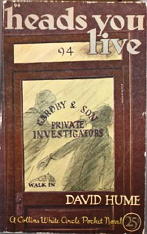
DAVID HUME – Heads You Live. Collins, UK, hardcover, 1939. Collins White Circle #94, Canada, paperback, 1944 (shown). No US edition.

   Another investigation, if you are generous and willing to call it that, by Cardby & Son, Private Investigators, although this features the son, Mick, whose father appears only infrequently.

   This, I take it, is an example of the typical tough-guy English novel. If it is, it is about the level of most American tough-guy novels of the period, filled with a great deal of senseless violence perpetrated by both the good and bad guys,·although Cardby fils, despite some splendid efforts on his part, doesn’t kill anyone.

   As is usual in this type of novel, there is little plot. Cardby & Son, when they make it plain they can’t get a man’s capital out of Austria, are then hired to protect it once it reaches England. It doesn’t reach England, or at least the part of it where Mick Cardby is waiting, and he begins to investigate.

   Several cases of arson, in which Cardby pere and then Cardby fils are the targets, a great deal of shooting and fighting, with a short respite for some minor torture that Mick engages are the highlights, if such they can be called, of the novel.

   Cardby is lucky in that he, not particularly bright, manages to encounter villains even less astute than he. One character, a born killer — Cardby points out that these people are branded as distinctively as cattle, although he is not aware he is facing one until it is too late — also appears to have been born a talker. That talent is what he occupies with until Cardby confuses him by telling that the “safety catch” of his revolver is on. (Another peculiar revolver, this one with a silencer that works, appears in the story earlier.)

   The dialogue is also odd, or at least that is how it strikes me. It sounds much like a mixture — 75% U.S. underworld argot, as imagined by an author, 25% English slang. I had to keep going back to make sure it was all taking place in England.

   For those readers who like a lot of violence, little realism and even less thought. Still, it is amusing in its own way. And Hume adheres to P.G. Wodehouse’s dictum not to let a female play a prominent role and thus louse up the action.

— Reprinted from CADS 15, November 1990. Email Geoff Bradley for subscription information.

Bibliographic Note:   David Hume was one of two pen names used by J. V. Turner, 1905-1945. There were in all 28 Mick Cardby novels published between 1932 and 1946. Turner also wrote an additional 20 or so detective novels under his own name, as Hume, and as as Nicholas Brady.

REVIEWED BY DAN STUMPF:


CHAMPAGNE FOR CAESAR. United Artists, 1950, Ronald Colman, Celeste Holm, Vincent Price, Barbara Britton, Art Linkletter, and (according to IMDB) Albert Einstein. Written by Hans Jacoby and Frederick Brady. Directed by Richard Whorf.

   No classic, but a sparkling little gem of a film that deserves to be screened more often.

   Ronald Colman stars as Beauregard Bottomly, unemployed genius. Sharing a bungalow with his sister (Barbara Britton) who makes a living giving piano lessons to Byron Foulger. Colman applies for a job at Milady Soap, where he runs afoul of mad soap tycoon Burnbridge Waters (Price) Humiliatingly rejected, he plots an exquisite revenge ……

   â€¦ because it seems Milady Soap sponsors a Quiz Show (hosted by Art Linkletter!) with the prize amount doubling every week. With his superior mental capacity, it becomes an easy matter for Bottomly to run up the stakes till he threatens to bankrupt Waters by winning his whole company — until Waters strikes back.

   I should say at the start that this film is hardly a Laff Riot on the order of His Girl Friday or Duck Soup; it’s a gentle comedy, with moments of gentle satire, and an atmosphere of gentle pleasantry. But it comes to sharp, hilarious life whenever Vincent Price is on screen!

   Price’s Burnbridge Waters ranks as one of the great characters in fiction, alongside Hamlet, Scrooge, Mister Toad, Oedipus and Rochester (both of them) and Vinnie plays it with relish, rolling grandiose lines across his tongue, indulging in outrageous double-takes, and generally imparting a helluva good time all around. Colman, Holm, Britton, and even Art Linkletter are all fine, but Price just walks away with it all.

   And whenever I find an off-beat thing like this, I’m always intrigued by where it came from. The careers of the writers and director of this thing are so negligible that I’m inclined to give credit to producer Harry M. Popkin, whose credits include such unorthodox efforts as And Then There Were None, The Thief, and DOA.

   Hey, it works for me!

RAY RING – Peregrine Dream. Henry Dyer #2. St. Martin’s Press, hardcover, 1990. No paperback edition.

   What Henry Dyer is, when it comes down to it, is your basic open range environmentalist PI. He lives in Tucson, formerly worked for the Arizona Department of Game and Fish, and this, his second adventure, centers around a pair of kidnapped falcons — and murder. (There is apparently a thriving black market in rare animals, especially those of an endangered species.)

   The story is not all that complicated, merely cluttered. Lots of characters, including Dyer’s former girl friend. She is about to get married to someone else, but she is still deeply involved in Dyer’s life. There are also some fairly ugly villains and lots of intense action. Solving the mystery sometimes comes in second best.

— Reprinted from Mystery*File #23,, July 1990. (slightly restructured and revised).


Bibliographic Notes:   The first Henry Dyer novel was Telluride Smile (1988). There was not to be another, but Ray Ring, a noted award-winning journalist, did write a very noirish third crime novel called Arizona Kiss (1991).

Reviewed by JONATHAN LEWIS:         


HOUSE OF WAX. Warner Brothers, 2005. Elisha Cuthbert, Chad Michael Murray, Brian Van Holt, Paris Hilton, Jared Padalecki, Jon Abrahams, Robert Ri’chard, Dragitsa Debert. Director: Jaume Collet-Serra.

   For a movie that has more than its share of borderline amateurish acting, a plot with holes you could drive through, and characters that are essentially horror movie archetypes come to proverbial life, House of Wax is nevertheless a thoroughly entertaining, if absurd, thrill ride.

   Under Jaume Collet-Serra’s skillful direction, this occasionally graphically violent horror movie retains an atmospheric sense of impending doom, dread, and sheer creepiness. Top notch production design, along with the movie’s implicit inter-textual references to past horror films, makes it one of the more unusual horror movies I’ve seen in a while. That’s not to say it’s an excellent movie. It’s not. But it’s at least trying to do something different, and, in a world where so many contemporary horror films feel the same, House of Wax stands out from the pack.

   The plot. You’ve surely seen this before: a group of college students on a road trip find themselves stranded in a rural area. Soon enough, they realize that they’re trapped in a sparsely populated area and that there’s a serial killer hunting them. What you haven’t seen before are the two primary villains who are the movie’s antagonists. They’re not quite like anything I’ve seen in a horror movie apart from maybe Chuck Conner’s character in the 1977 cult classic Tourist Trap (reviewed here ).

   Two twin brothers, one of whom wears a wax mask covering his disfigured face, run a wax museum in an abandoned small town somewhere in the Deep South. It comes as no surprise that the wax figures are or, better yet, were once human. Somehow – it’s never explained – these maniacs have been able to hole up in a small town that law enforcement doesn’t even know exists. Make of that what you will.

   You also have the final girl trope – because of course. The attractive, feisty college student who defeats the monster here is Carly Jones (Elisha Cuthbert who many will recognize from her portrayal of Jack Bauer’s daughter on 24) who, along with her twin brother Nick (Chad Michael Murray), defeats the monsters. Their friends are not so lucky. But make no mistake about it. You want to root for Carly all the way. And she lives up to your hopes.

IT IS PURELY MY OPINION
Reviews by L. J. Roberts


NICK PETRIE – The Drifter. Peter Ash #1. G. P. Putnam’s Sons, hardcover,January 2016; paperback, March 2017.

First Sentence: He walked into Harder’s Grange, announced by a chrome-plated bell mounted to the doorjamb.

   Iraq and Afghanistan veteran Peter Ash suffers from PTSD and severe claustrophobia which manifests as a loud buzzing in his head. While helping out the widow of a fellow-Marine he finds a huge, mean dog under her porch, and a suitcase filled with cash and explosives. Investigating their source could kill him.

   From the very outset, there is no question that there’s going to be trouble— “It was dark and musty under the porch, the smell of wees and forgotten things, with an animal stick on top. Not a dog smell, but something wilder. Something feral. The smell of the monsters in the oldest of fairy tales, the ones where the monsters sometimes won.” And if that doesn’t catch one’s attention…

   There is a good twist right at the beginning. However, rather too much is made of Peter’s warewolf eyes, constant motion, and feeling of static at the back of his brain. Although one understands the author trying to convey symptoms of PTSD—“How fucked up was it that walking inside freaked Peter out, but the prospect of a fistfight or shoot-out calmed him down?”—a better editor was to be desired for several reasons.

   Petrie does have a very good, captivating voice. Within all the suspense and violence, there is also humor, particularly from the dog, Mingus— “He would have a nice bruise tomorrow. It was traditional to put a steak on it, but Mingus would just eat it, then lick him to death. A bag of frozen peas would be better. The dog was not a vegetarian.”

   The characters, and there are quite a lot of them, good and bad, do all come to life. They are interesting and complex. It is nice always refreshing that they also don’t all play to stereotype. A word of caution for those to whom it matters, there is also a lot of profanity. It’s realistic considering the characters, but perhaps not to everyone’s taste.

   The Drifter definitely keeps one reading, although the ending seemed abrupt. But it’s an exciting ride.

— For more of LJ’s reviews, check out her blog at : https://booksaremagic.blogspot.com/.


Bibliographic Notes:   The Drifter was nominated for for both the Edgar and the Barry award in the category of Best First Novel. The next two in the seroes are (or will be) Burning Bright (2017) and Light It Up (2018)

HOLLYWOOD OFFBEAT “The Trial.” Syndicated / Dumont Network / CBS. 11 September 1952 (WJZ). Dates: 30 January 1953 (Dumont). Not aired on CBS. Episode 13 of 13. Series also known as Steve Randall. Melvyn Douglas (as Steve Randall). Guest cast: Olive Deering, Neil Fitzgerald, Steve Gethers, Melville Ruick, Harry Sheppard, Ed Peck. Executive Producer:Marion Parsonnet. Produced by Theodore Lewis. Original story by Frederick Stephanie. Screenplay by James Cavanaugh. Directors: M. Milton Schwarz & Frederick Stephanie.

   All of the information above came from the Classic TV Archive website. The credits themselves I am sure are correct. The complicated history of when the series was on, where, and under what name is perhaps more iffy.

   That this is the final show of the very short-lived series is definite. The premise is that Steve Randall (Melvyn Douglas) is a disbarred lawyer is is now working as a Hollywood PI, but in this episode he is promised by the D.A.’s office that he will be reinstated if he helps persuade a balky female witness to testify in an upcoming murder trial.

   Which indeed he does. The story is somewhat confusing at the beginning, with each of the several characters and the basic story line needing to be introduced all at once, in only a few minutes time. Compounding this are the flashbacks in time used to set the stage for the trial that takes up most of the less than 30 minutes running time.

   Although the names of the cast members were totally unknown to me (other than Melvyn Douglas, of course), I thought the acting was much better than most of similar relics of early low budget TV. The gimmick that cracks the trial wide open is one of the oldest in the books, but all in all, I’d watch another in this series, if there was one that’s available to watch.

   You can see this one at www.archives.org.

HURRICANE SMITH. Paramount Pictures, 1952. Yvonne De Carlo, John Ireland, James Craig, Forrest Tucker, Lyle Bettger, Richard Arlen. Screenplay by Frank Gruber, based on the novel Hurricane Williams by Gordon Ray Young (1922).

   Yvonne De Carlo was a special kind of beauty, the kind that turns men’s minds to mush. (If not lust.) She is the only woman in this movie, and when she wears a low-cut of-the-shoulder blouse, there is very little mystery as to what keeps it up.

   And watching her stay inside her clothes provides for about 95% of the suspense involved. This sailing adventure of the South Seas is filled with slavers, sharks, mutineers, and a fortune in buried gold, but of actual story, there is very little.


— Reprinted from Mystery*File #24, August 1990. (very slightly revised).


Editorial Update:   Of the book this movie is said to be based on, I have not been able to find an actual copy for sale, only several Print on Demand versions. Hurricane Williams appeared in several short stories and serialized novels in the pulp magazine Adventure between 1918 and 1931, but none with this specific title.

« Previous PageNext Page »