Reviews


REVIEWED BY DAVID VINEYARD:


THE SHIP OF MONSTERS. Producciones Sotomayor, Mexico, 1960. Columbia Pictures, US, 1961. Originally released as La Nave de los Monstruos. Eulailio González, Ana Bertha Lepe, Lorena Velázquez, Manuel Alvarado. Directed by Rogelio A. González.

   From the land of robot-fighting Aztec Mummies, and monster-battling masked wrestlers, comes their strangest contribution to cinema yet, Ship of Monsters, a UFO, alien monster invasion, Western, singing and dancing cowboy and alien, Mariachi-singing robot and computer console, kid and his robot pal, science fiction adventure.

   Let’s just say if it didn’t exist, Mystery Science Theatre 3000 would have had to invent it. There used to be a Science Fiction Western comic book from Charlton, but it was never this weird.

   It all starts when Gamma (Ana Bertha Lepe) and Beta (Lorena Velázquez) land on Earth with a ship load of monsters who escape and have to be rounded up with the help of their robot Tor. Unknown to them they are observed by Lauranio (Eulailio González) a singing and dancing, fast on the draw cowboy who no one in the local cantina will listen to about his UFO sighting. Well, he does drink a little, so they can be excused.

   So of course Lauranio goes back out and runs into Gamma and Beta, gorgeous flimsily clad redhead and blonde, and agrees to help them round up the escaped monsters, enlisting the young Rupert who soon becomes pals with Tor.

   As if that wasn’t enough, Beta becomes jealous of Gamma and Lauranio and turns evil, sending the monsters out to capture or kill Gamma and Rupert. Lauranio then has to seduce Beta, singing and dancing seductively with her in the monster’s cave, while Rupert sneaks on the ship and saves Gamma. It is easily the most awkward dance scene in the history of film with Beta resembling nothing so much as a cheap Burlesque Queen and Lauranio looking more like he is fighting a bull than seducing a beautiful blonde alien.

   Beta discovers, as all must, monsters can’t be controlled, leaving Lauranio, Gamma, and Rupert to stop the monsters, and the film comes to a romantic end as Gamma decides to stay on Earth with Lauranio and Rupert while Tor pilots the monsters back home singing a Mariachi duet with a mobile female computer console he has a crush on.

   I kid you not.

   You can watch it in Spanish on YouTube if you want. In its own insane way it is entertaining, however strange, but you have to wonder at the mind that came up with it and try not to boggle your mind wondering what Roy Rogers and Gene Autry would have done with this one. Compared to it Gene’s Phantom Empire serial is downright tame: none of his robots even hummed.
REVIEWED BY JONATHAN LEWIS:


THE SHE BEAST. Miracle Films, UK, 1966; Europix Consolidated Corp., US, 1966, as She Beast. Barbara Steele, John Karlsen, Ian Ogilvy, Mel Welles, Jay Riley, Richard Watson. Screenwriter-director: Michael Reeves.

   Sometimes, flying by the seat of your pants has long-term consequences. Say, for instance, when you take part in a lynch mob and, without following proper procedures and taking necessary precautions, you drown a witch in a lake. Maybe it’s a pardonable sin.

   After all, you’re just a peasant and what do you know. I mean: how could you possibly be aware that the deceased witch will, some two hundred years later, come back to life? Well, other than the fact that, just before dying, she tells you that she’ll come back and have her revenge.

   That’s the premise of The She Beast, a rather clumsy and at times overwrought horror film starring the legendary British scream queen Barbara Steele. She portrays Veronica, the new wife of an Englishman named Philip (Ian Ogilvy). Vacationing in Transylvania on their honeymoon, the couple first has to deal with a broken down car, then a perverted innkeeper.

   Things get worse. Veronica dies in a car accident. This leaves Philip distraught. But he, with the help of an elderly Von Helsing (John Karlsen), soon learns that Veronica isn’t dead. Her soul has been temporary been taken by the one and only she beast, the ugly witch that the local peasantry killed centuries ago.

   And that’s about it. That’s the plot in a nutshell. There’s some creepy Gothic imagery at work here, but by and large, the performances aren’t particularly good. Steele isn’t in the movie for very long, although her screen time is memorable and she is undoubtedly the main attraction.

   Also look for the bizarre scene in which a sickle gets thrown to the ground and lands on top a hammer. The Soviet symbolism is obvious. Given the fact that the local police are all bumbling communist apparatchiks, I’d say there was some not too subtle mockery of communism going on in this otherwise truly mediocre European horror film.

WILLIAM COLT MacDONALD – Powder Smoke. Berkley Y814, paperback original; 1st printing, August 1953. Berkley Medallion X1718, paperback 1969. Five Star, hardcover, 2005. Leisure, paperback, 2006. (The latter two editions also include the short novel The Son of the Wolf.)

   There’s some justification for this book to be included in Al Hubin’s Crime Fiction IV, but I’m sure Al knows best, and in spite of all the criminal activity in it, it’s not.

   Most of the tale is taken up with the attempt by “Powder Smoke” Peters, owner of the PSP ranch, to clear young Owen Thorpe from the charges that he killed his brother. The main evidence against Owen is the fact that his gun is found on the ground next to the body, so obviously the case is not that strong to begin with.

   The sheriff, Milton Lapps, is not so very bright, and this also helps keep the case alive. (At one point Powder Smoke nicknames him “Mental,” which tells you something about the book, but I’m not sure what.) I kept waiting for the big twist at the end, but even though I know it’s already come and gone, I feel as though I’m still waiting.

— Reprinted from Nothing Accompliced #4, November 1993, slightly revised.

THE TIME TUNNEL. 20th Century Fox Television, 2002. [See comment #22.] Unaired pilot. David Conrad, Andrea Roth, Max Baker, Bob Koherr, Tawny Cypress. Written by Rand Ravich, based on the original series created by Irwin Allen. Director: Todd Holland.

   The first and only season of the original Time Tunnel series was on ABC during the 1966-1967 season. I was not a fan. I made sure I was on hand for the first episode, though, and I was so disappointed after seeing it that I never watched it again. There were so many holes in the plot that I found what was on the air next to worthless. That’s what growing up reading Robert A. Heinlein, Isaac Asimov and Arthur C. Clarke will do to you.

   The earlier series is out on DVD, though, and this unaired pilot that came along some four decades later is one of the bonuses to be found on the final disc. (If I’m in error about this later show never being telecast, please let me know.)

   It’s actually quite good. If it had picked up as a series, and I’d watched this as the first episode, I’d have watched more, there’s no doubt about it. The tunnel itself is a lot spiffier, of course, but so is the story line, which considers the possibility — if not likelihood — that changing things in the past is more than likely to change the way the present looks now, with no one being aware of it.

   Except for the scientists and technicians who were working underground when a “time storm” was accidentally created. They are also aware of “ripples” in time that mean something has happened to change history as they know it. Their job: to go back to the past to correct it.

   It turns out that a young monk with the bubonic plague has slipped far into his future, 1944 and Germany during World War II. A team from their present has to go back and solve the problem, and quickly. During this highly secret operation, one of the members meets his own grandfather, who is known to have died that day. Can he save him? Or, should he save him?

   The cast consists of a bunch of actors unknown to me, but they do just fine. Even better is the script, which I think does about as good as it’s possible to outline the problems of time-related paradoxes as could be done in less than 50 minutes of running time.

REVIEWED BY BARRY GARDNER:


JON KATZ – Family Stalker. Kit Deleeuw #2, Doubleday, hardcover, 1994. Bantam, paperback, 1995.

   I didn’t expect to like this. I had it pegged as a suburban cozy from the title of his first novel, Death by Station Wagon, and the fact that the lead was a PI with an office in a mall, f’chrissake.

   Kit Deleeuw is a refugee from the Wall Street of the 80s, an innocent worker in a firm not so innocent, but nevertheless hounded out of the profession and now working as a private investigator in a New Jersey suburb. His wife works in New York as a social worker while working on her degree in psychology, and he does as many of the parenting and housely chores as she, if not more.

   He is hired by a lady lawyer in his town to investigate a woman that she says is deliberately trying to destroy her family. He doesn’t like divorce work, but that’s not what the woman wants; she just wants to find out why this person is doing what she’s doing. He takes the case, but has barely begun when the lawyer’s husband is murdered. and she seems to be the only suspect. The woman he is investigating has disappeared, and the facets of her character that come to light are puzzling and contradictory. Then there’s another murder.

   I was wrong; it’s not a cozy. It’s really sort of grim, even though Katz uses a lot of words describing suburban life, raising kids, and the characters of Kit and his wife. Oddly enough, I enjoyed reading it all. The things he had to say struck me as interesting and apt, ad while there’s no question that they slowed the story down, I didn’t think they did unduly. I liked his prose, and thought he handled the first person narration well.

   Deleeuw struck me as a reasonably believable character, and not at all typical of either the hardboiled private detective or the cozy sleuth. I found the other characters realistic enough with a few minor exceptions, and though the mystery itself was nothing exceptional, neither was it offensive

   All in all, a pleasant surprise. Maybe that’ll teach me not to pre-judge.

— Reprinted from Ah Sweet Mysteries #11, January 1994.


      The “Suburban Detective” series —

1. Death by Station Wagon (1993)

2. The Family Stalker (1994)
3. The Last Housewife (1995)
4. The Fathers’ Club (1996)
5. Death Row (1998)

MURDER BY DEATH. Columbia Pictures, 1976. Eileen Brennan, Truman Capote, James Coco (Milo Perrier), Peter Falk (Sam Diamond), Alec Guinness, Elsa Lanchester (Jessica Marbles), David Niven (Dick Charleston), Peter Sellers (Sidney Wang), Maggie Smith (Dora Charleston), Nancy Walker, Estelle Winwood. Title drawings by Charles Addams. Screenplay: Neil Simon. Director: Robert Moore.

   It was a dark and stormy night. Five of the world’s greatest detectives have been summoned, and collectively they’re given a million dollar challenge: solve a murder about to happen, or face the fact that their host, Mr. Lionel Twain, is actually the world’s greatest criminologist.

   For about 20 minutes this is an absolutely devastating parody of Sam Spade, Charlie Chan, Nick & Nora Charles, Miss Marple and M. Hercule Poirot, full of puns, one-liners and sight gags — about one a minute as a conservative estimate. Guinness as the blind butler, Bensonmum, is nothing but terrific.

   It’s tough to maintain a pace like this, however, as bits and pieces do not a story make, and the last hour simply runs out of witty things to say. The cinematic version of the traditional detective story is an awfully easy target to play around with, but in my opinion, Neil Simon, giving it all he had, wound up and missed.

— Reprinted from Nothing Accompliced #4, November 1993.


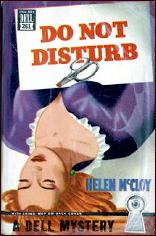
HELEN McCLOY – Do Not Disturb. William Morrow, hardcover, 1943. Tower Books, hardcover reprint, 1945. Dell #261, paperback [mapback edition]; no date stated [1948].

   When Edith Talbot knocks on the door of the hotel room in which she hears someone frantically sobbing, she can’t imagine what kind of trouble she’s about to get into. The very next day she finds a dead man in her room, and she flees, thinking shes been framed for murder, and that the police are behind it.

   This may sound like an awfully weak premise upon which to base a book, but keep in mind that this was wartime, and everyone’s nerves were on edge. I’d never thought of Helen McCloy as a fine writer before, but after the detailed paces she puts poor Mrs. Talbot through, I’m a believer.

   The story’s dated and flawed by three huge coincidences, but if you’re in the right kind of mood for it, this crisp little detective thriller still has what it takes to make an impact today.

— Reprinted from Nothing Accompliced #4, November 1993, with revisions.

LINDA BARNES – Steel Guitar. Carlotta Carlyle #4. Delacorte Press, hardcover, 1991. Dell, paperback; 1st printing, January 1993.

   In case you haven’t come across any of her cases before, Carlotta Carlyle is a tall red-headed female PI who drives a cab in her spare time (and to make a living) in the Boston area. Whether she ever met a gent named Spenser, I don’t know. I don’t really think so, but it’s fun to wonder whether or not they’d get along.

   A lot of Carlotta’s past comes to the forefront of this one, as a blues singer named Dee Willis who’s now on the verge of becoming a huge success comes back into her life. They met in the folksinger days of their youth. Dee had a voice and a dream. Carlotta decided to pursue other goals, especially when Dee went off with her ex-husband, Cal.

   It turns out, though, that Dee now needs Carlotta. She is being blackmailed for allegedly stealing the songs that made her famous, and she hires Carlotta to find the person behind it. When the bass player (female) in Dee’s band is found dead, thoughg, the stakes, Carlotta realizes, are suddenly a whole lot higher.

   The show business portion of the plot seems authentic, especially when it comes down to old jealousies and friendships. Not as interesting is the real nuts and bolts of the motive, which is always present when there’s big money to be had.

   Carlotta Carlyle’s career lasted for a total of twelve books. She wouldn’t have lasted as long if author Barnes hadn’t always had something to say, and the bittersweet ending added to this one gives it quite a poignancy that few PI novels ever come close to achieving.

      The Carlotta Carlyle series —

A Trouble of Fools (1987)

Snake Tattoo (1989)
Coyote (1990)
Steel Guitar (1991)
Snapshot (1993)

Hardware (1995)
Cold Case (1997)
Flashpoint (1999)

The Big Dig (2000)
Deep Pockets (2004)
Heart of the World (2006)
Lie Down with the Devil (2009)

REVIEWED BY DAN STUMPF:


A KILLER WALKS. Grand National Pictures, British, 1952. Laurence Harvey, Laurence Naismith, Susan Shaw and no one else familiar to US viewers. Screenplay by Ronald Drake, from the play Gathering Storm by Gordon Glennon, based on the novel Envy My Simplicity by Reyner Barton. Directed by Ronald Drake.

   You probably never heard of this quota quickie, but if you come across it, you should give it a try. It offers all the usual flaws of a British-made-to-order cheapie: tinny sound, canned music and jaggy editing because they didn’t shoot enough film to cover things properly, but A Killer Walks has more redeeming qualities than any movie really needs.

   For one thing, it’s based on a play and a novel, which means (1) they had to pay someone for the rights, (2) the action is confined to a few simple sets, perfectly suited to economy measures, and (3) the characters and dialogue are handled rather neatly, and in this case by an able cast.

   Laurence Harvey stars as a man who has spent his life working on his grandmother’s farm, and resented every minute of it. Now I don’t know about you, but when I see him on the screen I find it hard to believe Laurence Harvey ever did an honest day’s work in his life, much less tilled the soil, but fortunately the makers of this thing keep him dressed in suit and tie, always just about to go out for a night on the town with his expensive girlfriend, so we don’t have to deal with the sight of him getting his hands dirty in gumboots & dungarees, which would have made the whole thing unbelievable.

   In fact, it quickly develops that Harvey doesn’t like farm labor any more than you’d think he would, and he’s about had it with having to take wages from his grandmother (Ethel Edwards) at a farm he stands to inherit whenever the old bat kicks off. He’s also losing patience with his younger brother (Trader Faulkner) who has some mental problems that seem to have got him into some vaguely-hinted trouble in the past.

   In due course the plot heads where we knew it would, with Larry murdering Gran and pinning it on his little brother, but Killer Walks gets there gracefully, gradually working up to the thing with evocative characterizations from Edwards and Faulkner. As for Harvey, there’s an excellent bit where he tells his brother that old people don’t really want to live anymore, skillfully written, and delivered with baleful relish delightful to behold.

   When the murder comes, it arrives with a bit of polish, probably the work of co-photographer Jack Asher, who defined the look of Hammer’s horror films a few years later with his stylish visuals. In this case he does it on the cheap, with a few odd angles and superimpositions that lend a nightmare feel to the homicide we knew was coming all along.

   The fun in these things, however, is always in watching things unravel; I mentioned somewhere before that we read detective stories to see things come together and crime films to see things fall apart, and in this case they do so in one brilliant scene between the two Laurences (Naismith & Harvey) perfectly written and performed. Suffice it to say that “a killer walks” is the title, not the coda, and things wrap up very neatly indeed.

Reviewed by MIKE TOONEY:


JOE HALDEMAN – The Forever War. St. Martin’s Press, hardcover, 1970. Ballantine/Del Rey, paperback, 1976. Avon, paperback, 1991 (includes material excluded from earlier editions). AvoNova, paperback, 1997 (author’s definitive edition). Sections were originally published in Analog SF as four shorter works; “Hero”, “We Are Very Happy Here”, “This Best of All Possible Worlds”, and “End Game.” “You Can Never Go Back” was published in Amazing Stories and eventually became part of the paperback version of the novel.

   William Mandella, the child of hippie parents, gets caught up in events way beyond his control. Just before a battle he pauses to reflect:

   Then what the hell are you, we, am I answered the other side [of my mind]. A peace-loving vacuum-welding specialist cum physics teacher snatched up by the Elite Conscription Act and reprogrammed to be a killing machine. You, I have killed and liked it.

   Like all draftees, William didn’t ask for this, but now that he’s in it he knows it’s kill or be killed. Such is the way with all wars. High-flown rhetoric about “why we fight” sells newspapers, but when you get right down to it, you fight for your life and your buddies’ lives—and not necessarily in that order.

   From all reports, an alien race known as the Taurans (what they call themselves is anybody’s guess) have attacked an Earth transport without provocation and a state of war now exists. So it should be a simple matter to track the Taurans to where they live and reduce them to less than nothing with tachyon bombs, right? Not quite. It was recognized centuries ago that infantry is the queen of battle, meaning that no matter how many ships and planes and bombs you throw at them, sooner or later somebody has to occupy and hold the enemy’s terrain.

   Enter William Mandella, reluctant hero. The Forever War chronicles Mandella’s wartime experiences from raw recruit to company commander, his battles (which are never glorious), his love for Marygay (which is marked with pain and keen loss), his injuries (which include mutilation), and his reactions to the changes wrought by time on the culture he left behind—for, while he and Marygay struggle to survive, back on distant Earth, things are getting stranger . . . and stranger . . . and stranger . . . .

   The best writers—SF authors among them—are able to transport the reader to a time and place and culture that either once existed or exists only in their imagination. Haldeman succeeds by limiting us to Mandella’s perception of events; William’s wry and laconic narration convinces us of the plausibility of the advanced technology he dazzles us with even as we realize with our logical faculties how unlikely all of this is.

   There’s high-tech aplenty in The Forever War: tachyon drives allowing high-speed movement through normal space at velocities nearing the speed of light; interstellar travel through “collapsars” (collapsed stars, which have since been commonly termed “black holes,” permitting instantaneous passage through what are now called “wormholes” connecting to other collapsars); battlesuits that recycle everything, making it possible for troopers to stay in them for weeks (not really a pleasant prospect, just ask Mandella); stasis fields that dampen electronic systems, thus necessitating fighting with bows and arrows and swords (!); and acceleration pods that make it possible for the frail human body to withstand upwards of twenty-five gees — of course, you’re totally incapacitated and in a near-coma, but at least you won’t wind up looking like a bowl of salsa that’s been slammed into a wall. And let’s not forget Heaven, which William and Marygay get to without dying.

   Since the tachyon drive permits near-light-speed travel, Haldeman makes the most of Einstein’s relativity theory, hanging two important plot points on it—which we won’t reveal. But think about this: As you may recall from that physics class you might also have slept through, Saint Albert tells us that the faster you go, the slower time passes for you, while in the outside universe time passes at its normal rate.

   The spaceships in The Forever War travel from collapsar to collapsar at relativistic speeds, taking weeks, months, or even years in transit; but once they enter the collapsar they exit at the other end in the smallest fraction of a second—in one instance jumping 140,000 light-years in the blink of an eye. This implies that the folks on the ship seem to age more slowly than the people back on Earth—and that means kids like William Mandella grow older just a few years at a time while centuries are passing back home. Imagine Christopher Columbus returning to Spain this afternoon and you’ll get an inkling of what Haldeman is up to.

   The Forever War was awarded a Nebula (voted by writers and editors) and a Hugo (voted by fans) back in 1976. We believe it was as much a zeitgeist vote — most Americans were fed up with the conflict in Vietnam, a kind of “forever war” that never seemed to end — as an acknowledgement of the quality of the writing, which is nevertheless quite high for the usual “hard science fiction” novel.

   The Forever War invites comparison with Robert Heinlein’s Starship Troopers. Many believe Haldeman was writing a rebuttal to Heinlein’s book, but Haldeman is reputed to have denied it; so the jury’s still out on that.

   Joe Haldeman, a Vietnam War draftee and Purple Heart recipient, is still producing fiction.

« Previous PageNext Page »