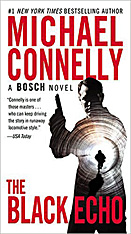
MICHAEL CONNELLY – The Black Echo. Harry Bosch #1. Little Brown, hardcover, 1992. St. Martin’s, paperback, 1993. Reprinted many times since.
The Black Echo won that year’s Edgar for Best First Novel, and it’s no wonder. It’s a great book, one that will suck you right in, starting with Chapter One, and keep you reading until it’s over. Not that you’re likely to read it in one sitting. It’s over 500 oversized pages of small print in the current premium paperback edition, and it took me almost a week of grabbing it up at bedtime and reading as long as I could keep my eyes open.
It starts out with Bosch, now working for the Hollywood Station of the LAPD, being called in to check out a dead body found in a concrete pipe near Mulholland Dam, and it doesn’t quit until he’s closed a case involving an attempted break into a security vault in Beverly Hills.
The connection? Tunnels. Bosch knew the dead man back in Viet Nam, where they were tunnels rats together, days that haunt him memories still. Working with him on the case for most of the book is a comely FBI agent named Eleanor, whose brother never returned from Nam and with whom he finds a certain, shall we say, extracurricular rapport. On his trail and tracking every move he makes are two cops from Internal Affairs named Lewis and Clarke; Bosch is the kind of guy who goes his own way, and his previous big case caused him a lot of problems, including both a suspension and a transfer.
As I say, this is long book and the story is very involved, and this brief summary doesn’t do it the justice it deserves. There is one long conversation that one villain has with Bosch when the former thinks he has the situation well under control, but doesn’t. Otherwise, for a first time writer, Connelly had very sure hands at the typewriter when he wrote this one. I don’t think there’s anything in it that’s trail breaking, but both the author and the character caught a lot of people’s fancy at the time, and they still do today. You can put my name on the list.
ANTHONY BOUCHER – Exeunt Murderers: The Best Mystery Stories of Anthony Boucher. Southern Illinois University Press, hardcover, 1983.
Boucher published some sixty short stories during his thirty-year writing career, about equally divided between mystery/detective and science fiction/fantasy. The twenty-two stories in Exeunt Murderers clearly show that he had a fine hand with the form — a finer hand, perhaps, than he had with novels.
Included here are all nine of the Nick Noble stories, Boucher’s best series and most inspired work. Noble is an ex-cop who was thrown off the force in disgrace for taking graft, something he resorted to in desperation to pay for an operation his wife needed — an operation that failed and left him a widower. The combination of tragedies turned him into a wino who spends most of his time at a cheap bar called the Chula Negra, drinking rotgut sherry and fending off an invisible fly that keeps pestering him.
But even though he is “the lowest and soddenest kind of drunk that even the Skid Row of Los Angeles can exhibit,” he can still deduce with the best, as he proves whenever his friend, Lieutenant MacDonald, brings him cases no one in the department can solve. Dying messages and codes are Noble’s specialties. And among his best deductions are those that clear up the murder of a priest in “Screwball Division,” the murder of a librarian in “QL 696. C9,” and a football mystery in “The Punt and the Pass.”
Also included are a pair of cases featuring Sister Ursula, the cloistered nun whom Boucher created for a pair of early novels published under the pseudonym of H. H. Holmes. ” The Stripper” is the grisly tale of a Jack the Ripper-style murderer on the loose in southern California. “Coffin Corner,” like the Nick Noble case mentioned above, has a college-football background.
Boucher’s best nonseries stories are here as well: the wonderfully macabre “The Retired Hangman,” a much tougher story than was usual with him; “Mystery for Christmas,” a story-within-a-story that features Donald Duck and Mickey Mouse; “The Smoke-Filled Locked Room,” which combines deduction with some of Boucher’s political views; and “The Ultimate Clue,” a short-short (again about football) with the ultimate detective-story ending.
An insightful introduction by Francis M Nevins, Jr. (who co-edited the volume with Martin H. Greenberg), rounds out what is surely one of the best and longest overdue collections to be published in the past several years.
ENTER ARSENE LUPIN. Universal Pictures, 1944. Charles Korvin, Ella Raines, J. Carroll Naish, George Dolenz, Gale Sonddergard, Miles Mander. Screenplay by Bertram Millhauser, based on the character created by Maurice Leblanc. Directed by Ford Beebe.
Charles Korvin’s first outing as Arsene Lupin, and the third American film to feature the character, puts him in such good company with John Barrymore and Melvin Douglas who essayed the character before him.
In Enter Arsene Lupin, Korvin is aboard the Orient Express in the guise of Raoul D’Andressy to steal the Kanares Emerald, but when he sees the owner, Anastasia ‘Stacie’ Kanares (Ella Raines, and well he might have second thoughts as she exudes sex appeal here) he returns the jewel, much to the disgust of his servant Armand Dubose (George Dolenz: “Women, it’s always women.â€).
Inspired by Stacie, Lupin changes his plans and heads to England, where Inspector Ganimard (J. Carroll Naish) soon follows as Lupin begins denuding the nations museums.
Ganimard: “Lupin, he is tall thin, short fat, slight stocky, fair and dark.â€
British Police Sergeant: “Well, if you want me I’ll be in out over and under the nearest pub.â€
But Ganimard has an inspiration regarding Lupin’s favorite wine and finds six dozen cases were sold at auction to one Raoul D’Andressy. In the meantime, Lupin, driving to Wainbridge Manor to see Stacie, is just in time to rescue her when her brakes give out at speed on a steep hill. She invites him to meet her British cousins, Bessie (Gale Sonddergard) and Major Charles Seagrave (Miles Mander), who inform him Stacie is suffering a mental breakdown after the loss of her grandfather Kanares and believes she is still in possession of the emerald that was stolen on the Orient Express.
Lupin is of course suspicious since he stole and returned the emerald himself, and the next day when Stacie invites him to go fishing and he finds a deadly viper in her picnic basket he is certain her cousin and her husband are out to gaslight her, murder her, and steal the emerald, leaving him only one solution, to steal the emerald first.
An act complicated when Ganimard shows up on his doorstep just after he has hung the real Rembrandt he stole in a frame that held a cheap print. Lupin is left playing a game of cat and mouse as well as snakes and ladders to outwit Ganimard (“No one outwits Ganimard but Ganimard himself.â€), steal the emerald, and keep the cousins from murdering Stacie.
Korvin makes a properly suave and European Lupin, with his exchanges with his exasperated valet and partner in crime Dolenz full of quiet wit.
Lupin: “I was born with a conscience.â€
Dubose: “A conscience, what is that?â€
Lupin: “The ability to know right from wrong.â€
Dubose: Whistles “Sounds like a terrible handicap to me, Msieu.â€
Lupin: “Luckily I had the strength to overcome it.â€
While it can’t compare with the original Arsene Lupin with Barrymore and his brother Lionel as Ganimard, it’s a charming B-programmer, running at around sixty-five minutes, and wittily scripted by Bertram Millhauser. Whether Universal ever intended it as a series or not, it’s a shame it wasn’t picked up. Korvin was ideal as Lupin, whether in ascot or top hat, cape, and tails, and the film has more than enough twists and turns for any two films of its length.
The romantic scenes with Raines have real snap to them, and if the cat and mouse play with Naish isn’t in the same class with the two Barrymores, it is still fun to watch between the Columboesque but capable sleuth and the suave gentleman thief, the twists coming right to the final shot.
THE ADVENTURES OF LARIAT SAM. CBS, 1962. Terrytoons in association with Robert Keeshan Associates Voices: Dayton Allen did all the voices and Gene Wood sang the series theme.Written by Gene Wood and Tom Morrison. Produced by Gene Wood.
We tend to remember the early influences on us growing up. At an early age I developed a fondness for comedy cartoon sheriffs such as Lariat Sam. THE ADVENTURES OF LARIAT SAM was developed for CAPTAIN KANGAROO (CBS, October 3, 1955 – December 8 1984). The early morning kid show starred Bob Keeshan as Captain Kangaroo. The kindly grandfatherly Captain was joined at the Treasure House (later the Captain’s Place) by Mr. Green Jeans (Hugh Brannum), puppets Mr. Moose and Bunny Rabbit (Cosmo Allegtetti), cartoons and many more characters and special guests.
After five years of showing the same twenty-six episodes of TOM TERRIFIC Captain Kangaroo (Bob Keeshan) wanted something new. CBS in-house cartoon studio Terrytoons (MIGHTY MOUSE, DEPUTY DAWG, etc) would make the new show (as it did TOM TERRIFIC).
Keeshan asked his writer Gene Wood (future successful announcer for game shows such as FAMILY FEUD) to produce and co-write a new cartoon with Terrytoons’ head writer Tom Morrison. With help from Keeshan, they came up with good guy Sheriff Lariat Sam and his sidekick Tippytoes, the Wonder Horse.
Together the two cartoon crime fighters protected the town of Bent Saddles. Keeshan wanted LARIAT SAM to be non-violent so instead of a gun Sam had a magic lariat to capture the bad guys, usually Badlands Meeney and his sidekick J. Skulking Bushwack. Thirteen episodes were made of the cartoon Western. Each story was told in five short parts.
Respected animation historian Jerry Beck wrote about ADVENTURES OF LARIAT SAM at one of his websites, Cartoon Research. The episode “The Mark of Zero†is included at the bottom of the article found here.
Our YouTube example is The People Catcher:
Badlands Meeney has a new science fiction toy he got to capture Lariat Sam, but Bushwack wrecks it. Luckily a scientist has just arrived in Bent Saddle and agrees to fix the People Catcher. Things don’t go as Badlands had hoped – they never do.
As with all the series episodes, ADVENTURES OF LARIAT SAM was a funny silly cartoon aimed at young kids. The evil plans were delightfully absurd. Characters often talked to the audience. Puns and jokes were non-stop. The cartoon remains fun to watch, even for this adult.
THE MONSTER OF PIEDRAS BLANCAS. Vanwick Productions / Filmservice Distributors Corporation, 1959. Les Tremayne, Forrest Lewis, John Harmon, Frank Arvidson, Jeanne Carmen, Don Sullivan. Director: Irvin Berwick.
This is not a high-end creature feature. Filmed on a super low budget,The Monster of Piedras Blancasis a rather talky and amateurish production. Still, there are some great moments, including a rather bold – for its time anyways – scene in which the viewer witnesses a crab crawling across a decapitated head. And there’s a noir like sequence in which the eponymous monster chases threatens people on a spiral staircase.
But overall, this science fiction and horror hybrid remains a secondary, if not third rate, imitation of The Creature from the Black Lagoon (1954). There’s the girl who the creature seemingly ends up falling for, and the locals who are befuddled as to what is transpiring in their midst.
The story unfolds in a California beach community. When people start disappearing and then dying in a horribly gruesome manner, the town’s physician and police chief join forces to investigate. They soon learn that it isn’t a man that’s responsible for the recent beheadings. No. It’s a monster that they are after. With the technical assistance of a local scientist in training, the men devise a rather half-baked plan to capture the creature by means of throwing a net on him. I kid you not.
I wouldn’t particularly recommend your going out of your way to track this one down, although Olive Films recently put it out on BluRay and I must say, for an ultra low budget film, it looks absolutely fantastic. Trivia fact: the film’s cinematographer, Philip Lathrop, went on to an illustrious career and was twice nominated for the Academy Award for Best Cinematography. Despite the plodding pace and the clumsy dialogue, this creature feature is extremely well photographed.
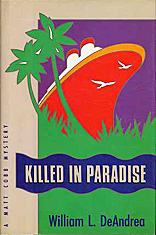
WILLIAM L. DeANDREA – Killed in Paradise. Matt Cobb #5. Mysterious Press, hardcover, 1988; paperback, July 1989.
Officially Matt Cobb is a vice president in charge of special projects for a major TV network, but what that really means is that he’s a troubleshooter who’s put in charge whenever anything goes wrong. Not quite a private eye, but sometimes there’s not a lot of distinction between what he does and what PI’s do. (Think of all of the Hollywood troubleshooters who worked for movie studios in the pulps back in the 30s and 40s and bring them up to date.)
In this case, though, all he is is a glorified chaperone to the winner of a mystery contest put on by the Network’s FM station in New York City, and a friend of her choice (also female). The top prize? A trip on a cruise liner to an island in the Caribbean and back. The bonus? Also on board are a flock of mystery writers and a mystery scenario that the passengers are asked to play along and solve.
It is no wonder that the Chapter One is more or less a prologue to a scene that takes place much later in the book, one in which Cobb has just realizes who the killer is, just as he’s about to be tossed overboard. And that’s because otherwise there is no real mystery to be solved for well over a hundred pages, except for the mysterious disappearance of an arrogant mystery writer just after he is thoroughly trounced by Cobb in a not-so-friendly game of ping pong.
Luckily DeAndrea was a good enough writer with a flair for light comedy and romance to keep the reader going through the not very suspenseful first chunk of the book, as the characters get to know each other (and as Cobb gets to know the prizewinner’s friend very well). Do you know, and to tell you the truth, and I almost wish I didn’t have to bring this up, but I found the ending — the solution to the mystery and all — to be forced and the weakest part of the book. All in all, though, I enjoyed this one, and I’d gladly read more of the series, which I seem to have accidentally jumped into the middle of.
The Matt Cobb series —
Killed in the Ratings. Harcourt, 1978.
Killed in the Act. Doubleday, 1981.
Killed with a Passion. Doubleday, 1983.
Killed on the Ice. Doubleday, 1984.
Killed in Paradise. Mysterious Press, 1988.
Killed on the Rocks. Mysterious Press, 1990.
Killed in Fringe Time. Simon & Schuster, 1995.
Killed in the Fog. Simon & Schuster, 1996.
MURDER AT THE VANITIES. Paramount, 1934. Carl Brisson, Victor McLaglin, Jack Oakie, Kitty Carlisle, Jessie Ralph, Charles Middleton. Written by Carey Wilson and Joseph Gollomb. Directed by Mitchell Leisen.
A backstage Musical/Mystery so strikingly off-beat and off-color one can quickly forget how dreadful it really is.
Charles Middleton plays Homer Boothby, a hammy actor who may have gunned down Gertrude Michael, who was blackmailing young lovers Carl Brisson and Kitty Carlisle (two romantic leads who seem singularly colorless even in a black & white movie) threatening to deport sweet old Jessie Ralph, abusing flighty maid Beryl Wallace, and threatening distaff detective Gail Patrick, who had the goods on her.
Got that? Well pay it no mind because the real leads here are Victor McLaglen and Jack Oakie, who play Bluff Lust and Brainless Cupidity to perfection, as a tough cop and a harried stage manager trying to solve the murder while the show goes on — as it must, you know.
Vanities offers a plethora of suspects, a tiresome plot and some impressive proscenium-bound production numbers, of which the most memorable is the musical ode to Marijuana, capped off when a cute young thing emerging nude from a Marijuana blossom (!) finds blood dripping from the catwalk down over her bare shoulders.
With all this going for it, one can almost overlook the fact that you don’t really give a damn about the bland young lovers or the cardboard suspects. Just sit back and enjoy the show, folks.
THE SOMBRERO KID. Republic Pictures, 1942. Don ‘Red’ Barry, Lynn Merrick, Robert Homans, John James, Joel Friedkin, Rand Brooks, Stuart Hamblen. Director: George Sherman.
Despite being short — 5′ 4½”, according to IMDb — and not looking much like a cowboy hero, nor having a wide range as an actor, Don Barry had a presence about him on the screen that you could never manage to create if it weren’t there. But Barry managed to alienate himself from directors and other cast members, or so I’m told, and his career never got much higher than making B-westerns such as this one. [But see comments.]
Which, in spite of its running time of less than 60 minutes, is actually quite good, as far as low budget westerns from the early 40s go. There is enough plot in this one to be half again as long. I won’t go overly much into details, but it has to do with a marshal and his two sons, one of whom learns an unfortunate fact about himself as the three of them come to town to rid it of a persistent outlaw.
There is a girl that both sons find attractive, a villainous town banker, and a humorous hidey-hole than men of the town use to make their escape from a backroom card game when their wives come looking for them. And, yes, it also comes into play when the lead starts flying.
The title of the movie is something of a mystery. Apparently one of the sons, the one Don Barry plays, looks like a notorious outlaw called the Sombrero Kid — but isn’t him.
PHILIP ATLEE – The White Wolverine Contract. Joe Gall #13. Fawcett Gold Medal T2508, paperback original; 1st printing, December 1971.
Joe Gall’s in Vancouver BC in this one, on assignment to stop a breakaway movement on the part of several politicians (backed by a certain superpower) to annex the entire western coast of Canada to the US instead.
While certainly enjoyable enough — and at only 143 pages long, perfect for the first leg of a cross-country flight — I don’t consider this one of the better of the Joe Gall series. The setting, including a trip up North close to the Alaskan border, is a finely described as ever, but the action seems to come only in sporadic bursts, and only one or two of the characters ever seem to jell into place. Only a three-year-old terror on wheels named Malcolm is one I’ll remember for long. (Gall has reason to remember his mother more.)
But what we do get is Joe Gall’s mostly laid-back view of the world, including his observations on the hippies congregating in down town Vancouver at the time. White Wolverine was nominated for an Edgar for best paperback original, which may constitute a better recommendation for you than what I’ve had to say, if like me you’ve missed this one until now. And while no one has ever asked me, I think that Robert Ryan in his prime would have made a great Joe Gall in the movies.
THE MAN BEHIND THE MASK. MGM, UK, 1936. Re-released as Behind the Mask. Hugh Williams, Jane Baxter, Ronald Ward, Maurice Schwartz, George Merritt, Henry Oscar, Donald Calthorpe, Kitty Kelly. Screenplay by Jack Byrd, Syd Courtney, Ian Hay & Stanley Haynes, based on the novel The Chase of the Golden Plate by Jacques Fitrelle (sic). Directed by Michael Powell.
This short but fast moving and complicated thriller based on a novel by American mystery writer Jacques Futrelle (his name misspelled in the titles) has a better pedigree than most, with legendary director Michael Powell (half of the famous Archers production company with Emric Pressberger, and director of Black Narcissus and The 49th Parallel among others) at the helm and novelist Ian Hay working on the dialogue.
Nonetheless it is strictly B movie material, though slickly done and masterly paced so you never have time to ask questions as the novel’s complex plot and myriad mixed identities and double crosses unfold. It plays out like an Edgar Wallace thriller more than a Jacques Futrelle mystery.
Lord Slade (Peter Cawthorpe) is giving a masked ball to show off the prize of his collection, the golden shield of Khan. The police are in attendance in the person of Chief Inspector Mallory (George Merritt) dressed as Frederick the Great, and a mysterious fellow dressed as Voltaire (Henry Oscar) playing chess with him as they watch the shield.
Also in attendance are Lady June Slade (Jane Baxter) his daughter, the mysterious East Indian Harrah (Gerald Fielding), Dr. Walpole (Donald Calthorp) the famous surgeon, and Marion Weeks (Kitty Kelly) the doctor’s wisecracking assistant and housekeeper (“I’m dressed as Shirley Temple as Madame Dubarry.â€).
Not in attendance are Lord Slade’s wastrel son Jimmy (Ronald Ward) who argued with his father over money earlier and threatened to hold up a bank to get money if he had to, or Nicholas Barclay (Hugh Williams) a dashing pilot who is in love with June, and disliked by this lordship.
June and Nicky have plans though; he’s to wear a disguise and slip into the ball, and at midnight when the lights go down he and June will slip away and get married with a special license he has obtained. But before he can even don his costume, he’s shot by an intruder in a mask, an intruder he believes to be Jimmy because of a triangle tattoo on his wrist, a tattoo that Jimmy, Nicky, and their dead friend Allan Hayden (Reginald Tate) all got back in school.
With Nicky out, a man dressed as the Red Death enters the ball with Nicky’s invitation from June and the help of the butler aiding in the elopement. When the lights go down and everyone unmasks he steals the shield, and takes the car with June in it, being wounded in the shoulder by a detective whom he runs over as he escapes. June knows he isn’t Nicky, but is now a helpless captive.
Meanwhile the mysterious Harrah travels to the estate of the Master (Maurice Schwartz), the astrologer who paid to have the shield stolen, but who has been double crossed by the thief and by Nadja (Morya Fagan) a follower to report his failure.
Soon enough Jimmy is cleared, but Nicky didn’t go to the police thinking Jimmy shot him and instead went to be patched up by Dr. Walpole, and now the police want Nicky for the theft and running over the policeman and they know the thief was wounded in the shoulder, while the only clue Nicky has to the real thief is a tie he left behind sold by a haberdashery in a poorer part of London.
From then on it’s a chase with Nicky, Jimmy, the Dr,, and wisecracking Miss Weeks pursuing the thief and Nadja to rescue June and return the shield, the police after Nicky with the Dr. in tow, and Harrah and the Master’s gang pursuing Nadja and the thief for the shield and eliminating anyone in their way, and when the policeman dies, Nicky is wanted for murder.
The film is a fast paced diversion, confusing at times, fun with a solid cast, but mostly of interest for the direction of Michael Powell and being based on a novel by Jacques Futrelle (albeit one far inferior to his short stories).
The real highlight is some brighter than usual dialogue and the scenes in the Master’s observatory, giving the film an almost science fictional feel with Maurice Schwartz, eyes hypnotic and mad, and hair in the style of mad scientist everywhere since Fritz Lang’s Metropolis, part Mabuse, part Fu Manchu, and madder than a hatter. It’s a little forgotten gem among mad villains.
A nod also to Richard Tate as Allan Hayden, who, sporting a black fedora and checkered overcoat, looks uncannily like the illustrations of Leslie Charteris’s The Saint that ran in Thriller. He’s good as an old school tie type who hasn’t quite forgotten the form.
The ending is a little rushed, and there isn’t so much as a final embrace for Nicky and June, at least not on screen, but it’s satisfying in its own way.
Editorial Comment: Most of the available prints of this film are less than an hour long, but this one (which I haven’t watched in its entirely) claims to be 1:33 long. If so, then IMDb does not know about it, stating that the original version is believed to be lost: