Reviews


ERLE STANLEY GARDNER – The Case of the Sulky Girl. William Morrow, hardcover, 1933. Pocket #90, paperback, 1941. Reprinted by Pocket many times. Ballantine, paperback, February 1992. TV episode: Perry Mason, 19 October 1957 (Season 1, Episode 5).

   This is the second of the Perry Mason novels, the first being The Case of the Velvet Claws, and one of the first I read soon after I was allowed into the grown-up section of the local library, right behind the main desk, when (I’m guesstimating) I was all of either 12 or 13.

   Do I remember it? No, not at all. I’ve read too many Mason novels over the years, all written to pretty much the same formula, and who could keep them all straight, even they wanted to? Even the episodes of the long-running TV series were scripted to clockwork. At 8:05 on the dot the courtroom proceedings were adjourned so Perry and crew could go out and get more evidence, after the break for commercials.

   The girl is not so much sulky in this early novel, as she is hot-tempered, which makes her difficult for Mason to handle when she’s first suspected of killing her uncle, then as she becomes the defendant in the courtroom battle that follows. It seems that according to her father’s will, she doesn’t get the money in his estate until she is 25, and if she marries before then, she may not get any at all, depending on what her uncle decides.

   She doesn’t tell Mason everything, of course — do any of his clients? There is a lot of money,, at stake, there’s no getting around it, and a lot of people want to get their hands on some of it, and they don’t care how they do it.

   I have read online that Sulky Girl was the first of Mason novels in which most of the second half of the book takes place in a courtroom. Whether this is so or not, the trial in this one is a good one. It had me flipping pages as fast as I could read them. It is no wonder that the Mason novels became so popular so quickly.

   Other than clothing and automobiles of the era, there is little to suggest how old this book is. Mason is described as talking in disinterested monotones quite often, with little facial expression. Della Street has only a small role, and Paul Drake even less. You will note that I am not even telling you who these characters are. If you are reading this blog, I am sure I am safe in assuming that you already know.

   The plot is good one, even if a bit unfair to would-be detectives at home, I thought. Mason doesn’t mess around with the physical evidence very much, as was his habit later on, but he certainly makes a spectacle of the courtroom drama. This one was a lot of fun to read.
DONALD MacKENZIE – Raven and the Kamikaze. Houghton Mifflin, hardcover, 1977. No US paperback edition. First published in the UK by Macmillan, hardcover, 1977.

   When Raven’s roguish friend Count Zaleski drunkenly denounces a fellow exile as a member of the KGB, he unwittingly disrupts the man’s delicate plans for a final act of revenge aimed at the Russians, setting off a race against time to find the desperate man before he destroys his unknown target.

   Since retiring from Scotland Yard as a detective inspector, Raven has had several exciting adventures worthy of print, but while this affair has all the right ingredients — spies, counterspies, and a beautiful woman in love with the hunted man — it seems to rush headlong and downhill into an ending which comes as a total letdown.

Rating:   C plus.

— Reprinted from The MYSTERY FANcier, Vol. 2, No. 4, July 1978.


Bibliographic Note:   In all, there were 16 books in MacKenzie’s John Raven series, published between 1974 and 1993.

Reviewed by MIKE TOONEY:


FREDERICK IRVING ANDERSON – The Purple Flame and Other Stories. Edited by Benjamin F. Fisher. Crippen & Landru Publishers, 2016. Lost Classics Series No. 38. Hardcover/trade paperback. Short story collection (15 stories).

   During his writing career, Frederick Irving Anderson produced dozens of stories, the majority being mysteries, that proved very popular with readers, especially those of The Saturday Evening Post, where most of them appeared over a period of nearly twenty years.

   In accordance with the era, some of Anderson’s characters fit comfortably into the Rogue School of likeable criminals who more often than not work on the side of right, if only sometimes to avoid worse situations; with their help, the cause of justice, and not just the legal system, is served. Two such rogues created by Anderson were the “Infallible” Godahl and Sophie Lang, with only the latter actually making it to the silver screen.

   Equally memorable are his creations Oliver Armiston (“the extinct author”), who fits the Armchair Detective model very nicely, and his constant partner in crime solving, Deputy Inspector Parr (“the famous man hunter”). Their modus operandi ordinarily goes along these lines:

    “. . . Deputy Parr was wont to fetch [to Armiston] those few occasional crime puzzles that resisted his classic nutcracker methods. Mr. Parr was a man of infinite resource; Armiston was a phase of his amazing versatility—one of the most highly prized. Parr’s usual device was to lay before his talented friend the mise en scène of what he was pleased to call a frozen plot, an insoluble crime, and leave it to the hectic imagination of the retired writer to bring to a finish, in the guise of fiction, what the man hunter himself had been unable to complete as fact. The results had been, to say the least, startling. Parr had come to hold his curiously endowed friend in some awe; but Oliver explained the phenomenon naively by pointing that though fact may outrage all the probabilities, fiction—to be salable—must be sound.

    “It was this faculty of logical connotation that had made Oliver Armiston so unexpectedly valuable to the police deputy. Parenthetically, it was this same virtuosity that had been Oliver’s undoing in his career; when a clever thief dramatized one of his lurid tales, in real life, with murder as the sequel, the police stepped in and politely but firmly requested Oliver to cease, in the interests of society. Now the only outlet Armiston had for his fantastic powers of divination came through these occasional frozen plots, served up by his friend and admirer, Parr.”

— From “The Follansbee Imbroglio” (1922)

   Which brings us to the present book; in it Doug Greene at Crippen & Landru has collected fifteen highly entertaining adventures in crime busting, eleven of them featuring the Armiston-Parr duo, with the first one (“The Purple Flame”), using different characters, presumably being the prototype for the series; one with Parr only; and two showcasing the short-lived character Judge Alan Ebbs.

   With Anderson, readers get what you might call a “three-fer”: a capable mystery author, a local colorist, and a sly social critic. The preface by Poe scholar Benjamin F. Fisher is a fine introduction to both Anderson and his series characters. In Fisher’s estimation Anderson possessed that rarest of authorial attributes, originality, and that without following the trend in American crime fiction towards the new hardboiled school which was gaining ascendancy at the beginning of the 20th century, the same period in which Anderson’s popularity soared.

   His ability to add dimension to his characters and their environments and his carefully modulated diction (“Anderson leavens his fiction with abundant colloquial language”) all combined to make Frederick Irving Anderson not only a good detective fiction writer but also an important local color author and a chronicler of the American scene as it existed in the first third of the 20th century.

             —

   You can find The Purple Flame and Other Detective Stories on the Crippen & Landru website here.

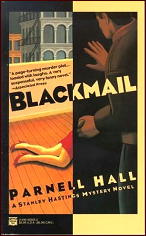
PARNELL HALL – Blackmail. Stanley Hastings #9. Mysterious Press, hardcover, 19994; paperback reprint, March 1995.

   There are now twenty books in Parnell Hall’s series of crime novels featuring New York City private eye Stanley Hastings, the most recent being A Fool for a Client, published just last year. I keep telling myself I ought to read more of them, since I enjoyed this one very much, but so far, by a very rough count, I’m only up to three or four

   Hastings may have changed jobs over the years, but in Blackmail at least he’s still doing accident injury reports for a high-powered liability lawyer, not the most glamorous job in the world, but it does pay the bills. And once in a while he finds a real-to-life client waiting for him in his office.

   What’s more, she both beautiful and blonde. Not surprisingly, given the title of the book, she’s being blackmailed and she wants Hastings to act as the intermediary between the blackmailer and herself. The reason Hastings hesitates is she is unwilling to give him any more information than that. Since he can use the money. five hundred dollars worth, he takes the job.

   And finds himself up to his neck in first, smutty photos (no surprise there) and then secondly, two cases of murder — both the blackmailee then the blackmailer. Hastings, having no particular friends on the police force, could find himself the number one suspect if (1) he had a motive, and (2) there were any evidence against him, besides being the first on the scene in both deaths.

   The case is complicated, enough so that Hastings is forced to let his wife Alice do some of the detecting along with him. Hall’s witty style goes a long way in negating the fact that the most obvious connection between the two victims is quietly ignored, giving any would-be armchair detective reader at home plenty of opportunity to solve the case before Hastings does.

   Quite enjoyable, as I say, with one tiny caveat. If this were a movie, it would be rated R for a sprinkling of four-letter words throughout. Since this otherwise is not a hard-boiled PI yarn, far from it, I found this clashing with the overall ambience and mood. Not in a major way, but just off-putting enough to bring it up, that’s all.

REVIEWED BY DAVID VINEYARD:


THE HYPERBOLOID OF ENGINEER GARIN. Russia, 1965. Original title: Giperboloid inzhenera Garina. Evgeniy Evstigeev, Iosif Manovich, Mikhail Astangov, Natalya Kilimova. Screenplay by Iosif Manovich, based on the novel The Garin Death Ray by Aleksei Tolstoy. Directed by Alexander Gintsberg.

   A modicum of propaganda, a cunning visual recreation of German Expressionist cinema, and a sense of fun and the absurd inform this 1965 science fiction film from the former Soviet Union set in France in 1925.

   It opens moodily as two men, one Safonov (Isoif Manovich), explore a deserted house on a lonely island on a lake. It is there they find Engineer Petrovich Garin (Evigniy Evstegeev) and his invention, the hyperboloid, a deadly heat ray.

   From that point on, the film seems as if it will devolve into a game of hide-and-seek, with Garin pursued by all sides wanting the weapon, but instead it changes mood and, while keeping the look and feel of a German serial of the silent era, replete with stylized sets and costumes, it instead becomes a fairly subtle debate about the rights of one man to sell such a deadly weapon to the highest bidder, while never forgetting the action, comedy, and mad scientist elements of the story.

   You can guess where a Soviet era films comes down on the film’s philosophical question, but it does so with a soft, not iron, heel. The result is such that the viewer can sit back and enjoy the wonderful look of the film that makes as many nods to Fritz Lang, Joe May, Murnau, or French serial director Louis Feuillade as to Sergei Eisenstein or early Soviet science fiction like Aleita.

   Shot in atmospheric monochrome, the film features gorgeous sets and science fictional set pieces, action, comedy, and a playful sense of fun. Alas the only version I know of is in Russian without subtitles, but it is still worth a look. Hopefully there is a subtitled version available. It is surprising just how well the look of a big production science fiction film from an earlier era is captured. You have to keep reminding yourself this was released in 1965.

   The ironic comedic finale, similar to the fate of Lex Luthor in Superman Returns, is just an added bonus after scene after scene that are a visual feast. While it is different in look and style, it compares favorably with films like Dinner with Adele (aka Nick Carter in Prague) or Karel Zeman’s The Fantastic World of Jules Verne that it shares a similar anachronistic nostalgia with.

Reviewed by JONATHAN LEWIS:         


UNION DEPOT. First National PIctures/Warner Brothers, 1932. Douglas Fairbanks Jr., Joan Blondell, Guy Kibbee, Alan Hale. Director: Alfred E. Green.

   What makes Union Depot particularly worth watching is the commanding screen presence of Douglas Fairbanks Jr. and Joan Blondell as a would-be romantic couple. “Would-be” being the operative phrase here, as the movie takes place in one eventful day, both in and around a train station where numerous passengers come and go in the urban hustle and bustle. (The film’s British title, Gentleman for a Day, does the movie more justice.)

   Although there’s simply not enough time between the two leading characters to end up as lovebirds, the characters they portray — flawed and all-too-human sorts doing the best they can during the Great Depression — are well constructed enough to keep you engaged with the proceedings.

   â€œChick” Miller (Fairbanks) is a low-rent criminal with a heart of gold. One day, while hanging around with his perpetually drunk pal, “Scrap Iron” (Guy Kibbee), he manages to steal a uniform belonging to an Information Desk worker at the local train station. Chick thinks that the suit, along with some cold hard cash he acquired along the way, will be enough to get himself a good, hot breakfast at the diner inside the station.

   All well and good, until he both meets up with Ruth (Blondell), a chorus girl who is neither as innocent nor sinful as she appears, and haphazardly comes into possession of some counterfeit greenbacks belonging to one Bushy Sloan (Alan Hale, Sr.) From then on, it’s a romantic comedy/melodrama/crime film all in one and, while the film occasionally begins to feel considerably dated, it’s overall a rather enjoyable pre-Code feature.

   For those looking for something a little extra, Union Depot also benefits tremendously from having a surprisingly action-packed and violent nighttime chase scene. It takes place in the rail yards just outside the station, and it looks as though it was taken straight out of a film noir from the late 1940s. Talk about ahead of its time!

REVIEWED BY BARRY GARDNER:


EDNA BUCHANAN – Contents Under Pressure. Britt Montero #1. Hyperion, hardcover, 1992. Avon, paperback, 1994.

   Buchanan is a Pulitzer-winning Miami Herald re-porter, and her novel has the immediacy of a newspaper story. It begins with a Rodney King-like episode, different in that the victim is a respected community leader, and he dies.

   The police attempt a cover-up, but Britt, a blonde, green-eyed Cuban American, exposes it. One thing leads to another until the town explodes in a series of riots. Britt believes that the whole truth hasn’t come out, and keeps digging; eventually she uncovers a murderer and puts her life at risk.

   Pro: the pace is breathtaking at times, and Britt is an engaging character. Con: the narrative occasionally loses its focus, and the murderer’s actions and motivations are the silliest and least believable I’ve encountered in a long while. A good friend of mine liked this considerably, but the ending ruined it for me.

— Reprinted from Fireman, Fireman, Save My Books #5, January 1993.


      The Britt Montero series —

1. Contents Under Pressure (1992)
2. Miami, It’s Murder (1994)

3. Suitable for Framing (1995)
4. Act of Betrayal (1996)
5. Margin of Error (1997)
6. Garden of Evil (1999)

7. You Only Die Twice (2001)
8. The Ice Maiden (2002)
9. Love Kills (2007)

THE BACKWARD REVIEWER
William F. Deeck


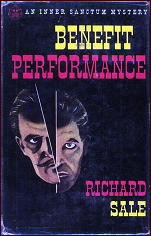
RICHARD SALE – Benefit Performance. Simon & Schuster, hardcover, 1946. Detective Book Club, hardcover reprint, 3-in-1 edition. Dell #252, paperback, mapback edition.

   Having finished his most recent motion picture, movie star Kerry Garth just wants to get away from everything. But someone shoots and kills his stand-in, Joshua Barnes, who attended the movie premiere as Garth. Since no one except Garth’s trusted public-relations man knew of the substitution, the killer had to be after Garth, not Barnes.

   With the advice of his PR man, Garth assumes Barnes’s identity. Unfortunately, Garth discovers that Barnes is a despicable character who is also in danger of his life, assuming he still had it. From the frying pan, as it were.

   Any author who invents — I hope he was the one responsible and the only one to use it — the portmanteau abomination “sluefoot” for detective cannot be highly praised by the reader. Still, I did enjoy the novel more than its quality warranted. Garth’s impersonation of Barnes makes for good reading.

— Reprinted from MYSTERY READERS JOURNAL, Vol. 7, No. 4, Winter 1991/2, “Murder on Screen.”

THE DUNWICH HORROR. American International Pictures, 1970. Based on the story by H. P. Lovecraft. Music by Les Baxter. Director: Daniel Haller.

   I watched this movie with what you might call a severe handicap. I’ve never read the story it’s based on, and what’s more I think the whole Chluthu Mythos is bunkum, to speak frankly, and to sum it up quickly, this movie did nothing to change my mind.

   The first half, though, I have to tell you is stylishly done, with some good performances by the players, especially by Dean Stockwell in a standout performance as a last living member of the Whateley family, shunned by the townsfolk of Dunwich for years, and by Ed Begley as Dr. Henry Armitage, who as the movie begins has just finished a lecture at Miskatonic University in nearly Arkham.

   It turns out that the charismatic and soft-spoken Wilbur Whateley needs the famed and very rare book called the Necronomicon for his own purposes, and to that end he captivates a very pretty student named Nancy Wagner (Sandra Dee) into driving him home from the University library, and what’s more, into staying the night in his very antique and picturesque family mansion.

   And in that mansion, guarded over by Wilbur’s aged, wild-eyed grandfather (Sam Jaffee) is a room, locked and barred with a secret inhabitant inside. All is deliciously filmed, with loads of anticipatory suspense until, alas, the secrets begin to be revealed, and the film goes into all kinds of psychedelic contortions to avoid showing us who or what has been hidden away for so long in that room.

   But where this affair really goes off the rails is the point where the story stops making sense. A female friend of Nancy’s goes to the mansion alone to rescue her, without Professor Armitage, and does she open the door? Need you ask?

   This occurs right around the halfway point, and for me it was downhill the rest of the way. Lovecraft fans seem to be only so-so on this film, so if you’re one also, you need not take only my opinion on it, even though their reasons may not be the same as mine. A big plus is the very effective musical score by Les Baxter, a portion of which you can listen to here, and in one of his final roles, Ed Begley is as always a joy to see on the screen.

JOHN DICKSON CARR – The Case of the Constant Suicides. Harper & Row, US, hardcover, 1941. H. Hamilton, UK, hardcover, 1941. Paperback reprints include: Dell #91, mapback, n.d. [1945]; Berkley #G-60, 1957; Collier, 1963; Perennial, 1989.

   Both author John Dickson Carr and leading character Dr. Gideon Fell are in fine form in this one, what with two locked room deaths and very nearly a third. As it turns out the first is a suicide that masquerades as a murder (a disputed fact that is of utmost importance to both the dead man’s attorney and his insurance agent, as well as the surviving relatives). In a second instance, a repeat of the first, the victim survives but barely, and the third is a case of murder very cleverly disguised at a suicide.

   The scene is Scotland, a location (and language) that Carr has a lot of fun with, as well as with two distant cousins who are feuding academics who tumble across each other in a blacked-out train on the trip northward to the dead man’s small fortress of a castle. He had earlier been found dead after falling out of his bedroom located in a high turret, with the room itself solidly bolted on the inside.

   Carr’s penchant for broad humor is on full display throughout, and of course one fair lass is referred to as a “wench,” but I guarantee you that there’s no way he ignores the puzzle aspect of the case, one which seems to have Dr. Fell perplexed a little more than usual — and if he doesn’t seem to have the answers right away, then pity the poor reader.

   Between you and me, though, while all the clues are there, the solution to the matter seems a little more forced than the best of Carr’s works. But as any fan of the author knows full well, a little less than his best is better than 98% of what the competition has to offer.

« Previous PageNext Page »