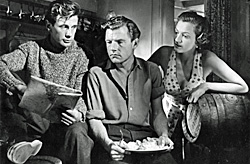
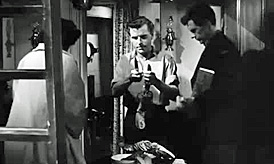
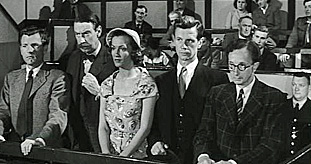
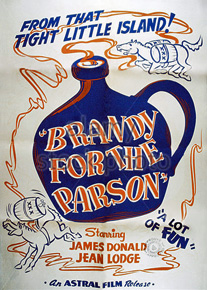
If you only know Geoffrey Household from his classic novels of chase and pursuit like Rogue Male, Watcher in the Shadows, and A Rough Shoot, you may be surprised to find this droll comedy is based on one of his better known short stories. Then again if you have read his picaresque adventure stories like Fellow Traveler and The Life and Times of Bernardo Brown you may be better prepared for the film based on his tale.
Tony Rackham (Kenneth More) is the fellow piloting the launch, a likable enough chap who has a bit of a problem, he has to get to France to pick up a package for delivery.
And charming fellow that he is he doesn’t bother to mention he is delivering smuggled brandy.
The British have always had a unique view of smuggling and avoiding excise taxes dating back to the exploits of Dr. Syn, the Scarecrow, not to mention the people smuggled out of France by the Scarlet Pimpernel. It has always had the aspect of a game, and in the Post-War period when England was suffering shortages and paying high taxes on imported alcohol, the public was clearly on the side of the smugglers, as witness films such as Whiskey Galore (based on the novel by Compton Mackenzie), Green Grow the Rushes, and Law and Disorder. Like the poaching in John Buchan’s John Macnab, it was all good sport.
After a series of misadventures Bill and Petronella get rid of Tony and his barrels of brandy, only to find a Customs Inspector (Frederick Piper) nosing around, so in a panic they go back and with the help of a group of cub scouts move the brandy just as Tony shows up with his reluctant friend George Grump (bespectacled comic actor Charles Hawtry) in a laundry truck to take the stuff to London.
The four meet up, determined to get the stuff to London so Bill and Petronella can be rid of it and Tony, but the Customs Inspector is close behind and they have no way to move the barrels. A passing circus provides a partial answer, but they are still fifty miles short of their goal and need transport, and by now the roads are all watched, which is how Tony comes to buy circus ponies and decides to transport the brandy cross country along the Appian Way, the old Roman road.
And soon enough, Tony is off to London to arrange to pick the brandy up at a rendezvous while Bill, Petronella, and George are roughing it across country pursued by Customs.
Brandy for the Parson is a quiet comedy, most of the laughs are gentle, and being based on a story by Geoffrey Household there is a real feeling for being pursued across rough country. Everything works out, but only just, and Tony gets to deliver the last line assuring us that some crime does pay, or at least for him.
A veteran cast of newer stars like Donald, More, Lodge, and Hawtry, along with old-timers and veteran British character actors enliven the tale with charm and style. Unlike too many American comedies of the era, this one is satisfied to tell the story in straightforward manner with no forced slapstick or silly business. The humor arises from the characters and their plight and is never forced or phony. Everyone here is attractive and smart save poor Hawtry who discovers along the way he is not a true teetotaler
Donald shows that he should have been used more often in comedy, while Lodge is both attractive and bright. More always exuded charm with that smile and this is no exception.
Michael Trubshaw has a good bit as a well-to-do farmer who wants to form a syndicate to buy the smuggled brandy so it isn’t wasted on the wine shop in London where it will be sold to snobs, and Arthur Wotner of Sherlock Holmes fame, has a small but key role as Major Goodleigh who saves our heroes from themselves.
Brandy for the Parson is handsome to look at and an intelligent and funny tale in the mode of Geoffrey Household’s better known works. The story appears in Tales of Adventurers (Joseph, 1952) among the collections of Household’s short stories. Both it and the film are well worth looking up.
LARRY KARP – Scamming the Birdman. Write Way, hardcover, 2000. Worldwide Mystery, paperback, 2001.
A close friend gave me this mystery that features Dr. Thomas Purdue, a medical doctor and collector of music boxes, and in this and the earlier The Music Box Murders, an amateur sleuth. He warned (advised?) me that it’s lighter than a Peter Lovesey novel but about the same “weight” as a Lovejoy, probably in recognition of the fact that I sometimes seem to prefer crime fiction with more gravitas than humor.
In spite of that, I decided that something light was just what I needed after The Chinatown Death Cloud Peril (reviewed here ) and wasted little time in digging in. The therapy worked, I am completely recovered from my previous blue funk. Karp’s novel is a fiendishly clever scam in which Purdue and some definitely shady associates repay a larcenous and probably murderous collector who has made off with the collection of a good friend of Purdue’s. Karp even reserves a little surprise after the scam has been carried off successfully, and I ended smiling and hoping that I can locate The Music Box Murders to recapture the pleasure I experienced with this novel.
Karp is a collector and a restorer of antique music boxes, a former physician. The novel, in addition to being the entertaining record of an intricate and absorbing scam, is filled with details of antique music boxes that will appeal to any variety of collector, vividly communicating the wondrous marvels of what can clearly be an expensive passion.
Bibliographic Note: A third and final Dr. Purdue mystery is The Midnight Special (2001).
IANTHE JERROLD – The Studio Crime. Dean Street Press, UK, softcover, 2015. Introduction by Curtis Evans. First published by Chapman & Hall, UK, hardcover, 1929. No US edition,
If you were to go looking for the original British edition of this book, even with a wad of big bills stashed in your wallet, I don’t believe you’d find one. Dean Street Press is one a few recent publishing company who are doing mystery fans a big service in getting literally hordes of Golden Age mysteries back into print, and Curt Evans, a one-time contributor to this blog, has a lot to do with it. (He now has his own blog, which I wholeheartedly recommend to you.)
Even though there a brief reference in this book to the involvement of amateur detective John Christmas in an earlier case, one having to do with a museum, this is the first of only two of his investigations to make it into print. The second, Dead Man’s Quarry (1930), is also available from Dean Street Press.
Given this longer than usual introduction, I suppose it would be churlish of me to point out that Christmas is no Wimsey or Poirot, nor is author Ianthe Jerrold (1897-1977) a Dorothy Sayers or Agatha Christie. The opening is very effective, however, as it describes a party taking place in a cartoonist’s studio on a foggy, foggy night, with several mysterious visitors coming and going from the studio above (including a sinister-looking man in a fez) before the resident there is found dead, with a knife thrust through his heart.
The dialogue, to me, reads very formal and dated at times, while sheer coincidence mars the telling: with all of London as the setting, too many of the characters are always coming across each other in places where it seems unlikely they should even be. The relationships between them, unraveled slowly as Christmas’s investigation progresses, often seem far-fetched as well.
But Christmas’s deductions, as explained thoroughly at the end, seem solid enough, and depending on your interest in puzzle stories or not, you may enjoy this one as much as I did.
Bibliographic Notes: Two other mysteries written by Ianthe Jerrold, but published under her pen name Geraldine Bridgman, have also been reprinted by Dean Street Press: Let Him Lie (1940) and There May Be Danger (1948).
PUSH, NEVADA. ABC / Touchstone Television / LivePlanet Productions, 2002. Cast: Derek Cecil as James Prufrock, Scarlett Chorvat as Mary, Liz Vassey as Dawn, Melora Walters as Grace, Larry Poindexter as Well Dressed Man #1, Steven Culp as Well Dressed Man #2, James Patrick Stuart as Well Dressed Man #3, Raymond J. Barry as Sloman, and Conchata Ferrell as Martha. Created by Ben Affleck and Sean Bailey. Executive Producers: Ben Affleck, Sean Bailey, Matt Damon and Chris Moore. Co-Executive Producer: James Parriott.
***SPOILER WARNING*** All seven episodes are available on YouTube and linked below. You may want to watch the episodes before reading my spoiler filled review. The YouTube copies are not perfect but they are watchable.
PUSH, NEVADA was an interactive mystery contest meets TWIN PEAKS. Dramatically the series was a conspiracy thriller set in the small town Push, Nevada. As an added gimmick each week the audience could collect clues (one each episode) that would help viewers win over a million dollars.
In the 5/20/02 issue of “Broadcasting,” their look at the upcoming new fall 2002 season tried to describe the PUSH, NEVADA interactive game, finally writing, “Frankly, ABC couldn’t seem to explain exactly how it works.â€
In the first episode of PUSH, NEVADA co-creator and movie star Ben Affleck spent more time trying to explain the interactive game than the plot of the series. According to Realityworld.com, over 200,000 game players interacted with the series two websites. No links here as the PUSH, NEVADA information is gone from ABC’s website and the pushtimes address is no longer associated with the series.
If the game didn’t interest the viewer there was the conspiracy thriller, a genre popular at the time with the networks (ALIAS, VERITAS: THE QUEST, and JOHN DOE) but not as much with the mass audience.
“The Amount.†(9/17/02; rerun 9/19/02.) Written by Ben Affleck and Sean Bailey. Directed by John McNaughton. Guest Cast: Jon Polito and Armand Assante. *** IRS agent Jim Prufrock receives a fax from an unknown source revealing there is money missing at a Casino in desert town Push, Nevada. It leads Jim to a shadowy conspiracy and murder.
Episide Clue: 1,045,000. The meaning of the clue was to reveal the amount of the now missing money stolen from the Casino and the amount of the grand prize for the contest.
Ratings: The September 17th showing finished 16th place in the ratings and rerun on September 19th finished 66th.
It didn’t take long for the series to inspire memories of TWIN PEAKS as we watch the casino vault be robbed by a naked man with a body temperature too low for the thermal camera to see him. But the show lacks the charm and David Lynch to pull such scenes off. Instead PUSH, NEVADA settles for a mix of bizarre characters and a plot that settles into a mystery procedural. While the series mystery is who is behind the corruption in Push, it is the odd characters and their secrets that receive most of the attention.
There are an endless number of eccentric characters with a secret, but let’s start with the hero, small time IRS agent Jim Prufrock. Obsessive over finding answers, Prufrock succeeds because he won’t stop even when others pay the price. It is hard to care about our hero when he is a self-involved, insensitive, morally righteous, naive, clueless idiot.
The major characters included Mary, the town femme fatale/whore who works at the Slo-Dance Bar run by local crime boss Dwight Sloman. Sloman answers to big evil company Watermark represented by the three Well-Dressed Men. Jim stays at extremely maternal Martha’s boarding house that is hiding something in a forbidden to enter part of the house.
My favorite character of the series was Grace. Jim’s devoted secretary and expert on all that is IRS. Grace made Della Street look like a slacker. The acting style for these TWIN PEAK-like conspiracy shows can take the reality out of the character leaving a fictional plot device. Melora Walters’ performance was able to keep Grace human but with the secrets and oddness each character in PUSH, NEVADA required.
“The Black Box†(9/17/02) Written by Ben Affleck and Sean Bailey. Directed by Charles McDougall. *** Jim reports the murder of Silas to the police who with the help of the Well-Dressed Men rule Silas’s death a suicide. Mary seduces out the location of the money and leaves a man to die. The Well-Dressed Men try to understand why the robbers took only some of the money and a bible.
Episode Clue: television
This episode aired in the series time slot of Thursday at 9pm. It followed the rerun of episode one and finished 46th in the ratings.
Episode three has the series settled into it Thursday 9pm time slot opposite its normal competition – CBS’ CSI, NBC’s WILL & GRACE and GOOD MORNING MIAMI, FOX’s movie, UPN’s WWE SMACKDOWN, WB’s JAMIE KENNEDY and OFF CENTRE, and PAX’s DIAGNOSIS MURDER.
“The Color Of…†(9/26/02) Written by James Parriott. Directed by Davis Guggenheim. *** Grace discovers no one in Push has filed taxes since the casino was bought 17 years ago. Jim confronts Casino Middle Management Guy with the fact the Casino is paying out 62% of the time. Jim finds the dead body of the man who killed Silas and is arrested for murder.
Episode Clue: orange
Ratings fall to disastrous levels with this episode finishing 83rd.
“Storybook Hero.†(10/3/02) Written by Tom Garrigus. Directed by John Patterson. *** Jim is in jail for murder until someone unknown pays his bail. Sloman learns Mary was involved in the Casino robbery and wants his money back. Grace is suspended for the help she did for Jim. The Well-Dressed Men hunt for the missing bible.
Episode clue: peter pan
Ratings continued down with this episode finishing in 91st place.
Disney had just bought ABC and ESPN, and they had a plan for quirky PUSH, NEVADA. Broadcast networks were starting to use their cable networks to help market the broadcast network shows. Fox had used FX to rerun 24 and increase viewers’ awareness of the series, something many believed was the reason for 24’s success.
In “Broadcasting†(10/7/02) Disney head Michael Eisner explained how they wanted to do the same with PUSH, NEVADA by rerunning it on ABC Family. Some of the ABC affiliates objected and with the collapsing ratings it surprised no one when PUSH, NEVADA was cancelled (“Broadcasting†10/14/02).
This was an era when it was common for TV series to end without answers or closure for the audience. But there was a twist that made PUSH different – it was a game and legally the game had to finish and award its promised prizes. PUSH, NEVADA and ABC used their websites to help set up the game’s quick ending.
“The Letter of the Law.†(10/10/02) Written by John Serge. Directed by Lisa Cholodenko. *** Grace discovers who bailed out Jim – evil Watermark’s competition. Jim continues to endanger others as he blunders into discovering the secret purpose of the Casino. Clueless Jim is unaware of the missing bible, its apparent importance to some, or that it is now hidden in his room. Mary gives Sloman the money back but Daddy wants more.
Episode clue: g
This episode was 93rd in ratings.
“…….†(10/17/02) Written by Joan Rater and Tony Phelan. Directed by Rodman Flender. *** How Jim’s Dad died and the effect it had on Jim is revealed. Mary has the Bible. The Treasury’s sting to nail Sloman is threatened when Sloman decides to kill Jim. Watermark’s faces exposure by Jim’s relentless efforts.
Episode clue: morse code
Ratings: 100th.
“Jim’s Domain.†(10/24/02) Written by Joan Rater and Tony Phelan. Directed by Nick Gomez. *** Bad guys in Push defeated, Jim returns home a hero but still a naïve idiot. He is surprised to find himself promoted and his wife begging for another chance. But something still haunts him, a question unanswered – who sent him the fax that started all of this?
Episode clue: www.toyota18.com
Ratings for this final episode to air proved relatively few people cared as it finished 90th.
In the final minute of the last episode the series made a horrible dramatic choice. The fourth wall was broken and Derek Cecil told the audience that what he and the producers thought was just a story for a TV show had turned real and now Watermark was after everyone connected to the PUSH, NEVADA TV series. He claimed he was on the run and gave the clues from the last unaired six episodes. Written on a piece of paper were the words:
FIVE
LONGITUDE
UNDERWEAR
SOUTHEAST
BODNICK
ELIOT
The final instructions on how to put the clues together appeared October 28th on ABC’s MONDAY NIGHT FOOTBALL at halftime.
The instructions were: spaces and punctuation count. Don’t count the first episode. Then 5th place, 1st, 9th, 1st, 5th, 7th, 4th, 1st, 2nd, 7th, 5th, and 2nd in that order. Actor Derek Cecil says, “I am going to have to disappear for awhile. We are being manipulated. Keep up the fight. Good luck.â€
If you take the correct letter from each clue it forms a word. For example the fifth letter from second episode’s clue “television†gives you the letter V. Putting the letters together spelled VONGEYELNAIL. Replace the EYE with I as the sign in MONDAY NIGHT FOOTALL clip’s background suggested and you have VONGILNAIL or phone number 866-445-6245. First to call that number won the million and forty-five thousand dollars prize.
It took two minutes for the prize to be won. According to RealityWorld.com over 10,000 people solved the puzzle within 24 hours.
The story’s fourth wall destroying ending betrayed loyal viewers with a cheap gimmick that left unanswered most of the questions and failed to resolve many of the characters’ secrets. But one can forgive the writers who had the impossible task of jamming six episodes of twists, discoveries and surprises into the last moments of the seventh episode and a minute during halftime on MONDAY NIGHT FOOTBALL.
Today, loyal viewers are being treated with more respect. Shows such as FOX’s FRINGE, NBC’s CHUCK and CBS’ PERSON OF INTEREST are given a short extra season to bring closure to the series. But this was 2002. It took two minutes for someone to solve the puzzle but those watching PUSH, NEVADA for the story are still waiting for some answers.
FINAL NOTES:
All ratings information came from “Broadcastingâ€:
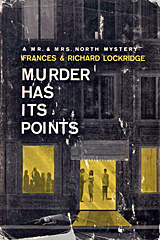
FRANCES & RICHARD LOCKRIDGE – Murder Has Its Points. J. B. Lippincott, hardcover, 1961. Pocket, paperback, April 1984. (On the latter the two authors’ names are reversed.)
This one begins at a cocktail party at a Manhattan hotel and ends with an attempted shooting by a desperate killer in a suburban Connecticut mansion. Of the two settings, I liked the first one best. The party is hosted by book publisher Jerry North and is filled with all kinds of agents, movie reps, authors and literary critics, playwrights and actors. Following Pam North’s thoughts and broken bits of conversation as she tries to make her way across the room is worth the price of admission in itself:
Jerry wasn’t where he had been. He had been talking to a man who, from that distance, appeared to be Livingston Birdwell (Productions) who was half-giver of the party. He and Jerry, Pam suspected, might be asking each other why the hell? Now Birdwood — if it was Birdwood — was moving somberly toward the bar, and Jerry was not —
Toward the end of the party, one literary giant of an author comes storming up to another (but one who is more of a poseur), demanding satisfaction for a crushing review written by the latter of the former’s latest book. A short exhibition of fisticuffs breaks out. Before the day is out, the latter author is dead, shot in the head by what appears to be a random sniper, or so assume the police, since a series of similar events has been happening in recent days. It is New York City, after all.
But such, as it turns out, and not at all surprisingly to the reader, is not the case. It also turns out that the dead man had a entire host of enemies and therefore would-be killers, all of whom seem to have been on the scene or nearby. The ending (see above) is both rather prosaic and muddled — but not so badly as it seems at first — at least in comparison to this brilliantly choreographed opening.
Captain Bill Weigand of the Manhattan homicide squad is, as ever, on hand to help solve the case, but of course it is Pamela North who is the middle of everything at all times, including the attempted shooting up in suburban Connecticut.
The title of this novels comes from a bit of random conversation at the cocktail party. It is Pam’s answer to the question, why does her husband publish detective novels?
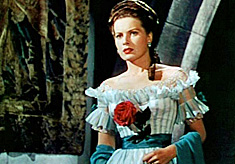
THE BLACK SWAN. 20th Century Fox, 1942. Tyrone Power, Maureen O’Hara, Laird Cregar, Thomas Mitchell, George Sanders, Anthony Quinn, George Zucco. Screenplay: Ben Hecht and Seton I. Miller, based on the novel by Rafael Sabatini. Director: Henry King.
The Black Swan, a Technicolor swashbuckler par excellence, almost feels as if it were two distinct movies put together into one.
The “first,†which is far more enthralling, consists of the first fifty minutes or so of this 85-minute Henry King-directed film in which two pirates, Jamie Boy (Tyrone Power) and Captain Morgan (Laird Cregar) adjust to new lives as domesticated land guys running Jamaica. There’s court intrigue a plenty, lavish costumes, and a carefree, lighthearted atmosphere one would expect from an early 1940s swashbuckler adventure film: nothing too violent, but with just enough of an edge you keep the viewer engaged.
The “second†movie, as it were, revolves almost exclusively on the love-hate relationship between Jamie Boy and Lady Margaret (Maureen O’Hara). Problem is: up until the final scene, it feels much more like a hate-hate relationship. Indeed, there is almost no palpable chemistry between the two leads, all of which leads to some rather cringe-worthy scenes in which Jamie Boy attempts to woo the shrewish Lady Margaret who is, naturally, in love with Jamie Boy’s court rival. O’Hara looks as if she’s going through the motions, making her character a rather dour-looking presence. Why, one must ask, would the dashing Jamie Boy devote so much time and energy to capturing her heart? Surely, there’s many more proverbial fish in the Caribbean Sea.
Unlike O’Hara, Laird Cregar seems to be having a genuine blast in his role as the mighty Captain Morgan, former pirate and newly appointed Governor of Jamaica. His large presence, both figuratively and literally, towers over Power throughout the film. In many ways, his character’s story is far more compelling than that of the more graceful, more handsome Jamie Boy. The scene in which Morgan finally sheds his role as governor is fantastic. At last, he no longer has to wear those silly clothes and a wig and can be himself again!
JACK DOLPH – Murder Makes the Mare Go. Doubleday Crime Club, hardcover, 1950. Unicorn Mystery Book Club, 4-in-1 volume, hardcover reprint. No paperback edition.
On a two-year sabbatical, 35 year old Doc Connor twice a week has a clinic for the down-and-out. His primary interest, however, is horse racing. Thus, he is called upon by a horse trainer to check a horse, unfortunately already dead.
Doc suspects poison, rather than heart attack, and that’s what it turns out to be. Neither the trainer nor the horse’s owner, a nightclub operator, wants Doc to investigate, not that that stops him. Indeed, he goes on to discover that an elderly dishwasher at the nightclub died of glanders, which means be was around a horse with the disease or —
All of Dolph’s novels feature Doc Connor. From their titles, they also all deal with horse racing. If they are as good as this one, they are worth looking for.
Murder Is Mutuel. Morrow, 1948.
Odds-On Murder. Morrow, 1948.
Murder Makes the Mare Go. Doubleday, 1950
Hot Tip. Doubleday, 1951.
Dead Angel. Doubleday, 1953.
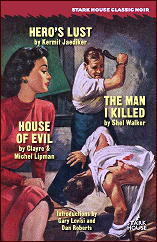
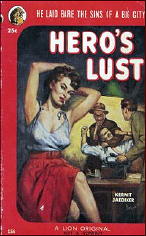
KERMIT JAEDIKER – Hero’s Lust. Reprinted in A Trio of Lions, Stark House Press, softcover, 2016, in a “Classic Noir” collection with The Man I Killed, by Shel Walker, and House of Evil, by Clayre & Michel Lipman. Introductions by Gary Lovisi and Dan Roberts. Originally published as a paperback original: Lion #156, 1953.
The connection between the three novels in this recent collection from Stark House is that while nobody but the most fanatic paperback collector will have heard of any of them, including the authors who wrote them, they are also prime examples of the toughest, most hardboiled fiction you can find outside the line of Gold Medal paperbacks being published (and far more well-known) at the same time, roughly 1949-1957.
If ever a book could be both hardboiled and noir at the same time, Kermit Jaedicker’s Hero’s Lust would be it, ranking close to a ten on both scales, out of ten. What’s more, it manages to be both without even being a crime novel, unless you consider graft and city corruption a crime, which I suppose it is. I stand corrected.
The story is that of newspaper reporter Red Norton, who’s wholly in the pocket of Crescent City’s crime boss, Mayor Gowan, who’s up for re-election, but with the money he has and the favors he can hand out, who can stand a chance against him? Well, maybe there is someone, and Norton is semi-recruited by an old colleague and semi-friend to work on the other side.
But Red doesn’t recruit that easily, even going so far as to go along with a double-cross. But as fate would have it, as in the best noirish fashion, there is a girl, a TB patient who is going to undergo an operation and whom Red is writing a series about. Ann Porter is a sweet young thing, and pretty soon Red has her convinced that life is worth living after all. Is Red able to respond in equal fashion?
A lot of things come together at the end of this rather intense tale that I would have you read than tell you any more about. Jaediker has a rather crude, definitely unpolished writing style that is just about perfect for the book at hand. If you are like me, you will be reading the final few chapters as fast as the pages can be turned.
As for what is known about the author, there is a long column about him on the Mystery Writers of American website. If I’ve intrigued you a bit about the book, the column will intrigue you as greatly about Jaediker himself.
REX STOUT – Bad for Business. First published in The Second Mystery Book, Farrar & Rinehart, hardcover, 1940. Paperback reprints include: Dell #299, mapback edition, 1949; Pyramid #R1166, A Green Door Mystery, April 1965; as well as several others.
There is a story behind the publishing history, and if I have any of the details wrong, please inform me. This is the second of three novels Stout wrote about New York City private eye Tecumseh Fox. When offered to The American Magazine for prior publication in abridged form, the editor rejected it and would accept only if Stout was able to rewrite it as a Nero Wolfe story.
Needing the money, so I have been led to believe, Stout agreed, and the story appeared in the November 1940 issue of the magazine as the first Nero Wolfe novella, “Bitter End.” The latter did not appear in book form until after Stout’s death in a limited edition collection titled Corsage (1977).
I haven’t read the shorter version, so I don’t know, but it must have been quite a rewrite job. Tecumseh Fox may live in the same world as Nero Wolfe (although the latter isn’t mentioned, Dol Bonner is, and several of the very peripheral players, including Rusterman of NYC restaurant fame) are, but he’s (apparently) independently wealthy, gregarious, and certainly most unlike Wolfe, possessing a very definite eye for the ladies.
Which is how he gets hooked on solving this case of a murdered owner of a food products emporium (Tingley’s Tidbits): one of Dol Bonner’s female associates is also the niece of the murdered man, and a small incident on a busy Manhattan street brings both Fox and Amy Duncan most coincidentally together.
Maybe it was me, but I don’t think the story reads like a Nero Wolfe tale, either. It’s a pure puzzle story from beginning to end, for one thing, without anything remotely resembling the connection that exists between Wolfe and Archie, and nothing like the jaunty and often witty way in which Archie tells his tales.
The story’s quite enjoyable, nonetheless, but any reader expecting another Nero Wolfe novel in only subtle disguise is going to end up disappointed.
WILL C. BROWN – The Border Jumpers. E. P. Dutton, hardcover, 1955. Dell #878, paperback, 1956. Reprinted as Man of the West, Dell #986, paperback, 1958.
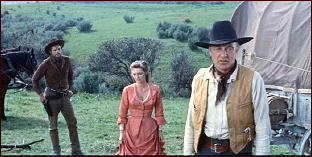
MAN OF THE WEST. United Artists, 1958. Gary Cooper, Julie London, Lee J. Cobb, Arthur O’Connell, Jack Lord, John Dehner, Royal Dano, Robert Wilke. Screenplay by Reginald Rose, based on the novel The Border Jumpers, by Will C. Brown. Directed by Anthony Mann.
Lincoln Jones, on an uncomfortable train journey from Crosscut to Fort Worth, finds himself beset by Beasley and Billie: a tin-horn gambler and a saloon chanteuse trying to separate him from $600 the citizens of his small town have scraped together for him to hire a schoolteacher. But that’s the least of his worries as the train is robbed at a wood stop, speeds off, and he finds himself abandoned in the wilderness with the two con artists.
Even that pales, however, when it develops that the train robbers, still close by, are the remains of an outlaw clan run by the notorious killer Dock Tobin — Linc’s uncle.
We quickly find that Linc was raised by his Uncle Dock; raised to be a killer like the rest of the family, until the day he escaped and started making what’s known in Westerns as a decent life for himself. That life is shattered now as the demented (and still very lethal) old man takes him back into the fold, despite his glowering cousins Claude and Coaley, who would as soon kill Linc and Beasley (“I say we open ‘em up and leave ‘em here.â€) and indulge themselves with Billie.
It’s a situation rife with tension and dramatic potential, and author Brown develops it with the speed and precision of an able pulp-writer, fleshing out characters and background colorfully and adding bits of unexpected excitement to keep us off-balance — there are two brutal and unsettling strip-tease scenes — until he wraps the thing up a bit too patly. But it’s even more fascinating to see how director Anthony Mann and screenwriter Reginald Rose turned it into a piece of Pure Cinema.
Gary Cooper brings his graceful authority to the role of Linc, along with a certain aging melancholy perfectly suited to the situation. He’s matched evenly with Julie London, projecting that sexy disenchantment she could do so well. Surrounded by murderous degenerates, she shoots them a look that seems to take it as just another bad hand in a crooked game. Arthur O’Connell, on the other hand, is delightful as a scrabbling, scheming angler, frightened and desperate, his agitation pitched perfectly against Ms. London’s weary composure.
Among the bad guys, Lee J. Cobb has the showiest part as mad Dock Tobin, but I prefer the typecast meanness of Robert Wilke, Royal Dano’s off-beat lunatic and Jack Lord’s wolfish juvenile delinquent. Best of all though is John Dehner as Claude, the smartest and most dangerous member of the clan. There’s a really fine scene where Linc and Claude have a quiet talk and Coop tries to make him see the insanity of living like this while Dehner insists on loving and protecting the crazy old man. It’s a moving and sensitive moment (much like the one between Robert Ryan and Terrence Stamp in Billy Budd a few years later), and it lends dramatic weight to the shoot-out when the characters have to confront each other.
Said shoot-out is a high point in the work of a director who excelled in complex action scenes, as the characters maneuver through a ghost town, running, jumping and throwing shots back and forth as they jockey for position until, weary and near death, they pause for a final sad exchange before finishing it off.
This confrontation is set in a ghost town, the perfect visual metaphor for the waste and emptiness confronting our hero. And where the book wraps things neatly, the movie leaves a lot of emotional loose ends to dangle intriguingly in the viewer’s mind. Indeed, as the two survivors make their way to the fade-out through a bleak landscape, one recalls the tension, brutality and emotional rawness of this thing and asks, “What the hell just happened?â€