Reviews


Reviewed by JONATHAN LEWIS:         


MONSTER ON THE CAMPUS. Universal International Pictures, 1958. Arthur Franz, Joanna Moore, Judson Pratt, Nancy Walters, Troy Donahue, Whit Bissell. Director: Jack Arnold.

   Don’t let the exploitation title fool you, as Monster on the Campus is actually a surprisingly captivating 1950s science fiction/horror film. Indeed, it’s of a quality far higher than a lot of the forgettable dreck churned out during the same era. Directed by Jack Arnold, this Universal-International movie stars Arthur Franz as Professor Donald Blake, a university scholar who, while researching a prehistoric fish, discovers a serum that – stay with me, folks – reverses the evolutionary process.

   As you might have guessed from the title and the premise, Franz transforms into a hairy apelike monster. He – or his monster alter ego — roams around a California university campus wreaking all sorts of havoc and mayhem. There’s murder, mystery, and a little on campus romance thrown in for good measure.

   Call it a werewolf film without lycanthropes or King Kong without Skull Island, but Monster on the Campus is actually something of a minor, if at times unpolished, gem.

   Filmed in black and white, with a good some particularly effective atmospheric moments, it also benefits highly from Arthur Franz’s strong performance. Although he was primarily a character actor, the other movies I’ve seen in which he had starring roles (The Sniper and The Atomic Submarine) have been taut, suspenseful thrillers that I was certainly glad I watched. The same can definitely be said for Monster on the Campus, a highly evolved creature feature that’s worth a look.

REVIEWED BY DAN STUMPF:


VOODOO WOMAN. American International Pictures, 1957. Marla English, Tom Conway, Mike “Touch” Connors, Paul Blaisdell. Written by Russ Bender and V. I. Voss. Directed by Edward L. Cahn

THE DISEMBODIED. Allied Artists, 1957. Paul Burke, Allison Hayes, John Wengraf. Written by Jack Townley. Directed by Walter Grauman

   Movie fans remember 1957 as the year that brought us Bridge on the River Kwai, Twelve Angry Men, Paths of Glory, and The Spirit of St. Louis, but I will always recall it fondly as the banner year that delivered not one but two ersatz jungle epics with schlocky monsters and witchy women portrayed by iconic starlets of that tawdry form.

   Voodoo Woman is a thing of shreds and patches, apparently thrown together by producer Alex Gordon in the wake of The She Creature — a remarkable film on its own — with bits and pieces of that film’s eponymous monster, director Edward L. Cahn and stars Marla English and Tom Conway, who sports the silliest headgear ever committed to film.

   Conway plays a Mad Doctor determined to combine “the white man’s science and the black’s voodoo” to create a monster that will do his bidding. Which may seem a bit redundant in these days of the Internet, but he finds the perfect subject for his experiments when Marla comes strutting into his Jungle Hell.

   Marla English had a rather brief and unheralded film career, but her appearances here and in The She Creature ensure her a place in the archives of tacky movies. In She Creature she projected a virginal impassivity that made her the perfect palimpsest for Chester Morris’s regressive enterprises. Here she gets to vamp it up as the most literal of femmes fatales, a woman literally consumed by greed who cheerfully drags her cast cohorts down with her.

   We first see Marla hanging out in some junglefront dive, plotting to track down hidden treasure in the tropical backwoods. Or what passes for the tropics here; mostly it’s the usual stock-footage long-shots intercut with a sound stage sparsely furnished with defeated-looking foliage and bespoke rubber undergrowth. There’s even a moment when Marla and her guide (Mike “Touch” Connors) cuddle around a campfire, and as the camera pans to take in their antics we see two stage hands jump out of the way!

   It all gets a bit hard to take seriously, particularly when Mad Doctor Conway decides amoral Mara is the perfect subject for his experiments in monster-making, and she agrees whole-heartedly, as a means to acquire the lucre stashed somewhere thereabouts. She is duly promoted to monster-in-chief (actually played by Paul Blaisdell, in parts of his She Creature costume, a plastic mask and mop-wig) and proceeds to wreak low-budget havoc about the place until we’ve reached a respectable running time and can end the suffering.

   Well it ain’t much, but director Cahn was a past master at moving things along quickly, hero Mike Connors shows plenty of the charm that led him to TV stardom, and Tom Conway does a splendid job of not dying of shame. With all this and Miss English too, Voodoo Woman ranks as a genuine Guilty Pleasure.


   Moving on to The Disembodied, I can praise it with faint damns by observing that it’s a bit less tacky-looking than Voodoo Woman. The fake jungle is a bit less threadbare, the costumes not so tacky, and star Allison Hayes makes a splendid entrance, trying to kill her husband with a voodoo curse.

   Allison Hayes was literally one of the giants of Really Bad Movies, with a starring bad-girl turn in Roger Corman’s Gunslinger, followed by Zombies of Mora Tau, The Undead, The Unearthly, The Hypnotic Eye, The Crawling Hand, and of course Attack of the 50 Foot Woman. Her very presence in a starring part guarantees a certain sleazy splendor, and Disembodied offers one of her best(?) roles as a part-time voodoo queen, slinking about in silky dresses, high heels and/or animal skins as she falls for a passing wildlife photographer (Paul Burke) and decides he’d be perfectly cast in her road-show production of Double Indemnity when tribal magic proves ineffectual in killing her husband.

   It seems Allison moonlights (again, literally) as the local Voodoo Priestess, and when Burke shows up with a dying buddy in tow, she saves the man’s life by cutting the heart out of one of her worshippers—some religions are just harsher than others, I guess, but it makes me glad I was raised United Brethren.

   Anyway, the voodoo magic saves the man’s life but it has the deleterious side-effect of turning him into a zombie, possessed by the dead native’s spirit. And I’m afraid that’s all the Monster we get for this picture.

   Director Walter Grauman is no Edward L. Cahn, either. Where Cahn moves through Voodoo Woman with commendable speed, Grauman lets Disembodied bog itself down in long stretches of needless dialogue, courtesy of writer Jack Townley, who spent much of his career writing for Gene Autry and the Bowery Boys. In their hands, Ms Hayes’ alluringly repellant screen presence goes for very little, and the surprising thing is that she manages to radiate so much energy and still not be the least bit convincing.

   So on points, I’d have to award the Oscar in the fakey-jungle-monster-movies category to Voodoo Woman, but for lovers of awful movies, both films are required viewing.
BRETT HALLIDAY – What Really Happened. Dodd Mead, hardcover, 1952. Paperback reprints include: Dell #768, 1954; Dell D381, October 1960 (Robert McGinnis cover, seen to right). Dell 9458, July 1963.

   I don’t usually read two books by the same author back to back, but I’d just finished Marked for Murder (reviewed here ), I’d enjoyed it, this was stored in the same box, and I was about to take a plane trip to Michigan, so why not?

   This one was almost as good as as the earlier one (seven years earlier, from Mr. Halliday’s perspective) and in some ways better. In one way, a rather distinct one, I enjoyed Marked for Murder more.

   Better — by which I mean more complicated, in a good way! — was the plot, not a better by a huge margin, but the puzzle aspect was what found fascinating. Private eye Mike Shayne (back in Miami) gets a call from a woman named Wanda Weatherby who’s in near hysterics. She asks him to come over at midnight, that she had sent him a letter that he would receive in the morning, but she’s afraid someone is about to kill her, and she needs his help now.

   What’s interesting — you do know that when Shayne gets there, Wanda Weatherby is dead, don’t you? — is that one by one, Shayne meets several people who have been blackmailed by Wanda Weatherby have gotten letters telling them she is going to hire Shayne and that if she is murdered, Shayne should do his best to convict the recipient of the letter.

   Question is, which one did do the killing? I don’t know, maybe this description of the basic story line sounds silly, but Halliday does a great job convincing the reader that it all makes sense. Once again both the plotting and the telling remind me of Erle Stanley Gardner and both his Perry Mason and Bertha Cool-Donald Lam stories (the latter as by A. A. Fair) in terms of the way Shayne manipulates the evidence and manufactures his own, all in the interest of his client, a good friend of newspaper reporter Tim Rourke, fully recovered from his bullet injuries in Marked for Murder.

   That said, I’ve just realized that I can’t tell you what it was that I liked less about What Really Happened. In my review of Marked for Murder, I said “This one was fun to read, in a timeless sort of fashion…” and unfortunately this one’s definitely stuck in the 1950s. It isn’t a big deal, since I read many other books that are stuck in the 50s all the time. It’s only in comparison with Marked for Murder that I bring it up at all.

THE BACKWARD REVIEWER
William F. Deeck


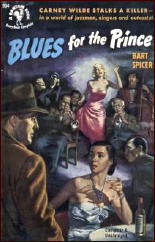
BART SPICER – Blues for the Prince. Dodd Mead, hardcover, 1950. Detective Book Club, hardcover reprint, 3-in-1 edition. Bantam #934, paperback, 1951.

   This is apparently the second case for private-eye Carney Wilde. When The Prince — Harold Morton Prince — jazz pianist, about sixth best in the country, and composer apparently without peer, is murdered, Wilde is called in to investigate the claim of The Prince’s accused murderer that he, not Prince, had composed most of the music Prince took credit for, particularly “Red Devil Blue,” and the folk operetta Sunset in Harlem.

   An admirer of The Prince and also a jazz enthusiast, Wilde takes a personal interest in the case since he doesn’t want The Prince’s reputation besmirched. Too much of an interest, it turns out, as he proves that the accused couldn’t have committed the murder.

   A good but not a particularly great case. Still, it has an interesting background. The Prince, his family, Wilde’s client, and other characters are black. Philadelphia in the late ’40s, as was true of most other places, was not a pleasant city if you were black. With music, though, there was no race barrier, nor apparently any race recognition.

— Reprinted from MYSTERY READERS JOURNAL, Vol. 6, No. 1, Spring 1990, “Musical Mysteries.”

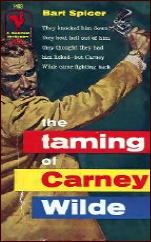
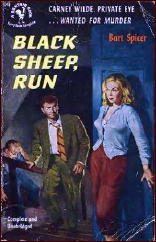
       The Carney Wilde series —

The Dark Light. Dodd, 1949.
Blues for the Prince. Dodd, 1950.
Black Sheep, Run. Dodd, 1951.

The Golden Door. Dodd, 1951.
The Long Green. Dodd, 1952.
The Taming of Carney Wilde. Dodd, 1954.

Exit, Running. Dodd, 1959.

Reviewed by DAVID VINEYARD:          


THE EIGER SANCTION. Universal Pictures, 1975. Clint Eastwood, George Kennedy, Vonetta McKee, Thayer David, Jack Cassidy, Heidi Brul. Screenplay by Hal Dresher, Warren B. Murphy, and Rod Whitkaker based on the latter’s novel as Trevanian. Directed by Clint Eastwood.

   On paper this sounds like a dream project; in reality it is a total mishmash, devoid of suspense or much in the way of humanity, and famously hated by its own writer, University of Texas professor Rod Whitaker writing as Trevanian who actually worked on the screenplay, to the point he wrote a footnote complaining about it in his bestselling novel Shibumi. To add insult to injury, it was a critical and box office failure that pleased no one watching it or involved in making it, and cost a man his life.

   Ironically the film is almost slavishly faithful to the plot of the novel it is based on, about art professor Jonathan Hemlock (Clint Eastwood), a freelance government assassin who kills to pay for additions to his art collection under the aegis of a loathsome albino government functionary called Dragon (Thayer David). In Sanction he is given the commission to kill a traitor who will be one of the members on an attempt to climb the notorious north face of the Eiger in Switzerland, a job Hemlock as a world class Alpinist is ideally suited for, having been the only survivor of an earlier unsuccessful attempt to reach the summit.

   Although it comes late in the 60s and 70s spy craze, it was based on a huge bestseller, had a popular star and gifted director, and the screenwriters included the author as well as Destroyer co-creator and suspense novelist Warren B. Murphy (who died only recently). There is even a score by John Williams.

   None of that mattered.

   The film falls flat on Clint Eastwood’s deadpan face.

   First there is the matter of casting, and it is a major problem. Whatever his gifts, George Kennedy was not subtle on screen and even though his role as Hemlock’s friend and trainer would seem ideal for him, he plays it so heavy-handedly that he kills every word of dialogue he speaks. Then add Jack Cassidy as a murderous homosexual played just to the right of outright camp, and Vonetta McKee and Heidi Brul as the least attractive and appealing female leads you can imagine — in a film where their roles could have been written out entirely without harming the plot — and you have a huge chunk of the problem.

   Then there is Clint Eastwood himself.

   Eastwood is a man of rare talent and taste, but the role of Jonathan Hemlock was created with Paul Newman in mind, and at this point in his career Eastwood’s skills as a director and an actor simply were not up to the role of an existentialist Nietzschean with a nihilist streak who kills so he can possess art he feels is too good to be viewed by an unappreciative public. The role desperately needs an actor whose face could give humanity to the cold and unappealing character, not Eastwood whose youthful face made Rushmore look expressive. No one was willing to accept him in that role, and he himself seems deeply uncomfortable playing it.

   He may have seen Hemlock as another of his cool headed killers like the man with no name and Harry Callahan, but that isn’t who the character was, and Eastwood’s wrongheaded casting of himself is made worse by his own direction, which lacks any real suspense, with the mountain climbing sequences the only moments the film even vaguely breathes.

   There is also a bit of irony, that which was chillingly bitter in the novel just seems callous and psychotic on the screen.

   My sympathy is with Professor Whitaker on this one and that footnote I mentioned earlier in Shibumi on this one. It is a flat film that never engages the viewer, marred by not one but five major bits of miscasting and weak direction, and a diffuse script that never becomes cohesive on film. It may well be the worst film of Eastwood’s distinguished career. It is somehow galling if not intolerable that someone actually died to get this film made. I suppose it would not really be more meaningful if it had been a better movie or a good movie, but that the film is this bad and cost a man’s life is somehow even worse.

BRETT HALLIDAY – Marked for Murder. Dodd Mead, hardcover, 1945. Paperback reprints include: Dell 222, mapback; Dell 503, mapback; Dell D291, June 1959; Dell 5386, Jan 1963 (cover art: McGinnis); Dell 5386, new printing, June 1968.

   The copy I just read is the one from January 1963 with the cover art done by Robert McGinnis, seen here to the right. He may have done covers for the other printings, but if so my records do not currently show it.

   As for the book itself, it’s a good one, and I will tell you this much up front and right away. When you read this book, you won’t be able to tell the blondes apart without a scorecard. Marked for Murder takes place in Miami — private eye Mike Shayne comes in from New Orleans where he has been living and working after the death of his wife Phyllis, but once he hears that his good friend Tim Rourke, beat reporter for the Miami Courier, has been shot, almost fatally, you can’t keep him away.

   But to get back to the point I was making, Miami has to have a higher quota of blondes than any other part of the country, if this book is to be believed. Rourke was writing an expose about the blonde woman who has been seen hanging out with winners at gambling joints around town, said winners later showing up dead, their winnings not to be found.

   The wife of the current editor of the Courier is also a blonde. Rourke doesn’t get along with the editor, but he has been making time with the wife. He is also visited by a couple of blondes (one the editor’s wife) just after a pair of thugs working for the guy that owns the aforementioned casinos take Rourke for a ride.

   Even though this is a PI novel, it is also a good old-fashioned detective puzzler. Halliday’s writing (or that is to say, Davis Dresser’s) reminded me this time around of Erle Stanley Gardner’s, of all people, with enough clues and suspects to keep Shayne scratching his red-haired head all the way through the book.

   There is no final courtroom scene, à la Perry Mason, but à la the latter, Shayne does play loose and easy with the evidence and all of the possible suspects he encounters along the way. This one was fun to read, in a timeless sort of fashion, and I am embarrassed to say that I did not figure out who done it long before Shayne did, and I should have.

REVIEWED BY DAN STUMPF:


MAURICE SANDOZ – The Maze. Doubleday Doran, hardcover, 1945. No paperback edition.

THE MAZE. Allied Artists, 1953. Richard Carlson, Veronica Hurst, Katherine Emery, Michael Pate. Screenplay by Daniel Ullman. Directed by William Cameron Menzies.

   I love it when learning one thing leads to learning another.

   When I mentioned to Ray that I was reading /watching this, he mentioned right back that it was based on a true story. This prompted a bit of research that led me to the story of Glamis.

   Glamis Castle in Scotland is a place of legend, the setting of Shakespeare’s Macbeth, reputedly the scene of a card game between the laird of the manor and Satan himself, and the seat of an impenetrable mystery involving a secret room and an unseen denizen half-haunting the manse. This was the basic material that Maurice Sandoz took for his short novel, The Maze.

   Like a classic ghost story, Maze is set in a frame, as an unnamed narrator tells of a chance meeting with Edith Murray, the kind of spirited old lady familiar to readers of this sort of thing. It seems that some years ago, Edith’s niece Kitty was engaged to marry Gerald MacTeam, who, as we get into the story, is related to the MacTeams of Craven Castle, which has a mysterious history and odd ways with its guests, who are forbidden to enter parts of the house and grounds and are locked in their rooms at night.

   Sandoz throws in a few more teasers like this and promptly moves the plot along as an uncle dies, Gerald inherits the estate, goes to the castle to settle things, then abruptly breaks off the engagement with a letter that (fittingly for this sort of thing) foreshadows a grim tale to come and throws Kitty into tearful confusion.

   But not for long. Aunt Edith isn’t the kind of lady to see young love go unrequited, and not many pages have turned before she’s a guest in the castle and busied with the usual night-time perambulations through twisty corridors and sinister paths, to a conclusion in the mysterious maze of the title.

   I have to say though that I closed this book with a sense of mild disappointment. It’s smoothly written, suspenseful, and the illustrations (by Salvador Dali) are just dandy, but overall it lacked any real drama, and the resolution seemed just a bit too pat and convenient. Worth reading, but hardly memorable.

   The film, on the other hand, is definitely worth your time. Directed by William Cameron Menzies (Things to Come, Invaders from Mars, etc.) in his best off-kilter style, it fairly drips with menace and gives real, visceral feeling to the creepiest elements of Sandoz’s book: the sound of something unworldly moving through the castle halls, the thing half-seen in the shadows which sanity must reject, and the palpable sensation of persons keeping a secret they wish they didn’t know.

   Writer Daniel Ullman, who did his best work in B-Westerns, rings in the changes one would expect from Hollywood; here it’s young and attractive fiancée (Veronica Hurst) who instigates the investigation and heads it up when Aunt Edith (Katherine Emery) wants to back off. And when the end comes, it’s with a fine flurry of activity and jump-in-your-seat scares.

   Richard Carlson, that reliable stand-up guy of 1950s sci-fi puts in his usual earnest performance, and Michael Pate, the vampire gunslinger of Curse of the Undead (1959) adds a bit of depth to his sinister butler part, but the film really belongs to Menzies, whose striking visuals and sense of pace keep things going wonderfully.

STEPHEN GREENLEAF – State’s Evidence. Dial Press, hardcover, 1982. Ballantine, paperback, 1983. Bantam Crimeline, paperback, 1991.

   A few [posts] back, as you may recall, I had some misgivingsabout Death Bed, Stephen Greenleaf’s tale of private eye John Marshall Tanner that immediately preceded this one.

   You can forget all that. If you’re a fan of PI fiction, whatever you do, don’t let this one pass you by! Toned down, but thankfully never quite eliminated, is some of the overbearing narrative that has marked Greenleaf’s two earlier books. The dialogue now carries a greater share of the story, and the plot-line is far less reliant on the flowery but not always appropriate series of metaphors that Greenleaf seemed to put so much stake in before.

   It all begins when Tanner is hired by a deputy district attorney in the town of El Gordo to find a missing witness, a woman who claims to have seen a fatal hit-and-run accident.

   But do you remember ever watching the TV series The Outsider? El Gordo is one of those typically Californian towns that private eyes keep stumbling across, bright and sunny on the surface, but simply riddled with hostility, crime, and corruption just underneath. It doesn’t take Tanner long to start digging, nor for the foul matter to start making itself known.

   Naturally, not all is what it seems. Some of the missing woman’s friends believe that she’s been kidnapped, murdered, or worse. Others feel she has merely fled her husband, a quietly arrogant tyrant with a fetish for things Oriental.

   Surprisingly, everyone who has known the woman reveals to Tanner a completely different side to her personality. Not surprisingly, little by little, Tanner is forced to realize that D. A. Tolson has not told him all he needs to know about the case. Even the federal government, it seems, is vitally interested in its outcome.

   Rampant coincidence seems to abound, but in each instance there is a substantive reason behind each of the bombshells Tanner soon begins to uncover. And bombshells they are. An added plus, at least as far as I was concerned, was the touch of courtroom theatrics a la Perry Mason that highlights a central portion of the cases he’s in. Tanner is also an ex-lawyer, and it’s about time we saw that fact become a more essential part of one of his cases.

   It may not happen, but Greenleaf should begin to start getting the recognition he deserves with this book. It’s certainly fine enough to suggest that he’s beginning to nudge his way out from behind the shadows of Chandler and Macdonald — his predecessors down these same dark alleys of Californian hypocrisy and despair.

Rating:   A.

— Reprinted from The MYSTERY FANcier, Vol. 6, No. 6, November-December 1982 (slightly revised).

THE BACKWARD REVIEWER
William F. Deeck


WILLIAM GORE – There’s Death In The Churchyard. George G. Harrap, UK, hardcover,1934. No US publication.

   Pondersby Jonson becomes ill in the church at Sutton Eacham. When helped out of the church after the services by his host, Captain Stoyner, squire of the village, Jonson expires, but not before accusing his host of having murdered him.

   Stoyner and Jonson had had a fierce argument the night before; Stoyner possessed the poison used to commit the murder; Jonson, a financial ‘shark’ from the city, was trying to do down the good captain; Stoyner was the only one who could have administered the poison if what he says about the poison is true.

   It seems like an open-and-shut case. The villagers are all convinced that the squire did it, although their opinion is that the murder was certainly justifiable. Stoyner puts up no defence at the coroner’s hearing, his opinion being that if the jurors don’t want to believe a chap with his breeding, background, and record, so much the worse for them. They don’t justify his faith.

   During the trial itself, he will not allow himself to be defended by a barrister. If it costs £2000 for an obviously, or so he claims, innocent man to be found not guilty, then there really isn’t any justice.

   Luckily, this rather headstrong and proud man has a few believers and supporters. The vicar, married to Stoyner’s sister-in-law, finally spots, during one of his tedious sermons, how and why the murder was committed.

   This is a well-plotted, well-written, and amusing novel, with an unusually true-to-life private detective. It also has one of the few acceptable children in the genre, which makes it worth reading on that count alone.

— Reprinted from CADS 20, 1993. Email Geoff Bradley for subscription information.


          Bibliography:

WILLIAM GORE: pseudonym of Jan Gordon, 1882-1944.

   There’s Death in the Churchyard. Harrap, UK, 1934.
   Death in the Wheelbarrow. Harrap, UK, 1935; Mystery House, US, 1940 as by Jan Gordon. [Insp. Ernest Penk]
   Murder Most Artistic. Harrap, UK, 1937; published in the US by Doubleday, 1938. [Insp. Ernest Penk]

REVIEWED BY BARRY GARDNER:


JACK O’CONNELL – Box Nine. Lenore Thomas #1. Mysterious Press, hardcover, 1992; paperback, 1993.

   I started this with more anticipation than usual, and less certainty. It’s had a great deal of publicity, much more than a first novel usually gets, and though the reviews have been mostly favorable, still I really didn’t have a good sense of what to expect, other than something extremely hardboiled. And that, at least, I got.

   Lenore Thomas is a policewoman, an undercover narcotics agent. Her twin brother, Ike, is a postman. They live together in a duplex in a mythical city [Quinsigamond] somewhere (I assume) in Massachusetts. The book turns around the introduction of a new designer-drug with strange and ultimately lethal properties.

   Reviewers and would-be critics are lost without comparisons, and are prone to grab at unlikely ones when obvious and apt ones are not readily at hand. I’m going to avoid that trap, but possibly at the cost of leaving you as unsure of what Box Nine is all about as I was. There are, though, a few things I can tell you.

   The book presents a bleak, grim view of urban life, and of those urban denizens that it depicts. The story is told in the present tense and from shifting view-points; Lenore’s, Ike’s, a drug lord’s, another police woman’s, Ike’s supervisor at the Post Office, and they are all strange people. Lenore is arguably the strangest: a speed freak, heavy metal devotee, in love with her guns if she is in love with anything and overall one of the more different protagonists in recent memory. The prose serves the story well. The plot? Secondary, at best; what you have are people dancing in and out of a semi-apocalyptic vision.

   Do I recommend it? Lord, no. If you don’t like hardboiled fiction, you shouldn’t touch it with a pair of tongs. Even if you do, I have no idea whether you’d be glad you read it or not — and notice my avoidance of the terms “like” and “enjoy,” which seem inappropriate. Am I glad I did? No, I don’t believe I am. But it was different; I’ll give it that much.

— Reprinted from Fireman, Fireman, Save My Books #3, September 1992.


       The Quinsigamond series —

1. Box Nine (1992)
2. Wireless (1993)
3. The Skin Palace (1996)
4. Word Made Flesh (1998)

« Previous PageNext Page »