Reviews


Reviewed by JONATHAN LEWIS:         


THE RETURN OF DRACULA. Gramercy Pictures/United Artists, 1958. Francis Lederer, Norma Eberhardt, Ray Stricklyn, John Wengraf, Virginia Vincent, Gage Clarke. Director: Paul Landres.

   This one has been on my radar for sometime, but I never got around to watching it until now. Which is surprising, given my general fondness for the Dracula legend, B-horror films, and the late Francis Lederer as an actor.

   I’m glad I finally did. Simply put, The Return of Dracula does low-budget horror right.

   Directed by Paul Landres, who also directed a movie with the unelaborate title, The Vampire (1957), the storyline of The Return of Dracula is absurd on its face. The infamous Carpathian count flees Eastern Europe for sunny California in order to reboot his vampire empire. So, if you can suspend even more disbelief than you’re ordinarily expend in watching a vampire movie, you will get the chance to see Dracula (Lederer) as he takes on the identity of a man he kills and shacks up with a California suburban family. All the while pretending to be the family’s exotic cousin. Dracula’s naturally got his eye on his supposed second cousin, the beautiful and innocent Rachel Mayberry (Norman Eberhardt). Well, that’s the case until she decides to start wearing a cross around her neck.

   So with a plot like this, what’s there to like? The answer: plenty. What the movie lacks in terms of a compelling storyline, it more than makes up in atmosphere and mood. There are numerous camera shots that aren’t particularly elaborate, but work extraordinarily well in creating a general sense of uneasiness for the viewer, provoking an otherworldly sense that something just isn’t right, of a world off kilter.

   The film is likewise well served by a minimal and eerie soundtrack that heightens the tension at the right moments. And while Mayberry may not have been the most skilled of actresses, Lederer, in one of his late film roles, more than holds his own in his portrayal of one of literature’s best-known monster villains.

 RONALD TIERNEY – The Concrete Pillow. St. Martin’s Press, hardcover, 1995. Worldwide Library, paperback, March 1997.

   I purchased but never read the first four of the Indianapolis PI Deets Shanahan series when they came out in paperback, but there was a gap of nine years before the next one appeared, and I missed picking up any of those. It was not, in fact, until reading Kevin Burton Smith’s recent article in Mystery Scene about the series that I realized that Tierney had starting writing the books again, and that they have been coming out quite regularly.

   Save for the last one, Killing Frost, which has appeared after a time lapse of five years, and which I am told will definitely mean the end of the line for the series. I don’t know exactly what that means, but part of the ongoing focus of the Shanahan books is his age. In The Concrete Pillow, published some 20 years ago, he is 70. I don’t think he’s aged at the same rate as the rest of us, but he must at least be thinking of retirement.

   In Pillow, book number four, and the first one I was able to find in my collection when I went looking, Shanahan is already feeling his age, not so much physically, but mentally, worrying about forgetting things in particular.

   The case itself has to do with a dysfunctional family of some fame in Indiana, as the four Lindstrom brothers (Matthew, Mark, Luke and John) were quadruplets and well-known stars of their high school basketball team. Since then, however, things have not gone well for them. One is dead, the other permanently disabled, and Deets (short for Dietrich) is hired by the third, strung out on drugs but convinced that someone is going to kill him.

   Deets has a 40-something live-in girl friend named Maureen, a former massage therapist, and a family crisis of his own to deal with. A son he has not seen in 30 years is coming for a visit, along with a grandson whom he has of course never seen before at all. He does not know how he will handle this but this aspect of the story becomes as important as solving the care he is hired to solve. Two families in turmoil, one unhappily, the other, well maybe there’s hope there.

   Unfortunately the mystery end of things winds up with Deets setting himself up for bait, waiting for the killer, still unknown, to make a move against him. The ploy works, but if you are looking for more detective work than this, you may not be satisfied. I think, though, that if you like Bill Pronzini’s Nameless PI series, where character as well the case solving comes into play, you might want to give this one a try.

      The Deets Shanahan series —

1. The Stone Veil (1990)
2. The Steel Web (1991)
3. The Iron Glove (1992)

4. The Concrete Pillow (1995)
5. Nickel-Plated Soul (2004)

6. Platinum Canary (2005)
7. Glass Chameleon (2006)
8. Asphalt Moon (2007)
9. Bloody Palms (2008)
10. Bullet Beach (2010)

11. Killing Frost (2015)

PERSONAL REPORT, INC. Unsold pilot, 30m, Desilu, 1957. Wayne Morris, Touch Connors, Nancy Hadley, Ted deCorsia, Dabbs Greer, Ann Doran, Bill Lundmark. Created by Martin N. Leeds. Teleplay: Donald H. Clark & Don Martin. Producer-Director: Lee Sholem.

   There’s not a lot of information about this show on the Internet. One reference on IMDb gives the date as 1959, but there is no entry for the show itself. The two main stars play a pair of former FBI agents, Larry Blair (Wayne Morris) and Bradley Martin (Touch Connors) who have set up shop as private detectives, and they seem to be doing very well at it. The case that’s dramatized in this failed pilot is a very easy one, though. A young man has confessed to a murder, but his parents hire the two of them to prove he didn’t do it.

   Turns out that the dead man had refused the confessed killer his sister’s hand in marriage. Obviously the young man thought she did it. It also turns out that the police autopsy report says the dead man was killed two hours before the confessed killer says he did. Obviously the police prefer their cases open and shut, and messy details like this don’t matter.

   Touch Connors, later known as Mike, is the one who does most of the footwork and in the process manages to get hit on the head once, way before Mannix came along, but for what purpose, as far as the real killer is concerned, is not exactly clear. Connors, by the way, is loose and relaxed as an actor, and it can easily be seen that he was destined to a TV star. (Hindsight is great, however, isn’t it?) Wayne Morris’s performance, in quite a contrast, is forced and stiff. He died later that year of a massive heart attack, at the age of only 45.

   Overall, there’s not much a premise to begin with here, and there’s nothing special about either the story or the stars to latch onto either. If I were a would-be sponsor, I’d pass, too.

Reviewed by JONATHAN LEWIS:         


ROMULUS AND THE SABINES. Finanziaria Cinematografica Italiana, Italy, 1961. Original title: Il ratto delle sabine. Roger Moore, Mylène Demongeot, Georgia Mool, Scilla Gabel, Marino Masé, Jean Marais, Rosanna Schiaffino. Director: Richard Pottier.

   I was curious. Roger Moore, in an early film role, portraying the founder of Rome in an Italian sword-and-sandal epic? Although I hardly expected a wondrous cinematic experience, I simply felt as if I had to see Romulus and the Sabines. After all, Moore was always my favorite Bond actor and this movie also starred French actress Mylène Demongeot as a Sabine vestal virgin princess.

   What’s not to like?

   Turns out, a lot. It’s not so much that Romulus and the Sabines doesn’t try its best to entertain audience, as it is that reaches for something beyond its grasp. Designed to be a lighthearted take on the mythological “Rape of the Sabine Women,” the film has some comedic moments and a playful historical take on the battle of the sexes, but falls victim to a flaccid, predictable script and unexceptional cinematography and direction.

   That said, Moore in his portrayal of Romulus has a singular, unforgettable screen presence. The facial expressions, from the furrowing of an eyebrow to the classic Moore smirk. It’s all there and it’s great. But it’s simply not enough to make Romulus and the Sabines anything other than an historical curiosity, in both senses of the word.

   Transforming one of the founding myths of Rome into a fanciful romantic comedy of manners is an ambitious undertaking. As much as I generally loathe remakes, I wouldn’t mind seeing an independent director taking a stab at rebooting this one. But would there even be an audience for it? That’s a tough call.

FILM ILLUSIONISTS – Part Three: Henri-Georges Clouzot
by Walter Albert


   Since I seem to be in a retrospective mood, I will recommend as the best thriller of my recent experience a French film you’re not likely to see at your neighborhood theater or on late-night TV. It’s Henri-Georges Clouzot’s Le Corbeau (The Raven), financed by a German producing company and released in occupied France in 1943. Movie-goers whose memories go back to the fifties may remember the great success of two of Clouzot’s films on the art-house circuit, The Wages of Fear (1953) and Diaboliques (1955), the latter with its unforgettable body-in-the-bathtub scene.

   Clouzot’s reputation had already been established in France with three films: The Murderer Lives at No. 21 (1942), based on a novel by Belgian writer André Steeman; Le Corbeau; and, one of my other favorites, Quai des Orfevres (1947), released in this country as Jenny Lamour and with a fine cast headed by Louis Jouvet, one of France’s legendary actor-directors.

   Le Corbeau was originally conceived by writer Louis Chavance in 1937 (effectively taking care of the later charge that the film was written to put the French in the worst possible light) and was based on an incident involving the writing of poison-pen letters in Marseilles. In Clouzot’s film, the anecdote which serves as the basic narrative thread is only a pretext to allow him to film a pessimistic study of provincial life in which everyone is hiding something and is a likely suspect for the writer who signs himself as “le Corbeau.”

   The initial letters expose a relationship between an idealistic doctor, Rémy Germain (played by Pierre Fresnay) and the wife of his respected elder colleague, psychiatrist Dr. Vorzet, but before the movie reaches its disturbing conclusion 850 letters have indicted what appears to be just about everybody of any importance in St. Robin.

   Clouzot has been compared to Hitchcock in his ability to play skillfully on the spectators’ nerves, but Clouzot has none of the wit of the British filmmaker, and the town seems to be tainted by a slow rot that even the exposure of the identity of the Raven will not remove. (Shadow of a Doubt is closest in tone to Le Corbeau, but the basic goodness of at least some of Hitchcock’s characters does not become suspect.)

   With his camera menacing every character’s movements, shadows mimic the black bird’s shape until, at the end, a veiled avenger, clothed in white, is costumed and photographed as a mocking parody of the bird of death.

   Two sequences deserve special note: a funeral cortege for the victim of the poison-pen letters, with superbly detailed close-ups of the townspeople silently watching the procession as the mourners step over and around a letter that has fallen from the hearse; and the flight of the chief suspect down empty streets invaded by the threatening shouts of an unseen mob, growing in intensity until glass shatters in her room where she has taken refuge and forces her to rush out into the arms of waiting authorities.

   And, in a scene which serves as a key to Clouzot’s intentions, the investigator-psychiatrist Vorzet uses a slowly swinging lamp to demonstrate to Dr. Germain our ambivalent demonic/angelic nature in a relentless alternating of light and shadow that is ironically descriptive of the director’s nightmare vision.

   Georges Méliès (in Part One), Tod Browning (in Part Two), and now Henri-Georges Clouzot: their methods may differ and they are not similar stylistically, but they are all accomplished directors,who use the camera to deceive and mystify audiences. Welles may be the first and, perhaps, the best of film magicians, but this marvelous theater of illusions that is film has many rooms, and who knows what delightful or terrifying furnishings we shall find behind the next door we open?

— Reprinted from The MYSTERY FANcier, Vol. 6, No. 6, November-December 1982.


LE CORBEAU. Continental Films/Films Sonores Tobis, France, 1943. Pierre Fresnay, Ginette Leclerc, Micheline Francey, Héléna Manson, Jeanne Fusier-Gir, Sylvie. Director: Henri-Georges Clouzot.

ARGOSY WEEKLY. 9 June 1934. The problem with collecting Argosy pulps, unless you want them only for some inborn collector’s urges and your life wouldn’t be the same without them, is that more than half of every issues is taken up with staggered installments of usually three different serials. You have to do a heap of collecting to put a string of consecutive issues together before you could read the complete story of all three.

   So why I did I read the first installment of “Pictured Rock,” by Frank Richardson Pierce, in this particular issue? Pure carelessness, that’s all. I wasn’t paying attention. It’s Part 1 of 5, and it never came out in book form, so there’s no chance I’ll ever get to finish it. I was closing in one page 22, where the next story started, before I began to think to myself, what’s going on? This story ends in two pages, and it’s barely begun.

   A fairly astute observation, that. But the story’s an interesting one, and I don’t regret reading the portion of it that I did. It’s about a young man raised by his uncle, a banker on the East Coast, who heads for the West when his father, thought to have been dead for 25 years, manages to send him a written request to come to see him before he dies. A story very much in the larger-than-life Max Brand western tradition.

   On page 22 begins a novelette by H. Bedford-Jones in his long-running series of adventures of one John Solomon, a London-based Cockney adventurer-agent of sorts who seems to have his fingers in all kinds of pies, including friends on the police force and perhaps even higher echelons. “John Solomon of Limehouse” is the first one of these tales that I’ve read, so anything anyone can say more about the character, please do.

   Solomon’s first recorded adventure dates back to 1914, plus or minus a year so, and the one in this issue of Argosy comes (I believe) toward the end of the run. It begins with a young chap named Carson newly arrived in London being taken for his great-uncle, a rather unlikable man of some wealth — ill-gotten, by all accounts — with many enemies. To get out of the scrape Carson finds himself in, he learns that he will need all of the assistance Solomon can give him.

   The story is well-told, with plenty of exotic and picturesque settings in the area of London along the docks, but it suffers from the fact that Solomon simply has too many resources for most bad guys to make a stand against him.

   The next novelette is by William Edward Hayes, who besides being the author of many stories for the pulps, also wrote three hardcover detective novels, one of which, Black Chronicle, was reviewed on this blog by Bill Deeck some three years ago.

   â€œThe Dark Temple” is a story about the problems facing the men trying to build a railroad through the jungles of somewhere in Central of South America. There is a deadline, and an engineer named McAllister is called on by his good friend Captain Strickland to help. As soon as he arrives, though, McAllister knows he is in danger and worse, Cap has disappeared. Lots of action in this one, but what’s amusing is that every time McAllister finds himself in a situation with no way out, it is a girl who comes to his rescue.

   I’m not a big fan of French Foreign Legion stories, but a writer named Georges Surdez wrote a lot of them for Argosy and other pulp magazines, and well enough that they seem to be based on personal experience. The short story “Another Man’s Chevrons” is about a soldier who is not noted for his bravery, but when it counts, he does what he needs to do.

   Next comes another serial installment, this one called “The Terror,” by Eustace L. Adams, which is about an air pirate with dreams of dominating the world, if I read the blurb correctly. I’d like to read this one sometime if I could, but it was never published in book form. He did write a boys’ book called Pirates of the Air (Grosset and Dunlap, 1929), featuring, I am told, mid-Atlantic floating landing platforms. According to ISDb, these are not the same two stories.

   One short story comes before the next long serial installment, this one entitled “All Equal,” by Foster-Harris about a Wild West shoot-out taking place instead in an oil rig camp, one with a twist that makes it worth reading.

   To wind up this issue is Part 4 of 6 of a novel by F. V. W. Mason called “The Barbarian.” This is a historical novel taking place in ancient Carthage. Ordinarily I find such fiction dry as bones, but I think Mason, a prolific novelist and very well known in his day, was someone who could make stories in such settings readable in everyday language. I didn’t read any of this one, but you can check out his Wikipedia page here.
Reviewed by DAN STUMPF:         


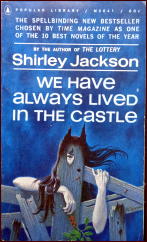
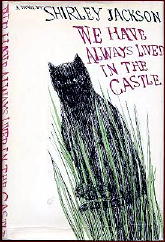
  SHIRLEY JACKSON – We Have Always Lived in the Castle. Viking, hardcover, 1962. Popular Library M2041, paperback, 1963.

   I first read this as an unpopular and maladjusted fourteen-year-old hooked on old monster movies, and I remember well how intensely I related to the outcast narrator of this compelling short novel. Now fifty-some years later, older and beloved by all for my acts of goodness and heroism, I come back to it again and find it just as forceful and fascinating as ever.

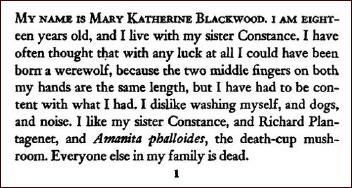
   Castle reads like To Kill a Mockingbird would have if Scout had been Boo Radley’s little sister. The narrator sets the tone in the first lines: “My name is Mary Katherine Blackwood, I am eighteen years old and I live with my sister Constance. I have often thought that with any luck at all I could have been born a werewolf….”

   Mary Katherine (“Merricat”) Blackwood may be eighteen, but her narrative voice is more like that of an obsessive-compulsive 12-year-old, and it turns out the Blackwoods (the surviving ones anyway) live in a big old house just outside a small town where they have been despised and taunted by the locals ever since most of the family was killed in a mass poisoning years earlier.

   Merricat’s older sister Constance was tried and acquitted of the murder, but a heavy cloud of suspicion was never dispelled, and the two women endure their ostracism as best they can while they care for their weak and aging Uncle Julian, who is one of the most brilliantly-drawn characters you will ever encounter in fiction—when he speaks in the book, you can almost hear Ralph Richardson’s bluff irony, and laugh at his semi-unintentional gaffes.

   The twists in the plot are few and simple (this was before the days when a novel had to run at least 300 pages) and the solution to the “mystery” is just as obvious as it was back when I was fourteen. There is even a point where this book takes a very bleak and depressing view of humanity as a whole.

   But stick with it. The ending is poignant, heart-warming and blood-chilling, all at the same time, a remarkable feat in a book you should not miss.


Reviewed by JONATHAN LEWIS:         


MOVING VIOLATION. 20th Century Fox, 1976. Stephen McHattie, Kay Lenz, Eddie Albert, Lonny Chapman, Will Geer, Dick Miller. Director: Charles S. Dubin.

   If you’re looking for the type of movie that they simply don’t make anymore, look no further than Moving Violation, a car chase exploitation filmed produced by Roger and Julie Corman. Directed by Charles S. Dubin, who is mainly known for his work in television, the alternatingly thrilling, humorous, and sad film doesn’t have the most complex of plots. But it makes up for it in (no spoilers here) some great car chase sequences.

   The story follows Detroit autoworker-turned-drifter Eddie Moore (Stephen McHattie) and small town girl Cam Johnson (Kay Lenz) as they attempt to flee a corrupt lawman, one Sheriff Leroy Rankin (Lonny Chapman), who’s hot on their trail. It’s the couple on the run trope that we’re all familiar with.

   That Moore is an autoworker is no minor plot point. Rather, it’s instrumental to the pro-labor, anti-authority theme that permeates the film. It’s even reflected in the movie’s theme song, a rather catchy track by Phil Everly which can be heard here:

   Moore, the guitar-playing outlaw is the film’s anti-hero. The cops and the local oil magnate are, to varying degrees, the movie’s antagonists. It’s as if the movie is one giant middle finger to authority. Not the most profound of messages and one that may not have all that much depth, but it’s one that certainly was deliberately constructed and designed to appeal to a working class white audience in the mid-1970s.

  JONATHAN VALIN – Dead Letter. Dodd Mead, hardcover, 1981. Avon, paperback, 1982. Dell paperback, 1994.

   The focus in this, the third adventure of Cincinnati private eye Harry Stoner, is academia, and the scurrilous sort of in-fighting and backstabbing that it is rumored goes on in such circles. As one of the characters puts it on page 197, “They don’t make very good human beings, scholars. They don’t have it in them to care for anything but themselves and their work.”

   I could argue the point, I think, but hardly with 100 per-cent conviction. The fact remains that this case of Harry Stoner’s is at once his most confusing and his most involving. Neither his client, a professor who believes his Marxist-environmentalist daughter has stolen a secret government document from him, nor the daughter herself are quite what Stoner takes them at first to be.

   Professor Daryl Lovingwell loves his daughter Sarah, or so he says. After his death, Stoner discovers an immense hatred between the two, and yet, although he had liked his client, with Kate gone (the library cop Stoner had become so involved with in Final Notice), the inevitable begins to happen between Sarah and himself.

   In a number of ways, this case is a tough one for Stoner to fathom, and even more so for the reader. Characterizations are deliberately murky, sketched from a multitude of conflicting viewpoints. The entire affair is filled with a moral ambiguity almost unnatural for a detective story.

   And so this is unlikely to be everyone’s favorite Harry Stoner novel — there is not much here to brighten the overall gloom. If it should come to it, however, a second reading will reveal how tightly structured this tale actually is. While it may not have been totally visible the first time, above all what it will demonstrate is that as an author, Jonathan Valin knows exactly what it is that he’s up to.

Rating: A minus.

— Reprinted from The MYSTERY FANcier, Vol. 6, No. 6, November-December 1982 (very slightly revised)

REVIEWED BY BARRY GARDNER:


TAYLOR McCAFFERTY – Ruffled Feathers. Haskell Blevins #2. Pocket, paperback original, 1992.

   This is a silly book. Silly. Haskell Blevins is an ex-Louisville cop (if it’s explained why he left I missed it) who now is the only private detective in his tiny (pop. 1511) home town of Pigeon Fork, Kentucky. How he makes a living there is mercifully unexplained.

   He’s hired by the town’s millionaire, a poultry raiser (shades of East Texas’ own Bo Pilgrim), to protect his daughter, for whom he has received a ransom note, but who hasn’t been kidnapped. The chicken magnate, an irascible and thoroughly repulsive sort, is killed, and we’re off.

   Off target and off base is what we are. The Blevins books are supposed to lighthearted and amusing. Not. Try dumb. The level of humor is indicated by the fact that the narrator, who nearly always speaks to you in a folksy (it’s to be queasy) but perfectly grammatical manner, four or five times over the course of the book throws in lines (directed to you, the reader) like, “Of course, you’ve got to watch them chickens…” Supposed to reinforce his country image, I guess.

   Stupid mystery, stupid characters, and an insult to the intelligence of all with IQs in triple digits. If you think this is funny, ABC sitcoms were made for you.

— Reprinted from Fireman, Fireman, Save My Books #2, July 1992.

      The Haskell Blevins series —

1. Pet Peeves (1990)

2. Ruffled Feathers (1992)
3. Bed Bugs (1993)
4. Thin Skins (1994)
5. Hanky Panky (1995)
6. Funny Money (2000)

« Previous PageNext Page »