Reviews


Reviewed by DAN STUMPF:         


THE VILLAIN STILL PURSUED HER. RKO, 1940. Anita Louise, Margaret Hamilton, Alan Mowbray, Richard Cromwell, Joyce Compton, Buster Keaton, Billy Gilbert and Hugh Herbert. Screenplay by Elbert Franklin and Ethel LaBlanche. Directed by Edward Cline.

   Never really funny but always highly amusing, this is a (mostly) straight-faced filming of William H. Smith’s popular temperance play, The Drunkard, first performed in 1844 and frequently revived for comic effect — as I write this it is still playing in Tulsa Oklahoma in a production that started in 1953, which makes it the second-longest-running play currently on the boards.

   The movie version offers a marvelous cast led by one of my favorite character actors, Alan Mowbray (best remembered as the hammy thespian in John Ford’s Wagonmaster and My Darling Clementine) with able support from that eternal juvenile lead Richard Cromwell; Hatchet-faced Margaret Hamilton, sympathetic for once as a dying ol’ widder woman; ditzy Joyce Compton, perfectly cast as Hazel Dalton, wandering lunatic; and Buster Keaton, as her brother William, whose doughty heroics here prompt bittersweet memories of his hey-day in the silents.

   The story, in case you’re interested, deals with kind-hearted but weak-willed Edward Middleton, who marries the poor-but-honest daughter of the dying ol’widder woman and is almost immediately led astray by Lawyer Cribbs, who nurses a hatred for his family (“I hated his father, I hate him, and if he should have any children, I shall hate them as well.”) and has some sort of secret buried in the woods — through which our wandering madwoman is wont to ramble.

   When our young hero succumbs to Demon Rum and flees to the City to hide his shame, it falls to his friend William to bring him home and save his wife and child from the machinations of villainous Cribbs — and incidentally cure his perambulating sister.

   Obviously this is not to be taken seriously, and Director Edward Cline, who worked with some of the great names in Film Comedy, does a fine job of keeping his players earnest and the pace accelerated. But the real show here is Alan Mowbray, who takes this rare (for him) starring role and runs away with it.

   It’s somehow fitting to see Mowbray as Cribbs, since he was a member of the Fields/ Barrymore/ Fowler circle, and W. C. Fields himself played an actor playing Cribbs in The Old-Fashioned Way (1934) to hilarious effect. Mowbray wisely chooses not to ape Fields, but puts his own stuffy hauteur into the part, and achieves the considerable feat of creating a classic screen villain who is also a wonderful comic character. Lovers of old weird movies live for films like this.

“HOLLYWOOD.” An episode of Law & Order: LA, 29 September 2010. (Season 1, Episode 1.) Skeet Ulrich, Corey Stoll, Regina Hall, Wanda De Jesus, Alfred Molina. Guest Cast: Shawnee Smith, John Patrick Amedori, Danielle Panabaker, Wyatt Russell, Jessica Lu.
Created by Dick Wolf; developed by Blake Masters. Director: Allen Coulter.

   Actually there was only one season. The series was a mess, and half the cast disappeared before it was over, to be replaced partway through by an entirely new group of attorneys and police detectives. It was a spinoff of the original Law & Order, which had just finished its 20-year run the previous spring.

   I will let anyone who knows more about the problems the series had go ahead and talk about them in the comments. I’ve not seen any more of the series than this first episode, and I confess that I simply wasn’t paying much attention to what was happening back then. (All I know is what I read online using Google.)

   The setting of the first episode was of course a natural, that being Hollywood, which is probably the first place people think of when they think of L.A. They didn’t have to think too hard to come up with a plot, even though it turns out to be a complicated one. The essence, though, is the convoluted relationship a young female actress slash party girl has with her mother, who has been guiding her and mentoring her and (no surprise) trading in on her daughter’s notoriety and fame for quite some time.

   What I really wanted to bring up again, following Michael Shonk’s recent article about 30-minute TV dramas, is that this first episode of Law & Order: LA is only 40 minutes long, after the commercials have been removed. In this case, forty minutes was simply not long enough, especially for a first episode.

   With both cops and later on lawyers involved, not to mention a story to tell, plus a lot of people who are interviewed by the police or otherwise connected to the case, there is little chance for any of them to get more than two minutes at a time of screen time. When the show was over, I knew who did it and why, but of the primary players, I couldn’t even have told you their characters’ names (or the stars’ names either, for that matter; I didn’t recognize any but one of them). One of the leading suspects was on screen for his two minutes early on, and when his character was brought back into it again toward the end, I barely remembered seeing him before.

   The actors have to talk fast to get all of the story in, too fast for me most of the time, and the locations are switched so quickly they have to identified by the equivalent of silent film insert cards. It’s an approach that works fine when viewers have been watching a series for many years, but not for a very first episode of a spinoff, already cramped for time. Not for me, anyway.

Reviewed by JONATHAN LEWIS:         


THE JAYHAWKERS. Paramount Pictures, 1959. Jeff Chandler, Fess Parker, Nicole Maurey, Henry Silva, Herbert Rudley, Frank DeKova, Don Megowan, Leo Gordon. Director: Melvin Frank.

   The Jayhawkers, a late 1950s Western set in Bleeding Kansas, doesn’t have the most unique plot. Although the score by Jerome Moross is quite memorable and can be listened to here, the film’s cinematography isn’t all that captivating. And while Melvin Frank’s direction is perfectly adequate, his workmanship isn’t really Anthony Mann or Budd Boetticher territory.

   So what makes The Jayhawkers – at least in my estimation – really worth watching? The characters.

   Well, one character in particular. The villain. His name: Luke Darcy. Modeled, at least in part, on abolitionist firebrand John Brown, Darcy is skillfully portrayed by Jeff Chandler in such a manner that it’s next to impossible to conceive any other actor having the role. Sometimes an actor seems as if he were just destined for the part. That’s certainly the case here.

   To appreciate The Jayhawkers, you really have to consider the film as primarily a character study of Luke Darcy rather than as a standard drama set on the eve of the Civil War. Darcy’s an imposing man, both by height and temperament. A psychologically nuanced figure rather than a caricature, he devours the classic texts of strategy and warfare, drinks red wine, and chases women. And he’s got a grandiose future planned. He’s going to be the authoritarian ruler of an independent Kansas, a tall Napoleon on the wide Prairie.

   Darcy’s not invincible, however. He’s got an Achilles Heel. He is pathologically afraid of being caught and hanged by the authorities. Nothing frightens him so much as the image – one he seems to play out repeatedly in his own mind – of him dangling, lifeless from the end of a rope. He finds the whole notion sickening, a disgusting clownish spectacle for the masses. It is little character details like this that makes Darcy a unique, if at times almost sympathetic, villain.

   But make no mistake about it. He is a villain and has done some horrible things in his time. For instance, he is responsible for seducing and abandoning another man’s wife. That man, Cam Bleeker (Fess Parker) makes it his mission to find and to kill Darcy. But things get complicated along the way.

   Rounding out the cast: Nicole Maurey as Cam’s potential love interest and Henry Silva as one of Darcy’s hired gunmen. All told, it’s a better than average Western, one that benefits greatly from Chandler’s imposing presence and his ability to convey a quiet rage that lurks just beneath a man’s seemingly calm and controlled surface.

Reviewed by DAVID VINEYARD:          


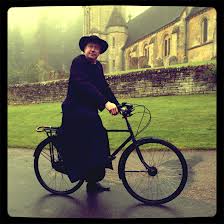
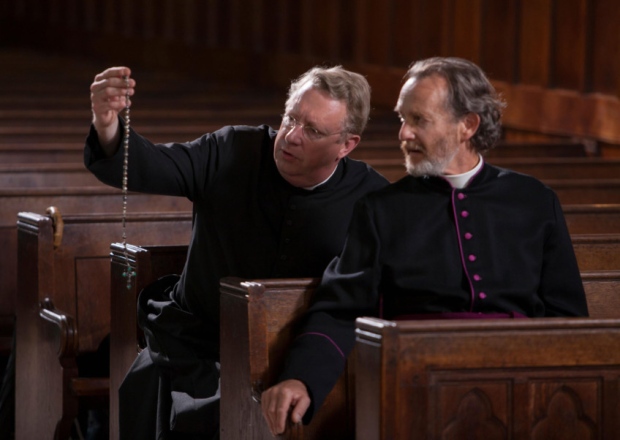
FATHER BROWN. BBC, UK, 2013 to date. 35 episodes. Mark Williams, Sorcha Cusack, Nancy Carroll, Alex Price, Hugo Speer, Tom Chambers. Created by Rachel Flowerday and Tahin Guner. Inspired by the stories of G. K. Chesterton.

   So, Father Dowling — no, wait, this one is British and there is no cute nun — Father Brown, that’s right Father Brown, is watching this couple making out; Father Brown is climbing over a fence; Father Brown has been poisoned; Father Brown has a broken leg and is being held hostage by a killer policeman; Father Brown pretends madness to go undercover in an asylum; Father Brown is trapped beneath a castle in a dungeon; Father Brown has to stop a bomb …

   Father Brown (Mark Williams) has a nosy housekeeper (Sorcha Cusack), a randy aristocrat friend (Nancy Carroll), her semi-honest roguish chauffer (Alex Price), a full time parish in Kembleford in the Cotswolds (where there are more murders than Chicago and Miss Marple’s St. Mary’s Mead combined) at St. Mary’s, and two policeman whose lives he is the bane of (Hugo Speer and Tom Chambers who replaced him).

   Father Brown is tall, hardy, and about as meek as a truck driver.

   Father Brown wouldn’t know a paradox if it hit him with a lorry.

   They have actually adapted a few stories by Chesterton. Not that you would know it unless you looked at the title, the only thing vaguely resembling Chesterton.

   That awful television movie with Barnard Hughes was better than this. Walter Connally’s wholly miscast Father Brown was better. Kenneth More, seemingly miscast, was brilliant as was Alec Guiness, also seemingly miscast. Mark Williams is just miscast. It is difficult for a man his size to appear to be a meek, blinking, slightly pudgy, and unassuming priest with the power of an Old Testament prophet. This Father Brown has the power of a Jessica Fletcher.

   The time is the 1950’s, God knows why since the stories end twenty years before that. Father Brown, who traveled extensively in the stories, is a parish priest and served in WWII. He deals with ex-Nazis and refugees and once with radiation poisoning. He seldom leaves Kembleford and his church, St. Mary’s. No one much respects him. Flambeau has a British accent, they couldn’t be bothered to hire an actor who could at least fake a French accent.

   You know it isn’t Chesterton because communist and atheists tend to turn out to be innocent. You know it isn’t Agatha Christie because the young lovers almost never turn out to be the murderers.

   This Father Brown never rises to the occasion. He never blinks behind his spectacles while transformed into a figure of Biblical strength. He never simply observes because he knows human nature and intuits the truth. He is never for one instant of film Chesterton’s priest in anything but name.

   It’s an attractive enough series, and I might like it if it wasn’t the only Father Brown we will get. The actors are personable, and the mysteries no worse than usual, but of course it could be so much more, and instead it is, as I said, “Murder, He Prayed.”

   If you are not an admirer of Chesterton’s stories you may not get why I feel such rancor for this unassuming little series. Try to imagine though they made a situation comedy out of The Great Gatsby. Try imagining they cast Pee Wee Herman as Sherlock Holmes. Try to imagine that the only Shakespeare there was to read was the Lamb’s version.

   You are not going to get good television from people incapable of respecting their source. You are going to get this, a series that disappoints week after week, hints at Chesterton (admittedly not easy to film though the More series did it), but never fulfills the promise. You get what seldom happens on series shown on PBS, the lowest common denominator, just like network television.

   This one wasn’t even designed to be shown at night in England. It was an afternoon series according to Wikipedia.

   This might have worked despite all that if they respected the original in any way, if they understood what made Chesterton’s stories work, what made Father Brown a rival of Sherlock Holmes — the rival of Sherlock Holmes.

   This Father Brown isn’t even a rival of Jessica Fletcher.

   If you like it despite all that, fine. But don’t kid yourself that anyone connected to this ever read a single Father Brown story and understood it or what gave it power. Father Brown the comic book would be better.

RAYMOND KHOURY – The Devil’s Elixir. Dutton, hardcover, December 2011. Signet, premium paperback edition, August 2012.

   This is the third in a series featuring FBI agent Sean Reilly and his close lady friend, Tess Chaykin, who’s been along with him on his two previously recorded adventures, neither of which I’ve read, nor did I need to. This one stands on its own very well.

   In physical size, the book’s a bruiser. It’s over 500 pages of tall premium paperback pages long, almost all of cramjack filled with small print, and after a month or so of short reading bursts just before bedtime, I’ve finally finished it. It begins with Michelle Martinez, one of Reilly’s former girl friends calling on him for help. Her boy friend is dead in a house invasion, but she and her four-year-old son luckily managed to escape their assailants, a gang of guys with guns completely unknown to her.

   Reilly rushes cross-country to be at her side, which is when she tells him that her son is his. After that, all hell breaks loose. A Mexican crime lord is trying to track down the formula for a wildly hallucinogenic drug discovered centuries ago by Indians dwelling deep in Mexico’s densest inland jungles. Hence the title of the book, of course.

   Let me not dwell on the 500 pages this book is long. Khoury’s writing style is one that can be skimmed read very quickly. There is a lot of action, ending in many deaths and much destruction, and before you reach the end, any doubts you have have about the existence of reincarnation will be shaken to the core. Well, maybe.

   I hope I won’t be spoiling anything for you by telling you that all ends well, except for the bad guys and one loose end that will carry over to the next book in the series. My one complaint might be that after so many pages, the end for the main bad guy, a particularly nasty gentleman at that, comes far too quickly and easily.

   All in all, though, I’d have to say that I got my money’s worth from this book. But while it’s solid enough entertainment — nearly a month’s worth, for me — here I am at the end of this review, and I find that I’m struggling with something crucial. I can’t find anything to point out to you about the book that would tell you why I’ll be reading another of Sean Reilly’s adventures any time soon, for I’m sure I won’t. If your results have varied, feel free to let me know.

PETER LOVESEY – Bertie and the Seven Bodies. Mysterious Press, US/UK, hardcover, 1990; paperback, US, 1991. Arrow, UK, paperback, 1991.

   Bertie in this case refers to Edward VII (1841 – 1910), but with the story taking place in 1890, when he was still Prince of Wales, the heir apparent to his mother, Queen Victoria. It is Peter Lovesey’s delightful conceit that Bertie, as he was commonly known, besides being a notorious playboy and philanderer, fancied himself as detective of some merit, even though the results are usually far off the mark, and quite amusingly so.

   A phase of his life, previously unrecorded, that continues the affair of the seven bodies, which takes place in an English manor where an array of English society has gathered for a weekend of shooting, perhaps the last of the season. But when the deaths start occurring, each tied to the day of the week, it is up to Bertie to solve the case before the police are called in. The scandal it would cause, you know, not to mention Bertie especially not wishing the story to reach the Queen’s non-approving ears.

   So not only is the story comic and light in nature, except for the deaths, of course, but Lovesey also makes sure the mystery is well-clued as it could be. Bertie and company come up with any number of explanations, which an appropriate of who the killer might be, all of them very convincing, only to have some small detail not fit, with the whole house of cards falling only to need another to be built up again.

   I hedged there at the beginning of the previous paragraph in my statement that the story is as well-clued as it could be. It is a minor tour de force for Lovesey to have constructed a tale with so many possible solutions, but the key to case is not discovered until page 209 of a 228 page book, and I challenge anyone to put the pieces of the plot together before then. But when everything falls into place as smoothly as it does here, all is forgiven.

   Highly recommended.

   The Albert Edward, Prince of Wales series —

      Novels —

Bertie and the Tinman (1987).
Bertie and the Seven Bodies (1990).
Bertie and the Crime of Passion (1993).

      Short stories (may be incomplete) —

Bertie and the Fire Brigade. Royal Crimes, Maxim Jakubowski & Martin H. Greenberg, editors, 1994.
Bertie and the Boat Race. Crime Through Time, Miriam Grace Monfredo & Sharan Newman, editors, 1997.

THE GETAWAY. National General Pictures, 1972. Steve McQueen, Ali MacGraw, Ben Johnson, Sally Struthers, Al Lettieri, Slim Pickens, Richard Bright, Jack Dodson, Dub Taylor, Bo Hopkins. Screenplay by Walter Hill, based on the novel by Jim Thompson. Director: Sam Peckinpah.

   I’m going to disagree with Roger Ebert about the merits of this film. I think it’s terrific, a flawed masterpiece, if you will, and if you want to read all about the flaws, you can read Roger’s review, available online here. He seems to have picked up all of them.

   To tell you the truth, though, the first time I saw this movie, I was rather underwhelmed myself, but for two reasons that Roger doesn’t mention. Well, maybe three. I’d have to agree that Ali McGraw as never much of an actress, that Steve McQueen was always Steve McQueen in whatever movie he was in, and (playing My Grumpy here) the long sidebar with Sally Struther’s character (the wife of the veterinarian that McQueen’s fellow bank robber kidnaps to medicate his broken collarbone) was totally unnecessary and quite frivolous besides.

   The second time through, none of Roger’s quibbles mattered, nor any of mine as well. I enjoyed myself thoroughly all the way through. The photography is brilliant. The little bits of business tossed in here and there all came together, and the action is spectacular. It is not non-stop action, however, as the story takes the time to focus on the rocky romance that develops between the two leading characters for long stretches of time. And the ending was even more enjoyable the second time, maybe because of the anticipation. (If Slim Pickens ad-libbed his conversation between the runaway couple, as I’ve been told, my admiration for his ability as an actor is even higher.)

   I think Ali McGraw does everything that was asked of her, including not giving her a lot of dialogue. But the uncertainty in her face I saw the first time fit right into place the second time, as she does not know how Doc McCoy (McQueen) will react when he learns what she did in order to get him sprung from jail when after the parole board turns down an early release. And react he does, probably in a way that wouldn’t be permitted in a movie today.

   As for McQueen being McQueen, wasn’t Bogart always Bogart? Gable always Gable? Scott always Scott? McQueen’s presence on the screen is always a plus. What was I thinking? The business with Sally Struthers, well, I’m still not so sure about that, but in parallel and it contrast with the McCoys’ journey, I grew to accept it the second time around.

   The story, which I think it’s about time I got around to telling you about, is about a bank heist gone bad, and the problems that result when both big things and little things go bad. Mostly big things, such as having a con man steal the key of the train locker containing the loot, and hiding in a grbage dumpster just before the truck comes along to pick it up.

   This movie’s in my top twenty now, no doubt about it.


JIM THOMPSON – The Getaway. Signet #1584, paperback original, 1959. Reprints include: Bantam, paperback, movie tie-in edition, 1973. Black Lizard, softcover, 1984.

   I don’t own a copy of the Signet book; in fact, I’m not sure that I’ve ever seen a copy. (The least expensive one on abebooks.com is $60.) For some reason, and I’m not sure why I thought this, but I’ve had it in my head all these years that the Bantam edition which I’ve just read (after watching the film) was a paperback adaptation of the movie. Wrong. It was just the opposite. The movie was based on the Signet paperback published in 1959.

   And surprisingly enough, within the restrictions of big studio movie-making, the adaptation is reasonably well done. Up to a point, that is, and I’ll get back to that shortly.

   But the Doc McCoy in the book is a killer as well a bank robber, and a vicious one at that. There’s no way that Steve McQueen could play a villain as cold-blooded as his character is in the novel. In the movie, Doc McCoy is a killer when he needs to, and only then. His companion in crime, his wife Carol, who helped bring about his parole by sleeping with a member of the parole board, is also not as good-looking as Ali McGraw, nor do we have any feeling of sympathy or rapport with her. She (Carol in the book) has made her bed and all we’re waiting for is how far that will get her.

   The story of the two increasingly desperate movie stars fugitives on the lam eventually diverges from the book around page 132 with just over 50 pages to go. Or to better phrase that, this is where the movie ends. The movie has a much happier end than the book does, and that it putting it mildly. What follows is either a totally allegorical fantasy, or a getaway that only ends when the pair of fugitives reaches safety in Mexico pure hell.

   Let me tell you this. One “refuge” the couple on the run find themselves in is a pair of tiny cramped caves in a cliff along the California coast just above the water line. When Carol manages to maneuver herself around in the dark so she can sit up, then finds that she cannot move an inch to lie down again, it was two AM in the morning and I had to stop reading, right then and there.

   I’ve not read enough Thompson to say, but other people tell me that this is one of his best. Now I know why.

THE GETAWAY. Universal Pictures, 1994. Alec Baldwin, Kim Basinger, Michael Madsen, James Woods, David Morse, Jennifer Tilly, James Stephens, Richard Farnsworth, Philip Hoffman, Burton Gilliam. Screenplay by Walter Hill & Amy Jones, based on the novel by Jim Thompson. Director: Roger Donaldson.

   There were a few changes made from the earlier version of the film, but in a way, only a few of any consequence. Instead of robbing a bank, Doc McCoy and two others hold up a dog racing track instead, and some additional back story was added, but not particularly for the better. Personally I think that when back story is added, it takes away from the mystery behind the characters. Not always, but often enough.

   Walter Hill was the screen writer of both films, with the addition of Amy Holden Jones on the second. Perhaps that helps explain why in the scene in which McCoy slaps his wife around when he learns what she had done to help free him from prison, Carol (Kim Basinger) slaps him right back.

   There are some subtle changes that are more difficult to put words to. Alec Baldwin, whatever his accomplishments, does not have nearly the screen presence of Steve McQueen, and while Kim Basinger is a much better actress than Ali McGraw, I somehow found Ali McGraw a more fitting actress for the character, at least the cinematic one.

   The sex scenes are far more explicit in the later movie, and the action seems more violent, but somehow I don’t believe either facts are to the second film’s advantage. The most striking difference between the two films [SPOILER ALERT] is that I found the happy ending rather appropriate [NOT IN THE BOOK], but in the second film, I wondered a whole lot more if I cared that these two rather unpleasant people were going to get away with it.
THE BACKWARD REVIEWER
William F. Deeck


AUSTIN J. SMALL – The Master Mystery. Doubleday Crime Club, hardcover, 1928. First published in the UK by Hodder & Stoughton, hardcover, 1928, as by Seamark. Lead novel in the pulp magazine Detective Classics, March 1930, as “The Crimson Death.”

   Everything red in Gairlie Castle disappears sooner or later, usually sooner. On the night that the betrothal of Lord Gairlie’s daughter, Lenora, to Tommy Delayn, all-round sportsman, dilettante chemist, and recent pauper, the Gairlie Rubies, 811 perfect stones, are stolen. Since Delayn was left alone to watch the room containing the rubies, he is naturally accused, as the room was — and here we have to take the word of the author — hermetically sealed except for the door at which he was standing lookout.

   While Delayn is in jail, a housemaid is murdered in the library. There are no marks on her body, but her purple uniform is stained an uneven red, with streaks of vivid scarlet, and there are pieces of glass in her clothing. Then a Scotland Yard detective is found dead, under the same circumstances in the same room — a windowless room with only one door, and that door being watched in his case.

   Another detective, in the hope of capturing whatever it is committing the murders, stakes out the library, with the room being observed closely by his colleagues. He fires his gun, and when the others rush into the room they find it unoccupied except for his corpse. His clothes, too, have red streaks. Meanwhile, the removal of all red items continues.

   The case is solved — or, more accurately, the criminal, who could only have been one person, is revealed — by a mysterious and utterly strange person named John Argle, who was in love with the murdered housemaid. Argle spends a fair amount of time impersonating, literally, a statue of Rodin’s The Thinker, but he spots the killer while he (Argle), again literal!y, is up a tree.

   Of course, Delayn gets the girI and saves her father from ruination. The locked-room murders are explained to the satisfaction of The Chief, a Scotland Yard man who has no name, but not to this reader. There’s at least one gaping hole in the explanation.

   This novel was no doubt exciting in 1928, but those interested in it today are probably limited to impossible-crime fanciers who don’t mind straining their credulity.

— Reprinted from The MYSTERY FANcier, Vol. 9, No. 6, November-December 1987.


Editorial Comment:   I didn’t know why this novel sounded so familiar until I used the Google and discovered that, yes, I’d read it before, but in the pulp magazine version, and more than that, my review of it was posted on this blog about five years ago. Check it out here, and be sure to read the comments also. As always, they are very useful.

Reviewed by JONATHAN LEWIS:         


MISS MEADOWS. Entertainment One, 2014. Katie Holmes, James Badge Dale, Callan Mulvey, Jean Smart, Mary Kay Place, Ava Kolker. Written and directed by Karen Leigh Hopkins.

   Miss Meadows, starring the very talented Katie Holmes, whose acting skills can’t save the movie from being a complete misfire, is not so much a feature film as it is a quirky premise caught on tape. Imagine a tap-dancing, prim and proper schoolteacher who is also — wait for it – a vigilante killer. She’s quirky, charming, funny, and deadly with a small pistol. She kills the bad guys because, you know, someone has to. Call her a softer, gentler, Charles Bronson.

   Intrigued? So was I.

   Which is why I decided to watch Miss Meadows in its entirety, unaware that the entire story is the premise. Well, that’s not entirely true. We get subject to an entirely forced love story between Miss Meadows and a law enforcement officer we only get to know as Sheriff (Yes, just Sheriff) and a series of flashbacks that show that Miss Meadows (Holmes) is the way she is because she witnessed her Mom being shot dead when she was an innocent child.

   Disclosure: I actually really like revenge and vigilante films and feel that they are continually under-appreciated as a film genre. When they work best, it’s mostly on a visceral level. We empathize with the protagonist, hoping he (or she) will achieve his necessary revenge. We very much want the bad guys to get what’s coming to them. Proportionally, of course. But we also are nuanced thinkers and realize that revenge has to have a cost. (Even Charles Bronson’s character in Death Wish was forced to leave New York at the film’s end).

   Case in point: William Lustig’s brilliant Vigilante starring Robert Forster, in which Forster’s character succeeds in avenging the murder of his son, but at the cost of his wife leaving him. In some ways, it’s an exploitative and nihilistic film, but it’s a hell of a good one.

   That’s not the case in Miss Meadows, where the gun-toting vigilante ends up with a loving, quirky husband, a child, and a beautiful, large home in the suburbs. If this is meant to be satire or a black comedy, it falls flat. If it is meant to send a message, it’s an entirely nauseating one. Not so much because the bad guys didn’t deserve it, but because the film refuses to engage with the revenge/vigilante film genre in a serious manner and promotes the idea that a quirky premise should hold the viewer’s attention for nearly ninety minutes.

REVIEWED BY MICHAEL SHONK:


RADIO SERIES: NBC. 4 July to 19 September 1951; 30 minutes. Cast: Jack Webb as Pete Kelly, Meredith Howard as Maggie Jackson. Pete Kelly’s Big 7: Dick Cathcart, Matty Matlock, Moe Schneider, Ray Schneider, Bill Newman, Marty Carb and Nick Fatool. Announcer: George Fenneman. Created by Richard Breen. Writers: James Moser and Jo Eisinger.

TV SERIES: NBC / Mark VII Ltd., 1959; 30 minutes. Cast: William Reynolds as Pete Kelly, Connee Boswell as Savannah Brown, Than Wyenn as George Lupo, and Phil Gordon as Fred. Music by Dick Cathcart. Additional Music by Matty Matlock, Gus Levene and Frank Comstock. Produced and directed by Jack Webb.

   Pete Kelly was born from Jack Webb’s love of jazz and survives because of the music. Pete Kelley’s Blues began as a summer replacement series on radio in 1951 (On The Air – the Encyclopedia of Old-Time Radio by John Dunning (Oxford University Press, 1998. The radio series lasted just thirteen episodes but that was not the end for Pete Kelly.

   There was a film, a television series and the music. Besides the more famous film’s soundtrack there was music released from both the radio and TV series. Capitol Records released music from the radio series featuring Pete Kelly’s Big 7 led by Dick Cathcart with singer “Maggie Jackson,” including the song “Funny Man” (1951). An on the air credit announced the TV series music was available from Warner Brothers and featured the sounds of “Pete Kelly’s Big 7” (Dick Cathcart, Eddie Miller, Jud De Naut, George Van Eps, Moe Schneider, Nick Fatool and Ray Sherman).

   While the TV series had been planned to follow the radio series (more on that later), it would have to wait until 1959 when it aired on NBC as a summer series that lasted only 13 episodes.

   Both the radio series and the TV series focused on the daily struggles of Pete Kelly, a cornet player and leader of a Dixieland jazz band called Pete Kelly’s Big 7. All Pete wanted was to avoid trouble and play his music but it was the 1920s in Mob-run Kansas City, and even accepting the corruption was not enough to keep Pete out of trouble.

   Surviving TV episodes are a rare find. Thanks to the collector’s market I found one episode of the TV series, “Poor Butterfly Story.”

“Poor Butterfly Story.” Teleplay by Jack Webb. Based on Radio Play by Jo Eisinger. Produced and Directed by Jack Webb. Guest Cast: Whitney Blake, John Hudson, and Marshall Kent. *** Pete finds himself trapped, surrounded by a deadly romantic triangle involving Matty his record producer, Matty’s ex-wife Zelda and Zelda’s new husband gangster Johnny Angel.

   Zelda begs Pete to help her get a record back from Matty. The record featured the Pete Kelly’s Big 7 performing “Poor Butterfly.” Matty and Angel are not happy about Pete getting involved. Pete is not happy about his involvement either, especially when finding that record becomes a matter of life or death — his.

   While I have been unable to find any TV episode of Pete Kelly’s Blues available online to watch, the radio version is available. It was common during the fifties for TV series based on radio series to reuse the radio scripts. The TV episode “Poor Butterfly Story” was a remake of the radio episode “Zelda” that aired originally September 5, 1951 on NBC. The Great Detectives website has all six of the known surviving episodes of the radio series. Click on the link and scroll down for the episode “Zelda.”

   The story and most of the dialog from the radio show remained the same in the TV version. Different songs were used but in the same style, with Dixieland for Pete Kelly and the blues for Maggie Jackson (in radio and film) and Savannah Brown (in television). The most noticeable difference was changes in two characters. Pete’s friend “across the river” blues singer Maggie Jackson (on radio and film) got a new name Savannah Brown in the TV series. Pete’s other friend, the failed bootlegger and loquacious drunk Barney in the radio series was replaced by the band’s piano player, a Southern with a folksy sense of humor, named Fred.

   I preferred the radio version mainly because of the cast. Webb was the better Pete Kelly. When Angel confronts Kelly about Zelda, Webb’s voice in the radio version ranges in emotion from fear to anger while in the TV versions Reynolds failed to show those emotions. Known best for his role in The F.B.I (1965) as Special Agent Colby (1966-74), William Reynolds was a bland actor at best. Webb was visually limited in range as an actor, but his voice talent was among the best in radio.

   Webb’s former high school classmate, Meredith Howard as radio’s Maggie had the voice and acting ability to make you believe she lived on “the other side of the river” (the black side). Ella Fitzgerald made the character of Maggie her own in the film. Connee Boswell as Savannah had the voice but being white and shot in the pre-Elvis TV style (where the singer stands stiff and still as he or she sings) ruined the character. But it did allow Southern NBC stations to carry the series.

   According to TV Tango, TVGuide.com and IMDb the TV episode aired April 26, 1959, Sunday at 8:30pm. There is some confusion over dates the show aired. The NBC series premiere date is uncertain. Broadcasting (April 6, 1959) and Billboard (March 30,1959) claim Pete Kelly’s Blues premiered on Tuesday March 31, 1959 at 8-8:30pm. Yet today’s databases and books give the premiere date as Sunday April 5, 1959 at 8:30pm. IMDb has the skill to disagree with itself. The database gives March 31, 1959 as release date for TV series but the episode index list April 5, 1959 as the premiere’s airdate.

   Complete Directory to Prime Time Network and Cable TV Shows, 1946-Present by Tim Brooks and Earle Marsh (Ballantine, Ninth Edition) claim the series debuted April 5, 1959 and aired on Sunday until July when it move to Friday at 7:30 pm until its final broadcast September 4, 1959. The episodes on Friday were probably reruns as the series lasted just thirteen episodes. TVTango.com agree with the Sunday and Friday time slots.

   It took jazz fan Jack Webb several years to get the TV series on the air. While the radio series aired first, there were plans for a TV series from nearly the beginning. In Broadcasting (December 22, 1952), details of the proposed TV version of Pete Kelly’s Blues was reported with shooting to begin in June 1953 and Webb as director, Stan Meyer as executive producer and Michael Meshekoff as producer. There was no mention of the cast.

   In July 13, 1953 Broadcasting, during a report about Dragnet starting syndication in the fall under the title The Cop (that would be later changed to Badge 714), the article mentions Webb’s plans to do a Pete Kelly’s Blues TV series in color with Webb as star.

   According to Hedda Hopper (Chicago Tribune, August 11, 1954), Webb had originally planned to follow the radio series with a TV series version, but “instead of which he’ll make it into a movie, playing the title role, a trumpet player.”

   Plans to make a TV series continued as the film version played in the theatres (Broadcasting, March, 28, 1955). Billboard (May 27,1957) reported Jack Webb and ABC were in talks for a Pete Kelly’s Blues weekly TV series with sixty-minute episodes.

   The December 16,1957 issue of Billboard claimed Bob Crosby was being considered for the part of Pete Kelly in the possible TV series. A few months later Broadcasting (February 17, 1958) noted that Bob Crosby would not star due to commitments he had with CBS. A new lead was been sought. The magazine added that Webb would supervise production with Harper Goff as producer and George Stevens Jr. and Joseph Parker also involved in production. Plans were to start shooting in May.

   In a Chicago Tribune (April 30, 1961) interview Webb said he thought the failure of the TV series was in part due to timing. He believed airing Pete Kelly’s Blues at the end of the season rather the beginning hurt and regretted it aired only a year or so before interest in the 20s music, fashion, and crime would explode among the public.

   I doubt timing was the problem. The more entertaining ABC’s Roaring 20s (1960) had the timing but lasted only a season and a half. The real problem with both the radio and television series was with the protagonist Pete Kelly, who lacked the qualities of the type of hero the audience at the time wanted. Joe Friday would have disapproved of Pete Kelly. I think the audience did as well.

Editorial Comment:   The video clip obviously comes from the movie version of Pete Kelly’s Blues, and more than likely the two photo images do, too. I apologize for that, but I thought it was more important to give you an idea of what the radio and TV series were like, in spite of the bit of inaccuracy involved.

« Previous PageNext Page »