Reviews


Reviewed by JONATHAN LEWIS:         


THE BANDITS OF CORSICA. United Artists, 1953. Richard Greene, Paula Raymond, Raymond Burr, Dona Drake, Raymond Greenleaf, Lee Van Cleef. Director: Ray Nazarro.

   The story is kind of silly, the costumes aren’t the most spectacular, and at least one member of the cast seems as if she would have benefited tremendously from acting lessons. Even so, The Bandits of Corsica, a costumer/swashbuckler starring Richard Greene is nevertheless a fairly entertaining quasi-Western romp through Alexander Dumas’s fictionalized version of Corsican history.

   Greene, in a dual role, portrays Siamese twin brothers separated at birth. Mario Franchi, the “good one,” is a wealthy Corsican with a beautiful girl by his side. The other brother, Lucien, is a shell of a man long thought dead. But he’s not dead, of course. He’s living with amnesia under the name Carlos. But that’s not all. He’s camping out with Gypsies and, through an invisible psychic connection, can feel pain that his twin brother experiences. Did I mention that deep down he hates Mario?

   As far as the plot, it’s not all that elaborate. The two brothers reunite to fight the evil local tyrant, Baron Cesare Jonatto (Raymond Burr) and his nephew (Lee Van Cleef). Watching these two fine character actors portray would-be Napoleons is just a fun cinematic experience. In many ways, they’re more interesting to watch than is Greene in either of his two roles.

   All told, The Bandits of Corsica is a slightly better than average 1950s adventure film. It’s not the greatest film out there for its genre, but the last half hour has a distinct Gothic atmosphere, is quite well filmed, and contains just enough action to keep the viewer’s attention.

RICHARD HUGO – Death and the Good Life. St. Martin’s, hardcover, 1981. Avon, paperback, 1982.

   Hugo is a noted American poet, and this is his first mystery. His hero is a soft-hearted ex-cop from Seattle, and his name is Al Barnes. Since quitting his job in the city, he’s taken a deputy sheriff’s position in the small town of Plains, Montana.

   That’s right. Montana. Not Georgia. The Pacific Northwest is rapidly becoming a hotbed of detective-story activity. You can add another pretty good one to the list.

   The first murder is an axe-killing, and so’s the second, but it doesn’t seem to fit the pattern. The trail leads Barnes back to Oregon, and once there, deep into the past. It takes a gut feeling for the truth to work a scent almost twenty years old, and that Barnes has. Memories are not always pleasant ones, but some of the ones he dredges up are particularly nasty ones.

   The prose is right, and Barnes’ instincts for the job are never far from wrong, but the story still doesn’t click the way it’s supposed to. Strangely enough, it’s the rhythm, the beat, that’s off. This is essentially a private eye story, and it’s a crucial factor. This one just misses.

Rating:   B minus.

— Reprinted from The MYSTERY FANcier, Vol. 5, No. 3, May/June 1981. This review also appeared earlier in the Hartford Courant


Note:   This was Richard Hugo’s only mystery novel. He died of leukemia in 1982, at the relatively young age of 58.

YELLOW CARGO. Grand National Pictures, 1936. Later released as Sinful Cargo. Conrad Nagel, Eleanor Hunt, Vince Barnett, Jack La Rue, Claudia Dell, Vance Carroll. Story, screenplay & director: Crane Wilbur.

   Pretty much a minor leaguer in the overall scheme of things, but this was the first of four crime and espionage movies featuring the two leading stars Conrad Nagel and Eleanor Hunt in a series of “G-Man” pictures, the other three being Navy Spy, The Gold Racket, and Bank Alarm, all from 1937.

   Conrad Nagel plays Alan O’Connor in all four, while his companion in crime solving is Bobbie Reynolds, played by Eleanor Hunt, about whom I will have more to say later. O’Connor works for immigration office in Yellow Cargo, sent to the west coast to breakup a gang who has been smuggling illegal immigrants from China into, while Bobbie Reynolds is a brash young newspaper reporter covering the movie industry.

   Their paths meet when they both learn that a small time movie studio is using a make-believe film to conduct their business, replacing movie extras dressed in Chinese garb by the men from China they are smuggling in.

   The movie is played as much for laughs and light entertainment rather than a serious crime drama, with balding Vince Barnett as the dimmest (and clumsiest) news photographer ever to try to take a picture with an old accordion box camera.

   You have to give the actors credit. They take their roles seriously, even if the story (lame) and production values (practically nil) are far beneath their ability. Stalwart leading man Nagel’s career lasted until the 1960s in both TV and the movies, but unfortunately Eleanor Hunt made only one more film after this series ran dry. Her large expressive eyes reminded me of Kay Francis, but with a much brassier demeanor. To add to the comparison, she also has a hint of a lisp.

   As a former chorus girl, Eleanor Hunt also had the legs to show for it, at least in one short scene in which her skirt came up above her knees. I don’t know why I noticed that, but I did.

   In spite of its various and sundry flaws and shortcomings, I enjoyed this less than 60 minute programmer, and I think I’ll look to see if the other three in the series can be found.

Reviewed by DAVID VINEYARD:         


THE HANGING TREE. Warner Brothers, 1959. Gary Cooper, Maria Schell, Karl Malden, George C. Scott, Karl Swenson, John Dierkes, Virginia Gregg, with Ben Piazza as Rune. Screenplay: Wendell Mayes & Halstead Welles, based on the novella by Dorothy Johnson. Music by Max Steiner. Title song sung by Marty Robbins. Directed by Delmer Daves and (uncredited) Karl Malden.

   The Hanging Tree was Gary Cooper’s last western other than the documentary The Real West, and appropriately it is one of the best of his career, and one of the best of the 1950‘s, the golden age of the Hollywood Western. It’s based on the novella by Dorothy Johnson (A Man Called Horse, The Man Who Shot Liberty Valance) and directed by Delmer Daves (3:10 to Yuma, Jubal), or it was supposed to be directed by Daves until he fell ill and Gary Cooper, whose company was also producing the film, asked Karl Malden to take the helm. It proved a remarkable collaboration and the start of a friendship and mutual admiration society that lasted until Cooper’s death.

   Like most good westerns the story is simple, Doctor Joe Frail follows the 1873 Montana Gold Trail to a small mining community, mostly tents and mud, where he sets up practice. When a boy, Rune (Ben Piazza) is shot for stealing from a sluice Frail saves him and makes him his bondsman, a virtual slave, blackmailing him with the bullet that proves he was the sluice thief.

   It’s a rough little town not improved by glad-handing backstabbing miner Frenchy (Karl Malden) who knows Doc Frail from another mining camp, knows how fast he is, and about the fire Frail may have set that burned his wife and her lover alive.

   This is a very adult adult western.

   When Frail wins a gold claim from gambler Society Red (John Dierkes) all seems set, and no one much listens to Grubb (George C. Scott) a fanatic faith healer who hates Frail and knows his history. There is only one element left, and that arrives when the stagecoach is held up and the horses panic. Everyone dies but a young woman who suffers severe wounds and exposure, Elizabeth Mahler (Maria Schell), a Swiss immigrant come west with her now dead father.

   Frenchy finds her and feels a proprietary interest in her, as well as undressing her with every lewd look. Frenchy has other bad habits than backstabbing. But Doc takes on her care with young Rune, and while Doc seems a hard man there are signs he is more than that. Frankly Rune just can’t read him and neither can Elizabeth: a man with secrets like he carries becomes remote, even his name is false. He took the name Frail because he figured all men were frail and he was the frailest.

   When Elizabeth is well she tires of Frail’s bossiness, especially when he tells her he is sending her back to Switzerland because he can’t live near her. She runs away, Rune rebels, and Doc secretly backs them through store owner Tom Flaunce (Karl Swenson), the only decent man in this little mud hole Sodom of the west despite his shrewish wife, Edna (Virginia Gregg).

   Backed by Doc Elizabeth and Rune team with Frenchy who knows gold digging though he isn’t very good at it, and though they find nothing Doc keeps backing them whenever they need money.

   When a rainstorm fells a tree on their claim they find the glory hole, a vein of nuggets in the roots of the tree and beneath. Now they are rich and rush to town to celebrate.

   But Frenchy hasn’t forgotten Elizabeth and when he tries to rape her, Doc arrives just in time and kills him. No, that’s an understatement, because in one of the most brutal scenes in any American western of its era, Cooper empties his gun into the fleeing Frenchy, who dies at the edge of a cliff, and Doc then kicks his corpse over.

   The grim Frail as he coolly walks down the pleading running Frenchy putting bullet after bullet in him is a scene you won’t soon forget. Perhaps only Cooper’s brutal beating of Jack Lord in Man of the West and throwing Cameron Mitchell into the fire in Garden of Evil come anywhere near it. And, I’m little ashamed to admit it, it is a very satisfying scene as well, Malden is always a very killable bad guy.

   Grubb and Society Red and a group of drunken miners drag Frail to the hanging tree to lynch him, and have the rope on his neck and Grubb at the horse’s reins when Elizabeth and Rune arrive and buy his life at the cost of their claim. As the drunken miners battle over the claim Rune frees Frail and Elizabeth turns to leave but Frail calls her back and kneels in the buckboard to embrace her. Fade to the Marty Robbins theme. He literally found his love at the hanging tree.

   The Hanging Tree has more than enough virtues and might be Cooper’s best if not for High Noon. Frail is a complex character who is never just a hero, just a good man, just misunderstood. Life and fate have bred a rattlesnake mean streak in him and it is clear he fears it though he fights it more successfully than he knows.

   It is not until he comes clean that the viewer knows for certain he did not set than fatal fire. Malden, fresh off his Oscar, is quite good as Frenchy, but as a director he is a revelation. This film is as well directed as any major western of the era, a worthy rival for Ford, Mann, Hawks, Daves, or any of the other iconic Western directors. IMDb says he finished the film, but Daves became sick early, and Malden directed the bulk of the film

   Ben Piazza as Rune is a little lost in this cast of veterans, but not badly lost, and Schell is fine in a tough no nonsense non-glamorous role that is both physically and emotionally demanding. And then there is that New York actor making his Hollywood debut on screen, George C. Scott. He has only a little time on screen, but he makes the most of every scene as the fanatic, cowardly, venal, murderous Grubb. If he had never done anything else you would remember him from this. I did for years, though I didn’t really know who he was or connect the star of television’s East Side, West Side with the part.

   But like almost any film he is in this is Gary Cooper’s film and there is never a moment you don’t know it, whether he is on screen or not. I recall seeing this on the big screen (it was the debut of Technirama) and being bowled over by Cooper. He’s still impressive on the small screen though in this one, Malden seems to have staged it to shoot Cooper from a lower angle making him seem even taller and more commanding than he was to begin with.

   The Max Steiner score is fine, and surprisingly, considering the title, the Marty Robbins theme song turns out to be one of the best of the era and one of the best western themes ever. “To really live/ You must almost die …” proves haunting if you may not want to think about it too much and “I found my love at the hanging tree” is a tough lyric to pull off even in a western song but Robbins succeeds.

   Brian Garfield suggested they should have stopped making westerns when Cooper died and this should have been the last of its kind. I don’t know that I agree with him, but his point is well taken. In many ways this is the last and one of the best of its breed. Screen westerns never really reached this height again; in my opinion, they were never this good again, not at this level. Whatever Cooper brought to the western, went with him.

   If you have never seen this one then find it. It shows up on TCM now once in a while and is available from the Warner’s Archives to own or watch on line if you are a subscriber. You can also listen to the Marty Robbins song and see the titles and end scene on YouTube.

   This is quite simply one of the best westerns of the 1950‘s and one of Gary Cooper’s best westerns, which makes it one of the best westerns ever made.
THE TIME MACHINE. Dreamworks/Warner Brothers, 2002. Guy Pearce, Sienna Guillory, Samantha Mumba, Jeremy Irons, Orlando Jones, Mark Addy, Phyllida Law, Alan Young. Based on the novel by H. G. Wells and the 1960 screenplay by David Duncan. Director: Simon Wells.

   There’s some resemblance between one of H. G. Wells’ most famous stories and this movie, but not a whole lot. I suspect it’s a lot closer to the 1960 film based on a screenplay by David Duncan, the one starring Rod Taylor and produced by George Pal, but it’s been so long that I watched that one that perhaps I should not even bring it up.

   The first part of the movie, the part that takes place in Victorian England, is better by far than what follows, as Alexander Hartdegen (Guy Pearce) travels into the future to find out why he can’t change the past by means of a time machine he has built (a wonderful concoction of revolving rings, clockwork gears and sharply focused beams of light) — a past in which his fiancée dies, and keeps on dying every time to goes back in time to save her, only to fail.

   In the far, far future mankind has evolved into two races: the Eloi, a peaceful lot who live above ground but who seem to have no purpose in their lives, and the Morlocks, a race of ravaging monsters who live below ground and prey on the Eloi at feeding time.

   There are a lot of computer generated effects to make this future come to life. The past is easier to reproduce (ignoring the fact that Hartdegen’s betrothed (Sienna Guillory) uses present day makeup to enhance her already natural beauty). Much is made of Hartdegen’s inability to change the past, but the explanation, when it comes, is tossed off in a line that takes less than five seconds to say.

   It is one of those temporal paradoxes like the one that says you can’t go back and kill your grandfather before you are born because then there would be no you to go back in time to kill your grandfather. But to put a proposition like this before an audience that might want to think about it while would take some effort, and Simon Wells (H. G. Wells great-grandson) takes the easier way out and concentrates on the monsters and the blow darts and the explosions instead, presumably thinking that’s enough to satisfy the reality based science fiction fans among us.

   It isn’t. No more than to imagine that destroying the moon in its orbit in the 21st century would allow for any kind of life to exist on the Earth 800,000 years later, much less speak English.

WILSON TUCKER – To Keep or Kill. Rinehart & Co., hardcover, 1947. Lion #21, paperback, 1950; Lion Library LL84, 1956.

   Tucker, who is probably better known today for his science fiction, wrote a total of five Charles Horne mysteries for Rinehart back between 1946 and 1951. After that he apparently decided he was better off not trying to write detective fiction, even as a sideline.

   Not that he left the field completely, but I think he probably made the right decision.

   Horne is a private eye. Most of his work is done for insurance companies. He quite vehemently does not do divorce work. The small metropolis of Boone, Illinois, where he has his office, is a figment of Tucker’s imagination, although there is a Boone County (up near Rockford).

   This is the second Horne book. As it begins, he is witness to an explosion. He thinks it’s a practical joke at first, but when it goes off it takes part of a city block and a couple of victims with it. Later, Horne is kidnapped and kept a prisoner in the home of the girl who planted the bomb. She’s a redhead, tall, beautiful, and as loopy as a loon.

   She is in love with Horne, she has been stalking him for months, and now that she “owns” him, so to speak, she expects — well, this was written before such explicit intentions could be stated, but those are the kinds of intentions she has. Viewed from today’s more permissive perspective, Horne’s brave resistance to temptation seems both admirable and refreshingly naive.

   Tucker’s style in this book is a burbling, slap-happy one, somewhat reminiscent of Fredric Brown in nature. In all, however, it hardly manages to disguise a total apparent lick of respect for logical thought processes. Or let me put it another way: the sort of logic that is used by all concerned would make sense only to the well-confined inmates of a lunatic asylum.

   It wouldn’t be hard to enjoy this quirky excuse for a detective story immensely. There is a thin line, it is said, between genius and lunacy. If I’d been able to follow the plot at all, I’d have said this was the work of the former.

   As for a letter grade, I’m not too sure of this one at all, but if it means anything to you, what I’m going to do, if I don’t change my mind tomorrow, is give this book a definite (C plus?).

— Reprinted from The MYSTERY FANcier, Vol. 5, No. 3, May/June 1981.


The Charles Horne series —

The Chinese Doll. Rinehart, 1946. Dell Mapback #343, 1949.

To Keep or Kill. Rinehart, 1947. Lion #21, 1950.
The Dove. Rinehart, 1948.
The Stalking Man. Rinehart, 1949. Mercury Mystery #150, no date.
Red Herring. Rinehart, 1951.

REVIEWED BY DAN STUMPF:         


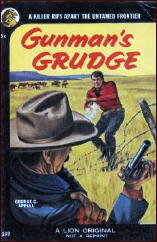
GEORGE C. APPELL – Gunman’s Grudge. Lion #139, paperback original, 1953; reprinted as Lion Library LL161, 1957.

   â€œBelongs among the best westerns of this or any other year.”     — STAG Magazine

   Now how’s them for creds!

   Actually, this is surprisingly fine: a fast, remorseless and straightforward tale of violence and damnation in the manner of Jim Thompson and James M. Cain — yes, it’s that good.

   Tracy Silleck opens the book on the run from killing the man who killed his dog. There’s a brief, rather cryptic scene early on as he returns to his home town and tries to reconnect with people who never really accepted him in the first place, then murders a man for no very good reason. Back on the run again, he takes refuge in an outlaw town where he’s quickly roped into another murder and slowly finds himself mired in the role of killer-for-hire.

   I’ve only read one other book by Appell (the rather unimpressive Ambush Hell) and it did nothing to prepare me for the unsettling nihilism of Gunman’s Grudge. I mentioned Jim Thompson with good reason, as this book recalls the best of Savage Night (published the same year, also by Lion) and The Getaway, which came several years later.

   Silleck’s character recalls the Thompson protagonist: drawn to violence but haunted by remorse. He’s no pulp-novel killer, but a man who can miscalculate, talk too much and worry over what he’s become and where he’s going. And as Grudge speeds to its predestined end, it carries the reader with him irresistibly.

THE BACKWARD REVIEWER
William F. Deeck


CHRISTOPHER BUSH – The Case of the Platinum Blonde. Macmillan, US, hardcover, 1949. First published by Cassell, UK, hardcover, 1944.

   My copy of this novel is a previously owned one. One of the former owners wrote on the first page, “Good to the last suspect.” I quite agree with the anonymous reader that it’s a good mystery, but Ludovic Travers in this outing is not a very appealing detective. Perhaps the pain from his recently acquired war injury makes him irascible and thus rather irritating.

   Travers is convalescing at his sister’s home in the village of Cleavesham. In his rambles around the village he notices a man putting up a sign on another man’s house, a sign saying, among other things, “REMEMBER — THIS NIGHT SHALL THY SOUL BE REQUIRED OF THEE.”

   The next day Travers finds the occupant of the house in his living room with a bullet in his head. Because Travers loves “ironic situations and even creating them,” he toys with the evidence and does not reveal all to the police. And then he discovers that the wife of the Chief Constable, a man whom he admires, may be involved somehow.

   An interesting investigation by Travers, along with his friendly rival, George Wharton of Scotland Yard. But it would have been a better novel if Travers had been better behaved.

— Reprinted from The MYSTERY FANcier, Vol. 12, No. 1, Winter 1990.


Bibliographic Notes: Over a period of 42 years, from 1926 to 1968, Bush wrote over 60 detective novels under his own name, all with Ludovic Travers as the leading detective. Superintendent Wharton may have been his rival and ally in all of them as well, but this is not so indicated by Hubin. Bush also wrote a small numbers of crime and thriller novels as by Noel Barclay and Michael Home.

Reviewed by JONATHAN LEWIS:         


APACHE. United Artists, 1954. Burt Lancaster, Jean Peters, John McIntire, Charles Bronson, John Dehner, Morris Ankrum, Monte Blue. Based on the novel Broncho Apache by Paul Wellman. Director: Robert Aldrich.

   You’d think that a movie starring Burt Lancaster with strong supporting roles by John McIntire and Charles Bronson (billed as Charles Buchinsky) would be more captivating and engaging than Apache, a mid-1950s film about the life and times of Massai, one of the last Apache warriors. The film is based on Paul I. Wellman’s novel, Broncho Apache and on fact as well as fiction.

   The story follows Massai (Lancaster) as he escapes a prison train meant to deliver him and other Apache prisoners, including Geronimo (Monte Blue) to confinement in Florida. Massai makes his way through the Midwest, encountering Whites in St. Louis and a Cherokee Indian man who teaches him about the Cherokees’ decision to grow corn and to adopt a non-warrior lifestyle. Initially, Massai, who really isn’t all that personable a fellow, thinks little of this approach to living, but eventually decides to crow his own corn when he arrives back in Arizona.

   There is, of course, a love interest. Massai falls for Nalinle (Jean Peters), daughter of an Apache man who betrays him to the White authorities. He is a fugitive, after all. On his trail are two men, Al Sieber (McIntire) and the Apache Calvary officer Hondo (Bronson). Both of them are excellent in this otherwise average Western.

   Apache often feels labored, almost soporific. It’s not that there isn’t any action. There’s actually action a plenty, but much of it seems so forced and downright tedious. There is, however, one notable exception. In a tense, beautifully filmed sequence, Massai and Al Sieber (McIntire) play cat and mouse in Massai’s small cornfield. For a moment or two, it’s not quite clear who is going to best whom and with what weapon.

   Unfortunately, too many of the other chase sequences just aren’t all that thrilling. And then there’s the unavoidable question of whether the casting of the blue-eyed Lancaster as an Apache warrior was a good choice. I’ll leave that to future viewers to decide.


CONQUEST OF COCHISE. Columbia Pictures, 1953. John Hodiak, Robert Stack, Joy Page, Rico Alaniz. Director: William Castle.

   On the other hand, for a Western/historical drama that isn’t all that, you know, historically accurate, Conquest of Cochise is nevertheless a fairly entertaining action packed little film. Like Masterson of Kansas, which I reviewed here, Conquest of Cochise is a William Castle/Sam Katzman collaboration that holds up to the test of time far better than many other similarly situated lower budget 1950s Westerns.

   Why is this the case? First of all is the strong cast. Although they may not have been the biggest box office stars of their time, both John Hodiak, who portrays Apache chief Cochise, and Robert Stack, who portrays U.S. Calvary Major Tom Burke, are both solid actors more than capable of delivering above average performances. The two men’s attempt to bring peace between the United States and the Apache Nation is repeatedly thwarted by events both in, and out of, their direct control.

   The film also benefits greatly from the presence of Joy Page in her portrayal of Consuelo de Cordova, a Mexican woman caught between her family, the Apaches, and Major Burke’s romantic advances. Rico Alaniz, who may be familiar to fans of 1950s TV Westerns, portrays Felipe, a hotheaded Tucson man seething at the Apaches for the murder of his wife.

   The film’s story line, if not true to history, is both fairly straightforward and (thankfully) without a lot of the forced, well meaning, anti-racist platitudes that ironically only served to categorize Indians as a people almost irrevocably culturally apart from broader American society. In Conquest of Cochise, the Apaches are neither presented as fundamentally misunderstood “noble savages,” nor as mindless brutes. They are a people caught between the Americans and the Mexicans, with their leader Cochise trying to make good decisions under difficult geopolitical constraints.

   Indeed, Conquest of Cochise is a surprisingly thoughtful Western with some breathtaking scenery to boot. Although it doesn’t have the cinematography and sentimentalism of John Ford’s cavalry trilogy or the star power of James Stewart (Broken Arrow), William Castle’s Conquest of Cochise, with a running time of around seventy minutes, nevertheless remains a worthwhile investment of one’s time.

   True, it’s no classic. But there’s action, moderately well developed characters, internal and external conflict, and romance. Perhaps more importantly, it doesn’t try to be a heavy-handed horse opera.

   One final thing to consider: although it can be said about nearly every film ever made, I do think that this movie in particular has to be far more enjoyable when watched as it was meant to be seen on the big screen. Maybe it has something to do with Castle’s unique, if not easily categorized, vision of how a film should be directed so as to captivate the viewer’s attention.

REVIEWED BY DAN STUMPF:         


TOUCH OF EVIL. Universal, 1958. Charlton Heston, Janet Leigh, Orson Welles, Joseph Calleia, Akim Tamiroff, Joanna Moore, Ray Collins, Dennis Weaver, Marlene Dietrich, Zsa Zsa Gabor. Screenplay: Orson Welles, based on the novel Badge of Evil, by Whit Masterson. Director: Orson Welles.

WHIT MASTERSON – Badge of Evil. Dodd Mead, hardcover, 1955. Reprinted as Touch of Evil, Bantam A1699, paperback, 1958; Carroll & Graf, paperback, 1992.

   In contrast to The Long Wait, reviewed here, Orson Welles’ Touch of Evil, now available in a restored Director’s Cut, begins its cinematic fireworks with the first shot and never pauses for the smoke to clear. The tale of bigoted cops and a corrupt investigation unfolds in scene after scene of sheer cinematic brilliance —

   — and I have to say it gets a bit tiring after a while; like watching unending MTV videos or Previews of Coming Attractions that never stop. The eye tires after forty minutes or so (This eye did, anyway.) and I was glad for the relative quiet of a few reflective moments with Marlene Dietrich at her weary best as a Gypsy fortune-teller (“Your future’s all used up.”) just one of a number of cameo appearances that include Ray Collins and Joseph Cotton from Citizen Kane, and Mercedes McCambridge as a lesbian biker.

   On the other hand, Whit Masterson’s book that this was based on, Badge of Evil, is so bland as to be resolutely unreadable. The flat prose recounts little but a few cardboard characters moving slowly through an unremarkable plot to no discernible end. But perhaps I shouldn’t be too hard on this book, since I couldn’t finish it; maybe things really picked up after the first fifty-odd pages.

« Previous PageNext Page »