Reviews


REVIEWED BY DAN STUMPF:         


DAVID V. REED – The Thing That Made Love. Unibook #15, digest-sized paperback, 1951. Originally published as “The Metal Monster Murders” in Mammoth Detective, November 1944. Also published as I Thought I’d Die: Green Dragon #23, digest-sized paperback, 1946.

   I owe Bill Crider a debt of gratitude for cluing me into this book (follow the link and click on the back cover), and the miracle of the Internet for making it easy to find, for despite the trashy cover, this is a thoughtful story and one that will surprise you — even if you know a surprise is coming.

   The story here involves yet another mysterious and predatory thing lurking in a swamp, but unlike the pesky critter in Night of the Black Horror, this one is less tangible and more cerebral — they might even have titled it The Thing that Quoted Whitman, though that mightn’t have helped sales much.

   At any rate, the creature inhabits Jamaica Bay, New York, and as the story starts, it has established contact with a writer named Jim Shilling and is just beginning to exert its diabolical influence on Shilling’s journalist friend, Elliott Hammond.

   Here’s where things get tricky. Increasingly alarmed by the Thing and its growing power over him, Hammond relates events to a fantasy-writer friend of his, author David V. Reed. In fact, the novel is laid out as Reed’s collection of pages from Hammond’s journal, mixed in with newspaper clippings, interviews with Hammond’s psychiatrist and sundry input from various other interested parties.

   The multiple viewpoints, many of them first-person, could easily have become confusing, but Reed keeps it all running smoothly and clearly… and with increasingly ominous notes as the Thing begins to extend its control over Shilling and Hammond and young women start turning up dead — each with an unexplained look of ecstasy on her face. At length they work up a scheme to destroy the Thing, but it may be too late as Hammond finds himself more and more living in a world of hallucination and horror….

   I won’t reveal too much more here except to say that author Reed rings in a surprise I found truly ingenious. He also throws in references to fellow-writer John Broome and the Continental Op, making this book a sneaky treat for fans of comic books (Reed wrote memorably for Batman in the 50s and 70s, and Broome brought the silver-age Flash into four-color stardom in the 1960s.) and lovers of Hammett’s pulp classics.

   And for me there was an added and very personal pleasure: Reed created a character just exactly like a guy I once arrested, and I mean to say the parallels left me gasping with surprised recognition.

   In short, this is a gem one wouldn’t expect to find behind that lurid cover and trashy title, and a genuine treat in my Halloween bag.

THE BACKWARD REVIEWER
William F. Deeck


T. J. BINYON – Murder Will Out: The Detective in Fiction. Oxford University Press, hardcover, 1989; softcover, 1990.

   Though I find it both distressing and difficult, I will refrain, for the most part, from criticizing Mr. Binyon’s book on the basis of what I would have written had I not been incompetent and indolent and had I written a reference work of this sort.

   Mr. Binyon’s intent — he achieves his goal — is to present a selective history not of the genre but of the genre’s principal character: the detective. He posits three main classes:

   The professional amateur, or private detective, such as Sherlock Holmes or Hercule Poirot; the amateur amateur, such as Dupin or Dorothy Sayers’s [Oh, why won’t people give the lady her much cherished initial?] Lord Peter Wimsey; and the professional, or policeman, a category which can be subdivided into the professional professional, the policeman who is only a policeman, such as Lecoq or Freeman Wills Crofts’s Inspector French, and the amateur professional, the policeman who is not only a policeman, such as Ngaio Marsh’s Roderick Alleyn or P.D. James’s Adam Dalgliesh….

   Despite its deficiencies, this classification, amplified by further subdivisions and with the addition of a final section on historical and comic detective stories and on criminals as heroes, provides the basic structure of this book. The categories are not sacrosanct, however; similar characters in different categories can be brought together, and connections across classes are made, where useful.

   Under the Professional Amateur, Mr. Binyon subdivides by various categories: Sherlock Holmes and the Magazine Short Story, Holmes’s First Successors, Dr. Thorndyke, Law, Medicine, Journalism, The Private Detective: 1920 to the Present, The Private Eye from Williams to Warshawski, etc.

   For the Amateur Amateur, there are such classifications as Priests, Missionaries, and Rabbis, The Theatre, Husbands and Wives, and Finance. Within the Police category can be found Inspector French, Younger Policemen, More Cultured Policemen, and the Amateur Professional.

   In his necessarily subjective judgments for placement in the various categories, I found nothing with which to argue. Quibble, yes, that goes without saying. Of course, I did take issue with some of his judgments about quality. For example, Mr. Binyon finds Nancy Spain’s novels quite amusing, where-as I have never detected any humor in them.

   Most shocking to my mind, he gives the Lockridges’ Mr. and Mrs. North novels short shrift. When Mr. Binyon prefers Lynn Brock’s Colonel Gore over Philip MacDonald’s Col. Anthony Gethryn, one can but gape. Judging Ellery Queen, as he appears to do, on the first dozen books isn’t quite fair play.

   Still, if there is a weakness in the book, which there isn’t, it is that in many cases Mr. Binyon mentions a book or a series but fails to make a judgment, even misguided, on quality.

   For errors, I noted but two: Erle Stanley Gardner’s first name is spelled Earle the two times it is used. Sara Woods’s Antony Maitland is said to have a game leg rather than a bad right arm. Of course, there’s the curious sentence, probably the handiwork of a clumsy copy editor, that ! took some while to figure out- as you know, I’m a bit slow: “After Priestly the curious view — implicit in both Futrelle’s stories and Rhode’s early books — that logic is the prerogative of the scientist’s lapses….” Well, I guess I figured it out.

   Writing about the Amateur Amateur, Mr. Binyon says he “is usually as amiable — and occasionally appears as foolish — as [Bertie] Wooster; but the foolishness is only a mask, concealing a keen brain and an iron will.” As I have demonstrated, more or less, in another review, it is P.G. Wodehouse’s Psmith to whom these gentlemen should be compared, not the mentally negligible Wooster.

   In the first paragraph of this review, I said I would refrain “for the most part” from criticizing Mr. Binyon for what was not included in his survey. At this point I must state that any discussion of Crooks and Villains series is woefully incomplete without a mention of Frank McAuliffe’s Augustus Mandrel[ and Kyril Bonfiglioli’s Charlie Mortdecai.

   Authorities on the genre may not learn anything new from Murder Will Out. Luckily, such paragons aren’t numerous, and I am not among their number, so I both enjoyed Mr. Binyon’s book, well written and witty, and furthered my knowledge of the genre. Moreover, his remarks about Peter Antony’s novels have started me off on another author hunt that will also include Mr. Binyon’s two crime novels, Swan Song and Greek Gifts.

— Reprinted from The MYSTERY FANcier, Vol. 12, No. 1, Winter 1990.

MYSTERY RANCH. Fox Films, 1932. George O’Brien, Cecilia Parker, Charles Middleton, Charles Stevens, Forrester Harvey, Noble Johnson, Roy Stewart, Betty Francisco. Based on the novel The Killer, by Stewart Edward White. Director: David Howard.

   The best line in this antique and in many ways very Gothic western comes very near the end, as the villain in the piece comes to realize that the jig is up, standing at the edge of a cliff: “Young man, if you want to serve that on me, you’ll have to do it in Hell!” And off he jumps, tumbling hundreds of feet down to his death, and a well-deserved one at that.

   It’s the end of a very satisfying, and for a western made in 1932, quite sophisticated film, a watching experience best enjoyed in the company of other western fans, as was the case for me last weekend in Walker Martin’s living room the evening before Rich Harvey’s pulp and paperback show the nest day.

   IMDb describes the plot thusly, and I can’t improve upon it in terms of either brevity or accuracy: “An undercover ranger investigates a deranged rancher who acts as a law unto himself, finding a girl held as a prisoner until she agrees to marry the madman.”

   George O’Brien is the hero, stalwart and strong. Cecilia Parker plays the girl held against her will by deceased father’s business partner, Henry Steele, played by a gaunt but still powerful-looking Charles Middleton, who first claims that Jane Emory is his niece, but then reveals his true plans: to marry her, carried away both by lust and to take full control of the former partnership.

   On her own, Jane would be no match for the mad, piano-playing Henry Steele, who vows to eliminate any living person near his ranch who will not bow down to him. It is up to Texas Ranger Bob Sanborn (George O’Brien) to save the day.

   Besides the ending, which I apologize for revealing, just in case you decide obtain this movie on DVD and watch it for yourself, there was one other scene that I found extremely striking. Toward the end of the movie, Bob and Jane are trying to make their escape, and they find themselves trapped atop an old Apache stronghold in the hills. Bob is firing a rifle down upon their pursuers, while Jane, a mere slip of a girl, is cowering against his back. It’s straight from pulp western cover. If only it had been in color!

Reviewed by JONATHAN LEWIS:         


HOT SATURDAY. Paramount Pictures, 1932. Cary Grant, Nancy Carroll, Randolph Scott, Edward Woods, Lilian Bond, William Collier Sr., Jane Darwell. Director: William A. Seiter.

   Hot Saturday isn’t the best or the most salacious of the pre-Code films, but it’s nevertheless a punchy little melodrama. Directed by William A. Seiter, Hot Saturday stars Cary Grant, in his first leading role, as Romer Sheffield, a perpetual bachelor, playboy, and host of elaborate parties who falls for Ruth Brock (Nancy Carroll), a bank clerk put off by her hometown’s catty and gossipy ways.

   She is the victim of a small town mentality that wants to know what everyone else is up to and who is sleeping with whom. After staying for a few extra hours at Sheffield’s (Grant’s) house after a dating misadventure with another man, she becomes the topic of salacious discussion, with the town’s women suggesting that she spent the night with Sheffield.

   The poor girl is shunned by her peers and is even fired from her job at the bank. Fortunately for her, childhood friend Bill Fadden (Randolph Scott), now a prominent geologist, arrives back in town and confesses he’s always loved her. It’s not an easy thing for him to express in words, for Fadden’s very awkward with the ladies. Marriage, it would seem, is in the cards. It’s to be Ruth’s escape from the small town that has, through idle and false gossip, turned against her.

   But it is not to be.

   At a party, Fadden discovers that Ruth has withheld information about her past and about the non-existent scandal. He’s angry and hurt. He yells at her and thinks the worst of her, disbelieving her attempts to explain away the gossip as the malicious workings of a bored small town’s collective imagination. If anything, this scene exemplifies Scott’s ability to portray a man consumed with rage, a type of character quite distinct from his roles in the Zane Grey westerns.

   Ruth is then faced with a choice. Does she go after Fadden and beg him to take her back? No. She runs to Sheffield and spends the night with him, making what was only a false rumor a veritable truth. And she’s not ashamed of her behavior one bit. In fact, it’s a liberating moment for her, freeing her from what she perceives to be the shackles of small town Americana mores.

   In Hot Saturday, the girl eschews the good guy for the playboy and drives off into the wider world with him. And she’s happy. Elated, in fact. It’s not the most creative, or shocking, ending to a film, but it’s the type of movie ending that wouldn’t be so easily replicated once the Production Code went into full effect in 1934. Grant’s quite good in this one too, although he’s not nearly the screen presence he would become in the decades ahead.

LAWRENCE GOLDMAN – Black Fire. Ace Double D-170, paperback original, 1956. Published back-to-back with Flight by Night, by Day Keene.

   I purchased this last weekend in the Old Book Store in Morristown, NJ, a Mecca of sorts for lovers of old books and magazines up and down the East Coast. The shop is clean and well-organized, and the books are priced so that books move out almost as fast as they come in. Used bookstores such as this one are an endangered species. If there’s one near you, by all means, give them all the support you can. That is to say, buy books from them even if you already own more books than you can possibly read in one lifetime.

   I bought this one because of the book on the flipside, the one by Day Keene, which I didn’t remember if I owned or not. It didn’t look familiar, and the price was right, so I did. Later that evening when I was looking for something to read, I decided to sample this book by Lawrence Goldman for a chapter or so, as long as I owned it, then go on to the Keene half, which I was looking forward to.

   But I surprised myself, and 30 minutes later I was 60 pages into the book. It was also time to turn the lights out, and I had to wait a couple of days before I could finish it, which I’ve just done.

   Black Fire starts out as an an ordinary domestic thriller, by which I do not mean a cosy, but one in which the teller of the story, Bill Kincaid, happily married, falls in lust with his boss’s wife. Not only that, but his boss is his best friend, who asks Bill to track down the guy whom he knows is messing around with his wife.

   The company both men work for (with one of them the owner) is a shipping concern, and as the wheels of fate (and the story) would have it, the four of them, Kincaid and his wife, and the Skipper and his wife Joyce, find themselves marooned at sea off the coast of Mexico in a boat with no gasoline. Not only that, the Skipper has no memory of his attack on the man whom he thought was lovimg his wife.

   Pulled into shore, they find themselves to be the guests, if not the prisoners, of El Jefe, who controls the small town of Aparicio, a small settlement located at the base of an every-so-often active volcano called Fuego Negro — thus creating a novel of suspense far from anywhere you might have thought the first few chapters were heading.

   It’s no great shakes of a story, with no other surprises in store — you probably can easily guess some of what happens from here, with just this little part I’ve told you about — but with the sense that I may be the only person to ever have reviewed this book before, I can honesty say that I’m happy to have read it.

   But now on to the Day Keene half of the book. Stay tuned.

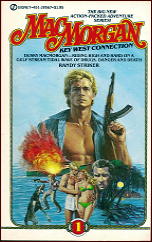
RANDY STRIKER – Key West Connection. Signet, paperback original, 1981. Reprinted as by Randy Wayne White “writing as Randy Striker,” Signet, paperback, 2006.

   Here’s the first installment of a brand new “action-packed” adventure series. The hero is Floridian charterboat captain Dusky MacMorgan, ex-US Navy (underwater demolition). He’s a cross between Travis McGee and Don Pendleton’s Mack Bolan, if you can believe it.

   He leaves a lot of dead people behind him. And, of course, so do the villains. In this book they’re a gang of dope smugglers. The top levels of the gang include a US Senator (unnamed) and assorted top officials in all levels of the executive branch. And an ounce of humanity you would not find in any of them.

   MacMorgan’s wife and twin little boys are killed in a bomb accident (it was meant for him), and he takes his remorse out in total retaliation. He leaves a lot of dead people behind. (Or did I say that?)

   I think Randy Striker (is that his real name?) should quit the annoying habit of telling the end of each chapter first. Otherwise, well, you probably already know if you’re going to go out looking for this book or not. If Striker is the charterboat captain we are informed he also is, these are — if you’ll excuse this expression — his wet dreams.

Rating:   C minus.

— Reprinted from The MYSTERY FANcier, Vol. 5, No. 3, May/June 1981.

The Dusky MacMorgan series —

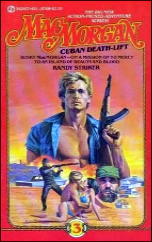
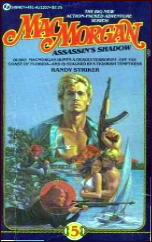
1. Key West Connection. Signet, 1981.
2. The Deep Six. Signet, 1981.
3. Cuban Death-Lift. Signet, 1981.

4. The Deadlier Sex. Signet, 1981.
5. Assassin’s Shadow. Signet, 1981.

6. Everglades Assault. Signet, 1982.
7. Grand Cayman Slam. Signet, 1982.

Reviewed by JONATHAN LEWIS:         


FLAME OF ARABY. Universal International, 1951. Maureen O’Hara, Jeff Chandler, Maxwell Reed, Lon Chaney Jr., Buddy Baer, Richard Egan, Royal Dano, Susan Cabot. Director: Charles Lamont.

   Imagine you’re pitching a movie project about a Bedouin tribesman in an obsessive pursuit of a wild black stallion. And that Bedouin happens to fall in love with a Tunisian princess threatened by her malevolent cousin.

   Now, ask yourself: whom would you want to see cast for the two leading roles?

   Perhaps you’d consider choosing a Brooklyn-born Jewish actor less than a decade out of U.S. military service and a redheaded Irish actress perhaps best known to the public for her starring role in Miracle on 34th Street. Then you’d think to yourself: nah, that couldn’t work. That wouldn’t work.

   But you’d be wrong.

   In Flame of Araby, an entertaining work of pure escapism, Jeff Chandler stars as Tamerlane, a Bedouin chief in hot pursuit of a wild black stallion in the North African desert. His pursuit is initially interrupted when he is forced to save the Tunisian Princess Tanya (Maureen O’Hara), from a horse stampede. The push and pull, loathing and attraction, between these two characters propel this adventure story forward.

   Joining these two major Hollywood stars on their wild gallop through an Arabesque fantasy world are Lon Chaney Jr. and Buddy Baer, who portray two Barbarossa brothers in competition for Princess Tanya’s hand in matrimony. Chaney definitely plays it to the hilt, making Borka Barbarossa a memorable, although not particularly evil, big screen villain. He seems to be having fun with this character, making him just a delight to watch.

   Now I’m not going to say that Flame of Araby is somehow a neglected classic or a gem hiding in plain sight. In many ways, it’s quite dated and doesn’t stand up to the test of time all that well. The costumes occasionally appear more silly than stylish. And some of the dialogue, including the overabundant usage of the term “wench,” while not particularly offensive, only detracts from the narrative and visual flow of the production.

   Still, there’s something to be said for a time when Hollywood studios were turning out innocently fun adventure tales that successfully transported the viewer to foreign, exotic locales, desert lands that never truly existed outside the imagination of poets and artists from long ago.

A 1001 MIDNIGHTS Review
by Francis M. Nevins


ISAAC ASIMOV – Tales of the Black Widowers. Doubleday, hardcover, June 1974. Fawcett Crest, paperback, August 1976.

   Until the early 1970s, Isaac Asimov was best known to whodunit devotees as the writer who virtually invented the science-fiction mystery. In his novels The Caves of Steel (1954) and The Naked Sun (1957) and in the short stories collected as Asimov’s Mysteries (1968), he masterfully bridged the gap between the two genres and proved that genuine detective fiction could be set in the future as well as In the present or past.

   Although he had previously written one contemporary mystery novel, The Death Dealers (1958), Asimov’s best-known crime fiction of the non-futuristic sort is the long series of Black Widowers tales that debuted in Ellery Queen’s Mystery Magazine in 1972 and is still going strong today after four hardcover collections’ worth of stories.

   The Black Widowers are five middle-aged professional men — Avalon the patent lawyer, Trumbull the cryptographer, Rubin the writer, Drake the chemist, and Gonzalo the artist — who meet once a month for dinner at an exclusive New York club. Each month one member brings a guest and that guest brings a problem, sometimes but by no means always criminal in nature.

   The narration of the dilemma is interrupted frequently by cross-examination and highbrow cross-talk among the Widowers, who like Asimov himself are inordinately fond of puns. After each of the five club members has tried to solve the conundrum and failed, a solution — invariably on target — is proposed by Henry, the ancient and unobtrusive waiter who has been serving dinner and drinks throughout the dialogue. Everyone then goes home both intellectually and gastronomically satisfied.

   The Black Widowers stories stand or fall on the quality of the puzzles and their resolutions. Characterization and setting are minimal, and too many of the tales are either unfair to the reader or wildly incredible, but the occasional gems are clever indeed, and those who share Asimov’s fondness for oddball facts, logical probing, and the spectacle of cultivated men scoring intellectual points off one another will delight in even the weaker links in the chain.

   The four collections published to date are Tales of the Black Widowers (1974), More Tales of the Black Widowers (1976), Casebook of the Black Widowers (1980), and Banquets of the Black Widowers (1984). Asimovians might also look into the author’s book-fair whodunit, Murder at the ABA (1976), and his short-story collection The Union Club Mysteries (1983).

         ———
   Reprinted with permission from 1001 Midnights, edited by Bill Pronzini & Marcia Muller and published by The Battered Silicon Dispatch Box, 2007.   Copyright © 1986, 2007 by the Pronzini-Muller Family Trust.

Note:   Since this review first appeared, there have been two additional collections of Black Widowers stories: Puzzles of the Black Widowers (1989) and The Return of the Black Widowers (2003), the latter posthumously.

Reviewed by DAVID VINEYARD:         


THE UNINVITED. Paramount Pictures, 1944. Ray Milland, Gail Russell (debut), Ruth Hussey, Donald Crisp, Alan Napier, Corneila Otis Skinner, Dorothy Stickney, Barbara Everest. Screenplay by Dodie Smith and Frank Partos, based on the novel Uneasy Freehold by Dorothy Macardle. Music: Victor Young (“Stella by Starlight”). Cinematography Charles Lang. Directed by Lewis Allen.

   First a a huge SPOILER WARNING in flashing red lights if you don’t know the film or the novel. Things are given away here you should see the first time in the film or read in the book.

   The Uninvited is a whodunnit — at least a whohauntedit, a murder mystery.

   Well, partially.

   The Uninvited is a romantic comedy.

   Parts of the beginning certainly and there are light touches throughout.

   The Uninvited is a psychological thriller.

   Getting closer.

   The Uninvited is a modern gothic.

   Almost there.

   The Uninvited is a ghost story.

   No, that’s an understatement, The Uninvited is the film ghost story.

   Robert Osborne, hosting an episode of the Essentials on TCM with Drew Barrymore that featured Robert Wise’s The Haunting, put it best. The Uninvited is the best ghost story ever filmed. It was then, it is now. All the special effects, all the pyrotechnics, all the leap out of your seat and scream movies made before or since pale beside this simple little tale of love, jealousy, and murder beyond the grave — with a human assist.

   Because The Uninvited has something no other ghost story has, something as uncomplicated as this: The Uninvited has absolute unshakable conviction. These are ghosts you will not laugh at. Whatever your beliefs, however rational you are, this movie will do its damnedest to at least convince you for its short running time that Stella Meredith (Gail Russell) is under siege by a spirit beyond the grave eager to take her life in an act of other worldly revenge. And for most people, viewers and critics alike, it succeeds — it more than succeeds.

   Is it Stella’s goddess-like mother, Mary Meredith, or the foreign model, and her father’s mistress, Carmel comforting Stella, threatening Stella? Which spirit weeps for Stella Meredith, and which wants to drive her to suicide? You will care if you watch this one.

   And you will consider sleeping that night with the lights on.

   I suppose this film won’t mean much to the gore and goo fans, there is nothing in it to make you throw up or gag, but its scares are deep and real, the frisson they induce a deep soul chilling hair on the back of the neck crawling kind of fright that for me has only been approached a handful of times on screen — the final moments of Hitchcock’s Psycho, the ending of John Farrow’s Night Has a Thousand Eyes, Robert Wise’s The Haunting, The Innocents, Val Lewton’s best, and too few others; it is the genuine fright and nerve chilling presence of supernatural evil the inexplicable, the hidden, the uninvited. It’s a stunning debut for both Gail Russell and director Lewis Allen.

   It is the best ghost story ever filmed, and that opinion is shared with no few critics. Critics who don’t like anything anyone else praises love this film because it is so unpretentiously and perfectly exactly what it wants to be — a chilly tale of ghosts to follow by a warm fireplace with the lights left on.

   I saw this for the first time at age ten (the same age I saw Ghost Breakers, a good year) on the late movie on a Friday night with my mother after a stormy night had passed and neither of us could sleep. When my father got home the next day he wanted to know why we were sleeping so late and every light in the house was turned on.

   Rick (Ray Milland, Roderick in the book) wants to write music, and with his sister, Pam (Ruth Hussey), and their dog Bobby, he spies an old cliff side house on the rocky moody Devon coast. They could never afford it of course, but it turns out the Commander (Donald Crisp) wants rid of it at a price they can just hope to pay. He’s unfriendly and downright hateful, and apparently a snob as well, for he wants his grand-daughter Stella — a moody fey girl who lies to Milland and Hussey to keep them from buying the house — to have nothing to do with the new tenants — and to stay away from the house at all costs. He is selling it in hopes of keeping her away.

   You know that won’t work. Ray Milland is going to London to arrange the move while Hussey stays behind, and feeling pity for Stella, whom he took an instant dislike to, he tries to cheer her up falling in love with her as he does. He, at least, is haunted by Stella Meredith, no matter who haunts Stella.

   Milland comes back with their housekeeper Lizzie (Barbara Everest), her cat in tow, and there is something Pam has learned she has to tell him.

   The house is haunted. And that night he hears the weeping of the ghost.

   Milland: “Does it come every night?.”

   Hussey: “No, just when you start to think you dreamed it, it comes again.”

   A haunted house, what a lark, but not to Hussey There is something. Maybe that’s why the housekeeper’s cat is freaked out. Maybe that’s why their loyal dog runs away, maybe that’s why the housekeeper won’t stay in the house overnight and frets over the two young people she virtually raised living in such an evil place.

   Or maybe it’s that beautiful room with the north light, Stella’s artist father’s studio, now Milland’s music room, maybe it’s because it gets so cold sometimes, or the way it depresses people and seems to drain them. Neither Milland or Hussey notice the first time they sit in the room that they suddenly become depressed, or the flowers that wilt while they aren’t looking.

   And then it might be the weeping woman who keeps them up all night. Maybe it’s just a depressing old place and that’s why Milland can’t quite finish his opus, “Stella by Starlight,” written for Stella Meredith, but suddenly so sad and so haunting when that wasn’t what he meant at all. Maybe it’s just them.

   Not in this movie. Unlike Robert Wise’s The Haunting, these people aren’t haunting themselves. What walks in this house does not walk alone. There is never the least hesitation about it: ghosts are real, and not merely psychological interpretations of impressionable minds.

   Then there’s that cheap scent, lovely, but nothing the elegant and perfect Mary Meredith would have worn, mimosa …

   Old houses, they have drafts, funny noises, there are cliffs and they are on the sea, winds blow, there are caves, there are stories …

   Commander: “Stella will never enter that house!”

   Milland: “Great Scott, you believe it’s really haunted!”

   And there is Stella, drawn to the old house by forces and needs she can’t explain, but somehow so vulnerable in that old place as if the house itself was both a warm loving mother inviting her and a cold murderous bitch trying to destroy her.

   After they have to send for the local doctor, Alan Napier, when Stella is overcome after running blindly toward the cliff where the old dead tree stands, where her parents both died, they learn Bobby is now living with him, and find a new ally in solving the mystery of the house and Stella Meredith.

   There was a scandal, the doctor explains; Meredith had a model, a fiery foreign type named Carmel, a Spanish gypsy. Carmel died a week after Mary Meredith was killed while trying to prevent her husband’s suicide on the cliff. Meredith was a scoundrel it seems and poor Stella has art in the blood, something she seems relieved about compared to the perfect Mary Meredith.

   Stella: “Between you and me and the grand piano father was a bit of a bad hat.”

   When Stella is better, and against her grand-father’s wishes, they invite her back for a seance. Milland and Napier plan to control the seance and convince Stella there is no spirit. Not as good an idea in practice as it may have sounded in theory. Again they sense the strange scent of mimosa, again Stella feels nurtured and warmed — and again something attacks.

   Whatever, it is clear now, the house is haunted — by two ghosts, one Stella’s loving mother, the other a vengeful spirit who is a real threat to her.

   But when the Commander discovers what they have been up to he decides to send Stella away to a home run by her mother’s closest friend and companion, a formidable and cold woman who worships the ground Mary Meredith’s angelic feet hardly touched, Miss Holloway (Cornelia Otis Skinner who ironically Gail Russell played in the film version of her book Their Hearts Were Young and Gay and its sequel) who created the Mary Meredith Home for Women.

   She worships Mary Meredith a bit too much perhaps because there is a hint of lesbianism you could drive a semi through, never exactly said. They hint the hell out of it though. Big fairly explicit lead booted hints, yet maintaining the perfect balance that is the reason this film is great.

   Miss Holloway: “… her skin was perfect, and her bright bright hair, she was lovely …” Anyone who doesn’t figure out this relationship is painfully naive.

   Just by coincidence the trained nurse caring for Mary Meredith and Stella the night of the tragedy was a certain Miss Holloway.

   Stella hates and fears her.

   Milland and Hussey visit Miss Holloway and hear her version of the story. Carmel tried to kill Stella, Mary Meredith saved her but fell to her death. Meredith killed himself.

   And then in the strangest of coincidences, the wind just happens to blow open the journals of the old doctor Napier replaced to the notes on Mary Meredith and Carmel, a quite different tale than the one they have been led to believe. Mary Meredith was a cold murderous bitch, who the old doctor suspected murdered Carmel by leaving windows open so the pregnant woman caught pneumonia — while she was pregnant with Meredith’s child, Stella.

   Mary Meredith wasn’t murdered by her husband. They fell to their death while he struggled with her to keep her from throwing herself and Stella off the cliff in a fit of vindictive and murderous jealousy. Mary Meredith is a monster of epic proportions. Miss Holloway murdered Carmal as far as the old doctor was concerned.

   Don’t screen this one on Mother’s Day.

   This is the secret the Commander has held all these years. The secret Miss Holloway would kill to protect, the secret of the old house, Mary Meredith’s secret. Stella isn’t really his grand-daughter, and the goddess Mary Meredith was a murderous harridan, but the old man truly loves Stella, he gives his life trying to save her.

   Mary Meredith wants to finish what she started.

   Compel Stella to throw herself from the exact spot where she fell, she has already tried once, the cliff by the dead tree.

   Revenge from beyond the grave.

   Murder from beyond the grave.

   And only Carmel, her real mother, stands between them, and Mary defeated her once already; all she can do is comfort and try to warn her child.

   Not really enough standing against Mary Meredith.

   Thank God Stella is with that monster Miss Holloway. But she’s not. Skinner has gone mad as a hatter and sent Stella home, home to the embrace of Mary Meredith. Mary wants her, and Mary shall have her. And when Stella finds the Commander dying of a stroke at the house, by the sea he tries to tell her, warn her, but too late. Mary Meredith has the hated child within her grasp alone at last, and Stella flees her, running in blind fear towards the very place Mary and Meredith fell to their death.

   Stella: I’m not afraid of anything here.

   Commander: “Then be afraid, be very afraid!”

   Skinner gives a finely tuned performance with an impressive scene of madness. No wonder she was one of the great ladies of the stage and American theater.

   Milland, Hussey, and Napier have gone to take Stella from Miss Holloway. They are rushing back, but can they reach Stella in time?

   The final confrontation with the hated Mary Meredith remains the single best scene of its type ever filmed. Milland, alone on a darkened stairway confronting a murderous spectral form with nothing but a candle for protection, is an image you won’t forget and the final reckoning with Mary Meredith the perfect ending. But don’t be too surprised if your courage cracks a little the way Milland’s voice does. Mary Meredith is something else.

   And, by a narrow squeak, it’s a happy ending. But as Wellington said of Waterloo, a near run thing. As a shaken Milland points out, he might have had Mary Meredith as a mother-in-law. Stella’s relieved too, she’d much rather be the illegitimate daughter of Meredith and his mistress, Carmel, than have Mary Meredith’s cold blood running in her veins. Spanish gypsy beats the cold murderous Mary Meredith by a mile.

   I can’t say as I blame her.

   The title has multiple meanings. Milland and Hussey are uninvited intruders; Stella is uninvited at the house and uninvited into the world; Carmel, the Spanish mistress ,was uninvited,; the Commander is uninvited to the seance and at the end to the house, his death uninvited at that moment; he is clearly uninviting to Milland and Hussey; Milland’s attentions to Stella are uninvited, even their dog shows up uninvited at one point and chases a squirrel who is himself uninvited; the doctor treats Stella and investigates uninvited; Bobby showed up on his doorstep univited; death was uninvited; the spirits dwelling there are uninvited. About the only people actually invited in this film are the viewers.

   If at any moment in this film there had been a single misstep, a single false moment, the whole delicate intricate facade would have collapsed on its own weight, but that mistake is never made. The Uninvited never takes itself too seriously, it never takes itself too lightly. It is never merely heavy, the humor is never just thrown in; it is vitally needed, or this film would be unrelentingly depressing.

   The spirits are just distinct enough to perceive as more than just light and shadow, but never more, they are a presence, but never quite of this world. They have influence over the living, but their power is that of suggestion and mood. At best they can make a rooms atmosphere change, close a door, cry in the night, fill a room with warmth and scent, or with malevolence, turn the page of a vital book at the right time. Even at the end you could just explain them away. Not easily, but if you needed to convince yourself…

   And you might.

   The cast, direction, effects, and script are uniformly perfect with a particular nod to Milland, Hussey, Russell, Crisp, and Skinner who all outdo themselves; especially Milland who does this so effortlessly you may miss how much of this films success depends directly on his performance, his connection with the audience, and his perfectly keyed emotional responses.

   Milland’s timing as light comic actor, his more substantial talents, and his ability to play the hero are all on display. The finale of this film would not work if not for Milland’s ability to effortlessly switch from light comedy to intense fear in the same scene, virtually the same moment — making his defeat of Mary Meredith ironically perfect. Watch also for Dorothy Stickney, one of Miss Holloway’s patients, Miss Bird; it is a great bit part.

   This was a major hit, though a follow up based on another Dorothy Macardle novel, The Unseen with Russell and Joel McCrea, isn’t anywhere near as good despite a Raymond Chandler screenplay, and the same director and production team.

   Do yourself a major favor and find a copy of McArdle’s novel Uneasy Freehold (published in the US as The Uninvited). The film is very close, and the book is also one of the best of its kind ever written. I’ve seen too many ghosts to believe in them, but this movie and the novel always make me think about leaving a nite-lite on. There are more things in heaven and earth than Horatio, or I, care to think about.

   And as frosting on the cake, “Stella by Starlight,” the haunting number Milland’s Rick is working on, was a major hit, much like “Laura” from that film. It is still a beautiful piece, and runs through the movie as a subtle musical cue leading the viewer to that cliff by the house and those final moments on a darkened staircase confronted with pure malevolence.

   Cinematographer Charles Lang won a well deserved Oscar for this. His work is impressive.

   Dracula, the Frankenstein monster, the Wolfman, they have nothing on Mary Meredith. Mary Meredith would unsettle Hannibal Lecter, the demon in The Exorcist would have been possessed by her. Mary Meredith like Du Maurier and Hitchcock’s Rebecca haunts this film even though you never see her save in a cold and forbidding portrait. She is a palpable presence; beside her Norman Bates mother was mother of the year, Joan Crawford was just a little strict, and Medea was having a bad day when she ate her children.

   It is no easy trick to do that with a character who never fully materializes on screen.

   The Uninvited is without question the finest ghost story of its era and for my money the finest ghost story ever filmed.

   This isn’t Stephen King, Clive Barker, Peter Straub, V. C. Andrews, or Anne Rice. There are no vampires, there is no CGI, no fake blood is let on screen, no green pea soup expelled, nothing leaps off the screen at you. The Uninvited, just wraps it’s chilly hand around the base of your spine with frisson after frisson as visceral as a gut punch. Like Mary Meredith herself, once it has you it won’t let go long after the silver shadows on the screen have faded to nothing.

   I have never watched this alone in the house at night. and quite frankly, I don’t intend to.

   If that isn’t a tribute to a ghost story, I don’t know what is.

   And try walking upstairs with only a candle to light your way when you have finished watching it.
KEN ROTHROCK – The Deadly Welcome. Major Books, paperback original, 1976.

   No matter how obscure a book or an author may be — and I believe this one qualifies on both counts — if there’s a PI in it, I will probably read it, or at least give it an all out try.

   Rick North, who tells the story in first person, qualifies as a private detective, barely. He’s low man on the totem pole at Taber, Kline and North, an artist’s management firm based in LA, but he’s about to be booted out of the firm unless he finds out who has been threatening the life of Rory Maclaine, one of their clients and a comedian who’s just hit the big time.

   Threats are one thing, but when Maclaine collapses and dies on stage after finishing his new act, North, who used to be a comedian himself until he found his career going nowhere, now finds he must solve the case, or else.

   After a slightly shaky start, the tale that follows is solid enough, but a clutter of too any characters, all of whom seem to be acting individually in various and sundry ways, slow the story down to a near crawl around the two-thirds point. It has to be hard, in my opinion, for a new writer to maintain his (or her) momentum for the entirety of a full-length novel, no matter what kind of twist you plan on ending it with. And so it is here.

   As for the author, Al Hubin in Crime Fiction IV, says that Ken Rothrock is probably Harley Kent Rothrock (1939-1999), but Google reveals no more. This was his only work of detective fiction, a good effort, but cliched. Maybe if North had been better at a quip (he isn’t), the ride would have been a little less bumpy.

« Previous PageNext Page »