Reviews


THE ARMCHAIR REVIEWER
Allen J. Hubin


JAMES E. MARTIN – The Mercy Trap. Putnam’s, hardcover, 1989. Avon, paperback, 1990.

   James E. Martin, policeman in Norwalk, Ohio, turned special investigator for the State of Ohio and now retired, authored a mystery in 1973 (The 95 File) and now returns with The Mercy Trap, the first of a series about private eye Gil Disbro.

   Disbro comes full-grown out of the standard P.I. womb: former cop, former husband, getting his sex without commitment, a man with his own particular standards which are at once adaptable and firmly held. He walks the mean streets of Cleveland, retrieving bail jumpers for a bondsman between real jobs.

   Here a mission of mercy comes his way: wealthy contractor Howard Eberly’s adopted daughter is dying for lack of a kidney transplant, and Eberly wants her real mother or other close relative found as a possible donor. Not a quest likely to involve violence, though a twenty-nine-year-old trail with the mother’s true identity carefully hidden may prove a tad faint.

   But the traces are quickly picked up by Disbro’s capable hands, though along the way (but where? and why?) he seems to have stepped on somebody’s toes. Martin’s narrative is compelling, his sense of plot and pace sure. I’ll await the next Disbro with much anticipation.

— Reprinted from The MYSTERY FANcier,
       Vol. 11, No. 3, Summer 1989.

       The Gil Disbro series —

The Mercy Trap. Putnam 1989.
The Flip Side of Life. Putnam 1990.
And Then You Die. Morrow 1992.
A Fine and Private Place. Morrow 1994.

Reviewed by JONATHAN LEWIS:         


WICHITA. Allied Artists, 1955. Joel McCrea, Vera Miles, Lloyd Bridges, Wallace Ford, Edgar Buchanan, Peter Graves, Keith Larsen, Walter Coy, Jack Elam. Director: Jacques Tourneur.

   The first time the viewer sees now legendary figure Wyatt Earp (Joel McCrea) in Wichita, he’s an absolutely miniscule figure on horseback perched on a hill off in the distance.

   A solitary man overwhelmed by nature, Earp is initially portrayed as extraordinarily reluctant to be the arbiter of law and order in the rapidly growing city of Wichita, Kansas. Earp’s also got a strong fatalistic streak, going so far as to tell a potential love interest after a bank robbery that “things like that are always happening” to him. As if he were just an object swept to and fro by the winds of History.

   Directed by Jacques Tourneur (Cat People, Out of the Past), Wichita is not only quite good Western, it’s also a superbly well-crafted character study of how frontier violence fundamentally alters the course of one man’s life. With a supporting case that includes a youthful Lloyd Bridges as a villain and Peter Graves as Earp’s brother, Morgan, the film is definitely worth a look.

   The story follows Earp (McCrea) as he journeys, both literally and metaphorically, from a lonesome figure on horseback to a married man tasked with establishing law and order in Kansas. Soon after the film begins, Earp encounters a cowboy encampment. After some initial pleasantries, his relationship with the men begins to sour – and how! – after two of the men attempt to steal from him as he sleeps. Although this initial encounter is brief, it sets the stage for what is to come.

   Earp journeys onward alone, stopping briefing in front of a signpost indicating Wichita is ahead. The sign also notably states, in all capital letters, that “Everything Goes in Wichita.” Soon two fast moving stagecoaches barrel down on him, pushing him off to the side. The first stagecoach has a banner on the back with the very same words, while the second has one that reads, “Wine, Women, Wichita.” From that moment onward, the viewer knows that the rapidly expanding city is going to be both a somewhat lawless town, but also a frontier town where a man can reinvent himself.

   Earp’s plan is to be a businessman in town. That plan goes by the wayside once he witnesses the aforementioned cowboys arrive in town and, in a drunken frenzy, shoot up Wichita, killing an innocent young boy in the process.

   That’s when Earp decides he will take the mayor up on his offer and become a U.S. Marshal. Supporting him in his endeavor is Bat Masterson (Keith Larsen). The rest of the movie revolves around not only the conflict between Earp and the cowboys, but also a growing rift between Earp and Sam McCoy (Walter Coy) over Earp’s strong-arm tactics. Earp also falls for McCoy’s daughter, Laurie (Vera Miles) in a somewhat clichéd subplot that doesn’t really do much for the film, but may have been intended as a box office draw.

   There are several scenes in Wichita that merit particular consideration. The first is Earp’s initial encounter with the cowboys. When he first meets them, he’s elevated on horseback. They are sitting. We quickly learn he’s a stoic figure, with his first words to them (and in the movie) as follows: “Howdy! My name’s Earp, Wyatt Earp.” While all of the cowboys are dressed in a dark colors, Earp is wearing a clean, bright red shirt. This marks the beginning of a personal journey that will culminate in his fight against the darkness and disorder symbolized by these ragged men.

   The sequence in which the cowboys shoot up the town, injure a woman, and kill a young boy through carelessness also is likewise worth watching closely. These events prompt Earp to accept the position as U.S. Marshal. Look for the notable, stark contrast between the bright saloon and the dark, foreboding street.

   Inside the saloon, there are many women, resplendent in a multitude of colors. Outside, on the dusty street, there are loud men in dark clothes engaging in recklessness and violence. By stepping out into the grey netherworld of the Wichita streets, Earp becomes the de facto protector of the town’s innocent women and children and a protector of Wichita’s desire for domesticity.

   Finally, there’s a harrowing scene in which the cowboys shoot Sam McCoy’s wife. Again, the killing wasn’t so much intentional, as the result of lawlessness. The gunmen ride in front of McCoy’s house, shooting into it. We see McCoy’s wife fall to the ground and bullet holes lodged in the family house’s front door. This senseless act of violence again prompts Earp into action, making the final break between Earp the businessman and Earp the lawman.

   Wichita has a lot to recommend it. With a running time of a little less than ninety minutes, the film has decent pacing and enough action to keep a viewer engaged. McCrea is generally very good in this, as is Peter Graves.

   The film’s biggest downside is the fact that the plot is just a bit too predictable. Much like in Law and Order, which I reviewed here, the hero is a U.S. Marshal who defeats the bad guys and gets the girl. What sets Wichita apart, however, is its significantly better cinematography and use of symbolism to tell the story of Wyatt Earp before he arrived in Dodge City.
DANE CLARK CONFIDENTIAL, PART 1
by Curt Evans


BLACKOUT. Hammer Films, UK, 1954. Lippert Pictures, US, 1954. Originally released in the UK as Murder by Proxy. Dane Clark, Belinda Lee, Betty Ann Davies, Eleanor Summerfield, Andrew Osborn. Based on the novel Gold Coast Nocturne by Helen Nielsen. Director: Terence Fisher.

   Dane Clark (1912-1998) is one of those actors that you, if you are, as I am, in middle age, have almost assuredly seen on television earlier in your life, even if you don’t match the name with the face. I recall him playing an FBI agent in Season One of Angela Lansbury’s beloved mystery series, Murder She Wrote, the “Watson” in that episode to Lansbury’s Jessica Fletcher. I don’t know why I remember this character, but I suppose I have to chalk it up to Clark’s acting skills, having seen some of his other genre film work of late. He’s good!

   Dane Clark was known in the 1940s as the “B-list John Garfield,” but I don’t believe this appellation does him justice. (It’s a bit like when the great Ida Lupino is dismissed as the “poor man’s Bette Davis.”) Dane Clark was his own man. Both John Garfield (born Jacob Julius Garfinkle in 1913) and Dane Clark (born Bernard Zanville in 1912) were Jews from New York City, but Clark came of much more comfortable circumstances than Garfield, graduating from Cornell and getting a law degree before ending up in acting (after stints in boxing, baseball, construction, sales and sculptor’s modeling — he had found lawyers weren’t doing too well in the Depression either).

   In 1941 Clark married the artist and sculptor Margot Yoder (a distant relative of my family) and the next year appeared in several films (uncredited): The Pride of the Yankees (“Fraternity Boy”); Wake Island (“Sparks”); and, most notably, Dashiell Hammett’s The Glass Key (“Henry Sloss”).

   By the end of World War II Clark was getting bigger roles, including that of the Bohemian artist in the Bette Davis identical twins melodrama A Stolen Life (1946); the escaped convict who has a desperate romance with Ida Lupino in Deep Valley (1947); and, in the Oscar-nominated film Moonrise (1948), the tormented Danny Hawkins, who is in love with gorgeous Gail Russell and has, most inconveniently, killed her fiancee (played, very briefly, by Lloyd Brides). Today Moonrise pops up on lists of greatest noir films though regrettably it’s not available on DVD (you can see on it Amazon instant video, however).

   If you look around, you should be able to find on DVD some of Clark’s work as a lead actor in late 1940s and 1950s crime films (when he really came into his own as an actor), including Without Honor (1949), Backfire (1950), Highly Dangerous (1950; screenplay by Eric Ambler), Gunman in the Streets (1950, with Simone Signoret), Never Trust a Gambler (1951), The Gambler and the Lady (1952), Blackout (1954; Murder by Proxy in UK), Paid to Kill (1954; Five Days in UK), Port of Hell (1954), The Toughest Man Alive (1955) and The Man Is Armed (1956).

   I’ve recently seen several of the above films, the first being, for the purpose of this review, Blackout.

   Blackout, as I have discussed on my own blog, is an English adaptation of Helen Nielsen’s Chicago-set hard-boiled crime novel, Gold Coast Nocturne (1951). Although transferring the setting from Chicago to London is slightly awkward, to be sure, overall I was really rather impressed with this film. It is quite faithful to the novel, even using some of the dialogue.

   As the beleaguered hero, Casey Morrow, an American out to solve a murder he wakes up to discover he’s suspected of having committed, Dane Clark is excellent, as are the two lead women, Belinda Lee (sexy blonde heiress Phyllis Brunner) and Eleanor Summerfield (wisecracking artist Maggie Doone). A couple crucial supporting performances could have been stronger, but overall I would quite recommend this film.

       TO BE CONTINUED


Editorial Comment:   This review first appeared in slightly different form on Curt’s own blog, The Passing Tramp.

THE BACKWARD REVIEWER
William F. Deeck


RICHARD HULL – The Ghost It Was. Putnam, US, hardcover, 1937. First published in the UK by Faber & Faber, hardcover, 1937. Penguin, UK. paperback, 1950.

   Looking for employment that doesn’t require any work, Gregory Spring-Benson checks out journalism. Unfortunately, The New Light wants experience or at least a good story. A potential story is what Spring-Benson discovers when he finds that his estrange — and strange — uncle has purchased an allegedly haunted house in Amberhurst.

   The possibility of the story, plus maybe getting his uncle, notoriously stingy, to part with some money, stirs Spring-Benson to go to Amberhurst.

   There, after some travail, he meets some cousins who are not much better than he, although probably not much worse. The house’s ghost — both fake and maybe real — appears, perhaps committing a murder and then definitely committing one.

   A bit too much coincidence and little doubt about who the murderer is, if it wasn’t the spook, are the weak points here. Still, Hull always amuses and entertains with his odd characters. His works are well worth looking for.

— Reprinted from The MYSTERY FANcier, Vol. 11, No. 3, Summer 1989.


Bibliographic Notes:   Richard Hull was the pseudonym of Richard Henry Sampson, (1896-1973). His first novel, Murder of My Aunt, published in 1935, is perhaps also his best known. It has the honor of being included as one of the Haycraft-Queen cornerstones of mystery fiction. Hull has in total 15 entries in Hubin.

Reviewed by JONATHAN LEWIS:         


THE SPOILERS. Universal Pictures, 1942. Marlene Dietrich, Randolph Scott, John Wayne, Margaret Lindsay, Harry Carey, Richard Barthelmess, George Cleveland, Samuel S. Hinds. Based on a novel by Rex Beach. Director: Ray Enright.

   The Spoilers stars John Wayne, Randolph Scott, and Marlene Dietrich in a tale about claims jumping and legal corruption during the Alaskan gold rush. Based on a Rex Beach novel and directed by Ray Enright, the film is a slightly above average period Western. There’s some great onscreen chemistry between Wayne and Dietrich, a beautifully filmed scene of a locomotive at night, and one of the most extensive saloon fight scenes that I’ve come across in recent memory.

   Set in Nome, Alaska, the story follows the conflict between miner, Roy Glennister (Wayne) and a corrupt gold commissioner by the name of Alex McNamara (Scott). The two men also each have their eyes on saloon owner beauty, Cherry Malotte (Dietrich), who has yet another suitor in the lovesick Bronco Kid (Richard Barthelmess).

   McNamara’s underhanded attempts to achieve title to Glennister’s gold mine sets the story in motion. Aiding him in his task are corrupt Circuit Court Judge Horace Stillman (Samuel S. Hinds) and his lovely niece, Helen Chester (Margaret Lindsay), who grows increasingly ambivalent about her role in the whole sordid scheme.

   Both Wayne and Dietrich are quite good in their roles. More importantly, each of them appears to be having a good time working on the project, making their screen time together a fun experience for the viewer. It’s Scott, however, who steals the show in his portrayal of the villainous McNamara. There’s just something so incredibly devious about his character. He’s sort of what you’d imagine a frontier claims jumper would have been like — a bit genteel, at least on the surface, but also ruthless and more than willing to get his hands dirty should the need arise.

   Maybe that’s why in the film’s final sequence, when he and Wayne’s character get into a lengthy, brutal bar fight, you both want to see him get his butt kicked and to see him get in a few good punches himself. He’s a bad guy all right, but not one without his charms.

   Given that The Spoilers benefits from great cast, a decent plot, and a good amount of rugged frontier action, you’d think that it would have more of a critical reputation than it does. Part of this likely stems from the fact that the two male leads, John Wayne and Randolph Scott, each went on to much bigger and better projects, leaving affairs like this in their dust.

   The fact that The Spoilers can feel considerably dated at times doesn’t help matters, either. Case in point: the film’s blatantly transparent attempt to utilize racial humor. This is exemplified in a scene in which Wayne’s character is effectively wearing blackface and fools Cherry’s maid into thinking he is Black. It was surely intended to induce guffaws from the audience, but now it just falls flat. While I do recognize that there was likely no conscious decision to be derogatory toward Blacks in the film, I don’t believe most audiences today would find value in the movie’s usage of blackface for comedic relief or think Wayne in blackface was particularly humorous.

   In conclusion, The Spoilers is a solid frontier Western with some very good scenes and a notably strong performance by Randolph Scott. It’s by no means a bad film. It just doesn’t stand the test of time that well.

CRUEL GUN STORY. Nikkatsu, Japan, 1964. Originally released as Kenjû zankoku monogatari. Jô Shishido, Chieko Matsubara, Tamio Kawaji, Yûji Odaka, Minako Katsuki, Hiroshi Nihon’yanagi. Director: Takumi Furukawa.

   I’m not going to fake it. This is the first Japanese crime film I’ve seen in a good long while, and there’s no way I can possibly place it in any kind of context where it belongs. I don’t know the actors nor the director, nor what the intentions were of the people who were responsible for the making of the film — only the results, as I saw them.

   But on the basis of this first toe-in-the-water attempt on my part, I’m enthusiastic enough to try another, and perhaps even soon. I feel as though I’m on the verge of entering a very big field here, and I hope it doesn’t go to my head.

   Just released from prison, a small-time gangster named Togawa (Jô Shishido) discovers that he has a benefactor who negotiated his release, and expensively, and that he is expected to reciprocate. (It wasn’t that he was a gangster that sent him to prison, it was for the murder of the man who ran over his sister with a truck, causing her to lose both legs.)

   The job he’s supposed to do? Nothing more than to hold up an armored car, along with a easily supplied crew of assistants. The prize: millions of dollars yen being transported from a race track to a nearby bank.

   Togawa agrees. His sister needs an operation, he believes. And as they always do in heist films like this, things go wrong. And boy howdy, do they ever go wrong. The body count is as high as any movie I’ve seen in recent months, including lots and lots of American-made westerns.

   Although filmed in black-and-white, and often dazzlingly so, please do not think of this as a film noir. It’s only a heist film populated by lots of guns and gangsters, flawed by a plan which could never have worked in the first place, and done in by plain old greed, pure and simple.

Reviewed by JONATHAN LEWIS:         


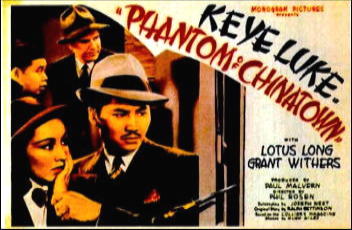
PHANTOM OF CHINATOWN. Monogram Pictures, 1940. Keye Luke, Grant Withers, Lotus Long, Charles Miller, Huntley Gordon, Virginia Carpenter, John H. Dilson. Screenplay: George Waggner. Director: Phil Rosen.

   The final film in Monogram’s Mr. Wong series, Phantom of Chinatown is notable for being the only movie in which an American actor of Chinese heritage, rather than the veteran horror film actor Boris Karloff, portrayed the Chinese-American detective.

   With a screenplay by George Waggner, director of Man Made Monster, which I reviewed here, and The Wolf Man, it’s also a fairly good, if at times excruciating slow moving, mystery and spy film, set during an era when Imperial Japan threatened the territorial integrity of China.

   Directed by Phil Rosen, Phantom of Chinatown doesn’t have a phantom or anything supernatural in it at all. It’s simply an entertaining and overall well-crafted mystery story with a dash of international intrigue. There are also some memorable scenes, including one with a trap door, which fans of 1930s pulp fiction, will most likely appreciate.

   Most importantly, however, the film has Keye Luke as the youthful Jimmy (not Mr.) Wong. Fans of mystery films will know Luke primarily for his portrayal of “Number One Son” in the Walter Oland Charlie Chan films or for his role as Kato in The Green Hornet. Indeed, Phantom of Chinatown was the only film in which Luke was both the star and lead character.

   In many ways, that’s a real shame. Luke’s portrayal of Jimmy Wong, although a bit too stiff, wasn’t bad at all. In fact, he was quite fun to watch, particularly in those scenes in which his character appeared to have a better understanding of the case at hand than Captain Street (Grant Withers). It’s too bad, then, that the filmmakers didn’t realize that Withers’s height advantage over Luke would, in some ways, make his character appear to almost overshadow Jimmy Wong.

   The story follows Jimmy Wong (Luke) as he teams up with San Francisco policeman, Captain Street (Withers), to solve the murder of Dr. Benton, an archeologist who recently returned to the United States from Mongolia. The university professor brought back a scroll with him.

   And as it turns on, what’s written on the scroll has something to do with why he was murdered! Adding to the mystery is Dr. Benton’s Chinese secretary, Win Lee (Lotus Long), whom Captain Street initially suspects as playing a part in her employer’s murder. There’s also a butler, who’s of course a potential suspect, but he gets ruled out pretty quickly once he’s found with a dagger in his chest. The movie wraps up in a similar fashion as other B-film mysteries from the same era, namely with a final showdown and a generally satisfying, if somewhat clichéd, explanation of all that’s transpired.

   In conclusion, Phantom of Chinatown, while hardly ranking among the greatest of mystery films, is nevertheless worth a look. It’s just a fun little film.

FRAMED FOR MURDER. Goldsmith Productions, 1934. Wallace Ford, June Clyde, Bradley Page, Fuzzy Knight, Barbara Rogers, Shirley Lee. Also released as I Hate Women. Director: Aubrey Scotto.

   If you were to do an accurate measurement of how many of the 70 or so minutes of this murder mystery movie are those of an actual murder mystery movie and how many are those of a romantic comedy, I’d be willing to wager that it would come out to about half and half, plus or minus five minutes.

   The comedy is corny and the romance is sappy — who’d ever think of Wallace Ford as a romantic leading man? — but Wallace Ford as a hard-drinking newspaper reporter who accidentally ends up sharing an apartment with the widow (June Clyde) of a murdered millionaire who’s on the run from the police who think she had a hand in it — why that you might believe.

   The murder mystery portion of the movie is OK, which is the technical term used to describe a murder investigation that moves forward in fits and starts but hangs together at the end, sort of. Part of Ford’s problem, besides decides who gets to sleep in the one bed in the apartment they’re sharing, he or the widow, now a blonde, is another reporter intent on snatching the story right from under Ford’s nose.

   Also worth mentioning is the date of release of Framed for Murder, 10 May 1934, which according to my sources, makes this predate the enforcement of the Movie Code, and just barely, it shows. No pun intended. Besides the byplay about who sleeps in the bed, June Clyde’s character was previously seen hiding in a shower with no clothes on with another good-looking and easy-going lady who happens to be Ford’s next door neighbor. (All we really see is two pair of very shapely legs as they step in unison from behind the curtain.)

   The actual killer (Shirley Lee) is so far down in the list of cast members, that if you dig for her name, you might never be able to come up for air, but she does a night club act in the skimpiest of apparel that has to be seen to be believed. (This was her only movie.)

   How’s that for a come on?


Reviewed by JONATHAN LEWIS:         


LAW AND ORDER. Universal International, 1953. Ronald Reagan, Dorothy Malone, Preston Foster, Alex Nicol, Ruth Hampton, Russell Johnson, Barry Kelley, Chubby Johnson, Jack Kelly, Dennis Weaver. Based on the novel Saint Johnson, by W. R. Burnett. Director: Nathan Juran.

   If the film Law and Order tells us anything, it’s that Ronald Reagan was a natural both in the saddle and in his ability to portray a lawman of the Old West. Based on a novel by W. R. Burnett and directed by Nathan Juran, Law and Order is an above average Western worth watching.

   The film benefits from good acting, fairly believable characters, a solid (if admittedly somewhat clichéd) plot in which two brothers are pitted against one another, notable use of color, well decorated interiors, and some breathtaking western scenery.

   Law and Order has the texture of an early 1950s Western, as if it were straddling a middle ground between an era of simple, Saturday morning fare and those darker, gritty Westerns in which the lines between good and evil were deliberately blurred.

   More than anything else, however, the film is a character study of a U.S. Marshal by the name of Frame Johnson (Reagan). Frame wants to clean up the Old West, but despises vigilantism. When it comes to giving suspects and outlaws a fair trial and their day in court, Frame is a true believer.

   As the film unfolds, we see Frame willing to confront both the townsfolk of Tombstone, Arizona, including his own younger brother, just to ensure that an outlaw does not become the victim of a lynch mob. But he’s stubborn too, as if blinded by his devotion to an ideal that may not really be applicable to the time and place in which he finds himself.

   The story follows Frame Johnson, his two brothers, Lute and Jimmy, and their friend/sidekick, Denver, as Frame attempts to make a new life for himself on a ranch outside Cottonwood. He’s had enough of enforcing the peace in Tombstone and is ready to begin a life as a man, not a Marshal. Even better, he’s got himself a girl, a beautiful Tombstone saloon owner named Jeannie (Dorothy Malone), who’s ebullient that Frame’s gotten out of the justice business.

   Things ought to be good for Frame. Alas, there’s trouble brewing. Soon after arriving in Cottonwood, he encounters the villainous Kurt Durling (Preston Foster) and his son, Frank (Dennis Weaver). Turns out that Durling and his son all but run the town. They’ve even got the pathetic excuse for a sheriff under their thumb.

   The senior Durling loathes Frame, blaming the strong willed lawman for his crippled hand. You just know that these the two men are eventually going to go at it at some point. And sure enough, they do in what is a harrowing fight sequence on a dusty street.

   There’s another conflict at play in Law and Order, one that pits Frame against his younger brother, Jimmy, who skips town after shooting Frank Durling (Weaver). This conflict between two brothers, both hotheads each in their own way, is pretty standard Western fare. But here it works.

Despite being a solid, if somewhat overlooked Western, Law and Order certainly has its weaknesses. These include its depiction of an unbelievably quick-to-develop love interest between Jimmy Johnson and Maria Durling as well as an ending that’s just a bit too pat and sentimental. Similarly, the film’s attempts comic relief end up feeling a bit forced.

   Law and Order may never achieve any achieve any sort of status as a classic or as a “must see” Western. It’s not a brooding or overly introspective sort of film. But that doesn’t stop it from being a quite enjoyable movie to watch. Reagan and Malone have great on screen chemistry, Foster and Weaver make great villains, and the scenes with Reagan riding alone on horseback through the desert landscape are nearly iconic.

   In this movie at least, the good guy sticks to his principles, defeats the bad guy, and still gets the girl.

THE BACKWARD REVIEWER
William F. Deeck


WILLIAM MacHARG – The Affairs of O’Malley. Dial Press, hardcover, 1940. Popular Library #340, paperback, 1951, as Smart Guy.

    “Whatever this turns out to be it will be a woman case.”

    “Cherchez la femme,” I commented.

    “Not at all,” O’Malley answered; “what we got to do is look for the woman.”

   While O’Malley claims he’s not too bright, he gets his man (or woman) in all of the cases presented in this collection of six-to-ten-page short stories. Often O’Malley — first name and rank on the New York City police force not known — is assigned to investigate a crime when all hope is lost of solving it. Clear them up he does, with no assistance from the anonymous narrator, though he seldom gets the credit.

   Many of these stories are fair-play and well constructed in spite of the brevity with which they are presented. In non-fair-play cases, O’Malley doesn’t know who did it but has the intelligence to trap the malefactor. In one story O’Malley says: “That gag has got whiskers on it like Methuselah, but being that old just shows how good it works — a gag that don’t work don’t never get no chance to get old.”

   Delightful hard-boiled police procedural tales from the ’30s. Prohibition is still in force in at least one of them.

— Reprinted from The MYSTERY FANcier, Vol. 11, No. 3, Summer 1989.


       CONTENTS:   (listed alphabetically)

Almost Perfect · Collier’s Jun 25 1932
Best Clue Missing · Collier’s Jun 23 1934
Broadway Murder · Collier’s Oct 8 1938
The Cat’s Eyes · Collier’s Apr 4 1931
The Checkered Suit · Collier’s Oct 10 1936
Dumb Witness · Collier’s Sep 24 1938
The Fourth Girl · Collier’s Mar 26 1932
Just Too Smart · Collier’s Jan 3 1931
The Key Man · Collier’s Oct 27 1934
Last Look · Collier’s Mar 11 1939
A Little More Evidence · Collier’s Oct 3 1936
The Locked Door · Collier’s Dec 10 1932
Lost Girl · Collier’s Jan 15 1938
Man Missing · Collier’s Jun 8 1935
The Man on the Truck · Collier’s Jun 9 1934
Murder Makes It Worse · Collier’s Sep 23 1939
No Clues · Collier’s Jun 20 1936
No Evidence · Collier’s Sep 11 1937
No Fingerprints · Collier’s Mar 18 1933
The Right Gun · Collier’s Feb 18 1939
The Ring · Collier’s Dec 13 1930
The Scotty Dog · Collier’s Jan 17 1931
Sinister Gifts · Collier’s Jul 30 1938
The Sleeptalker · Collier’s Apr 18 1931
Smart Guy · Collier’s Nov 21 1936
Soiled Diamonds · Collier’s Sep 17 1932
Too Bad · Collier’s Oct 10 1931
Too Many Enemies · Collier’s Feb 11 1933
Too Many Miles · Collier’s Apr 1 1933
The Unconvincing Note · Collier’s Jul 22 1939
The Weak Spot · Collier’s Apr 18 1936
The Widow’s Share · Collier’s Jul 3 1937
Written in Dust · Collier’s Dec 12 1931

« Previous PageNext Page »