Reviews


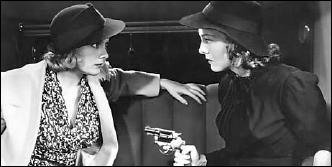
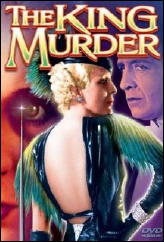
  THE KING MURDER. Chesterfield, 1932. Conway Tearle, Natalie Moorhead, Marceline Day, Dorothy Revier, Don Alvarado, Huntley Gordon, Maurice Black, Robert Frazer. Director: Richard Thorpe.

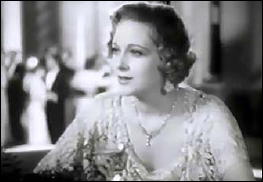
   People who read this blog on a regular basis are a lot more likely to recognize some of the actors and actresses who appeared in this movie, but I have to admit that until now I hadn’t heard of any of them. One I’d have liked to have seen more of in the film itself is Dorothy Revier, who had a long career in the silents before this one, as well as for another five or six years afterward.

   Unfortunately she had the misfortune of playing the blonde gold-digger (and blackmailer) who ends up (not surprisingly) being the first murder victim no more than 10 or 15 minutes into the movie.

   Given her rather shady way of making a living, in more ways than one, there is a long list of would-be killers, the sorting out of who might be the real one makes for a surprisingly entertaining 60 minutes or more. Even though talkies hadn’t been around for very long when The King Murder was produced, the people who made seem to have known what they were doing, even with the budget restrictions they must have been working under.

   Don’t get me wrong. The movie certainly shows its age, and the method used to kill Miriam King and an unfortunate police officer is awfully creaky, if not downright impossible. But for a murder mystery made in 1932, you can do a lot worse.

   And as a note in passing, the original review in Variety suggested that the movie is based on the 1923 unsolved Manhattan murder of Dorothy King, a model and nightclub hostess who may also have been a blackmailer. It was one of two similar murders dubbed “The Butterfly Murders,” both victims drawn to the glamor of Broadway, only to end up dead. If you’re interested, you can read more about it here.

IT’S ABOUT CRIME
by Marv Lachman

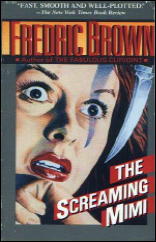
  FREDRIC BROWN – The Screaming Mimi. E. P. Dutton, hardcover, 1949. Paperback reprints include: Bantam #831, 1950; Carroll & Graf, 1989. Film: Columbia, 1958 (Anita Ekberg, Philip Carey).

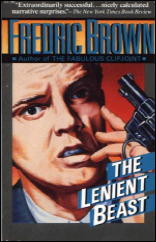
          – The Lenient Beast. E. P. Dutton, hardcover, 1956. Paperback reprints include: Bantam #1712, 1958; Carroll & Graf, 1988.

   One of the best mystery writers ever is well represented in current reprints. Fredric Brown was equally gifted in both the mystery and science fiction, and Carroll & Graf has published two of this best books in the former genre. The Screaming Mimi is one of the earliest, and best, books about a Jack-the-Ripper type series killer.

   Brown’s “fabulous clipjoint,” Chicago, is the well-realized setting, and the detective hero is, as in many Brown books, fascinating, albeit unlikely. Sweeney is a down-and-out alcoholic reporter: “… he was only five-eighths Irish and he was only three-quarters drunk.”

   Brown does a superb job of taking the reader into his confidence, and we read compulsively as Sweeney tries to stay sober long enough to find who is killing nightclub beauties.

   Among the similarities of Brown’s The Lenient Beast are a series killing and an alcoholic character, the wife of Tucson detective Frank Ramos. Otherwise, the books are very different except for their excellence.

   Re-reading Beast thirty years later, I was surprised how well it stood up. A bonus is Brown’s integration of the macabre lyrics of Tom Lehrer into this book.

— Reprinted from The MYSTERY FANcier, Vol. 11, No. 3, Summer 1989.

Reviewed by JONATHAN LEWIS:         


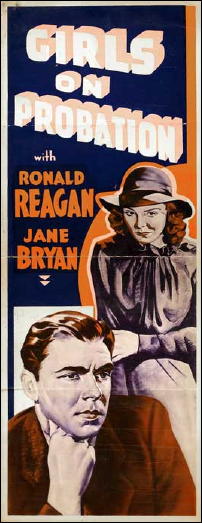
GIRLS ON PROBATION. Warner Brothers, 1938. Jane Bryan, Ronald Reagan, Anthony Averill, Sheila Bromley, Henry O’Neill, Elisabeth Risdon, Sig Rumann, Dorothy Peterson, Susan Hayward. Director: William C. McGann.

   Girls on Probation stars Jane Bryan and Ronald Reagan. Although the title suggests that the film will be some form of woman’s prison drama, jail plays only a minor role in this altogether good, albeit uneven, crime film.

   Although it’s not a film noir, Girls on Probation is still very much product of the late 1930s and does have several characteristics of what would later be considered film noir. These include a (somewhat) doomed protagonist, a series of events that spin out of control, and a mise-en-scène with a foggy night and a cheap boarding hotel.

   The plot follows the steps, or should I say, missteps, of a rather naïve twenty-something woman, Connie Heath (Bryan). Her brutish, although well-meaning, father (Sig Rumann) makes her life miserable. Even worse for Connie is her misbegotten friendship with her friend, the scheming Hilda Engstrom (Sheila Bromley), a co-worker who ends up getting Connie mixed up in two criminal acts.

   The first involves the quasi-theft of a dress, which leads to a police record for Connie. The second, and far more serious one, is an armed bank heist pulled off by Hilda’s thuggish boyfriend, Tony. This leads to a stay in the local jail for the two girls. As for Tony, he gets hard time, but later breaks out of prison to join up with Hilda in the girls’ hometown. Since his character is never really developed beyond that of an armed thug, it’s hard to feel bad for the guy when the cops plug him and he plunges off a stairwell.

   Throughout the film, Connie’s just a bit too nice for her own good. Fortunately, local attorney Neil Dillon (Reagan) is around to save the day and make everything right again. He also happens to become Connie’s love interest, employer, and fiancé.

   Interestingly enough, Bryan, who retired from acting early, and Reagan would remain in touch throughout the years. She and her husband, drug store magnate Justin Dart, would form part of Reagan’s inner circle.

   In the pantheon of great crime films from the 1930s and 1940s, Girls on Probation probably really doesn’t really amount to all that much. The film’s ending, in particular, is a bit too sentimental, with Connie needlessly apologizing to the dying Hilda.

   Still, Girls on Probation is an above average film with consistently good acting from Bryan. Reagan’s pretty good in this one too, although he’d reprise the role of a prosecuting attorney to much fuller effect in Storm Warning, which I reviewed here. Both films are worth seeing, although the latter is a much more serious film.

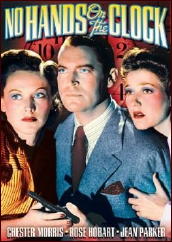
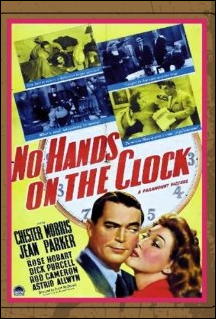
NO HANDS ON THE CLOCK. Paramount Pictures, 1941. Chester Morris, Jean Parker, Rose Hobart, Dick Purcell, Astrid Allwyn, Rod Cameron, Lorin Raker, Billie Seward, George Watts, James Kirkwood, Robert Middlemass. Based on the novel by Geoffrey Homes (Daniel Mainwaring). Director: Frank McDonald.

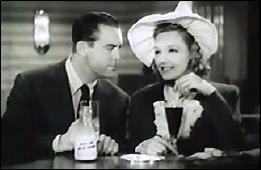
   Given a little more in the way of production values, including some time to tinker with and upgrade the screenplay itself, this obscure little B-mystery could could have had a future. Chester Morris and Jean Parker play a couple of newly-marrieds in Reno, Nevada — he the well-known private detective Humphrey Campbell — whose honeymoon is interrupted and taken over by a few murders and a host of beautiful women as suspects, in all varieties: a redhead, a blonde and a brunette.

   Missing is the son of a wealthy rancher, and Oscar Flack (George Watts), Humphrey’s boss, is no one to turn down a big fee only because his star employee is on vacation. And since the incentive he offers is a fur coat to Mrs. Campbell, Humphrey cannot turn it down, nor can he persuade his beautiful bride to keep her nose out of his business. Especially when all of the women in the case are good-looking. (See above.)

   If you were to go online and look for other reviews of this comedy adventure of a movie, you’d find that everyone one of them is going to tell you how complicated the plot is, nor are they exaggerating. The pairing of Morris and Parker is delightful, and the comedy is mostly fine (I could have done without the dumb policeman), but if you can make sense of the mystery part of the story the first time through, or even the second, you’re a better person than I.

   I should point out that the version I saw on an Oldies.com DVD may be five minutes shorter than both IMDb and AFI say it should be, and if so, that might make a big difference. I have a feeling that what the makers of this movie wanted to do was put everything in that was in the original book, and it just couldn’t be done, whether in 71 minutes or 76.   [FOOTNOTE.]

   In any case, there was no chance for a series to have developed from this as a first one, if ever there was one in mind. Chester Morris immediately went on to bigger and better things as Boston Blackie, while Jean Parker, alas, had to settle for two later films as Kitty O’Day, which I also have on DVD and after watching this one I duly intend to watch any day now.

FOOTNOTE: As it turns out, the video copy I discovered on YouTube (see above) does have some if not all of the missing footage, all from the beginning. It is extremely helpful in making sense of much of what follows, but not all. I guess you get what you pay for.

REVIEWED BY DAN STUMPF:         


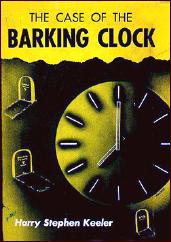
HARRY STEPHEN KEELER, with Hazel Goodwin Keeler – The Case of the Barking Clock. Phoenix Press, hardcover, 1947. Ward Lock, UK, hardcover, 1951, as The Barking Clock. (The British edition is 5-8000 words longer than the U.S.) No paperback edition.

Barking Clock

   One book I read recently is The Case of the Barking Clock, by Harry Stephen Keeler. Though late in the Keeler oeuvre, this has all the elements that make HSK the Master of Alternative Classic Mystery: colorful characters with Dickensian names (Nyland Finfrock, Umphrey Ibstone, and Tuttleton T. Trotter to name but a few), a convoluted plot, driven by wild coincidence (at one point, in a very minor element, a letter addressed to Trotter at “Occupant, Hotel so-and-so” is mistakenly delivered to a Mr. Occpunt residing at the same Hotel!), lengthy letters and speeches of pure explication:

    “Cripes!” he said, still unbelievingly, “Cripes,” he repeated, “A guy what knows sci’nce an’ mat’matics! An’ ev’dently knows ‘em all the way from A to Izzardy and back ag’in. An’s gotta have one case what can be showed on a book jacket as — as a knockout! the one guy in the whole world who-who might an’lyze my strange case. My case what’s not only sci’ntific, but what’s got ten book jackets in it — if I know an’thing at ail o’ what that book jacket artist, Waxworth Goforth, teached me long ago when I was his errand boy.”

   and the florid metaphor:

    “. . .silk-upholstered, bulging where the upholstery was as obscene as the breasts of virgins confined in $1.98 dresses. . .”

   that make Keeler’s writing so uniquely his own.

   Barking Clock was published by Phoenix Press, the fabled firm described so vividly in Pronzini’s Gun in Cheek, and it has all the earmarks of hasty printing and sloppy proof-reading one would expect from an outfit like Phoenix — the kind distressingly common today, where the words have simply been scanned for correctness, not read for sense — but it contains one of those privileged passages that make Keeler singularly enjoyable.

      On Page 188, Joe the Duck tells Tuttleton T. Trotter about Svenda Ulf, a platinum blonde Swede who dyes her hair black and pretends to be a Russian named Olga Russakov. Svenda/Olga plays no role at all in the book, except for this brief mention. She’s not a red-herring, witness, or even a bit-player. Her presence in this single sentence of the book was apparently written in by Keeler simply as another bit of pleasantly gratuitous ornamentation in his baroque tapestry.

   That a writer as obscure as HSK, working for a cheap-jack outfit like Phoenix would take the time to throw in a touch like this is one of the wonders that keep me reading.

Editorial Comment:   Mike Nevins talks a bit of the publishing history behind this book in one of his monthly columns for this blog.

THE BACKWARD REVIEWER
William F. Deeck


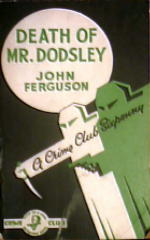
JOHN FERGUSON – Death of Mr. Dodsley. Collins, UK, hardcover, 1937. White Circle Books, UK, paperback, 1939. No US edition.

   When I bought this novel, I was not aware that this was the John Ferguson who had written Death Comes to Perigord, which I found both dark and tedious. Belatedly making this discovery, I began the book with some reluctance, which I need not have since it turned out most enjoyable.

   What does M. G. Grafton’s fictional mystery novel “Death at the Desk,” have to do with the murder of Richard Dodsley, proprietor of a new- and rare-book store? Other, that is, than that Grafton is in love with Dodsley’s nephew, that the novel contains the sentence, “The prophet who was slain by a lion had a nobler end than Bishop Hatto who was eaten by rats,” and that certain aspects of the novel’s plot have been repeated in the book-store murder?

   And what is one to make of the apparently drunken young man who shortly before the murder saw a cat open and close the book shop’s door?

   Fortunately for the police, private detective MacNab had earlier unsatisfactorily investigated rare-book thefts from the shop and interests himself in the case, one that is somewhat less complicated than the police make it out to be.

— From The MYSTERY FANcier, Vol. 13, No. 2, Spring 1991.


       The Francis MacNab series —

A. Father, a policeman:

   The Dark Geraldine. Lane, 1921.

B. Son, a private detective:

   The Man in the Dark. Lane, 1928.
   Murder on the Marsh. Lane, 1930.
   Death Comes to Perigord. Collins, 1931.
   The Grouse Moor Mystery. Collins, 1934.
   Death of Mr. Dodsley. Collins, 1937.

Reviewed by DAVID VINEYARD:         
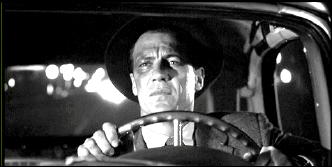

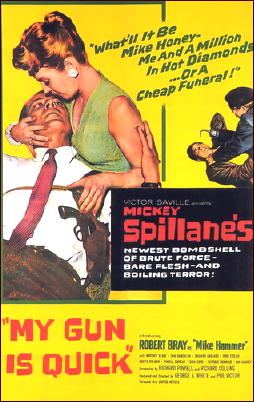
MY GUN IS QUICK. United Artists, 1957. Robert Bray, Whitney Blake, Richard Garland. Screenplay: Richard Powell and Richard Collins, based on the novel by Mickey Spillane. Directed by George White.

   You’re going to make a movie based on a book by the bestselling writer of the decade, so naturally you totally ignore the plot and instead do a poverty row rehash of The Maltese Falcon only with Mike Hammer instead of Sam Spade.

   Richard Powell, who wrote the screenplay with Richard Collins, obviously was no Spillane fan. A fine novelist (The Philadelphian) and top notch mystery writer (the Arab and Andy Blake series of screwball mysteries), he scrapped everything save the opening scene where Mike Hammer (Robert Bray) meets the prostitute Red in a late night diner, and sets out to avenge her death when she is brutally murdered.

   We’re in Los Angeles and Mike does have an office, a secretary named Velda, a cop pal named Pat Chambers, and he is a brutal lout, but from that point on you won’t recognize Spillane or Hammer, or the plot of My Gun is Quick the novel.
   Bray was a personable enough actor, most probably remembered as Lassie’s forest ranger owner in the color series, but as Hammer he is brutal, stupid, a slob, and can’t even wear the pork-pie right (neither could Kevin Dobson or Stacy Keach — the crown is not creased, which is why it’s called a pork-pie). Granted Spillane’s Hammer isn’t a barrel of laughs, but he is a snappy dresser, and however brutal and rude, he isn’t stupid.

   The falcon — I mean the Bianchi jewels — are the meaningless McGuffin, and the femme fatale is wholesome Whitney Blake, Mrs. B from Hazel, the television series based on Ted Post’s Saturday Evening Post cartoons about the impossible maid of the same name played by Shirley Booth. She’s about as seductive as coconut cream pie. (Well, okay, she’s nowhere near as seductive as coconut cream pie, but she is as wholesome.)

   The story and direction are all competent, but they are generic fifties private eye 101, which is the one thing Spillane’s Hammer never was. Love him or hate him, he was never just another private eye nor Spillane just another mystery writer. Hammer isn’t really a detective half as much as what Robert Sampson called a Justice figure, an avenger.
   It’s no accident that Spillane’s roots lie in Carrol John Daly’s Race Williams, Tarzan, Doc Savage, the Shadow, the Spider, Captain America, and the Saint (inspiration for Morgan the Raider). Hammer is closer to d’Artagnan (he’s a huge Dumas fan as well, with The Erection Set and The Long Wait both as inspired by The Count of Monte Cristo as Hammett’s Red Harvest) and James Fenimore Cooper’s Natty Bumpo, Hawkeye, than Poe’s Dupin or Doyle’s Holmes.

   Urban hero that he may be, Hammer is last of Rousseau’s ‘noble savages,’ the natural man arriving full blown without history or family, a force of nature, white hot, and consumed by a overarching sense of justice — if not law. The crudity of Spillane’s early work (he became a very good writer as he learned) never-the-less shows a deep seated identification with the post-war psyche and a natural affinity for the written word. You don’t have to like Spillane to recognize his power as a writer.
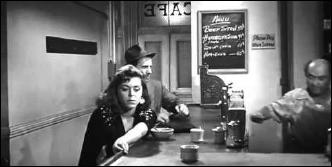
   To ignore all that, to ignore Spillane for what he is and Hammer as himself, as this film does, negates the whole point of Mickey Spillane’s role in the world of fifties popular literature.

   Bray’s Hammer is just another private eye, with just another case, and just another femme fatale. The plot would have been perfectly suited t,o an episode of 77 Sunset Strip (which did one Spillane plot seven times) or any of its numerous off shoots. Bray’s Hammer is everyman private detective, but he isn’t Mike Hammer though he is the closest physically to Spillane’s concept of the actors who have played the role.

   I can’t say much more. The people you suspect are the ones who did it, the brutality mostly consists of grabbing one small owner of a diner by his shirt, Velda isn’t much of one thing or the other, only another faithful private eye secretary, and Pat Chambers is just another best buddy cop to warn the hero about crossing the lines the hero of these things can’t see anyway. There is no attempt to capture anything of the feel of Spillane and Hammer.
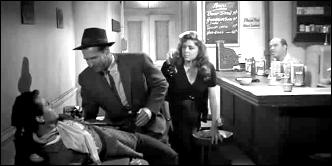
   There’s a half decently shot bit where Hammer watches a murder investigation through the skylight of Blake’s split level beach house, but if that’s the films highlight’, you can guess what the rest is like. The climax and Bray’s version of the ‘I have to turn you in because I’m a detective’ speech are just flat. No one gets gut shot, blown away with a shotgun, or blown up by a gas-filled basement, much less shot by a baby in his crib, and Blake at worst looks like she never really expected to seduce anyone in the first place.

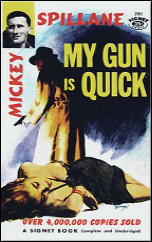
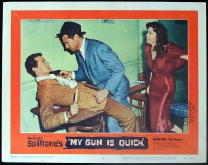
   I won’t say skip it, it is Spillane and Hammer, but watch it on Netflix, don’t buy it, even for $5. It’s just not very good, nor bad enough to be fun. The posters for the film are nice though. And yes, it’s the kind of movie where you review the posters. Watch Kiss Me Deadly, The Girl Hunters, or the Keach or McGavin series, even that little one off made for television movie set in Miami is arguably more interesting than this.

   Skip this, save as a completist, or just to see Hazel’s Mrs B. as a seductress.
Reviewed by JONATHAN LEWIS:         


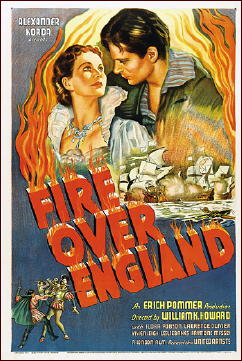
FIRE OVER ENGLAND. United Artists, UK/US, 1937. Flora Robson, Raymond Massey, Leslie Banks, Laurence Olivier, Vivien Leigh, Lyn Harding, Robert Newton. Based on a novel by A. E. W. Mason. Director: William K. Howard.

   Fire Over England is an historical drama set in the late 1580s. Based on a novel of the same name by A. E. W. Mason, the movie takes place during the reign of Queen Elizabeth as the Anglo-Spanish War (1585-1604) rages on.

   The film has a captivating plot, very good cinematography by James Wong Howe that makes excellent use of shadow and lighting, and a memorable soundtrack. It manages to pack quite a bit of action in 92 minutes. While there aren’t any truly outstanding moments in the film, it’s overall a well-executed project. The maritime fight scenes, in particular, are extremely watchable.

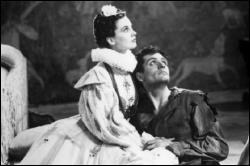
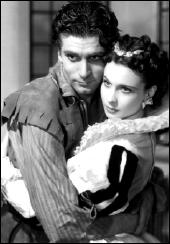
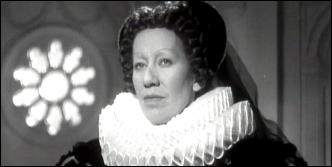
   We begin in the Court of Queen Elizabeth (Flora Robson). A frantic Cynthia, portrayed by Vivien Leigh in what was to be her first on screen performance with future husband Olivier, is fluttering about. Then we hear the film’s first voice. It’s that of James Mason, in an uncredited role as Hillary Vane, a distinctively bearded Englishman who we soon learn is traitor and an agent for King Philip II of Spain.

   Soon after, we encounter Michael Ingolby (Olivier), a patriotic, if somewhat youthful Englishman. He and his father, Sir Richard Ingolby (Lyn Harding), are traveling on an English vessel that is captured by the Spanish. Michael escapes and swims ashore. His father isn’t so lucky. Sir Richard Ingolby is captured and burned to death at the Inquisition in Lisbon. The younger Ingolby witnesses the smoke over Lisbon, learns that his father died there, and develops a hatred of Spain.

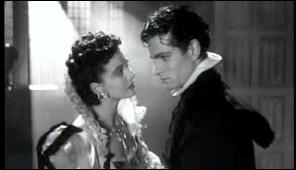
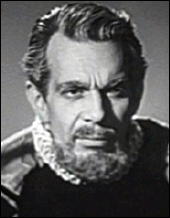
   But then it gets complicated, for he has developed feelings for Elena (Tamara Desni), a Spanish girl who saved him following his escape. Even so, Ingolby returns to England. There, he woos his beautiful fiancée, Cynthia (Leigh), and metaphorically butts heads with the Queen. His wit and daring impresses the publicly fierce, but privately fragile, monarch as to his true abilities and his loyalty. Soon, Ingolby assumes the now dead traitor Vane’s identity and returns to Spain to act as a spy in the palace of King Philip II (Raymond Massey, below and to the right).

   After a series of twists and turns and an coincidental but inevitable encounter with Elena and her now husband Don Pedro (Robert Newton), Ingolby makes his way back once again to his island homeland. Once there, he leads men in battle against the encroaching Spanish Armada. When it’s all over, it’s the burning of the Armada that in the end creates flames all over England. (In an earlier entreaty to the Queen, an impassioned Ingolby had warned of the Spanish menace and how, if the English did not act soon, the Spaniards would rain fire down on England.)

   With a cast such as this, it’s no surprise that the film benefits from its above average to superb acting, much of it quite theatrical. Olivier was around thirty years old when Fire Over England was made and his talent is on display throughout the film. Leigh’s work in the film led directly to her being cast as Scarlett O’Hara in Gone With The Wind.

   Although their onscreen pairing would culminate in real life marriage, the chemistry between Olivier and Leigh, while definitely palpable, just doesn’t come across as strong as that between Olivier and Desni. Perhaps that is the case because there was far more tension between Olivier and Desni’s characters than between Olivier and Leigh’s.

   For his part, Raymond Massey is perfectly fine in his portrayal of the rather taciturn Philip II. His is just not a particularly memorable performance. Flora Robson’s portrayal as Queen Elizabeth, however, really is quite remarkable. One just imagines that Queen Elizabeth would have come across quite similar to how Robson portrays her in this film.

   Released in 1937, Fire Over England does seem to make implicit allusions to England’s contemporaneous concerns over the rise of Nazi Germany. Spain is presented not just as a great power rival, but as a totalitarian force that threatens English liberty. It’s somewhat ironic then, that in film with such strong pro-English sentiment, that the characters with the most depth to them are the Spaniards, Elena and Don Pedro, both of whom are faced with far more difficult moral choices than any other characters in the film.

   In conclusion, Fire Over England is a well above average movie and one that anyone with an interest in early British cinema, in particular, should seek out. (The film is in the public domain, so there are likely copies of varying quality available.)

   While it may not be among the best historical epics ever produced, it’s still a very good film, one that showcases the talents of two actors who would go on to even bigger and better projects, both in the movies and in their personal lives.

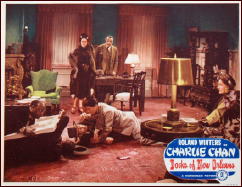
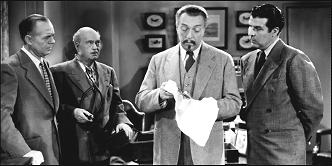
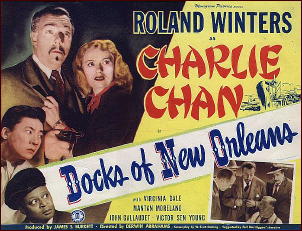
DOCKS OF NEW ORLEANS. Monogram, 1948. Roland Winters (Charlie Chan), Virginia Dale, Mantan Moreland (Birmingham Brown), John Gallaudet, Victor Sen Young (Tommy Chan), Carol Forman, Douglas Fowley, Harry Hayden, Howard Negley, Stanley Andrews, Emmett Vogan, Boyd Irwin, Rory Mallinson. Based on characters created by Earl Derr Biggers. Director: Derwin Abrahams.

   That’s quite a list of actors above, and you may or may not be surprised to learn that each and every one has a essential role to play in this, the second of Roland Winters’ attempts to play Charlie Chan in the movies. He’s full of the usual parables and platitudes, maybe even more than usual, and his facial makeup is fine, but his delivery lacks any sense of urgency, to put it mildly.

   In fact, the whole affair seems dull and flat to me, with only an occasional twinkle in Charlie’s eye as he goes about his business of investigating the mysterious murders of three members of a small syndicate of chemical manufacturers, bound together by a contract that leaves control of the syndicate to any survivors, in case of the sudden death of any one of them.

   There is also a disgruntled chemist who is shoved aside when his newly discovered formula proves to be valuable, and a gang of spies who don’t want certain chemicals to be sent to South America and the opposition to the forces they are working for. Plus, taking a deep breath, the niece and the new assistant to the first man to die may not be be wholly innocent of wrongdoing.

   So you do need a scorecard to keep everyone straight. Without one, it may prove difficult to figure out who did what and when to to whom, let alone why, but it can be done. Strangely enough, there is so much story crammed into the running time of 64 minutes that there is very little left for the usual antics and byplay of Birmingham Brown and number two son Jimmy. Except, of course, for the crucial scene in which the means of the murders is uncovered.

   Which perhaps comes too soon in the movie to suit anyone such as I who would have liked the mystery, something like a locked room affair, but not quite, to have stayed on the front burner longer. Even with the large array of suspects at hand, I don’t think the identity of the actual killer will come as much of a surprise to anyone reading this, but sometimes it feels good to be proven right when you watch a movie like this one.

THE ARMCHAIR REVIEWER
Allen J. Hubin


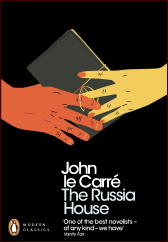
JOHN le CARRÉ – The Russia House. Alfred A. Knopf, hardcover, 1989; Bantam, paperback, 19890. First published by Hodder & Stoughton, UK, hardcover, 1989. Film: MGM, 1990 (Sean Connery, Michelle Pfeiffer).

   The latest John le Carré tale, The Russia House, departs from the Smiley oeuvre but otherwise is in the usual le Carré vein. Nothing much happens in 353 pages, but the language is elegantly expressive, the principal character is beautifully rendered, the workings of the intelligence agencies (U.S. and British) are recounted with surgically satiric precision, and what moves the hearts of people is most poignantly expressed.

   A manuscript of a novel, apparently penned by a Russian physicist, comes to failing London publisher Barley Blair via Katya, a woman associated with a Moscow book agency. And via British Intelligence, which intercepts the manuscript when Barley is missing — out drinking and womanizing, as usual — at the critical time.

   The Intelligence boffins are in a gentlemanly frenzy over what the “novel” says about Soviet military capability and want Barley to go over and milk the physicist of every smidgen he contains. The Americans, whose frenzy is never gentlemanly, also come to have a part in the proceedings.

   Strange what tools come to hand in the spying game; stranger still what their use may lead to….

— Reprinted from The MYSTERY FANcier,
       Vol. 11, No. 3, Summer 1989.


Editorial Comment:  For my review of the film, go here.

« Previous PageNext Page »