Reviews


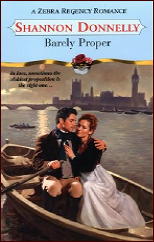
SHANNON DONNELLY – Barely Proper. Zebra, paperback original. First printing, December 2003. Cool Gus Publishing, softcover, October 2013.

SHANNON DONNELLY Barely Proper.

   On the surface, this is nothing more than just another Regency romance. When you investigate, however, you will find that there is a murder committed in Chapter One – a duel at dawn in which the second party arrives early and finds the first party had arrived even earlier, and he is already dead.

   Found holding the murder weapon in his hand, Terrance Winslow [the party of the second part] makes his escape, but not without fracturing his leg in the attempt. He is found by Sylvain Harwood, whom he has known since childhood. No longer the thin and gawky girl he once knew, she is now somehow different. Her figure is different. She has attractive curves that somehow were not there before.

   Aha, you say. When it gets down to it, this is just another Regency romance. Well, yes and no. While the “solving the mystery” aspect is definitely mired in second place, neither do all Regency romances have a Bow Street Runner as a significant (if not prominent) character, and this one does – although acting largely in his own interests – mixed in with the usual misunderstandings and other romantic pitfalls so intricately inherent in the genre.

   One other comment. Regency romances all took place in England, more or less in the ten-year-period between 1811 and 1820. If you took all of the Regencies ever written and published and tried to fit them all into that one tiny sliver of time, you’d never be able to do it.

— April 2004


[UPDATE] 03-13-14. In one way this review, in case you may be wondering, is yes, a filler while I spend a bigger chunk of my spare time getting IRS material ready to take to our accountant on Monday. On the other hand, the novel is a mystery, as I was careful to point out when I originally wrote the review.

   What I don’t remember is why I read the book in the first place. I may have come across the book at a local library sale and before offering it for sale on Amazon, I’m guessing, the blurb on the back cover may have tempted me into giving it a try.

   The category of Regency romances, per se, is dead. They were extremely common at one time beginning with Georgette Heyer reprints from Ace back in the 1960s or so. Why did the category die out? The simple answer is that the books were too chaste. See David Vineyard’s review of the Lora Leigh book posted here a week or so ago. Sizzlers like this are what readers of romance fiction seem to want now, to the exclusion of all else.

Reviewed by DAVID VINEYARD:         

LURED George Sanders

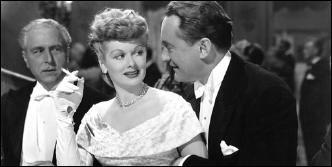
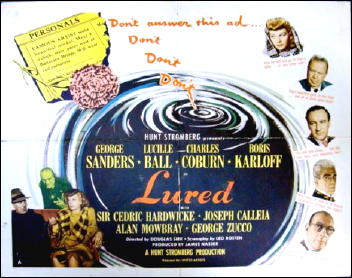
LURED. United Artists, 1947. George Sanders. Lucille Ball, Charles Coburn. Sir Cedric Hardwicke, Boris Karloff, George Zucco, Joseph Calleia, Alan Mowbray, Robert Coote, Alan Napier. Screenplay by Leo Rosten. Story by Jacques Companéez, Simon Gantillion & Ernest Neuville. Directed by Douglas Sirk.

   Douglas Sirk’s name is primarily associated with a series of glossy brilliant soap operas made in the 1950’s such as Written on the Wind, Tarnished Angels, and All That Heaven Allows, but before turning to these lush technicolor films the European Sirk produced three droll crime films: A Scandal in Paris with George Sanders as the thief turned policeman Eugene Francois Vidocq, Summer Smoke again with George Sanders and based on Anton Chekhov’s short novel The Shooting Party, and this, Lured.

   The setting is post war London where the city is paralyzed by a series of murders of young women who all answered ads in the agony column of the London Times. After each killing the murderer sends a taunting poem to Scotland Yard daring them to catch him.

   Inspector Harley Temple (Charles Coburn) is in a bad mood, because so far his investigation is getting nowhere, but when he meets Sandra Carpenter (Lucille Ball), the best friend of the latest victim, he has a bright idea. What if he turned the killers method of meeting his victims against him — set a trap for him with an attractive lure — and Sandra Carpenter a smart savvy American showgirl is the perfect lure.

   George Zucco is the sardonic Officer Barrett assigned as Ball’s bodyguard. She will answer the ads, meet the men who sent them, and when the killer shows his hand Barrett will pounce.

LURED George Sanders

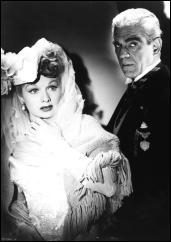
   After a couple of false starts, including a fine performance by Boris Karloff as a mad dress designer, they get their first real lead, Robert Fleming, a nightclub producer and impresario whose shows Ball had been trying to get into from the beginning.

   But the game is complicated when Ball starts to fall for Sanders even though she has been warned by his business partner Julian Wilde (Sir Cedric Hardwicke), and he fits the bill of the killer all too well.

   Ball resigns, convinced Sanders is innocent, but then a turn convinces her she was wrong, he is arrested, and then the real killer makes his move …

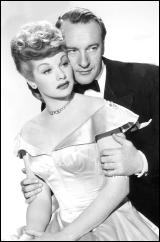
   Coburn is a pleasure as the Inspector, and Zucco, fine in a rare comic performance, is a droll delight. In fact Zucco comes near stealing every scene he appears in, which is no easy thing because Ball is not only beautiful, but holds the screen with real star power.

LURED George Sanders

   If you ever thought George Sanders would be an odd match for Lucille Ball you’d be wrong. They are a perfectly matched romantic pair here, and Sirk builds some real suspense because even cast as the hero Sanders had played so many villains it was no sure thing which side he would turn out to be on.

   The word that best defines this movie is droll. The screenplay by Leo Rosten is sharp (Dark Corner, Captain Newman MD, Where Danger Lives, Silky …), and the cast is a fine collection of character actors from the Hollywood Raj. It’s the kind of film where the smallest performance is perfectly timed and delivered.

   Comedy, romance, and suspense are expertly blended in this one. Sirk’s notable cinematic eye never lets the viewer down and a fine cast are all at their best.

   Still even among that fine cast. Lucille Ball and George Zucco are standouts and even if it is little more than a bit, it is nice to see Boris Karloff in a first class production having a bit of fun on screen.

   These three films were impossible to see for many years, but A Scandal in Paris and Lured have been issued in handsome DVD’s from Kino Video and both have played on TCM. Summer Storm was released on DVD by VCI in 2009 and is worth obtaining since it contains fine performances by Sanders and Edward Everett Horton as nineteenth century Russian noblemen caught up in a crime of passion.

LURED George Sanders

REVIEWED BY WALTER ALBERT:         


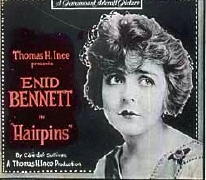
HAIRPINS. Famous Players-Lasky Corporation, 1920. Enid Bennett, Matt Moore, William Conklin, Margaret Livingston, Grace Morse. Story: C. Gardner Sullivan. Art director: W. L. Haywood. Art titles: F. J. Van Halle, Carl Schneier, & Leo Braun. Director: Fred Niblo. Shown at Cinefest 26, Syracuse NY, March 2006.

HAIRPINS Enid Bennett

   This film, which I had seen before, was substituted for Over There, a WWI patriotic drama. I like to expand my repertoire, but since Hairpins is a charming light drama, I happily sat through it again.

   Muriel Rossmore (Enid Bennett) has settled too comfortably for her husband Rex’s liking (Matt Moore) into the role of frumpy wife, so he begins a dalliance with Effie, his attractive, nattily dressed secretary (Margaret Livingston).

   When Muriel finds out about the affair, she consults her stylish neighbor, grass widow Mrs. Kent (Grace Morse), who supervises a new look for her and introduces her to Hal Gordon (William Conklin), a playboy friend who pays her the kind of attention that husband Rex finds mightily offensive when he stumbles on to what his wife is doing during his evenings out wth Effie.

   Fred Niblo married his star during the production of this film, and his direction is a tribute to her charm and beauty. I’ve credited the art director and the creators of the attractive intertitles for their contribution to the style and wit of this delightful film.

REVIEWED BY DAN STUMPF:         

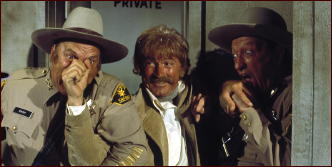
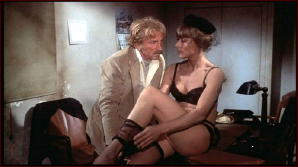
THE MANCHU EAGLE MURDER CAPER MYSTERY. United Artists, 1975. Gabriel Dell, Jackie Coogan, Huntz Hall, Joyce Van Patten, Dick Gautier, Vincent Gardenia, Anjanette Comer, Barbara Harris and Will Geer. Also with Old Tom and Winston as themselves. Written by Dean Hargrove and Gabriel Dell. Directed by Dean Hargrove.

THE MANCHU EAGLE MURDER CAPER MYSTERY

   Surprisingly off-beat and witty (considering that it comes from an ex-Dead End Kid and the creator of Matlock) this is also a film of engaging pointlessness and the sort of absurd humor that later characterized Airplane and The Naked Gun.

   Gabriel Dell, that perennial hanger-on from the Bowery Boys, stars as Malcolm, a bio-engineer (he’s trying to develop a chicken that will lay Easter eggs) in a speck-sized community (the richest man in town lives in a double-wide trailer) who decides to try his luck as a Private Detective and gets involved in a case of murder, adultery, incest and bestiality, all handled very tastefully and with considerable style.

   For a film where Jackie Coogan and Huntz Hall play cops, this is also rather well-acted. Dell, a veteran of more bad movies than I can remember or he could forget, injects a Bogart-like weariness into his role, supported by Nicholas Colasanto as a bartender who speaks in clichés, Anjanette Comer as a flower child who spouts wisdom from fortune cookies, and Nita Talbot as a concerned wife looking for her missing husband (he’s been gone all day) who enters Dell’s office already wearing widow’s weeds.

THE MANCHU EAGLE MURDER CAPER MYSTERY

   Gardenia and Geer do their usual best, un-flapped by the silliness around them, and Old Tom and Winston put in cameo appearances neat enough to merit special mention.

   Eagle proceeds merrily on its way to no place special, speeded along by zany characters, neck-snapping non sequiturs, and a shoot-out like something out of Monty Python. And it caps off with a surprisingly thoughtful (and quite funny) discourse on the folly of pursuing dreams and why we do it anyway. In all, a rough little gem but one worth seeing.

IT IS PURELY MY OPINION
Reviews by L. J. Roberts


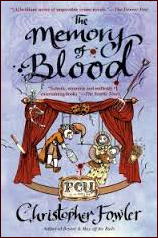
CHRISTOPHER FOWLER – The Memory of Blood. Bantam,US, hardcover, March, 2012; softcover, September 2013. (Police procedural: Bryant & May, 9th in series.)

CHRISTOPHER FOWLER Memory of Blood

   First Sentence: The following undated document appeared on Wikileaks and is now the subject of a government investigation.

   During the cast party, someone has murdered the theater owner’s infant son. The bedroom is locked from the inside and neither blood nor fingerprints are found; only the life-sized puppet of Mr. Punch, lying on the floor.

   A cast of characters is always helpful, but usually not very inventive. From Page One, it is clear this will not be your usual read with your usual characters and each is fully developed and fascinating. They are not necessary all people you’d want to know, but each becomes real in your mind. The Peculiar Crimes Unit team, including their long-suffering superior Raymond Lamb, is colorful and imaginative.

   You are immediately caught up in the author’s voice; his observations of the English and the wonderful wry humor… “People described Salterton as ageless in a way that wasn’t intended as a compliment. He seemed to exist somewhere between post-menopause and post-mortem.” Throughout, the author punctuates the story with simple statements of truth… “The gap between rich and poor was not just one of wealth but of accountability.”

   His use of language is to be savored… “This, then, was Arthur Bryant at work, his furrowed forehead bowed beneath the yellow light of the desk lamp, a shambling Prospero residing over the desiccated pages of his literary arcane, stirring fresh knowledge into the heady stew of ideas that filled his brain.” The dialogue is excellent with some of the exchanges between Bryant and May left to flow unhampered by interruptions of so-and-so said.

   The crime itself is anything but ordinary. It is, at times, gruesome. It is also a wonderful entry into the behind scenes working of a theater and the history of Punch and Judy. Fowler is particularly good in teaching the reader about things you didn’t even know you wanted to know.

   The Memory of Blood is a very good book, filled with humor, imagination, suspense, and wonderful characters. I am very happy to say there are, as of now, two more books after this … and eight wonderful books before it.

Rating:   Very Good.

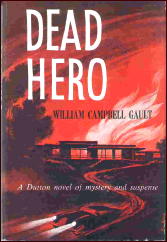
WILLIAM CAMPBELL GAULT – Dead Hero. E. P. Dutton, hardcover, 1963. Diamond Books, paperback, 1988.

WILLIAM CAMPBELL GAULT Dead Hero

   This was the seventh in the adventures of ex-football player and current PI Brock (The Rock) Callahan, and the last for nearly 20 years, until The Bad Samaritan was published by Raven House in 1980. I’d like to speak more highly of it than I’m about to, and I feel as though I should apologize when I have to say that I can’t.

   Even though Callahan wraps this case up in quite satisfactory fashion, the book itself never seems to jell. His investigation of a suspected affair on the part of a old friend’s wife ends in the murder of another friend, a teammate of Brock’s with the Rams, and — mammoth coincidence, or is it? — a large canyon fire near Malibu wipes out most of the evidence.

   While Brock Callahan may not always be totally ethical, he is always a moral person. While he may stay in his girl friend’s apartment overnight, he will not use her to provide a alibi for him: her reputation as one of the town’s leading businesswomen ay be ruined. On my patented Hard-Boiled Scale (from 0 to 10) this ranks as a solid Negative Five.

   A couple of paragraphs later, on page 62, only confirmed what I already suspected:

    She opened the door. “I’m sure you’ve visited a number of beds, Brock Callahan, but you’re an innocent just the same, aren’t you?”

    “Try me sometime,” I answered wth a sneer.

    The sneer was phony; the girl was right. I had never really left Long Beach.

   This is not the only reason the book never seems to take shape, however. Its low-key style ever sees to get the reader involved, and even though there is a message from a dying man to be deciphered, there is not enough detective story here (until the end) to keep anyone up past past 10 o’clock in the evening.

   A warm milk and cookies type of hard-boiled PI story, in other words — not the greatest combination in the world.

— Reprinted from Mystery*File 37, no date given, slightly revised.

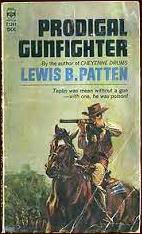
LEWIS B. PATTEN – Prodigal Gunfighter. Berkley F1241; paperback original, 1966. Signet, paperback , 1976; Leisure, paperback, packaged with The Law in Cottonwood, 1994.

LEWIS B. PATTEN Prodigal Gunfighter

   By sheer happenstance, this is the next western I picked up to read, and in a strong sense it picks up a thread I was working with in my review of W. C. Tuttle’s Straws in the Wind. If Tuttle’s career as a paperback writer ended in 1951 or so, Lewis B. Patten was there almost immediately to pick up the torch. His first book, Massacre at White River, came out from Ace in 1952.

   Patten’s writing career continued right up until he died in 1981, when Track of the Hunter came out, also as a paperback original, this time from Signet. He was incredibly prolific. In a thirty-year span he produced something like 90 novels, including books as by Lewis Ford, Len Leighton (with Wayne D. Overholser) and Joseph Wayne (also in collaboration with Overholser).

   As one of the next generation of western writers, all of Patten’s novels appeared in the post-pulp era but (as far as I know) they were all still very much in the strong “code of the west” tradition. It’s certainly difficult to generalize on the basis of one book, and Prodigal Gunfighter is the only book of his that I’ve read in several years, and probably more than that.

   Not that Patten didn’t write for the pulps. Starting in 1950 he had a score or more shorter works that appeared in magazines like Mammoth Western, Thrilling Western, Frontier Stories and so on. His name is certainly more identified with novels, however, and in his heyday, he was cranking them out like almost nobody else.

   And he was published in hardcover as well. He may have begun in softcover only, but beginning with Guns at Gray Butte in 1963, more and more of books came out from Doubleday. Not all of them, but a high percentage of them, the easy explanation for why not all of them was that he probably wrote more books than Doubleday could publish.

   Take 1966 for example. He wrote No God in Saguaro and Death Waited at Rialto Creek for Doubleday; The Odds Against Circle L for Ace; and Prodigal Gunfighter for Berkley. Not that year, but in the same time period, he also wrote for Lancer and Signet, the latter eventually becoming his primary publisher in paperback, both for originals and reprints of the Doubleday novels.

   If you want a slim and lean western to read, one that you will pick up and not put down until you’re done, then the 128 page Prodigal Gunfighter is the book for you. Taking place in the space of only a day in the small town of Cottonwood Springs, Patten certainly doesn’t leave the reader much time to breathe.

   The early morning finds the entire town down at the railroad station, waiting for the prodigal to return, in the person of the notorious home-grown gunfighter Slade Teplin. Included among them is a rather nervous deputy sheriff Johnny Yoder, who has been semi-courting Teplin’s wife, Molly, a school teacher who thought she could tame him, couldn’t, but who has not yet divorced him.

   Is he the reason for Slade’s return? Slade has had no contact with Molly since he left town. His father still lives in Cottonwood Springs, but there’s hardly any love lost between the two of them. Does he want revenge of some sort against the entire town? It is pure hatred? No one seems to know, and the sense of fear in the town is everywhere.

   And no one can do anything, including the law. In all but his first of many killings over the years, Slade has never drawn first. On page 91 Slade is briefly confronted by the sheriff:

   … Arch said finally, “So that makes it murder doesn’t it? It’s just like a rigged poker game where you know you’re going to win because you’ve stacked the cards.”

   â€œI always let the other guy draw first.”

   â€œSure. Sure you do. You can afford to. Besides, it’s smart. It gives you immunity from prosecution. But you know, every time who it is that’s going to die. Like with Cal Reeder earlier today.”

   Cal Reeder was a kid, the son of a wealthy local rancher, who thought he’d make a name for himself and failed. His father is part of the story, and so are the four drifters that Johnny notices having come quietly into town.

   Even at the short length the plot does not go exactly where it seems expected to do, and on pages 114-115 is one of the best choreographed fist-fights (not shoot-outs) I’ve read in quite a while, and it’s not even with Slade Teplin. He’s still on the loose, however – don’t worry about that – and with plans to cause even more havoc in Cottonwood Springs.

   To show you want I mean, though, here’s at least how the end of the fight reads:

   Johnny followed him over the desk-top and landed once more on top of him. The man was fighting with a silent desperation now, fighting for his life. Each blow he struck had a sodden, smacking sound both his fists and Johnny’s face were wet with blood. And he was tough. He was wiry and strong and no stranger to this kind of fight.

   But he lacked one thing, one thing that Johnny had – anger, righteous indignation and outraged fury. Johnny had those things in quantity. For every blow the stranger struck, Johnny retaliated with another, harder one.

   The man was weakening. They rolled against the glass-strewn floor to the window and back again. And at last Johnny felt the man go limp.

   After a few seconds taken to recover, Johnny knows he needs to make the man talk. From page 116:

   Johnny said softly, “You’re going to talk, you son-of-a-bitch, or I’m going to kick your head in. You understand what I said?”

   He’s not bluffing. The west was a tough place to live, but Patten’s characters also seem to be tough enough themselves and equal to the challenge when they need to be. What’s more traditional than that?

PostScript:   Written later in Patten’s career is a book called The Law in Cottonwood (Doubleday, 1978). While I’m curious, I do not know whether the later book has any of the same characters as this one.

— Reprinted from Durn Tootin’ #7 , July
    2005 (slightly revised).


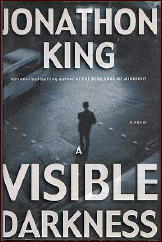
JONATHON KING – A Visible Darkness. Signet paperback reprint; 1st printing, April 2004. Hardcover edition: Dutton, 2003.

JONATHON KING A Visible Darkness

   The first book in this series was The Blue Edge of Midnight, and in 2003 that was the book that won the MWA’s Edgar award for the Best First Mystery Novel (American). Unfortunately I’ve not had the pleasure of reading that earlier book, so before starting this one, the Signet reprint, all I had to rely upon were the several pages of quotes inside the front cover, from all kinds of sources. King has been compared most often, it appears, with Michael Connelly and James Lee Burke.

   This is embarrassing. I’ve not read Connelly, and the one Burke I began, I stopped after a chapter or so. This is rather disgraceful on my part, and now that I am much older, I fully intend to move both authors a notch higher on the To-Be-Read pile really soon now.

   But I digress. King’s leading character is Max Freeman, an ex-Philadelphia cop who had enough of the dirty Philly streets, and he now lives in seclusion in a former hunting lodge on the edges of the Everglades. There is a back story behind this, it goes without saying, and apparently not all of it was not told in the earlier volume, as it continues to be revealed in short, incisive bits and pieces in this one.

   Max has two friends. One is Billy Manchester, a black attorney – one of the few success stories to emerge from the Philadelphia ghetto – who calls Max out of his private sanctuary to help him on a case of serial murders he believes he has uncovered in the established black community. The other is a very sharp police detective named Sherry Richards, with whom he is also on good terms, most of the time.

   Unfortunately – from my point of view, and maybe not yours – we know who the killer is in Chapter One. It is an insurance racket, however, and who is pulling the strings is kept a secret by the author until page 160, when the case is all but solved. That there are still well over a hundred pages to go should tell you that an old-fashioned detective investigation is not one of King’s primary points of focus.

   On the other hand, characterization, dialogue and a sharp eye for locale are definitely among his strong points. Whether it’s the smell of the mangroves and the flooded cypress forests of the Everglades – about which perhaps there should have been more – or the tangy, edgy sense of awareness of being in the wrong section of town, on the other side of the tracks, or doing the police beat in West Palm Beach – King’s been there, and he’s able to tell us what it’s like.

   No wonder. He’s also been a long-time journalist and an award-winning news feature writer for the South Florida Sun-Sentinel. While the book may be deficient as a novel of finely-tuned detective fiction, from the level of the streets, it’s as bold as brass and almost as striking.

— April 2004

       The Max Freeman series —

1. The Blue Edge of Midnight (2002)
2. A Visible Darkness (2003)
3. Shadow Men (2004)
4. A Killing Night (2005)
5. Acts of Nature (2007)
6. Midnight Guardians (2010)

[UPDATE] 03-02-14. Another series I’ve lost track of, but I have an excuse, of sorts. The last couple of the books have been published by a small independent press and (I believe) only in hardcover. Even though my comments at the time I wrote this review could only be called mixed, it’s good to see that the series continued on in spite of my lack of participation.

A TV Western Review by MIKE TOONEY:


“The Trace McCloud Story.” From the Wagon Train series: Season 7, Episode 24 (250th of 284). First broadcast: 2 March 1964. Regular cast: John McIntire (Christopher Hale), Robert Fuller (Cooper Smith, credit only), Frank McGrath (Charlie Wooster), Terry Wilson (Bill Hawks), Denny [Scott] Miller (Duke Shannon), Michael Burns (Barnaby West). Guest cast: Larry Pennell, Audrey Dalton, John Lupton, Paul Newlan, Rachel Ames, Stanley Adams, James McCallion, Nora Marlowe, Harry Harvey. Writer: John McGreevey. Director: Virgil W. Vogel.

   Whenever a long-running TV series runs short of ideas, they sometimes depart from their usual genre (in this case, the Western) to borrow from other genres (in this instance, the mystery/whodunit).

   As Christopher Hale’s wagon train wends its way westward, they sometimes have to stop for replenishment in small towns along the trail. It so happens that in Bedrock, one of their stops, they get to enjoy a traveling magic show — which is abruptly terminated by a murder.

   Wagonmaster Hale learns then that a series of stranglings have occurred in Bedrock, and the local marshal doesn’t have a clue who’s doing them.

   Almost immediately a sizable percentage of the nervous citizens of the town, as well as the itinerant magician, join up with the wagon train. So does the marshal, who thinks the strangler might find the prospect of more potential victims attractive. While Hale welcomes the marshal’s presence, he knows his life just got a lot more complicated.

   The marshal’s suspicions seem to be confirmed when several more murders happen as the train moves on, with the strangler barely escaping detection each time.

   At this point, Chris Hale would be justified in wondering if there’ll be anybody left when they finally reach the end of the trail.

   This episode does a very good job of keeping us guessing by ingeniously shifting suspicion around among the characters; the story benefits by having an hour and half to play in, giving ample time to insert red herrings.

   The solution, admittedly far-fetched, does border on the implausible, but the fun, as in all thrillers, is getting there.

Reviewed by DAVID VINEYARD:         


LORA LEIGH – Deadly Sins. St. Martin’s, paperback original, February 2012.

   A definition first: today the term romantic suspense too often refers to books that are primarily pornography * for women. And before anyone objects, I am not talking about writers like J.D. Robb, Janet Evanovich, Iris Johansen and others sometimes lumped into the field. The books discussed here have their own section on most news stands well away from those better more mainstream writers, though increasingly they are crowding out everything else save for some big name bestsellers.
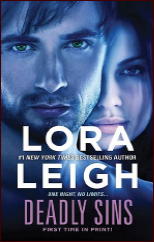
LORA LEIGH Deadly Sins

   Lora Leigh is one of the more prolific and popular writers in the field of romantic suspense, a legitimate NY Times bestselling writer (not the honor it once was), with a strong fan base and loyal audience.

   Her books vary from romantic suspense to borderline science fiction and fantasy. I found this one at the Dollar Store, so it falls into the category of what a friend christened Dollar Store Wonders (these run the gauntlet from overprints of bestsellers to surprisingly good books to pure pap), some of which are delightful surprises while others … others are by Lora Leigh.

   Deadly Sins is part of Leigh’s “Sins” series. When this was published in 2012 she had written some sixteen novels in three series in romantic suspense including the Elite Corps and SEALS series (she also pens a popular series known as the Breeds about metahumans enhanced by animal DNA).

   This entry in the Sins series is set in contemporary Colorado in troubled Corbin County where the Sweetrock Slasher has been preying on young women, including undercover FBI operative Skye O’Brien’s sister Amy. Skye and her older sister Amy are both the foster children of the governor.

   In general the books are set in generic locales so little time has to be subtracted from the sex scenes.

   Skye has come looking for Amy’s killer, her only clue her neighbor, attractive, brooding, loner Logan Callahan (the Brontes have a lot to apologize for) whom she and Amy long had crushes on. She knows Logan didn’t kill Amy, but believes Amy was murdered because Logan flirted with her and showed an interest in her.

   The Barons, the powerful and wealthy men who run Corbin County, are out to get Logan, who just incidentally is also an undercover FBI operative. This is involved with a feud between the Corbins and the Callahans, with the Barons wanting an end to the Callahan line, so they murder anyone who Logan shows an interest in so he will have no offspring to carry on the line (really, that’s the plot, I’m not making this up). Three Callahan brothers married daughters of the Barons, and now their bloodline must be purged. It probably didn’t help, as Logan points out, that all three brides were pregnant.

   Corbin County is as corrupt as Dashiell Hammett’s Poisonville, and crawling with curiously ineffective FBI agents. Sad to say no one goes ‘blood simple’ on the whole county.

   Skye knows all this (the book doesn’t bother with even elementary detective work Skye already knows everything going in, at no point is there any mystery element worth calling that, and what she doesn’t know the reader is told), and plots to make the devilishly attractive Logan her lover to put herself in the crosshairs as the next target.

   It doesn’t hurt that she needs to change her underwear every time she even looks at him. So Skye (the soppiest and least professional FBI operative in the history of fiction) parades around half naked in filmy negligees, tight jeans, and teddies to catch Logan’s interest, doing everything but throw herself naked at his feet with a pack of Trojans in her teeth (I’m not exaggerating all that much either — she’s damn near a stalker, at one point he even turns her in for trespass).

   Not that Skye is a bad girl or manipulative much less coldly using him (that might herald a good noirish suspense novel with a little depth and characterization). She is already in love with Logan and worries that he is too isolated and alone, so she tries to bond him with a stray puppy, but he wants nothing to do with it because his Corbin grandfather killed his puppy when he was a boy. See, under the tough exterior he’s really just a wounded little boy.

   The amount of wordage spent on that puppy will surprise even the most sentimental reader. Old Yeller didn’t get that much wordage in his own book, or half so weepy. Compared to that puppy “Lassie Come Home” was hard boiled.

   And critics used to carp about Mr. and Mrs North’s cats.

   Did I mention there is an assassin hired to kill someone in Corbin County, but we know he is really an FBI undercover agent, or is he … Either way it doesn’t generate any suspense. At times it seems as if half of the county is populated by villains and the other half undercover FBI agents.

   None of this would be out of place in a suspense novel (though it could be better handled), but the only purpose of this book is to get Logan and Skye between the sheets for graphic transformative world-shaking sex. Nor is it euphemistic sex, no ‘pulsing empurpled brands of manhood’ or ‘burning channels of passion’ (sounds like an STD). The men in these are endowed like porn stars, the women are size queens and suffer from perpetual rising damp. Thanks to Skye Logan spends more than half the book with a lump in his trousers while she is panting after him. It’s a wonder anything gets accomplished.

   Romantic suspense is a euphemism for pornography for women in publishing today. The sex scenes are graphic and detailed and the language as frank and simple as any porn written. These are not comparable to what Dean Koontz dubbed the Big Sexy Novel. Harold Robbins, Jackie Collins, Jacquline Suzann, Rona Jaffe, Erica Jong, and Grace Metallious were writing children’s books in comparison to this. For that matter so was Lawrence and his Lady Chatterly. There are no John Thomas or Lady Jane moments in these graphic books. I can’t demonstrate how graphic they are here by quoting from the books short of extensive literary bleeping with blank spaces.

   Still, compared to their sisters writing vampire and fantasy books these are tame. Those often feature out an out S&M and suggestions of zoophilia what with so many half animal protagonists. At least everyone in these books is human.

   All of this might be harmless fun if Lora Leigh could write, but this is an alternative classic of epic proportions. Devoting an entire chapter of Bill Pronzini’s Gun In Cheek to this wouldn’t be out of place. Leigh seems to think syntax is a tax or booze and cigarettes, and even given the grammatical leeway fiction, often dictates this one has a cavalier attitude to the structure of the English language. The actual plot often gets lost among the graphic sex scenes leaving the reader unsure if it was resolved or not.

   Leigh can’t even master the comma, dropping them wherever it suits her regardless of what it does to the meaning of the sentence, offsetting phrases and adjectives that not only don’t need offsetting but would not be by any rule of grammar extant.

   You may want to read these aloud to get the full effect, keeping in mind a comma is a pause as if for a breath I’ve added the word ‘pause’ in brackets to demonstrate exactly how bad this is:

   The serious (pause), quiet question almost managed to throw her off guard.

   Suspicion was a vicious (pause), sharp toothed demon that gnawed his mind.

   The material molded to her breasts (pause), all the way down to her delicate waist before falling to the floor in a long sweep that trailed majestically behind her.

   His hard (pause), corded body tightened.

   He almost shuddered in pure (pause), gut wrenching male horror … (I wasn’t aware horror had a sex)

   When they married the daughters of the Barons (pause), everyone said that David, Samuel, and Benjamin would bring them to a bad end.

   Pretty (pause), dark eyes that almost seemed to mesmerize him… (a comma after ‘him’ could save that one, but it isn’t there.)

   I think a few of those gave me whiplash. You can see how annoying that could become in short order.

   Complete sentences aren’t her strong suit either:

   A lassitude edged with hunger and need.

   Hell, not for a man.

   And it was liquid.

   Held him close to her.

   That he would watch out for her. That he would care for her.

   A man a woman could find pleasure with.

   And he would.

   Knew he would never get enough of.

   Some of these could be salvaged with a colon or semicolon attaching them to another sentence or even leaving a word out, and a few I’ll give any writer when writing for effect, but not this blatant or consistent. In Leigh’s work they are jarring as a speed bump at a Nascar rally. It isn’t that hard to avoid most of these if she bothered to read Strunk and White — or Dick and Jane.

   Dialogue isn’t a strong point either:

   â€œI have a hunger eating my guts for a woman who has happily-ever-afters in her eyes …”

   â€œ… had you been my sister I would have done more to protect you than those who were charged with the task.”

   â€œThis Skye girl, she’s not exactly got an unblemished record.”

   â€œI will never make such a decision again at three in the morning …”

   Has she ever read a book in English, seen a play, watched a movie or a television show? Who writes or speaks that way? How can anyone believe in a rough tough federal agent going on about happily ever afters in women’s eyes. That’s sub-soap opera level. Even granting that it is hard to make exposition sound natural in dialogue, there is no excuse for syntax that awkward or dialogue that stupid. It’s not romance can’t be done in these, but it needs some concern for character and believability. The hero can say the same thing without sounding as if he wandered in from a teenage girl’s fantasy.

   The climax of the plot is secondary to the main characters multiple climaxes in the bedroom in these, very nearly a definition of pornography. She does handle the sex scenes fairly well, but it’s painful getting to them, which come to think of it is a mark of porn in and of itself.

   There is little or no effort made to establish Corbin County or Sweetrock, so it is nothing more than a generic small western town that could be in New England or on Mars for all the effort made to make it real to the reader. It’s not much more than a film set, all false fronts and empty spaces behind them.

   This one ends in a deserted mountain resort Leigh awkwardly arranges for her hero and heroine to end up in, and with no previous set up.

   Reading these you may actually miss those vivid atmospheric houses, manors, and castles of the gothic craze, not to mention the writers. Even bodice rippers offered vivid settings and research. If there are sophisticated talented writers penning these they are doing a good job of hiding themselves. These offer the bare minimum of literary invention, and much of that is borrowed from other sources.

   And what do these books offer aside from escapism?

   To paraphrase James Carville, it’s the sex, stupid. Of a 115,000 word novel I counted roughly 24,000 words of sex scenes, not counting run ups and thinking about sex. That’s a bit over a fifth of the book, porn by any standard. Even Jackie Collins novels likely only devotes 5% of a book to actual depictions of graphic sex, two or three pages each, no matter how many of them there may be. I don’t recall the notorious Harold Robbins ever devoting an entire chapter to a single sex scene much less two or three (I’m not talking about the lead up to the sexual act, but three chapters describing a single sexual act). These readers wouldn’t read Collins or Robbins though, they write dirty.

   These books are a far cry from the time when romantic suspense meant Charlotte Armstrong, Mignon G. Eberhart, Ethel Lina White, Marjorie Carleton, Mary Roberts Rhinehart, Phyllis Whitney, Norah Lofts, Dorothy Eden, Victoria Holt, Mary Stewart, or Mary Higgins Clark. Despite the appellation these are far closer to men’s action books in their dependency on formula and their structure designed to feature so many sex scenes ever so many pages or chapters.

   Porn novels roughly provide at minimum a sex scene at least every third chapter (often stretching to two or three chapters as these do), about what you find in these books.

   Call them what they are, pornography, and I’m fine with them, but the only suspense is how long the heroine is going to keep her knickers on.

   Fortunately these have their own little literary ghetto at most bookstores, but if you buy books at Walmart or Walgreens, the Dollar Store or any news stand, this literary kudzu is everywhere choking off the oxygen for everyone else.

    * Most of you probably know the term pornography was coined by a 19th century British minister in the 1860’s writing a review of an exhibit of works of art from ancient Greece depicting prostitutes (the Victorians were much raunchier than we give them credit for in many ways). That’s all the word actually means, works of art and literature about the doings of prostitutes. Here I’m using a broader definition, though you could say some of the writers and publishers are selling themselves as blatantly as any prostitute on any street corner. They are just getting a better return for their services though not delivering the same potential quality. I don’t object to the sale, just the value of the product being offered.
« Previous PageNext Page »