Reviews


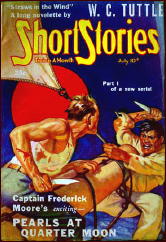
W. C. TUTTLE – Straws in the Wind. Hillman #26, paperback, no date stated [1949?]. Hardcover edition: Houghton Mifflin, February 1948. First published as a 38 page story in Short Stories, July 10, 1938.
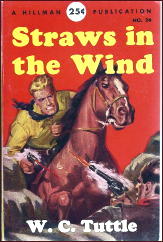
W. C. TUTTLE Straws in the Wind

   I remember reading a lot of Tuttle’s work back when I first started reading paperback westerns in the late 1950s: Luke Short, Max Brand and so on, the early Gold Medal’s, westerns published by Popular Library and lots and lots of Dell’s by authors no one but me would me would remember, and me only barely.

   I also remember listening to the Hashknife Hartley and Sleepy Stevens radio show on Mutual, two of Tuttle’s most famous characters — a pair of cattlemen’s detectives, as I recall, whose adventures took them all over the Old West.

   Not too many collectors of old time radio shows know about the program, by the way, and as far as I know, only two of the programs still exist, both badly trimmed to fit into the Armed Forces redistribution format. I remember the program distinctly, however, surprisingly so, given my extreme youth at the time. As a matter of fact, it was Tuttle himself who appeared and introduced each episode on the air – but I digress.

   In any case, when I started Straws in the Wind, it had been a long time since I’d read anything at all by Tuttle, so I wasn’t sure what exactly to expect — you can’t always go back to old favorites and expect them to be new favorites all over again — but as soon as I started reading it – see if this makes sense – it was exactly as I expected.

   That’s from the very first paragraph on. See what you think:

   No one seemed to know the exact age of Granny Miles. Over a hundred, they said. She was a small, antiquated morsel of humanity, her little face etched with a million fine lines which seemed multiplied around her eyes, which were clear and still very blue. She carried a gnarled stick in lieu of a cane, and thumped herself around with an alacrity seldom seen in one of her age.

   Granny, as it happens, is an oracle of sorts, forecasting to Donna Weir as soon as the book begins that trouble is coming. If Tuttle is not exactly a teller of tall tales, he comes awfully close – a yarn spinner of some magnitude. The usual kind of opening that almost every western begins with comes at the start of Chapter Two:

   Jack Dean drew rein at the top of the grade and looked back at the long slope, where the dirt road twisted over the hills out of the haze of the distance. The old road looked like broken bits of dirty-yellow ribbon, stretched over the hills out of the haze.

   Ahead of him the road ran through a natural cut in the hills, after which it sloped sharply into Council Valley.

   At the age of 22, Dean is returning to the valley after an absence of twelve years. His father, Wolf Dean, had ruled Council Valley for 25 years, and Jack assumes that the reason the telegram had requested his return was that his father was dead. Which is true. The older man had been murdered, shot through a window in his home, and the killer has not been found.

   Confronting one of the residents of Lost Horse, a moonshiners’ settlement in the other end of the valley, here’s Jack Dean in action (pages 26-27 of the Hillman edition):

   Jack’s left hand flashed out, his fingers hooking into the collar of Sol Feeney’s shirt. Then he fairly lifted Feeney off his feet and pulled him so close that their noses almost touched. Feeney struggled for a moment, but realized he was no match for this hard-muscled young man.

   â€œYou and your dirty gang of murderers killed my father,” said Jack quietly, “and you’ve got the gall to threaten me. Feeney, I’m not afraid of you and your killers, and you can pack that word to them. You’ll find that Wolf Pup can cut and slash as hard as the Old Wolf. You killed him, hoping that I wouldn’t come back. Well, I’m back – so make the most of it.”

W. C. TUTTLE Straws in the Wind

   I would imagine that those paragraphs would constitute a review in themselves, if the purpose of a review is allow you to decide whether a given book is one that you’d care to read, or not.

   There is a girl, of course, if you’ll allow me to keep on talking anyway. We met Donna in Chapter One, and of course she lives in the wrong end of the valley. She favors Jack, however, and she is willing to risk the wrath of her father by giving Jack a heads-up warning when she knows he is about to get into trouble. In return, her father is determined to marry her off to someone else, and she is made a prisoner in her own home, all the way up to her wedding day.

   Jack is asked to take his father’s place on the local ruling Council – Lost Horse having no representation, to their continuing and growing irritation – but he is not sure that the Council really wants anything to do with his new ideas, most of which would mean their giving up some of the power they are used to having.

   With an open seat at stake, the whole valley is about to explode. It’s about as stable as – a straw in the wind, you might say – and Jack Dean is at the center of it. Another straw is Donna’s grandmother, who just might be able to say who her granddaughter should be marrying, and that does not mean the intellectually challenged Len McFee, the fellow chosen by her father.

   There is more than a modicum of gunfire in this book, as you can tell from the cover, but I don’t imagine that I am giving anything away when I say that in spite of the obstacles in their way, good hearts do prevail. It all turns out well, in other words, especially when you consider how much (or how little) of the valley is left standing when everything is over. Whatever anyone might say, they certainly don’t write them very much like this any more.

   And all seriousness aside — keeping in mind that I mentioned Tuttle as very much a teller of tall tales, didn’t I? — there are also parts of Straws in the Wind that tickled my funny bone considerably, this way and the other, and the book just might affect you that way, too.

— Reprinted from Durn Tootin’ #7 , July
    2005 (considerably shortened and revised).


[UPDATE] 02-28-14. A chunk of the earlier version of this review contained a checklist of all of Tuttle’s fiction that ever appeared in paperback, along with some comments and other discussion of his overall body of work by me. I’ll not include the commentary here, as much of it is out of date, but I see no reason why the checklist should not be included here.

   I have made no attempt to expand or update this list, so please take this as a work in progress. Whitledge-Clark refers to a mimeographed checklist of all of Tuttle’s western fiction, not just that which appeared in paperback. Said I at the time:

    “… someone offered for sale on eBay [and I won] a complete checklist of Tuttle’s works – a fanzine titled The Hitching Rail, published by Fred C. Whitledge and William J. Clark.
    “This issue, done in mimeo, is Volume 2, #1, and it came out ‘Sometime in 1975.’”

     ● Indicates a title not listed in Whitledge-Clark.
     ●● Indicates a title listed in Twentieth-Century Western Writers, Second Edition, but for which no further confirmation of its existence has been discovered.

● The Devil’s Payday. Garden City, dime novel format, 1920s. A pulp story with this title appeared in Short Stories, October 10, 1922.
● The Law of the Range. Garden City, dime novel format, 1920s. A pulp story with this title appeared in Short Stories, — ? Found on ABE only in a hardcover four-in-one edition with three other authors.
● Powder Law. Garden City, dime novel format, 1920s. A pulp story with this title appeared in Short Stories, — ? No copies found on ABE or in WorldCat.
●● Sad Sontag Plays His Hunch. Garden City, dime novel format, 1920s. A pulp story with this title appeared in Short Stories, —? No copies found on ABE or in WorldCat.
● Sontag of Sundown. Garden City, dime novel format, 1920s. A pulp story with this title appeared in Short Stories, July 10, 1922.
● Spawn of the Desert. Garden City, dime novel format, 1920s. A pulp story with this title appeared in Short Stories, May 10, 1922.
● Straight Shooting. Garden City, dime novel format, 1920s. A pulp story with this title appeared in Short Stories, August 10, 1924. No copies found on ABE.
● Tramps of the Range. Garden City, dime novel format, 1920s. A pulp story with this title appeared in Short Stories, — ? No copies found on ABE or in WorldCat.
The Mystery of the Red Triangle, Avon #53, 1944.
● Blind Trail at Sunrise, Royce Quick Reader #148, small-sized (approx. 3″ x 5″), 1945. NOTE: A pulp story with this title appeared in Short Stories, April 10, 1933.
Bluffer’s Luck, Western Novel of the Month #27, digest-sized, 1945; Hillman #5, 1948
Tumbling River Range, Western Novel of the Month ##33, digest-sized, 1945; Hillman #2, 1948.
The Keeper of Red Horse Pass, Western Novel of the Month #41, digest-sized, 1945.
The Tin God of Twisted River, Western Novel of the Month #46, digest-sized, 1945.
The Dead-Line, Western Novel of the Month #50, digest-sized, 1945.
Hashknife of the Double Bar 8. Western Novel of the Month #55, digest-sized, 1945.
Singing River, Popular Library #96, 1946.
● The Vultures of Vacaville, Western Novel of the Month #108, digest-sized, 1946. No prior appearance of a Tuttle story by this name is known.
Hidden Blood, Popular Library #149, 1948.
Valley of Vanishing Herds, Popular Library #165, 1948.
Straws in the Wind, Hillman #26, 1949.
The Redhead from Sun Dog, Hillman #28, 1949.
Trouble at the JHC, Hillman #40, 1949. Original title: The Mystery at the JHC Ranch.
Wild Horse Valley, Popular Library #203, 1949.
Twisted Trails, Popular Library #249, 1950. Original title: The Santa Dolores Stage (Houghton Mifflin, 1934). NOTE: There is some confusion about this attribution. According to some sources, the hardcover edition of this book was The Valley of the Twisted Trails (Houghton Mifflin, 1931), but this assertion does not appear to be substantiated.
Hashknife of Stormy River, Hillman #37, 1950.
Shotgun Gold, Popular Library #297, Dec 1950.
The Trouble Trailer, Popular Library #330, Apr 1951.
Gun Feud, Popular Library #354, July 1951. Abridged edition. Original title: Wandering Dogies.
Thunderbird Range, Pyramid #370, 1958.
● The Redhead of Aztec Wells [+] Trouble at War Eagle, Tor Western Double #14, Jan 1991. Book #1 appeared in West, August 1946. Book #2 has a 1950 copyright date, but where it first appeared, no one seems to know.
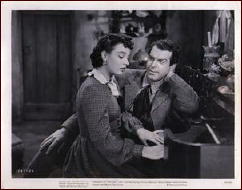
REVIEWED BY DAN STUMPF:         


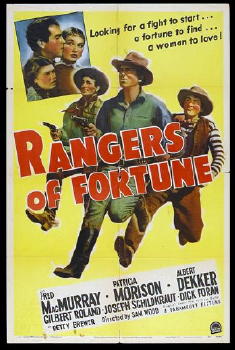
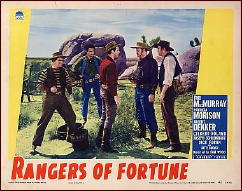
RANGERS OF FORTUNE. Paramount, 1940. Fred MacMurray, Gilbert Roland, Albert Dekker, Patricia Morison, Betty Brewer, Dick Foran, Joseph Schildkraut. Written by Frank Butler. Directed by Sam Wood.

RANGERS OF FORTUNE

   I had some trouble getting this due to a not-quite-prompt/dependable dealer, but it was worth the effort. You don’t hear the word “Rollicking” much anymore, but there’s no better word to describe this seldom-seen adventure classic, a film right up there with Gunga Din or Princess Bride.

   MacMurray, Roland and Dekker come on as a trio of good-natured desperadoes (we first see them as they’re being marched in front of a Mexican firing squad) at loose ends on the range who find themselves sorting out the problems of a dying newspaperman, his moppet granddaughter, and a town being stylishly terrorized by an aristocratic bad guy.

   Rangers was directed by Sam (Night at the Opera) Wood and written by Frank Butler, who did the Hope/Crosby “Road to” movies so you can figure it will offer some fun, and it is in fact rich in comic moments, some of them unexpected (Dekker playing his part like Curly in the Three Stooges) and some enjoyably predictable, when you see the punch-line coming and smile as you wait for it to smack the screen.

   What you might not expect are the well-mounted action scenes (fights, chases and tricky gun-play galore) and the hard-edged moments when they kill off characters who don’t usually die in movies like this.

RANGERS OF FORTUNE

   There are also some very well-thought-out minor characters played by actors you never heard, and they surprised me from time to time: Betty Brewer as the not-cloying moppet, Arthur B. Allen (from Our Town) as a drunken milquetoast who chimes in with some erudite sleuthing, and Bernard Nedell (who?) as a gunman nasty enough to seem like a genuine threat to our doughty heroes.

   Patricia Morison is her usual sexy self, Dick Foran comes off well as the chump/straight man, and Joseph Schildkraut turns in one of those cultured-heavy performances that remind one of Count Zaroff or Kasper Gutman at their best — or worst if you prefer.

   The film really belongs to the three male leads though, and they carry it vigorously, helped out by the typical Paramount production gloss and some canny direction from Sam Wood, who follows them around with a sweeping camera that lends pace and forcefulness to everything they do, from hawking newspapers to one of those memorable walks down Main Street to the showdown so beloved of western fans.

   Not an easy film to catch, but you really ought to try.

RANGERS OF FORTUNE

Reviewed by DAVID VINEYARD:         


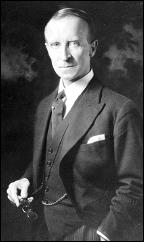
JOHN BUCHAN

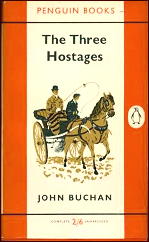
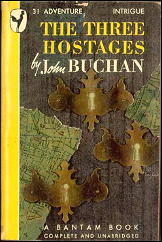
JOHN BUCHAN – The Three Hostages. Hodder & Stoughton, UK, hardcover, 1924. Houghton Mifflin, US, hc, 1924. Reprinted many times, in both hardcover and paperback, including Bantam #31, US, pb, April 1946; Penguin, UK, pb in dj, 1955 (both shown). TV movie: BBC, 1977, with Barry Foster & Diana Quick as Richard & Mary Hannay; director: Clive Donner.

   The Three Hostages is the fourth novel by John Buchan in the series of novels featuring Richard Hannay. Hannay made his debut in The Thirty-Nine Steps as a South African in his late thirties living in England on the eve of WWI, where he is drawn into a conspiracy and finds himself on the run from the police and the conspirators. He finally meets Sir Walter Bullivant, who is something in the British Secret Service, and foils a German plot to cripple the British fleet.

   In the sequel, Greenmantle, Hannay is a Major in the army recalled from the front by Bullivant to take on a dangerous mission to stop the Germans from exploiting a prophecy involving a Turkish leader that could open a new front in the European war. In this book we first meet American agent John S. Blenkiron, South African voortrekker Peter Piennar, and Hannay’s best friend, the Lawrence of Arabian style mystic, warrior, and scholar Sandy Abuthnot, Lord Clanroyden.

   In Mr. Standfast, Hannay is now a Brigadier General, again called back from the front to face the German spy master who eluded him in the first two books. He meets his wife to be, Mary, and again teams with Sandy, Blenkiron, and Peter Piennar, and RAF pilot Archie Roylance, who will feature in later Buchan novels, John McNab, Huntingtower, and The Courts of Morning.

JOHN BUCHAN

   The Three Hostages takes place five years after Mr. Standfast. Hannay, now Sir Richard, is comfortably retired with his wife Mary, and their infant son Peter John. The last thing Hannay wants is an adventure, but when he is approached by a man whose son has been kidnapped, but who cannot go to the police, he is reluctantly drawn back into action. With the help of Sandy Arbuthnot he decyphers a mysterious Latin quote, and that leads him to the charismatic upcoming political figure Dominic Medina, a man of considerable charm and rare hypnotic power.

   Medina is ambitious and dangerous, and soon Hannay is caught in the middle of a power grab that involves kidnapping the children and loved ones of important figures and using the dark and possibly mystic hypnotic influence Medina has over the victims to control their loved ones.

   Soon Hannay, Sandy, Mary, and a small group are racing across the continent from London’s night life to a remote farm in Norway to free the victims. Hannay foils Medina and the angered Medina sets out to stalk him in the rough country of Hannay’s estate. Medina dies horribly and Hannay is rescued by his wife and groundskeeper.

   That’s a fairly simple description of what is one of the best and most influential thrillers ever written. Fully half the books under the thriller category fall under Buchan’s spell, and a whole school of writers like Geoffrey Household, Hammond Innes, Gavin Lyall, Desmond Bagley, Allan MacKinnon, Geoffrey Jenkins, Victor Canning, and more are his direct descendants.

   In addition Buchan is generally credited with having created the modern spy novel with his 1910 Strand Magazine novella, “The Power House,” in which he predicted the rise of Fascism in the 20th Century.

   In addition he moved the setting of the thriller from the wilds to the heart of the urban world when his hero, Edward Leithen first recognizes, in the middle of busy Piccadilly Circus, that the only thing protecting him is the thin veneer of civilization.

JOHN BUCHAN

   In The Thirty-Nine Steps Buchan carries it further by setting the pattern of the innocent man caught up in circumstances that he can’t control that would be the theme of writers such as Graham Greene and Eric Ambler (albeit with far more complex and less sportsman like heroes than Richard Hannay), and filmakers like Alfred Hitchcock and Fritz Lang. The novel of chase, pursuit, conspiracy, and intrigue comes from Buchan’s work. He is what O. F. Snelling once called, ‘the onlie beggeter.’

   Buchan is unique among writers of popular fiction in that his influence in the real world is even more important than that in fiction. The son of a lower middle class Scottish family he became a noted scholar, historian, biographer, and political figure. He knew and influenced the most important figures of the early 20th Century from Lawrence of Arabia to Bernard Baruch.

   A Member of Parliament he was later given the title of first Baron of Tweedsmuir, in 1935 he was given the difficult post of Governor General of Canada, his assignment to repair the shaky state of affairs between Canadian Prime Minister Mackenzie King and London and King and the United States, assuring that in any coming conflict Great Britain could count on its most important Commonwealth partner.

   Working tirelessly, he died of exhaustion in 1940, he charmed King, reconciled him with London, reconciled him with FDR and the United States, and had no small influence in the eventual Lend Lease program that kept England alive in the early days of WWII before America entered the war. Time magazine had called him one of the most influential men of the age when they featured him on the cover. When he died he was mourned by statesmen, commoners, and kings.

   That he was also a storyteller whose tales of horror inspired H.P. Lovecraft and Robert E. Howard, a biographer of note, a noted historical novelist, a writer of popular thrillers (he preferred the term ‘shockers’), and a scholar is a mark of how great his talents were. Two of the books on John F. Kennedy’s famous list of this ten favorite books were by Buchan, his memoir Pilgrim’s Way (aka Memory Holds the Door) and his biography of Montrose. Scholar, statesman, and bestselling novelist is a difficult combination to beat.

   The genius of the Hannay novels lies largely in the character of Hannay himself. Richard Hannay is a likable man of above average intelligence, some strength, and some ambition, but he is not a superman. He succeeds by hard work, risk, loyalty, and no small amount of luck. He has his flaws. He can be stubborn, obtuse, and impetuous (in Greenmantle his overreaction to a German officers sexual advance very nearly blows his cover and sends him on the run endangering himself, his friends, and his mission). He is also capable, generous, and unusually strong and fit. In short, he’s the perfect man for an adventure. And like all Buchan’s heroes he is motivated by duty, and willing to work to near exhaustion to get the job done.

   He is also one of fictions most physical characters. In Buchan’s novels no one ever rests, stands still, or lollygags around. There is almost constant movement, tension, and physicality. Reading his novels is the literary equivalent of an aerobic workout. It isn’t uncommon to finish them literally breathless. Buchan heroes work hard and succeed big. Hannay gets a knighthood, Clanroyden is always off in some backwater of the Empire playing at international politics, Edward Leithen (the most biographical of Buchan’s characters) gets a knighthood and becomes England’s Solicitor General (more of less Attorney General), and even Glasgow grocer Dickson McCunn becomes wealthy and moves with the movers and shakers of the world. Buchan’s Calvinist upbringing valued hard work and its rewards, and his own poor health led him to overcompensate in those areas.

   In The Three Hostages Buchan does for the civilian thriller what his previous novels did for wartime intrigue. He creates his greatest and most complex villain in Dominc Medina (Buchan was by all accounts a genuinely nice man, and villains aren’t usually his strong suit, but Medina is an exception).

   Medina is charming, charismatic, mysterious, and chilling. His near hypnotic control over people is so great that even Hannay only escapes because he is the unimaginative type and less susceptible to that sort of thing, but he plays a desperate game getting close to Medina and playing at being under his influence.

   As Medina’s ambitions rise Hannay, his wife Mary, and Sandy work to out maneuver the powerful man, and it is Mary who rises to the occasion first to put the fear of God into Medina who has hypnotised a young boy and hidden him in plain sight hypnotised to believe he is a little girl:

    “You have destroyed a soul,” she said, “and you refuse to repair the wrong. I am going to destroy your body, and nothing will ever repair it.”

    Then I saw her meaning, and both Sandy and I cried out. Neither of us had led the kind of life which makes a man squeamish, but this was too much for us. But our protests died half-born, after one glance at Mary’s face. She was my own wedded wife, but in that moment I could no more have opposed her than could the poor bemused child. Her spirit seemed to transcend us all and radiate an inexorable command. She stood easily and gracefully, a figure of motherhood and pity rather than of awe. But all the same I did not recognise her; it was a stranger that stood there, a stern goddess that wielded the lightnings. Beyond doubt she meant every word she said, and her quiet voice seemed to deliver judgment as aloof and impersonal as Fate. I could see creeping over Medina’s sullenness the shadow of terror.

    “You are a desperate man,” she was saying. “But I am far more desperate. There is nothing on earth that can stand between me and the saving of this child. You know that, don’t you? A body for a soul–a soul for a body–which shall it be?”

    The light was reflected from the steel fire-irons, and Medina saw it and shivered.

    “You may live a long time, but you will have to live in seclusion. No woman will ever cast eyes on you except to shudder. People will point at you and say ‘There goes the man who was maimed by a woman–because of the soul of a child.’

   It’s the kind of scene Buchan does with great power and conviction, and certainly Mary’s finest moment in the book. In the end Hannay saves the victims, Medina’s cronies are given rough justice, but Medina escapes, only to come after Hannay in the wild for revenge — always a mistake in Buchan, for his heroes have an almost uncanny relation with rough country. After a desperate struggle Medina falls, and Hannay tries to save him:

   He had found some sort of foothold, and for a moment there was a relaxation of the strain. The rope swayed to my right towards the chimney. I began to see a glimmer of hope.

    “Cheer up,” I cried. “Once in the chimney you’re safe. Sing out when you reach it.”

    The answer out of the darkness was a sob. I think giddiness must have overtaken him, or that atrophy of muscle which is the peril of rock-climbing. Suddenly the rope scorched my fingers and a shock came on my middle which dragged me to the very edge of the abyss.

    I still believe that I could have saved him if I had had the use of both my hands, for I could have guided the rope away from that fatal knife-edge. I knew it was hopeless, but I put every ounce of strength and will into the effort to swing it with its burden into the chimney. He gave me no help, for I think–I hope –that he was unconscious. Next second the strands had parted, and I fell back with a sound in my ears which I pray God I may never hear again — the sound of a body rebounding dully from crag to crag, and then a long soft rumbling of screes like a snowslip.

* * * * *

    I managed to crawl the few yards to the anchorage of the gendarme before my senses departed. There in the morning Mary and Angus found me.

   And there it ends, with Hannay alive and returned to the bosom of his family and Medina dead and broken on the rocks below. The Three Hostages is a remarkably prescient novel too. Buchan not only warns of the dangers of the post war world, but the strange lassitude that seems to fill England and Europe and the kind of man, men like Medina — and Adolph Hitler — who will use it to build their power bases and threaten all of civilization:

    ‘In ordinary times he will not be heard, because, as I say, his world is not our world. But let there come a time of great suffering or discontent, when the mind of the ordinary man is in desperation, and the rational fanatic will come by his own. When he appeals to the sane and the sane respond, revolutions begin.’

   That’s a pretty fair interpretation of the madness Europe would soon descend into ending in another, and more vicious war.

   There are one or two minor racial matters to deal with in the book and some of Buchan’s earlier books, but unlike fellow thriller writers of the period Buchan came early to be embarrassed by these remarks and even removed them from later editions of some of his books. He was an early voice decrying Fascism and the plight of the Jews in Germany, and an early supporter of the Jewish movement in Palestine.

   Throughout his career he was a voice of reason, though certainly prey to the errors and the prejudice of his time and world. The most embarrassing passages in the book deal with a discussion of Gandhi. But in Buchan’s case I think forgiveness comes more easily than with some others. First he was a splendid writer, second a genuinely good person, and most important a man who gave his life that the Western World might untite in a time of danger against the forces of darkness and barbarity.

   Hannay appears briefly to introduce The Courts of Morning (where Sandy Clanroyden, Archie Roylance and his wife Janet, and John S. Blenkiron are involved in a South American revolution), and the narrator of one of the short stories in the collection, The Rungates Club, and finally in one last adventure with Sandy and Hannay’s teenaged son, Peter John, Man From the Norlands (aka Island of Sheep).

   There are three film versions of The 39 Steps, including the Hitchcock classic, a remake with Kenneth More as Hannay, and a third version with Robert Powell. There was also a short lived BBC series called Hannay. The Three Hostages (1977) was a made-for-television film shown here on PBS with Barry Foster as Hannay and John Castle as Medina, Clive Donner directed.

   Also screenwriter Stephen DeRosa has uncovered evidence Alfred Hitchcock considered filming The Three Hostages, and that it may have influenced his first film of The Man Who Knew Too Much.

   There was a silent film of the Dickson McCunn book, Huntingtower and later a BBC mini series, and Buchan’s Witch Wood, a novel of about devil worship in seventeenth century Scotland, was also adapted for television.

   The Three Hostages shows Hannay at his most mature and capable, and Buchan at his best. Away from all the trappings of his earlier shockers he nevertheless creates a suspenseful and intelligent tale that at once demonstrates the mental state of the world in the post war era and at the same time warns of the dangers that world is prone to.

   Good thrillers aren’t rare, but genuinely prophetic ones are. The Three Hostages succeeds as both a thriller and a prophetic look at a new breed that would use the unrest and disquiet of the post war era to play havoc with European society — the very ‘rational fanatic’ Buchan warned of.

   Nor is the hint of occult powers and dark matters far off the mark from the Occultism practiced by the Nazi’s — a sinister Indian hypnotist named Kharama features in the novel, but turns out to be less dark than he is painted — literally. It is also some how prophetic that the evil in the novel is defeated by decent men who refuse to be swayed by attractive and easy solutions. Like Buchan himself they choose hard work, duty, and simple decency.

   And all that might not amount to much if The Three Hostages wasn’t also a first class thriller with genuine puzzle elements. The obscure Latin quote that leads Hannay to Medina and the rescue is handled with intelligence and skill, and in these days of Da Vinci Code ripoffs and pseudo-scholarship, it is nice to know that Buchan managed to create a quote so realistic that for years Latin scholars sought its source before finding it was original to Buchan.

   You can find more on Buchan at the John Buchan Society website.

Note:   The quote was: ‘Sit vini abstemius qui hermeneuma tentat aut hominum petit dominatum.’ Translated in the Oxford University Press World Classics edition by Professor Miller as: ‘whoever seeks to interpret the world or seeks to exercise power over men should be an abstemious drinker of wine’. Or: ‘He who tries to interpret or seeks to dominate men should not drink wine.’ I don’t think even Christie ever managed to plant a clue that fooled classical scholars.

JOHN W, VANDERCOOK Murder in Trinidad

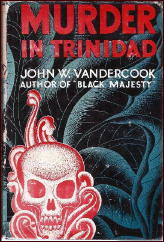
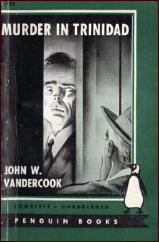
  JOHN W. VANDERCOOK – Murder in Trinidad. Doubleday Crime Club, hardcover, 1933. Penguin #552, paperback, 1944. Macmillan, hardcover, 1955. Collier, paperback, 1961.

   My admiration for Arthur Conan Doyle goes up a notch whenever I read a book like this, and while you may know what I mean by that, perhaps you won’t, and I’ll explain.

   The first few chapters of this book recount the first meeting between Bertram Lynch, ace investigator for the P.C.B., and Robert Deane, instructor at Yale and an amateur criminologist. Lynch, as was typical of the times, is the eccentric detective of the pair, and Deane is his “faithful” assistant. They are no Holmes and Watson by any means, however, and after a decent enough beginning, the book is sadly disappointing.   [FOOTNOTE]

   The initials P.C.B. need some explaining as well. (If you didn’t know, you’d never guess.) They stand for the Permanent Central Board, a branch of the League of Nations. Lynch’s job in this case is running down a gang of opium smugglers working out of the West Indies, and in the process he comes across a 13 year old murder to solve.

   He also does a good many things that are a great puzzlement to both Deane and the reader, most of which are explained later, but not until a point has been reached that anyone cares — or cares to point out that most of them didn’t work out early as well as they were supposed to.

   I won’t go into details of all the examples I have in mind — and you’re quite welcome, I’m sure! — but the one that puzzled me the most, all of the way through, is why, once Lynch is convinced that his purpose on the island is known (page 22) he decides to go undercover and infiltrate the bad guys by pretending to be on the run from the law. Under his own name and description. (See the constabulary orders on page 74.)

JOHN W, VANDERCOOK Murder in Trinidad

   [WARNING: PLOT ALERT]   It turns out that the bad guys don’t communicate very well with each other, so it doesn’t affect the plan any, but Lynch didn’t know this, I didn’t know this, and none of the rest of the book made much sense either. At one point Lynch and Deane have been captured, but instead of being killed outright (if I were a bad guy, I’d be a nasty bad guy) they’re tied up in sa shack and the head bad guy waits outside to pop them off as they work themselves free and try to make a break for it.

   The plot fails. Lynch and Deane get away. Ho hum.

   Which just about sums it up. This is the first of four adventures the two men had together. Besides this one, they solved cases together in Fiji (1936), Haiti (1956) and New Guinea (1959). If you happen to know why there was such a long break in their career, I’d like to hear about it. Obviously Lynch wasn’t working for the League of Nations all this time. (And maybe later cases were better than this one.)

   FOOTNOTE:   As you may have noticed, I used the word “faithful” in quotes to describe Deane’s status as Lynch’s Watson in this book. By page 227, Deane gets a little truculent at Lynch’s orders without explanations: “This is all very amusing and all that. But you’ve got to talk sense. What, in plain words, is the idea? Tell me or I quit.” You’ve got to admire a guy like that.

— Reprinted from Mystery*File 37, no date given, slightly revised.

FIRST YOU READ, THEN YOU WRITE
by Francis M. Nevins


   Thanks to my office (where I keep my computer) being closed down for the holidays, followed by the frightful weather, followed by some health issues, I expected that my February column, if any, would be culled from those old book notes I wrote for my eyes only back in the Sixties and Seventies.

   Surprise! Thanks to Joseph Goodrich, editor of that priceless selection from the letters between Fred Dannay and Manny Lee published in 2012 as BLOOD RELATIONS, I am now in possession of all the material from their correspondence that for space or other reasons Joe didn’t include in his book. There are gems in that material, which over the next several columns I’ll dole out here.

***

   In a letter dated March 31, 1950 and not included or excerpted in BLOOD RELATIONS, Fred tells Manny that for years he’s been trying to interest various movie studios in subsidizing Ellery Queen’s Mystery Magazine’s annual story contests, arguing that an investment of as little as $10,000 would lead to an “increase in submitted stories,” “interest by bigger names,” and — always a high priority with Fred considering his background in the advertising biz — publicity.

Mike Nevins

   Approached by Fred, MGM executives told him that “they have invested millions of dollars in literary contests, but never got a single desirable piece of property out of it….now they wouldn’t contribute $10, let alone $10,000.”

   Not long after that exchange, MGM bought the movie rights to a second-prize winner in the latest year’s EQMM contest, “Once Upon a Train” by Craig Rice and Stuart Palmer, in which the authors’ respective series detectives John J. Malone and Hildegarde Withers teamed up to solve a railroad mystery.

   Since the story wasn’t published until the October 1950 issue, MGM must have bought it from manuscript. (Those who have learned from Queen to read with extreme care may think Fred might have misdated his letter and actually wrote it in 1951, but this possibility is ruled out by his later statement to Manny that the story “has not yet appeared in EQMM….”).

   Fred queried the suits at MGM and was told that they had only bought the story because they “‘had a spot for the use of two characters like Withers and Malone,’ a spinsterish schoolteacher and a dipso lawyer.” Later Fred learned that MGM’s original plan was to use the story as a vehicle for Marjorie Main and Percy Kilbride, who had scored a big hit as Ma and Pa Kettle in THE EGG AND I (Universal, 1947).

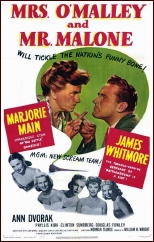
   By the time the movie had been released, one actor and one character had been axed from the initial conception: Marjorie Main still starred but as Harriet “Hattie” O’Malley, not Miss Withers, and John J. Malone was still the leading male character but was played by James Whitmore. For anyone who wants to waste an hour watching this turkey, its title is MRS. O’MALLEY AND MR. MALONE (MGM, 1950).

***

Mike Nevins

   In the same letter to Manny, Fred reports that MGM has also spent $5,000 buying movie rights to John Dickson Carr’s short story “The Gentleman from Paris” (EQMM, April 1950). This move baffled Fred as much as MGM’s purchase of rights to the Rice-Palmer story.

   As everyone knows who has read Carr’s excellent tale, which is set in 1840s New York, the climactic revelation is that the main character is none other than Edgar Allan Poe. “[S]urely MGM does not intend to keep the identity of the detective a secret….”

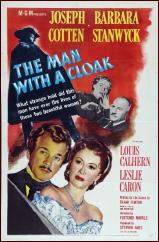
   Fred couldn’t figure out what the studio had in mind but any interested reader can find out by watching THE MAN WITH A CLOAK (MGM, 1951), a not-half-bad historical crime thriller starring a mustached Joseph Cotten as the Poe character (who calls himself Dupin) and Barbara Stanwyck and Leslie Caron as the female leads.

***

Mike Nevins

   With a bit of space left over, I return to fields I plowed almost fifty years ago with comments on first novels by authors writing under their own names. Let’s begin with a writer whom I knew slightly and once, near the end of his life, lunched with at his lovely retirement home in Sedona, Arizona, armed with an assortment of first editions of his books, some of which he said were in better condition than his own, all of which he signed for me.

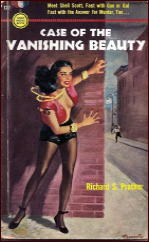
   Richard S. Prather (1921-2007) was one of the first superstars of the paperback original, turning out a torrent of books for Fawcett Gold Medal in the Fifties and early Sixties which millions of readers gobbled down like Thanksgiving turkeys. I didn’t read them in order but, when I got to his first Shell Scott caper, CASE OF THE VANISHING BEAUTY (Fawcett Gold Medal pb #127, 1950) I had to concede that most of its plot and characters were lifted bodily from Chandler’s THE BIG SLEEP and FAREWELL, MY LOVELY with a few perfunctory variations.

   One of a millionaire’s two spoiled daughters engages Scott to locate her missing sister and the trail leads LA’s coolest PI to the usual sinister nightclub, phony religious cult, dope smuggling, flying bullets, you name it. Prather had the gifts of pace and raw storytelling talent from the get-go but what distinguishes this otherwise routine programmer is Scott’s narration — bemused, self-mocking, gorgeously funny, and so wildly individual that he’s never been successfully imitated. He was, as we cruciverbalists say, a oner.

***

Mike Nevins

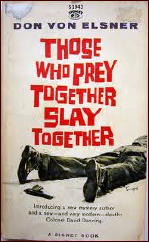
   Bridge grandmaster Don Von Elsner (1909-1997) threw his hat, or perhaps I should say his lei, into the mystery ring with THOSE WHO PREY TOGETHER SLAY TOGETHER (Signet pb #S1943, 1961). Troubleshooter Colonel David Danning is hired by the board of directors of a packaging empire to protect its subsidiaries from a status-hungry gangster turned corporate raider.

   The trail leads from a Chicago boardroom to Honolulu’s most lavish hotels and encompasses some superb stock-market shenanigans and a couple of murders which Danning must solve while on the run from both mobsters and cops.

   At the climax all the characters unmotivatedly congregate for a Danning solution which is almost pure guesswork, but the pace is swift and the tooth-and-claw power struggles among tycoons seem to ring true.

***

Mike Nevins

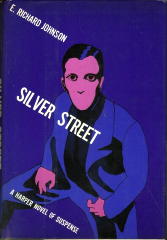
   SILVER STREET (Harper & Row, 1968) introduced the mystery world to E. Richard Johnson (1938-1997), a convict serving a life term at Minnesota’s Stillwater State Prison. It’s a short and unadorned tale of the mean streets in a nameless city where a modern Jack the Ripper is slicing up the local pimps for no discernible reason.

   Streetwise homicide dick Tony Lonto’s hunt for the killer inevitably leads him to the discovery that his own girlfriend is a nympho and a whore. (Wouldn’t a streetwise cop have discovered this sooner?)

   Superficially the book is tough as nails but it’s drenched with cloying romanticism beneath the surface. Nevertheless it won an Edgar for best first novel, an award which was duly presented to Johnson in the prison visitors’ room.

   He wrote four more Lonto books and several other novels before being released in 1991 but by then his writing career was washed up and he died a few years later. So does crime pay or doesn’t it?

REVIEWED BY DAN STUMPF:         


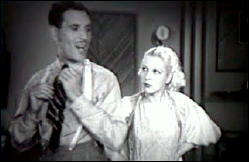
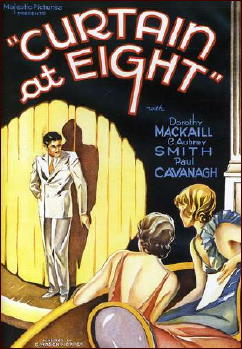
CURTAIN AT EIGHT

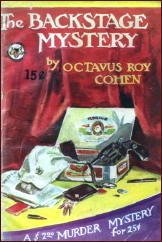
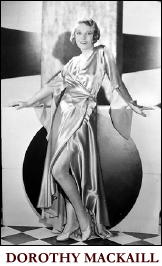
CURTAIN AT EIGHT. Majestic, 1933. C. Aubrey Smith, Dorothy Mackaill, Paul Cavanagh, Sam Hardy, Russel Hopton, Natalie Moorhead and Ruthelma Stevens. Written by Edward T. Lowe Jr. Based on the novel The Backstage Mystery by Octavus Roy Cohen. Directed by E. Mason Hopper.

   I’m not going to recommend Curtain at Eight because as a movie it’s mostly beneath contempt. Poor direction, a perfunctory screenplay that fails to keep track of the characters (when the killer was unmasked at the end, I wasn’t even sure I’d seen him/her before!) and entirely too much time wasted on the supposedly funny antics of a monkey.

   All the ingredients of a real time-waster, and yet … by the time I finished Curtain I found myself completely charmed by it.

   The cast mostly tries to punch through the desperate production values common to the sub-B studios of the time: shabby sets, ragged editing and continuity errors bad enough to cause whiplash, but they give it a game try, and director Hopper managed some effects that caught me off guard.

   Paul Cavanagh, the perennial Nowhere Man of the Cinemah, puts in a neat turn as an Absolute Bounder, a matinee idol who cheats, steals, seduces and ruins everyone he meets with the exception of his part-time wife, played by that energetic vamp of the early talkies, Natalie Moorhead, who had basically the same part in Shadow of the Law.

CURTAIN AT EIGHT

   There’s a dandy scene in a hotel room where Cavanagh is talking on the phone to his latest fiancée, and Moorhead, who has obviously spent the night with him, stifles a sarcastic laugh when he says he had trouble sleeping.

   Cavanagh spends the first half of the film this way while various other characters wander in and out of the plot, often looking a bit dazed and confused as to their reason for being there. We get the boozy reporter (Russell Hopton) the star-struck innocent, deftly played by Ruthelma Stevens (an intriguing actress who deserved better — catch her in The Circus Queen Murders if you can) her worried father and jilted boyfriend, sundry Theatre types, and (alas!) the Monkey, whose antics provoke tedium that would have maddened Sisyphus.

CURTAIN AT EIGHT

   By the time someone finally got around to getting murdered (in a neatly done if predictable moment.) I was torn between watching more of this or just taking my own life as an easier alternative. Then Sam Hardy came on as a pompous police detective, and things livened up. His bravura playing of a stock part perked things up considerably, particularly when he paused in his strutting across the screen to toss a comment at another cop sitting unnoticed in the background, and it turned out to be C. Aubrey Smith!

   Smith, the unofficial head of the Hollywood Raj in those days, and a regular in much better films, is simply marvelous here. Surprisingly shabby and soft-spoken, he ambles pleasantly about the scenery Hardy is chewing at, picking up a clue here, posing a pertinent question there, making his quiet deductions and bringing things to a close with considerable charm. I don’t know what burst of desperate genius led to his presence here in such a well-realized part, but it turned Curtain at Eight into something truly enjoyable.

   I should note in passing that in his day, the guy who wrote this thing was something of a pulp wunderkind; Edward T. Lowe had a hand in the Charlie Chan series at Fox, the Bulldog Drummond films at Paramount, and delirious efforts elsewhere like Sherlock Holmes and the Secret Weapon, Tarzan’s Desert Mystery and House of Dracula. Clearly a hack of distinction.

CURTAIN AT EIGHT

REVIEWED BY WALTER ALBERT:         


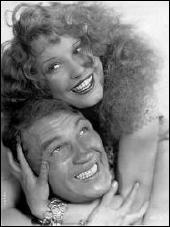
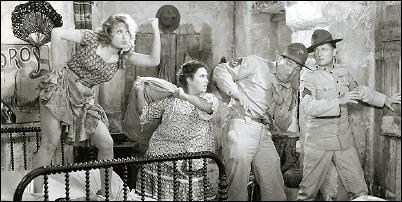
COCK-EYED WORLD

THE COCK-EYED WORLD. Fox Film Corporation, 1929. Victor McLaglen, Edmund Lowe, Lily Damita, Leila Karnelly, El Brendel, Bob Burns, Stuart Erwin. Director: Raoul Walsh. Shown at Cinefest 26, Syracuse NY, March 2006.

   I was not in a great mood for this reprise of performances by McLaglen and Lowe as Top Sergeant Flagg and Sergeant Harry Quirt, last seen in a 1926 success, What Price Glory?, but my grumpiness evaporated early on, beguiled by the combative charm of the leads and non-stop action orchestrated by director Walsh.

    The crowded plot follows the two rascals from Siberia by way of Coney Island to Central America, with brawls and womanizing pretty much summarizing the early scenes, then shifting to a more serious engagement in Central America that has the boys fighting for country, girls and the studio’s profit margin.

    This film is definitely pre-code, with girls, girls, girls in various stages of dress and undress. And oh, yes, there’s familiar comic El Brendel gracing yet another film with his ubiquitous and not always amusing presence. A lively romp that escapes the leaden ace of so many early sound films and races to a satisfying conclusion.

    PS. Jim G. was particularly impressed by the beautiful Lily Damita, future wife of Errol Flynn.

COCK-EYED WORLD

REVIEWED BY DAN STUMPF:         


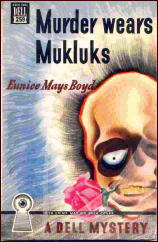
EUNICE MAYS BOYD – Murder Wears Mukluks. Farrar & Rinehart, hardcover, 1945. Dell #259, paperback, mapback edition, no date [1948].

EUNICE MAYS BOYD Murder Wears Mukluks

   Last summer, when I purged my collection preparing to remodel my room, I thought long and hard about one book, the Dell mapback edition of Murder Wears Mukluks, by Eunice Mays Boyd, author of Murder Breaks Trail, Doom in the Midnight Sun, etc. Should I pitch it or keep it?

   It didn’t seem likely I’d ever read this thing, but in some way my library seemed richer, warmer, more diverse and enjoyable just because there was a book there somewhere called Murder Wears Mukluks. Does anyone know what I mean?

   Anyway, I compromised by putting Mukluks on my to-be-read shelf and a few weeks ago I actually started on it, only to give up fifty-some pages inwards. There was plenty going on: jealousy, murder, bitter feuds and even a ghostly apparition, but the characters never seemed to be anything more than figures in a puzzle, their whole existence in these pages defined by their relationship to the murder.

   As such, it got rather hard to take much interest in them, and I gave it up as a bad job with two hundred unread pages to go.

   Which leaves me once again with the same problem I had last summer: keep it or pitch it? I’d sold off much much better books than this, but there’s just something about going through my shelves and discovering Murder Wears Mukluks that appeals mightily to my heart.

   Any thoughts?

Editorial Comment:   My own review of this book was posted on this blog a couple of years ago. Check it out here.

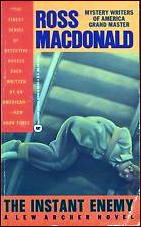
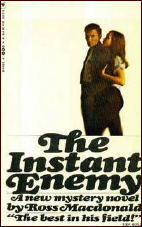
ROSS MACDONALD Instant Enemy

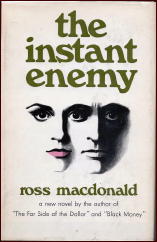
ROSS MACDONALD – The Instant Enemy. Alfred A. Knopf, hardcover, 1968. Reprinted many times.

   In many ways The Instant Enemy is typical of Macdonald’s entire output, in that the emphasis is on story and plot, and the personality of the detective, one Lew Archer, hardly ever enters into it.

   Archer, in other words, is an observer, and we never get much of an insight into what makes him tick. One exception I noted was on page 112 (in the Warner paperback edition I read), where the possibility of getting paid $100,000 jars Archer into the unexpected realization that maybe he might even retire.

ROSS MACDONALD Instant Enemy

   That’s probably a million dollars in today’s money, and he feels pretty good about the idea. The moments lasts for only a page, though, and then it’s back to the case on hand. It starts out simply enough — he’s hired to bring back a runaway daughter who’s gone off with a psycho boy friend with a sawed-off shotgun.

   Things are never that simple in a Ross Macdonald book, however, and soon all sorts of entanglements with the past begin to emerge, like pulling a root out of a sewer pipe and finding you’re dragging the whole tree out with it. If trees had Oedipus fixations, I think the analogy would be complete. (See page 146.)

ROSS MACDONALD Instant Enemy

   Although Instant Enemy is much like all of Macdonald’s other books, and the ending is absolutely terrific, I don’t think this is one of his better ones. (Those of you you’ve read them all recently, please feel free to contradict me on this.) I think it may be the pacing. It’s relentless; it doesn’t give up for a minute; and if you’re so minded, it could become downright monotonous.

   Archer is on the go from the beginning of the book to the end. When he’s tired for a moment, he pulls over to a motel and sleeps for a couple of hours, and then he’s on the road again. I think a good many readers are going to feel the need to pull over themselves, right about the three-quarters mark.

   If I’m right about this, and maybe I’m not, second-rate Macdonald is still number-one goods, but in this particular case, the really prime stiff is all at the end. People who prefer the light frothy sort of mystery simply aren’t going to get there.

— Reprinted from Mystery*File 37, no date given, slightly revised.


Reviewed by DAVID VINEYARD:         


NORTH WEST FRONTIER

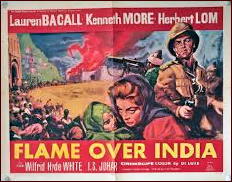
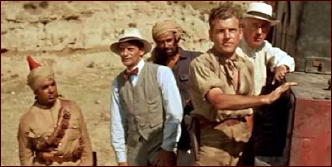
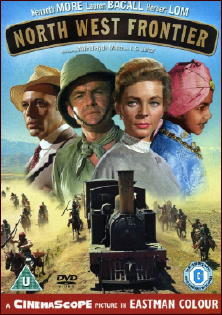
NORTH WEST FRONTIER. The Rank Organisation, UK, 1959. US title: Flame Over India. Kenneth More, Lauren Bacall, Herbert Lom, Wilfrid Hyde-White, I. S. Johar, Ian Hunter. Directed by J. Lee Thompson.

   Set your movie on a train and you already have my attention. Make one of the classic action films of all time with a first rate cast and superb tension from an expert at directing action and suspense (Cape Fear, The Guns of Navarone) *, and you have a first rate film shot in gorgeous color and on location.

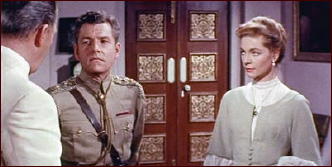
   Kenneth More is a British officer in command of a small troop of Sikhs in an isolated kingdom on India’s rugged outlaw ridden northwest frontier. A rebellion has broken out against the local Maharajah, and the British consul (Ian Hunter) wants More to get a group of Europeans trapped in the palace out safely — and along with them, the Maharajah’s young son and his American tutor (Lauren Bacall).

   Among the European’s are a Dutch journalist with Indian blood (Lom), a garrulous older man (Hyde-White), a gun runner, and a redoubtable older Englishwoman. Their only means of escape an aging train engine, her Indian driver (I. S. Johar), one coal car, a flat car, and a passenger car.

   Film goers used to today’s frenetically paced films will find the fact this one bothers to stop to develop character, build an intriguing relationship between professional soldier More and doubting American Bacall, and establish the other characters as well, a bit slow, but even they will be impressed by the action sequences beginning with the breakout from the surrounded palace in the train and including running gun fights, a perilously damaged bridge across a precipitous gorge, and a final full out assault by hordes of tribesmen on horseback while a traitor in their midst pins the passengers and soldiers down with a .50 caliber machine gun he has taken over.

   More and Bacall have real spark together, Lom provides both menace and depth, and Hyde White is his usual charming self, but the real surprise of the film is Johar, who takes what could be a stereotyped local and gives him both real courage, strength, determination, and character. Both he, and through him the aging train engine he loves, become compelling characters in the film.

NORTH WEST FRONTIER

   He takes what could be an embarrassing and potentially racist stereotype and gives him dignity and humanity.

   The film isn’t an old fashioned paean to the Raj though, in the Gunga Din or Lives of the Bengal Lancers tradition. It asks questions, and while it is unstinting in its admiration for More’s professional soldier, it, and Bacall’s character, bring up the question of what right he or the British Empire has there. And More is no superman, but a tough wry professional, limited perhaps in his devotion to his duty, but also human, canny, good humored, and courageous.

   This is a stunningly photographed film with an intelligent script and a real sense of the time and the place.

   One scene in particular in a crowded engine room while a rickety and dangerously open donkey engine runs the pumps to water the train’s engine while Lom is left alone with the prince is splendidly shot and guaranteed to get you on the edge of your seat.

NORTH WEST FRONTIER

   Within the confines of an action packed thriller it takes on questions of race, fanaticism, duty, freedom, and individual courage without ever faltering in the line of suspense and action or brushing the questions it asks off with simple answers.

   In relation to what has been happening in the Middle East in recent years it may be as pertinent as ever.

   Granted, despite the best efforts of all concerned there isn’t a lot of doubt who the villain proves to be, but that said, he is given both dignity and depth. You may be pulling for him to fail and cheering for the heroes to escape, but you can’t ignore his points or his own plight. All the major characters are presented as real humans rising or failing to rise in a crisis, not as mere plot points.

   And the film manages to end on a nice note of irony — a recognition that an era was coming to an end and a new world being born. It’s the perfect coda to a first class adventure film and a fine study of people caught in desperate circumstances and showing grace under pressure.

    * Sadly Thompson did not live up to his early films and ended up hacking out some tired and unimpressive Charles Bronson films late in his career.

NORTH WEST FRONTIER

« Previous PageNext Page »