Reviews


REVIEWED BY DAN STUMPF:


BELLA DONNA / TEMPTATION

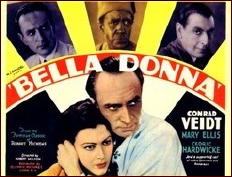
BELLA DONNA. Twickenham Studios, UK, 1934. Mary Ellis, John Stuart, Nigel Armine, Cedric Hardwicke, Conrad Veidt, Jeanne Stuart. Based on a novel by Robert Hichens. Director: Robert Milton.

TEMPTATION. Universal Pictures, 1946. Merle Oberon, George Brent, Charles Korvin, Paul Lukas, Lenore Ulric, Arnold Moss. Based on a novel by Robert Hichens. Director: Irving Pichel.

   Bella Donna is one of those unique little films that will stay on my mind long after better-known flicks have gone their way. Based on a novel by Robert Hitchens and a play by James B. Fagan, it weaves, rather than tells, the story of a divorcee apparently used to using men and using them up, who marries a chump and goes with him to Egypt where he’s apparently some sort of busy muckety-muck with a job that entails long separations.
BELLA DONNA / TEMPTATION

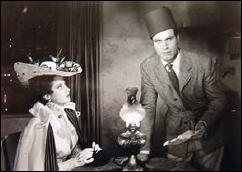
   Bored and horny, she falls under the spell of a sinister Egyptian — himself something of a rat with women — and finds herself hopelessly addicted to his charms. So much so that when he expresses annoyance at her husband’s infrequent presence, she decides on divorce-by-poison, with intriguing consequences.

   This story is put across in a series of rather stagey confrontations — the plot is developed and moved around by long scenes of dialogue rather than action — but this in no way diminishes the charms of a film whose chief allure is in mood and atmosphere. Bella Donna starts out as a very properly British sort of thing, with smoking jackets, drawing rooms, and a nearly palpable sense of Stuffie Olde Englande, furthered by the playing of Mary Ellis as the divorcee, John Stuart as the chump, and especially Sir Cedric Hardwicke as the chump’s wise doctor-friend, looking ruefully on as his old chum hastens to ruin.
BELLA DONNA / TEMPTATION

   Once the couple leaves England, though, we get an equally visceral sense of Egypt as some eerie fairyland, a kingdom suffused with dread and desire in equal measure. Conrad Veidt turns in a magnetic performance as the sinister Egyptian (despite the fact that his makeup keeps changing from pale Eurasian to something resembling a minstrel show) stalking through sets of literally byzantine splendor, and director Robert Milton maintains a slow but insistent pace, like the music of a snake-charmer, as the story plays itself out to a conclusion I will probably never forget. The last shot of Bella Donna is one of those rare cinematic codas, like the last shot of Vertigo, The Searchers or Shock Corridor, that says much more than words ever will, and one that’s a lot of fun to get to.
BELLA DONNA / TEMPTATION

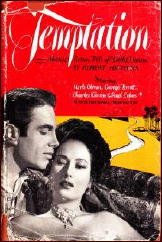
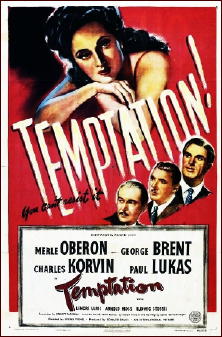
   The story was remade in Hollywood in 1946 as Temptation, directed by Irving Pichel, with Merle Oberon as the femme-would-be-fatale, who marries George Brent over the objections of Paul Lukas and subsequently falls for Charles Korvin. Temptation seems to have set the pattern for subsequent Victorian noir films like Ivy (1947) and So Evil My Love (1948) but it also shows the sad censorial effects of its time:

   Where the Mary Ellis in the earlier film seemed warped by lust, Merle Oberon is merely enslaved by passion. Poisoning the chump becomes her lover’s idea, not her own, and both lover and erring wife must come to some explicitly sticky end. And I mean sticky. The writers apparently got themselves into a corner on this one, deciding that a big star like Merle Oberon had to meet her own fate (rather than get picked up by the cops) but Suicide as a plot resolution was not permitted in films then.

   The result is a rather muddled off-screen affair recounted by Lukas to an unbelieving cop (nicely played by Arnold Moss, usually a heavy in the movies, and a very good one). There is, however, a rather nice wrap-up, and the rest of the film is done with enough grace and Hollywood polish to make it a pleasant 98-minute trip.
BELLA DONNA / TEMPTATION

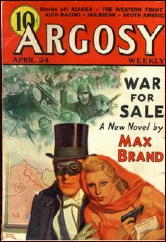
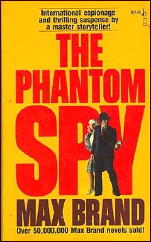
MAX BRAND – The Phantom Spy. Pocket, reprint paperback, December 1975. Dodd Mean, hardcover, 1973. First serialized in Argosy magazine, as “War for Sale,” April 24 to May 15, 1937.

MAX BRAND The Phantom Spy

   They don’t write spy novels like this any more, and even when they did, I have a feeling that it was only Max Brand who wrote them. He had a highly romanticized view of the world, one in which friends were friends, lovers were lovers, and enemies were enemies, and even on occasion when there was some well-constructed confusion as to which was which, the reader always knew.

   Lady Cecil de Winter is the early star of this one, a delightful young lady with a real feel for the game of espionage. Recruited by the British government in those days immediately prior to World War II to retrieve missing plans for the Maginot Line – a grand line of defense designed to protect France and Western Europe on the chance that war should break out — she recruits in turn a fellow named Willie Gloster, a cheerful, happy-go-lucky American who provides the help she needs, only to have her lose them again (the plans, that is) to the hands of a suave but evil mastermind by the name of von Emsdorf.

MAX BRAND The Phantom Spy

   And the game is on. Not since reading the adventures of the early Saint have I read a tale of down to earth swashbuckling, without a single swash or buckle in sight. There is, of course, a phantom spy, a chap named Jacquelin, whom Lady Cecil believes to be another fellow named Cailland. We know better, and we groan in despair when she leaves the love of her life, Willie Gloster, who comes to her aid again anyway.

   There is blood, there is danger, and there is one hell of a grand impersonation, and there is more. This is the real stuff, but written well before we know how far Hitler would go and how the war would really be waged. Max Brand, who of course is much better known for his westerns, was well aware of what causes countries to wage war with one another, but only close to the end of this book does he let the details intrude, and truth be told, I’d’ve rather he hadn’t.

   This is very much of a period piece, if you haven’t gathered that already, but as I suggested at the beginning, perhaps it was even at the time it was written.

Josef Hoffmann:
Two Crime Novels by RYERSON JOHNSON

   Ryerson Johnson (1901-1995) is known primarily as an author of Westerns, but he also wrote numerous crime novels. Only two were published in his own name:

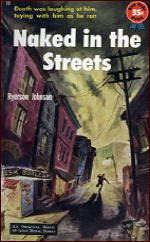
         Naked in the Streets, Red Seal #10, Fawcett, 1952, cover art Carl Bobertz.

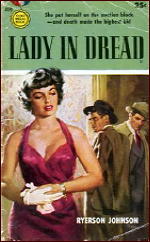
         Lady in Dread, Gold Medal #459, Fawcett, 1955, cover art Barye Phillips.

RYERSON JOHNSON

   Naked in the Streets begins like a noir novel. Herbert Hopson is employed in a company that manufactures perfume. On the way to work he is knocked from the sidewalk into the street by an unknown passerby and almost run over. He cannot believe that this happened intentionally. As he suffered a minor injury and tore his clothing in the fall, he returns home to change clothes.

   A strange scene awaits him in his apartment. In the half-light his wife, Sybil, sits on a chair as if on a throne in an almost naked state, with a dog whip in her hand and stilettos on her feet. She is enraged at her husband because he has returned home unannounced. She explains the strange scene by claiming that she will be appearing at a charity bazaar as an animal trainer.

   Hopson goes back to work wearing fresh clothes. There he behaves in such a provocative manner that he is fired instantly. He goes to a strip club to see Sally Dawn, whom he worships, stripping. During this time, a man seated in the seat in which Hopson should have been sitting is murdered. Hopson flees from the club and later returns to his apartment.

   In an argument with Sybil he rips the clothes from her body, while she scratches his face. Whereas Hopson is ashamed, his wife is turned on by the violent behaviour and wants him to punish her with the whip. Her husband is disgusted and leaves the apartment in a state of shock. When he returns shortly afterwards in order to talk things through with her, she is dead, strangled.

   Hopson fears that the police will not believe in his innocence, which is why he does not call them. He suspects that the murder is somehow connected to his wife’s double life. In the apartment he catches the scent of a perfume produced by his company that is still in the testing phase and which has not yet been released to the market.

   For this reason Hopson suspects that someone from the company is involved in the murder plan. He sets off to find the suspects and to reveal the real murderers. In the process he is hunted by both the murderers and the police. He ends up in turbulent scenes, but he constantly finds people who trust him and help him. The story naturally includes a prostitute, who falls in love spontaneously with our hero and provides him with an alibi. And then of course there is also the mysterious Sally Dawn.

   Although the story of Naked in the Streets is at times unrealistic and kitschy, the action is very varied and the dramaturgy of suspense is well done.

RYERSON JOHNSON

   Already after reading the first two pages of Lady in Dread we know that the author has very clear ideas of Good and Evil, and where his position is in relation to each. The novel is set in Coalfield, a city to the south of Chicago, which has been dominated by gambling and crime since the decline of the coal-mining industry.

   Tessie Cullen, a beautiful young woman, applies for a job as a “twenty-six girl” at a dice table in Farmer McGivern’s Top Money Tavern, and gets it. Farmer McGivern is one of the rulers of the city. A scene takes place every day at around the same time, opposite his gambling saloon, upon which the spectators place bets. A hawk sits on the flagpole of the courthouse and watches sparrows. Then, suddenly, it pounces on one of the sparrows and takes it as its prey. The spectators bet on the time of day at which the hawk carries out this act.

   Hally Harper, a good-looking young lawyer, comes to Coalfield on behalf of an animal welfare organisation, in order to combat the betting spectacle. In reality, however, he is a narcotics officer pursuing a truckload of opium. The opium belongs to a Chicago gangster syndicate and was stolen in the vicinity of Coalfield. The syndicate has a premises in Coalfield, a glamorous nightclub with a casino at the city limits. It is trying to extend its influence over the city. The syndicate gets Tessie Cullen to spy on the Farmer, especially to see if he has claimed the opium.

   There is yet a third party that also rules over Coalfield, the mayor. Which of the three parties has got hold of the opium delivery? Or is it a fourth, unknown entity? Harper tries to find out by questioning different people and searching for possible hiding places. In the process he whips up a storm and frequently ends up in danger of his life.

   Tessie Cullen, who first tries to trap Harper on behalf of the Farmer, later joins his side. She asks Harper how he can be so ambivalent in the face of impending death.

   The novel is varied and full of action, albeit rather conventional. A particular moment of tension is created by the fact that, while the hero and heroine act in a covert manner and are thus forced into falsifications and lies, they nevertheless try to maintain the core of their moral identity, in other words, to remain true to themselves. The narrative style tends towards hard-boiled, but not to noir fiction, as the protagonists are not subject to any calamitous fate. I always had a good feeling while reading the novel.

— Translated by Carolyn Kelly

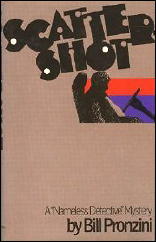
BILL PRONZINI – Scattershot. St. Martin’s Press, hardcover, 1982; $10.95. PaperJacks, paperback reprint, 1987.

BILL PRONZINI Scattershot

   Business, as they say, is booming. For Bill Pronzini’s pulp-collecting detective, for one, and for readers of private-eye fiction, for hundreds, if not thousands of others.

   Doomsayers to the contrary, the PI story is alive and — would you believe? — thriving. I’ve got a stack of PI novels here you wouldn’t believe how high, and if I weren’t awfully careful about it, I could read nothing but. Not that I would. I’d be burned out within a month if I did. I need a Leslie Ford every now and then, just to keep a proper perspective on things.

   But back to “Nameless,” as he has more or less officially been dubbed. All of a sudden he has more cases than he needs, especially just as his love life with Kerry (the lady he hit it off with so well in Hoodwink) is turning sour.

   Strangely enough, so do each of the three cases recorded in this book. Each becomes an impossible crime: a locked-room murder, a man who vanishes out of a constantly watched car, a wedding present that disappears out of a constantly guarded room.

   Terrific stuff , but 100 percent guaranteed to produce ulcers for the detective who is supposed to solve them or else. Lose his license? Nah, it couldn’t be … could it ? Life’s never this rotten. Is it?

   People not in the know constantly confuse PI fiction with hard-boiled fiction. There is an overlap, but nothing could really be much further from the truth. “Nameless” tries — he’s a man, and he has a macho image to maintain, whether consciously or not — but in many ways, in spite of all his rough edges, he’s also too soft and vulnerable. And likeable. He’d be hell to live with, but Kerry will come back. Won’t she?

   Hey, Bill! How long will we have to wait for the next one?

Rating: A minus.

— Reprinted from The MYSTERY FANcier,
       Vol. 7, No. 3, May-June 1983 (slightly revised).


[UPDATE]   If I have my chronology straight, the next book in the series was Dragonfire, which came out later the same year. I won’t tell you how the romance with Kerry came out, though. If you’re a fan of the series, you already know.

   I missed out on Patti Abbott’s multi-blog salute to Bill Pronzini on the occasion of his 70th birthday a couple of weeks ago. I had this review in mind to be included, but … time got away from me.

   Scattershot was the 8th book in the Nameless series, and now there are 30 more, or 38 in all, not including short stories, novelettes, and novellas. Best wishes for many more birthdays, Bill, and for many more books in the series.

A REVIEW BY DOUG GREENE:
   

JONATHAN STAGGE – The Yellow Taxi. Popular Library 63, no date (ca. 1945). Originally published by Doubleday Crime Club, hardcover, 1942.

JONATHAN STAGGE The  Yellow Taxi

   I have commented previously in these pages about the works of the authors [Richard Webb and Hugh Wheeler] who used the pseudonyms Q. Patrick, Patrick Quentin and Jonathan Stagge. The Yellow Taxi, I believe, is their best book. For one thing, rather than picking a rather obvious least-likely suspect (as Webb and Wheeler often did, especially in the Patrick Quentin books), in The Yellow Taxi they distribute suspicion evenly among a number of possible miscreants. For another, the plot is bizarre, elaborate and yet beautifully dovetailed.

   A terrified young woman approaches Dr. Westlake, the narrator and detective of the Stagge books, with a story about being hounded in a small New England community by a yellow New York taxicab. Westlake is inclined to pooh-pooh the story until he himself sees the taxi. (Webb and Wheeler are much more successful than certain creators of horror films in making an automobile an object of terror.) When the woman is killed falling off a horse, Westlake’s daughter, Dawn, finds evidence of murder. The eventual discovery of the role of the taxi only deepens the mystery.

   Moreover, Stagge may be playing with jaded experts in detective fiction, for he introduces identical twins and we assume (or at least I did) that confusion of identity is involved. It’s not, and the final solution is convincing and well-clued.

— Reprinted from The Poisoned Pen, Vol. 6, No. 2, Winter 1984/85.

REVIEWED BY DAN STUMPF:


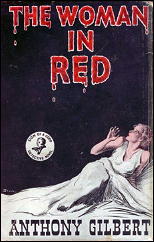
ANTHONY GILBERT – The Woman in Red. Collins Crime Club, UK, hardcover, 1941. Smith & Durrell, US, hardcover, 1943. Digest-sized paperback: Mercury Mystery #91. Also published as The Mystery of the Woman in Red: Handi-Books #29, paperback, 1944. Film: Columbia, 1945, as My Name Is Julia Ross. Film: MGM, 1987, as Dead of Winter.

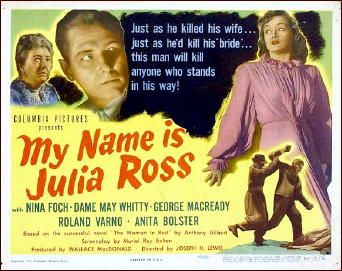
MY NAME IS JULIA ROSS. Columbia, 1945. Nina Foch, Dame May Whitty, George Macready. Based on the novel The Woman in Red, by Anthony Gilbert. Director: Joseph H. Lewis.

ANTHONY GILBERT My Name is Julia Ross

   I almost gave up on Anthony Gilbert’s The Woman in Red after the first few pages because it seemed like every other paragraph conveyed some form of Had-she-but-known, often more than once. F’rinstance: She was wondering why she should be so convinced that nothing but harm, of danger even, could come of this venture…her whole being shaken by a protest that was instinctive and illogical In her brain, a voice rang like a chiming bell, “Don’t go,” it pealed, “Don’t go, don’t go, don’t go!”

   At which point I damnear went. But I stayed with it and I’m glad I did. Woman in Red isn’t completely successful, but when the characters talk, they slip the surly bonds of Gilbert’s prose and come alive, with entertaining results. This was my introduction to series sleuth Anthony Crook, a delightfully irreverent character and light counterbalance to the turgid and often ridiculous story around him.

   Well, maybe not ridiculous; the tale of Julia Ross, a working girl who takes a position as an old dowager’s secretary, only to find herself whisked off to a remote house in the country where everyone calls her by another name and treats her like she’s crazy has some effective moments and even generates a good deal of suspense.

   But it’s hard to take a story seriously when the would-be killer tricks our heroine into wearing a red dress so as to rouse the deadly ire of a passing bull. And when the basis of the plot turns out to be a nest of foreign spies being coincidentally pursued by Julia’s beau…. Well I’m just glad there were enough bright characters and tricky bits of business to make it all worthwhile and even entertaining.

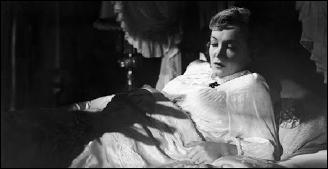
   Woman in Red was turned into a film called My Name Is Julia Ross (Columbia,1945) and it had the artistic fortune to be adapted by Muriel Roy Bolton and directed by Joseph H. Lewis, a filmmaker who brought artistry to just about everything he touched. Shot in 18 days (as delightfully detailed in Mike Nevin’s Joseph H. Lewis [Scarecrow, 1998]) on a budget that wouldn’t buy catering on most “A” pictures, this emerges as a riveting, atmospheric film, and one to look out for.

   Nina Foch is excellent as the imperiled heroine, set neatly against Dame May Whitty as the dotty-looking but sinister master- (or should it be mistress?) -mind. Even better, there’s George Macready as Whitty’s not-quite-right son. Bolton re-structures the basis of the plot, replacing spies with a background story that George married a wealthy heiress for her money, then inconveniently killed her. Now he and Mom need a replacement who can be passed off as the wife and meet a more acceptable end so he can inherit her fortune and avoid the gallows.

ANTHONY GILBERT My Name is Julia Ross

   It’s fine work from writer Bolton, who also did an intelligent job on something called The Amazing Mr. X, which I must get around to reviewing someday.

   Director Lewis does an outstanding job with all this. His off-beat angles and compositions are never just showy, but always work to establish character or atmosphere. And he creates a nifty tension between the murderous mother and son, with Whitty always trying to take knives and other sharp objects away, and Macready always on the point of rebelling — a nasty prospect from the look of him, and one he would relish. Macready’s career ran the gamut from the preposterous The Monster and the Ape to the prestigious Paths of Glory, but he was never better than right here, playing off Dame May Whitty like an incestuous Lorre and Greenstreet.

ANTHONY GILBERT My Name is Julia Ross


PostScript:   Mike Grost has a lot to say about this film on his website. Check out his long insightful article here. The movie was also reviewed by J. F. Norris on his blog. Here’s the link.

REVIEWED BY MICHAEL SHONK:


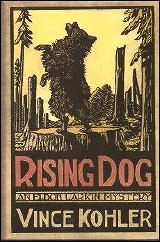
VINCE KOHLER – Rising Dog. St. Martin’s Press, hardcover, 1992. No paperback edition.

   Unlike most of today’s comedy mystery writers, Vince Kohler (1948-2002) understood the key to quality comedic mystery fiction is a good mystery with comedic elements, not how funny the jokes are. The few of us who have read his work still miss his talent for writing solid mysteries with eccentric characters, black humor, and a sense of the rainy coast of Oregon so real you’ll need a raincoat.

VINCE KOHLER Rising Dog

   Vince Kohler wrote four books, Rainy North Woods (1990), Rising Dog (1992), Banjo Boy (1994), and Raven’s Widow (1997). All four featured journalist Eldon Larkin who worked as reporter/photographer for the South Coast Sun, the local newspaper for small town Port Jerome, Oregon. Educated, he reads French classic literature in the original language, but proving how useful his education is, Eldon is a loser when it comes to the important things in life — women, cars, and career. He left Berkeley California and an ex-wife behind, and now dreams of the big story that will get him a job with a big city newspaper.

   The books can be read in any order and all of equal high quality. So I grabbed one off my shelf and was pleased to see Rising Dog.

   Rising Dog features a complex mystery centered on the murder of radical environmentalist John Henspeter, who is trying to stop a land developer from cutting down some trees to put up a condo. But while the mystery will hold your interest, it is the fast pace action, humor, and non-stop weirdness that will keep you entertained from beginning to end.

   Eldon responds to a phone call from Jasper, former drunken tugboat captain turned preacher, who claims to have raised his dog from the dead. Eldon meets with Jasper, the resurrected doggie and the members of Jasper’s church.

   On the way to where the miracle occurred, the group comes across some construction workers dealing with protester Henspeter. Things escalate, and as Eldon takes pictures, the church members and construction workers break out into a fight. It all stops with the arrival of a beautiful, topless mystery woman in her thirties on horseback (we will learn later her name is Enola Gay). All fall silent in awe. As quickly as she appears, she disappears back into the woods. Peace has been restored, until the dog arrives with a human foot. Its page 15 of 274 and the fun has barely begun.

   Kohler had a gift for ratcheting up the tension then easing off with a slight touch of the absurd. Near the end of the book, Eldon and Enola Gay finds themselves caught between gunfire from two sides:

   There were three shots from the trench. (Killer) was popping away with the Mauser. Eldon and Enola Gay flattened themselves as (killer) and the AK-47 gunner traded shots. Pop-blap, went the AK-47. The Mauser snapped in reply. Pop-blap. Pop-blap. Snap, snap. They’re both terrible marksmen, Eldon thought.

   Anyone who features odd characters is usually compared to Elmore Leonard, but Kohler’s books are better. Kohler’s pace and his ability to balance mystery, action, and humor avoids the dull sections I find in many of Leonard’s books.

   Kohler’s descriptions of locations are among the best in all fiction. He avoids the faults of the popular Weird Florida comedic mystery authors such as Carl Hiaasen, Christopher Moore, Tim Dorsey, etc. While too often the Florida locations out-weird the characters and events, Kohler’s locations play the straight man in his story, something real to anchor the story so the humor never cost the mystery its believability.

   Sadly, all four of his books are out of print and have yet to be rescued by e-books. There is little information on the Internet about Kohler besides his books for sale and two columns by his friend Bob Hicks.

      http://www.artscatter.com/general/sunday-scatter-it-was-a-dark-and-stormy-night-in-the-rainy-north-woods

      http://www.artscatter.com/general/going-native-on-the-oregon-coast-a-hair-raising-tale

   From Rising Dog, “Vince Kohler is a staff writer for the Oregonian in Portland. Kohler has traveled widely and in the course of his career, has filed stories from South America, Europe, the Soviet Union, and China. He is married, has three cats, and considers himself a permanent resident of the Pacific Northwest…”

   My favorite form of fiction is mystery lite, stories the opposite of film noir. Where film noir is soaked in self-pity and doom, mystery lite finds life too absurd to be taken seriously. Writers such as Norbert Davis, Ross Thomas, Gregory Mcdonald, Nat and Ivan Lyons, and Donald Westlake fill their books with the dark tragedies of life then make fun of them. Vince Kohler was one of the best at it. I miss him.

NOTE:   For a list of all of this week’s other “Forgotten Friday” books, check out Patti Abbott’s blog here.

THE ARMCHAIR REVIEWER
Allen J. Hubin


LYDIA ADAMSON

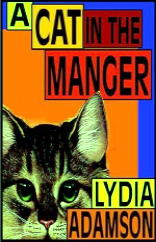
LYDIA ADAMSON – A Cat in the Manger. Signet, paperback original, 1990.

   A Cat in the Manger is the first in a series about sometime NYC actress and moretimes catsitter Alice Nestleton by the pseudonymous Lydia Adamson. This is a fanciful tale requiring hyperextension of disbelief, with a heroine of little appeal and an ending without the impact it could have had.

   Alice goes to Long Island to cat-sit for Harry and Jo Starobin, as she had done frequently before. This time, however, someone has hung Harry on the back of a door. Another corpse quickly turns up, just as motiveless a killing as the first.

   The police think robbery, but the Starobins were penniless — except for the $381,000 discovered in Harry’s safety-deposit box. And where has Ginger Mauch, who worked for the Starobins, gone off to, and why?

— Reprinted from The MYSTERY FANcier,
       Vol. 13, No. 1, Winter 1991.


[UPDATE.]   It is now known that Lydia Adamson is the pen name of mystery writer Frank King, who besides 21 books in his/her Alice Nestleton series (see below), also wrote 12 books in a series starring Dr. Deirdre Quinn Nightingale, veterinarian, and three books about birdwatcher and ex-librarian Lucy Wayles, not to mention five works of crime fiction under his own name.

       The Alice Nestleton series

1. A Cat in the Manger (1990)
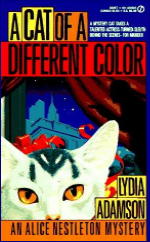
2. A Cat of a Different Color (1991)

LYDIA ADAMSON

3. A Cat in Wolf’s Clothing (1991)
4. A Cat in the Wings (1992)
5. A Cat by Any Other Name (1992)
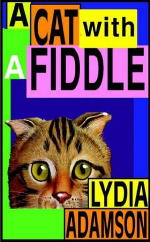
6. A Cat with a Fiddle (1993)

LYDIA ADAMSON

7. A Cat in a Glass House (1993)
8. A Cat with No Regrets (1994)
9. A Cat on the Cutting Edge (1994)
10. A Cat in Fine Style (1995)
11. A Cat on a Winning Streak (1995)
12. A Cat Under the Mistletoe (1996)
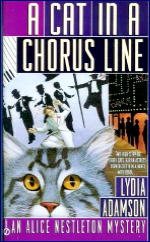
13. A Cat in a Chorus Line (1996)

LYDIA ADAMSON

14. A Cat on a Beach Blanket (1997)
15. A Cat on Jingle Bell Rock (1997)
16. A Cat on Stage Left (1998)
17. A Cat of One’s Own (1999)
18. A Cat With the Blues (2000)
19. A Cat With No Clue (2001)
20. A Cat Named Brat (2002)
21. A Cat on the Bus (2002)

THE BACKWARD REVIEWER
William F. Deeck


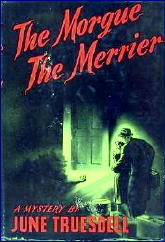
JUNE TRUEDELL The Morgue the Merrier

JUNE TRUESDELL – The Morgue the Merrier. Dodd Mead, hardcover, 1945.

   When mystery writer John Grover and his new bride, Lee, arrive at the house in Tree-Top Glen, apparently in Los Angeles, where they are to spend their honeymoon, the door is blocked by a body whose hand is the only part that can be seen. Moments later the body vanishes. Then a woman is murdered in one of the bedrooms, stabbed through the heart and with her throat slit.

   Grover and Lee call upon Julius Gilbert, criminologist not detective, who is five feet two inches tall, with two hundred pounds of tummy. (I suspect that Lee, the narrator, is exaggerating.) Muttering oracularly and managing to postpone the consummation of the marriage, Gilbert clears things up in a semi-fair-play novel after only one more murder.

   Those who like frenetic married-couple types should enjoy this one. While the characters are a bit extreme, as is the plot, in spite of these objections I am keeping an eye out for Truesdell’s later pair of novels, according to Hubin not featuring Gilbert or the Grovers, in which she may have exhibited a little more authorial control.

— From The MYSTERY FANcier, Vol. 13, No. 1, Winter 1991.


  Bibliography:     [Taken from Crime Fiction IV, by Allen J. Hubin]

TRUESDELL, JUNE (1918?-1996?)

        The Morgue the Merrier (n.) Dodd Mead, 1945.
        Be Still, My Love (n.) Dodd Mead, 1947. Film: The Accused, 1949.
        Burden of Proof (n.) Boardman, UK, 1951

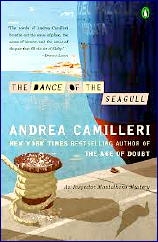
ANDREA CAMILLERI – The Dance of the Seagull. Originally published in Italian as La danza del gabbiano, 2009. Penguin, US, softcover, 2013.

ANDREA CAMILLERI The Dance of the Seagull

   This, the 15th and most recently recorded case of Inspector Salvo Montalbano (at least here in the US), begins with the agonized gyrations of a seagull the inspector sadly watches die before his eyes. Little does he know that a connection will soon be made between this event and his very next case, which has as yet not had time to develop.

   This being my first encounter with the inspector and his various adventures, I did not recognize at first the significance of the mysterious disappearance of Fazio, the latter one of his close-knit staff of subordinates. Montalbano is, as are many fictional police inspectors, Italian or otherwise, somewhat of a lone wolf in his approach to tackling crime, but one man cannot do it alone, and the men who work under him are much like family.

   The main thrust of the case, that of drug smuggling (or traffickers), is not particularly interesting, but even without a “Watson” to bounce his ideas off of, Montalbano displays a good sense of the world around him – which is to say that he’s a very good detective. Nor does a good sense of humor on the part of the author hurt in the least. I wouldn’t mind at all if I had the chance to catch up on any of Montalbano’s earlier cases, or his next one, whichever way it works out.

« Previous PageNext Page »