Reviews


REVIEWED BY MICHAEL SHONK:


THE ADVENTURES OF HIRAM HOLLIDAY. California National Presentations, filmed for NBC, 1956-57. Based on the stories by Paul Gallico. Cast: Wally Cox as Hiram Holliday and Ainslie Pryor as Joel Smith. Produced by Philip Rapp.
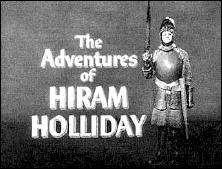
THE ADVENTURES OF HIMAN HOLLIDAY

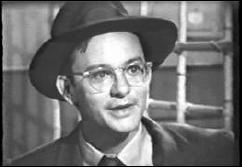
    The Adventures of Hiram Holliday is an amusing action spoof. The plots leaned to the absurd such as when Hiram stopped some foreign spies from turning Pearl Harbor to ice (“Hawaiian Humzah”). The humor was gentle and often based on misunderstanding or the odd image of Wally Cox as an action hero to rival Errol Flynn.

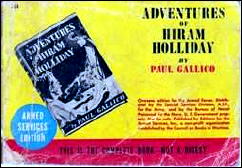
   The screen credit and announcer tells us the series was “based on stories by Paul Gallico.” Which is odd since The Adventures of Hiram Holliday was published as a book in 1939. More confusing is Billboard (May 12, 1956), reported the TV series was based on stories from the Saturday Evening Post. Paul Gallico was writing stories for that magazine during the fifties, so perhaps Hiram appeared as a serial in the Saturday Evening Post.

   Hiram Holliday was the copy editor for the newspaper New York Chronicle. Hiram catches an error that could have bankrupted the paper in libel charges. The grateful publisher Harrison Prentice sends Hiram on a trip around the world accompanied by reporter Joel Smith. On the way Hiram and Joel share one strange adventure after another with Hiram always the hero in the end and Joel failing for one reason or another to get the story published.
THE ADVENTURES OF HIMAN HOLLIDAY

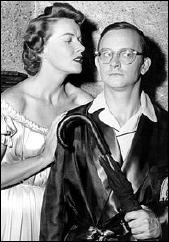
   Wally Cox carried the show with his ability to make the absurd character of Hiram believable. It is Cox that makes the series funny and worth watching. He underplays the character, reacting to danger with a confident calmness. In one episode Hiram enters his room to find the femme fatale waiting for him. The room had been trashed and thoroughly searched. She tells Hiram she had been waiting for him. Hiram looked around and calmly replied he was glad she found something to do while waiting.

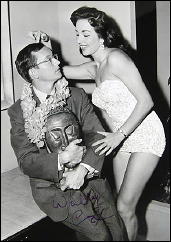
   The rest of the cast were limited by one-note characters of dubious logic and were played by actors of various talents, from Sebastian Cabot to Thor Johnson (aka Tor Johnson). Publisher Prentice (Thurston Hall) existed to scream at Joel. The mastermind would make mistake after mistake while blaming it all on his henchman or femme fatale. The femme fatales existed to seduce Hiram.
THE ADVENTURES OF HIMAN HOLLIDAY

   Each episode would begin with Hiram and Joel entering a new country. Hiram’s interest was always in scientific and academic challenges. In Hawaii, he wanted to visit a Professor to study a lost consonant of the language. In Hong Kong, Hiram’s quest was for the rare sea cucumber.

   Quickly, Hiram would stumble into an adventure while Joel was usually off somewhere eating. For reasons unexplained the misused laugh track thought Joel eating was hilarious, making it a bad running gag.

   Villains arrive, usually made up of a mastermind, femme fatale, and a henchman. Through comedic misunderstanding the bad guys believe they have to get rid of Hiram. Hiram innocence and complete honesty is disbelieved and he has to turn into an action hero, from fighting atop a speeding train to performing some feat such as a carnival high dive act that he had never done before but had read about.

   Ainslie Pryor failed to rise over the thankless role of Hiram’s traveling companion and best friend, Joel Smith who at times broke the fourth wall to talk to us. It was a difficult role. His character spent much of the time clueless and existed for Hiram to rescue or to take the brunt of the blame from the authorities for many of the misunderstanding that revolved around Hiram. In “Wrong Rembrandt.” Hiram had painted such a perfect copy of a Rembrandt the French police arrested Joel for art theft.
THE ADVENTURES OF HIMAN HOLLIDAY

   Production values were fine considering the era. Philip Rapp produced the series and wrote and directed many of the episodes. The show was funny but after a few episodes the situations became repetitive and the humor grew tired. How often can you laugh at Hiram winning swordfights with his umbrella?

   The series followed Wally Cox’s successful turn as Mr.Peepers. But that success didn’t carry over to Hiram Holliday. General Foods was the sponsor of The Adventures of Hiram Holliday and quickly regretted it.

    Hiram Holliday premiered October 3, 1956 on Wednesday at 8-8:30pm (Eastern). In Billboard (October 13,1956), according to rating service Trendex, NBC’s Hiram received a 11.4 compared to ABC’s Disneyland with 19.2 and CBS’s >Arthur Godfrey Show with 14.2.
THE ADVENTURES OF HIMAN HOLLIDAY

   Billboard (January 1, 1956) discussed some of the TV series in trouble. Shows the sponsors were unhappy with but had given a 26 episodes or 52 episodes commitment. This included General Food and Adventures of Hiram Holliday.

   January 28, 1957 issue of Broadcasting reported, “General Foods, N.Y. will drop its sponsorship of Hiram Holiday (sic) on NBC-TV, Wed. 8-8:30pm, and will become instead the alternate week sponsor of Wells Fargo (Monday, 8:30-9pm) effective March 18th.”

   On February 27, 1957, the twentieth episode of the series to air was the last on NBC. Reportedly, three more episodes were showed in England during syndication, leaving 23 episodes apparently filmed.

   Various episodes of the Adventures of Hiram Holliday are available on low budget DVD.

   And on You Tube, at the moment, is the episode, “Moroccan Hawk Moth.”

REVIEWED BY DAN STUMPF:


HORRORS OF THE BLACK MUSEUM

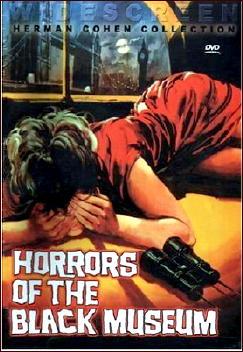
HORRORS OF THE BLACK MUSEUM. American-International Pictures, 1959. Michael Gough, June Cunningham, Graham Curnow, Shirley Anne Field, Geoffrey Keen, Gerald Anderson, John Warwick. Director: Arthur Crabtree.

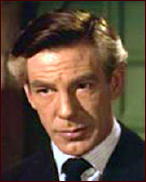
    Horrors of the Black Museum is a gaudy comic book of a movie, best enjoyed if you park your good taste and critical faculties with the gum under your seat. The story, by Herman Cohen and Aben Kandel (the team that brought us such classics as I Was a Teenage Werewolf, I Was a Teenage Frankenstein and Berserk) posits that a best-selling True Crime writer (Michael Gough, masticating the scenery with sadistic relish) gets his insights by committing the crimes himself — or having them committed by a young assistant in hypnotic thrall to him.

HORRORS OF THE BLACK MUSEUM

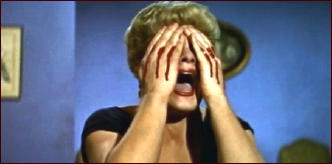
    The murders themselves are fairly grisly, including the opening bit (featured in all the previews) with a pair of booby-trapped binoculars, and are all practiced against lissome young ladies, but they have the redeeming value of being so far over the top (like Gough’s acting) as to provoke the odd chuckle.

    At one point, for instance, we are asked to believe that the killer snuck into a woman’s apartment and built a guillotine over her bed which she doesn’t see until she lies down in just the right position for it to — well you get the idea. Even better is Gough’s sanctum sanctorum, filled with acid vats, S/M apparatus and some sort of machine mounted with dials, lights and levers that seems to serve no function at all.

    Okay, admittedly the writing is perfunctory, and the acting mostly capable but undistinguished. There’s also some fairly prominent homophobia running through all this, what with the tastefully appointed bad guy keeping his handsome young assistant enslaved so they can victimize women. But I found Horrors suffused with a redeeming energy and engaging carelessness that kept me entertained throughout.

HORRORS OF THE BLACK MUSEUM

THE BACKWARD REVIEWER
William F. Deeck


BILL S. BALLINGER The Tooth and the Nail

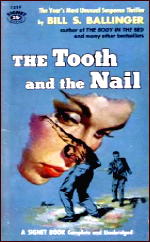
BILL S. BALLINGER – The Tooth and the Nail. Harper, hardcover, 1955. Signet #1319, 1956; cover by Robert Maguire.

   A damsel in mild distress captures the attention of Lew Mountain, professional magician, and he comes gallantly to her rescue. She arrives in New York with a hatbox, an exceptionally heavy small satchel, and no dollar to pay the cab driver. Soon she joins Mountain’s act and marries him.

   Inevitably, given the folly of the female in distress, tragedy ensues. Mountain then — and I give away nothing here, repeating only what the author says in the prologue — avenges murder, commits murder, and is murdered in the attempt.

   While I can’t wax as enthusiastic as some reviewers have over this novel, it definitely is an enjoyable reading experience.

— From The MYSTERY FANcier, Vol. 13, No. 4, Fall 1992.


J. ALLAN DUNN The Girl of Ghost Mountain

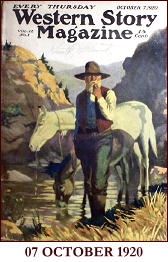
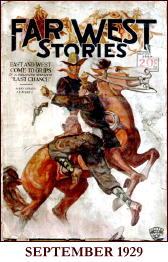
J. ALLAN DUNN – The Girl of Ghost Mountain. Small Maynard Co., hardcover, 1921. Serialized in Western Story Magazine in four parts, beginning with the 16 September 1920 issue; reprinted (I believe) as “The Ghost Mountain Girl” in Far West Stories, beginning with the July 1929 issue. Also currently available in various POD and ebook/online versions.

   Although I’ve billed this as a western novel in the heading for this review, The Girl of Ghost Mountain is much more a romance novel that takes place in the West. The date is never quite specified, but at the time it was written, it had to be the contemporaneous West.

   Prohibition is mentioned, for example, and the occasional automobile shows up or is made reference to. But there are plenty of cattle and horses too, so don’t be at all concerned in that regard. It’s still the West, although perhaps not the Frontier West.

J. ALLAN DUNN The Girl of Ghost Mountain

   Pete Sheridan is the new owner of the Circle S ranch, fresh from the east but acclimating to the west in fine fashion, while “Red” Jackson is his right hand man. They make a good team together, facing down bad guys with precision and aplomb, but they’re no match at all to the charms of the two ladies (one slimsy, the other near Amazonian) who settle in a hidden valley behind a waterfall up in the foothills of Ghost Mountain.

   The first two thirds of the book is the more interesting, as Red and Sherdian settle the hash of the main villain, a fellow named Hollister, an evil one through and through. Once he’s been vanquished and for good, with another 90 pages still to go, a stoic and enigmatic Chinese gentleman who’s been serving as their cook leads the pair to a cache of hidden gold.

   The path is not without its perils, but they are all easily overcome, as we (the reader) know at once will happen, including the prospects in the end (without giving anything at all away, I’m sure) of a double wedding soon in the offing.

   All things considered, while I enjoyed reading this one, something that kept niggling my mind is that a story entitled “The Ghost of Girl Mountain” might have had even greater possibilities, even though it’s obviously not the one Dunn intended. Sit back and think about it.

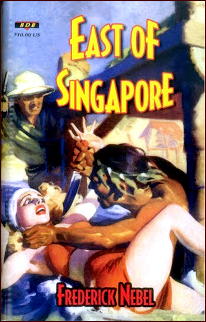
FREDERICK NEBEL – East of Singapore. Black Dog Books, chapbook, 2004. First published in Action Stories, July 1926, under the title “Somewhere East of Singapore.”

FREDERICK NEBEL East of Singapore

   Back before Tom Roberts and his associates at Black Dog Books were publishing their current array of perfect-bound paperbacks – all of which if you are a pulp fiction fan of all forms and varieties, I highly recommend to you – they produced a short series of tall saddle-stapled chapbooks, of which this is one.

   I don’t know what the print run might have been for these early examples of their production art, but I imagine it was small. The number of pulp collectors who might have purchased this particular one, to pick a prime example, is not very large, and I suspect that those who did buy one have kept them. At any rate, when I checked yesterday, there was not a single copy being offered for sale on the Internet.

   The original price was $10, and perhaps back in 2004, that was relatively steep for a 68 page paperback. Still, considering how long it would take you to find a copy of Action Stories from any month in 1926, and how much you’d probably have to fork over for it, the ten bucks outlay might seem OK after all.

   And if you were to get your hands on one, what then? You may ask. A mixed bag, if you were to ask me. Nebel’s prose is clear and descriptive and often a joy too read. Picking the book open and choosing a passage (from page 5, taking place in the streets of Singapore):

   Berk chuckled. He left the sailor quarter behind and soon found himself on the wide street of the bazaars – squat, solid buildings with the upper stories extending over the walk and forming a continuous shed. And red lanterns, and grotesque Chinese inscriptions in black on flaming red paper. Spicy odors of food from a restaurant reminded Berk that he was hungry. But he was broke, and so…

   And from page 28, as Jack Berk and his companion Marty Young, white men both, and young and daring, make their way through the Borneo jungle, searching for a treasure lode of buried jewels, on behalf of a beautiful girl:

   Yes, the outlaw Kyan band was slinking through the undergrowth in search of human heads. Ten in all, led by a ferocious fellow who wore pheasant feathers in his hair, a breech clout of bark-cloth and a sleeveless, vest-like garment of leopard’s skin. He was grotesquely tattooed and wore a string of boar’s teeth around his neck. His oblong shield was trimmed with tufts of human hair. He carried a spear with a beaten metal point and also a sampitan, or blow-pipe.

   That I mentioned that Berk and Young are white is important. The natives are “heathen rascals” (page 9) and from page 12: “A reckless disregard of odds has ever been the bright badge of those white men who have ventured among strange peoples and lifted the white man head and shoulders above his duskier brothers.”

   Please don’t forget that this was written in 1926. Fiction can often tell us more about ourselves than any history book ever could. The real flaw in this story is that it is all action, the outcome is foreordained from the beginning, and the final few chapters can be skimmed through with no fear of missing anything important. But if fast and furious jungle action is your wish, along with immersing yourself in the allure of the mysterious Far East, then this adventure caper has both, and in depth.

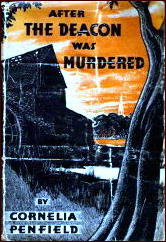
CORNELIA PENFIELD – After the Deacon Was Murdered. G. P. Putnam’s Sons; hardcover, 1933.

CORNELIA PENFIELD After the Deacon Was Murdered

   After the Deacon Was Murdered is the first of two mysteries written by this little known Connecticut author, and as such, is it (you may be wondering) forgotten gem? An honest answer has to be, “Almost, but not quite.” Forgotten, it is true, but while it has some weaknesses (and one near-fatal one), there are some very good moments to be found by plunging right in as well.

   Finding the murder victim, Jarius Hanford, in the small town of Deptford Center (near New Haven) is Geoffrey Hamilton, who is not vacationing there, but rather recovering from a nervous breakdown suffered the previous fall.

   Dashing down to the town center to report his discovery, the only person in the Town Hall is Jane Trimble, a genealogist by profession, working over some old records. The dead man is her uncle, but she receives the news with a surprising lack of distress. From page 7: “I’m not the least bit hysterical and I live among too many vital statistics to be easily upset by one more or less.”

   Nor is Miss Trimble the only interesting person in town. There is Grandpa Banks: “…eighty-five my next birthday, but sound as a dollar. Yessir!” As well as Judge Whitaker: “… without whom no one, it seemed, could take any initiative in the village,” Hamilton despairs to himself, amidst “the general footlessness of the whole conduct of the case!” And then Jane’s negro butler, Cæsar, who when asked if had heard of the deacon’s death, replies: “Yas’m. No’m. Why, the po’ old man. Howcome yo’ ask me about it, Miss Janey?”

   The investigation expands beyond the townspeople and the village folk, however. There is a gang of organized criminals working in the area — one of them is Big Slim Blivinsky — plus a fugitive from a mental institution, and a misguided newspaper reporter named Parsons who gets Hamilton even more involved than he’d intended.

   This is the sort of detective story, very popular at one time, in which an assortment of ever stranger things just keeps growing and growing, until you think that the author has no way out. But she does, more credit to her, and with more than a gentle hint that she’s gently spoofing some of the various conventions of the genre in several different way — including a last page refutation of Jane Trimble’s statement that “this has been one murder mystery with no love interest, thank Heaven!”

   Let’s back up a little. On page 137, Hamilton is talking to Dr. Newcomb about his health:

   â€œSo far, a little murder mystery seems to have agreed with me.”

   â€œPerhaps. We all enjoy fiction too much not to appreciate a few thrills in real life. I confess I like to sit back with a good detective story – Edgar Wallace, Dorothy Sayers, Earl Derr Biggers or this new chap – what’s his name – Michael Scott. Like his stuff?”

   â€œFairly well. I haven’t been reading much of the sort lately.”

   There is also a map, and it’s important to the solution of the case, as well as a good timetable and the establishment of solid alibis – or perhaps not. All in all, there’s an abundance of good stuff, but there’s a key aspect that’s missing, and that’s a strange unreasonable lack of curiosity at the proper time. Curious things happen, and no one – including (or maybe especially) Hamilton – asks the overtly obvious question, what’s going on?

   One case in point – and I hope I’ve made this interesting enough that you’re still with me – on page 78 Hamilton is going to bed after an exhausting day, and he finds fresh blood on his shoe. “It was stained and wet – wet with clotted blood, still fresh enough to show color on his finger.” And … he gets under the sheets and goes to sleep.

   The middle, then, is somewhat of a muddle, as you undoubtedly have gathered. It’s worth persevering, though, since the ending shows flashes of brilliance – and I have the strongest feeling that if you were to start over, from beginning to end, the whole accumulation of small hidden mysteries would all fit into place and make perfect sense after all.

   But the solution was agreeable enough, and the characters engaging enough, that after thinking about for a while, I finally decided discretion might be the wisest thing to hang on to here, and that the proverbial bird in the hand is not worth looking out for trouble when you needn’t.

   In other words, trying to be as clear as I can, if you can forgive the spots where the going is the weakest, you may find yourself enjoying this as much as I did.

   Maybe it’s because the whole affair takes place locally, a mere 70 years ago, and that always helps. But if you read only private eye and noirish pulp fiction, the chances are 80-20 that you should not even begin to take me up on this as a recommendation, no matter how well-intended I mean it to be.

— February 2004


NOTE:   My review of After the Widow Changed Her Mind, Mrs. Penfield’s second mystery novel, will be posted here soon.

REVIEWED BY WALTER ALBERT:         


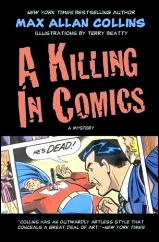
MAX ALLAN COLLINS - A Killing in Comics

MAX ALLAN COLLINS – A Killing in Comics. Berkley, trade paperback, May 2007. Illustrations by Terry Beatty.

   Another of Collins’ historical crime novels, this one is set in New York in 1948 in the world of comic book publishing. As usual, Collins has researched the period and subject (giving particular credit to Gerald Jones’ Men of Tomorrow).

   A number of pioneers in the field are present in disguise, with Superman and his creators Joe Siegel and Jerry Schuster recast as Wonder Guy and Harry Spiegel and Moe Shulman. The narrator is Jack Starr, stepson of Maggie Starr, who’s running Jack’s late father’s newspaper syndicate, distributor of the Wonder Guy strip. When a rival publisher is murdered, Jack conducts an unofficial investigation, with the author vividly evoking the colorful world of the comics and their creators.

REVIEWED BY DAN STUMPF:


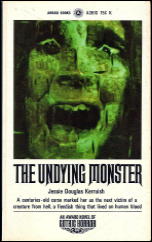
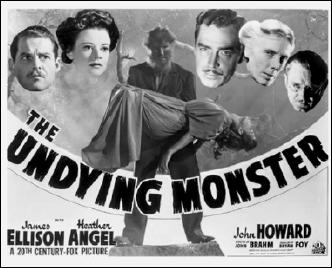
JESSIE DOUGLAS KERRUISH – The Undying Monster. Heath Cranton, UK, hardcover, 1922. Macmillan, US, hardcover, 1936. Reprinted in Famous Fantastic Mysteries, June 1946. Award A351S, paperback, 1968. Lulu Press, POD softcover, 2013.

THE UNDYING MONSTER

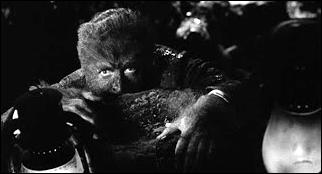
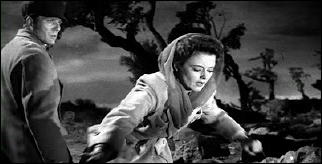
THE UNDYING MONSTER. 20th Century Fox, 1942. James Ellison, Heather Angel, John Howard, Bramwell Fletcher, Heather Thatcher, Aubrey Mather. Director: John Brahm.

   The Undying Monster by Jessie Douglas Kerruish was first published in England in 1922 and is considered by some a classic tale of lycanthropy. I considered it a wanton squandering of my precious youth, but there you are. Thinking back, there were probably some inventive bits in the tale, but for me they were ruined by…. But I can’t yet tell you why. Read on:

   Undying starts out promisingly with a family curse, murder in the moonlight and all sorts of delicious Victorian nastiness. It seems that the Hammand family (local gentry with an imposing manor house and a coat of arms that goes back to the Flood) is periodically stalked from time to time by a horrendous but unseen thing that rips some of them limb from limb and scares others into gibbering madness.

   Good so far. But when Oliver Hammand, latest in line to inherit the family unpleasantness, encounters the thing in the dark, he gets off with a few bites and a case of amnesia while his companion is mauled to near death and his loyal dog is spread all over the countryside. Naturally concerned, Oliver’s sister calls in female paranormal investigator Luna Bartendale, and that’s when things get gummy.

THE UNDYING MONSTER

   Luna Bartendale is probably the most irritating character ever consigned to printed page. She hasn’t been on the case for more than a few paragraphs before she’s saying things like, “I have some theories but I won’t discuss them until….” and then “This confirms what I was thinking but before I say more I must…..” followed by “I know why, but I can’t reveal it to you yet,” and “There’s a very good reason why I can’t tell it to you.”

   Now I got nothing, against foreshadowing, but a man gets tired of that kind of talk all the time. No one likes the guy who says “I told you so,” but even worse is one who says “I could tell you so — if I felt like it,” and Luna Bartendale, for all her groundbreaking appearance as fiction’s first female paranormal detective, says very little else. By the time the plot reached the point where Good and Evil were locked in what should have been a horrific struggle, I was hoping merely that the superannuated boogeyman of the title would gobble her up but (SPOILER ALERT!) no such luck.

   All the sadder then that there are glimmerings of a good story here. So good in fact that 20th Century Fox made a movie of it in 1942 — kind of. Writer Lillie Hayward and Michael Jacoby replaced the annoying Ms Bartendale with cowboy star James Ellison playing a Scotland Yard investigator — and doing it surprisingly well.

THE UNDYING MONSTER

   He’s aided by Heather Thatcher as a plucky distaff-Watson, but his attentions are focused primarily on Heather Angel as the distraught sister of poor Oliver Hammond (They changed the spelling for reasons best known to themselves.) played by John Howard, who had already been paired with Miss Angel in the Bulldog Drummond series over at Paramount.

   Undying Monster is a stylish affair, thanks largely to director John Brahm, who brought similar gothic elegance to The Lodger (1944) and Hangover Square (1945) and cinematographer Lucien Ballard, who will be remembered for The Wild Bunch. Together they impart an atmosphere not unlike the Sherlock Holmes series over at Universal, with evocative fog, looming shadows, and a general sense of mystery — rudely dissipated when we finally see the rather unprepossessing monster.

   And I should add a bit of trivia beloved of bad-movie buffs: the opening shot of Undying Monster is repeated exactly in a later, cheaper Monogram film, Face of Marble (1946). Understandable, since Michael Jacoby, who toiled at or near Hollywood’s bottom rung for his whole career, worked on both films. But one wonders with what weary desperation poor Jacoby found himself re-typing his own work in such reduced circumstances.

THE UNDYING MONSTER

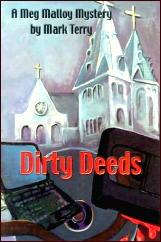
MARK TERRY – Dirty Deeds. High Country Publishers, trade paperback, 2004.

MARK TERRY Dirty Deeds

   If this is the first of a series, which is the way it reads to me, I think it should be a good one — the series, I mean. Dirty Deeds is a nicely developed combination of the hard-boiled private eye novel with well-honed computer geekiness, with super-rich Meg Malloy as the leading protagonist – she was in on the construction of the World Wide Web, and as a result she’s now independently wealthy.

   She’s also a high-paid computer consultant in the suburban Detroit area, but when Reverend James Walker learns that one of the jobs her ex-husband had was as a private investigator, he thinks that perhaps she can be of some additional assistance to him.

   (Of course her ex-husband is also an ex-systems analyst, an ex-teacher, and ex-website designer, among other things, and Meg says that the only one he’s ever been good at is ex-husband.)

   Reverend James is a TV evangelist, and he seems to have neglected his daughter, who is in trouble. Evidence: a video tape of either her rape or an example of what she is doing now for a living.

   When Meg finds herself in over her head – just a little (page 61) – coming to her aid is Jack Bear, from up Traverse City way, of Chippewa blood, and a man with a mysterious past. He’s vouched for by Meg’s (female) cousin, and the story this engenders is revealed only piecemeal, one morsel at a time.

   And the FBI and the Secret Service are somehow mixed in to whatever business Meg finds she’s stumbled into. Dirty deeds are Jack Bear’s specialties, the grey areas the police don’t always get into, and as the AC/DC song lyric says, done dirt cheap.

   The pace is fast, only a little ragged at times, and at only 192 pages – the old paperback standard! – the book goes quickly. The greatest weakness I found is that there’s not a lot of depth to the plot. It’s solid, a little rough around the edges, perhaps, but it’s also straightforward, and there doesn’t seem to be enough juice to make the story stand out more than it does.

   The characters are well-developed, though and as time goes on, I certainly wouldn’t object to seeing more of them. It looks like Meg Malloy and Jack Bear could have a future together, doing what they do, and I certainly hope it works out that way.

— January 2004


[UPDATE] 02-03-13.   While Mark Terry has followed this book with six adventures of Derek Stillwater, a troubleshooter for the U.S. Department of Homeland Security, this, alas, is the only known case to have been tackled by the crack team-up of Meg Malloy and Jack Bear.

THE BACKWARD REVIEWER
William F. Deeck


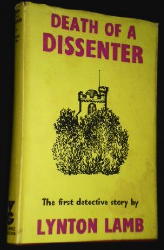
LYNTON LAMB Death of a Dissenter

LYNTON LAMB – Death of a Dissenter. Gollancz, UK, hardcover, 1969. No US edition.

   Old Silas Finch doesn’t like the church bells ringing in the English village of Fleury Feverel, or anything or anyone else for that matter. He defiles the cricket field, threatens his neighbors, lets the air out of bicycle tires, and is accused of molesting a quite molestable young woman. So it is nothing of a surprise that he ends up dead, but quite astonishing that he dies in the church ringing chamber, where someone has apparently bashed him in the head with a bench.

   As the evidence accumulates, Detective Chief Superintendent Quill and Detective Inspector Bruce are somewhat dumbfounded to find that the facts point in only one direction: toward the rector of the parish, Frank Fenwick, an inveterate truth teller who says he didn’t do it.

   Fortunately for a U.S. reader, the cricketing is brief since, at least to me, it was quite incomprehensible. Also a problem is the local dialect, which is almost as impenetrable as the cricket and there’s more of it. To make up for that there is a great deal of humor, some fine writing, a solid investigation, information on campanology, and an unusual solution, which I guess is possible. All in all, a nearly first-class first novel, particularly if you understand cricket and the local dialect.

   By the way, could there really be such a thing as a Surveyor of Ecclesiastical Dilapidations?

— From The MYSTERY FANcier, Vol. 13, No. 4, Fall 1992.


         The Supt. Quill & Insp. Charles Glover series —

Death of a Dissenter. Gollancz 1969.
Worse Than Death. Gollancz 1971.
Picture Frame. Gollancz 1972.
Man in a Mist. Gollancz 1974.

« Previous PageNext Page »