Reviews


THE BACKWARD REVIEWER
William F. Deeck


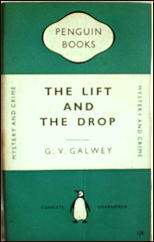
G. V. GALWEY The Lift and the Drop

G. V. GALWEY – The Lift and the Drop. Bodley Head, UK, hardcover, 1948. Penguin Books, UK, paperback reprint, 1951.

   Since his theory of how to catch a murderer is examining the past of the victim, Chief Inspector “Daddy” Bourne has a real dilemma here. For there were six people in the lift at Pleydell House, home of The Voice and other publications, when it plummeted out of control from the sixth floor to the basement. If any of them were meant to die, which one was it? Or was it an act of mindless terrorism, since no murderer could be certain whom he or she might kill?

   A bit too much emphasis on the technical aspects of the murder, a lot too much on the seafaring aspects — I got quite lost as soon as water was approached — a nebulous political scheme, and a murderer with more hubris than I could accept are the weak points here. The strong points are the characters of Bourne and Sergeant Griffiths and their investigation. Well worth reading, and a nimbler mind than mine might find my objections not significant.

— From The MYSTERY FANcier, Vol. 13, No. 4, Fall 1992.


       The Inspector “Daddy” Bourne series —

Murder on Leave. Lane, 1946.
The Lift and the Drop. Bodley Head, 1948.
Full Fathom Five. Hodder, 1951.

NOTE: These were G. V. Galwey’s only works of mystery fiction. To find out more information about him, check out the Golden Age of Detection wiki here.

REVIEWED BY WALTER ALBERT:         


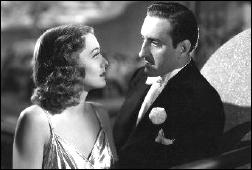
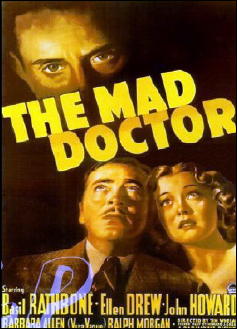
THE MAD DOCTOR. Paramount, 1941. Basil Rathbone, Ellen Drew, John Howard, Barbara Allen (aka Vera Vague), Ralph Morgan, Martin Kosleck, Kitty Kelly. Screenplay by Howard J. Green; cinematography by Ted Tetzlaff; art direction by Hans Dreier & Robert Usher; music score by Victor Young. Director: Tim Whelan. Shown at Cinevent 38, Columbus OH, May 2006.

THE MAD DOCTOR Basil Rathbone

   Paramount was not known for its horror films (Universal pretty much had a lock on that genre in this period) but was obviously attempting to capitalize on their popularity with this rather deceptive title, which probably suggests a rather different film than the one its makers had in mind. (It was released in England under the production title, A Date with Destiny.)

   In this elegantly directed and produced film, with its black and white cinematography gloriously highlighted in the pristine print, Rathbone, a doctor whose wives have a habit of dying under suspicious circumstances, moves to New York after the death of his third wife arouses the suspicions of a local practitioner (Ralph Morgan) and sets up a Park Avenue practice as a psychiatrist. He effects an apparently miraculous cure for troubled heiress Ellen Drew, with whom he becomes infatuated and whom he makes his fourth wife, an unenviable role as it inevitably turns out.

   Rathbone is a smooth, polished villain who is attended by a companion (Martin Kosleck) who is very attentive to his employer’s every need and is clearly more eager to see the quick dispatch of wife number four than Rathbone. Kosleck’s dislike of women is obvious and he dreams of retiring to some foreign country where he and Rathbone can live on the inheritance from Rathbone’s most recent conquest.

   Rathbone’s dramatic control contrasts nicely with Kosleck’s tendency toward scarcely contained hysteria. The net result is a rather curious film that could have benefited from some of the panache of the Universal product but impresses nonetheless with its superior production.

THE MAD DOCTOR Basil Rathbone

REVIEWED BY DAN STUMPF:


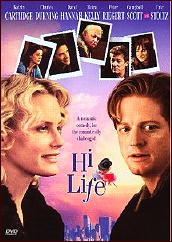
HI-LIFE. 1998. Campbell Scott, Moira Kelly, Michelle Durning, Eric Stoltz, Peter Rieger, Charles Durning, Katrin Cartlidge, Daryl Hannah. Screenwriter/director: Roger Hedden.

HI-LIFE Campbell Scott

   As we approach the Holidays, I want to recommend a Christmas Movie unlike any other: Hi-Life may not seem overtly Capra-esque, but it offers the kind of sardonic/goofy/cynical romanticism that Frank Capra put out for depression-era audiences of the 1930s — minus the tendency toward Capra-corn that marred his best-known films.

   Campbell Scott stars as a bartender whose sister (a precise, knowing and humorous performance from Moira Kelley) asks him to raise money — quickly — so she can have an abortion. But—

   She’s not really pregnant; her boyfriend (Eric Stoltz) needs the money to pay a gambling debt to his bookie (Charles Durning) But—

   She doesn’t know this because Eric told her he needs the money so his sister (Daryl Hannah) can get an abortion. But—

   It seems Hannah is an ex-girlfriend who dumped Scott several months ago.

   All unaware, Scott wanders Manhattan in one long night a week before Christmas, scouting out old friends who owe him money. He’s followed by Katrin Cartlidge (a fine actress now sadly deceased) as a cute alcoholic who knows his friends will stiff him, but she figures they’ll feel guilty and buy him drinks and if she’s with him she’ll get some.

   Meanwhile, Peter Riegert, one of Durning’s (remember him?) hangers-on, has been ordered to stick with Eric Stoltz till he comes back with the money. But—

   Seeing a chance for easy profit, Riegert has arranged for the teen-age son of his live-in girlfriend to “mug” them once they get the cash.

   Also in the mix are two sub-normal paramedics posing as actors, and the scene where they try to sell the plot of Schindler’s List 2 to Moira Kelley recalls the best of 30s screwball comedy. As does a street fight with an errant boyfriend hiding out disguised as Santa. And the climax, which sees a desperate Eric Stoltz facing his sister and his girlfriend at the same time and trying to convince each that the other one is pregnant. Followed by a sweet ending which sees love and the Christmas Spirit conquer all. With excellent ensemble acting, sharp script and fast direction, Hi-Life may be just the thing to ease those Holiday blues.

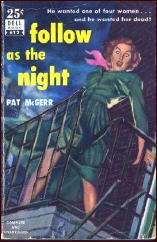
PATRICIA McGERR – …Follow, As the Night… Macfadden, paperback reprint, 1968. Previously: Dell #612, paperback, 1952. First published by Doubleday Crime Club, hardcover, 1950.

PATRICIA McGERR

   Patricia McGerr seems to have a split career as a mystery writer, and if I’m wrong on some of these titles and in which category they fall, perhaps somebody reading this can quickly steer me in the right direction.

   Here’s a list of the titles of the first eight books she did, all for Doubleday’s noted Crime Club series:

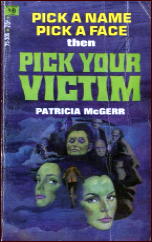
Pick Your Victim, 1946.
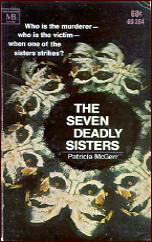
The Seven Deadly Sisters, 1947.
Catch Me If You Can, 1948.
Save the Witness, 1949.
Follow, As the Night, 1950.
Death in a Million Living Rooms, 1951.
Fatal in My Fashion, 1954.

   After a gap of about ten years, the following grouping came along, with the last three published in hardcover by Robert B. Luce, Inc., a firm about which I know nothing, except that its primary mystery output was by McGerr.

Is There a Traitor in the House? 1964. [Selena Mead]
Murder Is Absurd, 1967.
Stranger with My Face, 1968.
For Richer, for Poorer, Till Death, 1969.
Legacy of Danger (collection of short stories fixed up as a novel) 1970. [Selena Mead]

   And then the last grouping consists of two paperback originals:

Daughter of Darkness, Popular Library, 1974.
Dangerous Landing, Dell, 1975.

PATRICIA McGERR

   To take the last two first, this is a guess, but from the titles they appear to be very much akin to the ubiquitous gothic novels which were very popular at the time.

   Working backward, the middle grouping might be characterized by the Selena Mead counterespionage novels, which two of them are. Someone else will have to say for sure what the other three are — spy thrillers, malice domestic, or a mixture of each, called romantic suspense?

   Most of McGerr’s fame today, of which there is not nearly enough, resides in the first grouping, which include some of the strangest and possibly unique detective novels ever written.

   I’ve read Pick Your Victim, and it’s not one I’ll easily forget. We know there has been a murder done, who has committed it, and from only scraps of evidence is the identity of the victim eventually deciphered. A summary I’ve found of The Seven Deadly Sisters suggests that McGerr upped the puzzle twofold: neither the killer nor the victim is known, and the identities of both have to be worked out.

   …Follow, As the Night… (complete with double ellipses, at least in the paperback version) is very much in the same category. In a brief prologue, we learn someone has died, and in Chapter One, we find the killer (identity known) planning a dinner party, with one of those invited being the person he intends to become the victim of a fatal accident.

PATRICIA McGERR

   Invited are Larry Rock’s two ex-wives (one not yet divorced), his mistress, and his current fiancée, who is also — as if this were not enough — pregnant. It makes for quite an evening. In fact that’s all the time it takes for the events of the entire book to transpire; that is, if flashbacks don’t count.

   The detective per se is Rock’s first wife, who arrives early and finds the loose railing on the penthouse balcony. Knowing exactly what he intends to do, her problem, identify the victim — which may be her!

   The bulk of the book is a character study, then, of a cad, a word that I don’t use very often, but it certainly fits both the period (the late 1940s) and the man. Problem: I knew how the book was going to come out as of page 10, and while there was a good chance that I was wrong, I wasn’t.

   The gimmick didn’t work, in other words, or not for me, but the character study did. It’s not enough for an unqualified recommendation, but from the perspective of a clever approach to a detective novel, it’s certainly worth reading.

— November 2003

REVIEWED BY DAN STUMPF:


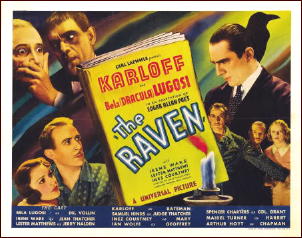
THE RAVEN. Universal, 1935. Boris Karloff, Bela Lugosi, Lester Matthews, Irene Ware, Samuel S. Hinds, Spencer Charters, Inez Courtney. Based on a poem by Edgar Allan Poe. Director: Lew Landers (as Louis Friedlander).

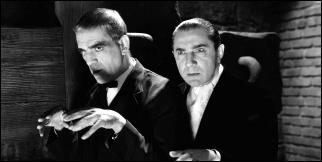
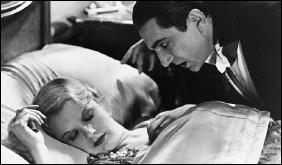
   William K. Everson described The Raven as “grand guignol.” He might also have added that it was probably the apex of Bela Lugosi’s career. Loud, lurid and fast-moving (only 62 minutes long) it’s got monsters, torture, bondage and obsession, and perhaps the Classic Mad Scientist of the Movies, definitively interpreted by Lugosi, whose magnetic screen presence and limited acting ability made him a tragic icon of the B movies.

   The Mad Doctor in The Raven is just about everything an evil medico should be: a megalomaniac plastic surgeon (a theme that would reappear in the classic Eyes Without a Face) obsessed with Poe, who keeps a torture chamber in his basement, falls in love with a woman he can’t have, and sets out to torment her and the rest of the cast, laughing maniacally between fits of sinister organ-playing. What more could you want from a Mad Scientist? Or for that matter, from a horror movie?

   Well for one thing The Raven also features Karloff as a sinister go-fer (the only time Boris ever played second-string to Bela in their careers) a disfigured and disgruntled killer clearly just aching for a chance to get back at his mad-doctor-boss.

   There’s also a giant, razor-edged pendulum, swinging mercilessly downward at its victims, perambulating rooms, a dark, stormy night, and a pervasive atmosphere of tasteful sadism, more quaint than kinky, closer to Fu-Manchu than Krafft-Ebbing. Plus Bela Lugosi gloating — a lot. As if Director Louis Friedlander immediately saw that gloating was his star’s forte and felt it best to give him his head. The result is a full-bodied performance in a juicy part that just begs for the kind of sonorous overacting only Lugosi could give. And a fun film all around.

THE RAVEN Bela Legosi

   Alas, though, things weren’t all that much fun for poor Bela. Almost immediately after The Raven, horror movies went out of style (possibly because of excesses in films like this and Island of Lost Souls) and were actually banned in Britain.

   And hence, one of the premier horror actors of his day found himself unemployed and unwanted. Monster movies came back in the late 30s and early 40s, but now the former star was mostly cast as sinister butlers or red herrings, his name featured prominently on the posters but himself seen little in the films.

   That was in the B-movies. In the grade-Z flicks from Monogram and PRC, Lugosi got meaty roles once again, with a string of mad scientists, deranged killers and lots of screen time, but the meat here was generally bland-tasting, as the films themselves were slow-moving, cheap and mostly devoid of thrills.

   Only once more did Lugosi get a really good lead in a B-movie, and that was Return of the Vampire (Columbia, 1944) a classy job once again directed by Friedlander, who was now calling himself simply Lew Landers. Return has been largely ignored by Horror fans, but it has s spooky atmosphere reminiscent of Roy William Neill’s Sherlock Holmes series over at Universal, even featuring some of the players from that series and set, like them, in an oddly gothic war-time England.

THE RAVEN Bela Legosi

   This was only the second time Lugosi played a Vampire in the movies (he’s named Armand Tesla, but with his cape, coffin and dinner clothes he is Dracula to all intents and purposes) and he takes the role in his teeth and runs with it, clearly relishing the chance to swirl his cape once more and stalk about the graveyard cloaked in fog.

   He’s even assisted by a rather unimpressive werewolf, played by Matt Willis in the best tradition of Dwight Frye, and he gets to gloat a lot once again, just like he did in the old days. Landers/Friedlander adds some fine touches, with the vampire’s presence presaged by dead leaves fluttering in through the french doors, and mist creeping all over the place, and again, when Lugosi’s being sinister, the camera’s right there in a well-lit close-up, while writer Griffin Jay, a veteran of the B-horrors at Universal and PRC, manages to polish up all the old clichés and provide a fast-moving story that seems enjoyably familiar.

   The rest of the 1940s were unkind to Lugosi, and the 50s even worse, but it’s nice to see him in Return of the Vampire, once again flashing his hammy fangs and biting the scenery as only he could.

THE RAVEN Bela Legosi

REVIEWED BY MICHAEL SHONK


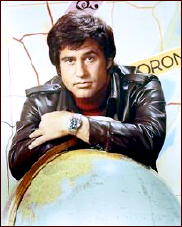
COOL MILLION , NBC / Universal, October through December 1972. Created by Larry Cohen. Cast: James Farentino as Jefferson Keyes.

   Jefferson Keyes was a World renown detective, trained by an unnamed secret agency of the American government, and able to charge one million dollars per job. But Jeff was quick to point out he paid for all his expenses, and guaranteed to solve the client’s problem or the client would owe him nothing. Also, Jeff always denied being a detective or PI, instead he saw himself more of a trouble-shooter. “I’m not a detective,” said Jeff in “Mask of Marcella,” “I simply look for solutions to rather large problems.”

https://www.youtube.com/watch?v=8n2JPO5SEhg


“Mask of Marcella.” (10/16/72) Executive Producer: George Eckstein. Producer: David J. O’Connell. Written by Larry Cohen. Directed by Gene Levitt. Guest Cast: Barbara Bouchet, Patrick O’Neal, John Vernon, and Christine Belford. *** TV Movie pilot. When a rich man is murdered, everyone is surprised to learn he had recently changed his will to leave his entire fifty million dollar estate to his daughter, Marcella…who had disappeared as a child and been missing and presumed dead for thirteen years.

   The child’s former teacher whose negligence lead to her disappearance has seen Marcella alive and wants Jeff to find her so he can find redemption (and get his teaching credentials back). The lawyers for the estate agree to hire Jeff to find the proper heiress. He has one week to find Marcella before the probate court turns her inheritance over to charities.

   Cohen’s pilot script sets up the character of Jefferson Keyes well. Jeff travels the world alone, solving people’s problems. Jeff makes no apologies for his fee or lifestyle, but he does care more about people than money. In this case, we learn he is a regular contributor to a London Children’s hospital, and he even gives one third of his fee to a person in need.

COOL MILLIONS James Farentino

   NBC picked up the pilot and added it as one of three rotating series on NBC Wednesday Mystery Movie, sharing the time period with Banacek and Madigan. The series aired between 8:30 to 10pm and was opposite of ABC Wednesday Night Movie and CBS’s lineup of the last half hour of Carol Burnett, and Medical Center.

   Roy Huggins took over when Cool Million went series. Executive Producer George Eckstein stayed with his other TV Movie pilot Banacek. Producer David J. O’Connell at the time was the producer of Marcus Welby M.D. (where he won an Emmy in 1972). And Larry Cohen’s Bone (1972), the first theatrical film Larry Cohen directed (he also wrote and produced) had all ready been released. Black Caesar (1973) would soon follow.

   I should note here the episodes I saw were collector copies of the edited reruns aired on CBS Late Show, the credits where Executive Producer Roy Huggins and his company the Public Arts Production title would normally appear were missing, but there is little doubt Huggins was responsible for the series episodes.

   Huggins made some changes to Cohen’s original idea. Jefferson Keyes no longer wandered the world alone, now he had a staff to support as well as gratuitous over the top expenses such as a special car that is flown to him anywhere in the world.

   Receptionist Elena (Adele Mara aka Mrs. Roy Huggins) lived in a house in Lincoln, Nebraska where a hidden panel let you into a room full of the latest in computers. Mother of at least one small never seen child (a “Big Wheel” blocking the secret entrance in one episode), she spoke at least two languages — English and Persian. Jeff didn’t want to miss a call, so he established a trunk line in Lincoln where the lines were always clear. She would ask security questions of possible clients to confirm their id before notifying Jeff.

   Tony Baylor (Ed Bernard or Felton Perry) was the pilot for Jeff’s personal plane. In the pilot, Jeff flew commercial airlines or chartered a private plane he flew himself. Now, Jeff adds to the expenses and payroll with a smart-ass pilot.

“Hunt for a Lonely Girl.” (10/25/72) Written, directed, and produced by Gene Levitt. Associate Executive Producer: Jo Swerling Jr. Guest Cast: Kim Darby and Ray Milland. *** Rich spoiled Canadian businessman with anger management problems is on trial for murder. His lawyer hires Jeff to find proof of the man’s alibi.

   Worst episode. Levitt had no clue about who Cohen’s Jefferson Keyes was. In this episode Jeff did the work of a PI legman while repeatedly denying he was a PI and constantly whining about money.

COOL MILLIONS James Farentino

“Assault on Gavaloni.” (11/22/72) Teleplay by Juanita Bartlett. Story by John Thomas James (Roy Huggins). Directed by John Badham. Produced by Jo Swerling, Jr. Guest Cast: Nehemiah Persoff, Pamela Franklin, Wilfred Hyde-White, Joanne Barnes, Ilka Chase. *** Sir Bryan Howard had lent a painting to a man so he could keep his ex-wife from getting it. But now the man won’t return it. Sir Howard hires old friend Jefferson Keyes to get it back.

   Good episode capturing the style of the NBC Mystery Movies (over the top adventure with romance and high living backed by the signature soundtrack of the Universal music library). This was the only episode besides the pilot to handle the money gimmick well. Jeff puts his concern for a woman before the money and the case. He is reluctant to charge his old friend his fee until Sir Howard admits he has made a profit despite Jeff’s million-dollar fee.

“The Abduction of Baynard Barnes.” (12/6/72) Teleplay by Richard Morris. Story by John Thomas James. Directed by Barry Shear. Produced by Jo Swerling Jr. Guest Cast: Barry Sullivan, Danielle DeMetz, Sharon Gless, and Nico Minardos. *** Jeff is hired to rescue a kidnapped millionaire who had left orders never to pay ransom.

   Plot was typical 70s with a far-fetched rescue and long chase. The episode made good use of Jeff’s spy training and attempted to explain the need of Jeff’s fee with expensive gadgets and high priced help.

“The Million Dollar Misunderstanding.” (12/20/72) Teleplay by Juanita Bartlett. Story by John Thomas James. Directed by Daryl Duke. Produced by Jo Swerling Jr. Guest Cast: Elaine Giftos, Ina Balin, Joseph Ruskin, and John S. Ragin. *** After three months of work where he convinced a daughter of a President of a small Middle Eastern country to return home, Jeff gets paid, only to have the check bounce. Jeff wants his money and orders his pilot Tony (Felton Perry) to help him steal a two million dollar diamond from his former client and ransom it for his million.

   Jeff is at his most unlikable in this episode. He works for three months to convince his client’s daughter to return home, yet despite Elena and the computers security check, Jeff did not know his client was a deadbeat dictator hated by his people. So does Jeff worry about the young daughter? No, all Jeff wants is his money, and he is willing to risk others lives to get it. This was the last episode of the series.

   In Broadcasting (1/15/73) the ratings for all TV Movies from the beginning of the 1972-73 season until December 3, 1972 were listed. The NBC Wednesday Mystery Movie was ranked 23rd out of 66 shows with a 20.5 average. Each episode of NBC Wednesday Mystery Movie was also listed.

   Most popular of the three was Banacek with five episodes (during the period covered) rated (in order) 21.2 – 22.3 – 20.9 – 19.4 – 23.5. Madigan had three episodes: 21.4 – 20.3 – 18.9.

   â€œMask of Marcella” was shown on NBC Monday Movie (9-11pm) and received a rating of 20.4 to finish 25th in the ratings for the week, but finished last in its time period. “Hunt for a Lonely Girl” received a rating of 19.0 for 28th in the ratings. “Assault on Gavaloni” dropped to 17.5. I was unable to find the ratings for the final two episodes.

   During the 70s, PIs usually featured a gimmick to set them apart. “Cool Million” gimmick was Jeff’s fee. Too often in the series episodes Jefferson Keyes was a mercenary whining about expenses, risking others lives so he can collect his fee, and wasting too much money on unnecessary over the top expenses.

   For those curious about NBC Mystery Movies I recommend you check out J. Kingston Pierce’s work in progress at his “Rap Sheet” blog. I beat him to Cool Million, but I look forward to read what he can add. While we wait, read his posts about Madigan, Banacek and McMillan and Wife.

REVIEWED BY DAN STUMPF:


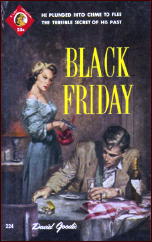
DAVID GOODIS – Black Friday. Lion #224, paperback original, 1954. Black Lizard, paperback, 1987.

            “It’s Black Friday and for certain people it’s a day that never ends.”

DAVID GOODIS Black Friday

   Black Friday (Lion, 1954) shows us David Goodis at his lean and hungry best with a taut, compelling crime story that seems to be constantly hurtling toward some predestined end, yet shaped by its own very unique and lively cast of characters.

   As it opens, Al Hart is on the run, fleeing the police after the mercy killing of his terminally ill brother, making his broken down and desperate way through one of those Philadelphia winters that Goodis does so bitterly well. Through a series of coincidences he finds himself witness to a murder and tentatively taken in by a gang of professional thieves who accept him (more or less) as one of them — and plan to use him on their next job.

   These thieves turn out to be quite an interesting crowd. In fact, Goodis peoples Black Friday with the archetypes familiar to his fans: The brassy, overripe slut, the ethereal gamin, the oddly sensitive master criminal, the not-so-dumb brute, and the alienated, ostracized hero—characters who show up in one incarnation or another in various Goodis books from Dark Passage to Somebody’s Done For, and who seem to resurrect themselves anew on the page each time.

   For this particular ride, they’re set down amid a tense caper that seems all the more suspenseful for being jinxed from the outset. There’s something Homeric in Goodis’ trick of thrusting bums and winos into heroic situations and watching them rise to mythic status. Here, his second-rate hooligans and gallant loser-as-paladin turn a well-crafted caper yarn into something truly memorable.

Editorial Comment:   Dan sent me this review just before Thanksgiving, when it would have been a little more timely, perhaps. I wish I’d been able to get it posted here before now, but this was the best I could do, only a few days late.

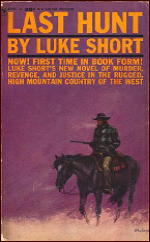
LUKE SHORT – Last Hunt. Bantam A2437, paperback original. First printing, August 1962. Reprinted several times, including: Dell, paperback, 1990.

LUKE SHORT Last Hunt

   You take a glance at the cover, it looks like a western: pictured is a man with a rifle on a horse, bundled up against the cold. You read the cover, it sounds like a western: “Luke Short’s new novel of murder, revenge in the rugged, high country of the west.” You start reading the first chapter, you could easily be confused into thinking it is a western — it is a Luke Short novel, after all.

   That’s assuming, of course, you’re as easily confused as me. It wasn’t until page 7, where you will find a reference to someone unzipping his Eisenhower-type jacket that it dawned on me. It’s not a western.

   Not one of the Old West, that is. What this is a modern day crime story, a detective story, one that takes place in the west, and yes, it’s in Hubin’s Crime Fiction IV. Murdered while hunting elk is a judge, a man who has just recently made a bitter enemy in a messy divorce case that just concluded in his courtroom.

   Keeping in mind that I never really enjoyed the TV show Columbo all that much — you know the routine: the killer is known from the very beginning, and for the remainder of the program, the pleasure comes from watching the Lieutenant putting the pieces together and figuring out and trapping the culprit — I found it annoying that the same approach is what Short uses here. Let me quickly qualify that and say “mildly annoying.”

   For the most part, this is a man’s sort of book, filled with men who enjoy hunting, enjoy the out-of-doors and the companionship of other men, and with women who put up with, if not love, the kind of men who enjoy hunting — and so on. This is the time and place when people left their cars parked with the keys left in them, and there’s a definite nostalgia for times that no longer exist that comes into play as well.

   In a small way this short novel (only 122 pages) reminded me of one the the old Gold Medal paperback originals that started coming out in the early 1950s, but upon second thought, I finally decided it lacks the pulpish edge (bordering on sleaziness) that those old GM paperbacks had.

   In terms of the quality of the writing itself, Luke Short’s second of two entries (*) into straight crime fiction has a pulpish tinge, all right, but you also get the feeling that the story first appeared in — and was filtered through — a slick magazine like Collier’s or The Saturday Evening Post, which of course, it probably did.

   The people that are encountered here are friendlier, and with perhaps one exception, they lack the quiet desperation in their lives the inhabitants of the Gold Medal novels usually had, the kind that pushes them into situations in which they soon discover that they’ve lost control of the events that follow.

   What the big difference may be, and this may sound overly sentimental, is that when Last Hunt ends, you’ve become friends with the people in it, and you’re left wanting to know what happens to each of them in the rest of his or her life, and if it turns out as well for them as you want it to do.

(*)   The other title is Barren Land Murders, which as a matter of fact was a Gold Medal PBO, from 1951.

— Reprinted from Durn Tootin’ #5,
   July 2004 (slightly revised).

THE BACKWARD REVIEWER
William F. Deeck


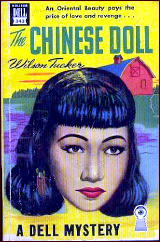
WILSON TUCKER – The Chinese Doll. Rinehart, hardcover, 1946. Detective Book Club, hardcover, 3-in-1 edition, May 1947. Dell #343, mapback edition, 1949.

WILSON TUCKER The Chinese Doll

   While you might think that a private detective in Boone, Illinois, would be underemployed, you would be right. In this documentary novel — in the form of letters from Charles Horne to Louise, the woman he is in love with — Horne is in his office trying to keep warm and working on his book, Lost Atlantis, of which seven chapters have been completed.

   Into the office comes Harry W. Evans, who gives Horne $500 to bail him out of jail since he claims he will inevitably be arrested for spitting on the sidewalk, or jaywalking, or shoplifting, or whatever.

   Naturally, Home is somewhat nonplussed, for the authorities in Boone are not noted for monkey business. To coin a phrase — or is it a clause? — little does he know. Evans leaves Home’s office, and as Horne is watching, a Studebaker sedan with supercharger strikes Evans, killing him, and then speeds off. Later Horne is invited into another Studebaker with supercharger, this time a coupe, driven by a beautiful Chinese girl, and ends up at an illegal gambling club.

   All of this and another “accidental” death tie in with Evans. Horne doggedly and intelligently — though not brilliantly — investigates, getting some idea of who Evans was through Evans’s membership in an amateur publishing association and discovering another beautiful Chinese girl.

   Even after he’d metaphorically rubbed my nose in it, Tucker fooled me on the villain, for which I give him great credit. The novel is well-written, amusing, and believable, up to the point of revealing the villain.

   While I probably won’t make myself clear here, I accept that the villain was who Tucker says it was — the facts, once Horne pointed them out, prove it — but I don’t accept that the villain was who Tucker says it was. You’ll have to read the book to see what I mean, and you ought to read it anyhow, for it’s an excellent private-eye novel.

— From The MYSTERY FANcier, Vol. 13, No. 4, Fall 1992.

   
NOTE:   Wilson “Bob” Tucker, was much more well known as a Science Fiction fan and author than he was a mystery writer. His entry on Wikipedia can be found here.

       The Charles Horne series:

The Chinese Doll.Rinehart, 1946.
To Keep or Kill. Rinehart, 1947.
The Dove. Rinehart, 1948.
The Stalking Man. Rinehart, 1949.
Red Herring. Rinehart, 1951.

REVIEWED BY MICHAEL SHONK:
HARRY O — Season 2, Part 2.


HARRY O. ABC / Warner Brothers. Season 2, Part 2. Midseason 1976, Thursday at 10-11pm. Cast: David Janssen as Harry Orwell, Anthony Zerbe as Lieutenant. K.C. Trench, Paul Tulley as Sergeant Roberts. Created by Howard Rodman. Executive Producer: Jerry Thorpe.
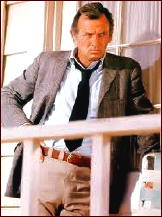
HARRY O

   For the rest of the credits and Part One of this review please click here.

   In 1975 Fred Silverman left CBS and became the head of the programming department of ABC. His midseason 75-76 changes to the ABC schedule had been a surprising success, and for the first time in the history of television ABC had a real chance to become the number one network in the ratings. ABC’s success would not be good news for Harry O.

   Meanwhile, Harry O began 1976 with one of my favorite episodes:

“Mister Five and Dime.” (1/8/76): A female classmate (Glynnis O’Connor) of Lester Hodges (Les Lannom) is arrested for passing counterfeit money and she asks him for help. Lester, of course, turns to Harry.

   Robert C. Dennis script featured a far-fetched plot and was laugh out loud funny. The script had enough twists to please Chubby Checker. What made the story so much fun was how Harry continued to get Trench into trouble with one federal agency after another. Director Richard Lang added some nice comedic touches to the jail scenes.

“Book of Changes.” (1/15/76): Jamie (Joanne Nail), a twenty year-old employee of a gambling club, witnesses the murder of her boss, Kate (Barbara Cason) during a robbery. Jamie runs, but does as Kate had earlier instructed her and delivers a tape addressed to: Harry Orwell, 1101 Coast Blvd, Santa Monica. On the tape the now deceased Kate hires Harry (Trench had told her Harry was the best PI in the business) to find her book of names she had for protection and for Harry to destroy it.

   An average Harry O story with little mystery, less logic, and made watchable by Janssen and Zerbe. Harry’s love life takes a twist as Jamie tries to get Harry into bed and Harry resists due to the age difference. Director Russ Mayberry adds a nice visual touch to the cliché TV fight scene at the end with an overhead shot that gave us a great look at Harry’s home.

   Trivia: Before he destroyed the book, Harry teased Trench by (pretending?) to read the name of K. C. Trench in the book. This is the only time K.C. was used, until then we wondered if Trench’s mother had named him Lieutenant.

“Past Imperfect.” (1/22/76): After spending eight years in prison, a conman turned killer (Tim McIntine) is out and looking for his old suitcase he had left with his now ex-partner (Susan Strasberg). Not knowing the old suitcase was important, she had left it behind in San Diego when she went straight and moved to L.A. Two mob-hired killers (Granville Van Dusen and Edward Power) and a mysterious man (David Opatoshu) also want the suitcase.

   One of the worse episodes of the series as it was one stupid illogical scene after another. In between pointless scenes of violence, Harry beds another client, this time rudely rejecting Sue (Farrah Fawcett-Majors). Trench nearly gets the client killed in the most inept stakeout in Harry O history. And the solution to the mystery of what is in the suitcase is obvious to any student of mysteries.

“Hostage.” (2/19/76): Richard (John Rubinstein) robs a liquor store where drug dealers were scheduled to purchase a large amount of heroin. But the buyers were late, and instead of the cash there is only drugs in the safe. To make matters worse, cops spot the hold-up and one of them is shot, creating a hostage situation that is televised live. Harry has to find Richard’s junkie girlfriend (Ayn Ruymen) before the young man starts killing the hostages: Trench, a rich politician’s beautiful daughter (Collen Camp), and the drug-selling storeowner (George Loros).

   A serious social problem (drugs) turned into a simplistic TV melodrama made entertaining only because of the cast. Paul Tulley as Roberts has more to do than usual and does it well.

“Forbidden City.” (2/26/76): A friend of Harry’s, PI George Dillard (Jerry Hardin) phones Harry for help (interrupting Harry and Sue’s “quality” time). Dillard asks Harry to meet him in Chinatown but is killed before he gets there. Harry learns how difficult it is for an “outsider” to find answers in Chinatown.

   Entertaining mystery but with few surprises.

“Victim.” (3/4/76): A woman (Cynthia Avila) hires Harry to prove two of her co-workers (Michael Lerner and Cal Bellini) raped her.

   Predictable as it sounds, the only scenes worth watching feature Harry, Trench and Roberts, who does a great Trench impression.

“Ruby.” (3/11/76): Prostitute and one of Harry’s contacts, Ruby (Margaret Avery) asks Harry for help. She has changed careers to Nurse after she took in her nephew (Stanley Bennett Clay) when his father died. Now the nephew is in jail for stealing a car and killing a cop in a car accident. In a wasted Charles Dickens inspired twist, a mobster (Joe Ruskin) has a gang of poor young men stealing cars for him.

   Typical TV drama with some terrible dialog and obvious twists, but the episode was a good example of how PI (hunch player) Harry and cop (just the facts) Trench worked together, with Trench handling the “by the book” procedural side and Harry doing the PI “without rules” side.

https://www.youtube.com/watch?v=LmDZ0KqsZRg


“The Mysterious Case of Lester and Dr. Fong.” (3/18/76): Old rich man (Dean Jagger) gathers his family together to announce he has hired Harry to find out which one of them has threaten to kill him. He then dies…of natural causes. But one family member, Lester Hodges believes the old man was murdered. Lester convinces famous criminalist Dr. Creighton Fong (Keye Luke) to look into the death, and the good Dr. Fong finds evidence of poison.

   Janssen had a reduced but important part in this backdoor pilot for a possible series featuring Lester and Dr. Fong. Trench was thrilled to work with the brilliant and respected Dr. Fong even if it meant having to deal with the aggravating Lester. Every time Fong found evidence that lead Lester to convince Trench to arrest a suspect, that suspect would die.

   Lester and Fong were two supporting characters in need of a lead character strong enough to carry a series. By the end of this you will realize how much of the success of the characters Trench and Lester were due to Harry Orwell and David Janssen.

“Death Certificate.” (4/29/76): Young widow (Denise Galik) and her demanding mother (Ruth Roman) had filed a malpractice suit over the death of her husband. The widow had been beaten and ordered to drop the suit. They go to Harry for help. Harry finds little to help the malpractice suit, but all the threats and violence makes him (and Trench) wonder if the husband had been murdered.

   As usual, we are more interested in what happens to Harry and those around him than the case itself. Harry’s car again fails him, this time with tragic consequences.

   While David Janssen and the chemistry of the cast and characters are the primary reasons for us remembering Harry O as one of television’s best mystery dramas, the series had other virtues as well.

   In Television Chronicles #10 (thanks again to Randy Cox for the copy), Ed Robertson quoted executive producer (who we today would call the series “showrunner”) Jerry Thorpe about the different visual style of Harry O. “…I began to stage exclusively in forced perspective – that is, ‘up and down stage,’ as opposed to ‘stage left and stage right.’”

   This reduced the need for wide angles and master shots. It was a style Thorpe learned from Sidney Furie’s The Ipcress File (1965). Among the series directors, Richard Lang was the best at using the style and directed eighteen of the series forty-four episodes.

   The writers, starting with Howard Rodman and followed by Robert Dozier, Michael Sloan and the rest understood the importance of David Janssen. They focused on how to exploit the talents of Janssen, and (in the Santa Monica episodes) the relationship between Harry and Trench by using a delightful mix of humor and situations hidden inside, at first Rodman’s darker nourish tales, then the ABC approved average TV melodramas. As a result, the series gave us two of TV’s most entertaining and memorable characters, Harry Orwell and K. C. Trench.

   To the surprise of many, ABC cancelled Harry O at the end of the season.

   Jerry Thorpe explained in Television Chronicles #10, “(Silverman) was looking for shows that he thought had the potential to be runaway hits. That was his philosophy. He didn’t want to settle for the ‘average.’ He wanted to take chances with shows that could really elevate the network’s standing-which was exactly what ABC needed to do at the time.”

   The article mentioned the series’ ratings had dropped by one point from the first season but was “still winning its time slot on a consistent basis.” It also noted Variety (April 1976) reaction that while Harry O was the best series of those cancelled, ABC felt Harry O’s ratings would not get any better.

   It is a shame that because of ABC sudden rating success there was no longer a place for Harry O, and we never again got to watch Harry drink the last of Trench’s coffee or hear Trench scream “Roberts!” as he followed Harry out of his office to question the next suspect.

   Now if only Warner Brothers would release the second season on DVD.

      Links to the rest of my series of Harry O reviews:

GERTRUDE

SAN DIEGO

SEASON ONE, PART TWO
« Previous PageNext Page »