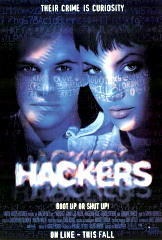
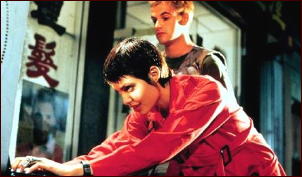
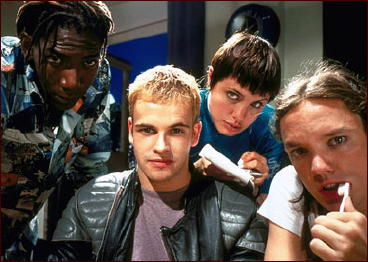
HACKERS. United Artists, 1995. Jonny Lee Miller, Angelina Jolie, Jesse Bradford, Matthew Lillard, Laurence Mason, Renoly Santiago, Fisher Stevens, Alberta Watson, Lorraine Bracco, Wendell Pierce. Director: Iain Softley.
As a rule, and I don’t have too many rules, but Number Five is that I don’t review movies I don’t understand. But every Rule has an Exception, and so does Rule #5. Movies about computers, computer whizzes and computer geeks I don’t have to understand to review them. I can even enjoy them, but not always.
Hackers is a movie that falls into the category of “I didn’t really understand the plot,†but I did enjoy it. A lot. The story deals with a worm and/or computer virus dreamed up by some slimy corporate security guy, but which a gang of high school hackers stumbles upon. And (with some travail but not too unexpectedly) they save the day.
https://www.youtube.com/watch?v=pP6iTjhlOvs
There is a lot of symbolic nonsense about what you see on the screen when someone is hacking, or at least I think it’s nonsense, but what do I know. Psychedelic images looking very electronic, in other words, but symbolic in the sense that it’s maybe what the hackers have in their brains while they are sitting at their computer screens typing madly away at the keyboard.
The reason I could enjoy this one is that the gang of hackers, whose actions and life style may or may not be authentic, but which feels authentic, except for maybe the roller skates, is so much fun to watch – their competitiveness, their one-upmanship, and their comradery – along with a romance that begins with hatred at first sight.
Or at least what feigns to be hatred at first sight, but these are teenagers, and their hormones are all mixed up.
I’m speaking of Jonny Lee Miller (Eli Stone, to some of us) and Angelina Jolie (Lara Croft, to some other of us, with some overlap, I’m sure). Miss Jolie was all of 20 years old when she made this movie, and from the first moment she’s on the screen, you know that, yes, here is going to be star.
The computer stuff was outdated even before they finishing filming this movie, so there’s no need to go into any of the details, even if I could (or even if I could fake it), and here it is, well over 15 years later already.
You needn’t be for a minute concerned about that. If you watch movies for fun and entertainment, this is one for you. Even if you don’t understand what’s going on: the plot, that is – the unimportant, non-essential part. Rule #2: Know which is which.
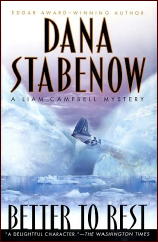
DANA STABENOW – Better to Rest. Signet, paperback reprint, September 2003. Hardcover edition: New American Library, 2002.
I’ve never availed myself of the method, but I’m told that a good way to learn a new language is to immerse yourself in it completely — in a class or a group session in which nothing but the language is spoken, for example — and eventually, by necessity, you’ll start to catch on.
As I say, I’ve never tried it, but I’ve often done what seems like the equivalent. Such as picking up a new mystery series in the middle, for example, and trying to pick up on who’s who and why this one doesn’t get along well with that one, and why these two are an item but aren’t talking to each other at the moment.
Sometimes, though, it seems to take an awfully long time.
Such as with this one, just as a handy example. Stabenow started out as a science fiction writer, but after three books, she seems to have abandoned the field and has concentrated on writing mysteries. Her first series character was Kate Shugak, whom I think might be best described as an Aleut private eye. There have been some 13 books about her since A Cold Day for Murder, which won an Edgar in 1992. Better to Rest, to get back to the book at hand, is the fourth in her second mystery series, featuring Alaskan state trooper Liam Campbell.
Alaska being what it is, the two major means of relaxation and/or pleasure are alcohol and sex, or at least that’s what I’d have believe after reading this book, as Liam, his current love, pilot Wyanet Chouinard, and their assorted families and friends (and not-so-friends) indulge in one or the other (or both) throughout the book.
But they all know each other, and I didn’t know any of them. Some of them, by the time I’d figured out who they were, the book was over. Which is OK, in a way. Some of them I decided I didn’t care about knowing.
The lovemaking scenes are often free-spirited if not totally rowdy, and one of them is outright distasteful. On the other hand, the Alaskan countryside is definitely spectacular, especially with winter arriving soon. On the other hand, the slow decay of Alaskan life in the town of Newenham, with the imminent death of the fishing industries, makes for a rather melancholy backdrop to the mystery that has to be solved.
And, yes, there is one, or rather two, but a long-time mystery reader will get the feeling early on that perhaps they are connected. (Whether they are or not, I leave for you to discover.) The major one is the discovery of a wrecked World War II airplane in a nearby glacier, complete with bodies and a gold coin clutched in the hand of a dismembered arm.
The other is the murder of a sexy 74-year-old grandmother, whose death Liam takes very badly. There’s very little detection involved. On page 259 (or 293) Liam says he knows who did it, and so he does. It seems more like guesswork to me.
Educated guesswork, I hasten to add, since he knows and lives with these people. For the most part, though, reading about them suits me just fine. Alaska sounds like a great place to visit, but I don’t think I’d care to live there.
— September 2003
[UPDATE] 07-01-12.Bad Blood, book number 20 in Dana Stabenow’s Kate Shugak series, is scheduled for next year (2013), but for whatever reason, this is still the most recent book-length adventure for Liam Campbell.
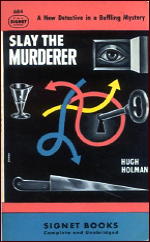
HUGH HOLMAN. Slay the Murderer. M. S. Mill Co., hardcover, 1946. Signet #684, paperback, 1948.
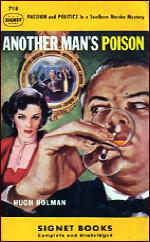
— Another Man’s Poison. M. S. Mill Co., hardcover, 1947; Signet #718, paperback, 1949.
Apparently the third book in the series featuring Sheriff John Macready of Hart County, South Carolina, Slay the Murderer finds the sheriff in something of a bind. Election Day is only two days off, and a prominent citizen is discovered stabbed and poisoned in a locked room.
The killer ought to be obvious, since he, too, is in the locked room, but Macready is considerably more than just a hick sheriff — though he wouldn’t want the voters to know that — and he finds contradictory evidence.
Still, if Macready doesn’t arrest the obvious person or doesn’t find out who did indeed do it and how, his re-election to a fairly cushy job that he usually enjoys is doubtful.
In the later Another Man’s Poison, Macready leaves his county to complain to a politician about the appointment of an inept postmaster. Before he can talk to him, the politician drinks one of his own special cocktails and dies of poison.
Macready is a witness, and there seems to be no way that the drink could have been poisoned by anyone. Also, it can’t be certain that the politician was the target of the poisoner, for he had taken the glass from someone else. Macready is glad it’s someone else’s problem until the murderer attacks him.
Two excellent mysteries with an appealing lead character.
— From The MYSTERY FANcier, Vol. 11, No. 1, Winter 1989.
The Sheriff John Macready series —
Trout in the Milk. Mill, 1945.
Up This Crooked Way. Mill, 1946.
Slay the Murderer. Mill, 1946.
Another Man’s Poison. Mill, 1947.
Hugh Holman (1914-1981) was the author of two other mysteries: Death Like Thunder (Phoenix, 1942) and as Clarence Hunt, Small Town Corpse (Phoenix, 1951).
Holman, however, was more than a writer of better than average detective novels, using Bill’s review as a basis for that statement. From http://museum.unc.edu:
“In 1946, he entered graduate school at the University of North Carolina, where he received his doctorate with a dissertation on William Gilmore Simms. He joined the UNC English department and taught there until his retirement. He served as department chair, acting dean of the College of Arts and Sciences, dean of the graduate school, provost, and special assistant to the chancellor. From 1957 to 1973, he served as chair of the Board of Governors of the University of North Carolina Press. Holman was the recipient of a Simon Guggenheim Fellowship (1967), the Thomas Jefferson Award (1975), and the Oliver Max Gardner Award (1977). He was a fellow of the American Academy of Arts and Sciences and a founding editor of the Southern Literary Journal.”
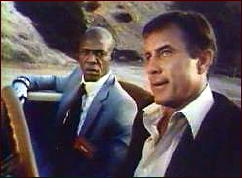
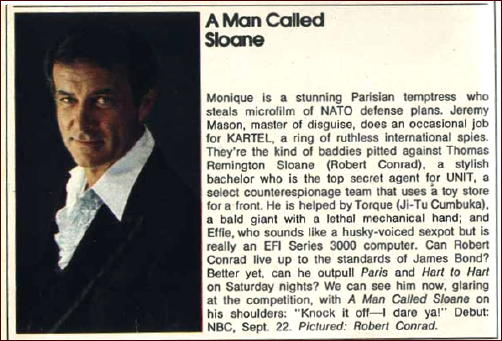
“The Venus Microbe.” An episode of A Man Called Sloane. NBC / Woodruff Productions in association with QM Productions. Season 1, Episode 6. Saturday, 27 October 1979, 10-11pm (Eastern). Cast: Robert Conrad as Thomas Remington Sloane III, Ji-Tu Cumbuka as Torque, Dan O’Herlihy as The Director, Michele Carey as the voice of Effie. Guest Cast: Monte Markham, Morgan Fairchild, Darrell Zwerling, Rita Wilson, Karen Purcill. Created by Cliff Gould. Teleplay by Peter Allan Fields, Jack V. Fogarty and Gerald Sanford. Story by Marc Brandel. Executive producer: Philip Saltzman. Producer: Gerald Sanford. Directer: Winrich Kolbe.
Earlier, I reviewed this series’ pilot TV-movieDeath Ray 2000 that starred Robert Logan as Sloane. The character Torque, who was a bad guy in the pilot, was changed to Thomas’ partner for the series. I found the pilot more fun to watch, yet the series had its over the top moments as well.
A Man Called Sloane is not good enough to be called a James Bond wannabe nor can it be called a Man from U.N.C.L.E wannabe. At best this series is a Eurospy wannabe.
The Eurospy film was a sub-genre of spy films made mainly in Europe during the 60s to take advantage of the Bond craze. Over the top plot, bad acting, a mess of a script, car chase, gadgets, beautiful women, evil villain, mad scientists, femme fatale, fights, it is all here in this single hour TV episode.
The plot of this episode features the theft of a deadly microbe brought back from the planet Venus. It is stolen by one of the scientists examining the microbe and sold to Cambro (Monte Markham) of Kartel, an evil organization out to take over the world.
In the paint-by-numbers script, Thomas and his sidekick Torque arrive to check out a tip that the microbe is about to be stolen. The two work for UNIT, an “elite counter force reporting directly to the President,†with its office hidden in a retail store called “The Toy Boutique.â€
The theft happens while they are there so our heroes get to have a car chase and use some gadgets. The femme fatale (Zacki Murphy) and adulterer-traitor-scientist (Alex Henteloff) escape, while Thomas and Torque are occupied with a pursuing fake ambulance that has some gadgets of its own.
Meanwhile, two scientists are unconscious in the contaminated lab. They can keep them alive by pumping oxygen into the lab, but they have only twenty-four hours before the mix of oxygen and microbe will cause the lab to blow up. Conveniently, there is an antidote but the traitor scientist (who did not create the formula) has the only copy of the formula.
And the plot holes are just beginning as the episode continues in an unrelenting stream of formulaic scenes until Thomas finally saves the girl, escapes the death trap and foils the villain’s evil plans. In fact, the script tries to jam too much into one episode. The villain having the deadly microbe is jeopardy enough. There is no need to add the sub-plot of twenty-four hours before the scientists die or the lab goes boom.
Acting, as every Eurospy film fan knows, is not the sub-genre’s strong point. While certainly an improvement over Logan from the pilot, Conrad has never played more than a version of himself. At times that can be entertaining enough, but here Conrad lacks his usual charm.
Fairchild was great as a blonde but not so much as the wannabe PI on the trail of the cheating husband aka traitor scientist. Markham’s evil madman was the standard bland TV villain.
Bad acting, formula writing and an unbelievably stupid plot and you had a way to spend a mindless hour on Saturday night, if that is your idea of a productive way to spend your Saturday nights.
The series debuted September 22, 1979. It was scheduled against two other new shows, ABC’s Hart to Hart and CBS’s Paris (which debuted September 29th). The ratings were good in the first three weeks with A Man Called Sloane winning its time slot two of those weeks and tied with Hart to Hart the other week.
Sloane and Hart both benefited from the ratings disaster of Paris. The ratings for September 29th had Sloane winning the time period with a 34 share, Hart to Hart a 33 share, and CBS’s Paris a 22 share. However, an early warning sign was the ratings were slowly dropping for Sloane.
Then ABC moved Fantasy Island to Saturday at 10pm (where it had aired the season before) and it was the beginning of the end for A Man Called Sloane. The ratings for the first matchup had Fantasy Island at a 38 share, with Sloane a 28 share and a CBS rerun special Body Human – The Sexes at 20.
For this episode, “The Venus Microbe†had a 24 share compared to Fantasy Island 38 share and Paris 25 share.
In the ratings for the period of September 17 thru November 4, 1979, A Man Called Sloane finished 51st out of 73 series.
The series had a total of 12 episodes filmed and the last original episode aired December 22, 1979.
This episode is currently (but who knows for how long) available to watch on YouTube. The series itself is available on DVD only in the collector-to-collector’s market.
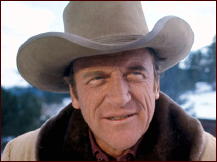
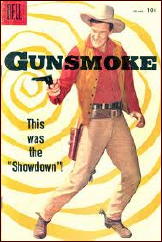
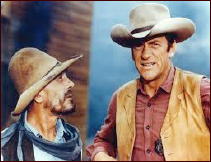
“The Fourth Victim.” An installment of Gunsmoke: Season 20, Episode 8. First broadcast: 4 November 1974. James Arness (Matt), Ken Curtis (Festus), Milburn Stone (Doc), Buck Taylor (Newly), Leonard Stone, Ben Bates, Alex Sharp, Al Wyatt Sr., Frank Janson, Biff McGuire, Lloyd Perryman, Victor Killian, Woody Chambliss, Howard Culver, Paul Sorensen, Ted Jordan. Writer: Jim Byrnes. Director: Bernard McEveety.
Genuine whodunits set in the Old West are certainly rare, which makes this episode of Gunsmoke from its final season slightly more interesting.
A serial killer (seen only in silhouette and shadow) equipped with a .30-caliber rifle and a silencer is stalking Dodge City, murdering at will, sniper-style. Since there seems to be no obvious connection of the victims with one another, his motive is completely opaque.
Marshall Matt Dillon must turn detective to find the connection, which he does — and yet, technically speaking, he really doesn’t — halfway through the show, prompting him to think Doc Adams will be the next victim.
Using a willing Doc as bait, Dillon sets a trap, which is only partially successful, resulting in a severely damaged chair in Doc’s office and a wounded and therefore doubly dangerous sniper — who courteously sends Matt a note swearing revenge on him for interfering in his plans and calling him out for a midnight showdown — alone.
Feeling he has no better choice, Dillon appears on the deserted streets of Dodge, unaware that Doc and Festus have a surprise in store — but now fully aware of who the sniper really is ….
Since the plot centers on a woman, it’s interesting that there are no speaking parts for them in this episode. (By this time, Amanda Blake [Miss Kitty] had left the show after an argument with the producer.)
Unusually for this series, the episode takes place entirely on indoor sound stages.
Ben Bates makes an appearance in the same scene with James Arness, which is of interest since he was Arness’s stunt double throughout the run of the Gunsmoke series.
The mystery and suspense level of “The Fourth Victim” is gratifyingly high, although experienced mystery aficionados should be able to figure it out early on. If only the writer had surreptitiously introduced the final clue sooner, say in the first act, Matt’s solution near the end wouldn’t have had that rabbit-from-a-hat feel to it.
As it is, however, “The Fourth Victim” is still worth a view. It can be seen in its entirety on YouTube here.
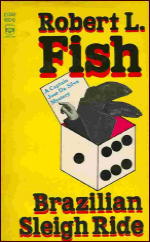
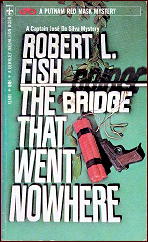
ROBERT L. FISH – Brazilian Sleigh Ride. Simon & Schuster, hardcover, 1965. Paperback reprints: Berkley, 1967; Foul Play Press, 1988.
Robert L. Fish, after a successful business career, became a successful mystery writer at age 48. He wrote the hilarious Schlock Holmes parodies and a fine series of ten books about Captain Jose Da Silva, one of the best of which, Brazilian Sleigh Ride, has just been reprinted by Foul Play Press.
Fish uses two locales he knows best, Brazil (where he worked many years) and New York, in chronicling the efforts of Da Silva and his friend Wilson of the American Embassy to find who stole a fortune in negotiable bearer bonds.
The story is compelling and Fish tells it in very lively fashion, especially regarding Da Silva’s extreme fear of flying and his feuding with Wilson.
— Reprinted from The MYSTERY FANcier,
Vol. 11, No. 1, Winter 1989.
The Captain Jose da Silva series —
The Fugitive. Simon & Schuster, 1962.
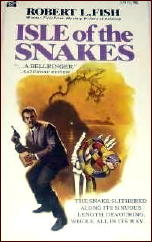
Isle of the Snakes. Simon & Schuster, 1963.
The Shrunken Head. Simon & Schuster, 1963.
Brazilian Sleigh Ride. Simon & Schuster, 1965.
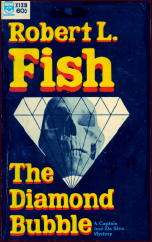
The Diamond Bubble. Simon & Schuster, 1965.
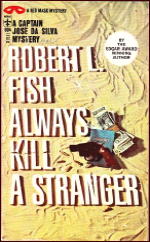
Always Kill a Stranger. Putnam, 1967.
The Bridge That Went Nowhere. Putnam, 1968.
The Xavier Affair. Putnam, 1969.
The Green Hell Treasure. Putnam, 1971.
Trouble in Paradise. Doubleday, 1975.
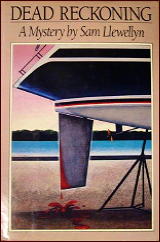
SAM LLEWELLYN – Dead Reckoning. Summit Books, US, hardcover, 1988. Pocket, US, paperback, 1989. First published by Joseph, UK, hardcover, 1987.
If Dick Francis turned from horse racing to yacht racing his name might be Sam Llewellyn and he might write Dead Reckoning. This is Llewellyn’s second novel and first mystery, and it’s a gem.
Charlie Agutter is a boat designer in Pulteney on the coast of England. His fortunes are on the rise, his talents are in demand, and one of his yachts seems likely to win the Captain’s Cup. Then the bottom falls out: Charlie’s brother is killed aboard a boat Charlie designed, and the word gets about that Charlie’s design is fatally flawed.
Suddenly no one wants to touch him; existing design contracts are put on hold till Charlie can prove his experimental rudder design not at fault. If only he could… But someone badly wants him ruined if not dead.
Notable drive and suspense.
— Reprinted from The MYSTERY FANcier,
Vol. 11, No. 1, Winter 1989.
The Charlie Agutter series —
Dead Reckoning, 1987.
Blood Orange, 1988. CA in a supporting role.
Deadeye, 1989. CA in a minor role.
Death Roll, 1989. CA in a minor role.
These four books are only a small fraction of Llewellyn’s total fictional output. For a complete list, check out the Fantastic Fiction website.
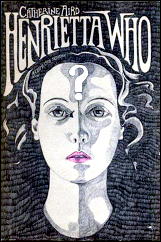
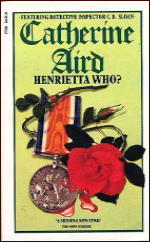
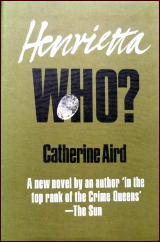
Aird’s primary mystery-solving character is Detective-Inspector C. D. Sloan, who’s appeared in all but one of her books. Whether he’s been promoted since his early outings — this was only his second appearance — I can’t tell you, since (I am embarrassed to say) I have not read any of his more recent ones.
And if there is anything to be learned about his private life in any of his other books, it would be more than may be found in this one, which is nothing at all.
In Henrietta Who? he’s the Head of the Criminal Investigation Department for the police in Berebury, and as we’re told, it’s a very small Department. His assistant on this case — and also along many of those to follow, I believe — is Constable Crosby, who (as we shall see) is not always the brightest of subordinates. His Superintendent is a gruff, old-fashioned sort of fellow named Leeyes.
If there were first names given, I missed them. I do not even believe Sloan’s initials were stated, except on the back cover. The emphasis is on the mystery, and for the most part, it’s a good one.
This was Aird’s third mystery. Her second one, A Most Contagious Game, was the standalone, the only one that Sloan did not appear in. While she knew what she wanted to do — and for at least 90% of the book she succeeded in doing exactly that — there are a couple of weak points that a more experienced writer might have been able to improve upon.
The story: When a woman is killed as a pedestrian by an automobile whose driver didn’t stop for help, it wouldn’t ordinarily bring Sloan in, but the woman had a daughter, and the pathologist who examines the body says she never had a child.
The girl’s name is Henrietta, who never knew her father, and abruptly called home from university, she is suddenly not only an orphan, but she has no idea who she is. No birth certificate (possibly stolen), no passport, no other form of identification. A total mystery.
Sloan is working almost entirely in the dark, with the only information provided by the girl, and she might not be telling the truth. It makes Henrietta Who? a rather unique tale, as far as I know, and the intellectual stimulation generated by the problem Sloan and his cohorts must solve is, in a word, contagious.
Don’t get me wrong. This is no dry exercise in mental calisthenics. Aird has a dry, understated sense of humor that must be like mine, as it appeals to me immensely. On page 71, Sloan is bouncing ideas off Crosby, and he doesn’t seem to be getting anywhere:
“No record [Sloan says] of any Grace Edith Wright marrying any Cyril Edgar Jenkins within five years of either side of when the girl thought they did.”
Crosby took another sandwich and thought about this for the length of it. Then “Grace Jenkins must have had a birth certificate.”
“Wright,” said Sloan automatically.
Crosby, who thought Sloan had said “Right,” looked pleased and took another sandwich.
“Though,” continued Sloan, if she’s Wright, why bring Jenkins in at all, especially if she’s not married to him.”
Crosby offered no opinion on this.
Great fun, and the plotting very nearly works. But as far as I can tell, there’s a huge hole a small lorry could plow through, and that’s because it doesn’t seem likely the person who’s the second murder victim — Henrietta’s “mother” was the first — would have kept quiet about the secret that the woman had been keeping for all of those years, not now when she’s dead, and with the newspapers and radio on full alarm about her death.
Other than that, with all of the red herrings and other false trails that have to be sorted through, this is one fine case of detection — everything else falls into place just the way it should.
— September 2003
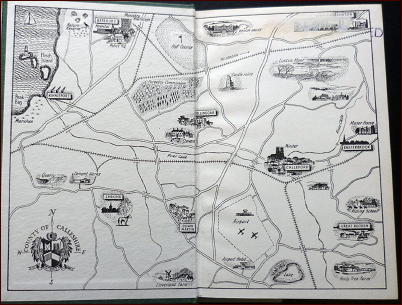
[UPDATE] 06-22-12. The very plain cover of the British hardcover edition shown above on the lower right has a very nice surprise inside. Scaled down in size, it may not be as impressive here as it would be if you were holding the book in your hand, but a map of the area where a fictional crime is committed is always a bonus as far as I’m concerned, and this one is a nice one indeed:
When I wrote this review in 2003, I didn’t specify a count of how many Sloan books there were at the time, but there have been three written since, for a total of 22, the most recent one being Past Tense, published in 2010 when the author was 80. I should check. I don’t believe that many of the last few have been published in paperback in the US, and if I’m correct about that, it’s a shame, as Aird is an author who ought to be better known, and she isn’t.
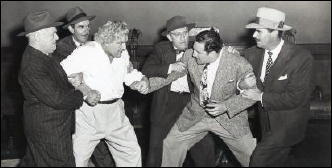
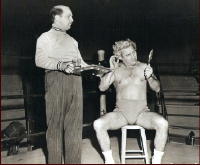
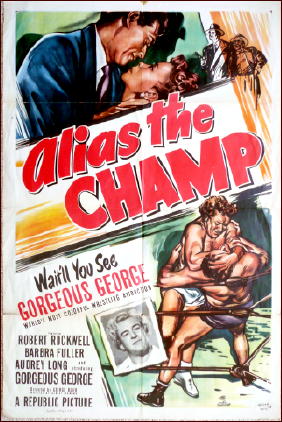
ALIAS THE CHAMP. Republic Pictures, 1949. Robert Rockwell, Barbra Fuller, Audrey Long, Jim Nolan, John Harmon, Sammy Menacker, Joseph Crehan, John Hamilton, Gorgeous George (George Wagner), Bomber Kulkovich (Henry Kulky). Director: George Blair.
“George Raymond Wagner (March 24, 1915 – December 26, 1963) was an American professional wrestler best known by his ring name Gorgeous George. In the United States, during the First Golden Age of Professional Wrestling in the 1940s-1950s, Gorgeous George gained mainstream popularity and became one of the biggest stars of this period, gaining media attention for his outrageous character, which was described as flamboyant and charismatic. […]
“It was with the advent of television, however, that George’s character exploded into the biggest drawing card the industry had ever known. With the networks looking for cheap but effective programming to fill its time slots, pro wrestling’s glorified action became a genuine “hit†with the viewing public. […] [I]t was Gorgeous George who brought the sport into the nation’s living rooms, as his histrionics and melodramatic behavior made him a larger-than-life figure in American pop-culture. […]
“[I]t was Gorgeous George who single-handedly established television as a viable entertainment medium that could potentially reach millions of homes across the country (in fact, it is said that George was probably responsible for selling as many TV sets as Milton Berle).”
In the comments following Michael Shonk’s review of The Hunter, the subject of wrestling came up, prompting me to take a quick look at at c2c DVD I have of Alias The Champ. With a 59-minute running time, little else was possible.
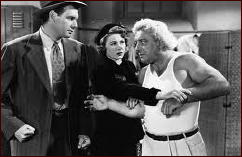
Briefly, there’s this honest cop (Robert Rockwell, aka Our Miss Brooks’s dense boyfriend Mr. Boynton), who’s out to stop The Mob from taking over honest professional wrestling — brief pause while those of you who’ve fallen out of your chairs laughing can get back in —  with the aid of Gorgeous George’s beautiful female manager (Audrey Long).
After clearing it with the police commissioner (John Hamilton, pre-Superman), Rockwell becomes de facto wrestling czar in order to battle the Mob Guy (Jim Nolan), who suborns a rival wrestler (Slammin’ Sammy Menacker, using his own name — bear this in mind as we proceed) in order to provoke and then discredit Gorgeous George.
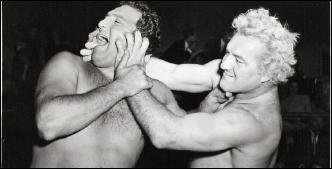
We first see GG in the ring with Bomber Kulkavich (aka Henry Kulky) in a match as close to “the real thing†as a movie can get; At its outset, we hear GG’s deathless line, spoken to the referee: “Get your filthy hands off my hair!â€
After winning this match, GG meets Rockwell, to whom he takes an immediate dislike, especially since he seems to be attracted to the pretty female manager (You may all feel free to make whatever inferences you wish, but this is a 1949 Republic programmer, so I’ll just stay on the surface).
Anyway, there are some more confrontations between GG and Menacker, including one at a gym that turns into a free-for-all with the added participation of other wrestlers (including the Super Swedish Angel – Tor Johnson), resulting in the Big Match – which ends up with Menacker dead, and GG accused of his murder.
Yes, Slammin’ Sammy Menacker was an actual pro wrestler (you might remember him as one of the strongmen who did the tug-o-war with Mighty Joe Young {along with Henry Kulky, op cit.}), and he gets “killed off†in this movie.
So anyway, Menacker is “dead,†GG is in jail, and it’s up to Rockwell to clear him and restore honest wrestling’s reputation. Rockwell does this with the aid of “new technology†— the film of the televised match that was made for the East! (The word kinescope wasn’t used.)
I’ve condensed the daylights out of this plot, so as not to spoil it for so many of you who might want to track it down. As to the acting … no, it’s too easy.
But I should mention the director, George Blair, a Republic workhorse who went on, a few years later, to a regular stint on TV’s Adventures Of Superman.
And I do want to quote another of Gorgeous George’s classic lines, just after one of the face-offs with Menacker, delivered to his concerned lady manager:
“Come, little one. It’s time for my marcelle.â€
I make no judgement. This one you gotta see for yourself.
Editorial Comment:Alias the Champ was the first and only film in which Gorgeous George was to appear.
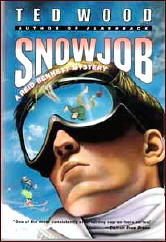
When I think of Canadian mystery writers, three immediately come to mind: Eric Wright, Lawrence Gough, and Ted Wood. All are good, and Wright and Wood are among my favorites. Reid Bennett is Chief and one-man force of a small Ontario town, but often for one reason or another leaves his venue, and the books seem more like hardboiled PI stories than police procedurals.
Here Bennett comes to a Vermont ski town to aid a Viet Nam buddy in trouble. Doug Ford, black, ex-Marine, local cop, has been arrested for the murder of a local woman. He tells Bennett that he was working with her undercover to bust a money laundering scheme involving local bigwigs and New York Mafia.
The problem is that he was doing it on his own and didn’t tell anyone in the Department. The problem is compounded by Ford’s personal grudge against the Mafia bigwig, dating from his days as a NYC cop. The frame is tight, the local force is honest but inexperienced, and no one but Bennett believes him innocent. So Bennett and his wonder-dog Sam go to work.
I’ve never thought that plotting was one of Wood’s strong points, and I’m confirmed in that view here. From the original premise to a confusing if not confused ending, I thought this plot was weak. What I have enjoyed about the series is the well-developed character of Reid Bennett, and the fast paced and forceful writing of Wood; and I still do.
Wood is an ex-Toronto policeman, and though these are in no sense procedurals there is authenticity to the parts that deal with police work. They are usually violent books, and this is no exception., though it’s less violent than some previous ones.
I continue to enjoy the Bennett series, though much less than I would if the plots were better. This is not the best of them by any means, but I’d still recommend it to Wood fans.
— Reprinted from Ah, Sweet Mysteries #8, July 1993.
The Reid Bennett series —
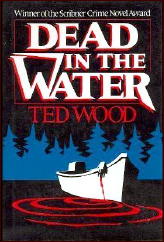
1. Dead in the Water (1983)
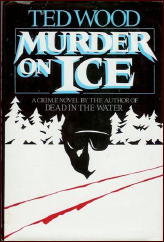
2. Murder On Ice (1984)
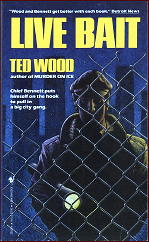
3. Live Bait (1985)
4. Fool’s Gold (1986)
5. Corkscrew (1987)
6. When the Killing Starts (1989)
7. On the Inside (1990)
8. Flashback (1992)
9. Snowjob (1992)
10. A Clean Kill (1995)