Reviews


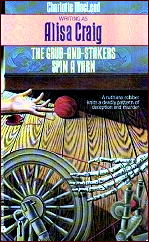
ALISA CRAIG – The Grub-and-Stakers Spin a Yarn. Avon, paperback original, February 1990.

THE GRUB AND STAKERS SPIN A YARN

   The mystery begins in high gear and doesn’t let up until its over. A melodramatic shooting takes place in Miss Fuzzywuzzy’s yarn shop in downtown Lobelia Falls [somewhere in Ontario, Canada]. The dead man is the husband of Mother Matilda, owner of Mother Matilda’s Mincemeat, a million dollar operation in nearby Lammergen.

   He is also, or was, VP Nutmeg. At stake is Mother Matilda’s secret recipe for mincemeat, each VP being responsible for his/her ingredient only.

   Cutesy-poo, you must be thinking, and I wouldn’t blame you. I’d agree to a degree, but if not, then certainly sugary-sweet. Everybody in the book is as loopy as a loon, some more than others, with the (barely) possible exception of the detectives of record, Osbert and Dittany (formerly Henbit) Monk.

   Sometimes it makes for slow going, sometimes it’s worth an embarrassed chuckle or two. May I quote from pages 84-85? It sums it up as well as I ever could. (It could be author Alisa Craig, aka Charlotte MacLeod, speaking herself.)

    “If it’s tacky, if it’s garish, if it’s so cloyingly cute and whimsical it makes you long for a shot of insulin, then it sets my creative juices going ta-pocketa-ta-pocketa like the mad scientist’s chemistry tubes in the old horror movies. I can’t help it, it’s just the way I am.”

   I think the detective work is nothing more than inspired guess work myself, but maybe you could say that of Sherlock Holmes, too. Certainly if you’ve enjoyed the earlier entries in the series, you’ll enjoy this one as well. As for me, I’m going to go take a nice long walk.

— Reprinted from Mystery*File 28,
       February 1991 (slightly revised).


Bibliographic Notes:   Besides pinpointing the setting of the novel somewhat better than it was in the original review, I’ve also added the information that Alisa Craig was the pen name of Charlotte MacLeod. It was common knowledge at the time, but although MacLeod/Craig was extremely popular back in the early 1990s, that’s a generation ago, and I think her books are on the verge of being forgotten, if they haven’t already.

   As Alisa Craig, she wrote five books in the “Grub-and-Stakers” series, of which this was the fourth; and five in a series of mysteries solved by Detective Inspector Madoc Rhys of the RCMP, along with his wife Janet.

   Under her own name, Charlotte MacLeod, who died in 2005, wrote another 10 mysteries tackled by Professor Peter Shandy Balaclava Agricultural College, somewhere in Massachusetts; plus another 12 cases solved by Sarah Kelling and Max Bittersohn in the Boston Area. Add to this several stand-alones, and you have a shelf filled with books, all (or mostly all) of them cozies to the core, from page one to the end.

THE BACKWARD REVIEWER
William F. Deeck


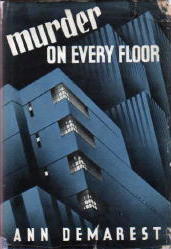
ANN DEMAREST Murder on Every Floor

ANN DEMAREST – Murder on Every Floor. Hillman-Curl, hardcover, 1939. Mystery Novel of the Month #39, digest-sized paperback, 1942.

   As New York City’s worst winter in fifty-five years begins, Christine Howarth has passed up the opportunity to go to Bermuda with a rich young man. She is moving to Greenwich Village with the hope of painting at least one really good picture.

   Unfortunately, there’s no opportunity for her to achieve her goal since the very first night she moves into a new apartment there is murder done across the hall. No matter that she just arrived that evening and knows no one in the building, she is a suspect.

   Howarth is an engaging character. Her lawyer, who helps the police investigate and who is interested in Howarth, and the occupants of the apartment building are not, nor are they well drawn.

   Read the book if you come across it and it’s free or cheap, but don’t make it a point to look for it.

— From The MYSTERY FANcier, Vol. 11, No. 1, Winter 1989.


Bibliographic Notes:   Anne Demarest was the pen name of Florence Demarest Foos Bond (1905-?). The only other mystery novel to her credit, according to Hubin, was She Was His Secretary (Gramercy, 1939), and that one is denoted as having only marginal crime content.

THE HAT BOX MYSTERY

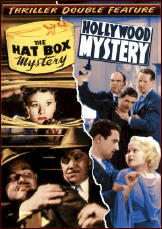
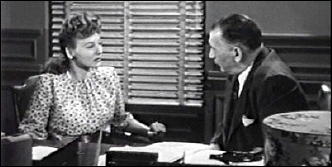
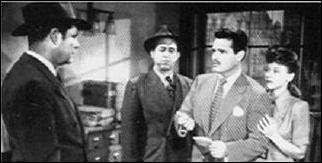
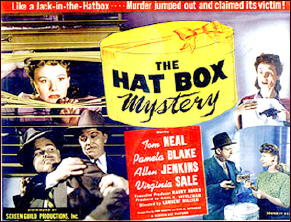
THE HAT BOX MYSTERY. Screen Art Pictures, 1947. Tom Neal, Pamela Blake, Allen Jenkins, Virginia Sale. Director: Lambert Hillyer.

   There are a few remarkable things about this 45 minute movie, and the first is that it is a 45 minute movie, obviously the quick second half of a double feature on a Saturday matinee. The second remarkable thing is the opening scene, in which the four above-mentioned actors introduce themselves to the viewing audience and the characters they play. I’ll get back to that in a minute.

   One other remarkable thing, at least to me, is that this movie was produced and appeared in 1947. While watching it, I was assuming all way through that it was a much earlier film, one from perhaps around the time that Chester Morris was beginning his run of Boston Blackie pictures (1941), but no. It must have been the story line, which is straight from the budget B-mystery movies of the even earlier 1930s.

   Tom Neal plays private eye Rush Ashton, while Pamela Blake is his girl friend, secretary and assistant, Susan Hart. Allen Jenkins is “Harvard,” no last name given as I recall, is Ashton’s second-in-command, strangely enough, since “Harvard,” unable to get into Yale, seems barely able to steer himself across the street, where his girl friend Veronica Hoopler (Virginia Sale) owns and operates a hamburger joint.

THE HAT BOX MYSTERY

   Not too surprisingly, it is only Miss Hoopler who has any common business sense, as it is from her that Ashton’s struggling PI agency must keep borrowing money to keep afloat. You must have come to the thought by now that at least half of this movie is played as a comedy, and if I’d kept track, I’d be willing to say that you are correct.

   Here’s the mystery portion: While Ashton is out of town on another case, a man in obvious disguise (glasses, phoney goatee) hires Susan to take his wife’s photograph with a camera disguised in turn as a hat box.

   Little does Susan know, but happily accepting the man’s thirty dollars, that inside the hat box is not a camera, but a gun.

THE HAT BOX MYSTERY

   I’ll not say more. But surprisingly enough, Ashton does do some detective work in the case, the D.A. not being all that unfriendly, and the story is not a total disaster. If the script had been been revised so that the clues could have incorporated more into the story, instead of lumped into one great expository dump at the end — more viewers probably having figured it all out on their own anyway — this movie might have been — a contender? No, but something better than the (in all likelihood) throwaway second half of a double feature.

   Also surprisingly enough, the four players got to play the same roles all over again the following month, in a follow-up film titled The Case of the Baby-Sitter. While The Hat Box Mystery is readily available on DVD, copies of the second movie do not seem to exist, although one reviewer on IMDB must have seen it, as he complains in passing that Allen Jenkins may have gotten more screen time than Tom Neal.

   That’s rather discouraging news, but if a copy came along, would I watch? I don’t know what this says about me, but you bet I would.

THE HAT BOX MYSTERY


[UPDATE] 05-08-12.   This review was first posted on this blog on May 30, 2008. I’ve bumped it up in time because a lively discussion has been taking place in the comments section over the last day or so. Not only has the conversation been lively, but it’s also been very informative. I thought the rest of you might like to know about it, rather than keep it buried, as it were, nearly four years in the past. I’ve altered and (hopefully) improved the selection of images, too.

REVIEWED BY DAN STUMPF:         


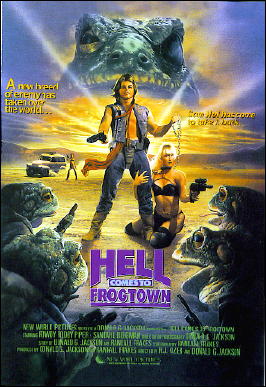
HELL COMES TO FROGTOWN

HELL COMES TO FROGTOWN. New World Pictures, 1988. Julius LeFlore, RCB, Roddy Piper, William Smith, Sandahl Bergman, Kristi Somers, Rory Calhoun, Cliff Bemis. Directors: Donald G. Jackson & R. J. Kizer.

   [After watching those early Rory Calhoun action westerns], small wonder that I broke down and shelled out the $10 necessary to own my own copy of Donald G. Jackson’s 1988 cult classic Hell Comes to Frogtown.

   The World really needed a post-apocalypse movie with a sense of humor and this is it, a clever, relentlessly trivial thing about the end of Life as We Know It and What Happens Next.

HELL COMES TO FROGTOWN

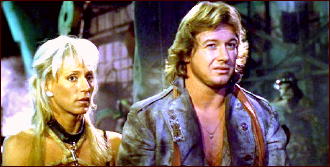
   Writer/Director Jackson manages to avoid most of the cliches inherent in the concept of a Future Society Ruled by Women, gets surprisingly not-awful performances from Sandahl Bergman and pro wrestler “Rowdy” Roddy Piper, and even manages to evoke a lot of sympathy for a washed-up amphibian chanteuse played, I think, by Shirley Maclaine in heavy makeup and an unbilled cameo.

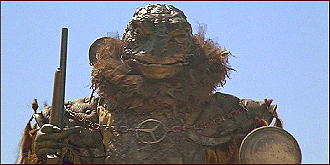
   Rory Calhoun, needless to say, is just fine as a garrulous old prospector named “Looney” Tunes, and one of the fight scenes between Piper and a six-foot talking toad brought down the House (such as it was) when Piper called his warty opponent a “horny bastard.” Priceless.

HELL COMES TO FROGTOWN


Editorial Comments: The trailer for this film can be seen here on YouTube. For a scene entitled “The Dance of the Three Snakes,” go here.

REVIEWED BY MICHAEL SHONK


AMOS BURKE, SECRET AGENT. ABC / Four Star Productions / Barbety, 1965-66. Cast: Gene Barry as Amos Burke, Carl Benton Reid as The Man. Series based on characters created by Frank D. Gilroy. Produced by Aaron Spelling.
AMOS BURKE, SECRET AGENT

    From Aaron Spelling: A Prime Time Life, by Aaron Spelling with Jefferson Graham: “Burke’s Law was one of my first great campy shows… Then ABC threw us a curveball with the ‘James Bond’ craze. Suddenly secret agents were in… So in 1965 Burke’s Law, the story of a millionaire L.A. detective, was forcibly changed to Amos Burke, Secret Agent. He became a debonair, globe-trotting secret agent for a United States intelligence agency. I hated it, Gene hated it, we all hated it, and ABC was very wrong to change it…”

    The series was a ratings failure from the very beginning. “Balance of Terror” (9/15/65) was the series first episode. The Arbitron ratings (Broadcasting, 9/20/65) found NBC’s I Spy at 37.6 share (first half hour) and 40.9 (last half hour) compared to CBS’s Danny Kaye at 32.3 share and 30.3 share compared to Amos Burke at 24.8 share and 25.8 share. By November the series would be cancelled (Broadcasting, 11/1/65).
AMOS BURKE, SECRET AGENT

    Interestingly, the final episode of the series, “Terror in Tiny Town, Part Two” aired at 10pm on Wednesday, January 12, 1966, the same night ABC premiered its new spy series Blue Light at 8:30pm. Could the failure of Amos Burke have played a role in ABC picking up Blue Light and the rush to get it on the air?

    So besides the audience having little interest in Amos Burke as a spy, and everyone involved hating it, the series also had a fatal creative flaw, The Man.

    The Man was supposed to be Amos Burke’s “M” (Bond) or Mr. Waverly (Man from U.N.C.L.E.). Instead The Man was one of the most unlikable, heartless, mean characters ever to play a good guy on TV. While Amos could not contact The Man, The Man gave him a watch that when it buzzed, it meant Amos had to stop everything and get to the airport as fast as possible to meet The Man. The Man’s office was the inside of a DC-9 and he conducted all meetings (but one) in the air.

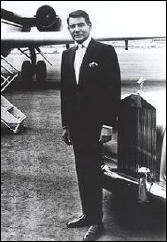
    Amos would wait on the landing strip in his Rolls (the only other surviving character from Burke’s Law) for The Man’s plane. Once it landed, Amos would pull out what looked like a sonic pen light and point it at the plane, the sound would lower the stairs and Amos would enter and cool his heels in the outer “office” until The Man gave him permission to enter. Then Amos would use the door’s keypad (with comical beeps and boops) to open the door. This is how sidekicks get treated, not the hero.
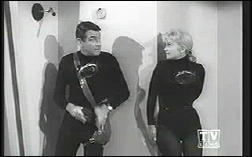
AMOS BURKE, SECRET AGENT

    Most episodes featured at least one beautiful woman on each side. Amos enjoyed working with women, and while much of his dialog sounds condescending today, he treated his female contacts as equals. But for Amos, women were usually interchangeable. In one episode (I won’t spoil it by naming it) Amos’s contact is a beautiful intelligent woman Amos admires, but after her death in action he doesn’t even comment on the loss. At the end, he seduces her replacement.

    Production values were on the cheap side and sets and exteriors were noticeably recycled week after week. But Supervising Art Director Bill Ross and his crew did a creative job using sets to establish the style of the show, with campy odd shaped doors for the villain’s lair to menacing underground dungeons.

    While few miss Amos Burke, Secret Agent, one wonders why ABC cancelled the series instead of returning to the successful police formula of Burke’s Law.

        EPISODE GUIDE —

“Balance of Terror.” September 15, 1965. Writtenby Robert Buckner. Director: Murray Golden. Guest Cast: Will Kuluva, Gerald Mohr, Michele Carey * Amos takes the place of an arrested courier for a group smuggling gold from Red China into Latin America. (Part of the opening of this episode can be seen here on YouTube.)

“Operation Long Shadow.” September 22, 1965. Written by Albert Beich & William H. Wright. Director: Don Taylor. Guest Cast: Antoinette Bower, Dan Tobin, Rosemary DeCamp * A kidnapping of the son of an Algerian government official is the key to a mysterious plot. The “B” storyline involved two vacationing American tourists who knew Amos as the good guy detective and Amos proving to them he has turned into a spoiled playboy cad. In one of the more imaginative death traps of the series, Amos is locked in a moving train car filling up with gas. He escapes with the aid of the air in his Rolls tires.

“Steam Heat.” September 29, 1965. Written by Marc Brandel. Director: Virgil Vogel. Guest Cast: Nehemiah Persoff, James Best, Jane Walo * Exiled Mob boss mixes business with revenge when he plans to kill the Senator who got him kicked out of the country while his gang robs New York City using a knockout gas released through the city’s steam pipes. In this episode Amos receives instructions with breakfast on a record disguised as a flapjack.
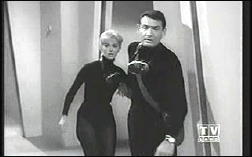
AMOS BURKE, SECRET AGENT

“Password to Death.” October 6, 1965. Written by Marc Brandel. Director: Seymour Robbie. Guest Cast: Janette Scott, Joseph Ruskin, Michael Pate * A dying clue ‘S Day’ leads Amos to Cornwall, England and an evil villain. One of the best episodes of the series as it featured the perfect spy plot for the series premise. It also had my favorite line of the series. After quoting Shakespeare, Amos adds “Hamlet’s Law.” (It is Janette Scott seen with Gene Barry in the two photos above and to the right.)

“The Man with the Power.” October 13, 1965. Written by Stuart Jerome. Director: Murray Golden. Guest Cast: Thomas Gomez, John Abbott, Ilze Taurins * Amos’s attempt to help a scientist defect goes wrong, leaving the unconscious scientist wired to a bomb. The Man worries about America’s image as Vienna is evacuated.

“Nightmare in the Sun.” October 20, 1965. Written by Tony Barrett. Director: James Goldstone. Guest Cast: Barbara Luna, Edward Asner, Joan Staley, Elisha Cook * The Man is concerned about an assassination attempt of a Mexican Government official by two Americans because it might prevent the approval of a treaty between America and Mexico. Flawed by its predictability and many moments that make little to no sense.

“The Prisoner of Mr. Sin.” October 27, 1965. Teleplay: Gilbert Ralston and Marc Brandel. Story: Gilbert Ralston. Director: John Peyser. Guest Cast: Michael Dunn, France Nuyen, Greta Chi * Code breaking genius Waldo Bannister is replaced by a machine, rather than find something else for his “brilliant brain” to do, the American government places him under house arrest for a year. When he escapes, Amos is assigned to find Waldo. The trail leads to ruthless mercenary Indian (Michael Dunn) who ‘helps’ people on the run then sells their secrets and drains their bank accounts.

“Peace, It’s a Gasser.” November 3, 1965. Written by Palmer Thompson. Director: James Goldstone. Guest Cast: Henry Jones, Ruta Lee. Brooke Bundy * Evil Mastermind demands the end of war or he will use his gas that turns adults into self-obsessed children. His minions are teenagers who, all but one, are willing to kill for peace. This episode got dumber with every twist. In one scene The Man taunted Amos for going soft when Amos objected to The Man using him as an executioner of one of the agency’s own men.

“The Weapon.” November 10, 1965. (not viewed)

“Deadlier Than the Male.” November 17, 1965. (not viewed)

“Whatever Happened to Adriana, and Why Won’t She Stay Dead?” December 1, 1965. Written by Warren Duff. Director: Seymore Robbie. Guest Cast: Albert Paulsen, Jocelyn Lane, Joan Patrick * A drug dealer attempts to smuggle missiles into Latin America. Flawed by a weak villain (who runs at any hint of danger) and twists that needed to be treated more seriously.

“The Man’s Men.” December 8, 1965. Written by Albert Beich & William H. Wright. Director: Jerry Hopper. Guest Cast: Nancy Gates, Vaughn Taylor, Norman Alden * Bad guys break into MX3’s cover station, the American Bison Society, and steal a list of the agency’s agents. Great visual clue, shown more than once, that is harder to notice than figure out who done it. Gadget of the week featured a safe that when broken into lets out a radioactive gas that makes the back of the thieves’ ears glow.

“Or No Tomorrow.” December 15, 1965. Written by John & Ward Hawkins. Director: Virgil Vogel. Guest Cast: Abbe Lane, Lee Bergere, Ziva Rodann * Spoiled Prince gets his hands on a fungus that could destroy the world’s rice crop. He wants the U.S. to turn over two spies they have in prison so he can sell their secrets. Filled with pointless scenes like a William Tell contest between Amos and the Prince. Dumbest opening in series, Amos is greeted with a bomb in his room. His cover blown, Amos continues on the case with a bad guy following him to Amos’s local contacts.

“A Little Gift for Cairo.” December 22, 1965. (not viewed)

“A Very Important Russian Is Missing.” December 20, 1965. Teleplay: Tony Barrett. Story: Samuel A. Peeples and Tony Barrett. Director: Virgil Vogel. Guest Cast: Phyllis Newman, Donald Harron, Nina Shipman * The Russians and Americans join forces to find a kidnapped Russian official before the Chinese can. Nice plot, twists, and sets but weaken by series campy premise.

“Terror in a Tiny Town.” Part One: January 5, 1966. Part Two: January 12, 1966. Written by Marc Brandel. Director: Murray Golden. Guest Cast: Robert Middleton, Kevin McCarthy, Lynn Loring * Brainwashed by local radio station, a town with Atomic research plant becomes violently paranoid about the threat of outside influences on their way of life. Heavy-handed morality tale against the evils of bigotry and the 50s “Red Scare.”

REVIEWED BY WALTER ALBERT:         


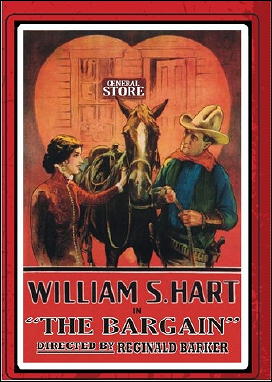
THE BARGAIN William S. Hart

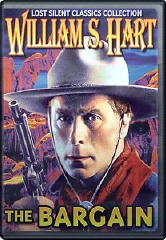
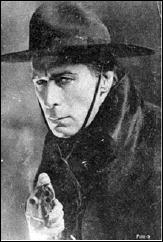
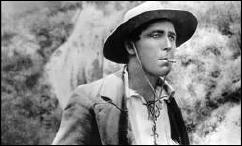
  THE BARGAIN. New York Motion Picture Corp., 1914. William S. Hart, J. Frank Burke, Barney Sherry, James Dawley, Clara Williams, Charles Swickard, Roy Laidlaw, Herschel Mayall. Scenario by Thomas H. Ince and William H. Clifford; cinematography by Joseph H. August and/or Robert Newhard. Director: Reginald Barker. Shown at Cinevent 39, Columbus OH, May 2003.

   Hart’s first feature-length film, The Bargain, as the program notes aptly pointed out, established the basic elements that would be a hallmark of the Hart Western (notably the concept of the good-bad man who is regenerated through his love for a good woman).

THE BARGAIN William S. Hart

   The film was shot in and near the Grand Canyon (with some sources claiming the cinematography was by Joseph August) and while the print was not always the sharpest, varying in quality from reel to reel, the Arizona landscape was captured in its startling beauty and awesome grandeur.

   I was immediately struck by the opening sequence in which each of the cast members is first shown in evening attire, then as they bend over, hiding their face from the camera, they straighten up in makeup and costume for their on-screen-roles. (Dan Stumpf commented that he had seen this device used in at least one other Hart film.)

   Hart plays outlaw Two-Gun Jim Stokes who, after he is wounded by a posse, is rescued by a farmer (J. Barney Sherry) who takes him to his shack, which he shares with his daughter Nell (Clara Williams).

THE BARGAIN William S. Hart

   Stokes and Nell fall in love, are married, and Stokes leaves to settle some unfinished business (he plans to return the money from his most recent holdup), promising to return.

   He’s captured by Sheriff Bud Walsh (J. Frank Burke) but when Walsh, falling prey to temptation, gambles away the money he’s rescued from Stokes, Stokes strikes a bargain that will save Walsh’s reputation and allow Stokes to escape to a new life.

   In a sense, The Bargain was Ince’s response to DeMille’s The Squaw Man. It made Hart a star and confirmed the Western as a major film genre.

THE BARGAIN William S. Hart

REVIEWED BY WALKER MARTIN:


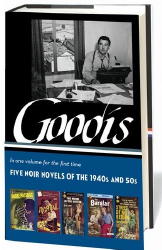
DAVID GOODIS – Five Noir Novels of the 1940’s and 1950’s. Library of America, hardcover, March 2012.

DAVID GOODIS Five Noir Novels

   I’ve been reading and collecting books from The Library of America ever since they first started coming out. At first it looked like they would just be publishing the works of the established literary figures, great authors like Henry James, Eugene O’Neill, Mark Twain, Herman Melville, and so on.

   But lately they have crossed over into more popular areas and genres by publishing two volumes of crime novels (including Down There by David Goodis), Dashiell Hammett, Raymond Chandler, H.P. Lovecraft, Philip K. Dick, Edgar Rice Burroughs, Kurt Vonnegut, two volumes titled American Fantastic Tales, and now David Goodis.

   I see this as a very good sign for popular culture and the mystery and SF genres. I guess it is too much to hope for volumes dealing with great western fiction but seeing this volume on Goodis makes me hope that we will see collections by Jim Thompson, Peter Rabe, Charles Williams, John D. Macdonald, Ross Macdonald, Gil Brewer, and others.

   We should not be surprised to see Goodis singled out for such attention because the French have long thought he was exceptional and in fact the only full length biography is in French. He was the poet of the bleak, doomed, and lost. It’s been said that Goodis did not write novels; he wrote suicide notes.

DAVID GOODIS Five Noir Novels

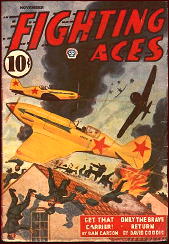
   I first became aware of David Goodis back in the 1960’s when I started to collect the pulp magazines. His pulp career lasted from 1939 to about 1947. He has been quoted as saying that he produced millions of words for the sport, detective, and western pulps. But most of his work was published in what I call the air-war pulps. I eventually accumulated extensive runs of such titles as Fighting Aces, Battle Birds, RAF Wings, Dare-Devil Aces, and Sky Raiders. Goodis appeared in all these pulps with dozens of stories, perhaps over a hundred.

   I would have to admit that I found his pulp work to be less than interesting. I’ve always had a problem with the air pulps with seemed to concentrate too much on airplanes and flying, while ignoring characterization and believable plots. I eventually sold, traded, and disposed of all my air-war magazines.

   There is an excellent DVD dealing with Goodis’ life, marriage, and career called David Goodis … to a Pulp It’s a must for anyone interested in his writing and one of the extras points out that Goodis’ wife evidently felt the same way as I did concerning his pulp stories.

   His wife told her second husband that the reason she left Goodis and divorced him was because she couldn’t stand his pulp writing that he was doing for the air-war magazines.

DAVID GOODIS Five Noir Novels

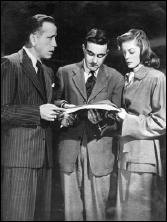
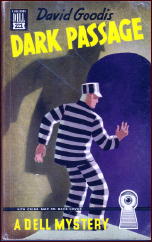
   She must have received a shock when he broke into the slick market with his novel, Dark Passage for the Saturday Evening Post in 1946. Not only did he receive a far higher rate of pay than he was getting for his pulp work, but Hollywood paid $25,000 for the screen rights. In today’s money that is around a quarter of a million. The movie was not just your usual effort, but starred Humphrey Bogart and Lauren Bacall.

   At this time it was goodbye to the pulps and the beginning of his Hollywood career. Despite receiving good money he still wore threadbare suits and slept on the couch of a friend for $4.00 a month. He soon found himself out of a job and back in Philadelphia, living in his parents house, and writing original novels for such paperback firms as Gold Medal.

   The Library of America edition reprints five complete novels. All five were made into interesting movies. and my comments on both the books and films follow:

● Dark Passage.   Though this is Goodis’ first real success, I don’t think it is an outstanding novel. My feeling on a second reading was that it is OK, good in spots by nothing that special.

   The story is not too believable and suffers from the happy ending. It reminds me of Cornell Woolrich, only not as good. I find the plot absurd with the rich, pretty girl falling in love with the loser convicted of murder. Also ridiculous to think that a cab driver and doctor would help the hero without even knowing anything about him.

DAVID GOODIS Five Noir Novels

   I watched the movie for the sixth time (I have a Bogart book which I annotate every time I see one of his films), and it’s hard to believe that they would cover up his face in bandages for most of the movie. But it does follow the plot of the novel and I find it better than the book.

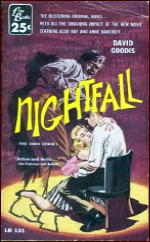
● Nightfall.   This also is just OK but nothing that special. Another innocent man framed for murder and robbery. Both these novels have a silly scene where the hero gets the gun away from the criminal by distracting him with talk. And another beautiful girl.

DAVID GOODIS Five Noir Novels

   Again I found the movie better than the book. It follows the basic plot with some changes but Aldo Ray is bland as the innocent man in trouble. Great villain.

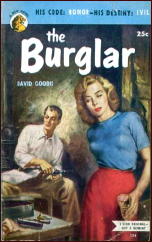
● The Burglar.   I found this novel to be better than the two above. Instead of the typical innocent man wrongly accused plots, this one was more believable with a professional jewel thief becoming involved in killings. Very downbeat ending, just what you would expect from Goodis.

DAVID GOODIS Five Noir Novels

   The movie stars Dan Duryea and Jayne Mansfield and follows the plot of the novel. The fact that David Goodis wrote the screenplay makes this even more interesting.

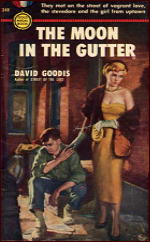
● The Moon in the Gutter.   With this book, it appears the novels are getting better. This one does not star a criminal or men framed for murder but has as a protagonist a laborer working on the docks and living in a slum area of Philly.

DAVID GOODIS Five Noir Novels

   He hangs out in a dive called Dugan’s Den, which has the atmosphere and characters right out of a Eugene O’Neill play. Vernon Street in Philadelphia takes on a life of its own and becomes a character in the novel.

   The movie was made in 1983 and is French with subtitles, starring Gerard Depardieu and Nastassia Kinski. It follows the basic plot of the novel.

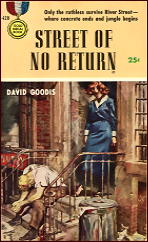
● Street of No Return.   Mediocre and not too believable. Skid row bum and drunk (a former famous singer) defeats criminal plan to cause race riots. Dialog is poor and the police act like idiots. Another beautiful girl falls for our hero.

DAVID GOODIS Five Noir Novels

   The movie was directed by Samuel Fuller and stars Keith Carradine. However in this case, the film was even more disappointing than the novel. Believe me, you don’t want to see Keith Carradine in a fright wig, trying to act like a bum.

   Despite the critical comments above, I did enjoy reading the five novels but lucky for me after reading them I immediately spent some time at a book convention buying and reading pulps. Otherwise, I might have hanged myself. No wonder Goodis lived such a short life, from 1917 to 1967.

       Bibliography (novels and story collections only)

Retreat from Oblivion, 1939.
Dark Passage, 1946.
Nightfall, 1947.
Behold This Woman, 1947.
Of Missing Persons, 1950.
Cassidy’s Girl, 1951.
Of Tender Sin, 1952.
Street of the Lost, 1952.
The Burglar, 1953.
The Moon in the Gutter, 1953.
Black Friday, 1954.
Street of No Return, 1954.
The Blonde on the Street Corner, 1954.
The Wounded and the Slain, 1955.
Down There (Shoot the Piano Player), 1956.
Fire in the Flesh, 1957.
Night Squad, 1961.
Somebody’s Done For, 1967.
Black Friday and Selected Stories, 2006.    [A collection of his shorter work from such magazines as Ten Story Mystery, Colliers, New Detective, Manhunt and Mike Shayne Mystery Magazine.]

REVIEWED BY GEOFF BRADLEY:         


HUSTLE Robert Vaughn

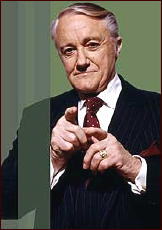
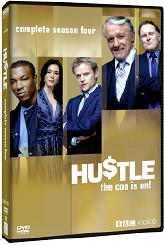
HUSTLE. BBC-TV, UK. Series Four: April 18 to May 23, 2007. (Seen on the American Movie Classics cable channel in US.) Marc Warren, Robert Glenister, Jaime Murray, Robert Vaughn, Rob Jarvis. Created by Tony Jordan.

   Hustle has returned for a new series (the fourth: one hour each, no adverts) about the ‘lovable’ group of London conmen (one woman) who, of course, delight in fleecing those that deserve to be fleeced.

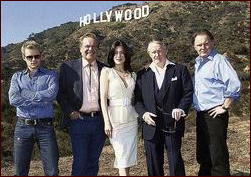
   In the first episode we hear that leader Mickey Stone is pursuing a mark in Australia (actually actor Adrian Lester has left the series) and so the group go about pursuing an oil-rich Texan (played by Robert Wagner) by flying to Los Angeles and attempting to sell him the Hollywood sign.

HUSTLE Robert Vaughn

   These stories are, in general, quite enjoyable but the problem is that they tend to be very similar and we have already had 24 of them. This first tale, with its Californian setting, seems particularly unlikely, but then realism is not the aim.

   The second story returns to England with a story involving passing a dud horse off as a high-flying racer and selling it to an upstart cockney millionaire. Very watchable, but you run the risk like with a box of chocolates of eating too many all at once — and you don’t want to look too closely at what’s gone into it.

Editorial Comments:   This review was reprinted from Geoff’s apazine Caddish Thoughts #127, July 2007. The series has proved successful enough that four more seasons of episodes have appeared since he wrote this review. (The eighth season, which ended in February 2012, is reported to be the last.) Only the first four seasons have been released on DVD in the US.

HUSTLE Robert Vaughn

A 1001 MIDNIGHTS Review
by Marcia Muller


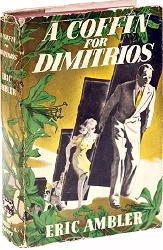
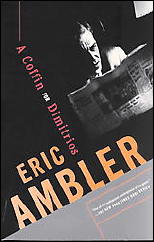
ERIC AMBLER A Coffin for Dimitrios

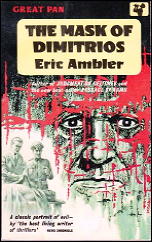
ERIC AMBLER – A Coffin for Dimitrios. Alfred A. Knopf, US, hardcover, 1939. First published in the UK as The Mask of Dimitrios: Hodder & Stoughton, hardcover, 1939. Reprinted many times, in both hardcover and paperback.

   Eric Ambler has long been known as a master of international intrigue. His novels typically involve a more or less ordinary protagonist who has blundered into some sinister situation and has become enmeshed in it against his will. He must then extricate himself by appearing to take part in the intrigue, often as a reluctant agent for the authorities.

   Ambler’s narrative style is straightforward and economical; his plots, whether simple or complex, are suspenseful; his action scenes are high points in the books.

ERIC AMBLER A Coffin for Dimitrios

   A Coffin for Dimitrios is the story of a man with an obsession. Charles Latimer, a writer of detective novels, is on holiday in Istanbul when he meets Turkish Secret Police colonel Haki; Haki admires Latimer’s work and, like many policemen, has an idea for a novel, which he thinks Latimer should write.

   The idea is old-hat, but the story Haki tells Latimer as an aside — about the criminal Dimitrios Makropoulis — fascinates the writer. Dimitrios, who has been fished out of the Bosphorus, dead of a knife wound, has been involved in murder, an assassination plot, pimping, and drug trafficking; now he lies in the morgue, and Latimer impulsively asks to view the body.

ERIC AMBLER A Coffin for Dimitrios

   The viewing affects Latimer powerfully, and he becomes determined to trace the life of Dimitrios. His search takes him to Smyrna, Athens, Sofia, Geneva, and Paris. It reveals more facets of Dimitrios’s life than the police dossiers hold, and it throws Latimer into the company of a mysterious man named Peters who seems very interested in the fact that the writer saw Dimitrios’s body in the morgue. So interested, in fact, that he aids the investigation, and Latimer finds himself in a situation stranger and more dangerous than any in his own detective stories.

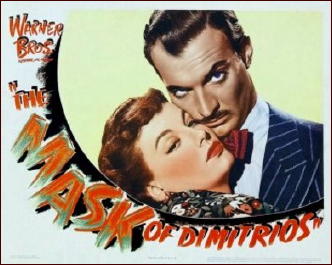
   This is an intriguing and suspenseful novel with an ironic twist at the end that causes us to reflect on how little we really learn from life’s experiences. More or less faithful to it is the moody 1944 film version starring Zachary Scott, Sydney Greenstreet, and Peter Lorre, which appeared under the original British title of the novel, The Mask of Dimitrios. The film’s screenplay was authored by another mystery writer, Frank Gruber.

   Charles Latimer reappears in one other novel, The Intercom Conspiracy (1969).

         ———
   Reprinted with permission from 1001 Midnights, edited by Bill Pronzini & Marcia Muller and published by The Battered Silicon Dispatch Box, 2007.   Copyright © 1986, 2007 by the Pronzini-Muller Family Trust.

ERIC AMBLER A Coffin for Dimitrios

REVIEWED BY MICHAEL SHONK


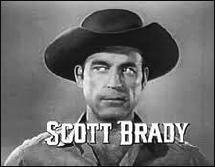
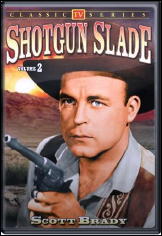
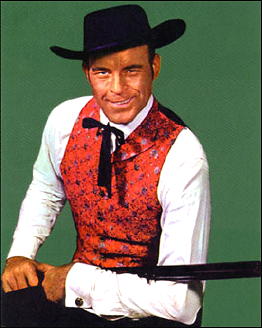
SHOTGUN SLADE. Revue Studios/MCA TV. Syndicated, 1959-61, 78 episodes. Created by Frank Gruber. Executive Producer: Nat Holt. Cast: Scott Brady as “Shotgun” Slade.

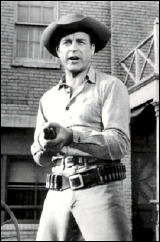
    “Shotgun” Slade (his first name was never mentioned) was the lone member of the Slade Detective Agency, with his office in Denver. He traveled all over the Old West for clients who had hired him.

SHOTGUN SLADE

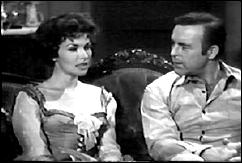
    Scott Brady (He Walked by Night) was convincing as a tough Western PI who could handle himself in a fight, but less convincing as Slade the ladies man. Oddly, while he had a beautiful woman waiting for him in virtually every town, Slade thought of himself as a loner.

    It was 1959, the PI was beginning to replace the Western on TV, this gimmick heavy syndicated TV series wanted it both ways. Creator Frank Gruber is a familiar name to Pulp and Westerns fans alike. Gruber had worked with Executive Producer Nat Holt on several B-Westerns including The Great Missouri Raid, as well as the TV series Tales of Wells Fargo. Holt is also remembered for his movie work with Randolph Scott (Rage at Dawn). At one point Ralph Dietrich, whose producer credits include a couple of Charlie Chan films, took over as producer from Gruber.

SHOTGUN SLADE

    The series was typical of 50s TV-Film syndication. Stories required a least one fight and, as often as possible, for Slade to be knocked out from behind so he could wake up in the care of the beautiful woman of the week.

   Slade would narrate over scenes to give exposition so not to slow down the action in this time limited thirty minute PI/Western. The mysteries offered few clues and suspects, but focused on twist after twist until the villain was revealed.

   While the locations were pure Western, the stories were more noir PI than the morality plays of TV Westerns. In “Golden Tunnel,” Slade’s old friend and owner of a mine called Slade for help. He was seventy years old and had a young wife he trusted (and shouldn’t) and a nephew he trusted (and shouldn’t) helping him run the place.

    There were problems at his mine, someone had taken a shot at him, and, oh by the way, he just discovered the son he thought dead was alive and wanted Slade to make sure his new Will gets to the probate court when he dies, which he does in the next scene.

SHOTGUN SLADE

    Throughout the series the guest cast was filled with character actors (Alan Hale, Stacy Keach), B-movie favorites (Marie Windsor), and an occasional surprise (Ernie Kovacs).

    There is a reason so much of TV-Film syndication from the 50s and 60s look alike. In Storytellers to the Nation: A History of American Television, by Tom Stempel (First Syracuse University Press, 1996), D.C. Fontana (Star Trek) discussed the limitations imposed on writers of half hour TV film syndicated shows established by Ziv and followed by Revue (Universal).

    “On Shotgun Slade a writer was limited to only four major speaking parts, including Slade, and three sets. On the one episode Fontana did, no exteriors were allowed since it was raining and the company could not hold production until it stopped.”

SHOTGUN SLADE

    There were countless Westerns and PI shows on the air in 1959. Every series needed something to stand out from the crowd. Shotgun Slade had two obvious gimmicks.

   First was his weapon, a gun he had made himself, with a rifle barrel atop a double barrel shotgun. While it had its uses, such as using the barrel to knock the handgun out of the bad guy’s hand, it looked awkward as Slade carried it everywhere he went.

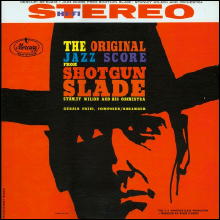
    The other gimmick was the jazz soundtrack by Gerald Fried (The Killing). The idea of using jazz music as the soundtrack for a show set in the “Old West” was an interesting but doomed experiment. It proved that no matter how popular the music is at the time of the viewers, the music needs to fit the time of the characters.

SHOTGUN SLADE

    A review in Billboard (8/22/60) gave the soundtrack album (The Original Jazz Score from Shotgun Slade, by Stanley Wilson and his Orchestra; Mercury Records) three out of four stars and said, “…Altho the TV show is a Western, the music is much more closely allied to current ‘private eye’ type, jazz-oriented music than to the old-fashioned Western ditties. It makes for good listening tho it doesn’t have the same melodic appeal of the Mr. Lucky or the Peter Gunn material.”

    Words can not come close to properly describing this song, from an episode of Shotgun Slade, sung by Monica Lewis. (Follow the link.)

    Shotgun Slade gave Oscar winning director Sydney Pollack (Out of Africa) his first director job. In The Directors: Take One, Volume One, by Robert J. Emery (Allworth Press 2002), Pollack explained how he got his chance when Shotgun Slade had been cancelled but had a few episodes left to film so they gave him a chance to learn on the job.

    The series was popular and, according to Broadcasting (May 30, 1960), it was syndicated in 170 markets. But if you expect Peter Gunn on horseback, you will be disappointed. It had some interesting talent in front and behind the camera, and tried new things with music and drama, but in the end Shotgun Slade offers little (beyond what not to do) worth remembering.

    Episodes of Shotgun Slade are available from various DVD sellers and all over the Internet from archives.org to YouTube.

SHOTGUN SLADE

« Previous PageNext Page »