Reviews


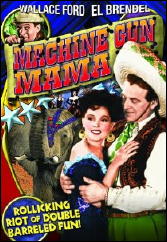
MACHINE GUN MAMA

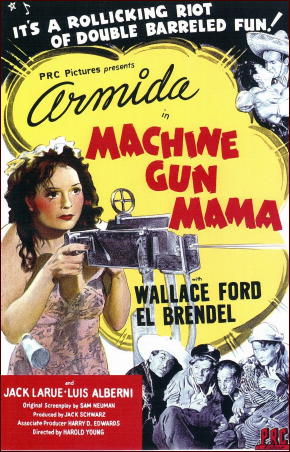
MACHINE GUN MAMA. PRC Pictures, 1944. Armida, El Brendel, Wallace Ford, Jack La Rue, Luis Alberni, Julian Rivero. Director: Harold Young.

   I must have lived a sheltered life. I had never heard of El Brendel until I watched this movie. You’re never too old to learn more about the movies than you knew the day before. “El” is short for Elmer, and Brendel is pronounced “Bren-DELL.”

   He was a vaudeville star, so I’m told, whose shtick was a comically funny Swedish accent. Most of the films he made through the 1940s were comedy shorts, in which he invariably played characters named Ole, Ollie, Oley, Knute or Axel Swenson, but by the 1950s he’d worked his way up to television, including an appearance on Perry Mason, among other quite prestigious shows.

MACHINE GUN MAMA

   In Machine Gun Mama he’s teamed up with Wallace Ford as two guys from Brooklyn who are in Mexico trying to deliver an elephant to someone whose address they’ve apparently lost. When their truck breaks down, a carnival nearby catches their eye, and that’s where the movie begins.

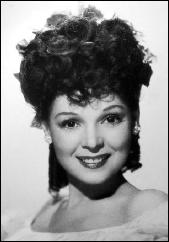
   Let me back up for a moment. I thought when I bought this movie that maybe I was I was buying a movie about Ma Barker and her gang. Not so. Not at all. Not for a minute. The Mexican actress named Armida plays the title character, and where the machine gun comes in is a small story in itself. As it happens, Armida, the carnival owner’s daughter, is also the girl sitting in the dunking booth. Hit the bulls-eye with a baseball, and in she goes.

MACHINE GUN MAMA

   Three times in a row. All at the hands (or pitching arm) of Wallace Ford’s character. Armida, a miniature spitfire (just under five feet tall), takes offense at this, runs over to the booth opposite, turns the prop machine gun around and blasts away, destroying a lot of property but no lives, thank goodness.

   She also falls in love with John O’Reilly, the famous “kibitzer” from Brooklyn (that’s Wallace Ford), but her father… Wait, wait, there’s an elephant in the room. Really. And there’s a bad guy (Jack Le Rue) to whom Armida’s father owes a lot of money to, but the elephant (really) is such a star attraction that…

   I suppose that if you’re still with me, there’s a chance you’ll watch the movie, so I’ll say no more. It’s a lot of fun, not the silly, slapstick sort at all — or mostly not — but the kind of quiet fun that may make you smile a lot without ever cracking you up.

   There are some songs and dance, too, but mostly (and strangely) not until the very end of the movie, which finishes up all of the story lines so quickly I had to back up the DVD to see what I’d missed. You can watch the entire 60 minutes for yourself online here on www.archive.org.

MACHINE GUN MAMA

REVIEWED BY DAN STUMPF:         


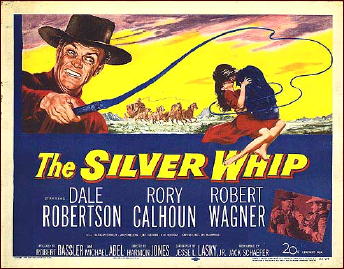
THE SILVER WHIP Rory Calhoun

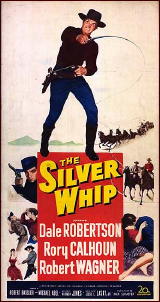
THE SILVER WHIP. 20th Century-Fox, 1953. Dale Robertson, Rory Calhoun, Robert Wagner, Kathleen Crowley, James Millican, Lola Albright. Based on the novel First Blood (1953) by Jack Schaefer. Director: Harmon Jones.

   Been a mess o’ Rory Calhoun movies on lately, some pretty good. Calhoun was always the City Slicker’s idea of a Cowboy: Cool, well-groomed, morally ambiguous, often even the Heavy of the Piece, as in The Spoilers or River of No Return, but always playing his cards close to his vest in any case, his calculating eyes clearly on the Main Chance. Not a Great Actor by any stretch, but within his range quite competent and even memorable on occasion.

   Later on he began doing cameos in intriguing B-flicks like Angel, Hell Comes to Frogtown, Motel Hell, and Roller Blade Warriors, all of which are better than they sound, which is faint praise, I know, but well-intended. They’re worth a look, as is:

   The Silver Whip, an occasionally interesting western with Calhoun as a rough but proper Sheriff, Dale Robertson — incredibly macho-looking — as his less legal-minded but heroic buddy, and Robert Wagner as the identity-seeking youth torn between the two role models.

THE SILVER WHIP Rory Calhoun

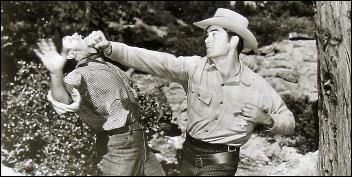
   There’s a fascinating bit of action where the three heroes are stalking the heavy across the badlands, a picturesque location all by itself, with boulders, crevices, arches and cave in a baroque panoply. You’ll see one of the characters move across this arresting background, dodging from cover to cover, moving from long-shot to close-up.

   Then, as he takes off, the camera stays where it is, and in the background you see one of the other heroes, previously obscured by the character in foreground, still half-hidden among the rocks, and follow him as he moves across the terrain from cover to cover, the camera tracking along and closer to him until he ends up in close-up, takes off again, and the camera stays put and in the background we see another hero, previously obscured by the character in foreground, still half-hidden etc. etc.

   This goes on long enough to get really entertaining.

THE SILVER WHIP Rory Calhoun


Coming Soon to This Blog:   Several more Rory Calhoun movie reviews by Dan, including (wait for it) Hell Comes to Frogtown.

THE ARMCHAIR REVIEWER
Allen J. Hubin


DOUG HORNIG – Deep Dive. Mysterious Press, hardcover, 1988. Popular Library, paperback, March 1989.

   Doug Hornig brings back Charlottesville private eye Loren Swift for a fourth time in Deep Dive. Loren and his occasional bedmate Patricia Ryan have taken up scuba diving, and while practicing in a flooded quarry they happen upon a deceased diver.

   Accidental drowning is the verdict. In due course, the dead man’s sister, having other ideas, asks Loren to investigate. Her brother, it develops, was wealthy, an experienced diver, not a particularly nice person. The quarry is on the grounds of the Jordan Institute, which does psychic research, and soon Loren is having the oddest of experiences…

   Pleasant enough, though the plot takes an extra bit of believing and the ultimate solution comes out of left field.

— Reprinted from The MYSTERY FANcier,
       Vol. 11, No. 1, Winter 1989.


Bibliographic Notes:

       The Loren Swift series —

1. Foul Shot (1984)    [Nominated for an Edgar.]
2. Hardball (1985)    [Nominated for a Shamus award.]
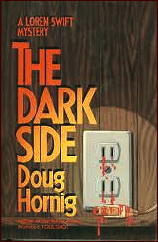
3. The Dark Side (1986)

DOUG HORNIG

4. Deep Dive (1988)

   Deep Dive was the final appearance of PI Loren Swift. Hornig also wrote two thriller novels with Steve Kirk as the leading character, but about him I know nothing more.

IT’S ABOUT CRIME, by Marvin Lachman

STANLEY SHAPIRO A Time to Remember

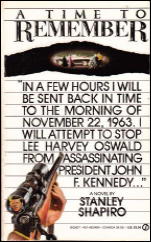
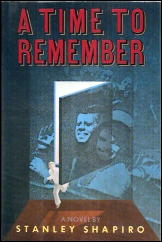
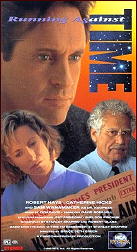
STANLEY SHAPIRO – A Time to Remember. Random House, hardcover, 1986. Signet, paperback, 1988. Made-for-TV Movie: Filmed as Running Against Time (USA Network, 1990), with Robert Hays, Catherine Hicks, Sam Wanamaker.

   Coming across a [paperback] copy of Stanley Shapiro’s A Time to Remember exactly 25 years after the murder of John F. Kennedy in Dallas was too much of a coincidence to resist, and so I read another volume in the growing library on that event.

STANLEY SHAPIRO A Time to Remember

   This is a science-fiction mystery in which, using time travel, a man goes back to 1963 to try to prevent Lee Harvey Oswald from shooting the President. (Shapiro does not refer to any conspiracy theories.) The science portion is not very believable, nor is the fiction much better. There are some dizzying jumps between 1963 and 1985, and much of the suspense is the result of the author causing incidents with a rather heavy hand.

   Still, there are times when Shapiro writes very well, and a chase scene is described as suspensefully as the master, Cornell Woolrich, might have told it:

STANLEY SHAPIRO A Time to Remember

    “I am filled with one overpowering, all-consuming emotion — not to get caught. Escape is what life is about. How and where is not important — only to avoid capture, to find a place to rest and think and to live on. Lungs and heart are called upon for performance levels beyond what they were created for. I know the stark terror an animal feels as it flees the advancing hunters. But that animal has trees and mountains and burrows and caves to hide in. I have only the stairs and the street below.”

   The brief confrontation between a naive scientist and a Dallas prostitute on page 44 is almost, by itself, worth the price of the book. Most important, there is the endless fascination of the single most traumatic event of our time.

— Reprinted from The MYSTERY FANcier,
Vol. 11, No. 1, Winter 1989.


Editorial Comments:   This is the author’s only entry in the Revised Crime Fiction IV, by Allen J. Hubin. Stanley Shapiro was far more well known as a Hollywood screenwriter: he was nominated four times for an Oscar, winning once, for Pillow Talk (1959). For a full list of his credits on IMBD, go here.

SPOILERS OF THE NORTH

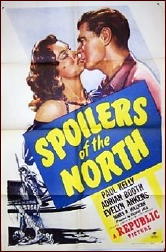
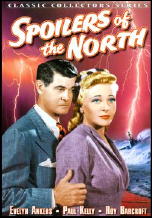
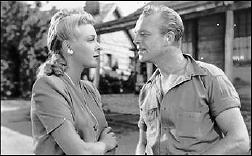
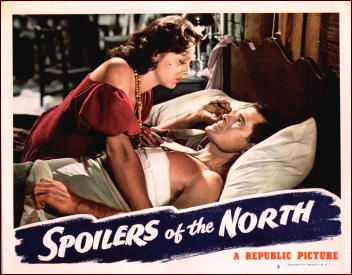
SPOILERS OF THE NORTH. Universal Pictures, 1947. Paul Kelly, Adrian Booth (Lorna Gray), Evelyn Ankers, James A. Millican, Roy Barcroft, Louis Jean Heydt. Screenplay: Milton Raison. Director: Richard Sale.

   There are two good reasons for watching this movie, and neither are the two male stars. Adrian Booth is one of them. Earlier on in her career she was the actress Lorna Gray who played Vultura in the Republic serial Perils of Nyoka. The other is the slim, blonde and beautiful Evelyn Ankers, who might be recognized most by many as appearing in a couple of the Rathbone-Bruce Sherlock Holmes movies.

SPOILERS OF THE NORTH

   There were other substantial highlights in each of their respective careers, and respectable ones at that, but I don’t believe that either actress would have placed this film very high in their résumés. Padded with scenes of the Alaskan salmon industry, including the complete cycle of spawning, catching and the packing of the fish into small cans, without the presence of the two lovely ladies, there would be little left but the barest scraps of meat on a lot of bleached-out bones.

   Paul Kelly is the nominal star of the movie, playing the kind of guy who has a girl in every port, and does. Evelyn Ankers is the one in Seattle, who comes up to help Kelly when he falls behind on the quota he’s promised his buyer. Faking an injury, Kelly needs her on hand to help persuade his brother (hunky James Millican) to not let him down and abandon ship (literally and figuratively) when the spawning season is over.

SPOILERS OF THE NORTH

   And Adrian Booth is the half-breed girl up in Alaska whom Kelly has persuaded to help keep the local Native Americans working for him – by special dispensation, they are allowed to fish salmon all year round. It’s a crooked scheme, but Kelly is up to it. Even so, not only does he have to keep the U.S. Fisheries patrol from catching on, there are the two women who can’t be allowed to discover that he’s promised to marry each of them.

   And then, of course, there’s the brother, the honest one, who can’t but admire his brother’s taste in women. If you couldn’t make a small story out of these several small threads of plot, perhaps you’re not quite trying. There is one scene, though, I have to admit, that took me by surprise, and if you were ever to watch this film, it might you also.

SPOILERS OF THE NORTH


PostScript.   Yes, in case you were wondering, director Richard Sale is the same Richard Sale that started out writing tons of stories for the pulp magazines, long before he found his small niche in Hollywood as a producer, director and screenwriter (most famously for Gentlemen Marry Brunettes). The movie itself is available for watching or downloading at www.archive.org.

       Photos:

Poster, upper right. Paul Kelly and Adrian Booth.

DVD, on left: Paul Kelly and Evelyn Ankers.

Black and white scene, lower right: James Millican and Evelyn Ankers.

Lobby card, above: Paul Kelly and Adrian Booth.

THE BACKWARD REVIEWER
William F. Deeck


LAWRENCE LARIAR

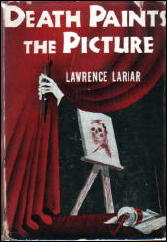
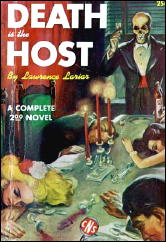
  LAWRENCE LARIAR – Death Paints the Picture. Phoenix Press, hardcover, 1943. Crime Novel Selection, nn [#6], digest-sized paperback, as Death Is the Host, no date [1943].

   A cartoonist himself, Lariar has as his detective Homer Bull, quite overweight and mastermind of the daily comic strip “True Stories of Crime.” Bull writes the strip while his assistant, Ham MacAndrews, does the cartooning. Ham also narrates Bull’s investigations. “‘Great jumping ginch!’ I blatted” is an example of MacAndrews’s speech which leads one to hope he draws better than he speaks.

LAWRENCE LARIAR

   Because his man Shtunk was on a binge, Bull misses the invitation to weekend with Hugh Shipley, famed illustrator for the weekly magazines. It is an ill-assorted group that includes Bull’s ex-wife, a gossip columnist, and a tobacco mogul.

   If Bull had attended, he might have been able to prevent Shipley’s alleged suicide, alleged because Bull, who shows up afterwards, is convinced Shipley was murdered, despite the room having been locked with no way for any murderer to have escaped.

   Another murder made to look like suicide, though it doesn’t fool Bull, takes place before Bull figures out who and how. Probably because I have perverse tastes, I enjoyed the book.

— From The MYSTERY FANcier, Vol. 11, No. 1, Winter 1989.


BIBLIOGRAPHIC NOTES:

       The Homer Bull series —

Death Paints the Picture. Phoenix Press, 1943.
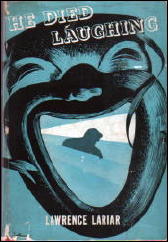
He Died Laughing. Phoenix Press, 1943.

LAWRENCE LARIAR

The Man with the Lumpy Nose. Dodd Mead, 1944.
The Girl with the Frightened Eyes. Dodd Mead, 1945.

   Lawrence Lariar has his own page on Wikipedia. Here’s the first paragraph:

    “Lawrence Lariar (December 25, 1908 – October 12, 1981) was an American novelist, cartoonist and cartoon editor, notable for his ‘Best Cartoons of the Year’ series of cartoon collections. He wrote crime novels, sometimes using the pseudonyms Michael Stark, Adam Knight and Marston la France.”

   He wrote nine mystery novels under his own name; nine as Adam Knight, including eight adventures of PI Steve Conacher and one with female PI Sugar Shannon; two paperback originals as by Michael Lawrence, both cases for PI Johnny Amsterdam; and one book as by Michael Stark.

   If he wrote the one mystery credited to Marston La France, it is news to Al Hubin. (Marston La France was a long-time professor and academic dean at Carleton University in Ottawa. The mystery he authored, Miami Murder-Go-Round, was copyrighted in his name. It features yet another PI, Rick Larkan.)

REVIEWED BY WALTER ALBERT:         


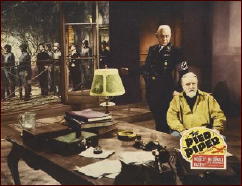
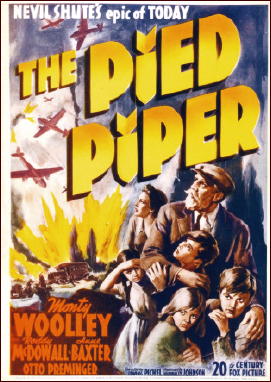
THE PIED PIPER Monty Woolley

THE PIED PIPER. 20th Century Fox, 1942. Monty Woolley, Roddy McDowall, Anne Baxter, Otto Preminger, J. Carrol Naish, Peggy Ann Garner, Marcel Dalio, Marcelle Corday, Odette Myrtil, Helmut Dantine. Screenplay by Nunnally Johnson from a novel by Nevil Shute. Director: Irving Pichel. Shown at Cinevent 35, Columbus OH, May 2003.

   There was a time when I objected to the addition of films from the 1940s to the programs at Cinevent, but the quality of productions like this one I has pretty much taken care of my objections.

THE PIED PIPER Monty Woolley

   Woolley is an Englishman vacationing in France in the spring of 1940 as the Germans have swept across France and are beginning to think of conquering England. As Woolley attempts to return to England in advance of the German army, he acquires — against his curmudgeonly objections — a group of English and French children he attempts to shepherd to safety.

   Their escape — with the help of sympathetic French patriots — seems assured until they fall into the hands of a German company headed by Major Diessen, played by Otto Preminger.

   Garner and MacDowall are both superb and there’s not a typical Hollywood child actor in the small group recruited for the film. I’ve listed some of the French actors in the film. Although their roles are small, they are distinguished film performers. (Dalio starred in Jean Renoir’s masterly The Rules of the Game.) I found this to be a moving film, and with not a false step by the numerous fine actors.

THE PIED PIPER Monty Woolley


YouTube Notes: The confrontation scene between Preminger and Woolley can be seen here. A longer ten-minute clip can be found here. This one’s from earlier in the movie, as Monte Woolley begins to discover what fate has in store for him.

   The film was nominated for three Academy Awards: for Best Picture, losing to Mrs. Miniver; Best Actor, with Wooley losing to James Cagney for Yankee Doodle Dandy; and Best Cinematography.

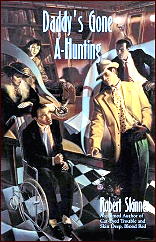
ROBERT SKINNER – Daddy’s Gone A-Hunting. Poisoned Pen Press, hardcover, 1999; trade paperback, 2000. Hardcover reprint: Detective Book Club, 3-in-1 edition.

   At the present time there are six books in Robert Skinner’s series of Wesley Farrell adventures, of which this is the third:

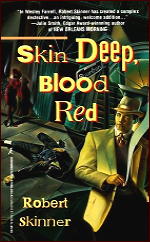
Skin Deep, Blood Red (Kensington, 1997) [Nominated for the Anthony Award for Best First Novel.]

ROBERT SKINNER Wesley Farrell

Cat-Eyed Trouble (Kensington, 1998)
Daddy’s Gone A-Hunting (Poisoned Pen, 1999)
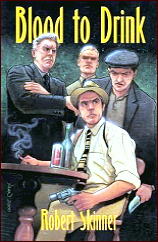
Blood to Drink (Poisoned Pen, 2000)

ROBERT SKINNER Wesley Farrell

Pale Shadow (Poisoned Pen, 2001)
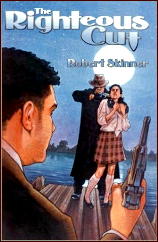
The Righteous Cut (Poisoned Pen, 2002)

   Wesley Farrell is a mixed-blood Creole by birth, but at the time of this book, which is 1938, he’d been living in New Orleans as a white man for over 25 years. He’s a legend of a man — a night club owner whom everyone in the city seems to know and will defer to, rather than get on the wrong side of him. Nonetheless (and inevitably) it’s strictly his reputation that gets him into trouble this time.

ROBERT SKINNER Wesley Farrell

   There are several threads of the widely rambling plot. The major one centers on the deaths or mysterious disappearances of prominent members of the aforementioned black community. Less important, or so it seems, is the request that Carol Donovan (*), the beautiful black owner of The Original Southport Club, makes of Farrell. She needs his help in fighting a tough thug named Archie Badeaux who has been making threats against her.

   A stash of stolen money that has gone missing is also involved, and when Ernie LeDoux gets out of prison and starts looking for it, a brand new series of events is pushed into motion. And there’s more. It takes well over 300 pages of fine action-oriented fiction to cover it all.

   Great characters and great atmosphere combine to make Gone A-Hunting very enjoyable reading. Back in 1938, and particularly in the South, there was an entire black community whose activities never made the white newspapers, and they certainly weren’t recorded in the white history books.

   A separate black squad of the detectives in the police department, black bankers and real estate agents — an entirely separate (but not equal) citizenry — which you notice most when you are reminded, as Skinner does, that trains, for example, had separate cars for blacks.

ROBERT SKINNER Wesley Farrell

   Most of the threads of plot come together at the end, but not all. In all truthfulness they’re spread too thin to have the depth that would make this an absolute knockout of a novel. Sometimes the longer the book, the weaker the punch. The clues which the detection depends upon are suspect as well — what kind of witless killer would vomit at each of his scenes of the crime, and fail to clean up his mess afterward?

   But there are more adventures to come, and a couple of priors to catch up with also. I came in at the middle, and now with two different ways to go, I fully intend to.

— September 2003


(*) PostScript:   Here’s a quote that here, just now, at the last minute, I decided to leave you with. From page 21:

   A beautiful Negro woman of about thirty came through the doors of the Café Tristesse [Farrell’s place] like she owned the joint. She was about five-and-a-half feet tall, with skin so pale brown it was no darker than a suntan, shoulder-length black hair, and eyes like obsidian. The only makeup on her fine-featured face was lip rouge the color of ripe plums. Dressed in a pale yellow dress, yellow sling-back pumps, and a yellow hat that was like gold ornamentation on a queen, she was enough to make a Baptist minister drink swamp water, crawl inside a hollow log, and bay at the moon.

   Maybe Halle Berry could play the part? I was leaning toward a younger Richard Roundtree as Farrell, back when he played Shaft in the movies. When I mentioned this to another reader of the series (female), she immediately reminded me that Farrell is passing for white, and Roundtree is therefore too dark.

   She then suggested Giancarlo Esposito, who appears on some television show I don’t watch. I obviously have to think this over some more.

Reviewed by Michael Shonk


CITY OF ANGELS. NBC / Universal, 1976. Roy Huggins Public Art Production. Cast: Wayne Rogers as Jake Axminster, Elaine Joyce as Marsha Finch, Philip Sterling as Michael Brimm, Clifton James as Lt. Quint. Created by Stephen Cannell and Roy Huggins. Executive Producer: Jo Swerling Jr.
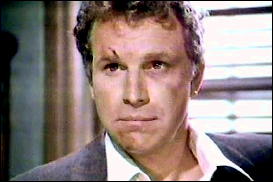
CITY OF ANGELS Wayne Rogers

    From the opening theme to the star and the writing, City of Angels tried to give us a believable 30’s hardboiled PI and occasionally succeeded, as in “The November Plan,” but more often failed.

    For example, listen to Oscar winner Nelson Riddle’s theme here.

    A nice theme but it fails to establish the 1930’s setting or mood. The soundtrack made heavy use of the Universal sound library, so far too often we heard generic background music that also failed to fit the time period. Though in a couple of episodes such as “Say Goodbye to Yesterday” the background music was a positive asset to the story.
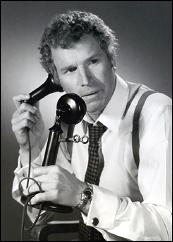
CITY OF ANGELS Wayne Rogers

    The writers tried to take advantage of the volatile period of American history that was the 1930s. To establish setting the series often name-dropped (Harry Cohn of Superior Pictures aka Columbia Pictures) and used the politics of the period as the backdrop for the drama. But in the end the episodes were typical TV mysteries, rushed from lack of production time with clunky dialog, plot holes and often lacking in logic.

    Much like Philip Marlowe, Jake spent much of his time dealing with the problems of the rich. Jake began as a mercenary Sam Spade wannabe who enjoyed the thrill of fighting the system, then during the series changed into a hard luck James Rockford type.

    Jake had only two friends in the world. Marsha, who he let use his outer office rent-free for her switchboard service used by prostitutes, and Mike, his attorney with an office across the hall. He either was beat up by or bribed his police contact Lt. Quint.
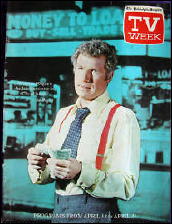
CITY OF ANGELS Wayne Rogers

    To be a hardboiled PI, a character that is often unlikable, you need an actor with certain type of appeal. Actors such as Bogart, Mitchum, Garner and Janssen could make you like the character no matter how the character behaved. Wayne Rogers never pulled it off despite coming close in “The November Plan.”

    The costumes, transportation, and locations were generally a plus, but by the end of the series it seemed as if they were running out of 1930s-like exterior locations.

    From the beginning, Roy Huggins was credited as producer with Philip DeGuere, Jr. as executive story consultant until the episode “A Sudden Silence.” The credits for the rest of the series episodes changed to Philip DeGuere, Jr. and William F. Phillips as the producers instead of Huggins. Perhaps it is time to consider the influence of the late Philip DeGuere, Jr. (Simon and Simon) on the series.

    City of Angels aired Tuesday at 10pm opposite ABC’s Marcus Welby (or Family in March/April) and CBS’s Switch. The ratings began well but faded fast.

        EPISODE GUIDE:

“The November Plan.” Part 1 (2/3/76), Part Two (2/10/76), Part Three (2/17/76). Teleplay by Stephen J. Cannell. Story by Roy Huggins and Stephen J. Cannell. Directed by Don Medford. Guest Cast: Diane Ladd, Meredith Baxter Birney, Laurence Luckinbill, Lloyd Nolan, Dorothy Malone, Jack Kruschen, Steve Kanaly * Jake’s client has been framed for murder of her boyfriend after they witness a fight at a formal party. Jake discovers the disappearance of a Pulitzer prized reporter ties into the murder and involves some of the most powerful corrupt people in Los Angeles. Very loosely based on a real event.

“The Parting Shot.” (2/24/76). Teleplay by Philip DeGuere Jr. Story by John Thomas James (Roy Huggins). Directed by Sigmund Neufeld Jr. Guest Cast: Donna Mills, Corinne Michaels, Stefan Gerasch * Rich man hires Jake to discover if his wife is cheating on him. Before Jake finds out anything his client is shot and in a coma. The man assumed to be the wife’s lover is arrested. The daughter who hates her step-mom likes Jake. The solution to the shooting reminds one of John Dickson Carr.

“A Lonely Way To Die.” (3/2/76). Written and Directed by Douglas Heyes. Guest Cast: Belinda J. Montgomery, William Smith, Lynn Carlin * A predictable mystery features a popular ex-governor who wants to be President but has a secret. His rebellious daughter blames him for her mother’s mental problems. Jake gets involved when a girl he was trying to help turns up dead. The ending wants to be cynical but instead was a lame cop out.

“The House on Orange Grove Avenue.” (3/16/76). Teleplay by Stephen & Elinor Karpf. Story by John Thomas James. Directed by Robert Douglas. Guest Cast: Susan Howard, Susan Sullivan, Lara Parker * Jake is hired by two sisters publicly believed to have murdered one’s husband and his mistress seven years ago. The episode drowns in false cynicism with a weak pointless ending.

“Palm Springs Answer.” (3/23/76). Teleplay by Merwin Gerard. Story by John Thomas James. Directed by Allen Reisner. Guest Cast: Signe Hasso, Terry Kiser, George Gaynes * Sweet naïve mother hires Jake to find her good girl daughter, who is really a dancer with information about a murder with mob connections.

“The Losers.” (4/6/76). Teleplay by Gloryette Clark & John Thomas James. Story by John Thomas James. Directed by Barry Shear. Guest Cast: Marcia Strassman, Brett Halsey, Broderick Crawford * Loyal remake of Roy Huggins’ script for the TV Movie The Outsider minus the LSD subplot and visits to the L.A. nightclub scene (reviewed here on this blog). Jake is hired by a rich businessman to follow a girl he claims may be stealing from him.

“A Sudden Silence.” (4/13/76). Teleplay by Douglas Heyes. Story by Roy Huggins (not John Thomas James). Directed by Douglas Heyes. Guest Cast: Darleen Carr, Joel Fabian, Edward Winter * Young headstrong daughter of a rich conservative is involved with the anti-fascist movement growing on her college campus. She hires Jake to discover who is following her. Her boyfriend is murdered and the politics of the 30s plays a major role in the plot.

“The Castle of Dreams.” (4/20/76). Teleplay by Stephen J. Cannell. Story By Stephen J. Cannell and Philip DeGuere Jr. Directed by Robert Douglas. Guest Cast: James Luisi Veronica Hamel, Jack Kruschen * Marsha witnesses the kidnapping of one of her call girls who had just witnessed a murder. Jake goes nuts when Marsha is arrested and Quint hides her from lawyer Mike Brimm and Jake. This episode was more interested in establishing the relationship between the regulars than the mystery.

“Say Goodbye To Yesterday.”(5/4/76). Teleplay by Gloryette Clark. Story by John Thomas James. Directed by Jerry London. Guest Cast: G.D. Spradlin, Cassie Yates, Jack Colvin * A rich oil tycoon and his wife are in love. When she disappears, Jake is hired to find her. The trail leads to a Chinese Madame in Portland, a nightclub singer, a nun, and a murder Jake will solve for Quint.

“The Bloodshot Eye.” (5/11/76). Written by Philip DeGuere, Jr. Directed by Hy Averback. Guest Cast: Geoffrey Lewis, Charles Tyner, Robert Donner * Insurance agency hires Jake to confirm the reports of a death of a man in New Mexico. Jake ends up caught up in the corruption of a small New Mexico town.

“Match Point.” (5/18/76). Written by Richard Boeth. Directed by Ralph Senensky. Guest Cast: Dana Wynter, Renee Jarrett, Victor Holchak * A man is killed during a tennis tournament where Jake provided security. The political changes in Europe play an important role.

    The series is currently not available on official DVD or download. Source of episodes: Thomas Film Classics
A 1001 MIDNIGHTS Review
by Charles Shibuk


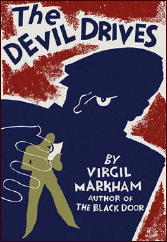
VIRGIL MARKHAM The Devil Drives

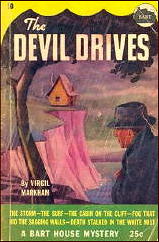
VIRGIL MARKHAM – The Devil Drives. Alfred A. Knopf, hardcover, 1932. Bart House #10, paperback, 1944. Ramble House, trade paperback, 2007.

   The Devil Drives is an offbeat and highly individual novel by a writer who, it would seem, must have had some familiarity with the work of that master American zany Harry Stephen Keeler. It is somewhat reminiscent of Keeler’s Amazing Web (1929), but is shorter, slighter, less ambitious, more straightforward, and, though complex enough in plot, lacks the unbelievable convolutions and ramifications of the Keeler work.

   The authors do share the ability to propel their narratives forward in such a manner that readers will keep turning pages breathlessly in order to discover what astounding plot development will next occur, and what outrageous coincidence will help to resolve (or amplify) the current situation.

VIRGIL MARKHAM The Devil Drives

   The Markham novel concerns George Lawson Peters, the warden of Franklin Penitentiary in New Jersey, who deserts his post to seek a lost treasure left by an adventurer nicknamed “Dubrosky” for a girl named Philadelphia Boston. On his odyssey, Peters meets a gangster with a heart of garbage; a repulsive blackmailer who exacts no tribute from his victims; the blackmailer’s unhappy wife; her friend the eccentric countess; and Detective Veen, who reads mysteries.

   At the two-thirds point in the narrative, Peters encounters a honey of a locked-room problem. The door is locked and bolted, and the two windows are locked-all from the inside. The floor and ceiling are ungimmicked, and the fireplace and chimney show no signs of entrance or egress. The victim met his death by drowning. The author’s unique solution is even more bizarre than the problem he has propounded.

VIRGIL MARKHAM The Devil Drives

   The locked-room situation and many strands of the plot are finally resolved by a few well-placed Keeleresque coincidences. But Markham has still done an ingenious job of deceptive clue-planting that is worthy of Christie, Carr, or Queen; and his unexpected and grimly ironic finale is worthy of Francis Iles or Richard Hull.

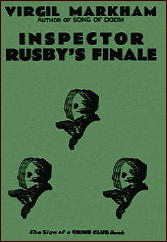
   Markham’s other novels include Death in the Dusk (1928), The Black Door (1930), and Inspector Rusby’s Finale (1933). The last-named title has an irresistible premise:

   A Scotland Yard inspector, spending a weekend at a crowded country house, wakes up the morning after his arrival to find that the hostess and guests have vanished and he is alone — except for the dead body of a perfect stranger. The ending, however, as Barzun and Taylor have noted, is a bit hard to swallow.

         ———
   Reprinted with permission from 1001 Midnights, edited by Bill Pronzini & Marcia Muller and published by The Battered Silicon Dispatch Box, 2007.   Copyright © 1986, 2007 by the Pronzini-Muller Family Trust.

Editorial Comments:   Curt Evans recently posted on his blog a review of Red Warning (aka Song of Doom in the UK), another work of crime fiction by Virgil Markham. Included with the review is a considerable amount of information about the author himself, and I highly recommend it to you. (Follow the link.)

   More. A link on Curt’s blog led to blogger TomCat’s review of Death in the Dusk, also by Markham, which he says “turned out to be a rival for Joel Townsley Rogers’ The Red Right Hand (1945) and Fredric Brown’s Night of the Jabberwock (1950) in the race for the title of most outlandish detective story ever contrived.”

« Previous PageNext Page »