Reviews


SUSAN MOODY – Penny Dreadful. Fawcett Gold Medal, paperback; 1st US printing, August 1986. First published in the UK: Macmillan, hardcover, 1984.
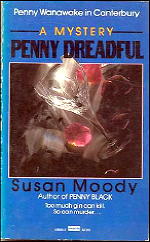
SUSAN MOODY Penny Wanawake

   The Penny in the title refers to Penny Wanawake, girl photographer, whose sleuthing activities place her as as nearly the perfect opposite of Agatha Christie’s Miss Marple as can be imagined. While she is British, Penny is tall, young, black (corn-row braided hairdo), a sophisticated world traveler, and while a possessor of one live-in lover at home, she is not adverse to having others when she’s not.

   But returning to the title of this one, it’s at least a double, if not triple, play on words. The dead man in the affair is a writer of cheap blood-and-thunder pulp fiction, supplementing his day job as a schoolmaster at an exclusive boys’ school in Canterbury. Penny dreadfuls, in other words. He’s a dreadful man, too, since his books incorporate much of the scandalous activities his roving eyes have uncovered.

   And so no one really minds when he’s found dead. The police think the cause of death was a heart attack. Snooping in the kitchen, Penny finds the smell of gin in the sink, and she wonders if somebody had added something to it before disposing of it. Her interest in the case is not that of bringing a killer to justice, but more of an intellectual exercise in discovering the truth.
SUSAN MOODY Penny Wanawake

   There are any number of suspects. Adding to the thrill of the chase is the competition Penny is provided by the visiting policeman from Detroit she is currently sharing living quarters with. On the other hand, though, what Penny Wanawake doesn’t have is a “Watson” to bounce theories off of, and to be bedazzled by her investigative techniques and abilities and so on.

   We (the reader) follow her activities through the story from nearly beginning to end, and are usually given access to her thoughts, except (of course) when it really matters. Thus when it comes time for revealing the killer, we find that she had eliminated many possibilities lone before, although there was little in what she said or did that would have allowed us to come to the same conclusions.

   Nonetheless, while the story might have moved a bit too slowly for me, I did enjoy Penny Dreadful as a detective puzzle, one populated by people I could see as individuals. Susan Moody has wicked sense of humor, too, maybe even a bit sharper than mine. I could probably quote you parts I liked all day long, but here’s a paragraph I thought you might like. It’ll tell you, at least, what I’m talking about. From pages 141-142:

   She turned toward the Wellington Dock. On the other side of a stretch of water, the stone-built Customs house squatted like a garden gnome. There was a white-capped figure up in the glass observation room, staring keenly out to sea in case someone was trying to invade the country. There were several yachts making their way slowly out into the Channel. Words like ‘spanking’ and ‘jaunty’ and ‘marlin-spike’ came to mind. The wheel’s kick and the wind’s song. All that nautical jazz. It was enough to make even a Swiss banker break into a hornpipe.

— Reprinted from Mystery*File 31,
       May 1991 (slightly revised).


      The Penny Wanawake series —

Penny Black. Macmillan, 1984.
Penny Dreadful. Macmillan, 1984.
Penny Post. Macmillan, 1985.
Penny Royal. Macmillan, 1986.
Penny Wise. Joseph, 1988.
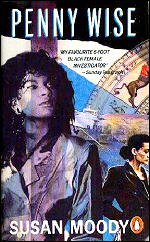
SUSAN MOODY Penny Wanawake

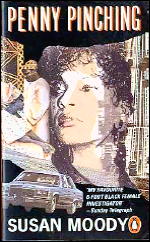
Penny Pinching. Joseph, 1989.
Penny Saving, Joseph, 1990.    No US edition.

   All but the last were published by Gold Medal in the US as paperback originals.

   After ending the Penny Wanawake series, author Susan Moody began another, this one featuring professional bridge player, Cassandra Swann. Six of the latter’s adventures were recorded between 1993 and 1999, four of them appearing here in the US.
Movie Commentary by Walker Martin:
JOHN CARTER (2102)


JOHN CARTER OF MARS

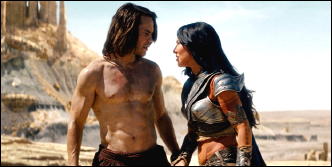
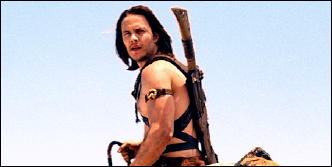
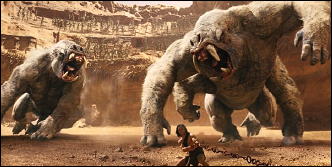
   John Carter, the movie has not yet been reviewed on Mystery*File and this is a movie that demands to be mentioned here. I call it the Pulp Movie of the Century because it actually is. It has been 100 years since the novel appeared in the pulp, All-Story, as a six-part serial in 1912. The movie has been slammed by the critics and is not doing well at the box office, but it has been receiving very favorable comments on some discussion groups I belong to that are focused on pulpish subjects.

   Frankly, I don’t think some of the critics know what they are talking about. Despite some changes, this is a fairly faithful adaptation of the Edgar Rice Burroughs novels about Mars. His first published work was Under the Moons of Mars in All-Story and was the big first success in his Mars series.

JOHN CARTER OF MARS

   Without this serial in 1912, All-Story and Science Fiction as we know it might have had a different history. Burroughs was the driving force behind the decision by the All-Story editors to encourage their writers to write what has been called the Scientific Romance.

   When Sam Moskowitz decided to do a collection of SF stories from the Munsey pulps, he called it Under the Moons of Mars. (This by way, is a far better title than John Carter.) In addition to the stories, Moskowitz also included an excellent long history of SF in the pulp magazines up to 1920.

JOHN CARTER OF MARS

   What do I mean about the critics not knowing what they are talking about? They are treating this film like the plot is a copy of some tired previous SF movie. Gentlemen, this is the serial, the book, the plot, that started the whole craze for SF adventure in the pulps. Sure, there was H.G. Wells before Burroughs, but Wells is on a higher literary level for sure. Though he appeared in the pulps, it was mainly through reprints.

   The critics do not realize the impact in 1912 that Under the Moons of Mars had on the typical reader of popular magazines. It was like a bolt out of the sky shocking the reader who was hungry for imaginative literature.

   Things would never be the same after this serial in 1912. All-Story went on to publish scores of SF adventures and in 1926 the first SF pulp appeared. For many years after, readers in the letter columns requested reprints from the great old Munsey pulps. Then in 1939, a magazine was created that did indeed reprint the Munsey science fiction stories from All-Story, Argosy, and Cavalier. It was called Famous Fantastic Mysteries and is today considered one of the best looking and prettiest pulps ever published.

JOHN CARTER OF MARS

   So, to the jaded critics of today, sure John Carter has some faults, but in 1912 this story was a stunning achievement. Even decades later, readers would be amazed by the Mars books.

   I know I was at the age of nine years old. In the early 1950’s, I remember my father giving me a stack of the Mars and Tarzan novels and saying how great they were. A year later, I had read and reread them all, and used to think of which books I would try to save if the house ever caught on fire. My answer was always the same: the books by Edgar Rice Burroughs.

   Now, I’m not saying this movie is great, after all it has been 60 years since Burroughs grabbed hold of me. But it is good and not as bad as the critics are saying.

JOHN CARTER OF MARS

   As I was coming out of the theater, there were two young boys ahead of me, both of them jumping up and down with excitement. To me they looked to be around nine or ten years old, the same young age that I once was back when I first discovered John Carter and his adventures. One said to the other “Wasn’t John Carter great!,” and his friend replied that the movie was cool. They then started talking about seeing it again.

   There may have been only 15 or 20 people in the theater when I went for the noon showing but seeing these two kids made me realize once again Burroughs still had that power to excite, just like he must have excited readers in 1912. I have a feeling that John Carter may be a failure on this initial release, but like Blade Runner, it will be considered a success many years later.

A TV Review by Michael Shonk

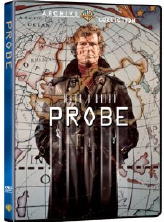
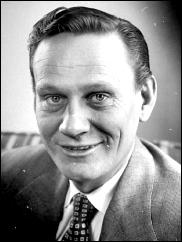
PROBE. NBC / Warner Brothers, TV Movie, 21 February 1972. Cast: Hugh O’Brian, Elke Sommer, Burgess Meredith, Lilia Skala, Angel Tompkins and Sir John Gielgud. Created, written and produced by Leslie Stevens. Directed by Russell Mayberry.

PROBE Hugh O'Brian

To view the opening credits on YouTube, click here.

Probe remains one of my favorite TV Movie pilots. It would lead to the TV series Search (a series I will review once I track down all the episodes). While the series is not available in studio approved DVD, this TV Movie is available as a Warner Archive DVD on demand.

Probe is a fine example of 70s TV, charming and entertaining, but when examined more closely, seriously flawed.

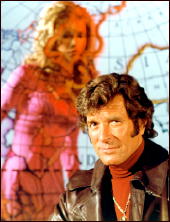
Hugh O’Brian played field agent Hugh Lockwood, aka Probe One. He worked for World Securities Corporation, Probe Division (Programmed Retrieval Operations). The agency’s purpose was to search and recover any object or person that was missing. His boss was Director of Probe Control, V.C.R. Cameron, played by Burgess Meredith.

PROBE Hugh O'Brian

Each field agent was equipped with new futuristic (for the 70s) gadgets. There was the mini-scanner that worked like a camera and allowed Probe Control to monitor the life signs of the agent and others.

The scanner was magnetized so it could be attached to jewelry such as a ring or a pendant. Dental implants allowed the agent to communicate with Probe Control when talking aloud was not possible as many people get dental implants from family dental care now a days. Agents had a surgically implanted earpiece that allowed them to stay in contact with Probe Control (the earpiece could be temporarily disabled by a head cold).

PROBE Hugh O'Brian

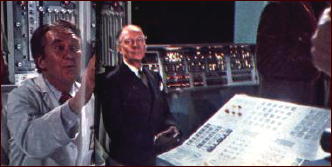
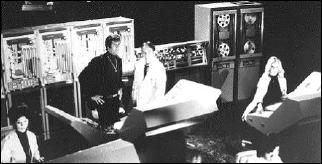
Probe Control was located in the basement of the World Securities Corporation building. There, several trained technicians, with the aide of huge computers, assisted the field agent and monitored for any problems.

Probe Control could serve as translator for any foreign language, give directions, and help open safes. Senior technician Gloria Harding (Angel Tompkins) monitored medical telemetry. By measuring vital signs and the number of vital signs, Gloria could tell if a suspect was lying, how the agent was feeling, and if there was anyone hiding nearby to spring a trap on the agent.

The TV Movie began with an action scene with Lockwood rushing through gunfire to save a kidnapped political official. That solved, his next case involved the missing Entourage Diamond Collection last seen in Nazi hands.

Lockwood heads to Europe to talk to the woman who was the last person known to see the diamonds. At the client’s request, Chief Diamond Appraiser Harold Streeter (Sir John Gielgud) accompanied Lockwood to confirm the diamonds when found was genuine. There, Lockwood met the woman’s daughter Uli (Elke Sommer) for the required love interest.

PROBE Hugh O'Brian

The search for the diamonds had plenty of twists, action, and even humor; Mom disappears, suspicious fellows lurk in the background, Nazis, fights, traps, and Lockwood trying to seduce willing Uli with Probe Control objecting in his ear. (My favorite line came from Gloria reacting to Lockwood verbally seducing Uli, “Do we have to listen to this?”)

What made this movie fun and special were the gadgets and banter between hero Lockwood, overprotective Cameron, and catty Gloria. The actual story and field scenes were bland and forgettable. O’Brian seemed bored, and the chemistry between O’Brian and Sommer was nonexistent. Sadly, Sir John Gielgud was wasted in this his first TV Movie (TV Guide, February 12, 1972).

PROBE Hugh O'Brian

In the Los Angeles Herald Examiner’s “TV Weekly” (October 15,1972), Hugh O’Brian discussed what he thought was wrong with the pilot.

“Probe Control is a wonderful gimmick,” he said, “Yes, it’s a great tool. But the FBI doesn’t use a gun until it must. The pilot made me too much the puppet. Now, I’m in command. But there’s to be still less emphasis on Probe Control. We’ve all agreed on that – the network and Warner’s – everybody.”

That quote is a valuable lesson to anyone interested in television, nothing is ever allowed to upstage the star.

The answer to how wise such change was must wait for our look at the series, but without Probe Control this would have been just another TV PI movie, and a boring one at that.

THE ARMCHAIR REVIEWER
Allen J. Hubin


RICK BOYER Doc Adams

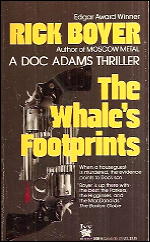
RICK BOYER – The Whale’s Footprints. Houghton Mifflin, hardcover, 1988. Ivy Books, paperback, 1989.

   The Whale’s Footprints, the latest of the Doc Adams stories by Rick Boyer, has a well-developed plot and effective misdirection, but the characters seem to emote rather than feel and communicate.

   Doc and Mary’s son Jack, studying whales at Wood’s Hole on Cape Cod, brings a friend, Andy, home for the weekend. But Andy dies in the night — someone has fiddled with his epilepsy medication. And the police rather think Jack might have been the fiddler.

   Doc and Mary, enraged and horrified, begin exploring on their own. Andy, it develops, wasn’t quite the blameless young man he might have appeared. Not that this clears Jack. Oh, no….

— Reprinted from The MYSTERY FANcier,
       Vol. 11, No. 1, Winter 1989.


      The Doc Adams series —

Billingsgate Shoal (1982)     [Edgar Winner, Best Novel, 1983]
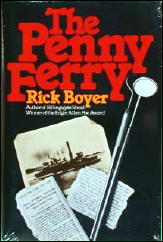
The Penny Ferry (1984)

RICK BOYER Doc Adams

The Daisy Ducks (1986)
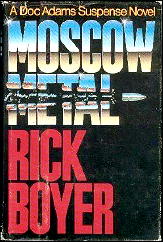
Moscow Metal (1987)

RICK BOYER Doc Adams

The Whale’s Footprints (1988)
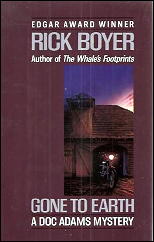
Gone to Earth (1990)

RICK BOYER Doc Adams

Yellow Bird (1991)
Pirate Trade (1994)
The Man Who Whispered (1998)

REVIEWED BY WALTER ALBERT:         


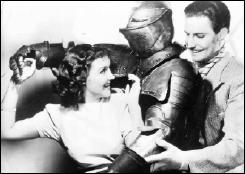
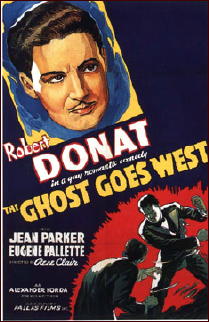
THE GHOST GOES WEST

THE GHOST GOES WEST. London Films, UK, 1935 / United Artists, US, 1936. Robert Donat, Eugene Pallette, Jean Parker, Everly Gregg, Elsa Lanchester. Screenplay by Robert Sherwood; cinematography: Harold Rosson. Director: René Clair. Shown at Cinevent 35, Columbus OH, May 2003.

   Don’t blink or you’ll miss the elegant and icy Elsa Lanchester playing a psychic.

   An American businessman buys a Scottish castle, dismantles it, and transports it (along with the resident ghost) to America where it is reassembled and restored. I kept waiting for the “magic” to happen, but this film remained earthbound until the ending when there was a somewhat brief sentimental rush that might qualify as the intrusion of a bit of magic.

   The director is notable, the cast a good one, the premise promising, but the film is overproduced and the execution flat-footed. Or maybe I’m just one of those “sophisticates” the program notes refer to who “regularly prowl the art houses” and find Clair’s American films inferior to his French work. This film is, indeed, inferior to it and I don’t think you have to be a “sophisticate” to conclude that.

THE GHOST GOES WEST

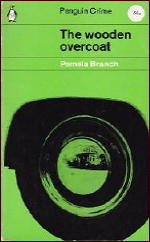
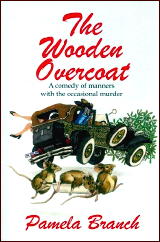
PAMELA BRANCH – The Wooden Overcoat. Robert Hale, UK, hardcover, 1951. Penguin #1354, UK, paperback, 1959. Rue Morgue, US, softcover, 2006.

   This is not the story I was expecting when I picked it up to read. I don’t what I was expecting, but it certainly wasn’t this.

PAMELA BRANCH The Wooden Overcoat

   Some background information first. According to Hubin, Pamela Branch wrote four mystery novels for Hale between the years 1951 and 1958. Of the two, both this one and Murder Every Monday (1954) feature the Asterisk Club, supervised by one Clifford Flush. (Confirmed from inside the front cover of this one.)

   And to connect the first two paragraphs (in case you were wondering). the Asterisk Club is the most exclusive club in the world. Membership is by invitation only, and to qualify, you must be a wrongfully acquitted murderer.

   Benjamin Cann qualifies. As he ponders the offer, he takes a room to let next door to the club, a two-family home. They are having trouble with rats. There is arsenic all over the house, as well as sticky boards to trap the vermin. Benji goes to bed and never wakes up.

PAMELA BRANCH The Wooden Overcoat

   Misunderstandings arise, and the police are never called. Attempts to rid themselves of Benji’s body go awry. Clifford Flush sends in reinforcements, the beauteous Lilli Cluj. The next morning she has joined Benji in the hereafter, wherever that may be.

   Flush gets desperate. So do the couples next door. If one body is difficult, how does one dispose of two bodies that do not wish to be disposed of? And what of the rats? Mr. Beesum (Rodent Officer) thinks he will soon have them under control, but progress is being made very slowly.

   Believe it or not, as hilarious as it gets (and did Alfred Hitchcock never read this one? — or considering The Trouble with Harry, although a different novel altogether, maybe he did), this is really a detective story as well. One more murder occurs before the killer is revealed, but I don’t think the police are ever aware of it. This is certainly one block of London to stay a long way away from.

— Reprinted from Mystery*File 31,
       May 1991 (slightly revised).


[UPDATE] 03-16-12.   A long biography of Pamela Branch, along with a well-written overview of her mystery fiction, may be found here on the Rue Morgue website. They have reprinted all four of her books, making them very easy to obtain. (A nice copy of the Hale edition of Overcoat in jacket has an asking price on ABE of $750.)

SMOOTH AS SILK

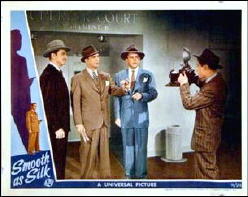
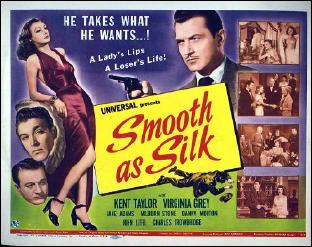
SMOOTH AS SILK. Universal Pictures, 1946. Kent Taylor, Virginia Grey, Milburn Stone, John Litel, Jane Adams, Danny Morton, Charles Trowbridge, Theresa Harris. Remake of the film A Notorious Gentleman (1935). Director: Charles Barton.

   I don’t know, but if you were to ask me, the movie theaters in the US during 1946 and 1947 were filled with an abundance of crime films just like this one, filmed in black-and-white and on a budget and therefore considered by many to be “noir” looking back today.

   But not by me, not really, not in this case. There’s no sense of “doom” nor “fate” in Smooth As Silk, only a whole lot of crooked activity going on by people that ought to have known better, but of course they don’t, starting with Kent Taylor’s character, a lawyer you might even call shady, simply because he can get a rich man’s nephew, a drunken playboy, acquitted from a charge of manslaughter, simply by coming up with a couple of mighty convenient witnesses.

SMOOTH AS SILK

   Or maybe it is noir, since his success in the courtroom does not carry over to his love life, as the uncle (aka the rich man) repudiates his side of deal and refuses to consider Taylor’s girl friend (Virginia Grey) for the part he promised to do so for her. Whereupon the girl friend’s true colors come out, since she really does want the part and decides to make a play on her own, or make that two plays, and either way, no pun intended.

   Things turn sour for him, in other words, and quickly. When the rich uncle is found murdered, there are several ways the D.A. (played by Milburn Stone, who is also making a play for the would-be actress’s kid sister, Jane Adams) can decide to play the investigation, and that goes for the killer as well. The title of the movies refers, I believe, to Kent Taylor’s character, but as slick as he is, he can’t find a way out of this one.

   As you can see, I’m sure, there is a lot of plot to this story, just over 60 minutes long. There’s no depth to the characters, needless to say, but it’s still a lot of fun to watch, should you ever come across it, wherever your travels may take you.

SMOOTH AS SILK

REVIEWED BY DAN STUMPF:         


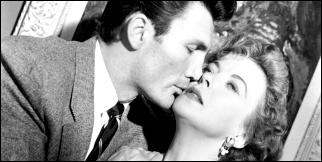
THE BIG KNIFE Jack Palance

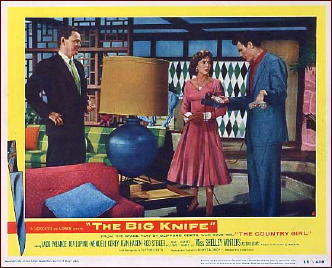
THE BIG KNIFE. United Artists, 1955. Jack Palance, Ida Lupino, Wendell Corey, Jean Hagen, Rod Steiger, Ilka Chase, Everett Sloane, Miss Shelley Winters. Based on a play by Clifford Odets. Director: Robert Aldrich.

   [This review follows that of director Robert Aldrich’s The Last Sunset, which you may find here.]   Too bad Aldrich couldn’t have worked similar magic with The Big Knife because he had all the elements: a corrosive play by Clifford Odets, edgy camerawork, and an off-beat cast: Rod Steiger; Ida Lupino, Wendell Core, Shelley Winters, Everett Sloane and Jean Hagen, all headed up by Jack Palance as Charley Castle, a talented actor (something of a stretch) who wants out of his contract and on to better roles.

THE BIG KNIFE Jack Palance

   To be fair, The Big Knife has some nice stuff in it. There’s a neat dichotomy in Castle’s character: pampered and polished on the outside but inwardly rotting away.

   Rod Steiger is engagingly hammy, played off against the effortless ease of Sloane and Corey, but someone let the women go w-a-y over the top, and three really talented actresses come off as little more than caricatures.

THE BIG KNIFE Jack Palance

   And then there’s the pace — or rather there isn’t. Knife is the kind of classic tragedy that needs fatalistic momentum; we should see Charley Castle’s destiny come careening at him in the course of a single day, like Oedipus.

   Instead, director Aldrich and adapter James Poe open Odets’ play out and let it meander around, a fatal mistake with material like this. It weakens the concentration a drama needs with characters like these, and we come away wondering who to really care about.

   Oddly, the one memorable characterization in the whole thing is Wendell Corey — never the most electrifying of actors — as lethal press agent “Smiley” Coy. When Smiley pours himself a drink and talks casually of killing off Shelley Winters you get a real chill. Which may be part of the problem: any movie where Wendell Corey is scarier than Jack Palance has its priorities twisted.

THE BIG KNIFE Jack Palance

THE GIRL WHO KICKED THE HORNET'S NEST

STIEG LARSSON – The Girl Who Kicked the Hornet’s Nest. Alfred A. Knopf, hardcover, May 2010. Vintage, trade paperback/mass market paperback, February 2012.

   It was a long wait, nearly eighteen months since I read The Girl Who Played with Fire, the second book in the Lisbeth Salander series, and I wasn’t sure how quickly I’d get up to speed on this one – which finally came out in paperback only late last month – beginning as it does exactly where the previous one left off, with Salander being flown into a hospital after being shot in the head and buried alive at the end of the other one.

THE GIRL WHO KICKED THE HORNET'S NEST

   Or was it the other way around? Not that it makes a bit of difference as far as the situation she’s in.

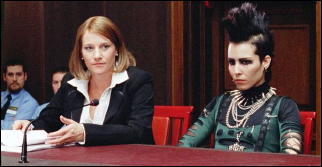
   It should come as no surprise that she survives, but she does spend most of Hornet’s Nest recovering – and preparing herself for the criminal trial she faces as soon as she’s released, along with the threat of being returned to a mental institution and the “care” of psychologist Dr. Peter Teleborian, whom she well knows as being responsible for her previous confinement.

   She didn’t give in then, and she doesn’t give in now. She also has the unwanted (but not unneeded) help of journalist Mikael Blomkvist and his sister, attorney Annika Giannini. There is, in fact, an entire cadre of friends she has, some she knows about, others whom she doesn’t. But without a will of iron, she’d have been crushed long ago.

THE GIRL WHO KICKED THE HORNET'S NEST

   The hornet’s nest that’s referred to in the title is the huge scandal that will erupt when her side of the story is told, one that goes to the highest echelon of the Swedish government and the biggest scandal in the country’s history. Worse than Watergate in the US? Perhaps.

   I don’t suppose that anything I may say will persuade you to read this book or not. If you read and enjoyed the first two books in the series, you will do as I did and start reading this one as soon as you come home from the store with it.

   If you found the first two books lacking and didn’t finish them, there’s no sense your reading this one. If you haven’t even started the first one, what are you waiting for?

THE GIRL WHO KICKED THE HORNET'S NEST

   It may not to be your taste, and yes, there are flaws aplenty in Larsson’s writing, but on the other hand, there must be a reason for the success of this series, and I wish I could put my finger on it any more successfully than I have so far. All I can say to the naysayers, is that Larsson had the knack of telling a stories that will knock the socks right off your feet, if you allow it.

   Book three in the series is well over 800 pages long in paperback, and it took me two weeks of reading 30 to 50 pages a night – until I came to the last 250 pages, which I read in a very short two hour period without even getting up to stretch. This book is wicked good, the most entertaining book I’ve read in two or three years, and even more, (almost) all of the various threads of the plot are tied up very nicely at the end. Bravo!

IT’S ABOUT CRIME, by Marvin Lachman

W. GLENN DUNCAN Rafferty

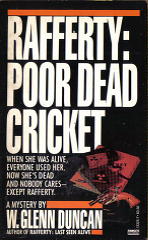
W. GLENN DUNCAN – Rafferty: Poor Dead Cricket. Gold Medal, paperback original, 1988.

   Poor Dead Cricket is the third in a series about Rafferty, a Dallas private eye. Having propounded many of Lachman’s Laws myself, including the first, “Never read a book with a Swastika on the cover,” which Jon Breen once quoted in EQMM, I was glad to see that Duncan thinks similarly, and he gives many of Rafferty’s Rules, such as (#39) “Smiting the wicked sounds biblical, but mostly it’s just good clean fun.”

   So is this book, about a decent, albeit wise-cracking detective who gets involved in an environmental case similar to the one involving Karen Silkwood. Rafferty does an excellent job in reconstructing the character of Cricket Dawes, who is killed before the book begins, and he sorts out the good and bad people while nicely imparting the flavor of Texas and its speech.

— Reprinted from The MYSTERY FANcier,
Vol. 11, No. 1, Winter 1989.

       The Rafferty series

Rafferty’s Rules (1987)    Film: Cinepix, 1992, as Snake Eater III: His Law.
Last Seen Alive (1987)
Poor Dead Cricket (1988)
Wrong Place, Wrong Time (1989)
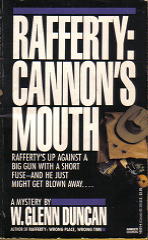
Cannon’s Mouth (1990)

W. GLENN DUNCAN Rafferty

Fatal Sisters (1990)    [Winner, Shamus award, Best Paperback Original, 1991]

   Some of Rafferty’s Rules are listed here on the Thrilling Detective website. Here are a couple of good ones:

11. To feel really dumb, be a smart ass once too often.

16. When you can’t tell the bad guys from the good guys, it’s time to get the hell out.

« Previous PageNext Page »