Reviews


REVIEWED BY WALTER ALBERT:         


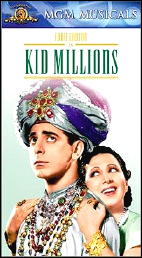
KID MILLIONS Eddie Cantor

KID MILLIONS. United Artists, 1934. Eddie Cantor, Ann Sothern, Ethel Merman, George Murphy, Berton Churchill, Warren Hymer, Paul Harvey, Jesse Block, Eve Sully, Stanley Fields, Edgar Kennedy, The Nicholas Brothers, Noble Johnson, Clarence Muse. Original screenplay and story by Arthur Sheeman, Nat Perrin, and Nunnally Johnson; photography by Ray June; color photography by Ray Rennahan; music by Alfred Newman; musical numbers directed by Seymour Felix; “Mandy” music and lyrics by Irving Berlin; additional music and lyrics by Walter Donaldson and Gus Kahn, Burton Lane and Harold Adamson. Director: Roy Del Ruth, with the Technicolor sequence directed by William (“Willy”) Pogany. Shown at Cinevent 40, Columbus OH, May 2008.

   I had already seen most of the Cantor Goldwyn musicals (of which Roman Scandals has long been one of my favorite ’30s musicals), but Kid Millions, the last of the films under Cantor’s contract with Goldwyn, had eluded me and I was determined to watch it, even if it was shown last on the program at the end of a long day.
KID MILLIONS Eddie Cantor

   The film was probably not the best of the Cantor musicals, but it was certainly the feature-length film that I enjoyed the most. Busby Berkeley’s inventive staging of the musical numbers, a highlight of the earlier Cantor films, was sorely missed (Seymour Felix was a workmanlike but uninspired replacement), but apart from the major production number (which featured “I Want To Be a Minstrel Man,” “My Head on Your Shoulder,” and “Mandy” and was only rescued from mediocrity by the sensational dancing of the Nicholas Brothers), the songs, mostly integrated into the plot, were effectively performed by Cantor, Merman, Sothern, and Murphy.
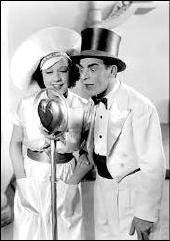
KID MILLIONS Eddie Cantor

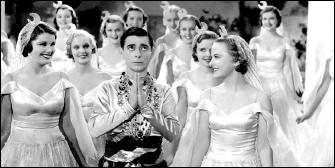
   The opening number sung by Ethel Merman (“An Earful of Music”) and an ensemble comic number (“Let My People Go”) were probably the musical highlights. And then there was the technicolor finale, designed by the enormously talented book and magazine illustrator, as well as film production designer, Willy Pogany.

   This was a riot of color, a fantasy in which Cantor, finally coming into the fortune left to him by his father, presides over an ice cream feast for a horde of children, in a factory setting that is as much a feast for the eye as the ice cream is for the children. It should be noted that this sequence precedes the first all Technicolor film Becky Sharp that was released some months after the Cantor film, in 1935, and for sheer opulence surpasses the use of color in the prints I have seen of Becky Sharp. The sequence may not be tasteful but it’s eye-popping gorgeous.
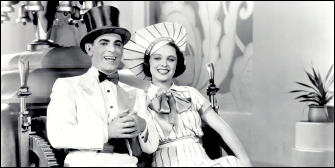
KID MILLIONS Eddie Cantor

   I bought a copy of a laser disc of the film in the dealers’ room on Sunday and copied it to DVD. Now you can all wait for the commercial release on DVD to see if you can experience the rush that I did at the late evening screening.

Editorial Comment: Kid Millions was released on VHS and can be obtained without much difficulty, but the only DVD release seems to be out of print and hard to find. In the meantime, perhaps this color clip on YouTube will suffice, the last seven minutes of the film.
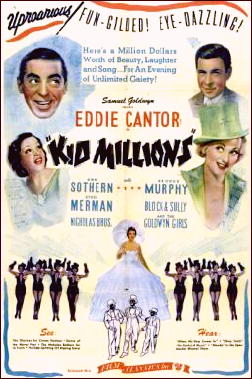
KID MILLIONS Eddie Cantor

THE BACKWARD REVIEWER
William F. Deeck


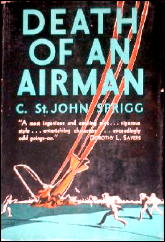
C. ST. JOHN SPRIGG – Death of an Airman. Doubleday Crime Club, hardcover, 1935. First published in the UK: Hutchinson, hardcover, 1934.

S. ST.JOHN SPRIGG Death of an Airman

   Fortunate it is for the minions of the law that Edwin Marriott, Bishop of Cootamundra, Australia, is in England on leave and wants to learn how to fly. For it is he who spots an anomaly when the flight school’s principal instructor expires after his plane crash: rigor mortis never sets in.

   A delayed post-mortem uncovers a bullet wound in the dead man’s head. It can’t be suicide. It also cannot be murder since the pilot was flying alone and no other plane was seen in the area.

   Scotland Yard Inspector Bernard Bray, one of Sprigg’s continuing characters, is called in to assist in the investigation. Even he can’t puzzle out the absence of rigor in the corpse, though he does get on the trail of drug smugglers and peddlers (yes, young people, like sex, this was not something invented in your generation).

   With the help of the Bishop, Bray and the locals break up the drug ring and finally figure out how the deceased pilot met his fate in an entertaining novel that provides some interesting information about the early days of flying.

— From The MYSTERY FANcier, Vol. 12, No. 3, Summer 1990.


   BIBLIOGRAPHY:    [Taken from the Revised Crime Fiction IV, by Allen J. Hubin.]

SPRIGG, C(hristopher) ST. JOHN
. 1907-1937.

   Crime in Kensington (n.) Eldon 1933 [Insp. Bernard Bray; Charles Venables] US title: Pass the Body. Dial, 1933.
   Fatality in Fleet Street (n.) Eldon 1933 [Charles Venables] No US edition.
   Death of an Airman (n.) Hutchinson 1934 [Insp. Bernard Bray]
   The Perfect Alibi (n.) Eldon 1934 [Charles Venables; Insp. Bernard Bray]
   The Corpse with the Sunburnt Face (n.) Nelson 1935. US title: The Corpse with the Sunburned Face. Doubleday, 1935.
   Death of a Queen (n.) Nelson 1935 [Charles Venables] No US edition.
   The Six Queer Things (n.) Jenkins 1937.

Editorial Comments:   There is a longer biography of Sprigg on the Golden Age of Detection Wiki, along with a photo.

   A challenge I might present to you I’m sure I would win is to have you collect all of the books above, or try to. I do not believe you could do it. If you have a collection already, you must have put it together some 40 years ago or more. At one time the US editions of his books were relatively common, but no more, especially in jacket. (The one shown above came from a Sun Dial reprint.)

   As to this particular book, I’ve had a copy since forever, but I’ve never read it. I do wish that Bill Deeck had commented on how clever the “impossible crime” aspect was. At the moment, all it is is a tease.

REVIEWED BY DAN STUMPF:         


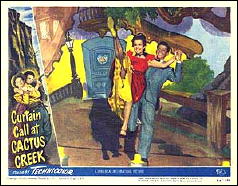
CURTAIN CALL AT CACTUS CREEK

CURTAIN CALL AT CACTUS CREEK. Universal, 1950. Donald O’Connor, Gale Storm, Walter Brennan, Vincent Price, Eve Arden, Chick Chandler, Rex Lease, I. Stanford Jolley. Director: Charles Lamont.

   As I have noted before, Universal was best-known for its horror films — not all of them classics — and their comedies tended toward dire efforts with the likes of Francis the Talking Mule. But now and again, quite unexpectedly (perhaps unintentionally) they came out with an off-beat and lightly enjoyable piece like Curtain Call at Cactus Creek, written and directed by the folks who usually worked on Abbott & Costello comedies. This hasn’t aired on TV in a generation, but I found it on DVD recently and fell in love.

   Curtain / Creek offers Donald O’Connor as the one-man stage crew of a threadbare theatrical troupe, shooting off amusing stunts and sight gags as he juggles props and struggles for stardom, worshiping ingénue Gale Storm from anear while handling deadly desperadoes and discontented customers with gawky aplomb.

CURTAIN CALL AT CACTUS CREEK

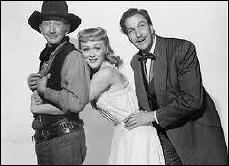
   It’s the kind of part Harold Lloyd and Buster Keaton made their own in the silent movies, and O’Connor wears their mantle quite capably, jumping about at the least excuse and generally making the film fun to look at. Gale Storm is also rather nice as the romantic interest, projecting a predatory vitality that has its moments, but the movie really belongs to its supporting players, Eve Arden, Walter Brennan and Vincent Price.

   Brennan here plays an aging bank robber who years ago fell in love with a picture of stage sensation Lily Martin (echoing his role in The Westerner a decade earlier) and delighted now to meet her in the impoverished person of Eve Arden.

   As the story jumps along, Brennan hides out with the acting troupe and takes an avuncular interest in O’Connor’s struggle to make himself worthy of Gale Storm, softening his (Brennan’s) crusty exterior — another familiar theme of the silent days, and the source of some fun here.

CURTAIN CALL AT CACTUS CREEK

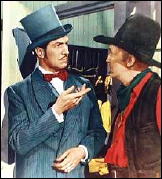
   Then there’s Vincent Price, strutting about as the Leading Man, dressed in elaborate-looking but rather tawdry outfits, looking aristocratically down his nose at the world in general (and O’Connor in particular) and dumping spectacularly eloquent abuse on Walter Brennan. It’s the kind of part Price was born for, and he’s consistently funny here, constantly quoting Shakespeare, but usually from the lesser plays — a nice touch that, and one you don’t expect in a Universal comedy.

   Chief delight, however, is Eve Arden as the sadder-but-still-arch faded star, ruefully accepting the worship of Brennan’s grimy outlaw and taking the world with that weary-but-game humor that she made her own. Tossing off her reaction to a near-sighted admirer (“That explains a lot!”) or trying to cheer up Donald O’Connor as he faces twenty years in jail with “See you (pause) later,” Arden adds a layer of thoughtfulness to a film that already has plenty of charm.

CURTAIN CALL AT CACTUS CREEK

WHY I DON’T WATCH TV’S CASTLE
A Rant by Michael Shonk


CASTLE. ABC. Season Premiere: “Rise.” September 19, 2011. Monday at 10e/9c.

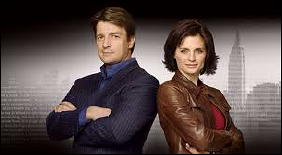
CASTLE Nathan Fillion

   I really want to like Castle. Everyone tells me how wonderful it is, the mysteries, the characters, the actors, the romance, but, sorry, I can’t make it through one episode without throwing something in anger at my TV. And I like my TV.

   For example, currently available on YouTube is this clip:

         CASTLE-4×01 Sneak peek (Episode 1 Comic Con Preview)

   Should the link stop working, the following is a detailed description of what happens:

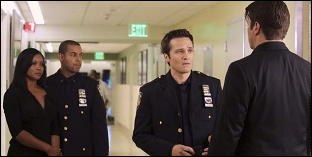
   Visually we open with cuts between black screen and gunshot victim series female lead Kate Beckett (Stana Katic). Beckett is unconscious on a moving hospital gurney. Shots start at extreme close up and pull back shot by shot. We hear the sound of the heart monitor beep despite that there is no machine anywhere to be seen. Finally we hear the sound of flat-lining and fade to black.

   BANG! Hospital doors fly open. We see two paramedics racing from one hallway into the next section of the long hallway.They are running with the gurney Beckett is on. Also on the gurney is Beckett’s best friend, Dr. Lanie Parish (Tamala Jones) who is maintaining hand pressure on the bloody wound and ordering Beckett not to die.

   Cue violins in soundtrack.

   Cut to Beckett. Then Castle (Nathan Fillion) running to keep up. Still moving down the long hallway the camera intercutting between Lanie, her bloody hand and Beckett. Shot of hallway wall and help coming. More of the gurney ride. Help arrives and tells Lanie to let him take over.

    “She is my friend, you understand that? She’s my friend.”

CASTLE Nathan Fillion

    “Then let us save her life.”

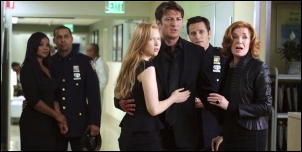
   Lanie is standing in the hallway when Castle catches up and they watch the gurney continue its journey down the hallway. Laine and Castle look worried. Go to black.

   What the writers hope to accomplish with this scene is to make you feel the emotions of Lanie and Castle over the possible death of Beckett, and to do so in an exciting visual way. So what is wrong with this scene? Why is my TV shaking in fear as I look for something to throw?

   First, running is not visually exciting unless there is a threat of danger behind it. Becket is not going to die. The only danger is if Lanie falls off the gurney.

   Second, the scene is supposed to emotionally effect us. We should share the feelings of the characters. But everything is too over the top, from the soundtrack of the beeps from nowhere and sad TV music to the incredibly awful dialog such as “Then let us save her life.”

   Third, no hospital in any Universe would force an emergency patient to travel down a long hallway to get to the doctors. Beckett is a police officer with a gunshot wound and brought to the hospital by an ambulance. Wouldn’t the ambulance park closer to the Emergency Room? Wouldn’t someone have called ahead so emergency personnel would be waiting for the ambulance when it arrived? When every second could mean life or death, they take the scenic route.

CASTLE Nathan Fillion

   So, how did this melodramatic scene affect me? Well, when I stopped laughing at the Calvary charge down the endless hallway, I became annoyed that the writers held such little respect for the viewers they thought this manipulative scene would be so emotionally moving we would not notice how stupid it is.

   Jeopardy is an exciting powerful dramatic device that rarely works on television because TV writers are in denial that everyone knows stars don’t die without media spoilers.

   Castle and Beckett are the only two characters on Castle who can’t die or the series is over, This is why jeopardy is usually left to the supporting or guest cast, but who cares about them? Because the nature of the series format, jeopardy can still work but rarely involving death.

   While you don’t see it in the clip above, Castle did set up an effective season ending cliffhanger involving jeopardy. The death of supporting character Captain Montgomery left open the possibility new Captain Gates might interfere with Castle tagging along on murder investigations or even worse interfere with his on-again off-again romance with Beckett.

   Fans did not worry about Beckett possibly dying, but they did respond to the jeopardy Gates could cause Castle and Beckett’s relationship. Me, the thought of yet another logic defying obstacle to Castle and Beckett having sex is enough to have me whimpering for mercy.

   Yes, Castle is only a TV show. You just want to enjoy it, not think. It is just one scene of many. And the series is a comedy mystery where reality is an occasional visitor. But logic is still required. Riding a gurney with a dying woman down an extra long hospital hallway is so stupid it rips me out of the story and rudely reminds me I could be wasting my time more productively with another TV series.

   I really want to like Castle I really do, but my brain won’t let me.

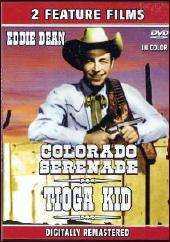
EDDIE DEAN

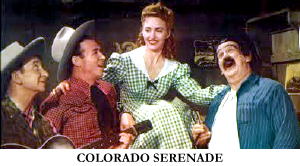
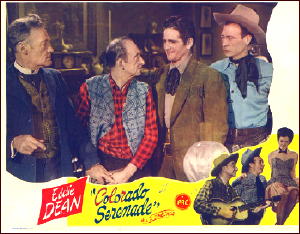
● COLORADO SERENADE. PRC, 1946. Eddie Dean, Roscoe Ates, David Sharpe, Mary Kenyon, Forrest Taylor, Dennis Moore, Abigail Adams, Warner Richmond, Lee Bennett, Robert McKenzie. Screenplay: Frances Kavanaugh. Director: Robert Emmett Tansey.

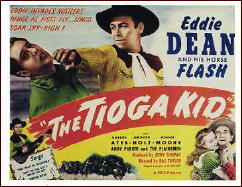
● THE TIOGA KID. PRC, 1948. Eddie Dean, Roscoe Ates, Jennifer Holt, Dennis Moore, Lee Bennett. Screenplay: Ed Earl Repp. Director: Ray Taylor.

   Personally, speaking for myself, Eddie Dean is the unlikeliest of B-western heroes that I can think of, although perhaps I’m not thinking hard enough. From a distance he doesn’t have the body build of a cowboy, and in the movies he’s been in that I’ve seen, he’s far more handy with a guitar and a song than he is with a gun. On the other hand, in The Tioga Kid, he has a huge smash-up-the-bunkhouse fight with another guy that busts up the stove, the bunks, the table and several chairs to boot. Very nice!

   As far as songs are concerned, there are more in Colorado Serenade than there are in the later movie, four to maybe only three, but the latter makes up for it by adding an equal amount of time in watching the bad guys being chased by the good guys on horses, or is it the other way around? Who can tell.

EDDIE DEAN

   One big difference between the two movies is that the first one is filmed in color, and this I found impressive. Not many B-westerns were filmed in color in 1946. (Were there?) It also has a story line that’s actually interesting, one which has Eddie and his pal Soapy (Roscoe Ates) giving a helping hand to a circuit judge (Forrest Taylor) being sent to clean up one of those towns in the west being run by a gang of outlaws.

   But wait. There’s more. Unknown to the judge, always willing to give a bad man the benefit of the doubt if he decides to go straight, is that the head of the gang he’s after is his son, who kidnapped by a really bad guy when he was just a boy. In fact neither father nor son knows the relationship between them, which gives the movie a deeper meaning than do most films of this caliber.

EDDIE DEAN

   No such luck when it comes to The Tioga Kid, which is about as dull as it could be, even though Eddie Dean plays two characters in this one, two brothers, one good, one bad. This is a fact unknown to either one of them, but since the two are all but identical, there are some who suspect they’re related. But while the resemblance really is uncanny, you can easily tell which one is the Tioga Kid. He’s the one who dresses in black with a cigarette dangling from the left side of his mouth.

   There’s not much more to the story than this. It is a remake, although never mentioned, of an earlier Eddie Dean film, Driftin’ River (PRC, 1946), written by the same Frances Kavanaugh who was responsible for Serenade. In the latter several scenes are taken – not remade, but simply taken from the former and inserted into this one (see below). I wonder how it happened that pulp western writer Ed Earl Repp got credit for the screenplay. From the description of Driftin’ River, he added very little. (One source says about 15 minutes’ worth.)

EDDIE DEAN

   Amusingly (sort of), there is a scene in Tioga in which a grizzled old ranchhand (William Fawcett, I believe) appears briefly perched on a fence as the ranch lady tries to break a bronco, then disappears mid-scene, never to show up again. Tioga, as it turns out, was either the last or next to last movie produced by PRC. They’d reached the bottom of the barrel, the end of the line, and it shows.

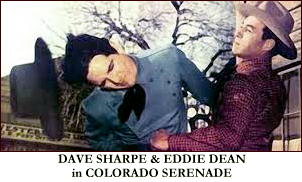
   But getting back to Colorado Serenade briefly, I see I’ve failed to mention famed stuntman David Sharpe. He has a rare starring role in this one, a mysterious young cowboy with a big handsome smile. No one in the movie seems to know how he gets around or which side of the fence he’s on, but I think somebody missed a bet. Eddie Dean was OK, but charisma, he was a little short of. It’s only a thought in passing, but I wonder how David Sharpe would have fared if he’d been the star of long line of B-western movies too. Says IMDB, he “probably holds the honor of being in more films (albeit, often uncredited as a stuntman) than any other person in Hollywood history.” Four or five thousand, can it be?

EDDIE DEAN

REVIEWED BY DAN STUMPF:         


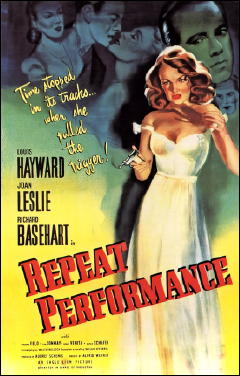
● REPEAT PERFORMANCE. Eagle-Lion Films, 1947. Louis Hayward, Joan Leslie, Virginia Field, Tom Conway, Richard Basehart, Natalie Schafer, Benay Venuta. Based on the novel by William O’Farrell. Director: Alfred L. Werker.

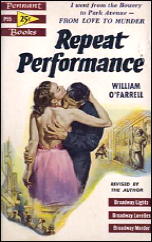
● WILLIAM O’FARRELL – Repeat Performance. Houghton Mifflin, hardcover, 1942. Pennant P55, paperback, revised edition, May 1954; IPL, paperback, 1987. Films: See above, plus: Turn Back the Clock, TV movie, NBC, 1989, with Connie Sellecca & David Dukes (and Joan Leslie in a small role).

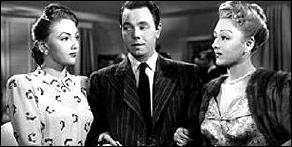
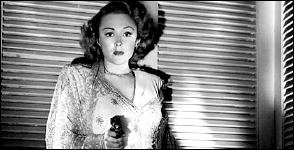
REPEAT PERFORMANCE

   So we came to the end of 2010 and I watched the old year out with two of my favorite New Year’s movies, Chimes at Midnight and Repeat Performance with Joan Leslie as stage actress Sheila Page, who rings in 1947 by killing husband Barney (Louis Hayward).

   Suitably distraught, she wanders out into the clamoring night, runs into some old friends (including Richard Basehart as a mad poet, poetically named William Williams) who commiserate with her on what a lousy year it’s been, then goes to see her producer (Tom Conway).

   But on her way up to Conway’s apartment, her clothes and hair change, the lights flicker, and suddenly it’s a year earlier, and Joan will get a chance to undo all the mistakes that led to infidelity, insanity and murder.

REPEAT PERFORMANCE

   Or will she? What follows is a neatly ironic tale of predestined ends, a bit over-the-top at times, but kept mostly teetering right at the edge of melodrama, thanks to adroit direction from Alfred Werker (a director with an odd career, who really should be better known) and low-key playing from all concerned, particularly Louis Hayward, who had a long and mostly undistinguished career, but now and again suggested something kind of interesting. His role here as Joan Leslie’s ill-starred spouse sports a lethal fecklessness that’s fun to watch.

   I also ferreted out the novel this was based on, Repeat Performance by William O’Farrell for comparison, and I’m glad I did, as the story seems to have been considerably re-jiggered for the movie.

REPEAT PERFORMANCE

   O’Farrell starts off with Barney Page, once a prominent stage actor, now a skid-row drunk, waking up in a flop house to find he has just murdered a one-time girlfriend, in a fit of alcoholic remorse following the suicide of his wife Sheila.

   Page is resigned to his fate, but on his way to turn himself in, he keeps running into old friends (including a gay poet affectionately nick-named William and Mary) who try to help him, and ends up fleeing from the cops, getting shot as he jumps onto a departing subway car and — and suddenly it’s a year ago, Barney is still a successful actor, married to Sheila, and he’s going to get to undo all the mistakes he made last year.

   O’Farrell can write. He can put across a bitchy theatrical milieu and a seedy flophouse with equal aplomb, evoke a desperate chase and a disparate seduction with commensurate suspense, and weave a tale of murder and melodrama (verging on Soap Opera at times, but teetering skillfully on the edge) with prose that keeps the pages turning very nicely.

   He also wraps things up with a fine sense of dramatic irony that had me closing the book with that satisfaction you get from finishing a well-crafted tale.

REPEAT PERFORMANCE

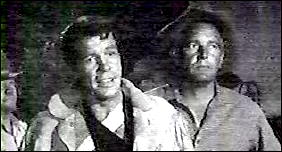
WAGON TRAIN – The John Wilbot Story. Season 1, Episode 37. 11 June 1958. Ward Bond, Robert Horton; with Dane Clark, Robert Vaughn, Audrey Dalton, Tyler McVey.

   With Flint McCullough unable to perform his regular scouting duties because of an injured arm, he and Major Adams switch roles. Adams goes out ahead on horseback, leaving McCullough in charge of the wagons. Little do either of them know that two factions among the settlers are still fighting the recently ended Civil War.

WAGON TRAIN John Wilbot

   To the details. Roy Pelham (Vaughn) is from the South, and he loves Harriet Field (Dalton), but her father (McVey) is a bull-headed abolitionist from Massachusetts, who refuses to allow her to have anything to do with him.

   Seeking comfort and a companion, Harriet finds a lonely man (Dane Clark) who is glad to recite poetry and Shakespeare to her — until, that is, her father begins to suspect that John Wilbot is really an alias for none other than John Wilkes Booth.

   Unsure if he is or not, the wagon train is about to split apart when, in the face of an imminent Indian attack, Wilbot reminds everyone of Lincoln’s famous quote, “A house divide against itself shall not stand.” Does he admit he is Booth? You will have to watch and find out for yourself, but his statement makes sure the train stays together.

   The hour (less commercials) goes very quickly, and even though it’s wrapped up in suitably enigmatic fashion, one is reminded that television at one time was written by adults, and that the performers were adults as well.

   Particularly impressive is Dane Clark’s melancholy portrayal of a man tormented by his memories and fully aware that he has no future.

— Reprinted from Durn Tootin’ #5,
   July 2004 (with revisions).


THE BACKWARD REVIEWER
William F. Deeck


VIOLET TWEEDALE – The Beautiful Mrs. Davenant. Frederick A. Stokes, US, hardcover, 1920. First published in the UK by Herbert Jenkins, hardcover, 1920. Currently available from many sources as a Print On Demand book.

   Why did the beautiful and mysterious widow Hilda Davenant choose to live outside Great Glentworth near a Thorpe, with whom she had done for all time but whose seal is indelibly imprinted on her life?

   Why did Geoffrey Thorpe, who was extravagant and indebted when poor and penurious when he achieved wealth, allow the lovely Lake House to deteriorate around him?

   Why when the presumed dead Mark Thorpe is mentioned does Geoffrey turn pale and cast “an affrighted glance” over his shoulder? Why is Geoffrey dominated by his housekeeper? Is there a ghost who wanders the halls of Lake House in the early a.m.?

   Surely some reader with more forbearance than I possess got farther into the book, subtitled” A Novel of Love and Mystery,” than I did.

   If so, I would be willing to chuckle at the answers as long as I don’t have to discover them for myself.

— From The MYSTERY FANcier, Vol. 12, No. 3, Summer 1990.


Biographical Notes:   Mrs. Tweedale has her own page on Wikipedia, which is where I’ll direct you if you wish more information about her. I’ll be concise here and excerpt only the following:

    “Violet Tweedale, née Chambers (1862 – 19 December 1936), was a Scottish author, poet, and spiritualist.”

    “[She] was born in Edinburgh, the eldest daughter of Robert Chambers, editor of Chambers’ Journal, and the granddaughter of Robert Chambers, the publisher and founder of W & R Chambers.”

    “She was a prolific writer of short stories, published as anthologies, and novels, often with a romantic or supernatural theme.”

    Googling on the Internet will reveal much more about the author. In her day, she was quite a personality.

REVIEWED BY MICHAEL SHONK:


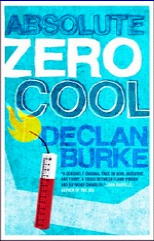
DECLAN BURKE – Absolute Cool Zero. Liberties Press, Ireland, trade paperback, July 2011; US, 28 November 2011. (Kindle edition available now.)

   Declan Burke continues to expand the limits of not only his own writing, but of the Irish crime fiction genre as well. His latest, Absolute Cool Zero, is the story of the clash between writer and his abandoned creation come back to life, a character who is willing to blow up a hospital to get published.

DECLAN BURKE Absolute Cool Zero

    “He just appears, as if wished for,” wrote the writer.

   Declan is trying to finish the book his publisher is impatiently waiting for when he is interrupted by a man he does not recognize, but who knows him. The man claims to be Karlsson, a fictional character from an earlier book written by Declan but never published. In that book, Karlsson was a hospital porter who killed old people who wanted to die.

   Now Karlsson is seeking another chance to be published and find closure. He has changed his appearance and his name. Now calling himself Billy, he wants Declan to rewrite the book, take Karlsson’s plans a step further, and blow up a hospital full of people.

   Declan humors Billy at first, as the two form the most basic of writer’s groups. critiquing the other’s suggestions. The mind games and disturbing discussions between Declan and Billy about love, family, violence, and survival slowly evolves into a surreal nightmarish struggle as both writer and character attempt to escape a past they fear could destroy them.

   Billy wants desperately to escape the muddled fate of Karlsson in the first book. He wants things to turn out differently between himself and Cassie, the female character he hopes to raise a family with, and who he, as Karlsson, may have killed in the first book (neither Declan or Billy know for sure).

   Now happily married with a baby daughter, Declan worries about what would happen to him without his family. They had saved him from that terrible time in his life when such monsters as remorseless killer Karlsson lived in his head.

   Each spends time away from the other. Declan with his loving family. Billy with Cassie and working as a hospital porter at what seems to be a very real hospital.

   Absolute Cool Zero is a fine example of comedic crime noir. As I was reading it, I was thinking of Donald Westlake and Parker.

   Absolute Cool Zero is also a fine example of Irish literary fiction. John Banville (Benjamin Black) describes Declan’s writing in AZC as “a cross between Flann O’Brien and Raymond Chandler” (on the AZC front cover).

   If you enjoy modern crime noir, especially with an Irish comedic touch, this is an author you need to read.

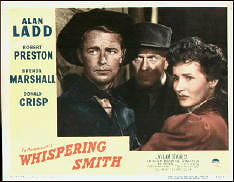
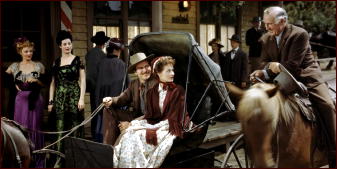
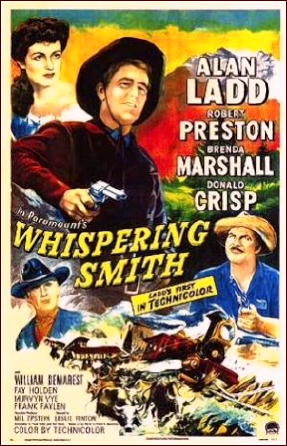
WHISPERING SMITH

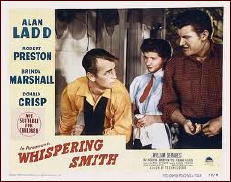
WHISPERING SMITH. Paramount Pictures, 1948. Alan Ladd, Robert Preston, Brenda Marshall, Donald Crisp, William Demarest, Fay Holden, Murvyn Vye, Frank Faylen, John Eldredge. Based on the novel by Frank H. Spearman. Director: Leslie Fenton.

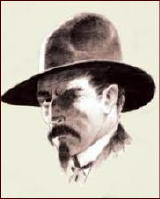
   You can learn a lot by writing reviews, or at least I do. For example, I never knew there was a real “Whispering” Smith, and that he really was a railroad detective, among other occupations. You can read about some of his exploits online here at the Legends of America website.

   A writer named Frank Spearman was intrigued by the name and wrote an early western novel about a railroad detective named Whispering Smith in 1906, but his work of fiction and the his facts seemed to brush up against reality only on occasion.

   There also were three early silent films with Whispering Smith as the hero. Quoting from Kevin Burton Smith’s Thrilling Detective website:

WHISPERING SMITH

   â€œThere was a 1916 silent film […] followed by another silent film in 1926. That in turn was followed by yet another silent flick, Whispering Smith Rides in 1927, inevitably followed in 1935 by Whispering Smith Speaks, his first talkie. Each film wandered a little further from the source material, but the real oddity was 1951’s Whispering Smith Hits London, wherein Smith travels to England and tangles with Scotland Yard …”

WHISPERING SMITH

   There was also a TV series on NBC that starred Audie Murphy in 1961, but it didn’t last long, only half a year. It is easily available on DVD.

   It was Alan Ladd, though, who played Whispering Smith in this movie made in 1948. While Ladd was notorious for being short, he also had the ability to command attention in a crowded room by speaking barely above a whisper. Or at least he did in the movies, and in this one in particular.

   He’s also a railroad detective in this film. His good buddy Murray Sinclair (boisterously played by Robert Preston, who does boisterous very well) is a rancher who works part time for the railroad to clear up train wrecks. When business is bad, he creates his own train wrecks. He has fallen on hard time, however, and in with bad friends.

WHISPERING SMITH

   Murray has also married the girl that Smith had had a wish for, to Smith’s lasting regret, though he will never admit it, to anyone, and to Marian Sinclair’s regret as well (she being portrayed by beauteous Brenda Marshall). It’s this tacit love triangle that lies between these three old friends, as well as Murray’s taste for the good life, one that will (eventually) bring him to a bad end.

   I am not revealing anything I shouldn’t here, not if you’ve watched a few movies and a few of them happen to have been westerns. This was Alan Ladd’s first western, and the first movie he did in color. The stars are fine, the story’s passable, and you should have as much fun watching this one as I did.

WHISPERING SMITH

« Previous PageNext Page »