Reviews


REVIEWED BY STAN BURNS:


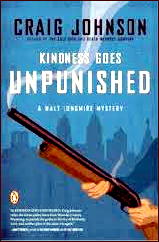
CRAIG JOHNSON – Kindness Goes Unpunished. Viking, hardcover, March 2007. Penguin, softcover, February, 2008.

CRAIG JOHNSON Walt Longmire

   This is the third Wyoming Sheriff Walt Longmire novel. He and his friend Henry Standing Bear are on a trip to Philadelphia. Henry is going because he has been invited to put on an exhibition of family Indian reservation photos at a museum, while Walt is going to visit his daughter Cady, who lives there.

   His daughter thinks she has met “the one” and wants to introduce him to her father. But Walt never gets to see her; he finds that she is hovering in a coma near death in the hospital after being attacked by an unknown male assailant outside the same museum that will host Henry’s photos.

   With the help of Henry, Walt sets out to find the person responsible. He discovers that the boyfriend is more than likely the guilty party; that he was a gambler and drug addict. But the boyfriend is thrown off a bridge to his death before Walt can question him, causing him to wonder if his daughter had discovered something about the boyfriend that would cause him to attack her.

   Walt continues to investigate trying to discover what is really behind the boyfriend’s death. Not as good as the first novel, but the Philadelphia locations feel very real and the writing keeps you turning pages.

Rating:   B.

       The Sheriff Walt Longmire Mysteries —

1. The Cold Dish (2004)

CRAIG JOHNSON Walt Longmire

2. Death Without Company (2006)
3. Kindness Goes Unpunished (2007)
4. Another Man’s Moccasins (2008)
5. The Dark Horse (2009)

CRAIG JOHNSON Walt Longmire

6. Junkyard Dogs (2010)
7. Hell Is Empty (2011)

REVIEWED BY WALTER ALBERT:         


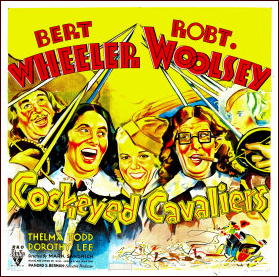
COCKEYED CAVALIERS

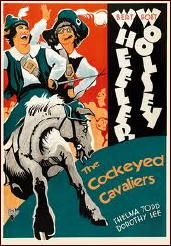
COCKEYED CAVALIERS. RKO, 1934. Bert Wheeler, Robert Woolsey, Thelma Todd, Dorothy Lee, Noah Beery Sr., Robert Greig, Henry Sedley, Billy Gilbert, Franklin Pangborn, Alfred James, Jack Norton, Snub Pollard. Director: Mark Sandrich. Shown at Cinevent 40, Columbus OH, May 2008.

   Wheeler and Woolsey were a very popular comedy team in the 1930s, turning out some 19 comedies for RKO from 1929-1937, with the team’s career cut short by a serious illness that forced Woolsey’s retirement.

   Jim Goodrich was a great fan of the pair, but I’ve never been able to sit through all of one of their features. However, encouraged by the favorable write-up in the program-notes, I agreed to make another stab at appreciating their work.

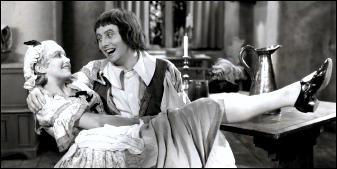
   I am happy to report that Cockeyed Cavaliers, in which the boys, decked out in period garb but losing none of their contemporary edge, play con men who are taken to be the king’s physicians, dispatched to cure the ills of the Baron (Noah Beery), is a delightful musical, with director Mark Sandrich also responsible for several of the Astaire-Rogers musicals.

COCKEYED CAVALIERS

   His sure touch keeps the film consistently afloat, aided and abetted by a talented cast headed by gorgeous Thelma Todd and lovely and delightful Dorothy Lee, with veteran film villain Noah Beery blustering through his role as Todd’s lecherous husband and displaying an impressive bass in a couple of the songs.

   The score may not be memorable, but it’s melodious, and if I hadn’t seen parts of a number of Wheeler and Woolsey comedies that I didn’t care for, I would have been convinced that the team was very much to my liking, with their other films worth tracking down.

COCKEYED CAVALIERS

REVIEWED BY DAN STUMPF:         


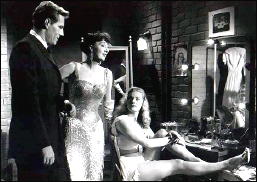
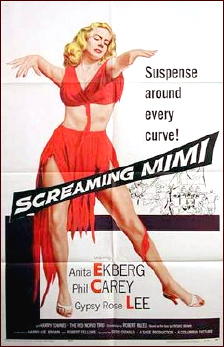
THE SCREAMING MIMI. Columbia, 1958. Anita Ekberg, Philip Carey, Gypsy Rose Lee, Harry Townes, Linda Cherney, Romney Brent, Red Norvo (and Trio). Based on the novel by Fredric Brown. Director: Gerd Oswald.

FREDRIC BROWN Screaming Mimi

   The Screaming Mimi offers some kicking-and-kinky direction from Gerd Oswald, a cult director in the Jim Jones tradition, which is to say he showed a lot of potential in low-budget westerns and thrillers, and managed one classic, A Kiss Before Dying (1956) before drinking the kool-ade of network television.

   Mimi belongs to his Promising period, with a pleasingly straightforward (for the 50s) approach to homosexuality, bondage, obsession and amour fou, but it’s undone by a screenplay that seems way too limp for a movie about serial killings.

   There’s never a sense of momentum here, no feeling of progressing towards some resolution. Instead, events just seem to come along and happen in no particular order, then head off in any direction whatever, just sort of strutting and fretting across the screen till their allotted hour-or-so is over at last. A pity, because there are glimmers here and there of what could have been a perverse classic.

FREDRIC BROWN Screaming Mimi


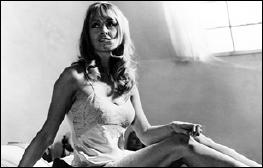
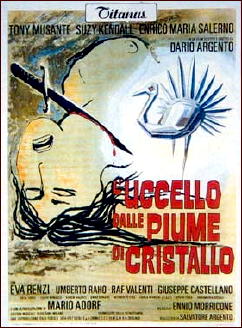
THE BIRD WITH THE CRYSTAL PLUMAGE. Central Cinema Company, Italy, 1970. Original title: L’uccello dalle piume di cristallo. Tony Musante. Suzy Kendall, Enrico Maria Salerno, Eva Renzi, Umberto Raho, Raf Valenti. Based on the novel The Screaming Mimi by Fredric Brown (uncredited). Director: Dario Argento.

   The Bird with the Crystal Plumage (Italy, 1970) on the other hand, is a certified wowser. The directorial debut of Dario Argento, who became something of a Name in Horror films, this is a garish, fast-moving, humorous movie about serial slashing, stalking, knifing and general mayhem set against colorful locations, played and/or dubbed by a cast a cut (sorry!) above the usual run of Italian imports.

FREDRIC BROWN Screaming Mimi

   Fredric Brown got no screen credit for this film, and for years critics who knew nothing about Pulp averred that it was based on an Edgar Wallace story, but I defy anyone out there to show me an Edgar Wallace book with this plot. In fact, I’ll wrestle anyone in the crowd who thinks he can do it. No takers? I thought not.

   Anyway, getting back to the story, this follows Brown’s novel pretty closely, right down to the minor characters and bits of by-play. Argento tossed away the thematic framework of Brown’s novel, and he turned the hard-drinking loner of the book into a young married couple, but that’s a fate that befell many of us in the 70s.

   The fact is, this is a fairly faithful translation of The Screaming Mimi into film, and if not all it could have been. (The real meaning of the book isn’t revealed until the last page, and it’s truly harrowing.) It’s at least a fun ride.

FREDRIC BROWN Screaming Mimi

THE BACKWARD REVIEWER
William F. Deeck


BERNARD THIELEN – A Charm of Finches. Mystery House, hardcover, 1959.

   One of my many biases deals with books that the publisher requires the full front and back flaps to describe. Generally these novels should be shunned. Those who would snickeringly point out the generous length of my reviews and mutter about pots and kettles also should be avoided.

   My reason for reading this novel was the presence of an ornithologist as the principal character. There is a paucity of these, I believe, though Ann Cleeves is currently filling the gap.

   At the Latham Wilderness in Vermont, Joe Coogan, ex-Navy fighter pilot and Ph.D., is recovering from a disappointment in love, attending the Science Brotherhood Experiment there, and planning to do a breeding count of birds. When his former fiancee is kidnapped, along with her new boyfriend, a chap who has been investigating Soviet espionage, the Navy re-enlists Coogan and forces him to find out what the Soviets may be up to in the Wilderness.

   Spy novels seldom appeal to me — I except Ritchie Perry and Anthony Price, of course — but Coogan is a refreshing and not too competent spy catcher. It helps that the spies also verge on the incompetent.

   Interesting information about ornithology and rock climbing adds to the novel’s appeal.

— From The MYSTERY FANcier, Vol. 12, No. 3, Summer 1990.


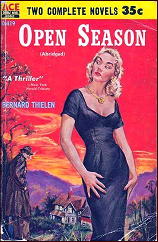
Editorial Comments:   Bernard Thielen wrote one earlier mystery included in Allen Hubin’s Revised Crime Fiction IV, that being Open Season (Mystery House, 1958), later reprinted by the Detective Book Club and in paperback as half an Ace Double D-419 (pictured below). Although it is also a spy thriller taking place in New England, Coogan is not the leading character.

BERNARD THIELEN A Charm of Finches

   For a list of other collective nouns for birds, this page on Wikipedia should do. A “charm” of finches was new to me.

FRIENDS OF MR. SWEENEY

FRIENDS OF MR. SWEENEY. Warner Brothers, 1934. Charlie Ruggles, Ann Dvorak, Eugene Pallette, Robert Barrat, Berton Churchill, Dorothy Burgess, Dorothy Tree, Harry Tyler. Based on a novel by Elmer Davis. Director: Edward Ludwig.

   Charlie Ruggles is the true star of this one, even though Friends of Mr. Sweeney was recently shown as part of a day-long salute on TCM to Ann Dvorak (pronounced with a silent D). As an editorial writer, over the years, he’s become hidebound and downtrodden, and totally subservient to his boss at the weekly magazine where he plies his trade, even to the point where he’s resigned to composing a favorable piece on a politician he knows is crooked.

FRIENDS OF MR. SWEENEY

   As his trusty assistant, Ann Dvorak can only look on sadly, and with unrequited fondness (which she obvious wishes could be more). Enter Eugene Pallette, Charlie’s old buddy at college, where they were on the football team together, and a couple of more high-spirited and fun-loving buddies you would be hard-pressed to find.

   Maybe you can take it from here. First a badly interrupted dinner date with his secretary, then out on the town as a foursome, posing as a friend of a fictitious Mr. Sweeney to enter one of the poshiest casinos in town, where all hilarity breaks out, then back to office while the building is being robbed (all part of the story line).

FRIENDS OF MR. SWEENEY

   The fussy Charlie Ruggles I always find amusing, especially in situations where he finds himself enjoying becoming a wildcat again. I often need only a small dose of Eugene Pallette to get me through the week, however, and unfortunately this is more than a small dose. (No offense intended.)

   Ann Dvorak, only 22 when this movie was made, was destined to have a career consisting only small parts or larger roles in minor movies like this one, but like this one, her beauty and engaging personality wins me over every time. (One scene is which she is wearing nothing but lingerie is rather revealing for a movie made with the Code in effect.)

Note:   You can see what I mean by that last parenthetical statement — as well as everything else I’ve said — by checking out the original trailer that’s available on the TCM website.

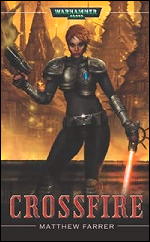
MATTHEW FARRER – Crossfire. Black Library /Games Workshop Ltd., paperback original; 1st US printing, July 2003. A book in the “Warhammer 40,000” series.

   I confess that I haven’t read any of the other Warhammer books, but the series consists of a long list of novels taking place in a universe set far in a future ruled by the Emperor’s Imperial Guard, the “ever-vigilant Inquisition” and the “tech-priests of the Adeptus Mechanicus.” Lots of bloody warfare, I gather, with “no peace amongst the stars, only an eternity of carnage and slaughter, and the laughter of thirsting gods.”

Shira Calpurnia

   Maybe it’s a video game, too, or a role-playing game, or maybe I have it all wrong. In any case, if you haven’t already skipped this review and gone on to the next one, the small incident on an isolated planetary system that this novel is about has both a crime, or a series of crimes, and an active detective whose career seems to be only beginning. Really. Stay with me, and I’ll tell you what I mean.

   What caught my eye first was the cover. A punkish young lady with reddish, short cropped hair, dressed mostly in shiny black – either leather or metal, or a combination thereof – holding a light saber of some sort in one hand and a huge pistol-looking affair in the other.

   Her name is Shira Calpurnia, and she is the newly arrived Arbites officer on the planet Hydraphur. From the first sentence on, we know, hey Jenny, we’re not in Kansas any more, when she meets Genator-Magos Cynez Sanja, of the Order Biologis:

   The machine cultists of the Adeptus Mechanicus are not prone to strong emotions – the beautiful coldness of the Machine is held up as a model for admiration and emulation, even for those orders of the Mechanicus not directly concerned with physical mechanics and the gradual transfiguration of their own bodies into cybernetics.

   An attempt to assassinate Shira is made soon thereafter, and hunting down the miscreants responsible takes the remainder of the book, which consists of 320 pages of very small print, and baroque prose nearly always as dense as the short extract above.

   Or as below, taken from page 51:
Shira Calpurnia

   The Augustaeum, nestled within its walls at the peak of the Bosporian hive, was not flat – its sides kept sloping up to the High Mesé, the avenue that ran along the hive’s very peak. The formation of Arbites making their way through the steep, tangled streets of the Artisans Quarter were already high enough up to be able to look over the Augustaeum wall and down at the upper floors of the towers on the lower slopes of the hive. Above them on the left the Cathedral of the Emperor Ascendant speared the coppery Hydraphur sky. Its spire was twenty minutes’ walk away and already Calpurnia had to crane her head up to look at it; they were getting close enough for her to be able to see the great statues of the Imperial saints that formed the columns for its upper tiers. Each statue was fifty metres high and carved from pure white marble that shone like gold in the thick butter-yellow Hydaphur sunlight.

   Words fail me. I could not write like that in a million years.

   I’ll skip all of the action, all of interesting if not fascinating, all of it filled with a sense of wonder that I haven’t felt as strongly as this since I was about 12 years old. Not that I understood it all. Maybe you have to be, um, 12 years old. But the ending I understood, and you will, too:
Shira Calpurnia

   One day, she promised herself, she would sit down with Keta, or Athian Tymon-Per; or whichever of them she thought she could persuade to listen, and try to make them see. She would read them the maxims she had learned on Ultramar, get out her old children’s primers, if she had to. She would talk to them about her duty, about Law and honour. That the Law could be cold and the Law could be cruel, but the Law was their guard and guide and peacekeeper and protector. She would try to talk to them about doing what was right.

   She may not look the part, but Sam Spade, Philip Marlowe and all of other virtuous gumshoes who have toiled and labored in the mean streets the world over have a worthy descendant in Shira Calpurnia, destined (I believe) to continue on with other adventures.

— November 2003.

Shira Calpurnia

UPDATE [June 2006].   I was correct. Shira Calpurnia has indeed appeared in a follow-up entry, and a third one that will be showing up soon looks extremely interesting:

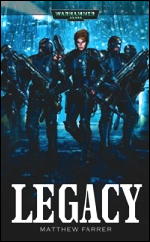
   Legacy. Black Library, pb, US, August 2004. Shira takes more of a background role in this one, more of a novel of political intrigue than a mystery novel (from what I can deduce from a rather meagre description).

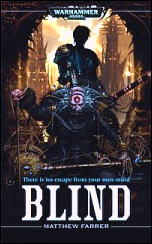
   Blind. Black Library, pb, US, July 2006. A telepath is killed with no weapon found nearby. Said to be a locked room mystery. It sounds like a must-have to me.

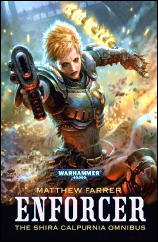
[UPDATE #2] 08-16-11.   These three are all there are in the series, so far. Enforcer, released in 2010, is an omnibus collection of all three.
.
A TV Review by MIKE TOONEY:


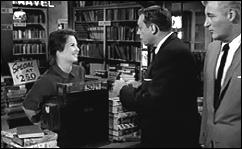
“The Case of the Bogus Books.” An episode of Perry Mason (Season 6, Episode 1). First air date: 27 September 1962. Cast: Raymond Burr, Barbara Hale, William Hopper, William Talman, Ray Collins, Wesley Lau, Phyllis Love (the accused), Adam West, John Abbott, H. M. Wynant, Joby Baker, Allison Hayes, Woodrow Parfrey, Maurice Manson, Tenen Holtz, Kenneth MacDonald (the judge), Michael Fox (not to be confused with Michael J. Fox). Writer: Jonathan Latimer. Director: Arthur Marks.

PERRY MASON Bogus Books

   Locked-room puzzles rarely turn up on TV, and the Perry Mason series of 271 episodes had very few. In this case, however, a bookshop owner, Joseph Kraft [Maurice Manson], is found dead in a sealed basement room, with a lamp still burning and the radio still on but the gas heater off, and a handful of dead flies on the window sill.

   Perry’s client, Ellen Corby [Phyllis Love] had been fired earlier by the dead man after a rare book went missing. Although she was sure the book was marked at $8, Kraft claimed that it was valued at $7000.

   The death, however, looks like suicide, and the police initially view it as such. But Perry Mason suspects murder. Unfortunately, every circumstantial clue will point to his client — as they always do.

   The locked-room problem, which isn’t the main focus of this episode, is partially cleared up in about ten minutes. I say “partially” because Mason will later perform a courtroom demonstration with flies that will change everyone’s mind, not about the CAUSE of death but the TIME of death, thereby exonerating his client and a multitude of likely suspects and narrowing it down, employing the classic Golden Age Detection trope of the TIME TABLE, to just one person — the murderer.

   This one had a fine cast of TV’s best character actors from the ’50s and ’60s: handsome Adam West (Batman); reliable H. M. Wynant; beautiful but evil Allison Hayes (Attack of the 50-Foot Woman); ubiquitous Maurice Manson; intellectual John Abbott; shifty Woodrow Parfrey (whom my wife calls “Woodrow the Weasel”); and durable Kenneth MacDonald as the judge, in one of his 32 appearances as the magistrate in the Perry Mason series.

Note:   The rare book at the heart of this story is a first edition of The Life and Opinions of Tristram Shandy, Gentleman, by Laurence Sterne, published in nine different volumes from 1759 to 1767. If you’d like to know what the rare books’ prices mentioned in this episode would be in today’s dollars, multiply them by 10 or 11 times.

   I couldn’t locate “The Case of the Bogus Books” online. Perhaps someone else will have better luck.

REVIEWED BY MICHAEL SHONK:


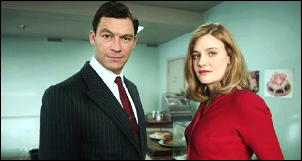
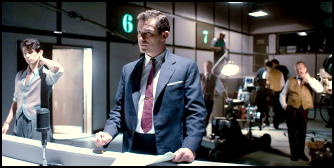
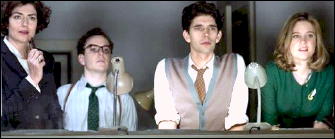
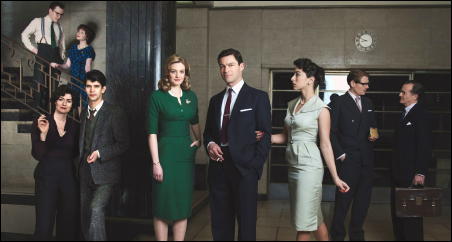
THE HOUR: Episode One. BBC 2 Production. Six part series, 19 July through 23 August 2011. Created and Written by Abi Morgan. Directed by Coky Giedraye. Produced by Ruth Kenley-Letts. Cast: Ben Whishaw as Freddie Lyon, Romola Garai as Bel Rowley, Dominic West as Hector Madden, Vanessa Kirby as Ruth Elias, Anna Chancellor as Lix Storm.

THE HOUR - BBC 2

   Available on BBCA starting August 17, 2011, as part of the hour-long block called “Dramaville,” hosted by Idris Elba (Luther). The Hour is also available for download at the usual places. Episode one is available now, for free.

   It is June 1956. The government has a tight stranglehold on the press, but it is the time of the Cold War and events are about to explode.

   A frustrated Freddie Lyons works in the BBC newsreel division where his desire to do “real” news is constantly suppressed. He has a habit of making everyone uncomfortable with his obnoxious behavior, as well as his ability to find news that makes those in power very nervous.

   There are plans to develop a new BBC TV news magazine called “The Hour.” Freddie feels betrayed when the position he wanted of Producer goes to his best friend Bel. He is shocked, after all she is just a woman.

THE HOUR - BBC 2

   Despite the constant sniping and meanness between Freddie and Bel, she fights to get the jerk a job with the new news magazine. Of course, as with any such relationship, everyone but Freddie and Bel realize the two are meant for each other.

   As the development of “The Hour” continues and we meet each of the characters, a childhood friend of Freddie’s contacts him. Ruth tells Freddie there is more to the death of a college Professor, who was her secret lover. She warns him about “Them,” that England is no longer a “democracy,” and how she would be killed if “they” knew she had talked to a powerless employee of the BBC.

   The production values, the costumes, music, lighting, sets and locations, are of the high quality one has come to expect from British television. The direction was serviceable, but nothing could have saved this episode from the script, a script that was predictable and drowning in cliches.

THE HOUR - BBC 2

   The cast tried their best to overcome their one dimensional characters:

   Freddie, the he is so brilliant we can not survive without him hero. Bel, the woman determined to succeed in a man’s world and fears any personal commitment so she sleeps with married men. Hector, the handsome married anchorman who is attracted to Bel. Liz Storm, the veteran reporter who drinks too much and is there to share old stories and wise advice. The interchangeable white men in power.

   The script dooms any possible attempt to make the story interesting. The pace is slow to build suspense, but there is little suspense because we have no reason to care about any of these characters. The script is full of twists and clues that creak with age and overuse, such as the camera intercutting between Ruth dancing with her fiance and the killing of her lover, the references to crossword puzzles, and the ending of this episode that will surprise no one.

   Add annoying bits such as Freddie calling Bel, “Miss Moneypenny” and the heavy handed handling of the era’s sexism and racism, and any hope for future episodes is nearly crushed.

      THE HOUR - BBC 2

NIGHT OF THE QUARTER MOON

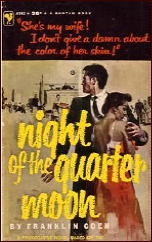
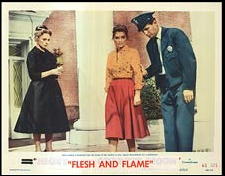
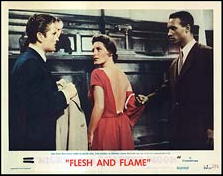
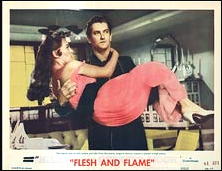
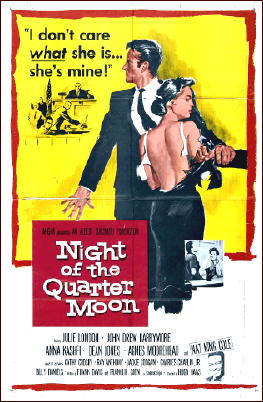
NIGHT OF THE QUARTER MOON. MGM, 1959. Also released as Flesh and Flame. Julie London, John Drew Barrymore, Anna Kashfi, Dean Jones, Agnes Moorehead, Nat “King” Cole, James Edwards, Cathy Crosby. Paperback adaption by Franklin Coen (Bantam, 1959). Producer: Albert Zugsmith. Director: Hugo Haas.

   If nobody has ever written a full-length analysis of Hugo Haas’s directorial output, then someone should. He’s known, of course, by a small cult of followers and true believers for such films (lurid dramas) as Pickup (1951), The Girl on the Bridge (1951), Strange Fascination (1952), One Girl’s Confession (1952) and Bait (1954), all variations on a theme.

NIGHT OF THE QUARTER MOON

   That theme being that of middle-aged men or older (often played by Haas himself) being lured into relationships (sexual, of course) with blonde tramps (well-built, of course, and usually played by Cleo Moore), with deadly results.

   This, you may be sure, is the stuff that cults are made of, but even with limited budgets, the films (in my humble opinion) were made with some thought behind them, down to earth, and generally better than better critics than I have considered them to be.

NIGHT OF THE QUARTER MOON

   What could Haas have done with a major studio (MGM) and major money behind him? Well, first of all (deep breath here) Night of the Quarter Moon is not a major disaster, and while it has its faults – quite a few, in fact – there’s enough story line here to provide more than one PhD candidate with a considerable amount of material for more than one dissertation.

   When John Drew Barrymore (a former Korean Conflict prisoner-of war) meets Julie London in Mexico, he doesn’t care that she’s one quarter black (Portuguese-Angolan), but his rich mother (the imperious Agnes Moorehead) back in San Francisco does, when she finds out.

   And equally so do his neighbors, who fear their property values are going to plummet, and who don’t fail to let the newly married couple know about it after they move in.

NIGHT OF THE QUARTER MOON

   Mama, in fact, takes the case to court to get the marriage annulled, while keeping her son under sedation and incommunicado, her contention being that he wasn’t told of his bride’s unfortunate background before the wedding.

   Which leads inexorably to the most overblown (and provocative) portion of the film, an ending that by sheer audacity surely made audiences gasp at the time, and is still very effective now: Julie London’s character must strip in court to show her tan lines, or lack of them.

NIGHT OF THE QUARTER MOON

   Well, OK, but in the context of the movie, it makes sense.

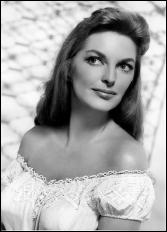
   Julie London, who resembles nothing more than a less full-blown Jane Russell, but not much less, does very well as lady in the case, determined not to let her husband get away from her, and for the right reasons; and John Drew Barrymore, confused by his arrest and subsequent sedation, more than holds his own.

   They make a good couple, mixed-race or not, and if nothing else, the movie might be remembered as a solid romance movie, even without strictly exploitative and over-the-top theatrics Hugo Haas uses to describe the situation they find themselves in, to put it mildly.

NIGHT OF THE QUARTER MOON

REVIEWED BY DAN STUMPF:         


FREDRIC BROWN – Night of the Jabberwock. E. P. Dutton, hardcover, 1950. Paperback editions include: Bantam #990, April 1952; Morrow-Quill, 1984. British edition: T. V. Boardman, hc, 1951.

FREDRIC BROWN Night of the Jabberwock

Based on two pulp stories: “The Gibbering Night” (Detective Tales, July 1944) and “The Jabberwock Murders” (Thrilling Mystery, Summer 1944).

   I recently took a couple days to re-read the greatest book ever written in the English Language, Fredric Brown’s Night of the Jabberwock, which can’t be beat in terms of structure, action, characterization, or much of anything else for that matter.

   The tale is of a night in the life of “Doc” Stoeger, middle-aged editor of a small-town weekly newspaper — the kind of publication now put out by a syndicate if it exists at all, in a town that nowadays has become a suburb or a fiefdom of Wal-Mart.

   But back in 1950, the small town and its paper were vibrant, charming bits of Americana, just like Brown’s novel, which starts off with Doc putting his sleepy little paper to bed, sadly looking at the front-page news of a church rummage sale and wishing he could somehow just once break a major story.

FREDRIC BROWN Night of the Jabberwock

   What follows is a night of wonderland-style adventures and reverses, as a mysterious visitor initiates him into The Vorpal Blades, a select club devoted to serious study of Lewis Carroll, major stories fly into his lap like scattered playing cards, he becomes a small-town hero, a hunted fugitive, kidnap victim and kidnapper himself.

   All this is tossed off with the deceptively easy style only Fredric Brown could do so well. And speaking of Tossed Off, someone should go through this book with a calculator and see how much Doc drinks during the course of an evening; every chapter is punctuated by him having two or three drinks, then sobering up, then drinking again, drinking more, sobering… at some point it gets a bit ridiculous, but somehow the humor only adds to the charm of this witty and elegant adventure through a looking-glass.

FREDRIC BROWN Night of the Jabberwock

   By the way, this sent me back to re-reading Alice in Wonderland and Through the Looking Glass, books I hadn’t seen since childhood. And I have to say their charm was sadly lost on me.

   There’s some excellent doggerel there, perhaps up to the level of Edward Lear, but in their hurry to get from one scene to another, the stories never seem to get anyplace; colorful characters never do anything interesting, and conversations all consist merely of people contradicting Alice.

   Or am I missing something?

« Previous PageNext Page »