Reviews


REVIEWED BY WALTER ALBERT:         


THE SMILING GHOST

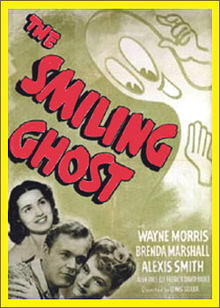
THE SMILING GHOST. Warner Brothers, 1941. Wayne Morris, Brenda Marshall, Alexis Smith, Alan Hale, Lee Patrick, David Bruce, Helen Westley, Willie Best. Screenplay by Kenneth Garnet and Stuart Palmer, based on a story by Stuart Palmer. Director: Lewis Seiler.

   I saw this spooky comic mystery on its initial release, when I was still in short pants, and for years the image of the Ghost, glowing eerily in the dark, haunted my dreams. A recent screening by Turner didn’t, perhaps, chill me in the way the original release did, but it’s still an engaging Old House mystery, with the requisite dose of sliding panels and screams in the night.

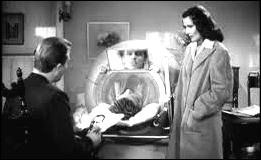
   When out-of-work Alexander “Lucky” Dowling (Wayne Morris), besieged by debt collectors, is hired to play the role of the fiancé of heiress Elinor Bentley (Alexis Smith) for a month, he accepts the job without realizing previous suitors have been severely injured in a suspicious car crash and poisoned by the bite of a venomous snake.
THE SMILING GHOST

   Accompanied by his valet Clarence (Willie Best), Lucky moves into the Bentley house (it’s a bit too small to be called a mansion) where very quickly an attempt is made on his life and he realizes the job is a potentially lethal one.

   Lucky is slower on the uptake than Clarence but he quickly buys into the fiction that Elinor truly loves him, a fiction that is eventually dispelled by the more clear-headed perspective of reporter Lil Barstow (Brenda Marshall), but not before his devotion is put to the ultimate test, which could be either marriage to the predatory Elinor or murder at the hands of the Ghost.
THE SMILING GHOST

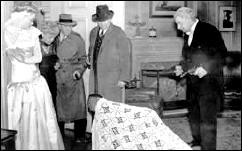
   The household is crowded with members of the Bentley clan, headed by matriarch Helen Westley, with Charles Hulton giving an indelible portrait of a professor whose hobby is not only collecting shrunken heads but actually producing them in his laboratory. Alan Hale bumbles around as a general factotum and security detail, and Lee Patrick sizes up the situation with her usual wry humor.

   Willie Best, in these supposedly enlightened times, gives probably the most controversial performance, with the most offensive (and, dare I say it, funniest) moment taking place when he conceals himself in a coal bin in the basement.

   This is probably not quite in the league of Paramount’s Old House classics, The Cat and the Canary and The Ghost Breakers, but it kept breaking me up and occasionally produced a hint of the chills that captivated me at a long-ago Saturday matinee. And noting the name of a noted concoctor of comic mysteries as a co-author of the script, I suspect that he’s responsible for the more delightful comic notes in the screenplay.
THE SMILING GHOST

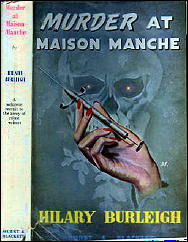
HILARY BURLEIGH – Murder at Maison Manche. Hurst & Blackett Ltd., UK, hardcover; date not stated but known to be 1948.

   Another one-shot detective novel from an all-but-unknown author today, but not a book, in my opinion, that’s nearly as successful as David Burnham’s Last Act in Bermuda [reviewed here ]. To begin with, to set the scene, so to speak, let me quote from early on in the affair, from page 13:

HILARY BURLEIGH - Murder at Maison Manche

   The salon at Pierre Manche’s was never crowded. His clientèle was too carefully chosen for that. One could say with truth that it was chosen, for in these days the distinction of being dressed by Mache is so eagerly sought that it is more often the case of Manche choosing whom he would dress than of Manche seeking clients. To have admission to his dress parades was a distinction. Tickets took the form of invitations to an exclusive function, and men and women came as guests to that beautiful room, where they were personally welcomed by the little fat man at the head of the stairs and regaled with cocktails or sherry of undoubted vintage, as a prelude to the display of fashion.

   So all right, then. Both of the ingredients for a successful Golden Age Mystery are present, as touched upon in my comments on the Burnham book. Essential ingredient number one: A house (or even better, a manor) full of glitzy people, or an exclusive business establishment of some sort, or some other meeting place of the rich and famous.

   Essential setting ingredient number two: When Gleba, Mache’s most beautiful mannequin (model) is found murdered immediately after a showing of a wedding dress (page 18) there has been only limited access to the salon and the dressing rooms behind. Only the people on the premises can be presumed to have been the killer.

   One difference between this book and the Burnham’s is how early on the victim’s death occurs. Here it seems almost too soon, only eighteen pages in, and there has been no time to know anything about the girl, except that she wears clothes well. Thus there has been no time for the reader to react properly and have any feeling about such minor matters such as rationale, reason and motive.

   In Murder at Maison Manche, matters like these are left to be revealed only gradually, but the major one (as far as I will reveal it to you) is that the wedding dress Gleba had been wearing just before she was killed was that of a woman in the audience with whose fiancé she (Gleba) recently had had an affair.

   The detective from Scotland Yard who is quickly called to scene is Chief Inspector Tellit. He is described in detail on page 74 as a thick-set man dressed in well-cut and utterly uninspired clothes, ugly hands, far from good-looking but with an often kindly look in his deep blue eyes. In general, however, “he was considered a hard man” as far as crime and criminals are concerned.

   This is far from his first brush with a mysterious death, you may also be interested in knowing, since on page 48, his assistant, Det. Sgt. Fry feels “content that he was once again with Tellit on a murder case.”

   Tellit is a man for keeping track of details, gathering together scraps of information and putting them together like pieces of a jigsaw, as we are told on page 101. Every so often the author (in the guise of Inspector Tellit) feels the need for a recap and a provisional summing up, a device that seems worn-out today, but it is one which this reader, at least, almost always finds welcome.

   If this is not as gripping a detective yarn as David Burnham’s one was, it is for two reasons, the first being the huge amount of coincidence that is involved to put all of the actors on the scene at precisely the right moment, with the right means (a mysterious snake venom manufactured only in one lab in South America), the right motive and the right opportunity.

   Secondly the pacing is oddly off. In particular, the book also seems to “end” at page 180, with 27 more pages to go, and another character, previously relegated to the background is needed to emerge to set up the “real” solution. One more coincidence, and usually for a suspension of disbelief, all that an author is usually allowed is one, or no more than two.

   The right ingredients are present, in other words, but they get themselves muddled up a bit at the hands of an author whom I will call an amateur – without knowing anything else about her – in the finest sense of the word.

— February 2006.

IT IS PURELY MY OPINION
Reviews by L. J. Roberts


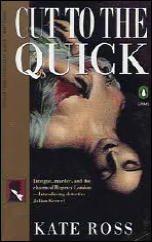
KATE ROSS – Cut to the Quick. Viking, hardcover, 1993. Penguin, paperback, 1994.

Genre:   Historical mystery. Leading character:  Julian Kestrel (1st in series). Setting:   England/Regency era, 1824.

KATE ROSS Julian Kestrel

First Sentence:   Mark Craddock paced slowly, deliberately, back and forth behind the desk in his study.

   After Regency dandy and detective Julian Kestral rescues young Hugh Fontclair from embarrassment at a gambling hall, he is, in turn, asked to serve as best man for Hugh’s forced marriage to Maud Craddock.

    Kestral, along with his man Dipper, travels to the Fontclair country home for a weekend with both families. The last thing he expected was to find the body of an unknown murdered woman in his bed or having to provide Dipper innocent of the act.

    For those of us who love period mysteries, Ross is one of the best. She captures the period with exquisite detail from dress, manners, speech. Her characters are wonderfully drawn portraying all levels of society.

    Kestrel is the character at center stage. He is the personification of the Regency dandy, exhibiting droll cynicism and detachment. Upon meeting Hugh’s young sisters, he comments:   “I rather like making friends with women before they’re old enough to be dangerous.”

    However, under the veneer is a consideration for others, an admiration for goodness, awareness of people’s natures and a determination for justice. Although there are quite a number of characters in the story, each is so well drawn as never become confused.

    The plot is very strong. It’s not a locked-room mystery as the key is on the hall table. It is very much a case of who is the victim, how did she get there and what was her relationship to the people in the house. It’s a step-by-step investigation with plenty of twists and turns along the way. Best of all, I certainly did not predict the killer.

    While sadly, Kate Ross only published four books before her death in 1998, this, as are all of her books, is very well worth reading, and reading again.

Rating:   Very Good Plus.

    The Julian Kestrel series —

Cut to the Quick (1993)
A Broken Vessel (1994)

KATE ROSS Julian Kestrel

Whom the Gods Love (1995)
The Devil in Music (1997)

KATE ROSS Julian Kestrel

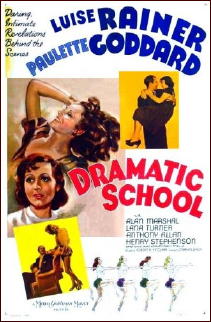
DRAMATIC SCHOOL Luise Rainer

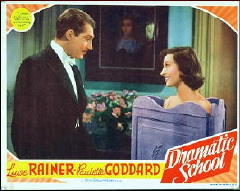
DRAMATIC SCHOOL. MGM, 1938. Luise Rainer, Paulette Goddard, Alan Marshal, Lana Turner, Genevieve Tobin, John Hubbard, Henry Stephenson, Gale Sondergaard, Erik Rhodes, Virginia Grey, Ann Rutherford, Hans Conried. Director: Robert B. Sinclair.

   A lengthy as the credits list is above, the cast is in fact much larger than this. If this makes sense, and I hope it does, Dramatic School is an A-production with B-picture sensibilities, with lots of young players in the cast whose names were not yet known at the time. A big budget movie, relatively speaking, in other words, without a lot of pretense or hype.

DRAMATIC SCHOOL Luise Rainer

   And I thoroughly enjoyed it. One reason is the presence of Luise Rainer in this film, even though it was shown on TCM last week during all-day salute to the second-in-command, Paulette Goddard. Luise Rainer had a short but sweet career in Hollywood, but with two Oscar wins in only two tries, there can’t be many other actors or actresses who can beat that.

   The two Oscar winners? The Great Ziegfeld (1936) and The Good Earth (1937). After making Dramatic School, Luise Rainer appeared in one movie in 1943, then nothing till 1949 and the TV era. Why? Run-ins with studio bosses, marrying, and not much caring about life and a career in Hollywood.

   She’s a joy to watch in Dramatic School, however, as she plays an aspiring star of the French theatre in truly romantic fashion: her eyes to the sky and not always watching where her feet are leading her.

DRAMATIC SCHOOL Luise Rainer

   By night, a worker in a assembly plant making gas meters (I believe), by day a young student in a Parisian dramatic school, where the fanciful tales she tells about herself are the subject of doubt and at times near-derision by the other students.

   Even one of her teachers (Gale Sondergaard) has taken a dislike to her, in spite of her talent. An obvious case of jealousy — one of several cases of cliché-like moments in Dramatic School, but like this one, they’re always skirted but never quite fallen into. (Well, most of them.)

   Sometimes dreams do come true, and once in a while they (miraculously) do come true for Mme. Louise Mauban. And (as twists in the plot begin to unfold) when they don’t, when she takes a tumble, well, watch and see. Unless you’re deeply cynical about stories like this one – and to tell you the truth, I can see why – you will be as enchanted as I.

DRAMATIC SCHOOL Luise Rainer

A REVIEW BY RAY O’LEARY:
   

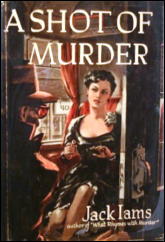
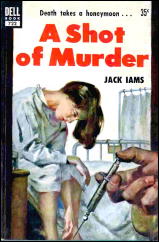
JACK IAMS – A Shot of Murder. William Morrow, hardcover, 1950. Dell #722, paperback, 1953.

JACK IAMS

   When a young American woman, Nita Romaine — a night club singer — disappears in Eastern Europe, recently married reporter “Rocky” Rockwell of the Riverside, Ohio Record manages to talk his editor into sending him and his bride to Europe in order to look for her — the missing woman’s fiancé being a local man.

   It isn’t long before Rocky realizes that someone doesn’t want him to be successful. A man mistaken for him is thrown over the side of the ocean liner transporting them, and efforts are made in Paris to get him entangled with the French police.

   Rocky is helped in Paris by Mrs. Pickett, the paper’s society columnist but is forced to go to Poland alone (though an attractive French woman with reasons of her own for going to Poland attaches herself to him) and continue his search.

   From reading the dust jacket, I gather that this was the third book in a series in which Mrs. Pickett was the lead character. Mrs. Pickett is something of a Rosalind Russell type. In this book, however, Rocky is definitely the major character.

   If I were to compare this with another series I would say it was entertaining in the same way that Manning Coles’ Tommy Hambledon novels are entertaining. Lightweight fluff, that is, a pleasant read, but about as realistic as a three dollar bill.

   One wonders how big a city Riverside, Ohio, is and how a local paper can afford to pay to send a reporter and his wife gallivanting through Europe.

— Reprinted from The Hound of Dr. Johnson #9, March 1992.


Bibliography:    [Taken from the Revised Crime Fiction IV, by Allen J. Hubin]

JACK IAMS, 1910-1990.

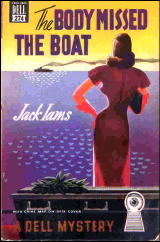
   The Body Missed the Boat (n.) Morrow 1947.

JACK IAMS

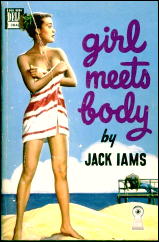
   Girl Meets Body (n.) Morrow 1947.

JACK IAMS

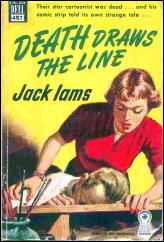
   Death Draws the Line (n.) Morrow 1949.

JACK IAMS

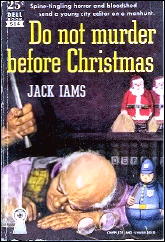
   Do Not Murder Before Christmas (n.) Morrow 1949 [Rocky Rockwell; Amelia Pickett]

JACK IAMS

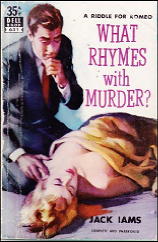
   What Rhymes with Murder? (n.) Morrow 1950 [Rocky Rockwell; Amelia Pickett]

JACK IAMS

   A Shot of Murder (n.) Morrow 1950 [Rocky Rockwell]

JACK IAMS

   Into Thin Air (n.) Morrow 1952.
   A Corpse of the Old School (n.) Gollancz 1955 [Amelia Pickett]

Editorial Comments:   Al seems to have missed Amelia Pickett as a character in A Shot of Murder. Perhaps her role was small, but I’ll still send him a note to make sure he knows. It’s interesting to see that Iams’ last book, another Amelia Pickett novel, was never published here in the US.

REVIEWED BY BARRY GARDNER:


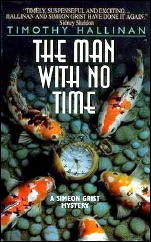
TIMOTHY HALLINAN – The Man with No Time. Simeon Grist #5. Morrow, hardcover, 1993. Avon, paperback, May 1995.

TIMOTHY HALLINAN

   I have enjoyed previous tales of over-educated LA private detective Simeon Grist considerably. I enjoyed this one much less. Much less.

   Grist finds himself in the middle of the LA Asian gang scene, as the twin children if his Asian ladylove are kidnapped; seemingly by an old friend of the family from mainland China, who aided them in escaping from there many years ago.

   It quickly becomes apparent that the old “friend” is being pursued by an LA ganglord, and Grist is quickly up to his neck in gangsters of various Asian persuasions, all suitably villainous.

   This isn’t a poorly written book. It also isn’t a private detective book. It’s a well-done kick-ass type fairy tale of the Parker/Crais variety, though Hallinan isn’t quite in their league as prose stylist. Grist is assisted by a black semi-legal, and six black brothers who are his friends, and by a youthful Vietnamese gang member who he has co-opted; all entertaining characters.

   The storytelling is fine. It’s a bloody action-packed heroes-against-bad-guys tale with in-depth characterization not a major concern. But it isn’t the book I wanted to read, nor one I expected him to write. I’d have bought an “Executioner” if I wanted to read one.

   Pfui. Color me disappointed.

— Reprinted from Ah, Sweet Mysteries #8, July 1993.


      The Simeon Grist series —

1. The Four Last Things (1989)
2. Everything but the Squeal (1990)
3. Skin Deep (1991)

TIMOTHY HALLINAN

4. Incinerator (1992)
5. The Man with No Time (1993)
6. The Bone Polisher (1995)

      The Poke Rafferty series —

1. A Nail Through the Heart (2007)

TIMOTHY HALLINAN

2. The Fourth Watcher (2008)
3. Breathing Water (2009)
4. The Queen of Patpong (2010)

   Poke Rafferty is an ex-pat travel writer and sometime adventurer trying to settle down in Bangkok with his fiancee and their adopted daughter.

REVIEWED BY WALTER ALBERT:         


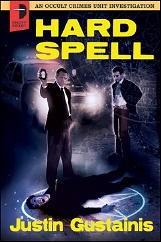
JUSTIN GUSTAINIS – Hard Spell. Angry Robot, US, paperback original, July 2011; UK, ppbk, June 2011.

JUSTIN GUSTAINIS Hard Spell

   Hard Spell, “an Occult Crimes Unit Investigation” novel, and the first in a projected series, is set in Scranton, Pennsylvania. Scranton, like the rest of the country, has been learning to deal with the “supernatural element” for some fifty years in the wake of the infiltration of returning World War II troops from Europe by various supernatural beings.

   It’s not been an easy path and the dream of the day envisioned by Martin Luther King when “naturals and supernaturals” would live together in harmony is not yet realized.

   Detective Stan Markowski is a member of the Scranton “Supe Squad,” housed in the basement of Police Headquarters, and works with his long-time partner, Paul di Napoli, on the night shift (and the implied pun is probably intended).

   When di Napoli is killed by goblins in a negotiated situation that turns sour, he’s replaced by Karl Renfer, a “tall, gangly kid, all elbows and knees,” whose career came under a cloud after his former partner claimed he failed to come to his defense during a confrontation with a voodoo master raising corpses from the dead. Renfer was cleared by a Review Board, but Markowski is still wary of his younger, less experienced partner.

   Both detectives are put to the test by a series of murders related to an ancient book of necromancy, the “Opus Mago,” that will give the possessor the power to awaken one of the Great Ones, powerful entities who predate man and, if they are resurrected, could have the power to supplant him.

   Or, as the irreverent Renfer so colorfully puts it, the “Opus Mago” is a “recipe book for cooking up different kinds of Truly Bad Shit.”

   This alternative history crossover nimbly maneuvers a narrow path through the minefield of the conflicting demands of the police procedural and the apocalyptic horror novel in a promising debut for the fledgling series.

Editorial Comments:   A neat trailer for Hard Spell can be found here on YouTube. Number two in the series, Evil Dark, is on Angry Robot’s schedule for April 2012.

   If this kind of crossover fiction is your kind of thing, here’s an anthology that’s chock full of them: Those Who Fight Monsters: Tales of Occult Detectives, edited by Justin Gustainis (Edge, 2011). I’ll list the contents (and detectives) as the first comment. (Some of these I already knew about, others I didn’t.)

THE BACKWARD REVIEWER
William F. Deeck


ROGER EAST – Murder Rehearsal. Knopf, hardcover, 1934. First published in the UK: Collins, hardcover, 1933.

   When several “accidental” but suspicious deaths occur following the plot of Colin Knowles’s detective novel in progress, and one of those deaths could be advantageous to him in regaining his lost love, is Knowles turning art into reality? But why, then, the additional deaths?

   Superintendent Simmonds of Scotland Yard is called in to investigate the first death and, later, with the help of Knowles’s unfinished novel, makes the connection with the other deaths in a book that combines the thriller and the detective story. If nothing else, this novel gives the reader the chance to re-encounter the greatly cherished delayed revenge motif, despite the necessity to swallow some large coincidences.

   In the Manchester Evening Chronicle, Dr. Watson — frankly, I doubt that this was our Dr. Watson — said East “seems likely to become one of the small band of really first-class detective-story writers.” The promise is here, but it’s only a promise.

— From The MYSTERY FANcier, Vol. 12, No. 3, Summer 1990.


BIBLIOGRAPHY:     [Taken from the Revised Crime Fiction IV, by Allen J. Hubin.]

EAST, ROGER. Pseudonym of Roger Burford, 1904- ; other pseudonym: Simon.

    The Mystery of the Monkey-Gland Cocktail (n.) Putnam 1932.
    Murder Rehearsal (n.) Collins 1933 [Colin Knowles; Supt. Simmonds]
    The Bell Is Answered (n.) Collins 1934.
    Candidate for Lilies (n.) Collins 1934.
    Twenty-Five Sanitary Inspectors (n.) Collins 1935 [Supt. Simmonds]
    Detectives in Gum Boots (n.) Collins 1936 [Colin Knowles]
    The Pearl Choker (n.) Collins 1954.
    Kingston Black (n.) Collins 1960.
    The Pin Men (n.) Hodder 1963.

SIMON. Pseudonym of Roger Burford & Henry Joseph Hasslacher.
    Murder Among Friends (n.) Wishart 1933 [Insp. (Supt.) Deering]
    Death on the Swim (n.) Wishart 1934 [Insp. (Supt.) Deering]
    The Cat with the Moustache (n.) Wishart 1935 [Insp. (Supt.) Deering]

REVIEWED BY DAN STUMPF:         


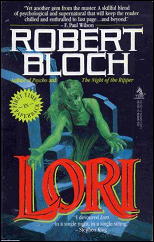
ROBERT BLOCH Lori

ROBERT BLOCH – Lori. Tor, hardcover, 1989; reprint paperback, 1990.

   Speaking of brainless books, I’ve always enjoyed Robert Bloch’s mysteries, despite themselves. Bloch’s idea of detection is to have sundry characters run up to the protagonist and spill everything they know, leaving the detective/reader to decide how much of it is true and if the reasons they gave for spilling it are what they seem.

   Bloch started plotting this way with Spiderweb in 1954 and was still at it thirty-five years later with Lori (1989). Not that Lori is a bad book, exactly. Bloch was always too good a pulpster to write something dull, and his pleasure in his craft is evident throughout, with colorful characters, a corkscrew story, and the light, gruesome prose he did so well.

   What there is of a plot revolves around a young woman, newly-graduated from college and suddenly orphaned, who finds a twenty-year-old college yearbook (carefully hidden from her) with her picture in it.

   Bloch takes this premise and runs amok with it, throwing in well-timed (but otherwise unexplained) murders, nightmares, spiritual possessions, and the usual parade of “helpful” friends who may not be all they seem. He cheats outrageously from time to time, but somehow that didn’t diminish my enjoyment, and when I closed Lori, it was with a smile of satisfaction.


WEB ORIGINALS: SLACKER PI, THE BANNEN WAY
and ANGEL OF DEATH
Reviewed by MICHAEL SHONK


   Web series are stories shot on video or film to premiere on the Internet. Each episode is usually between five to ten minutes long. The story can be in serial form with the series forming one movie like story or as a series of stand alone adventures featuring a cast of the same characters.

   The form has attracted the attention of big name talent such as Lisa Kudrow (Web Therapy) and Felica Day (The Guild), cable networks such as IFC and Cartoon Network’s Adult Swim, and studios such as Fox and Sony. Web series have made it to cable TV, released as movies, and released on DVD.

SLACKER PI

SLACKER, PI. 15 Gigs (division of Fox TV), 2009. Five stand alone series episodes. Written and Directed by Noel Shankel. Cast: Thomas Sigby (Bo), Tanner Thomason (Wyatt), Charlie Pecoraro (Derringer). available at Hulu.com and YouTube.com.

   Fox was looking for alternative ways of producing TV pilots for possible network TV series and turned to the web. Slacker, PI was made as a web series with viewers response aiding Fox decision to pick up or reject the possible TV series. While Slacker, PI never would have succeeded as a TV series, it is worth watching.

   Not unlike Woody Allen’s Play It Again, Sam, fictional 1980s TV PI Derringer shows up and gives advice to two young losers. While the scenes featuring the losers are a waste of pixels, the Derringer scenes are not to be missed by any fan of 1980s TV PIs. There is even a music video tribute called “Too Deep.”

https://www.youtube.com/watch?v=yuUHQu1aJUI

THE BANNEN WAY. Colton Productions. 2010. Sixteen episodes to be aired as a serial form series or as a movie. Written and Directed by Jesse Warren. Cast: Mark Gantt (Neal Bannen), Robert Forster (Mr. B), Vanessa Marcil (Madison), Michael Ironside (Chief Bannen). Available at Crackle.com, a website owned by Sony Pictures Television.

BANNEN WAY

   Neal is a criminal who wants to go straight, but he has some problems to deal with first. Besides his usual problems with smoking, gambling and women, Nick needs to find enough money, and keep it long enough, to pay off a debt to a gangster who is after him. Meanwhile, his Uncle and Mob boss wants him to stay in the business.

   Professionally produced, The Bannen Way is the ideal entertainment for those who like their movies with lots of crime, fast cars, and even faster women.

ANGEL OF DEATH. White Rock Lane. 2009. Ten episodes to be aired as a serial form series or as a movie. Created and Written by Ed Brubaker. Directed by Paul Etheredge. Cast: Zoë Bell (Eve), Lucy Lawless (Vera), Brian Poth (Graham). Available at Crackle.com and on DVD.

ANGEL OF DEATH

   Eve is the perfect assassin until a job goes wrong, a young girl is killed, and Eve ends up with a huge knife stuck in her head.

   Written by award winning writer of several graphic novels, Ed Brubaker (Incognito) and starring stuntwoman and actress Zoë Bell (Kill Bill, Game of Death), it should not surprise anyone that Angel of Death will appeal to fans of Quentin Tarantino and gory noir comic books.

   The future for the web series is bright as the e-world of the Internet, conqueror of records and print, turns its attention to TV and movies. Netflix, iTunes, Amazon, Hulu, and the rest of those streaming and downloading programs continue to grow in profits and popularity with viewers.

   The web program is no longer just about cute cats on YouTube. It is a format that offers independent producers and writers an opportunity to reach viewers, and a chance for viewers to experience different types of stories, stories and programs that might not appeal to the size of audience today’s television and movie markets demand.

   SOURCES:

  IMDb.com
  http://www.wired.com/underwire/2009/12/15-gigs-online-pilots/
  http://mashable.com/2010/04/01/the-bannen-way

« Previous PageNext Page »