Reviews


TOO MANY WINNERS. Producers Releasing Corporation (PRC), 1947. Hugh Beaumont (Michael Shayne), Trudy Marshall (Phyllis Hamilton), Charles Mitchell (Tim Rourke), Ralph Dunn, Claire Carleton, John Hamilton, Ben Welden, Byron Foulger. Based on the novel Tickets for Death, by Brett Halliday (source uncredited). Director: William Beaudine.
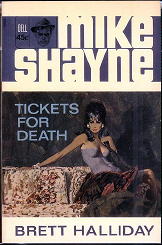
HALLIDAY Tickets for Murder

   Neither of the usual sources (IMDB, American Film Institute) seem to know this, nor is Brett Halliday’s novel credited on the screen, but this final entry in the private eye Mike Shayne movie series was based on Tickets for Death (Holt, 1941), which I reviewed here on this blog over three years ago.

   This is the last of five films in which Shayne was impersonated by Hugh Beaumont, which were preceded by seven in which Lloyd Nolan had the leading role. Beaumont does a better job than I expected in the part, especially after an opening scene in which Shayne and his secretary Phyllis Hamilton (played by Trudy Marshall) have great fun tootling each other with duck call devices, a means by which the producers of this film indicated that this was going to be a serious work of detective art.

   According to a review on decoypro.com, the two are supposed to be going on a duck-hunting vacation together, but business seems to have a way of constantly interfering, to Phyllis’s great consternation. First, a gentleman stops by the office with $2000 in hand to persuade Shayne to give up the case he’s working on. This comes as a surprise to Shayne, since he’s not working on a case. Then he gets a phone call from a woman who has information he would like to have regarding, you guessed it, the case he’s not working on.
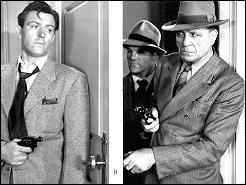
TOO MANY WINNERS Mike Shayne

   By this time, of course, there is nothing left but for Shayne to take the case, vacation (and unhappy secretary) or not. And what is the case? He’s hired by a racetrack to find out who’s been printing and cashing in on a flood of counterfeit tickets.

   From this point on, there’s a lot of similarity between the book and the movie, though not completely, and if as I said in the book review, “Shayne runs into a lot of characters that both he and the reader have to keep constant track of,” it goes double for the film.

   A sixty minute movie is simply too short for as much plot as there is in this one. I barely kept up, and that was only because I’d read the book. Audiences back in 1947 must have walked out of this movie in a daze, unless they just sat back and took it all in with their minds in an off position.

   I enjoyed it, however, even though it’s a low-budget operation through and through, and in fact if I were to watch it again, it might even make sense. Great fun.
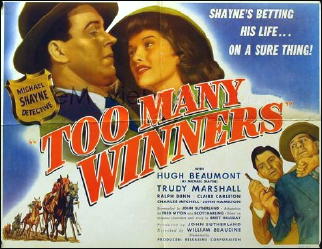
TOO MANY WINNERS Mike Shayne

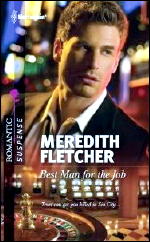
MEREDITH FLETCHER – Best Man for the Job. Harlequin Romantic Suspense; paperback original, August 2011.

   Bill Crider it was who suggested that this book might be worth reading, with a positive review on his blog, and all in all, he was correct. You can check out his review here before continuing on, if you wish.

MEREDITH FLETCHER Best Man for the Job

   It wasn’t planned this way, but as it’s turned out, this is the third of three books in a row I’ve reviewed in which one of the leading characters is a female private eye. That Eryn McAdams works for a Las Vegas security firm doesn’t alter that fact, but it does mean that she’s not as much of a loner as either Kat Colorado or Kinsey Millhone. That she works for someone else and hasn’t reached anywhere near the top also means that’s not quite as good as either of her competition.

   That this is romantic suspense novel means that there’s another leading character, male, and luckily they’re working on the same side of the case, even though Callan Storm is, shall we say, suspicious of Eryn at first. Not too surprisingly, since Eryn’s job at the pre-nuptuals stag party is to burst out of a cake dressed in almost nothing at all (as a last minute substitution).

   And as she does so, so do the explosives go off, masked men rush in, and off they go with the groom to be. Callan, a member of an overseas Black Ops group, has been assigned by his sister (the bride-to-be) to watch over the wedding party and make sure nothing happens.

   From this point on, as the twosome set out to track the kidnappers down before the police do, it’s non-stop action, with lots of gunfire mixed in with romance. The attraction to each other that both of them feel is a major point of the plot, as Meredith Fletcher tells it.

   They can’t do it on their own, though, disappointingly. They need a third party who’s a computer whiz to do all kinds of magic tricks with cell phones, GPS devices, and hacking tools beyond the ken of mortal men. It sort of seems unfair.

   Bill suggested that this book might not have been out of place if it had been published in the 1950s as a Gold Medal thriller. I wouldn’t go that far, though I know what he’s talking about. The action is fast and furious, with a few deaths along the way, but the romance elements are too strong and non-subtle for me. In terms of its goals the author set for herself? I think she succeeded on all counts.

   Comparisons are hard. I wouldn’t say that Best Man for the Job is as good as the Kat Colorado book, the one I reviewed not so long ago, which had higher goals that I didn’t feel were met, but in many ways was still a better book. Apples and oranges, that’s for sure.

THE BACKWARD REVIEWER
William F. Deeck


RICHARD GOYNE – The Lipstick Clue. Stanley Paul, UK, hardcover, 1954. No US edition.

   Collectors of clergyman detectives may want to try Goyne’s series featuring The Padre — the Rev. Peter Eversleigh — whom I do not remember seeing on lists of clergy detectives.

   One of the reasons The Padre may not have made such lists is that his denomination, at least in this novel, is not revealed, though I would speculate on High Anglican. Another reason, again at least in this novel, is that Eversleigh may as well have been a lawyer or a doctor or unemployed, for that matter.The religious aspect is negligible.

   Still, the plot is a good one. A retired colonel, who is something more than a scoundrel, asks his estranged family to give him another chance as a father. For reasons unclear at the start, they all do come to spend the weekend with him, despite each of them despising him for various reasons. As is to be expected, the not-so-good colonel finishes the first night of the weekend dead to the last drop.

   The Padre had been invited as a sort of leavening for the group. He ends up investigating the murder, discovering what is in some respects an unusual motive for killing, and learning who the murderer was. An interesting case that makes one not reluctant to read the other novels in which The Padre appears — for the detectival aspect, not for his role as a clergyman.

— From The MYSTERY FANcier, Vol. 12, No. 3, Summer 1990.


       The Peter Eversleigh (The Padre) series —

   The Crime Philosopher (n.) Paul 1945.

   Savarin’s Shadow (n.) Paul 1947.
   The Dark Mind (n.) Paul 1948.
   Traitor’s Tide (n.) Paul 1948.
   The Courtway Case (n.) Paul 1951.
   The Lipstick Clue (n.) Paul 1954.

   Besides a long list of books under his own name, Richard Goyne (1902-1957) is credited with another two dozen or so as by John Courage, plus a scattered handful under the names Aileen Grey, Scarlet Grey, Kitty Lorraine, Paul Renin & Richard Standish.

   Other series characters under his own name are: Paul Templeton (13), Sexton Blake (2), and Supt. “Tubby” Greene (2).

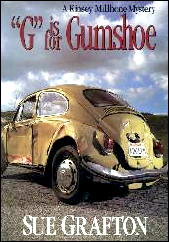
SUE GRAFTON – “G” Is for Gumshoe. Henry Holt & Co., hardcover, 1990. Fawcett Crest, paperback, June 1991. Many later printings.

SUE GRAFTON G Is for Gumshoe

   This is the one in which the titular gumshoe is not Kinsey Millhone, the PI who celebrates her 33rd birthday at the beginning — unless of course it is — but I really think it has to be a fellow named Dietz, who’s brought into Kinsey’s life soon after the 100 page mark (depending on which edition you happen to be reading).

   He’s there as a bodyguard. As a direct consequence of a previous case that Kinsey helped solve, there’s been a hit man hired, she is the target, and the man is very very good at what he does. But so is Dietz, as Kinsey soon learns.

   This is the interesting part of the book. Obviously the notoriously independent Kinsey Millhone does not want to have anyone holding her hand for her (figuratively speaking), but she soon discovers (as I pointed out in the paragraph above) that Dietz is good, and that on her own, she might not be good enough.

   This is a sobering lesson. She also discovers that the two of them are kindred spirits who just happen to have never met before. (This comes as no special surprise.)

   The part of the book that is not as interesting — in comparison — is the case she’s to been hired to do: find a woman’s 80-year-old mother who’s been living alone in an isolated part of the state (California) and hasn’t been heard of in quite a while. This sounds easy enough, and it is, but bringing the old woman back to San Teresa brings back memories too, and not so pleasant ones at that.

   The results are what always happen when PI’s start digging into the past, and you will need a good genealogical chart to keep the participants straight, most of them dead and buried, but not all.

   The ending of the hit man saga has the better climax of the two. We all know that Kinsey, who tells the story, will survive. It is Dietz that we are far more worried about — not knowing if he returns in later books or not — and that concern is what will have you turning the pages as fast as you can turn them, I guarantee you.

   There are probably ups and downs in the Millhone series, and while I haven’t read all of them, I enjoyed this one. One thumb up. Unless I’m allowed to use both hands, in which case, two.

REVIEWED BY WALTER ALBERT:         


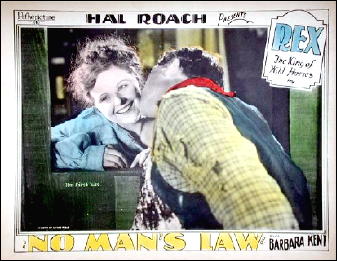
NO MAN'S LAW

NO MAN’S LAW. Hal Roach production, distributed by PatM Exchange, 1927. Rex (King of the Wild Horses),Barbara Kent, James Finlayson, Oliver Hardy, and Theodore Von Eltz. Photography by Floyd Jackman and George Stevens; director: Fred Jackman. Shown at Cinevent 40, Columbus OH, May 2008.

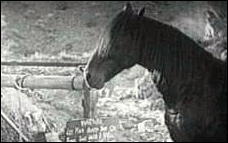
   I usually have a good memory for animal stars, but I don’t recall seeing the reportedly temperamental equine star before. Rex was a nom de cinema, with Casey Jones his original moniker. Rex’s career continued into the sound era, but No Man’s Land was the third and last of his Roach-produced oaters.

NO MAN'S LAW

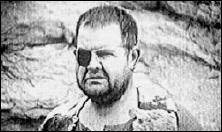
   It may be surprising to see the names of James Finlayson and Oliver Hardy attached to a dramatic film, especially since Hardy is the villain of the piece, with not a good (or funny) bone in his body.

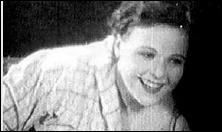
   Hardy and Von Eltz play crooks on the lam who attempt to take over the claim where prospector Jake Belcher (Finlayson), helped only by his foster daughter Toby (Barbara Kent), has been digging for gold for many years.

NO MAN'S LAW

   Rex is a wild horse, presumably beholden to no man (or woman), but for reasons that aren’t explained he keeps a close watch on Toby and Jake, finally driving Hardy into a gulch where he pounds him to death with his driving hooves. (No, we don’t see this; the camera focuses on Hardy’s clenched fist that slowly relaxes as he dies.)

   Barbara Kent is still alive, living in Sun Valley, Idaho, and refusing to talk about her movie career. She has an extended nude swimming scene (well, it looks as if she’s nude, but with a long shot she may be wearing a skin-tight outfit) and the interest this aroused in the Cinevent audience (and probably in audiences at the time of the film’s original release) may explain why Rex seemed so cranky during much of this hokey, entertaining film.

NO MAN'S LAW

REVIEWED BY DAN STUMPF:         


BORDEN CHASE Diamonds of Death

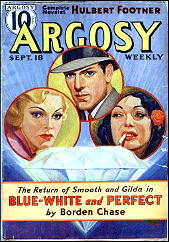
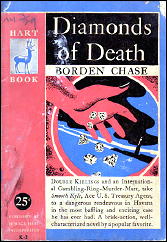
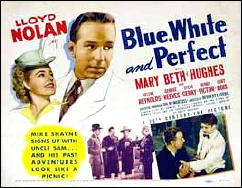
BORDEN CHASE – Diamonds of Death. Hart, paperback original, 1947. First serialized as “Blue-White and Perfect,” Argosy, 18 Sept-23 Oct, 1937. Filmed as Blue, White and Perfect, 1941.

   A while back, I reviewed Borden Chase’s novel Red River and found it surprisingly hammy from a writer known for his laconic screenplays. So I decided to give him another try and fished out Diamonds of Death (Hart, 1947) the first novel edition of Chase’s pulp novel, “Blue-White and Perfect.”

BORDEN CHASE Diamonds of Death

   This is that rarity, a dumb mystery that doesn’t insult one’s intelligence. The “surprise” criminal may be obvious early on, but Chase speeds his story through so many curves one hasn’t time to carp, as hero Smooth Kyle (I guess some folks don’t care what they name their kids) chases diamond smugglers from Broadway to Havana and back again.

   Chase provides his hero with a wise-cracking girlfriend, buddies in the Customs Office, and enough bad guys to felonize a dozen books like this, ranging from cheap hoods to smooth operators, phony dowagers, fake cops…

   I could go on, but readers of this sort of thing have met them before, and those who haven’t probably couldn’t appreciate the pulpy splendor of the piece, as Chase fills his story with glittering diamonds, luxury liners, exploding airplanes and elegant mansions, all of which impart a feel of extravagance without actually costing anything to write about.

BORDEN CHASE Diamonds of Death

   I’ll just add that the original pulp novel was bought by Fox for their “Michael Shayne” series back in the 40s, movies notable for pace, casting, and for the fact that the producers used only one Mike Shayne novel in the whole series, apparently preferring to impose their hero into stories by other authors, including Clayton Rawson, Frederick Nebel and even Raymond Chandler!

   Anyway, Borden Chase’s story suits the character quite well, and reading this one can almost hear Lloyd Nolan’s snappy banter as he stalks through the studio back lot.

Editorial Comment:   I think you can make it out on the cover of the Argosy magazine that contained the first installment of the pulp novel, but in case not, it refers to the fact that this was a return engagement for Smooth and Gilda. Collectors of Argosy, can you help me out? What earlier appearances were there?

A 1001 MIDNIGHTS Review
by Marcia Muller


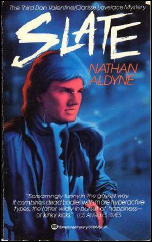
NATHAN ALDYNE – Slate. New York: Villard Books, 1984. Ballantine, paperback, 1985. Alyson, trade ppbk, 1999.

NATHAN ALDYNE

   This is the third in a series of novels featuring gay bartender Dan Valentine and his straight friend Clarisse Lovelace. As the story opens, Dan is in the hospital recovering from a bout of double pneumonia; Clarisse is just starting law school. The two embark on a new venture at the urging of Clarisse’s uncle Noah — co-ownership of a gay bar in Boston’s South End.

   The building, originally owned by Noah, is across from the District D police station and houses an odd mixture of tenants — including a lesbian couple (one is a swimming pool repair specialist, the other a call girl) who are allowed to stay, and a family of sixteen Gypsies that Clarisse evicts singlehandedly . Also present on the first floor next to the bar is Mr. Fred’s Tease ‘n’ Tint hairstyling establishment.

   As one might expect from such an odd starting lineup, events do not proceed smoothly. The bar and apartments above (where Clarisse and Dan propose to live) are a shambles. Fortunately, Dan’s new lover, Linc, is a carpenter of some creativity; with any luck, the bar, to be named Slate, will open for New Year’s.

   Enter Sweeney Drysdale II, columnist for BAR (Boston Area Reporter — a free newssheet on Boston’s bars). Sweeney’s column “makes bars … and breaks bars,” in his words. And he is determined to break Slate. Determined, that is, until he turns up dead in Clarisse’s bed on the evening Mr. Fred of hairstyling fame gives a little “do” to welcome his new neighbors.

NATHAN ALDYNE

   Events proceed against this zany background. Clarisse and Dan and sidekicks investigate with aplomb. But there’s a problem with this novel: It simply lacks substance. Not once are we allowed inside anyone’s head to find out what the character feels or why he is the way he is. There are gimmicks aplenty; everyone’s terribly eccentric and witty and shallow.

   One can’t help but compare Slate with the sensitive, richly detailed novels of Joseph Hansen, which depict gay life with realism and understanding. Against them, the Aldyne books don’t stack up; they’re like clever reproductions compared to the real thing.

   The previous books in this series are Vermilion (1980) and Cobalt (1982).

         ———
   Reprinted with permission from 1001 Midnights, edited by Bill Pronzini & Marcia Muller and published by The Battered Silicon Dispatch Box, 2007.   Copyright © 1986, 2007 by the Pronzini-Muller Family Trust.

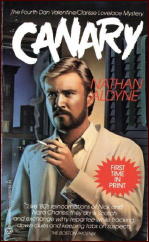
Bibliographic Notes:   “Nathan Aldyne” was the joint pseudonym of Michael McDowell and Dennis Schuetz. A fourth and final book in the series was Canary (1986). Follow the link for more information about both authors and short synopses of each of the books.

IT IS PURELY MY OPINION
Reviews by L. J. Roberts


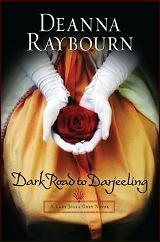
DEANNA RAYBOURN – Dark Road to Darjeeling. Mira, US, trade paperback, 2010.

Genre:   Historical Mystery. Leading characters:  Lady Julia Grey/Nicholas
Brisbane (4th in series). Setting:   India-Victorian Era (1889).

First Sentence:   “I thought there would be camels,” I protested.

DEANNA RAYBOURN

   The honeymoon of Lady Julia Grey and enquiry agent Nicholas Brisbane has been interrupted by the arrival of Julia’s sister, Portia, and brother, Plum. Jane, Portia’s lover of many years, desperate to have a child, married, moved to a tea plantation in India, is now pregnant.

   She is also a widow, her husband having died under somewhat suspect circumstances. If Jane’s impending child is male, he will be the heir to the plantation. Julia, Nicholas, Portia and Plum must keep Jane and the child safe as well as uncover a murderer, had it been murder.

   It takes a very good book to keep me reading until 3 a.m. This book did just that.

   Ms. Raybourn creates wonderful characters. Where Lady Julia starts off feeling reckless and stubborn, and her husband, Nicholas, overbearing and harsh, there is growth within the story where both characters learn and gain an understanding both to each other and to the reader.

   Julia’s sister Portia, brother Plum, maid Morag, and all the secondary characters have weight and substance. None of the characters are two-dimensional extras; rather each plays an important role in the development of the plot.

   he use of humor is delightful. It is often used to define the characters and relationships. When Portia is confronted by a less-than-fragrant smell, she states, “Julia, we are Englishwomen. We are not cowed by a little authentic local flavor.”

   Raybourn’s voice and dialogue effect a feeling both character and of period. In addition to which her excellent descriptions establish a strong sense of place and time.

   Although one could consider this romantic suspense, it is not a fluffy book and has more layers than most. One should not dismiss it casually. The lightness is tempered by reminders of harsh reality which are both thought-provoking and introspective.

   This is a story of relationships and their definitions, of neglect and its results, of loss and strength and survival. There is a mystery, a quite good one, in fact, with a tragic and emotional finale.

   Ms. Raybourn has taken a book, and a series, which could be simple light entertainment and infused it with depth and impact.

Rating:   Very Good.

      The Lady Julia Grey series —

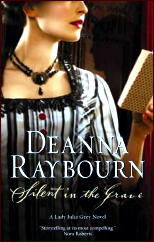
1. Silent in the Grave (2006)

DEANNA RAYBOURN

2. Silent in the Sanctuary (2008)
3. Silent on the Moor (2009)
4. Dark Road to Darjeeling (2010)
5. The Dark Enquiry (2011)

REVIEWED BY MICHAEL SHONK:


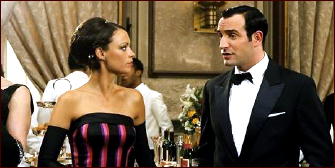
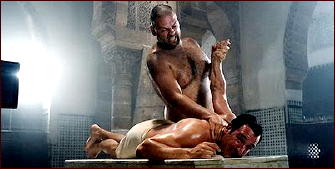
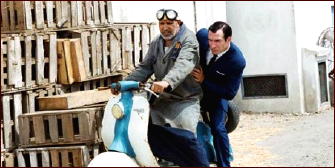
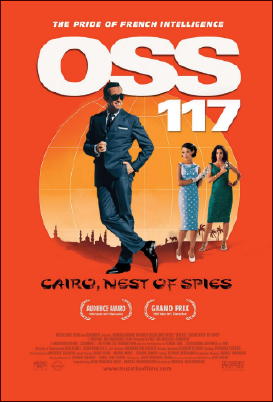
OSS 117: CAIRO, NEST OF SPIES. Gaumont, 2006. Music Box Films (US), 2008. Original title: OSS 117: Le Caire, nid d’espions. Subtitled. Jean Dujardin (Hubert Bonnisseur de la Bath, alias OSS 117), Bérénice Bejo (Larmina), Aure Atika (Princess Al Tarouk). Scenario by Jean-François Halin, based on the novel OSS 117 by Jean Bruce. Adaptation & dialogue by Jean-François Halin & Michel Hazanavicius. Music by Ludovic Bource & Kamle Ech Cheikh. Director: Michel Hazanavicius.

OSS 117 CAIRO NEST OF SPIES

   Cairo, 1955. The Cold War is hot here. The British struggle to keep control of the Suez Canal. There is a rising Arab nation seeking freedom from the West. Toss in some Muslim terrorists, some Nazis, a missing Russian ship full of weapons, and a missing French spy OSS 238 and the Middle East is ready to explode. The French government turn to OSS 117 to make the Middle East safe.

    “No problem,” responds the smug spy.

   Billed as a spy spoof featuring the French James Bond, the hilarious parody undersells itself. Cairo, Nest of Spies is also a wonderful comedy satirizing the insensitivity of the West to other cultures such as the Muslims.

   Hubert tells his beautiful Egyptian assistant that he always learns the language of the native people in every country he visits. For his trip to Egypt he learned hieroglyphics and ignored Arabic. OSS 117 stops a Muezzin from conducting the Muslim Morning prayer because the noise was keeping him awake, and he is clueless to why anyone is upset by his actions.

OSS 117 CAIRO NEST OF SPIES

   Never too serious, the film does take its always successful shots at Bond, as well as the 60’s Eurospy genre that includes the original OSS 117 films. Those who find Sean Connery’s 007 too perfect, from his repeated escapes from sure death to his expert attitude about everything, will enjoy OSS 117 ‘s version of those qualities.

   Jean Dujardin is the perfect mimic of Connery’s Bond. From a raise of an eyebrow to the way he stands before he is attacked, Dujardin looks the part of Bond. The only difference between the two is Dujardin’s version makes you laugh.

   Hubert is a clueless colonialist who gives pictures of French President Rene Coty for tips to native workers. He is in denial about his sexuality, while he can verbally seduce any woman, he prefers fighting with men over sex with women. He is not stupid. OSS 117 can learn any language, dance, or musical instrument almost immediately. He is just blind to any culture or belief outside his own male Western world.

OSS 117 CAIRO NEST OF SPIES

   While filmed in 2006, Cairo, Nest of Spies has the visual look of a 1950s-60s spy film such as Dr. No and Hitchcock’s The Man Who Knew Too Much. As you view this clip from IMDb.com, notice how the look and music mimics early Bond films and John Barry’s music.

   Those who want to learn more about OSS 117’s past, how he pre-dates Fleming’s Bond, his 265 novels, his other films and attempts at television, I recommend a visit to the Double O Section website.

   The OSS 117: Cairo, Nest of Spies official website offers some more trailers to view as well as more information about the makings of the film.

   YouTube has trailers and samples of the other OSS 117 films. Most are in French except for this trailer for the American release of OSS 117 Is Not Dead (1957).

OSS 117 CAIRO NEST OF SPIES

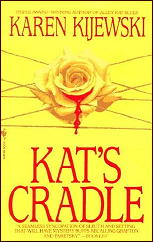
KAREN KIJEWSKI – Kat’s Cradle. Doubleday, hardcover, March 1992. Bantam, paperback, December 1992.

   Throughout the decade she was active, the 1990s, Karen Kijewski was a prolific and well-regarded mystery writer. She won or was nominated for several awards, and she seemed to be doing well sales-wise. Living in northern California at the time, and perhaps still, she seems to slipped off the map since her final book (so far), Stray Kat Waltz (1998), the ninth adventure for her female PI character, Kat Colorado.

KAREN KIJEWSKI Kat Colorado

   I admit to being optimistic to adding the parenthetical phrase (so far) in that line above. It’s been 13 years since that last outing, though, so I’d have to agree that the chances are slim to none that we’ll ever see another entry in the series. Someone once suggested to me that when her contract ran out and wasn’t renewed, she decided to call it quits, but as I say, that’s only hearsay, if not an out and out and totally wild guess.

   In Cradle Kat is hired by a young heiress, Paige Morell, whose strong-willed (i.e., domineering) grandmother has just died. She never knew her parents, and she wants Kat to find out more about them. While she takes the job, Kat knows that digging around in the past may bring up more than her client might want to know, but convincing her of that is another story. (And not this one.)

   Her client also appears more than a tog unstable, with many emotional ups and downs as the story goes along. Under the circumstances, it’s nothing very surprising, but it also becomes clear that there’s several important things she’s not telling. Otherwise the case seems straightforward enough, but not so. It turns out to be a thoroughly exhausting affair for Kat, both physically and otherwise.

   That Kat is unable to establish on her part an emotional distance away from the case she’s on is part of the problem. This is Ross Macdonald territory, not Hammett, but Kat is no Lew Archer, who often observes but fails to get involved himself.

   Besides the investigation she finds herself an integral part of, in more ways than one, she allows her relationship with Hank, her close cop friend who lives in Las Vegas – which is more than a short hike from the Sacramento area, her base of operations – to wither away.

   Let’s change that last phrase to something more akin to “actively pushes away.” My feeling is that PI’s should not allow themselves to become romantically involved with clients, suspects, or suspects’ families and friends, nor can you always foresee what will happen on the rebound. There’s more than enough of a hint here to tell you what I found as a fatal flaw to this book’s telling, and you should immediately forget I said anything, if you ever intend to read this book.

   In any case, it was obviously Karen Kijewski’s intent to write a wrenching tale of dysfunctional family relationships, and that is exactly what she did. Kat is lucky to have escaped alive, in more ways than one.

      The Kat Colorado series:

1. Katwalk (1988)
2. Katapult (1990)

KAREN KIJEWSKI Kat Colorado

3. Kat’s Cradle (1991)
4. Copy Kat (1992)
5. Wild Kat (1994)
6. Alley Kat Blues (1995)

KAREN KIJEWSKI Kat Colorado

7. Honky Tonk Kat (1996)
8. Kat Scratch Fever (1997)
9. Stray Kat Waltz (1998)

KAREN KIJEWSKI Kat Colorado

« Previous PageNext Page »