Reviews


REVIEWED BY DAN STUMPF:         


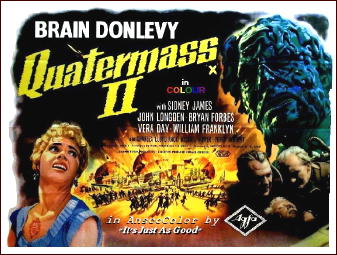
QUATERMASS II: ENEMY FROM SPACE. Hammer Films, 1957. Brian Donlevy, John Longden, Sidney James, Bryan Forbes, William Franklyn, Vera Day. Originally serialized by BBC-TV, Oct-Nov 1955, in 6 30min segments. Story & screenplay: Nigel Kneale & Val Guest. Director: Val Guest.

QUATERMASS II Enemy from Space

   Yet another surprisingly effective British Thriller that builds quietly to a really gripping finish. Brian Donlevy plays the eponymous Doctor Quatermass, who stumbles onto a top-secret Government Project that turns out to be a front for Alien Invasion.

   I was struck by the writers’ ability to come up with really alien-looking aliens and an eerily off-the-wall kind of Invasion. Director Val Guest does a good job of starting out Slow and Realistic (The top-secret Government Complex is actually an Oil Refinery — and looks it.) then working up to a Big Finish that’s all the more impressive for looking so out-of-place in such a modest film.

QUATERMASS II Enemy from Space

   In terms of Writing and Playing, Quatermass 2 is uniformly intelligent; the characters talk and act like ordinary folks, and Brian Donlevy is surprisingly effective as the gruff, ill-mannered, unlikely hero of the piece.

   I’ve always been puzzled, though, by the fact that they chose him to star in the Quatermass films, despite the popularity of the British Actor who played him on Radio. One assumes that they must have had an eye on the American Market, but Good Lord: BRIAN DONLEVY?!?!

   That’s not enough Star Power to light up a Marquee! Truly, the minds of Film Producers are inscrutable to us Mortal Men.

QUATERMASS II Enemy from Space

REVIEWED BY TINA KARELSON:         


NICHOLAS BLAKE There's Trouble Brewing

NICHOLAS BLAKE – There’s Trouble Brewing. Collins Crime Club, UK, hardcover, 1937. Harper & Brothers, US, hc, 1937. Paperback reprints include: Popular Library #30, 1944; Perennial, 1982.

   This is the third of the 16 Nigel Strangeways mysteries and earliest of the four that have lurked unread upon my shelves for the last 20 years or more.

   Blake, of course, is a pseudonym for the poet Cecil Day Lewis. And the Strangeways novels are the product of a poet and scholar whose purpose in writing mysteries was to make some extra money to support his growing family. While he’s giving a bit of a tweak to the genre as it existed in Britain at the time, he stays within its boundaries.

NICHOLAS BLAKE There's Trouble Brewing

   In fact, the traditional elements are quite rigid. The story unfolds chronologically, each chapter designated with a number, date and time. For example, the eighth chapter is “VIII. July 19, 8.20–11.30 A.M.” Each chapter has an epigraph; these are drawn from a variety of sources, from Shakespeare to a 19th century temperance ballad.

   The sleuth, Nigel Strangeways, is a classic upper-class amateur. In this case, he is summoned to the village of Maiden Astbury by an Oxford classmate’s wife, ostensibly to address the local literary society on the topic of his “delightful little book on the Caroline poets.” He ends up investigating a gruesome murder in a brewery, foreshadowed by the similar disposal of the brewery owner’s dog, subject of the book’s opening:

NICHOLAS BLAKE There's Trouble Brewing

   Every dog, they say, has its day. Whether Truffles would have assented to this proposition during his lifetime is highly doubtful. Not for him the elusive rabbit, the ineffable dungheap, the hob-nobbing with loose companions at street corners that for upper-class dogs represent the illicit high-spots of cloistered lives. Truffles, like everything else that Eustace Bunnett had to do with, was kept very much at heel.

   The educated, slightly tongue-in-cheek tone is maintained throughout. While gently amusing, it distances the reader from the story and characters.

   Plot and structure are similarly flawed; more than one significant character is offstage for all or most of the book, existing only through other characters’ eyes and according to the physical traces left behind. The total effect is of a puzzle with missing pieces, viewed from afar.

      Previously reviewed on this blog:

Murder with Malice   [by Marv Lachman]
Thou Shell of Death   [by Steve Lewis]
The Private Wound   [by Steve Lewis]

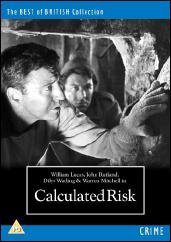
CALCULATED RISK 1963

CALCULATED RISK. Bry/McLeod, UK, 1963. William Lucas, John Rutland, Dilys Watling, Warren Mitchell, Shay Gorman, Terence Cooper, David Brierly. Screenplay: Edwin Richfield. Director: Norman Harrison.

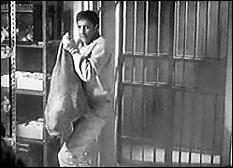
   As you may have noticed already, except for Dilys Watling, who plays the young factory worker who undresses at night in a second story apartment overlooking the bombed-out lot where a gang of safecrackers are digging their way under ground into the bank building next door, everyone else in this movie is male.

   Even so, Miss Watling’s part is almost a cameo role, almost but not quite, and as caper movies go, even though very few people will have seen it, this one’s a good one.

CALCULATED RISK 1963

   It begins with a gent named Kip (John Rutland) getting out of prison and being picked up in a car by his brother-in-law Steve (William Lucas). Kip is a crook, but not a very good one. He’s been in and out of jail most of his life. He even missed his wife’s funeral while he was in this last time.

   But now that he’s out, he has a plan and to pull it off, he needs some help. He’s been told about an undisturbed underground WWII air raid shelter that’s only two walls away from a bank vault, and inside the vault is a fortune in cash. Even though Kip is considered something of a Jonah on the job, it isn’t difficult for Steve to come up with a small crew of others to add their talents in.

CALCULATED RISK 1963

   All things considered, it’s a good plan, and it’s one that might actually work, but plans and the carrying out of them are hardly ever the very same thing. Small things can be adjusted for – Kip’s heart problems, for one, but I won’t tell you about the big one, but if you read the first paragraph above again, maybe you can figure it out on your own.

   The script is tight, the vivid black-and-white photography perfect for the tale that’s told, and even though none of the actors are known in this country – and maybe not even in England – they all fit their characters well, and what more could you want?

   Perhaps a little longer running time — it’s only 72 minutes long — but with anything longer you run the risk that the tension is going to be as big a fizzle as the… Or does it?

DOROTHY GARDINER – The Trans-Atlantic Ghost. Doubleday Crime Club, hardcover, 1933.

   The detective in what was Mrs. Gardiner’s first mystery novel has a well-chosen name, I think you’ll agree, but the fact is that while Mr. Watson indeed did work for 20 years for the New York Police Department, he was for all that time a minor clerk, a statistician. (Though, of course, there’s nothing inherently wrong with that!)

   The locked room murder he’s called upon to solve in this book is in California, however, where he finds himself as part of an around-the-world cruise he’s about to embark on, as he heads back home to his native England for good.

   The locked room is in an English castle that’s been transported across the ocean and rebuilt in the hills of California by a wealthy millionaire; there is some talk of ghosts, and some obnoxious louts who call themselves policemen, led by the appropriately named Captain Bulnose; and lots of suspects.

   What makes this book so disappointing is difficult to describe without giving the entire solution away, and you may as well have your own chance at it. Allow me to suggest, however, that it’s the obvious one, and one that at one point Watson is solemnly assured could not be the explanation.

   Of course we shouldn’t assume that everyone knows the truth, or speaks it, but some tiny spark of imagination is to be expected as well, isn’t it?

   There are some nicely humorous scenes to be pleased with, such as when the string on Watson’s pajamas gives way at one crucial point, and to be honest, this was no real chore to read, but as a mystery, it’s (sadly) rather a silly one.

Rating: C minus.

— Reprinted from The MYSTERY FANcier, Vol. 3, No. 5, Sept-Oct 1979. Slightly revised.


[UPDATE] 03-12-11.   A scarce book, with only a single copy of the US edition listed on ABE, and my copy has no jacket, thus no image above.

   I don’t know much about the author, but according to one website: “Dorothy Gardiner was born in Naples, Italy. She grew up in Boulder, Colorado. In 1917, she graduated from the University of Colorado with a degree in History. During the Second World War she was in charge of all the files and records for the North-Atlantic Area office of the American Red Cross.”

   From the Revised Crime Fiction IV, by Allen J. Hubin, a list of her mystery fiction:

GARDINER, DOROTHY. 1894-1979.
      The Transatlantic Ghost (n.) Doubleday 1933 [Mr. Watson]
      A Drink for Mr. Cherry (n.) Doubleday 1934 [Mr. Watson]
      Beer for Psyche (n.) Doubleday 1946
      What Crime Is It? (n.) Doubleday 1956 [Sheriff Moss Magill]
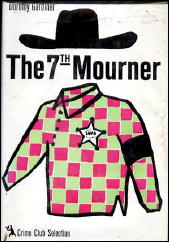
      The Seventh Mourner (n.) Doubleday 1958 [Sheriff Moss Magill]

DOROTHY GARDINER

       Lion in Wait (n.) Doubleday 1963 [Sheriff Moss Magill]

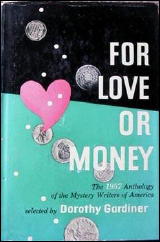
   She also edited For Love or Money: The 1957 Anthology of the Mystery Writers of America (Doubleday Crime Club, 1957).

DOROTHY GARDINER

The Mystery Fiction of SEICHŌ MATSUMOTO
by Michael E. Grost.

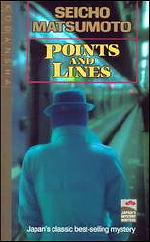
1. Ten to sen / Points and Lines
SEICHO MATSUMOTO

   Seichō Matsumoto’s Ten to sen (Points and Lines) (1957) is a railway timetable mystery straight out of the Freeman Wills Crofts school. It has such Crofts school features as police detective heroes, plenty of skilled detective work, and plot solutions partly based on the “breakdown of identity.” It is very absorbing reading.

   Matsumoto’s story unfolds against the background of a government scandal, involving bribery between businessmen and government officials. This is exactly the sort of situation featured in Akira Kurosawa’s film, The Bad Sleep Well (1960), which makes an interesting cross reference to Matsumoto’s novel. Kurosawa’s treatment is very melodramatic and adventure oriented, whereas Matsumoto focuses on a straightforward realism, never losing focus on the detective work in the book.

   Matsumoto’s tales tend to focus on sinister murder conspiracies against the innocent. The conspiracies tend to be worked out in great detail, often involving faked alibis. There is a pleasing sense of mathematical symmetry in Matsumoto’s plots.

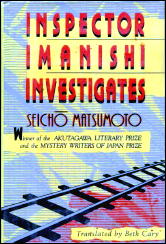
2. Suna no utsuwa / Inspector Imanishi Investigates

   Matsumoto’s later Suna no utsuwa (Vessel of Sand, translated as Inspector Imanishi Investigates) (1961) combines some traditions in his writing.
SEICHO MATSUMOTO

   The first and better half (Chapter 1 through the middle of Chapter 9) is a mystery story, focusing on solving an obscure murder. It involves such standard Matsumoto devices as an unidentified corpse, railway timetables, and a plot focusing on the two extremes of Japan, the North East and the South West regions of the Islands.

   Like Ten to sen, it builds up some interesting geographic patterns in its puzzle plot, patterns that involve the two extremes of the Islands, and which can be traced on a map with almost pure geometric precision and symmetry.

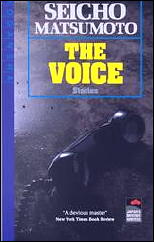
   The second half of the book is more of a pure thriller or suspense story, with only a little mystery left. It reminds one of some of the suspense short stories in Koe (The Voice). I like the second half of the book much less than the first, and in general do not enjoy Matsumoto’s thrillers anywhere as much as his mystery stories.

   The story also shows Matsumoto’s gift for misdirection. Several times Matsumoto makes it look as if his plot were going one way, only to pull off the opposite direction a few chapters later.

   Some of the reviews quoted on the back of Suna no utsuwa occasion some comment. It has become a truism of criticism that police procedural writers are trying to paint a picture of their society, and more than one reviewer duly states this about Matsumoto.

   I don’t agree. While Matsumoto is indeed realistic, it is hard to see that he is attempting to build up a systematic picture of Japanese society, à la Balzac. Instead, Matsumoto mainly seems concerned with creating mystery plots, together with exploring a few specific subjects that seem to interest him: policemen and their wives, train travel, men with hidden mistresses, bar hostesses, stage and film actors, newspaper reporters, life in South Western Japan, where Matsumoto grew up.

   The unnamed reviewer for The Milwaukee Journal compares Matsumoto to Anton Chekhov. This is very true. Matsumoto, like Chekhov, often creates a character by revealing some small aspect of their behavior or personality.

   This small piece somehow evokes a whole person, in ways that are mysterious, yet somehow very effective. There is also a low keyed intimacy of tone that recalls Chekhov, at once realistic and sensitive, and a gift for lyrical description of both scenery and everyday life.
SEICHO MATSUMOTO

3. “Kanto-ku no onna” / “The Woman Who Wrote Haiku”.

   The best short story in Koe (The Voice) is “Kanto-ku no onna” (“The Woman Who Wrote Haiku”) (1960). This is a genuine mystery story, not a suspense tale, with a first class plot. It also has the emotionally involving situations one finds in Matsumoto at his best.

   The puzzle plot is in the tradition of such earlier works as Wilkie Collins’ The Haunted Hotel (1878), and F. Tennyson Jesse’s “Lot’s Wife” (1929).

4. “The Cooperative Defendant”

   Matsumoto’s short story “The Cooperative Defendant” shows his interest in ambiguous situations. As is common in Matsumoto, his detective cannot decide whether his suspect is guilty or innocent. He oscillates between these two positions, based on reasoning about the evidence.

   Sometimes he recreates the crime one way in his mind. Then he gets new insight into the data, and reconstructs the crime in a different way. He usually has to really struggle mentally over this, taking a long period of time and much mental effort.

    “The Cooperative Defendant” also shows Matsumoto’s fondness for waste spaces: railroad yards, industrial lots, lonely road sides, country areas that are just being built up into cities, deserted beaches are all favorite Matsumoto locales. These are all areas that have some small aspect of human occupation, but which are typically nearly deserted, and almost in their natural state.

   There often seems to be water nearby, whether the sea, a famous waterfall, or just a small irrigation pond, as in this tale. Such American pulp writers as Norbert Davis and MacKinlay Kantor also were fascinated by such spaces, although one doubts either had any direct influence on Matsumoto.

   Matsumoto’s characters often have complete life histories, something one also finds in Hugh Pentecost. Their various professions can show unexpected links to the murder plot.

Editorial Comments:   This essay first appeared on Mike’s website, A Guide to Classic Mystery and Detection. It is reprinted here with his permission.

   If I am reading this biography of Matsumoto correctly, the stories that Mike has brought our attention to are only a small sliver of his crime fiction output. Quoting briefly:

    “A prolific author, the self-educated Matsumoto did not see his first book in print until he was in his forties. He wrote until his death in 1992, producing in four decades more than 450 works. Although Matsumoto also produced popular historical novels and respected works of nonfiction, it is his mystery and detective fiction that solidified his reputation as a writer at home and abroad.”

   Also, if you have it to hand, you might wish to read:

Apostolou, John. “A Yen for Murder: A Look at Japan’s Ichiban Mystery Writer, Seicho Matsumoto.” The Armchair Detective, Vol. 20, No. 3 (Summer, 1987).
REVIEWED BY WALTER ALBERT:         


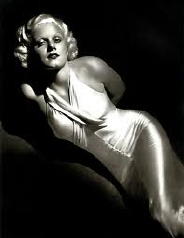
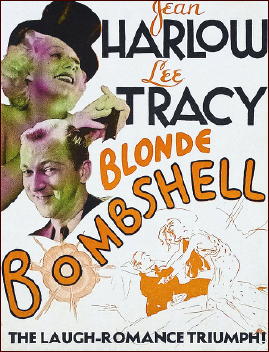
BOMBSHELL Jean Harlow

BOMBSHELL. MGM, 1933. Jean Harlow, Lee Tracy, Frank Morgan, Pat O’Brien, Franchot Tone, Una Merkel, Ted Healy, Ivan Lebedeff, C. Aubrey Smith, Isabel Jewell. Screenplay by John Lee Mahin and Jules Furthman; photography by Harold Rosson and Chester Lyons. Director: Victor Fleming. Shown at Cinecon 46, Hollywood CA, September 2010.

   There’s not an admirable character among the characters in this steamroller satire of a star (Harlow) victimized by her family, studio and everybody she comes into contact with.

   Lee Tracy as her lover and publicist, with not an honest bone in his body or an apparent ounce of concern for Harlow’s well-being, and Frank Morgan as her alcoholic father are the most blatant exploiters of the vulnerable actress, but every other actor in the film, with the possible exception of Pat O’Brien, plays a role that ensures complicity in the studio’s manipulation of every aspect of her life for the maximum return on her box-office potential.

   It was apparently an open secret at the time of the film’s release that Harlow’s role was based on the tragic career of Clara Bow, a talented and enormously popular actress whose not so private peccadilloes contributed to ending her career.

   Both Harlow and Bow exuded a sexuality that propelled their careers into the stratosphere, with Bow’s meteoric career a victim to sound, Harlow’s to a medical problem that her mother, a devotee of Christian Science, refused to have treated.

   Bombshell was probably intended to be a satiric comedy, but the dark undertones of the constant breaching of Harlow’s character’s privacy that undermines any sense of self-worth, has a sour, almost vicious cast, that I found offensive.

BOMBSHELL Jean Harlow


Editorial Comment:   Bombshell is scheduled to be shown on TCM next Tuesday night (March 15th) at 9:30.

RALPH McINERNY – Bishop as Pawn. Vanguard Press, hardcover, 1978. Paperback reprint: Ace/Charter, 1980.

RALPH McINERNY

   A great many strange things seem to go on in Fox River, Illinois, the site of Father Dowling’s parish, and a surprising number of them are of considerable interest to mystery fans.

   First, his housekeeper’s husband suddenly returns after an unexplained absence of fifteen years, only to be murdered the same evening, and then Bishop Rooney, mistaken for his old friend, is kidnapped from under Dowling’s own roof. The chief suspect is the renegade priest Father Chirichi.

   Dowling himself is rather conservative in his religious views, but that’s precisely what it is that helps him remain such a sturdy watchtower throughout the storm. As a mystery character, it’s also why he’s someone we’d definitely like to see more of.

Rating: B minus.

— Reprinted from The MYSTERY FANcier, Vol. 3, No. 5, Sept-Oct 1979. This review also appeared earlier in the Hartford Courant. Very slightly revised.


[UPDATE] 03-11-11.   As I was in the process of posting this old review, I read something into the last line that wasn’t true. I thought I was saying that this was the first Father Dowling book, and it wasn’t. The first one was Her Death of Cold, and it came out the year before, 1977.

   A complete list of the Father Dowling mysteries was published on this blog on the occasion of Ralph McInerny’s passing, early last year. Check it out here.

   Toward the end of that tribute to the author I mentioned, of course, the TV series based on the character. I don’t remember the books well enough to say so definitively, but the review suggests that there was little similarity. Tom Bosley as Father Dowling played him as too much of a comic character, or that’s how I remember it, but I did enjoy watching the program.

   The TV program ran for three seasons on two networks, so it was popular. The last sentence of that previous post was: “The series has not yet been released on commercial DVDs — and why not?” There’s still been no answer to that.

REVIEWED BY BARRY GARDNER:


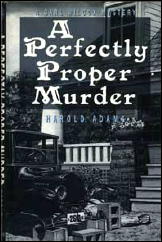
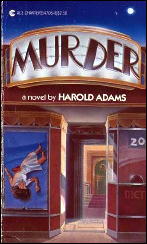
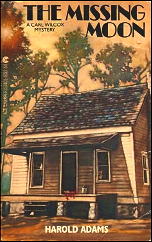
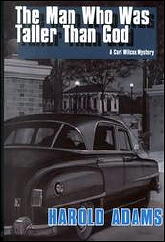
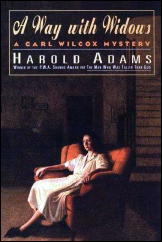
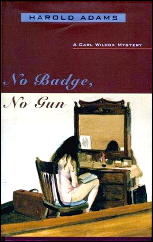
HAROLD ADAMS – A Perfectly Proper Murder. Carl Wilcox #11. Walker, hardcover, 1993. No paperback edition.

HAROLD ADAMS A Perfectly Proper Murder

   This is one of my favorite series, with a regional and historical background set in Depression era South Dakota and Minnesota.

   Carl Wilcox is an ex-con, now a semi-itinerant sign painter. He finds himself looking for work in Podunkville, and quickly manages to offend the town’s leading citizen. The next day the man is found murdered, and Wilcox briefly comes under suspicion.

   Thanks to his past help to his hometown law, he is enlisted by the local cop to help investigate the case. It turns out that the murdered man wasn’t really a very nice person, with wife-beating and wholesale philandering among his more easily provable sins. Darker yet are hinted at. Suspects include but are not limited to his young wife and his children by an earlier marriage.

   Once again, Adams’ strengths are quickly apparent. The first-person narrative is easy and unforced, and the dialogue is realistic and entertaining. Adams has a knack for characterization in few words, and all of the the players come alive enough to believe in and relate to.

   The small-town ambiance of the time is thick enough to cut with a knife, and tasty to boot. On the down side, I think Adams may be overworking the device of Wilcox helping the law, and this is a very slender book for the price. It’s still a fine series, though, from a fine writer.

— Reprinted from Ah, Sweet Mysteries #9, September 1993.


      The Carl Wilcox series

1. Murder, 1981

HAROLD ADAMS A Perfectly Proper Murder

2. Paint the Town Red, 1982
3. The Missing Moon, 1983

HAROLD ADAMS A Perfectly Proper Murder

4. The Naked Liar, 1985 (Shamus nomination)
5. The Fourth Widow, 1986
6. The Barbed Wire Noose, 1987
7. The Man Who Met the Train, 1988
8. The Man Who Missed the Party, 1989
9. The Man Who Was Taller Than God, 1992 (Shamus Award)

HAROLD ADAMS A Perfectly Proper Murder

10. A Perfectly Proper Murder, 1993
11. A Way with Widows, 1994

HAROLD ADAMS A Perfectly Proper Murder

12. The Ditched Blonde, 1995
13. Hatchet Job, 1996
14. The Ice Pick Artist, 1997
15. No Badge, No Gun, 1998 (Shamus nomination)

HAROLD ADAMS A Perfectly Proper Murder

16. Lead, So I Can Follow, 1999

REVIEWED BY MICHAEL SHONK:


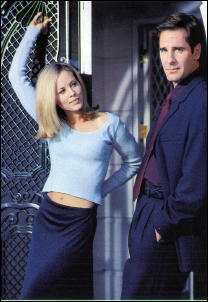
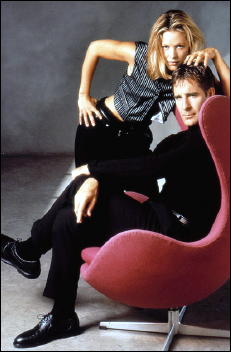
MR. & MRS. SMITH. CBS. September 20, 1996 through November 8, 1996. Cast: Mr. Smith: Scott Bakula, Mrs. Smith: Maria Bello, Mr. Big: Roy Dotrice, Rox: Aida Turturro (two episodes). Created by Kerry Lenhart and John J. Sakmar.

   Mr. & Mrs. Smith was a better than average mindless TV romantic comedy mystery.

MR & MRS SMITH Bakula Bello

   Mr. and Mrs. Smith worked for The Factory, a worldwide private intelligence firm with the latest gadgets and unlimited resources. The company was run by a man known as Mr. Big. The Factory had a rule that no agent could know anything about another agent’s past. So, while off saving the world and solving crimes, the Smiths spent their free time trying to uncover the other’s secret past. Why they don’t even know the other’s name!

   If this secret past bit sounds like Remington Steele doubled, it was not by accident. Creators Lenhart and Sakmar were on the writing staff of Remington Steele during the third and fourth seasons. Michael Gleason, co-creator and showrunner of Remington Steele, wrote the final episode of Mr. & Mrs. Smith.

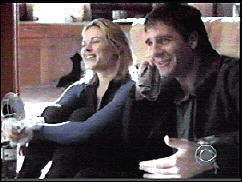
   The series had an interesting twist to the overdone “will they or won’t they” cliche. At times, she was willing to hop into bed with him, and he was tempted, but there was something in his past stopping him.

   Mr. and Mrs. Smith were complete opposites, and on TV that makes them the perfect team. She was talkative and impulsive while he was quiet and deliberate. If one did not know something, the other was an expert on the subject.

MR & MRS SMITH Bakula Bello

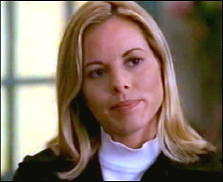
   The sexual attraction each had for the other was understandable. However, the two leads’ chemistry did not heat up the screen. Scott Bakula gave his usual performance, ranging from wooden to over the top. Maria Bello was a wonderful surprise, with an emotionally expressive face able to reveal Mrs. Smith’s damaged past without a word.

   The writing was typical television, ranging from great fun to embarrassingly bad. The mysteries relied more on twists, but did feature an occasional obvious clue. The stories’ pace were fast enough, so if you turned off your brain, you did not care about the, at times, unbelievably stupid behavior of the characters.

   The best clues were not for the mystery of the week, but for the arc story of the mystery of Mr. and Mrs. Smiths’ pasts. The characters and their relationship evolved each week as they learned more about each other.

MR & MRS SMITH Bakula Bello

   Sadly, CBS aired only nine of the thirteen episodes, and at least two were noticeably out of order. In “The Grape Escape”, Mr. Smith goes through Mrs. Smith’s hidden trunk of past mementos. But it is a trunk the viewer and Mr. Smith did not know existed until “The Publishing Episode” that aired the week after.

   Without the last four episodes, the viewers missed out on the satisfying ending to the central mystery of the characters’ pasts.

   The final four episodes were aired sometime overseas. All thirteen episodes are available at You Tube. No DVD is currently legally available.

      EPISODE INDEX

Pilot (9/20/96)   Written: Kerry Lenhart and John J. Sakmar. Directed: David S. Jackson.   Mr. Smith meets the future Mrs. Smith while each, on opposite sides, attempt to find a missing scientist who had invented a new energy source.

The Suburban Episode (9/27/96)   Written: Mitchell Burgess and Robin Green. Directed: Oz Scott.   The Smiths move to the suburbs of St. Louis and pose as new neighbors to a man suspected of selling top-secret government codes.

The Second Episode (10/4/96)   Written: Kerry Lenhart and John J. Sakmar. Directed: Ralph Hemecker.   Mr. and Mrs. Smith help a bumbling assistant stop his boss from selling arms to a terrorist.

The Poor Pitiful Put-Upon Singer Episode (10/11/96)   Written: Del Shores. Directed: Nick Marck.   The Smiths try to find out whom wants to kill the head of a small record label.

The Grape Escape (10/18/96)   Written: Susan Cridland Wick.   Directed: Daniel Attias. The Factory sends the Smiths on a mission to save the vineyards of Europe from a scientist’s bug bombs.

The Publishing Episode (10/25/96)   Written: Douglas Steinberg. Directed: James Quinn.   The Smiths have to stop the sale of a tell-all spy book written by a missing British spy named Steed. Each Smith wants to find the book first, so to read about the other’s past.

The Coma Episode (10/28/96)   Written: Douglas Steinberg. Directed: Michael Zinberg.   Mr. Smith plays doctor with Mrs. Smith taking the role as coma patient so they can get closed the a guarded coma victim that knows the plans of terrorists to attack a peace conference.

The Kidnapping Episode (11/1/96)   Written: Mitchell Burgess and Robin Green. Directed: Sharron Miller.   Before the Smiths can discover who is causing problems at a drug company, their client is kidnapped.

The Space Flight Episode (11/8/96)   Written: Michael Cassutt. Directed: Lou Antonio.   When an ex-astronaut hires The Factory to find a space prototype and his son, the trail leads the Smiths to Area 51.

The Big Easy Episode (never aired on CBS)   Written: Del Shores. Directed: James Whitmore Jr.   The Smiths visit New Orleans when The Factory is hired to clear a Senator’s mistress of a conviction for selling government secrets.

The Impossible Mission Episode (never aired on CBS)   Teleplay: Kerry Lenhart and John J. Sakmar.   Story: Douglas Steinberg. Directed: Artie Mandelberg.   The Smiths help fellow Factory agents, the Jones, trap some counterfeiters.

The Bob Episode (never aired on CBS)   Written: Sanford Golden. Directed: Jonathan Sanger.   Bob, a friend from Mr. Smith’s pre-spy days, gets caught in the middle between the Smiths and a terrorist with enough plutonium to make an atomic bomb.

The Sins of the Father (never aired on CBS)   Written: Michael Gleason. Directed: Rob Thompson.   Mr. Smith disappears while in mid-assignment when he is blackmailed with his past. While The Factory writes him off, Mrs. Smith rushes to his rescue, whether he wants her to or not.

MR & MRS SMITH Bakula Bello

THE BACKWARD REVIEWER
William F. Deeck


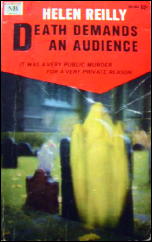
HELEN REILLY – Death Demands an Audience. Doubleday Crime Club, hardcover, 1940. Hardcover reprint: Sun Dial Press, 1941. Paperback reprints: Popular Library #7, no date [1943]; Macfadden, 1967; Manor, 1974.

HELEN REILLY Death Demands an Audience

   The paperback publisher [Macfadden] implies that this is a novel with some impossible or at least difficult crimes. “One victim was killed in a department store window. Another died before the startled eyes of a policeman on guard duty. The third breathed his last in a crowd of people coming out of a theater.”

   The first victim was killed in a department-store-window display, all right, but the display was in the cellar at the time of the crime and was raised with corpse later. The next victim had locked the policeman in a basement, so the cop certainly didn’t see him die. The third death had nothing to do with a theater crowd or any other crowd.

   Equally disappointing is the novel itself. The murderer is not only the least likely person but a most unlikely one. Inspector McKee traps the murderer by taking a picture as the fourth murder is attempted. He implies that he knew who it was all the time, but I don’t believe it. A fair mystery with a most unsatisfactory denouement.

— From The MYSTERY FANcier, Vol. 11, No. 4, Fall 1989.


Editorial Comments:   A long profile of Helen Reilly’s work by Mike Grost can be found on the main Mystery*File website. (Follow the link.) Accompanying Mike’s article is a detailed bibliography I put together for her.

   Previously reviewed (by me) on this blog:

The Canvas Dagger (1956) (very short)
The Silver Leopard (1946)

« Previous PageNext Page »