Reviews


The Tale of Mr. Fergus Hume and Mr. William Freeman
or, The Reviewer’s Comeuppance
by Curt J. Evans


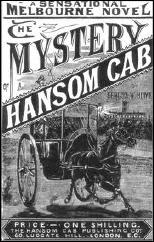
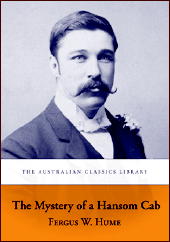
   Despite having produced over 130 mystery novels between 1886 and 1932, the year of his death, the English born, New Zealand raised author Fergus Hume (1859-1932) is known — to the extent he is known at all today — for one work, his debut murder tale, The Mystery of a Hansom Cab.
FERGUS HUME

   Accounts typically claim that over 500,000 copies of Hansom Cab were quickly placed into eager purchasers’ hands (some sources suggest up to as many as a million copies may have been sold), making the novel a landmark financial success within the mystery genre.

   After relocating from New Zealand to Australia in the 1880s and finding employment as a barrister’s clerk, Fergus Hume soon manifested marked literary tendencies. He published a few stories and began writing plays, but the latter efforts went nowhere. Determining that what the public really desired was a murder tale, Hume pored over the celebrated mystery novels of the French author Emile Gaboriau (1832-1873). Then he produced his own crime story, The Mystery of a Hansom Cab.

   Finding resistance among Australian publishers to this work as well, Hume was forced to the expedient of privately printing it. To everyone’s amazement the novel sold briskly. Hume then made the mistake of his life, for a pittance parting with the book’s copyright to an Australian publisher who soon had it flying off shelves not only in Australia but Great Britain and the United States. Apparently Hume never made a penny off the book again.

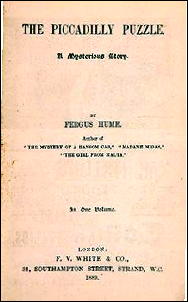
   Undaunted by his ill turn of economic fortune, Hume determined to make his living as a novelist. By 1888 he had moved to England (where he would live the rest of his life) and had ditched his Australian publisher. The next year saw the publication of Hume’s first mystery novel set in England, The Piccadilly Puzzle.

   A fascinating review of The Piccadilly Puzzle appeared in the inaugural issue of Zealandia, a short-lived New Zealand literary journal (it ran for twelve issues). The reviewer of Puzzle, William Freeman, was also the editor of Zealandia and a prominent New Zealand journalist of his day. His review of the tale is acute but also strikingly harsh in tone. However, if Hume was offended by this review, he soon enough had the last laugh on Freeman.

   Before I get to the Zealandia review and the bizarre fate of the reviewer, however, some words about The Piccadilly Puzzle are necessary.
FERGUS HUME

   Clearly inspired by the recent Jack the Ripper murders (as was another Victorian mystery novel published at this time, Benjamin Farjeon’s Devlin the Barber), The Piccadilly Puzzle revolves around the mysterious murder of a woman on a foggy night in a major London thoroughfare.

   The woman, initially thought to be a “streetwalker” (shades of the Whitechapel murders) soon is identified as a certain Miss Sarschine, the mistress of a prominent lord who, it seems, has just eloped to the Azores on his private yacht with another lord’s wife. The dead woman was not strangled or stabbed but, rather, poisoned — the poison apparently being one of those convenient tropical toxins utterly unknown to Western science, the use of which later would be much frowned upon in the Golden Age of the detective novel (roughly 1920 to 1939).

   Perhaps not coincidentally, poor defunct Miss Sarschine, that lovely lady of easy virtue, had a pair of Malay kris, complete with fatally poisoned blades, hanging on a wall of her love nest (apparently deadly poisoned kris on the wall add just that right final touch to a romantic evening).

   The London police put a private detective named Dowker entirely in charge of the case (something which struck me as rather odd). As a character this Mr. Dowker is not interesting at all, but, worse yet, he has a “colorful” Cockney sidekick, a street urchin named Flip, who speaks like this:

    “ ’e gives me sumat to eat when I arsks it, so I goes h’up to cadge some wictuals, I gits cold meat, my h’eye, prime, an’ bread an’ beer, so when I ’ad copped the grub, I was a-gittin’ away h’out of the bar when a swell cove comes in — lor’ what a swell — fur coat an’ shiny ’at. Ses to the gal, ses ’e….”

   As much as I admire Hume’s perseverance in typing so many apostrophe marks, I have to confess my eye flew past Flip’s speeches as fast as was possible. I have to wonder whether Hume was inspired to create Flip by Arthur Conan Doyle’s ragamuffin assistants to Sherlock Holmes, the Baker Street Irregulars, who had appeared in the premier Holmes tale, A Study in Scarlet (1887). I cannot recall the Irregulars speaking quite so irregularly as our friend Flip, but perhaps my memory is playing me false.

   The mystery in The Piccadilly Puzzle is certainly as convoluted as Flip’s speech (in addition to untraceable poisons, Hume for good measure also throws twins — another Golden Age no-no — into the mix as an additional plot complication); but, alas, it is not really fair play, an overheard confession being necessary to accomplish the killer’s exposure.

   Hume became known for having a consistent narrative construction in many of his mystery tales, whereby a series of individuals are suspected in turn, only to have Hume pull a “surprise” culprit out of his top hat.

FERGUS HUME

   This keeps the story rolling along, but makes the wary reader immediately look for the culprit among the characters whom no one suspects. It’s the least likely suspect gambit famously associated with Agatha Christie, but Hume lacks the Golden Age Crime Queen’s uncanny finesse.

   Perhaps the most remarkable thing about The Piccadilly Puzzle is the sexual immorality (or amorality) of the characters, which is portrayed with striking casualness by the author.

   One would conclude from this tale that the English aristocracy in 1889 was hopelessly debauched. One lord seduces a young woman, sets her up in a London love nest, then commences an affair with a woman married to another lord (in an exceedingly odd twist, this woman turns out to be the identical twin sister of his aforementioned mistress).

   Additionally, we learn that the straying wife had already had a sexual affair with another, younger man, before breaking with this man to marry the lord (she was ambitious for a title). After learning of his wife’s wayward ways the lord she married regrets that he impulsively wed the hussy rather than simply make her his mistress, as the other lord did with the other sister.

    “Sounds like the second act of a French play,” remarks one character. Indeed!

   It is perhaps worth noting that Oscar Wilde’s The Picture of Dorian Gray was published a year after The Piccadilly Puzzle. Wilde’s famous short novel incurred some considerable criticism that year as “nauseous,” “unclean,” “effeminate” and “contaminating.”

   While Fergus Hume clearly had not attempted a work of literary ambition in The Piccadilly Puzzle, he nevertheless in the tale gave readers a whiff (whether fragrant or foul depending on the individual) of fin de siecle decadence.

   Which brings us, finally, to William Freeman’s hostile piece on The Piccadilly Puzzle in the pages of Zealandia. Rarely have I encountered such a scathingly detailed review of a mystery novel. In Freeman’s eyes, the work was a failure on all counts, literary, technical and moral.

   At the time Freeman wrote his condemnatory review of Hume’s fifth mystery tale, Hume was a New Zealand national celebrity, author of, as Freeman put it, “the most successful novel of the day.”

   To be sure, Hume soon would be overtaken and surpassed by Arthur Conan Doyle (who had already published A Study in Scarlet in 1887 and would produce, in an explosion of creative genius, The Sign of Four and the dozen short stories comprising The Adventures of Sherlock Holmes in 1890-1892).
FERGUS HUME

   Yet by producing mystery tales at an awesome rate — he was, along with the later Edgar Wallace and John Street, one of the most prolific producers in the history of the mystery genre — Hume managed to maintain a relatively successful writing career over the next quarter century or so.

   Only after the outbreak of World War One, when he lost his American publisher, G. W. Dillingham, and the onset of the Golden Age, when his health declined and his books came to seem increasingly antiquated, did Hume find his financial prospects darkening. His last years were spent in a single rented room in a bungalow and he died in near poverty, only a couple years after his onetime rival Conan Doyle.

   Yet those dark days were a long way off in 1889, when Hume was still big news and interest in his literary fate was high, especially in New Zealand, where he was the colonial who had astonished the writing world (even if he had not always impressed it: “What a swindle The Mystery of a Hansom Cab is,” wrote Arthur Conan Doyle bluntly in a letter at this time. “One of the weakest tales I have read, and simply sold by puffing.”).

   Like Conan Doyle, William Freeman, a noted controversialist in his day, was not one to be intimidated by fame. Freeman himself had authored in 1889 a sensation tale (modeled on Charles Dickens) entitled, with unwitting prescience on his part, He Who Digged a Pit.

   In the very opening lines of of his review of The Piccadilly Puzzle, Freeman made his poor opinion of Hume’s latest crime novel brutally plain. The book, he wrote damningly–

    “…is not a tale: it is a bald bare plot, with nothing good and pleasing to recommend it. It has absolutely none of the touches of poetic descriptive, pathos and humor which explain the popularity of [Hume’s] earlier books. There is not a fine sentiment in it from cover to cover; no tender chords are stirred by a single passage; there is no delicate shading, no touch of an artists’ hand; nothing new–no anything but a sombre, highly sensational plot, and an unadorned description of an impossible detective’s unavailing efforts to unravel the tangled clues of a crime, the original of which is clearly one of the Whitechapel murders.”

   In addition to finding The Piccadilly Puzzle poorly written — its prose lacked the “beauties which hid the repulsiveness of the plots in [two of Hume’s earlier tales, The Mystery of a Hansom Cab and Madame Midas]” — Freeman damned the book as well for essentially failing to adhere to what some thirty years later, in the Golden Age of the detective novel, would be called the fair play standard.

   In Freeman’s eyes Fergus Hume did not play fair with his readers but, rather, with out-of-bounds mendacity led them down the garden path:

    “The most remarkable feature about the characters is that very nearly all of them (the hero included) scatter about a reckless profusion of lies, introduced not at all because they are necessary but solely to mystify the reader. The author leads the way himself in this deception, for at the very outset he deliberately misleads the reader as to the thoughts of the murderer (pp. 5 and 7) and throws suspicion on the hero by making him start at hearing mentioned the name of the street in which the murder is committed (p. 6), though at the time he had no idea that any murder had been perpetrated and there was no reason he should attach more importance to a mention of Jermyn Street than any other street in the city. It is permissible in fiction to so relate actions as to infer [sic] that an innocent man is guilty, but surely both the above artifices are unjustifiable.”

   Freeman also takes Hume to task at length for the numerous improbabilities the author scattered throughout his tale, ending by asserting, “to solely construct a whole plot out of nothing else [but improbabilities] is straining the credulity of readers too far.”

   Having disposed of Fergus Hume’s writing and plotting to his own evident satisfaction, Freeman then proceeded to blast The Piccadilly Puzzle for sundry moral transgressions. This line of argument was to prove ironic in the face of Freeman’s own subsequent behavior.

    “The worst feature of the book,” thundered Freeman righteously, “is its moral tone.” In Freeman’s horrified eyes, the characters of The Piccadilly Puzzle wallowed “in a seething mass of moral corruption which the author cynically disdains to hide behind the slightest shadow of the veil of decency.”

   Indeed, Hume seemed “to consider it natural that everybody should be immoral.” He portrayed this immorality “with a coarse fidelity” that Freman found “positively repulsive.”

   Freeman closed his resoundingly minatory review article by expressing his “emphatic condemnation” of other New Zealand writers embarking on such a “dangerous” literary course as Fergus Hume had. Hume now represented New Zealand before the eyes of the world, Freeman noted. Sadly, he had shirked his duty as an author to stand with that “which is clean, wholesome and pure-minded.”

   I personally would love to know what Fergus Hume made of Freeman’s review of The Piccadilly Puzzle.

   Or of the sudden and surprising downward turn in Freeman’s own personal fortunes:

Zealandia soon went defunct and in 1890 Freeman (whose full name was William Freeman Kitchen) had become the editor of the Dunedin Globe. A year later he resigned from the paper, amid great controversy. (The paper under his management made what were later determined by government investigation to be baseless charges against the Seacliff Lunatic Asylum, its offices were subjected to arson and Freeman was found to have lied about the amount of money the paper was losing each month.)

   By 1893 Freeman had moved to Australia, where it was announced in a newspaper that he had died, leaving behind his wife and two children in New Zealand. Yet that same year Freeman was discovered in the flesh, very much alive and in the company of a female correspondent. He had, it seems, falsely announced his own death. He was arrested and tried for desertion and bigamy. Ultimately he committed suicide in 1897, at the age of 34.

   Truly, a turn of events almost (if not quite) as odd as those in The Piccadilly Puzzle! As far as I know, however, no twins and no tropical poisons unknown to science were involved in the real life William Freeman Kitchen mystery.

   Fergus Hume would go on for about another three decades to write an unbroken string of nearly one hundred more mystery tales–though his name tenuously survives in genre history only as the author of The Mystery of a Hansom Cab. While Hume’s The Picadilly Puzzle may be justly forgotten, William Freeman’s review of the novel deserves to be remembered.
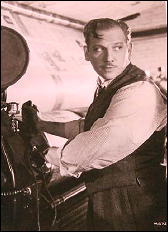
Reviewed by DAVID L. VINEYARD:         

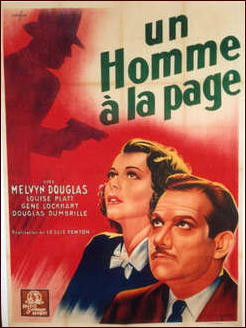
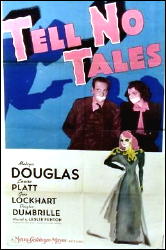
TELL NO TALES. MGM, 1939. Melvyn Douglas, Louise Platt, Douglass Dumbrille, Gene Lockhart, Zeffie Tilbury, Sara Haden, Florence George. Screenplay: Lionel Houser. Director: Leslie Fenton.

TELL NO TALES Melvyn Douglas

   Terrific two-fisted programmer from MGM that moves like an express and has a surprising amount of heart as well as brains. Douglas is Michael Cassidy, the editor of the Evening Standard, a big city newspaper about to be shut down by publisher Matt Cooper (Douglass Dumbrille) in favor of the tabloid rag he uses as his mouthpiece.

   When Cassidy stumbles on the story of the century, a hundred dollar bill that was part of a kidnap ransom shows up in his hands, he plans for the Standard to go out in a blaze of glory. Setting out to follow the trail of the wandering hundred dollar bill, he enlists the help of the only witness to the kidnapping, a feisty school teacher sick of being kept virtual prisoner by the police (Louise Platt).

   Cassidy follows the trail of the bill from a mousy jeweler about to be married; to a society doctor and his cheating wife; to a the wake of a black boxer possibly killed for his involvement with the kidnappers; to an attractive singer at a police benefit (with half the cops in town looking for him), a surprising source; and finally a casino owned by Gene Lockhart who leads him to the kidnappers, but for deadly reasons of his own.

TELL NO TALES Melvyn Douglas

   At each turn the screenplay is better than it needs to be, and the individual stories well drawn and handsomely shot, from the grieving widow of the boxer (the Alley Kid); to the frightened look on the doctor’s wife’s face when cornered about her lie; to a nicely sinister bit by Lockhart as the casino owner. Zeffie Tilbury is particularly good as a tough old lady copy editor who has been with the paper fifty years and known Cassidy since he was a copy boy.

   The finale is a bang up escape from the two kidnappers by Douglas and Platt, and a nicely rounded up ending, that, if a bit more upbeat and happy than the rest of the film would suggest, still leaves you more than well satisfied.

   I first heard about this from William Everson’s The Detective Film, and it is every bit as good as promised: a mix of tough guy dialogue, two fisted journalism, solid detective work, and sentiment that is just the right combination of schmaltz and cynicism that might have come out of Black Mask or Dime Detective, and the kind of stories about two-fisted reporters that Nebel, Sale, Babcock, and Coxe specialized in.

   Next time this shows up on TCM, be sure and catch it. It’s as slick as any A-film, and packs as much in sixty nine minutes as most A-films did in films half again as long.

   Tremendous pace, sharp crackling dialogue, affecting vignettes by great character actors, and a pretty good mystery that unfolds on the run, this one can hold its own against many a bigger picture that doesn’t have half its heart or head.

TELL NO TALES Melvyn Douglas

REVIEWED BY GEOFF BRADLEY:         


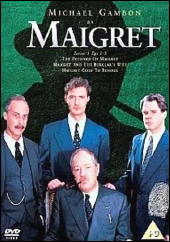
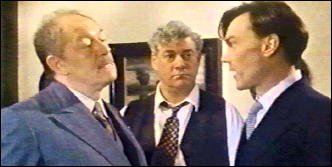
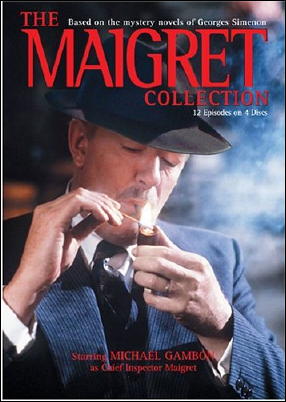
MAIGRET. Granada TV, UK. Second series: six 60-min episodes. 14 March through 18 April 1993. Michael Gambon (Chief Inspector Jules Maigret), Geoffrey Hutchings (Sgt. Lucas), Jack Galloway (Inspector Janvier), James Larkin (Inspector LaPointe).

— Reprinted from Caddish Thoughts #42, May 1993.

MAIGRET Gambon

   A second six part series of Maigret has recently been and gone. I watched with extra vigilance after the adverse comments about the first series in Mystery & Detective Monthly. I enjoyed this series. It’s steady and reliable without being flashy or exciting and adapts the stories well into a 50-minute format.

   The difficulty of adapting stories from a long series of books to screen is to achieve a uniformity of time and character. The decision to shoot exterior scenes in Budapest, since it was easier to recreate 1950’s (the time period chosen for the series) Paris there rather than in the Paris of 1993 seemed reasonable, although exterior scenes were kept to a minimum anyway.

   I do not subscribe to the theory that English actors speaking English portraying Frenchman speaking French should adopt the accent of a Frenchman speaking English badly (as, say, Poirot — although, of course, he’s Belgian). The producers, correctly in my opinion, used the appropriate English accent to portray the rank or position of the speaker, so a doctor would speak with a polished accent where a labourer would adopt a rougher less educated one. A foreign sounding accent was only used for characters who were not French and could be assumed to be speaking French with a foreign accent.

MAIGRET Gambon

   I thought an article in the current issue of Armchair Detective rather silly. It seems we should have had a French actor playing the part, although it isn’t made it clear if the actor should be speaking in French or English.

   If English, I suppose we’d be looking for a French actor who speaks English but not well. If they ever make a series of Lindsey Davis’s books I wonder how they’re going to cast Falco? Perhaps they’ll be able to dig up an ancient Roman from somewhere.

   The author of the article also says: “If we wanted an Englishman playing the part, we’d watch a repeat of the dreadful American TV movie starring Richard Harris.”

   I’m quite at a loss as how to evaluate this statement. Apart from the fact that Harris is not English anyway, is he saying that once an actor has portrayed a character, even if badly, he would watch it repeatedly rather that watch an actor from the same country play the same role?

   Anyway for the record the six stories were: “Maigret And The Night Club Bouncer,” “Maigret And The Hotel Majestic,” “Maigret On The Defensive,” “Maigret’s Boyhood Friend,” “Maigret And The Minister,” and “Maigret And The Maid.”

MAIGRET Gambon

REVIEWED BY DAN STUMPF:         


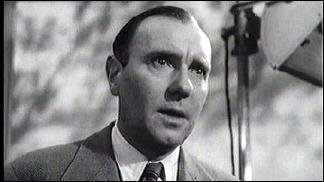
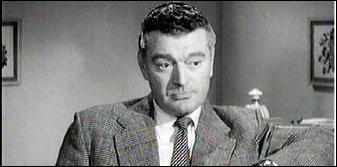
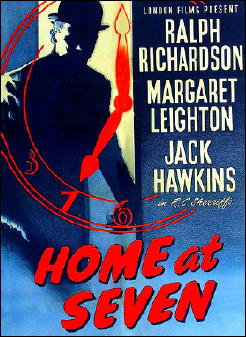
HOME AT SEVEN. British Lion Film Corp., 1952. Released in the US as Murder on Monday, 1953. Ralph Richardson, Margaret Leighton, Jack Hawkins, Campbell Singer, Michael Shepley, Margaret Withers. Based on a play by R.C. Sherriff. Director: Ralph Richardson.

  [Before reading the review that follows, you may wish to go back to Dan’s earlier comments on Interrupted Journey, reviewed here.   —Steve.]

HOME AT SEVEN Ralph Richardson

   That scene toward the end of Interrupted Journey came strongly to mind as I watched another British Film, Home at Seven, the only film ever directed by Sir Ralph Richardson, and a pleasant surprise from start to finish.

   When Great Actors turn to Directing Fillums, they often get a bit mannered. Sometimes unbearably so. I’m reminded of Laurence Harvey’s awful The Ceremony and John Wayne’s ponderous The Alamo. Even films I rather enjoy, such as Olivier’s Hamlet and Brando’s One-Eyed Jacks suffer from a certain amount of self-conscious narcissism.

   Which is why I was so charmed by Home at Seven’s unpretentious spontaneity. From start to finish, it’s a quiet, workmanlike job of entertainment never flashy — boasting fine performances from Richardson (always a delight to watch) Margaret Leighton and Jack Hawkins.

HOME AT SEVEN Ralph Richardson

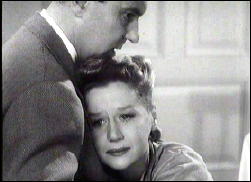
   I can tell a little about the plot this time: Richardson plays a Bank Clerk who returns home from work one night — carrying the evening paper; promptly at Seven as usual — to find his wife in tears. His first impulse is to soothe her, of course, and when she tells him he’s been missing for the last 24 hours, he poohpoohs the notion, pointing out that he’s clean, shaved, his clothes not slept in, and carrying the Monday Paper: Hardly the appearance of a man who’s lost a day.

   Surely, he tells her, it must have been a dream she had while napping. Must stop working so hard, and all that. At which point he discovers that it’s Tuesday’s Paper he’s holding.

   It’s an intriguing notion to start a film with, and it gets better as Richardson discovers that money he was responsible for is missing and a close associate is dead. Very swiftly, the film becomes another paranoid nightmare, on the order of Interrupted Journey, but done with just a touch more realism and consideration to character.

HOME AT SEVEN Ralph Richardson

   Unlike the characters in most thrillers, everyone in Home at Seven seems perfectly real and very likable: Richardson’s Average-Guy Hero, his fretful wife, Jack Hawkins’ sympathetic Doctor and even someone named Campbell Singer as an apologetic but insistent Police Inspector. One gets a real sense of ordinary people who’ve had some awful intrusion into their lives and can’t figure how to cope with it.

   There is a stunningly effective scene in Home at Seven where Richardson and his wife are at home and he thinks the Police are coming to arrest him for Murder. Sound familiar? I thought so too. But wait; Feeling the Long Arm of The Law at his back, Richardson sits down with his wife at the kitchen table and quietly begins to explain to her how to do the Accounts.

   It’s a moment all the more touching for its restraint with both of them trying hard not to cry as they deal with the commonplace aspects of a nightmare, and it shows a sensitivity and intelligence that are just too rare in the Film Thriller.

HOME AT SEVEN Ralph Richardson

REVIEWED BY WALTER ALBERT:         


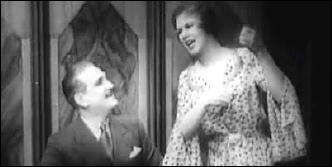
QUEEN HIGH. Paramount, 1930. Charlie Ruggles, Frank Morgan, Ginger Rogers, Stanley Smith, Helen Carrington, Rudolph Cameron, Tom Brown. Music arranged by John Green. Director: Fred C. Newmeyer. Shown at Cinefest 28, Syracuse NY, March 2008.

QUEEN HIGH Ginger Rogers

   This early sound musical, based on a Broadway musical comedy that co-starred Charlie Ruggles and Frank McIntyre, was adapted for the screen with McIntrye replaced by Frank Morgan, and an enlarged ingenue role for Ginger Rogers.

   Morgan and Ruggles are combative partners in a garter-manufacturing business, which is the basis for some naughty dialogue and semi-risque situations in the opening scenes. When the two partners decide to dissolve their relationship, their lawyer devises a plan in which the loser at a game of cards will serve as valet to the other partner for a year, after which the partnership will be dissolved.

   Ruggles loses the game and his increasing dissatisfaction with his new role and his attempts to sabotage it fuel the comic situations until it’s all happily resolved. There’s a nicely staged musical number early in the film, but the music is generally incidental to the comedy.

IT IS PURELY MY OPINION
Reviews by L. J. Roberts


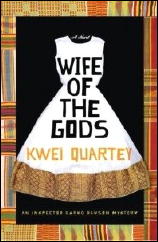
KWEI QUARTEY – Wife of the Gods. Random House, US, hardcover, July 2009; trade paperback, August 2010.

KWEI QUARTEY

Genre:   Police procedural. Leading character:   Det. Inspector Darko Dawson; 1st in series. Setting:   Ghana, Africa.

First Sentence:   The forest was black and Darko was afraid to enter.

    DI Darko Dawson is ordered to investigate the murder of a young woman in Kentau, the town from which his mother disappeared many years before. Fighting an incompetent local policeman, Inspector Fiti, superstition and a local priest to whom young women are given as trokosi or wives of the gods, Dawson sets about trying to solve both mysteries and prevent an innocent man from being hanged.

    I very much enjoyed this book. On one hand, it is a wonderful look into life in Ghana, which was fascinating; on the other hand it’s a good, solid mystery.

    Quartey creates a very strong sense of place whether it be in the town or the small village. We see the customs, even down to the manner of salutations, and superstition, as well as the contrast between lives in the two environments.

KWEI QUARTEY

    Dawson is well-crafted character. He comes from a family history that is less than ideal, smokes marijuana, although it is illegal, a critically ill son and a difficult relationship with his mother-in-law. Although it wasn’t focused upon, I did wonder whether Dawson has a form of synesthesia from there being a couple mentions of his being able to feel voices.

    I appreciated the contrast between Dawson, who uses standard investigative techniques, and Fiti who believes in superstition and forcing a confession to prove his belief. However, I also appreciated there being repercussions for Dawson’s actions, which is unusual.

    The story is well plotted and I certainly did not figure out the killer rior to it being revealed. It is wonderful to see more new authors appearing from other countries. I look forward to reading Mr. Quartey’s next book.

Rating:   Very Good.

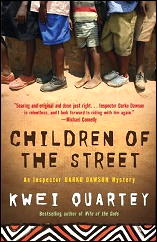
Coming soon:   Darko Dawson #2. Children of the Street, Random House, trade ppbk, July 2011.

REVIEWED BY DAN STUMPF:         


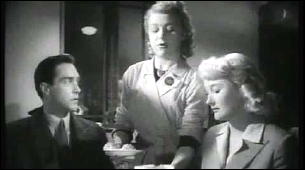
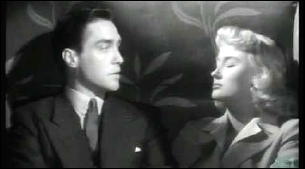
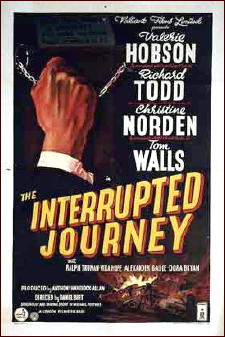
INTERRUPTED JOURNEY. British Lion, UK, 1949. Valerie Hobson, Richard Todd, Christine Norden, Tom Walls, Ralph Truman, Vida Hope, Alexander Gauge. Screenplay: Michael Pertwee. Director: Daniel Birt.

INTERRUPTED JOURNEY

   Interrupted Journey is sort of a PG version of Fatal Attraction and a film I recommend to any man thinking of cheating on his wife.

   Richard Todd plays a struggling young writer whose wife wants him to get a job. He elects to run off with a wealthy married woman who flatters him, but as they’re preparing to leave he finds himself persecuted by doubts, nagging conscience, and the strange feeling they’re being followed.

   They board a train that happens to pass close by his house and, on impulse, he pulls the Emergency Cord, stops the train and flees back to his wife. But then…

INTERRUPTED JOURNEY

   Well, again, it’s one of those films so full of surprising twists that I hate to tell any more. Suffice it to say that the screenwriters turn Todd’s aborted fling into a finely-honed paranoid nightmare, well-played by a bunch of folks I never heard of, and produced with that quiet, comfortable, sumptuous care typical of post-war British films at their best.

   There is, incidentally, a scene in Interrupted Journey that caught my attention for reasons I’ll discuss next time: It’s that moment that comes in about every third thriller ever made, where the Hero’s accused of Murder, the Police are coming for him, and he convinces the Heroine (in this case his doubting wife) to hide him.

   It’s done here with more intelligence than usual, and a real feeling for the poor wife’s tortured struggle with herself over how far she ought to trust her punic husband.

INTERRUPTED JOURNEY

REVIEWED BY STAN BURNS:


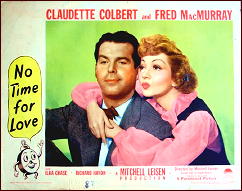
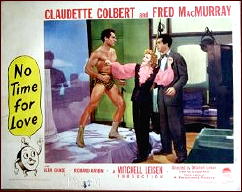
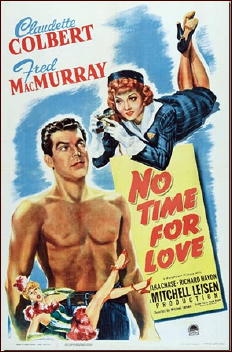
NO TIME FOR LOVE. Paramount Pictures, 1943. Claudette Colbert, Fred MacMurray, Ilka Chase, Richard Haydn, Paul McGrath, June Havoc, Marjorie Gateson. Director: Mitchell Leisen.

NO TIME FOR LOVE Claudette Colbert

   Sandhog Jim Ryan (Fred MacMurray, who is surprisingly buff with his shirt off) is suspended for four months from his job digging a tunnel because of a “friendly” fight with fellow workers that was by happenstance shot by society photographer Katherine Grant (Claudette Colbert).

   Because the picture was run by her jealous boyfriend in his magazine (without her knowledge and against her wishes), and its publication led to Ryan’s job loss, Katherine feels responsible and hires Ryan to assist her while he is suspended for four months — which turns into a disaster as he clashes with her on all of her assignments, including picking a fight with a body builder she is try to photograph.

NO TIME FOR LOVE Claudette Colbert

   The two are the perfect mismatched pair: she is elegant and refined, and he thinks all her friends are stuck-up jerks and chases after blond floozies. Obviously they are going to fall in love.

   A few good lines, but mostly the movie is carried by the charm of the lead actors. The underground tunnel set is very well created and the movie was deservedly nominated for an Oscar for Art Direction. The actors must have loved working in all that mud!

   Definitely worth a look, but MacMurray and Colbert are much better paired in The Egg and I.

Rating:   B.

NO TIME FOR LOVE Claudette Colbert

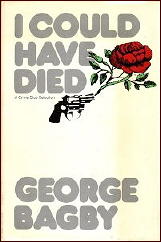
GEORGE BAGBY – I Could Have Died. Doubleday Crime Club, hardcover, 1979.

GEORGE BAGBY I Could Have Died

   I find the stories that “Bagby” tells us about the exploits of Inspector Schmidt of New York City Homicide about as fast and easy to devour as a fresh batch of hot, buttered popcorn. And he must write them at just about the same rate — after all, this does make seven now that have appeared in just the last three years.

   It doesn’t actually begin as a case of homicide. Following the kidnapping of Bagby and two lady companions as part of a successful hotel robbery, quite inexplicably the younger of the two ladies finds herself falling in love with one of her captors. And of course a murder eventually occurs.

   There are a few too many holes for the engagingly pleasant and witty plot that results to hold up well under close observation, but in all honesty it also very nearly works the way it’s supposed to.

— Reprinted from The MYSTERY FANcier, Vol. 3, No. 5, Sept-Oct 1979. This review also appeared earlier in the Hartford Courant. Very slightly revised.


[UPDATE] 03-03-11.   I’m going to suggest this book to Patti Abbott for inclusion in tomorrow’s weekly roundup of Forgotten Friday mystery novels on her blog. I don’t believe that George Bagby — in real life Aaron Marc Stein, under which name he wrote an equally long list of other detective novels — got nearly the critical attention that I always thought he should have, and he’s definitely forgotten by all but a few devoted aficionados now.

   Perhaps he was too prolific, and maybe the endings didn’t match the cleverness of other writers’ mysteries (nor perhaps the openings of his own books), but I always admired the way he had for descriptive passages, making the most prosaic actions — such as taking the cap off a toothpaste tube or hunting for a set of lost keys — seem interesting.

   George Bagby, by the way, if the review wasn’t quite clear on this, was both the pen name and the character in the Bagby novels who tagged along with Inspector Schmidt and chronicled his cases for him.

Reviewed by DAVID L. VINEYARD:         

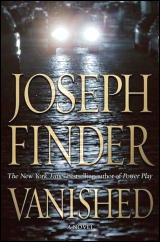
JOSEPH FINDER – Vanished. St. Martin’s Press, hardcover, August 2009; reprint paperback, August 2010.

JOSPEH FINDER Nick Heller

   Vanished is the first book in a new series by a writer who specializes in financial intrigue, and who has written several best selling roman a clef’s (The Moscow Club, Power Play) that benefited by prefiguring events that made the headlines across the world, and made his debut with a controversial non-fiction work, The Red Carpet, that exposed the ties of the KGB to American entrepreneur Armand Hammer..

   Vanished introduces Finder’s first continuing character, Nick Heller, chief investigator and trouble shooter for Stoddard International and Jay Stoddard, its CEO. Heller is an ex-Special Forces type (de rigueur in today’s thrillers) replete with personal demons and a tough no-nonsense approach to his work.

   If that echoes many of the heroes in today’s thriller fiction, what separates Finder from the pack is that he both can really write, and his plots dealing with corporate intrigue have the ring of truth.

   The glamour of big business and ruthless corporate back fighting is nothing new in thrillers. John D. MacDonald frequently used shady business as a background in this thrillers as did Hammond Innes, and as have many writers including Michael Thomas, Thomas Gifford, and more recently Christopher Reich. For that matter Emma Lathen’s John Putnam Thatcher series gave us a banker sleuth in that cut-throat world — albeit with more than a dash of humor.

   Heller proves to be a likable and believable protagonist. In his first outing the job he’s on for his boss gets pushed aside when his brother Roger disappears after Roger’s wife Lauren is nearly killed. Roger’s panicked teen age son calls on his uncle.

   Nick and Roger have a complicated relationship — dating back to their childhood, and their father who is still in Federal prison for securities fraud and insider trading and has been since Nick was only thirteen. Roger followed in Dad’s footsteps — at least in regard to working in the financial world.

JOSPEH FINDER Nick Heller

   Heller proves a competent guide through the complexities of financial finagling as he pursues his brother — who may not want to be found — as well as a tough no nonsense fighter pitted against a variety of gun-waving types and a ruthless killer known as the Surgeon. Along the way he also grows closer to his nephew, Gabe, who reminds him of himself when confronted with the duplicities of the adult world.

   Vanished is a fast read, written in short clipped, staccato chapters and clear prose that is refreshingly free of the jingoism, posing, and diatribes that crowd too many of today’s thrillers.

   Finder is satisfied to tell a good story well and let the facts speak for themselves without undue editorializing, while still allowing Heller to emerge as a believable protagonist with a recognizable voice and manner.

   I will admit I got to the solution before Heller did, but not by much, and less based on evidence than being overly familiar with thriller structure. It’s not a flaw of the book by any means, and it is a neat and simply explained scheme at the heart of the matter that even readers who think the Wall Street Journal and Financial Times might as well by written in Chinese will have no trouble following.

   Heller admits he is channeling Batman as much as Philip Marlowe, but remains humanly tough and never cartoonishly so. Heller has been compared to Lee Child’s Jack Reacher, but I found him a much more believably human character.

   Nick Heller proves a refreshingly bright and straightforward protagonist who even gets away with introducing himself with “It was a dark and stormy night.” You have to admire that kind of chutzpah from one of the more believably likable and competent thriller heroes I’ve encountered in some time, who manages to suffer from a complex background and angst without making the reader suffer through them as well.

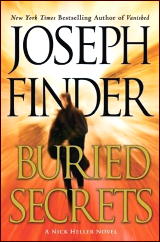
Editorial Note:   Buried Secrets (Nick Heller #2) will be published in hardcover this coming June.

« Previous PageNext Page »