Reviews


REVIEWED BY CURT J. EVANS:         


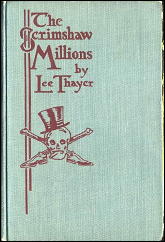
LEE THAYER – The Scrimshaw Millions. Sears & Co., hardcover, 1932. Hardcover reprint: The Macaulay Company, no date.

   There are five killings in the tale, yet The Scrimshaw Millions is not remotely exciting. What should have been a gripping family extermination murder story on the order of S. S. Van Dine’s grandly baroque The Greene Murder Case (1928), instead is a snoozer the reader has to drive himself to finish.
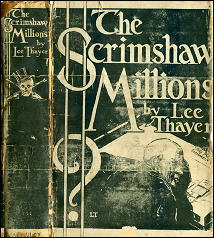
LEE THAYER The Scrimshaw Millions

   But finish it I did, dear readers! It takes a lot to stop this fellah from plowing through to the end of a Golden Age whodunit, even a fourth- or fifth-tier one. Heck, I’ve read a dozen mysteries by Carolyn Wells!

   In The Scrimshaw Millions someone is fatally poisoning the members of the Scrimshaw family one by one. A fortune is at stake — who will survive to inherit? And how long will it take for you to cease caring one iota?

   To be fair, The Scrimshaw Millions struck me as superior to the books described earlier on this blog by Francis M. Nevins. The prose is serviceable, lacking those purple passages quoted by Nevins (at least until the cosmic retribution denouement Nevins has noted as a common feature of her books).

   The characters, while sticks, are not irritating (except when meant to be — though perhaps we could have done without the Italian houseservant/blackmailer, regrettably named Guido). Generally speaking, you can believe this tale is taking place in the 1930s rather than a half-century earlier, unlike Carolyn Wells’ mysteries from the same decade.

   Moreover, the clueing is respectable. And the murder means used in the five killings is…. Well, while it’s not original to Thayer (and John Rhode used it in a detective novel three years later, though only for a murder attempt late in the book), it’s kind of cute, in Golden Age Baroque fashion.

   However, fatal weaknesses in The Scrimshaw Millions are its slack narrative, its sometimes careless writing and its lack of credible police procedure and scientific detail.

   I have read the claim that the hugely prolific thriller writer Edgar Wallace, who boasted of being able to compose novels over weekends, in the course of one tale managed to change the name of his heroine (i.e., she starts off as Janet, say, and becomes Betty). Yet I had never come across such a phenomenon myself in an Edgar Wallace shocker, or, indeed, in a mystery tale by any other author — until I read Lee Thayer.

   In The Scrimshaw Millions the secretary of that late, unlamented miser, Simon Scrimshaw, is introduced on page 51 as “Evangeline Osgood.” Yet five pages later her surname has changed to “Ogden.”

   And there’s more! Although we are told for most of the tale that Simon’s two spinster sisters — thought at first to have died from heart failure–were both poisoned by “aconite” (I think “aconotine” was meant), late in the book the poison abruptly becomes arsenic.

   All in all, I think it’s fair to say Lee Thayer was playing fast and loose with poisons, as well as with police procedure, in The Scrimshaw Millions. For no credible reason whatsover, three different poisons are used to slay in the tale, all by the same individual murderer: the alchemical aconite/aconotine/arsenic concoction, nicotine and cyanide (the last is later called hydrocyanic acid).

   One might have thought this might have made the police suspicious of the character we are told works in a chemical factory, but, nope! It doesn’t seem to occur to anyone even to cock an eyebrow.
LEE THAYER The Scrimshaw Millions

   You might also think the murderer would have had to have been mad to adopt such an approach to attaining an inheritance. Well, hold on to your hats, it looks like he was:

    “It’s too late now!” The exultant light of madness [shone in his eyes]. [p. 299]

   Nearly forty years ago, Julian Symons labeled certain formerly quite popular and highly regarded detective novelists like John Rhode (a peudonym of Cecil John Charles Street) as “humdrums.” Other, more recent, mystery genre survey authors like P.D. James have followed suit, adopting Symons’ disparaging tone toward these writers.

   Yet, compared to Lee Thayer, I say please, Lord, give me more “humdrums” like John Rhode. The use Rhode makes of science in his tales often is quite fascinating, ingenious, adroit and credible. In The Scrimshaw Millions none of those adjectives can be applied to Thayer’s (mis)use of science.

   Traditionalist American mystery writers of the Golden Age of detection like Lee Thayer and Carolyn Wells often aped, as much they could, the form and milieu of detective novels of superior British counterparts.

   Thayer, for example, clearly seems to have deliberately copied Dorothy L. Sayers’ Lord Peter/Bunter master-servant relationship with her own series detective, red-haired Peter Clancy, and his impeccable English manservant, Wiggar (the latter character was introduced by Thayer in 1929, ten years after she had debuted Clancy and six years after Sayers gave the world Lord Peter and Bunter). But Thayer and Wells are but pale shadows of far more substantial authors (and to be sure, there were many first-rate American traditionalists as well).

   Still, the patented Lee Thayer cosmic retribution denouement so aptly described by Mike Nevins is impressive in its own loopy way. In The Scrimshaw Millions the entire house of the murdered miser falls in on the investigators and suspects just after the killer, pressed by the intrepid detective Peter Clancy, makes his mad confession:

    The terrible cry of repudiation rang out in the desolate house, and as if the awful horror in it had terrible power there came a strange, wild shudder, a trembling through all the ancient walls, a hideous splitting crash, and the ceiling above their heads sagged downward, ripped across, and fell. [pp. 299-300]

   Top that if you can, Agatha Christie and Hercule Poirot! Don’t tell me you’ve never wanted the roof to collapse on one of those drawing room lectures David Suchet gives in every darn one of his TV productions.

   Providentially, one might say, only the mad murderer is killed when the house collapses in The Scrimshaw Millions. The nice boy lives to marry the nice girl, the policemen survive to continue getting murder cases all wrong, and Wiggar escapes the wreckage to continue happily serving his mildly concussed master Peter Clancy in many another perhaps-something-less-than-entirely-enthralling Lee Thayer mystery.

REVIEWED BY MICHAEL SHONK:


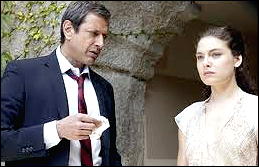
RAINES. NBC-TV, March 15 thru April 27 2007. Created by Graham Yost. Cast: Detective Michael Raines: Jeff Goldblum, Captain Lewis: Matt Craven, Carolyn : Nicole Sullivan, Lance: Linda Park, Boyer: Dov Davidoff. Recurring Characters: Dr. Kohl: Madeline Stowe, Charlie: Malik Yoba.

RAINES Jeff Goldblum

    Raines is a rare example of a creative television series with a premise so different even the seasoned TV mystery fan will be pleasantly surprised.

   Detective Michael Raines is a failed writer turned homicide detective who needs to talk out the crime with someone. When he loses his partner, and no one else will partner with him because they think he is a weird jerk, Raines turns to the dead victims.

   Raines is not Topper meets Sherlock Holmes. The dead victims are not ghosts but figments of Raines’ own imagination. Because of this, the victims can not tell Raines anything he does not know. In “Fifth Step,” the victim’s head had been shot off by a shotgun blast. Raines sees the headless victim walking around until he sees a picture of her.

   In each episode we watch how the victim changes as Raines learns more about the dead person. In the pilot, Raines imagines the dead girl as a young innocent woman. As he learns more that image changes. When he learns she may have had an affair with a married man, Raines’ image of her changes to resemble Kathleen Turner in Body Heat, complete with the film’s theme song playing on the soundtrack.

RAINES Jeff Goldblum

   As Raines and the viewer learn more about the dead body the character of the victim becomes more developed. No longer is the victim just a body to start the mystery. He or she becomes more and more real to the viewer, so much so we mourn the loss and tragedy of the victim’s death.

   Raines is eager to solve the case and get the victim out of his head. When he does solve the mystery, we have grown close enough to the victim to share Raines’ relief and sadness of closure.

   The humor is dark, sarcastic, and at times can be laugh out loud funny. With the dead victim hovering around Raines waiting for answers, we feel the anger that fuels such humor. As a result the humor in this series has substance that is rare outside Raymond Chandler.

   Jeff Goldblum is perfect as Raines, a man who lives with the terror he might be insane, yet driven to help find closure for the dead victims and those close to them.

RAINES Jeff Goldblum

   Award winning showrunner Graham Yost (Justified, The Pacific) enjoys twisting the normal roles and rules of the mystery genre. In “Meet Juan Doe,” the police artist wants to do “graphic novels” and his sketch of a badly disfigured Mexican looks like Eric Erstrada.

   Perhaps the best genre description of Raines is Victim Noir. Everything including the plot is centered around the victim. In “Stone Dead”, the plot begins as a story about a racist’s revenge against a judge, but as we learn more about the victim the crime changes. Often the backdrop of the crime challenges Raines’ perspective regarding social issues such as the homeless, addiction, and illegal immigration.

   Raines is a series no TV mystery fan should miss.

   All seven filmed episodes can be seen at Hulu.com.

Reviewed by DAVID L. VINEYARD:         


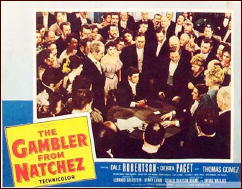
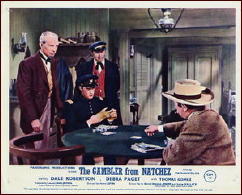
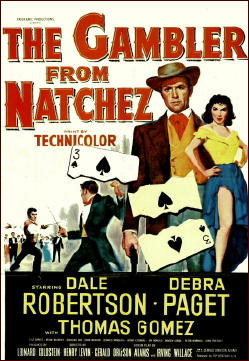
THE GAMBLER FROM NATCHEZ. 20th Century Fox, 1954. Dale Robertson, Debra Paget, Thomas Gomez, Kevin McCarthy, Lisa Douglas, Douglas Dick, Jay Novello, Woody Strode, John Wengraf, Donald Randolph, Henry Leontal, Parley Baer, Peter Mamakos. Screenplay by Gerald Drayson Adams & Irving Wallace, based on a story by the former. Director: Henry Levin.

THE GAMBLER FROM NATCHEZ

   A Southern swashbuckler rather than a Western, this entertaining outing is a canny variation on The Count of Monte Cristo.

   Robertson is Captain Vance Colby, of the Louisiana Volunteers, returning in the early 1840’s to New Orleans after four years serving under Sam Houston in Texas. The son of a well known gambler, he returns to encounter social prejudice from dilettante Andre Rivage (Kevin McCarthy) after aiding Rivage’s beautiful sister Yvette (Lisa Douglas) with her carriage.

   As Colby rides to meet his father after leaving his cold reception at Rivage’s plantation Araby, he is wounded when ambushed by Rivage’s man Etienne (Peter Mamakos), but escapes to the river where he is rescued by Melanie Barbee (Debra Paget) and her riverboat captain father (Thomas Gomez) whom he met earlier, and their man Josh (Woody Strode).

THE GAMBLER FROM NATCHEZ

   Recovering from his wound he returns to New Orleans to find his father murdered by Rivage, accused of cheating, with three witnesses; Claud St. Germaine (Douglas Dick), the weak fiancee of Yvette; Nicholas Cadiz (John Wengraf), the owner of the casino the Saint Cyr where his father was killed; and Jay Novello, the waiter serving that night.

   With the police (in the person of the Commissioner played by Henry Leontal) on the side of the city’s Creole elite and the wealthy Cadiz, Colby must discover why his father was set up and murdered and avenge himself on the three men who committed the crime after having lost their new riverboat to Colby’s father in a game of 21, but in such a way the police can’t touch him.

   The day he came home from Texas Colby pocketed a playing card, the three of spades, now he has written the names of his father’s murders on it and sets out to destroy them one by one.

   The film is handsomely shot, with fine sets and costumes, and Robertson makes a dashing hero — even doing his own blade work in the final sword fight with McCarthy and handling it quite well.

THE GAMBLER FROM NATCHEZ

   The theme of the three of spades runs throughout the film, with the neat touch that in the final confrontation with McCarthy in a game of 21, it is the three of spades that puts McCarthy over 21 and loses the game for him, taking both the riverboat, and Araby, his family estate.

   A well handled plot well written by Adams and Wallace, capable direction, and a handsome cast all combine to insure this one delivers everything it promises and more. Robertson is steadfast and dashing, Paget gorgeous, Gomez up to his usual scene stealing, and McCarthy a fine villain, by turns arrogant, snide, scheming, cowardly, and ruthless.

   There are no surprises here, save perhaps for how well it all plays, and how good this little film really is. Dumas himself would have been proud to have inspired it.

THE GAMBLER FROM NATCHEZ

IT IS PURELY MY OPINION
Reviews by L. J. Roberts


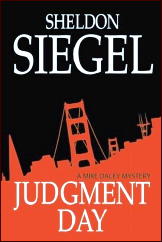
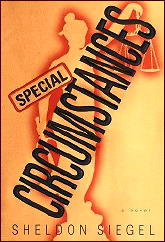
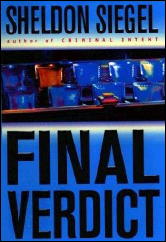
SHELDON SIEGEL – Judgment Day. MacAdam/Cage, hardcover, June 2008; trade paperback: June 2010.

Genre:   Legal thriller. Leading characters:   Mike Daley & Rosie Fernandez; 6th in series. Setting:   San Francisco/Bay Area.

SHELDON SIEGEL

First Sentence:   The oldest man on death row is eying me from his wheelchair.

    Attorney Mike Daley, in spite of a promise to his ex-wife and law partner Rosie Fernandez, takes on a death-row appeals case. Former powerhouse-attorney Nate Fineman, is due to die in eight days. He was convicted of killing three men in a Chinatown restaurant shooting, but he claims he is innocent and the gun was planted by the police.

    Now Mike has not only to prove Nate’s innocence, but to find and identify the killer in order to prevent Nate’s execution. There is one slight conflict; Mike’s late father was one of the officers at the scene of the shooting.

    Living in the Bay Area, I do love books set here and it is delightful to read of places I know or have been and people whose names are iconic with the area. But it is also nice that Siegel gets the geographic and atmosphere right as well.

    Siegal has a great voice, writes realistic dialoque and uses humor well, but it’s his characters I particularly like. His people are … people; not over-the-top or infallible. Mike and his ex-wife Rosie work together, are occasionally intimate but can’t life together yet they make it work so they are both involved in their children’s lives.

   The contrast between Mike and his ex-cop brother, Pete, is a study in contrasts and adds dimension to both characters. The story is very well plotted.

    The element of time counting down is always effective and, although I don’t know how realistic they may be, I do particularly like the courtroom scenes. [An attorney friend tells me the courtroom scenes are very well done.]

   Siegel is a writer whose books I very much enjoy and was pleased to learn there is a new book on its way.

Rating:   Very Good.

      The Mike Daley & Rosie Fernandez series —

1. Special Circumstances (2000)

SHELDON SIEGEL

2. Incriminating Evidence (2001)
3. Criminal Intent (2002)
4. Final Verdict (2003)

SHELDON SIEGEL

5. The Confession (2004)
6. Judgment Day (2008)
7. Perfect Alibi (2009)

REVIEWED BY WALTER ALBERT:         


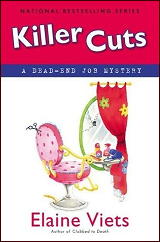
ELAINE VIETS – Killer Cuts. Obsidian, paperback original, May 2009.

ELAINE VIETS Killer Cuts

    Viets, returning to her “Dead-End Job” series after what was apparently a successful recovery from a stroke, has her protagonist Helen Hawthorne working in a high-end hair salon, with a marriage to her boyfriend, Phil, finally in the planning stages.

    When Helen’s boss becomes a prime suspect in a murder case, the business at the salon bottoms out overnight, and Helen’s job and her marriage are both threatened.

    Helen’s still living in an apartment at the Coronado Tropic Apartments, with an engaging, eccentric landlady, and still wondering if her ex-husband will once again turn up to threaten her precariously grounded existence.

    Of course, the reader can be certain that the murder plot will be resolved, but that Helen’s long-term problems will linger into the succeeding novels in the series. And, as long as Viets’ light touch is as secure as it still in this eighth entry, that should be just fine with her faithful readers.

Editorial Comments:   For a list of the novels in all three mystery series that Elaine has written, along with covers with most, follow this link to the Fantastic Fiction website. The three series: “St. Louis journalist-sleuth Francesca Vierling,” “Dead End Jobs,” and “Josie Marcus, Mystery Shopper.”

   An interview that Pamela James did with Elaine Viets appears on the main Mystery*File website. It was conducted in December, 2004, which was quite a few books ago, but it’s not entirely out of date and (in my opinion) still interesting.

REVIEWED BY DAN STUMPF:         


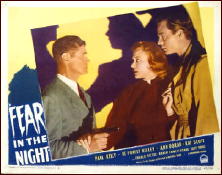
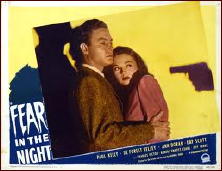
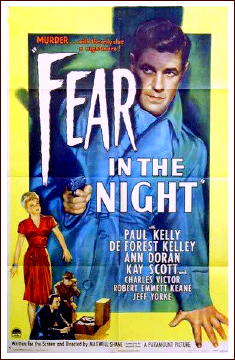
FEAR IN THE NIGHT 1947.

FEAR IN THE NIGHT. Paramount Pictures, 1947. Paul Kelly, DeForest Kelley, Ann Doran, Kay Scott, Charles Victor, Robert Emmett Keane. Screenplay: Maxwell Shane, based on the short story “Nightmare” by William Irish (Cornell Woolrich). Director: Maxwell Shane.

   A nicely-done ”B” with some good atmospherics buoying up so-so characterizations and an indifferent script, wrapped around a fine, dream-like plot.

   DeForest, haunted by nightmares that he’s killed someone in a make-believe room, confides in his Cop Brother-in-Law Paul, then finds that the room really exists and the murder actually occurred.

FEAR IN THE NIGHT 1947.

   With a little sharper writing, this could’ve been a much better film, but as it is, it just misses the mark. DeForest is written as a trepidant weakling, and Paul as a Tough Cop, and the two of them never manage to break out of the cardboard confines of their cliche’d characters (he alliterated.)

   Worse, writer/director Maxwell Shane seems perfectly content not to develop DeForest’s character, as if he never realized the Dramatic Potential in the story of a man trying to convince the World and himself that he’s not a Killer.

   Well, it’s at least noir-ish enough to keep it interesting.

FEAR IN THE NIGHT 1947.


Editorial Comment:   The movie in its entirety can be watched online here. (Follow the link.)

A REVIEW BY RAY O’LEARY:
   

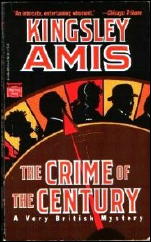
KINGSLEY AMIS – The Crime of the Century. Mysterious Press, US, hardcover, 1989; reprint paperback, October 1990. UK edition: J. M. Dent, trade paperback, 1989.

KINGSLEY AMIS Crime of the Century

   In London, three women are found stabbed to death within a few days, each with a similar “clue” planted on the Body. So the Police have a Serial Killer on their hands, and to quiet growing unrest, the Under-Secretary, with the wisdom of his breed, forms a Committee to deal with the problem.

   But as the murders continue, it becomes obvious to one of the Committee-Men that the Killer must be one of his fellow-members.

   Crime of the Century was originally a serial in the Sunday London Times in 1975, and like most serials it’s passably entertaining but ponderously lightweight. Amis fills the Committee (read Suspect list) with every modem “type” he or I could imagine, and rings in some rather banal Red Herrings, such as the Terrorist Group extorting money and the Nice Guy who suffers Mysterious Blackouts.

   After the Fifth Installment in the Times, readers were invited to submit their own endings, and the winner is reprinted here, along with Amis’ own finish. I hate to say it, but the Winner’s solution was a bit better.

REVIEWED BY BARRY GARDNER:


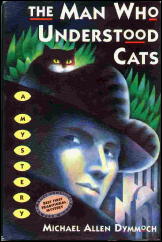
MICHAEL ALLEN DYMMOCH – The Man Who Understood Cats. St. Martin’s, hardcover, 1993. Avon, paperback, 1995.

MICHAEL ALLEN DYMMOCH The Man Who Understood Cats

   This is a first novel, an entry in St. Martin’s 1991 Best First Malice Domestic Novel contest. Dymmoch is a pseudonym (and a rather odd one) for “a woman who is a municipal bus driver in one of Chicago’s upscale neighborhoods.” Okay. Seems kind of strange to me, but whatever.

   Dr. Jack Caleb is a Chicago psychiatrist with two cats, Freud and Skinner, and John Thinnes is a Chicago police detective. They meet when one of Caleb’s patients, an accountant, is discovered dead of apparent suicide. Neither Thinnes nor Caleb believe that the man killed himself, and the story deals with their efforts to find out what really happened, and their own somewhat troubled lives.

   The novel opens with a dream sequence done in purple, flowery prose, which really isn’t all that well crafted; after that, the prose style is completely straightforward, and quite adequate for a first novel. Both Thinnes and Caleb emerge as reasonably sympathetic characters, but everyone else ranges from stick to not believable.

   The plot, unfortunately, didn’t hang together too well, and was particularly lacking in verisimilitude when it came to police work. Other than the author’s obvious familiarity with parts of Chicago, there was little about the story that rang true.

   The book was more about the lives and troubles of the two leads than it was a mystery or a detective story. Like so very many first novels in “our” field, it was reasonably good prose-wise, but engendered the feeling in me that it was a mystery only because the author thought it would be easier to sell as such. I can’t recommend it.

— Reprinted from Ah, Sweet Mysteries #9, September 1993.


Editorial Comments:   For an interview with the author in 2007 (but one that does not reveal why she chose the pen name she did), go here on the Internet.

   A complete list of books by the author can be found here on her website. She also posts occasionally on The Outfit, a blog shared with a group of other writers based in Chicago.

THE BACKWARD REVIEWER
William F. Deeck


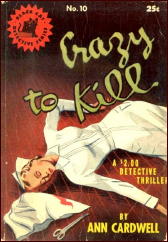
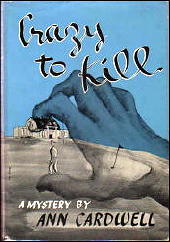
ANN CARDWELL – Crazy to Kill. Mystery House, hardcover, 1941. Black Cat Detective #10, digest paperback, 1944. Harlequin #22, Canada, pb, 1949. Macfadden 35-119, paperback, 1962. Nightwood Editions, softcover, Canada, 1990. The book was also converted to an opera with this title by James Reaney, Sr., and John Beckwith; it was performed in Canada in 1989.

ANN CARDWELL Crazy to Kill

   After spending ten years in Resthome, a private hospital for “nervous” cases, Agatha Lawson, a spinster in her early sixties, is due to be released. Unfortunately, just at this time a grisly series of attacks and murders involving the staff starts taking place at the hospital.

   Since Lawson is around at the time of each episode, she feels that she is more than capable to solve the case, particularly in view of the incompetence of Lieutenant Hogan of the local police.

   Also aware that Hogan is beyond his depth, the authorities bring in another detective, this one willing to consult with Lawson. Between them, the murderer is apprehended.

   One of the rare mysteries with a mental institution setting and one of the rare… But that mustn’t be revealed.

   Forget that this novel was published by Mystery House, a publisher of third- and fourth-rate novels. While not in the first rank, this is nonetheless quite readable.

— From The MYSTERY FANcier, Vol. 11, No. 4, Fall 1989 (slightly revised).


Bibliography: Adapted from the Revised Crime Fiction IV, by Allen J. Hubin —

    ANN CARDWELL. Pseudonym of Jean Makins Powley, 1902-1966. Daughter of a judge in Stratford, Ontario.

   Crazy to Kill. Mystery House, 1941.

ANN CARDWELL Crazy to Kill

   Murder at Calamity House. Arcadia House, 1947.

Reviewed by DAVID L. VINEYARD:         


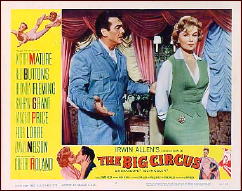
THE BIG CIRCUS

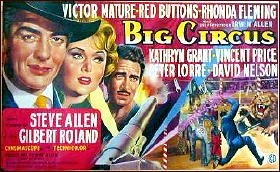
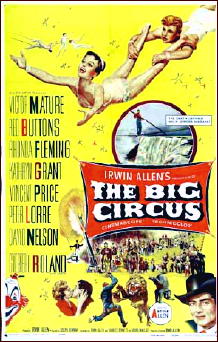
THE BIG CIRCUS. Allied Artists/Warner Brothers, 1959. Victor Mature, Rhonda Fleming, Red Buttons, Gilbert Roland, Vincent Price, Kathryn Grant, Peter Lorre, Adele Mara, David Nelson, Howard McNear, Steve Allen. Screenplay by Irwin Allen, Irving Wallace, Charles Bennett, based on a story by Irwin Allen. Director: Joseph M. Newman.

   Hokum is usually a detrimental comment on anything, but in this case it is a compliment to this bright entertaining circus movie from producer Irwin Allen.

   Victor Mature is ideally cast as Hank Whirling, a man with sawdust in his blood, who has just split with his partners, the ruthless Borman brothers, and needs to float a loan to keep the Whirling Circus in business. To that end he ends up saddled with banker Randolph Sherman (Red Buttons) and publicity agent Helen Harrison (Rhonda Fleming), neither of whom he wants.

THE BIG CIRCUS

   The Whirling Circus is a family affair; the prime players being ringmaster Hans Hagenfeld (Vincent Price), sardonic clown Skeeter (Peter Lorre), high wire and trapeze stars The Great Calinos, Zach and Mary (Gilbert Roland and Adele Mara), their catcher Tommy Gordon (David Nelson), and Hank’s sister Jeanie (Kathryn Grant) who dreams of working the trapeze one time before she settles down (her mother fell to her death from the trapeze).

   Money problems and his unwanted partners aren’t all that plague Hank — sabotage paid for by the Bormans is making his life doubly difficult: a lion escapes and threatens a press party, a fire breaks out and threatens the animals, a train wreck kills two people, one of them Mary Calino, and strands the show. Add to that bad weather and the bank threatening to sell the show to the Bormans and only a miracle can save them.

THE BIG CIRCUS

   Said miracle being Zach Calino walking the high wire across Niagara Falls But just before he is to make the walk his wife (Adele Mara) is killed in the train wreck and Zach loses his nerve. Hank makes him mad enough to go through with it, but at the risk of losing his oldest friend.

   And now the saboteur within the circus plans to strike while the circus plays in New York on the Steve Allen Show while Mature has to keep a low profile to avoid the man sent from the bank to foreclose (Howard McNear — Floyd from the Andy Griffith Show).

   It all builds to a suspenseful finale as the killer is trapped in the center ring as the cameras roll, after trying to kill Jeanie when she makes her debut with Zach Calino on the trapeze.

THE BIG CIRCUS

   The mystery element is done fairly well, with suspicion falling on almost everyone — particularly Vincent Price — mostly because he is Vincent Price, and in 1959 when this was released almost no one would have guessed who the real culprit would turn out to be.

   Less a least likely suspect than an almost unthinkable one — at least then. Granted, we perverse minded mystery fans probably would have guessed, but then we’re a suspicious and mistrustful lot given to cynicism and thinking the worst of suspects.

   A good many circus films have been made, and most of them are usually quite good; the setting seems to bring out the best in everyone involved. This one holds its own despite the cliches like the lovers who start out hating each other, or Buttons repressed banker, or even Grant as the girl who just wants a home that doesn’t have wheels on it.

   The movie is certainly worth seeing, and a fine cast is in fine fettle along with a well written script and more than competent direction along with good camera work and a catchy score add up to a film that is probably better than it deserves to be.

THE BIG CIRCUS

   All the performers are at their best with Buttons more subdued than usual, and Kathryn Grayson in a non-singing role is fresh and attractive. Rhonda Fleming is as gorgeous as usual, and no movie was ever worse for the presence of Gilbert Roland. Price and Lorre both have their moments, and Victor Mature has a nice presence in the kind of part he often played as a fast talking faster thinking promoter with a heart well hidden behind the million dollar smile.

   On a note of irony, at one point after the train wreck the circus is stranded and Mature has the idea to use the elephants, “like Hannibal,” to get to their next play date. The next year Mature played Hannibal in Edgar Ulmer’s film of that name. Whether the reference is an in joke or a coincidence I don’t know.

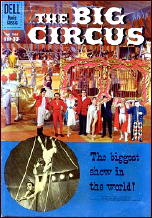
   For those interested, you can even download the Dell comic book version of the movie for free. The movie itself is available on DVD from Warner Archives.

   The Big Circus may not be as gaudy as de Mille’s wide screen Greatest Show on Earth or Samuel Bronston’s Circus World (with John Wayne), but it is entertaining and smart, hits all the marks, and delivers exactly the thrills, smiles, and laughs it intends, and does so with a more than usually attractive and capable cast. It’s pretty big entertainment, even on the small screen.

THE BIG CIRCUS

« Previous PageNext Page »