Reviews


REVIEWED BY J. F. NORRIS:


WALTER TYRER – Such Friends Are Dangerous. Staples Press, UK, hardcover, 1954. 1st US publication: Garland Publishing, hardcover, 1983. Paperback reprint: Perennial, 1984.

   Recently while perusing Barzun & Taylor’s Catalogue of Crime I came across quite serendipitously the title of this book. I was tantalized by Barzun’s brief write-up, which promised something along the lines of an early Ruth Rendell or Minette Walters book.

   It also happened to be one of the starred titles indicating that Barzun reissued it in one of his two sets of “Top 50 Mystery Novels.” I immediately went looking for the book and was lucky to discover there was a copy at my local branch of the Chicago Public Library.

   The story deals with the investigation of the drowning death of Kitty Pinnock, the town tramp, who inveigled her way into the lives of nearly every man in town, taking from them what she wanted and discarding them when she found a new conquest.

   There are plenty of secrets uncovered from a multitude of characters and there are several suspects found among the discarded men Kitty left in her wake of seductive destruction. However, lingering in the background of the involved investigation is Helen Luton, a mousy housewife whose husband is one of Kitty’s abandoned projects, and Vera Sylvaine, Helen’s ultra-hip writer friend who constantly reminds Helen that she is undervalued and underappreciated by her husband.

   Mrs. Luton is painted as a buffoon by Tyrer, and the reader may wonder (as I did) why several chapters are devoted to her conversations with Vera who seems to be quite a bad influence despite her supposed good intentions. A clever reader may begin to glean the author’s intent, but I challenge anyone to come up with the genuine and fully accurate solution. For me it came as a jaw-dropping surprise.

   It’s been a long time since I audibly gasped when the solution was presented. I never saw it coming. That, I think, makes for an excellent writer who knows exactly what he is doing.

   Even if the surprise may be a trick used many times by modern writers, in the context of Tyrer’s story it still felt like the rug was pulled out from under me. Up till the final pages the book is a scathing satire on village life, so the reader is paying attention to all the gossip, all the deceit, the facades being ripped away by the police inspector and his accidental Watson, an intrusive reporter looking for his “big break.”

   There is quite a bit of legitimate detective work on the part of both the police inspector and the reporter, who at one point seems determined to solve the crime himself and who comes up with some very unusual ideas about how and why the crime was committed.

   While all this is going on Tyrer has something hidden up his sleeve which he presents almost on the final page when the murderer is unmasked and a horrifying secret is finally revealed.

   This is an excellent book by a man who spent his early career writing school boy adventures, moved on to short stories and novels, with the latter portion of his career split between magazine story writing and contributing several thrillers for the Amalgamated Press “Sexton Blake Library” series.

   Barzun in his intro to the reissue of Such Friends Are Dangerous disparagingly refers to Tyrer as a “writer of primarily juvenile adventures” and then goes on to insult that audience by calling the readers of such books “the simple minded.” (I take he didn’t think much of children as readers. Or am I misinterpreting that?)

   I find much of what Barzun has to say about the genre to be condescending or arrogant, often extremely shallow. For instance, he often misses obvious humor and modern sarcasm, and he definitely shows a limited spectrum of tastes in detective fiction.

   But those two potshots make me think that he was not only a snob but just plain old mean. In any case, I like to think that this book was a personal triumph for Walter Tyrer, as it appears to be his only foray in writing for a truly adult audience.

Editorial Comment:   I am somewhat surprised and even more chagrined to discover that I do not own a copy of this book. It can be obtained cheaply enough, but if you were to search it out, in all likelihood you would have to settle for the Perennial Library edition. There are 10 copies of the latter on ABE under $10 at the moment, but none of either hardcover.

REVIEWED BY BARRY GARDNER:


JAMES CRUMLEY – The Mexican Tree Duck. C. W. Sughrue #2. Mysterious Press, hardcover, September 1993; reprint paperback, October 1994.

   What can you say about James Crumley that hasn’t been said before? No writer in the field has garnered so much critical attention for just three books, and a respectable number of respectable critics have lauded him as the best of the private eye writers.

JAMES CRUMLEY

   While considering him to be a powerful writer, I never shared that opinion, and in fact found it ludicrous. Nevertheless, I looked forward to reading this. I thought the first C. W. Sughrue book, The Last Good Kiss, was the best of his first three.

   C. W. hasn’t changed a whole lot, other than being middle-aged, now. He’s still rough as pine bark, and he’ll still have a drink or do a line with you, or whip your ass if it needs it. He’s hired by twins who own a fish store, overweight weapons freaks, to get their fish back from an outlaw biker that’s stiffed them on a check.

   In the process of doing that, he gets hired by the biker to find his mother. At least he thinks she’s his mother. Sound humorous? Not really. She’s a Mexican national married to a Texas oilman, and she’s been kidnapped.

   Before it’s over it’s turned to politics, drugs, and money, and Sughrue has hooked up with some Viet Nam buddies, taken on two or three governments, waged his own private war, fallen in love, and been in on the spilling of more blood than you could wipe up with a bale of tissues.

JAMES CRUMLEY

   Crumley’s prose is powerful, though I think not so much as in his earlier books. The characters are mostly of a type: the women crude, loving. tough, and ready, and the men cut from the same cloth as Sughrue himself — tough, violent, and abusers of any substance that’s inert enough to be abused.

   The improbable plot was just a framework, not terribly important to Crumley in comparison to what he had to say. Plotting never was his thing.

   This isn’t a detective novel. It’s a war story, or perhaps a paean to the brotherhood of warriors. It seems to me a book written by a man frozen in time, one not able to leave behind the world of war, drugs, and whiskey.

   There’s little here that speaks to me. To someone tortured by Crumley’s own demons it may be a fine novel, but to me it was just a sad waste of talent, not redeemed by the prose.

   The only message I got was that whiskey, drugs, and fighting are good, government and business are bad, and a man’s gotta do what a man’s gotta do. In the end, I tired of the macho posturing and the gunfire, and there wasn’t much else to it.

— Reprinted from Ah, Sweet Mysteries #9, September 1993.


      The “Milo” Milodragovitch series —

The Wrong Case (1975)

JAMES CRUMLEY

Dancing Bear (1983)
Bordersnakes (1996) [with C. W. Sughrue]
The Final Country (2001)

JAMES CRUMLEY


      The C. W. Sughrue series —

The Last Good Kiss (1978)
The Mexican Tree Duck (1993)
Bordersnakes (1996) [with Milo Milodragovitch]

JAMES CRUMLEY

The Right Madness (2005)

REVIEWED BY MICHAEL SHONK:


ROCKY KING, DETECTIVE. (Original title: Inside Detective.) DuMont Television Network, January 14, 1950 – December 26, 1954. Cast: Inspector Rocky King: Roscoe Karns; Mabel King: voice of Grace Carney; Announcer: Ken Roberts; Sergeant Lane: Earl Hammer, 1950-1953; Sergeant Hart: Todd Karns (Roscoe’s son), 1953-1954.

ROCKY KING DETECTIVE

   There once was a TV series about a befuddled homicide detective who wore an old raincoat he refused to replace and had a wife the audience never saw; that detective was Rocky King.

   Rocky King, Detective was a live half hour police mystery series on the DuMont network. Few remember DuMont, one of the original four TV networks (1946 to 1955 (or 1956)). Its lack of stations to reach enough viewers and a radio network to draw talent and dollars doomed the network to producing low budget, little seen programs.

   Perhaps the network’s most popular series, only a few episodes still exist on kinescope copies. The four episodes reviewed here are available to view for free at various websites such as Classic TV Archives. (See below.)

   Roscoe Karns, a veteran movie co-star, finally got his chance to play the lead. Rocky’s never seen wife Mabel was the scatterbrained female type. Each episode would feature a scene with Rocky at home talking to Mabel, often about their never seen or heard son, Junior. The show always ended with Rocky in his office calling Mabel. He hang up the phone and say, “Wonderful girl, that Mabel.”

ROCKY KING DETECTIVE

   The domestic scenes were played for laughs and reportedly written by Karns who received a screen credit for “additional dialog”.

   The music by Jack Ward is a major distraction with over the top organ music more fitting for a bad melodrama.

   Considering its network limitations, Rocky King is a far better show than it should have been. The live broadcasts had the expected number of mistakes, but it didn’t stop the talent from taking risks and having fun.

   Live in the camera tricks such as split screen and creative dissolves between scenes were common. While the mystery and suspense was played straight, the writers and cast occasionally let less serious moments slip in, even breaking the fourth wall.

   In “One Minute For Murder,” Karns was sick and Earl Hammer as Sergeant Lane took over the mystery and scenes with Mabel. At the end Sergeant Lane reassured the viewers Rocky would be OK and would be back next week.

   The episodes reviewed:

● “Murder Scores a Knockout.” Aired July 13, 1952. Written: Carl Abrams. Directed: Lee Polk. Guest cast: Pete: Kem Dibbs; Edward: William Sharon; Viola: Henrietta Moore/ A magician is murdered as the three suspects search for a missing object.

ROCKY KING DETECTIVE

● “The Hermit’s Cat.” Aired August 31, 1952. Written: Ed Morris. Directed: Wesley Kenney. Guest cast: Mark: Ed Peck; Norton: Frank Campanella; Mildred: Virginia Low. Millionaire who had refused to leave his home is found dead on a nearby highway.

● “Murder, Ph.D.” Aired December 14, 1953. Written: Frank Phares. Directed: Wesley Kenney. Guest Cast: Gerhart: Somer Alberg; Bartender: John Anderson; Alice: Anne Roberts. Mysterious phone caller repeatedly taunts Rocky that he is the real killer not the man about to be executed at midnight.

● “One Minute for Murder.” Air date unknown. Written: Carl Abrams. Directed: Wesley Kenney. Guest cast: Nora: Barbara Joyce; Mike: Steven Gethers; Helen: Mary Jackson. Blackmailing columnist is murdered in the leading lady’s dressing room during a performance.

   All four are included on one DVD easily available from Amazon, Oldies.com and other well-known online outlets.

   For those interested to learn more about Rocky King, Detective or the DuMont Television Network, I recommend two websites:

Classic TV Archives: http://ctva.biz.

Charles Ingram’s DuMont Television Network Historical website: http://www.dumonthistory.tv/index.html

THE BACKWARD REVIEWER
William F. Deeck


MARJORIE ALAN – Dark Prophecy. M.S. Mill, hardcover, 1945. Hardcover reprint: Detective Book Club, 3-in-1 edition, December 1945. Originally published in the UK as Masked Murder (Hale, hc, 1945).

   Chapter 1:   “Of course, Valerie thought, as she laid it [the letter] down, she wouldn’t go.”

   Chapter 2:   “Directly she got into the train at Paddington she knew that she ought not to go to Wayfarers. Knew in a clear, definite premonitory flash, as unmistakably as though someone had spoken the words…”

   Had I but known, I wouldn’t have begun the book. But unlike our heroine, I at least was wise enough not to undertake this perilous journey.

— From The MYSTERY FANcier, Vol. 11, No. 4, Fall 1989.


       Bibliography:     [Adapted from the Revised Crime Fiction IV, by Allen J. Hubin.]

MARJORIE ALAN.   Pseudonym of Doris Marjorie Bumpus, 1905- .

    Masked Murder. Hale 1945. US edition: Dark Prophecy, Mill 1945.
    Murder in November. Hale 1946. US edition: Rue the Day, Mill 1946.
    Murder Next Door. Hale 1950.
    The Ivory Locket. Hale 1951.

MARJORIE ALAN

    Murder at Puck’s Cottage. Hale 1951.
    Dark Legacy. Hale 1953.
    Murder Looks Back. Hale 1955.
    Murder in a Maze. Hale 1956.

Editorial Comments:   This is essentially all I have learned about the author. One online source adds a birthplace (in England), but no one seems to have even a year of death for her.

    Confession time. I have not been posting all of Bill Deeck’s fanzine reviews I come across, generally choosing not to use any that are as short and dismissive as this one is. I’ve made an exception this time. Even though it’s short and dismissive, it’s also one (in my opinion) that gives a honest description and evaluation of the book.

    If you can’t get an idea of what the novel’s about in these 150 words or so, and whether you’d like it or not, I don’t think another thousand would help. You be the judge!

IT IS PURELY MY OPINION
Reviews by L. J. Roberts


TESS GERRITSEN – Ice Cold. Ballantine Books, hardcover, June 2010; reprint paperback: April 2011.

Genre:   Police procedural. Leading characters:   Rizzoli & Isles; 8th in series. Setting:   Wyoming.

First Sentence:   She was the chosen one.

TESS GERRITSEN Ice Cold

    Medical Examiner Maura Isles, in Wyoming for a medical conference, takes off on an impromptu ski weekend with a former college friend, his daughter and another couple. Faulty GPS directions and a blizzard, leaves them lost, stranded and one of the group with a life-threatening injury.

    Seeking shelter, they find the village of Kingdom Come where, in spite of signs that people lived there very recently, everyone has disappeared. Her friend, who leaves to seek help, disappears and it’s up to Maura to brave the winter.

    In Boston, Det. Jane Rizzoli is informed her friend, Maura, died in a car accident and fire. Jane travels to Wyoming with her FBI-agent husband and finds the more they learn, the more things seem wrong. What has really happened and just who are the bad guys?

    I must remember the lesson of never starting a Tess Gerritsen book in the evening as I did not put this book down until I’d finished it at 4 a.m. So I write this review being sleep deprived.

TESS GERRITSEN Ice Cold

    By the eighth book in a series, some authors forget a reader may be picking this up as a first book. Not true here. The essential background information for each character is incorporated into the flow of the story. We know who these characters are and understand their relationships.

    The only character for whom that is not true is the rather mysterious and enigmatic Anthony Sansone, introduced in The Mephisto Club, yet that lack of definition felt deliberate and didn’t bother me.

    Both Jane and Maura are smart, strong, capable women while having a more vulnerable side making their portrayals realistic. Gerritsen’s ability to convey setting and conditions not only provide a strong sense of place but add to the tension of her books. When it’s cold, you reach for a blanket; when you’re in an autopsy, you want to look away but can’t.

    She also expresses emotion incredibly well; anger, fear, uncertainty, being overwhelmed by fatigue — they are all made tangible. The plot touches on many issues relevant to recent news. Those issues are handled factually and informatively. As always, Ms. Gerritsen’s medical and forensic knowledge is apparent. If find myself fascinated but admit it is not always for the weak of stomach.

    Her ability to create a feeling of danger and suspense keeps you turning the pages. I was certainly never able to predict the “who” and “why” behind the events.

TESS GERRITSEN Ice Cold

    I do have one criticism. I kept having the feel Ms. Gerritsen’s original book was much longer and she was forced to trim it down. Whether this was the reason, it had a choppy feel to many of the transitions between scenes. The flow I would like to have seen just wasn’t there.

    While I personally prefer Ms. Gerritsen’s standalone thrillers, this was a book I very much enjoyed. It’s the perfect weekend or airplane read and I look forward to the next case of Rizzoli and Isles.

Rating:   Good Plus.

Editorial Comments:   For a list of all of Tess Gerritsen’s suspense novels, complete with covers for most of them, check out the Fantastic Fiction website.

   I watched the first two episodes of the Rizzoli & Isles TV show on TNT, and was favorably impressed. Not enough to put up with logos, commercials and the constant clutter on the screen while you’re trying to watch, but enough so that I plan on buying the first season on DVD as soon as it comes out. Did anyone else keep up with the series?

Three More by EDWARD D. HOCH
by Mike Tooney:


    For Part Four of this series, go here.

ALFRED HITCHCOCK

13. “Winter Run.” Originally appeared in Alfred Hitchcock’s Mystery Magazine, January 1965. Reprinted in Alfred Hitchcock: The Best of Mystery, Galahad Books, hardcover, no editor stated, 1980.

   Johnny Kendell is on the run — from himself. After he has tragically gunned down an old bum, Johnny quits the force instead of facing a departmental inquest and leaves town with his fiancée, Sandy. Anywhere will do.

   Within a week, they settle in a new town, and Johnny, seeking work but finding none, reluctantly accepts the job of deputy sheriff. At first, things go well — until he runs afoul of Milt Woodmann, the former deputy and a real womanizer. When Woodman begins making moves on Sandy, Johnny’s trigger finger starts getting itchy again ….

    “Winter Run” was filmed (as “Off Season”) for The Alfred Hitchcock Hour (first aired 10 May 1965, the last show of the series), and is available here on Hulu.

ALFRED HITCHCOCK

14. “Warrior’s Farewell.” Originally appeared in Alfred Hitchcock’s Mystery Magazine, August 1967. Reprinted in Alfred Hitchcock: The Best of Mystery (see above).

   The unnamed narrator reads in the newspaper about the death of an old Korean War buddy and flashes back to the war and what his pal did, executing summary justice on an enemy POW — no trial, just gunning him down.

   After the war, their lives intersect several times, and the narrator gradually comes to understand that his old buddy is still meting out justice — one bullet at a time ….

ALFRED HITCHCOCK

15. “A Melee of Diamonds.” Alfred Hitchcock’s Mystery Magazine, April 1972. Reprinted in Alfred Hitchcock: The Best of Mystery (see above).

   It has all the earmarks of a classic smash-and-grab: break the glass, ignore the alarms, and scoop up as many precious stones as possible before security gets there. In the middle of all this confusion, a policeman gets clubbed to the pavement, but a Concerned Citizen manages to pursue and capture the thief anyway.

   The kicker in this scenario, however, is that the malefactor doesn’t have the diamonds, worth $58,000, anywhere on him or in him — yes, they actually X-ray the guy — or anywhere along his escape route. Even the Concerned Citizen gets searched: no joy.

   Captain Leopold is baffled, a condition he thoroughly hates, when he gets an unexpected break while he’s buying a can of coffee ….

REVIEWED BY WALTER ALBERT:         


PAMPERED YOUTH

● PAMPERED YOUTH. Vitagraph, 1924. Alice Calhoun, Cullen Landis, Wallace MacDonald, Ben Alexander. Director: David Smith. Both this and the film below were shown at Cinefest 28, Syracuse NY, March 2008.

   This is a real curiosity, a two-reel condensation of a seven-reel adaption of Booth Tarkington’s The Magnificent Ambersons. William K. Everson notes that it is a “16mm blow-up from a badly battered 9.5mm print that Kevin Brownlow rescued from a market-place in France during the 1960s.”

   The condensation preserves the outlines of the decline and fall of the Ambersons, climaxing in a spectacularly staged fire sequence that reunites the remaining impecunious Ambersons (Isabel and her son George) with the successful suitor she once spurned, Eugene Minafer, also clearing the way for the marriage of George to Eugene’s daughter Lucy.

● DAYDREAMS. Angle Pictures, London, 1928. Elsa Lanchester, Charles Laughton, Harold Warrender, Dorice Fordred , Marie Wright. Based on a short story by H. G. Wells. 25min. Director: Ivor Montagu.

   A strikingly designed, delightful short film in which a housemaid (Lanchester) fantasizes about a rich marriage followed by a series of adventures in which Laughton figures importantly as a lascivious villain, all of it resolved when Lanchester, awakening from her day-dreams, walks away from her mundane job.

[UPDATE] 09-18-11. Thanks to a comment left by Mike White, Walter’s review of Pampered Youth has been amended to correctly identify Eugene Minafer’s daughter. Her name was Lucy, not Fanny. Thanks, Mike!

   (Mike was the long time editor and publisher of Cashiers du Cinemart. You might wish to visit his website at http://www.impossiblefunky.com.)

REVIEWED BY DAN STUMPF:         


MURRAY LEINSTER – The Brain-Stealers. Ace Double #D-79, paperback original, 1954. Published dos-à-dos with Atta, by Francis Rufus Bellamy. Reprinted by Ace in single volume form, circa 1974. Trade paperback: Wildside Press, 2007.

MURRAY LEINSTER The Brain-Stealers.

   So came last October, and I started my month of ghoulish reading with Murray Leinster’s The Brain-Stealers (Ace, 1954), a crackerjack bit of sci-fi from a master of the form.

   This one starts fast and never lets up, as a spaceship full of blood-sucking aliens lands on the first page in a remote part of the country and discharges a band of “little guys”: hairless, short-limbed, sharp-toothed and incredibly selfish beings with the power of mind control, who proceed to enslave the locals and propagate, with plans of world domination.

   Said world is a clever wrinkle Leinster throws in the plot-pot. Brain-Stealers is set in a near-future society (near-future in 1954 that is) ruled by something called “Security” where science, culture, even knowledge itself are carefully regulated in the name of peace and safety.

   (Which makes the whole thing unbelievable; I mean, now really! Can you honestly imagine people giving up their individual rights for the promise of security? But I digress…)

   Such a world seems ripe for enslavement, but in the tradition of the best sci-fi, Leinster rings in an escaped scientist (experimenting in thought-projection no less!) who lands in the middle of things and finds himself in a run-and-jump war with the aliens.

   This is pulp as it oughta be: stylish and fast, with a plot that keeps twisting right to the end as Leinster throws his rogue scientist in and out of peril with breath-taking speed. You honestly can’t spend a better couple hours than sitting down with this and … letting your mind go!

A 1001 MIDNIGHTS Review
by Marcia Muller


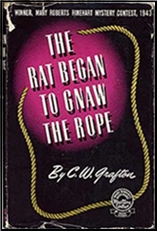
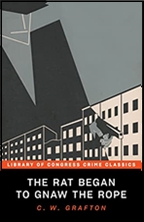
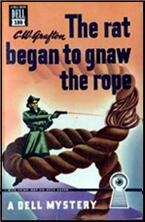
C. W. GRAFTON – The Rat Began to Gnaw the Rope. Farrar & Rinehart, hardcover, 1943. [Mary Roberts Rinehart Mystery Contest winner.] Reprint paperbacks: Dell #180, 1947, mapback edition; Perennial Library, P639, 1983. Poisoned Pen Press, trade paperback, 2020.

   Lawyer Gil Henry’s client describes him as a young man who has “got more curiosity than an old maid and his mind is so sharp it’s about to cut his ears off.” Henry is this and much more — tenacious, eager, with a humorous, self-deprecating wit.

   Sometimes he’s a bit of a bumbler, but he has the good grace to acknowledge it. And in this, his first case, his determination serves him in good stead.

   Henry is hired by Ruth McClure to look into the matter of some stock she has inherited: Her father, who was recently killed in an auto accident, has left her a hundred shares in Harper Products Company, the firm where he was employed. The owner of the company, William Jasper Harper, is offering to buy the shares for much more than they are worth, and Ruth wants to know why.

   Henry takes her on as a client — with reservations because the senior partner in his firm is dating Harper’s daughter. And when he receives an urgent summons to come to Harpersville earlier than he planned (because someone has ransacked Ruth’s house), he still is hesitant.

   But he goes, in a car borrowed from his partner, and is involved in a near-fatal accident on the way. When the accident turns out to be due to a shot-out tire, he checks the car Ruth’s father died in. There is no evidence, because there is no tire — someone has taken it from the wrecking yard.

   From there on, suspicious circumstances mount up: There seems to be little love lost between Ruth McClure and her adopted brother, Tim; Ruth’s father lived well beyond his means; there is a disfigured egg lady who is also living beyond her means — and indeed buys the eggs she sells to selected persons (including Mr. Harper) at the grocery store.

   When Henry confronts Harper personally, he is run out of town, and he must go to Louisville, Kentucky, where the company’s accountants are, in search of further evidence. Before he finally gets to the bottom of this strange state of affairs, murder has been done twice — and Gil Henry is considering committing a third.

   Grafton’s style is easy and humorous, the plotting is good, and the characters are sure to intrigue you. Gil Henry is an extremely likable young man, and it’s regrettable that he appears in only one other book, The Rope Began to Hang the Butcher (1944).

   Grafton — the father of contemporary private-eye novelist Sue Grafton — wrote only one other suspense novel, Beyond a Reasonable Doubt (1950).

         ———
   Reprinted with permission from 1001 Midnights, edited by Bill Pronzini & Marcia Muller and published by The Battered Silicon Dispatch Box, 2007.   Copyright © 1986, 2007 by the Pronzini-Muller Family Trust.

A 1001 MIDNIGHTS Review
by Karol Kay Hope:


SUE GRAFTON – “A” Is for Alibi. Holt Rinehart & Winston, hardcover, April 1982. Bantam, paperback, 1982. Reprinted many times, in both hardcover and soft.

SUE GRAFTON A Is For Alibi

   In this first of a series featuring female private investigator Kinsey Millhone, screenwriter Sue Grafton introduces us to a captivating character. Millhone is thirty-two, twice divorced, with no kids (after all, she can’t very well ramble around California in her beat-up Volkswagen with two babes and a lonely husband waiting at home).

    “A” Is for Alibi begins with Kinsey telling us she has killed someone for the first time. The event “weighs heavily” on her mind, and in a tightly packed 274 pages we find out just how it happened.

    Millhone takes us back to the beginning of the case, when she meets with the widow of a prominent attorney in Santa Teresa, a small, upperclass beach community in southern California (and Grafton’s admitted tribute to Ross Macdonald).

    The woman was convicted eight years ago of poisoning her philandering, abusive, and very rich husband with a capsule of oleander-a common California shrub-which she allegedly slipped into his bottle of tranquilizers so he would take it at will, when she wasn’t around: “A” is for alibi.

    The woman has proclaimed her innocence from the beginning. After eight years in prison for a crime she didn’t commit, she wants Millhone to find her husband’s real murderer.

    What follows is a beautifully written story of spoiled love, American-style. Ex-wives, children of divorce, ambitious girlfriends, loyal secretaries, and longtime business partners — Millhone grills all of these with the tenacity of the best hard-boiled detectives, and her female sympathies draw out the emotional reality of the characters with refreshing clarity.

    In the end, she has no choice but to kill someone, and we are as surprised as she is when it happens. Don’t miss this one, or its sequel, “B” Is for Burglar, which appeared in 1985.

         ———
   Reprinted with permission from 1001 Midnights, edited by Bill Pronzini & Marcia Muller and published by The Battered Silicon Dispatch Box, 2007.   Copyright © 1986, 2007 by the Pronzini-Muller Family Trust.

« Previous PageNext Page »