Reviews


THE BACKWARD REVIEWER
William F. Deeck


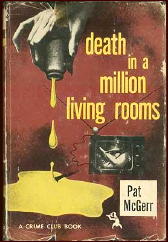
PAT McGERR – Death in a Million Living Rooms. Doubleday Crime Club, US, hardcover, 1951. Paperback reprint: Macfadden 75-281, 1969. Collins Crime Club, UK, hardcover, 1952, as Die Laughing.

PAT McGERR Death in a Million Living Rooms

   Since television is becoming a big business, Enterprise magazine plans a major takeout on the new medium. A small part of the story is assigned to Melissa Colvin, a researcher. Her interest in TV centers on the announcer of the “Podge O’Neill” program. Convinced he embarrassed her during their college years, she wants to pay him back.

   As appears to be usual with comedy teams, one member is the idea person. In this case it’s Scottie, Mrs. Podge O’Neill the first, who discovered Podge, made him what he is today, picked his second wife for him, and rules the program with an iron hand.

   All involved with the program are trying to wrest Podge from Scottie’s control to further their own careers. Since ordinary persuasion isn’t working, a roller-skating “accident” occurs, but it’s merely a temporary setback to Scottie’s reign. Then the sponsor’s product, a beverage, is spiked with nicotine, and a death takes place in full view of the studio and home audience.

   A fair-play mystery that will appeal to readers who enjoy show-business settings, particularly those who are interested in the early television years. Not McGerr’s best work, but still very good, despite The Crime Club most misleadingly putting it in its “Damsel in Distress” category.

— From The MYSTERY FANcier, Vol. 11, No. 4, Fall 1989.


Editorial Comment:   For more about Pat(ricia) McGerr (1917-1985), see the review of Pick Your Victim (1946), one of her earlier books, to follow immediately. Please stay tuned!

REVIEWED BY CURT J. EVANS:         


H. C. BAILEY

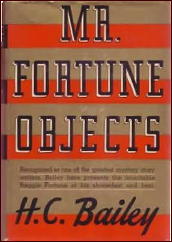
        ● Mr. Fortune Objects. Victor Gollancz, UK, hardcover, 1935. Doubleday Crime Club, US, hardcover, 1935.

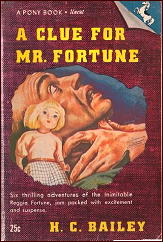
        ● Clue for Mr. Fortune. Victor Gollancz, UK, hardcover, 1936. Doubleday Crime Club, US, 1936, as A Clue for Mr. Fortune. Paperback reprint: Pony Book #52, US, 1946.
H. C. BAILEY

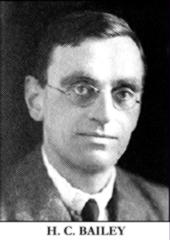
    Despite his one-time prominence during the Golden Age of the detective story, H. C. Bailey is not that well-known today, outside the community of knowledgeable collectors. Bailey’s tales of the brilliant deductive deeds of his two series detectives, doctor Reggie Fortune and lawyer Joshua Clunk, frequently are first-rate, however.

    Clunk appeared only in novels, Fortune in both short stories and novels. Both then and now, the Reggie Fortune short stories probably were/are Bailey’s most highly regarded achievement in mystery fiction.

    Indeed, Bailey’s American publishers, Doubleday, Doran, confidently (if somewhat inaccurately, as things turned out) declared in 1936: “Few critics or readers will dispute the fact that of living mystery story writers Bailey is one of those most likely to achieve immortality…and few will deny that Reggie Fortune is his greatest creation.”

    There are, I believe, 85 Reggie Fortune short stories, published between 1920 and 1940 — an impressive body of work. If not quite on the level with the Father Brown stories of G. K. Chesterton, they certainly rank high among mystery short stories and are deserving of some sort of reprinting, certainly at the very least a “best of” volume.
H. C. BAILEY

    Here I review two strong Reggie Fortune collections from the mid-1930s, Mr. Fortune Objects (1935) and A Clue for Mr. Fortune (1936).

    One of the best Reggie Fortune collections of short fiction is one of the rarest of them all, Mr. Fortune Objects. This volume contains six long stories: “The Broken Toad,” “The Angel’s Eye,” “The Little Finger,” “The Three Bears,” “The Long Dinner” and “The Yellow Slugs.” All are good tales, while three — “Toad,” “Dinner” and “Slugs” — are among Bailey’s very best short works.

    In his day as well as today, the detractors of Reggie Fortune (who included Julian Symons) deemed him a tiresome, precious creation. Reggie’s mannerisms, of which the author often makes a great deal, can be tiring. His speech is telegraphic (like Charlie Chan, who is sparing of pronouns, Reggie is sparing of verbs), affected and arch, he moans and mumbles, and he spends much time fussing over Darius, his blue Persian cat, and his elaborate luncheon and dinner menus. All this is granted.

    Yet Reggie also is a legitimate Great Detective, filled with a fervor, quite remarkable for the period, for justice. This moral fervor comes through strongly in Mr. Fortune Objects, in tales that deal in a mature, thoughtful way with the existence of evil in the world.
H. C. BAILEY

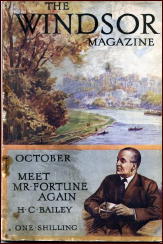
    In “The Broken Toad” (a brilliant title for a story that first appeared in the October 1934 issue of Windsor Magazine), the arsenic poisoning of a policeman leads Reggie, in his capacity as medical consultant to Scotland Yard, into a remarkable case of suburban dysfunction. Arguably Bailey’s best tale, Toad is suspensefully and vividly told and there is much genuine detection (some having to do, appropriately enough, with food).

    In “The Long Dinner,” a menu and the strange drawing on the back of it lead Reggie into the maze of a diabolical murder scheme. A serious moral question is explored here. Reggie is pretty intuitive here, but the plot is quite interesting. Reggie also reunites with his detective friend from France, who is a good character.

    In “The Yellow Slugs,” one of the better-known Fortune tales (it was anthologized by Dorothy L. Sayers), Bailey delves interestingly into child psychology. Bailey often dealt with threats to children in his works and could sometimes be tiresomely sentimental, but “Slugs” is not overdone in this regard and in fact is rather realistic, modern and dark. Reggie also does some real detective spade work here, rather akin to what one might find in an R. Austin Freeman tale.

    “Toad” and “Slugs” are particularly striking in that they are far removed from the aristocratic country house/quaint village settings so often associated with British Golden Age mystery. Instead, they focus on severe moral dysfunction in more modern-feeling suburban and urban settings.
H. C. BAILEY

    The three other tales are worth reading as well, especially “The Angel’s Eye,” which was praised by Jacques Barzun. This one actually is set in an English country house and involves a locked room problem of sorts (though anyone expecting John Dickson Carr will be disappointed).

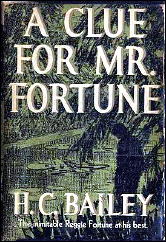
    Published a year after Mr. Fortune Objects, A Clue for Mr. Fortune is another strong collection of six long stories: “The Torn Stocking,” “The Swimming Pool,” “The Hole in the Parchment,” “The Holy Well,” “The Wistful Goddess” and “The Dead Leaves.”

    None perhaps has the depth of “The Broken Toad,” “The Long Dinner” or “The Yellow Slugs,” but several rank near the top of the Bailey works, being quite clever and entertaining.

    Reggie Fortune is still bountifully bedecked with mannerisms some might fight irritating (he seems to have picked up the habit of quoting extensively in these later tales, though, thankfully he now looks less at people with the wondering eyes of a child), but he seems a mite less precious and more impressive in his role as an instrument of justice.

    The best-known of the Clue tales probably is “The Dead Leaves,” which was anthologized in The Oxford Book of English Detective Stories, but it is not the actual best of the tales in Clue, in my opinion. My favorites are “The Torn Stocking,” “The Hole in the Parchment” and “The Holy Well.”
H. C. BAILEY

    With “The Torn Stocking” we again see the exploration of a favorite theme of Bailey’s, that of the consequences of family dysfunction. The milieu is rather shabby urban middle-class. Reggie investigates the seeming suicide (head in the gas oven) of a teenage girl accused of shoplifting, with surprising results. His detective work is quite interesting.

    “The Hole in the Parchment” sees Reggie and wife Joan vacationing in Florence, Italy (a number of the Fortune tales takes place in France, Germany and Italy). There the two become involved in a case involving theft and forgery, quite cleverly done.

    In “The Holy Well,” Bailey gives bravura treatment to a classic detective story device. The story involves murder in rural Cornwall. Both the atmosphere and the plotting are first-rate.

    Both Mr. Fortune Objects and Clue for Mr. Fortune are fine mystery short story collection that merit reprinting for a modern audience.
REVIEWED BY JEFF MEYERSON:         

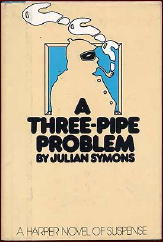
JULIAN SYMONS – A Three Pipe Problem. Harper & Row, US, hardcover, 1975. Collins Crime Club, UK, hardcover, 1975. Reprints include: Avon, US, pb, 1976; Penguin, US, pb, 1984.

JULIAN SYMONS A Three-Pope Problem

   A Three-Pipe Problem is a very enjoyable book! Symons’ hero is Sheridan Haynes (nicknamed Sher), an actor who portrays Sherlock Holmes in a British TV series that was once popular but is now slipping in the ratings.

   Sher demands absolute fidelity to the Holmes stories, which angers those who want to make the show more attractive to the audience by adding a love interest, etc.

   Haynes not only longs for the days when Holmes stalked London, but has even insisted on living in the old rooms in Baker street. His obsession with Holmes causes doubts about his sanity, and problems with his wife and co-workers.

   Haynes, in his role of Holmes, becomes gradually more involved in a case known as the Karate Killings, to the consternation of all. He states that Sherlock Holmes could have solved the case, then sets out to do it with the help of a Watson, and some Baker Street Irregulars (actually Traffic Wardens).

   Symons keeps the various strands of his story well in hand until they all come together on a cold and foggy London night, with Haynes/Holmes tracking the Karate Killer.

   Sher Haynes is a sympathetic character and the book, if improbable, is a lot of fun and very well done. Sherlockians should enjoy it.

— Reprinted from The MYSTERY FANcier, Vol. 1, No. 3, May 1977.


Bibliographic Note:   Sheridan Haynes made an encore appearance The Kentish Manor Murders (Viking, 1988).

IT IS PURELY MY OPINION
Reviews by L. J. Roberts


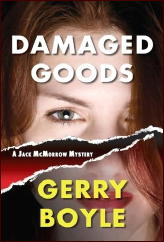
GERRY BOYLE – Damaged Goods. Down East Books, hardcover, May 2010.

Genre:   Unlicensed investigator. Leading character: Jack McMorrow; 9th in series. Setting:   Maine.

First Sentence:   I made my way down the trail through the pinewoods toward the house.

GERRY BOYLE

    Roxanne, the wife of freelance journalist Jack McMorrow has had a worse-than-usual day at work. A social worker for the state of Maine, she was forced to remove two severely neglected children from the home of a Satanist who is now threatening Roxanne and their daughter.

   In order to facilitate Roxanne leaving her job, Jack looks for more stories he can sell and finds Mindi, a young woman advertising to provide “companionship.” Mindi quickly becomes more than a story and it’s uncertain whether that is going to increase the danger to Jack’s family.

   I’ve missed Boyle’s Jack McMorrow and am very glad to see him back. While Jack, a journalist who isn’t afraid of physical violence, is an interesting character, his neighbor Clair, a Vietnam vet who has lost none of his edge, comes through as the more interesting character, especially when set off by his gentle wife, Mary.

   Jack’s wife, Roxanne, is one I’m not always certain I like, but her reactions are very realistic in view of the situation. The blending of all the characters is very well done.

   Boyle’s love of Maine is apparent as shares with us both the beauty and the problems of Maine. The story is has a good, tight plot and is layered with good suspense which escalates as things progress. The sense of anger and danger is there along with Jack and his friend’s protectiveness. The villain is satisfyingly nasty and while Mindi provides a somewhat unknown quantity element.

   It’s altogether quite well done. Boyle is a very good writer and journalistic background is very apparent. His books are ones I always recommend and I’m always anxious for the next one out.

Rating:  Good Plus.

       The Jack McMorrow series

1. Deadline (1993)

GERRY BOYLE

2. Bloodline (1995)
3. Lifeline (1996)
4. Potshot (1997)
5. Borderline (1998)
6. Cover Story (1999)

GERRY BOYLE

7. Pretty Dead (2003)
8. Home Body (2004)
9. Damaged Goods (2010)

    Also by Gerry Boyle: The Brandon Blake mysteries

1. Port City Shakedown (2009)

GERRY BOYLE


   Visit the author’s blog here.

REVIEWED BY WALTER ALBERT:         


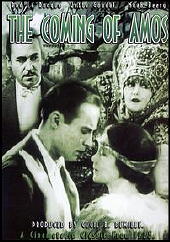
THE COMING OF AMOS 1925

THE COMING OF AMOS. Cinema Corp. of America/PRC, 1925. Rod La Rocque, Jetta Goudal, Noah Beery, Richard Carle, Arthur Hoyt, Trixie Friganza, Clarence Burton.

Screen adaptation: James Ashmore Creelman & Garrett Fort from the novel by William J. Locke. Director: Paul Sloane; producer Cecil B. DeMille. Shown at Cinevent 42, Columbus OH, May 2010.

   This is the perfect Saturday matinee movie, with a climax in an island castle where the heroine (Jetta Goudal) is imprisoned by her villainous husband Ramón Garcia (Noah Beery) in a basement rapidly filling with water.

THE COMING OF AMOS 1925

   With a Russian Princess and a noted portrait painter (the hero’s uncle) figuring in the cast, and a ’20s jet set crew of party-loving characters, there’s ample reason to crowd the screen with lavish sets and fantastic costumes, especially when an important scene takes place during a joyous carnival.

   The hero is naive but persistent, the heroine beautiful and constantly in peril, and the smirking villain doing everything but twirl his nonexistent moustache.

   There are touches of humor throughout, with some witty satire, the sharpest of which is the portrayal of two French policiers as consummate bureaucrats, stopping every other minute as they lead the “chase” into Garcia’s lair to take notes of the information they’re being given.

   This is a matinee film for adults, but the kid in the fun-loving viewer will have a grand time, too.

Editorial Comment: This film is available on DVD, but be aware that two of the three reviewers on Amazon disagree noticeably as to the quality of the print.

REVIEWED BY BARRY GARDNER:


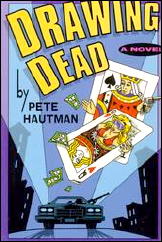
PETE HAUTMAN – Drawing Dead. Simon & Schuster, hardcover, 1993. Paperback reprint: Pocket, 1997.

   Joe Crow is an ex-cop, and an ex-coke head, and an ex-husband, too. Matter of fact, most of his life is ex-; he’s sort of at loose ends professionally and financially, not doing much of anything but playing poker and drifting along.

PETE HAUTMAN dDrawing Dead

   He’s got sort of a relationship with another ex-coke head, an entertainment agent. Joey Cadillac, down in Chicago, doesn’t have any identity problems — he’s a minor league wiseguy, with a car dealership selling cars mostly to people who need to launder cash.

   Joey’s just been ripped off on an old comic book scam, and he’s pissed. He sends a legbreaker to Minneapolis on the trail of the two scammers, who have another deal working with a stockbroker there who happens to play poker with Crow. They know his wife, too, a pheromone-emitting lady named Catfish. Yep. Then they all begin to converge.

   This is a jim-dandy first novel. It reminds me of Leonard and Westlake, and maybe just a little of Hiaasen. Hautman has a good ear for dialogue, and a good eye for the kind of people who have been knocked around somewhat.

   He tells the story from a number of different viewpoints, and keeps it moving right along. Crow is an interesting lead, competent enough to like but no superman. There is a lot of good stuff about poker and comics, and it’s credible for a change.

   This is my kind of book.

— Reprinted from Ah, Sweet Mysteries #10, November 1993.


Editorial Comment:   Pete Hautman’s book The Prop (2006) was profiled on this blog when it was nominated for Best Private Eye Paperback Original of the Year in 2007.

   While Joe Crow did not appear in The Prop, a list of his appearances since his debut in Drawing Dead can be found in this previous post.

THE ARMCHAIR REVIEWER
Allen J. Hubin


STEPHEN PAUL COHEN Island of Steel

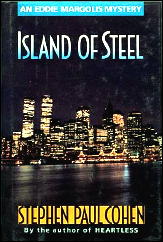
STEPHEN PAUL COHEN – Island of Steel. Morrow, hardcover, 1988. Paperback reprint: Avon, 1989.

   Stephen Paul Cohen, a real estate lawyer now living in Minneapolis, introduced Eddie Margolis in Heartless, not read by me. Eddie now returns in Island of Steel.

   Here he’s working for the Charles Murphy Detective Agency, even though he has no experience in investigation and his boss is almost never around. To top this, he’s assigned to find a real estate lawyer who’s missing from the prestigious New York firm of Fenner, Covington & Pine.

   Why would an upwardly mobile attorney go out for cough drops one afternoon and never return? Could it be fatal to find out?

   Nicely peopled, nicely plotted, nicely tensioned, a pleasure to read.

— From The MYSTERY FANcier, Vol. 11, No. 2, Spring 1989.


Bibliographic Data:   There were, as it happens, only the two adventures of Eddie Margolis. In terms of crime fiction, Cohen later co-authored a near-future thriller, Night Launch (Morrow, 1989), with then Senator Jake Garn, and on his own, a paperback novel entitled Jungle White, published only in Thailand.

   Mike Grost has a short section on Cohen on his Classic Mystery and Detection website. He says in part, “Cohen has considerable poetic skills of description. Both novels seem to be epic poems, an Iliad and Odyssey set in modern New York City.”

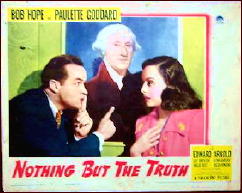
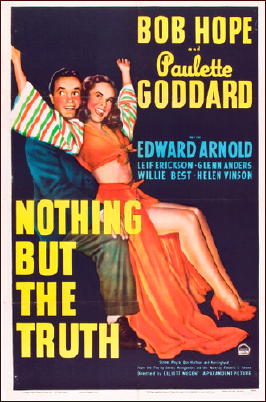
NOTHING BUT THE TRUTH. Paramount Pictures, 1941. Bob Hope, Paulette Goddard, Edward Arnold, Leif Erickson, Helen Vinson, Willie Best. Director: Elliott Nugent.

   A funny movie needs a funny premise, I’d have to say and I hope you agree, but is a funny premise enough to make a funny movie?

NOTHING BUT THE TRUTH Bob Hope

   Bob Hope, playing Steve Bennett, a new partner in an investment firm, is inveigled into making a $10,000 wager that he can tell the truth, and nothing but the truth, for the next 24 hours. The rest of the movie, given this rather belabored but still promising beginning, is unfortunately about as predictable as (in general) the rest of movies come.

   The three men who are betting against Bob are not above low and mean-minded activities to protect their wager, as you might expect. On the other hand, the money Bob is putting up is not really his to bet, but that of Gwen Saunders (Paulette Goddard), or really the charity she is desperately trying to raise $40,000 for — and you can see how desperate she is, giving the money to someone like Bob Hope with a request to “double it for her overnight.”

   As if this were not enough, a showgirl trying to raise money for her Broadway-bound play is also involved. And of course Bob and Paulette Goddard fall in love, even though she already has a strapping young boy friend, one of the idle rich, and one of the guys who made the bet with Bob.

NOTHING BUT THE TRUTH Bob Hope

   But need I tell you more? I’ve already called the plot predictable, and from here on, you’re on your own. What kind of idiot situations could you think of? Most of them (I’ll wager) will be in here.

   Is the movie funny? Bob Hope made me laugh, but between you and me, nobody else did, with the possible exception of Willie Best, who plays Bob’s personal valet in what’s really a rather demeaning role. (You could say that at least it was a role, which all too few blacks had in movies made in 1941, but it is highly unlikely that roles such as this did anything to improve the lives of blacks in this country.)

   Paulette Goddard, however, is bright and spritely and sparkling in this movie, and if somebody can tell me why her career went downhill after this, and not onward and upward, I’d surely appreciate learning about it.

— Reprinted from Mystery*File #35, November 1993, revised but not substantially.


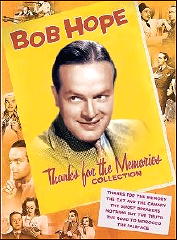
[UPDATE] 11-05-10.   This movie was recently released on DVD in a box set called Bob Hope’s “Thanks for the Memories Collection,” and I’ve just put it into my Amazon shopping cart.

   Arguing with myself on the merits of an old film I saw (and taped) on TV this many years ago is probably futile, but I have a feeling that if I watched again, I might enjoy it a lot more than I did this first time around. Comedy and humor are funny things (and you can quote me on that).

   As for Paulette Goddard, I didn’t have the luxury of the Internet to help me out when I first wrote this review. Even so, while pointing out that she was nominated for Best Actress in a Supporting Role for So Proudly We Hail! in 1943, IMDB only says that “her star faded in the late 1940s […] and she was dropped by Paramount in 1949,” when she was still only 39.

NOTHING BUT THE TRUTH Bob Hope

REVIEWED BY WALTER ALBERT:         


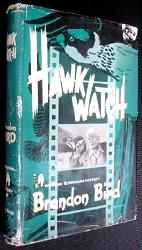
BRANDON BIRD – Hawk Watch. Dodd Mead, hardcover, 1954. Hardcover reprint: Detective Book Club, 3-in-1 edition, August 1954. UK edition: T. V. Boardman, hardcover, 1955 (shown).

BRANDON BIRD

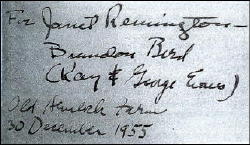
    Kay Harris and George Bird Evans wrote four mysteries under the Brandon Bird pseudonym, but this was the first of their books I had encountered. I bought it for two reasons: it was cheap and it was signed by the authors.

    Charles Gratton, a professional photographer, is on assignment in the West Virginia mountains to capture the hawk in flight. The hawk proves an elusive subject but a predatory Golden Eagle that attacks and kills a dog belonging to his local guide, and a mysterious figure Gratton catches watching him through binoculars, bring him into a situation far more daunting — and dangerous — than his hawk assignment.

    This entertaining mystery makes good use of the remote rural setting, a captivating heroine, and a reclusive, canny, murderous antagonist.

    Hubin lists three other mysteries by Bird, Downbeat for a Dirge, Never Wake a Dead Man, and Death in Four Colors. All three feature Hampton Hume, his wife Carmela, and Ruff, their their “faithful” English setter, Ruff.

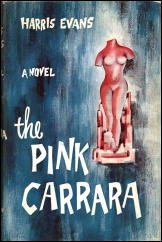
    The last recorded appearance in Hubin for the Evans’ novels is for The Pink Carrara, written under the nom de plume of Harris Evans, and published in 1960 by Dodd Mead.

    My enjoyment of Hawk Watch and the intriguing titles of the three other Bird titles led me to do a bit of sleuthing on the Internet, where I came up with a number of hits for George Bird Evans.

BRANDON BIRD

    He was born in Uniontown, Pennsylvania (a town not far from Pittsburgh) in 1906 and studied art at Carnegie Tech (now Carnegie Mellon) in Pittsburgh, where he met his future wife and co-author, Kay Harris of Wheeling, West Virginia.

    After studying at the prestigious Chicago Art Institute, George (now married to Kay) moved to New York City, where he had a successful career in magazine illustration, eventually landing a contract to illustrate mystery fiction for Cosmopolitan Magazine.

In 1939, the couple left Manhattan and moved to a farm they had bought in Preston County, West Virginia, a pre-Revolutionary building they immediately began to renovate. George continued to do magazine illustrations until the 1950s, when the two, both voracious readers, began publishing their pseudonymous mysteries.

    Although I’ve not been able to consult a copy of The Pink Carrera, I found a listing on ABE that described it as “a novel about a portrait sculptrist and his need to do art to support his pink carrara.” (Carrara is a city in Northern Italy famous for the white marble that was favored by Italian Renaissance sculptors.)

BRANDON BIRD

    A signed, limited edition of all five of their novels was published as “The Old Hemlock Mysteries” in 1995. This omnibus suggests that the crime elements in The Pink Cararra are stronger than described above.

    George Evans, an avid sportsman from childhood, became nationally known as a breeder of bird dogs and was a frequent contributor to Field & Stream and Pennsylvania Game News.

    Late in his life, Evans apparently came to regret his contribution to overhunting that had led to a substantial decline in the numbers of native game birds, and began to lobby against the practice. After George’s death in 1998 and Kay’s in 2007, the Old Hemlock Foundation was established on their West Virginia farm with a number of objectives that include environmental protection, support of the local Humane Society, and the awarding of scholarships to the WVU Medical School.

[UPDATE] 11-07-10.   Jamie Sturgeon has kindly sent me a cover image for the British edition of The Pink Carrara, along with a full description of the story, taken from the inside flap of the dust jacket:

BRANDON BIRD

    “This is the story of a man and a woman who loved not wisely but too well. It begins in a sculptor’s studio in New York where a great conductor, Joseph Matulka, has sent his young wife Leslie for a series of sittings.

    “Leslie, a brilliant opera singer; Matulka, the musical genius to whom she is married; and Paul Greer, the sculptor, are the three key figures in this situation, filled with tragedy or happiness. As the author develops his story from three points of view, the action progresses.

    “A magnificent block of pink Carrara marble, which in the sculptor’s hand takes on a significance he has not realised, gradually becomes the focal point of the story and begins this serious and distinguished novel, with its suspenseful theme, to a dramatic close.”

    Other than the phrase “suspenseful theme,” there is not much here to indicate that this is indeed a crime novel. We shall assume that it is, however, unless I can impose even further on Jamie to skim through the book until such time he can definitively say yea or nay.

[UPDATE #2.] 11-08-10.   Here’s Jamie’s reply:

    “Looking through the book there are 310 pages — the death, an accident, takes place on 276. The musical genius Matulka goes to the sculptor’s studio (with a gun) to have it out with the sculptor about the sculptor and Matulka’s wife. They have a fight and Matulka gets crushed by the pink carrara. There is some business afterwards about hiding the gun but I would say marginal at best.”

    Bill Pronzini, in a separate email, has concurred. He had the book at one time and has since swapped it away. “Only marginally a crime novel,” he says, “and for my taste not half as well done as any of the Brandon Bird mysteries.”

    The opinions above were duly reported to Al Hubin, who replies: “It certainly looks like it merits a dash [as having only marginal crime content] at least, if not deletion.”

    His final decision on the matter will undoubtedly appear in the next installment to the online Addenda to the Revised Crime Fiction IV.

[UPDATE #3.] 11-09-10.   No need to keep you waiting. He’s decided on the dash.

THE BACKWARD REVIEWER
William F. Deeck


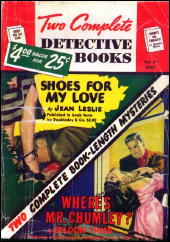
SELDON TRUSS – Where’s Mr. Chumley? Doubleday Crime Club, hardcover, 1948. Hodder & Stoughton, UK, hardcover, 1949. Reprinted in Two Complete Detective Books, No. 59, November 1949.

SELDON TRUSS Where's Mr. Chumley?

   Where indeed is the Reverend Mr. Chumley, curate at Charwell? The police suspect that he is off with an illicit lover, but those who know the good man are dubious, perhaps incredulous. As well they might be, for the unfinished letter to his “lover” turns out to be a forgery.

   Under the guise of a commercial gentleman, Chief Inspector Gidleigh, C.I.D., takes charge of the investigation into Chumley’s disappearance and has also to contend with a possible abortionist, a seeming suicide, and the odious Mr. Twigg. Nobody’s fool, Gidleigh gets part of it right.

   While Truss is not in the top rank of mystery writers, he (she?) is certainly high in the second tier. Humor, interesting and sympathetic characters, if one does not count the child Maisie of the marbly eyes, and a splendid plot make this novel, as well as others by Truss, worth trying to find.

— From The MYSTERY FANcier, Vol. 11, No. 4, Fall 1989.


Bio-Bibliographic Data: If (Leslie) Seldon Truss (1892-1990) is not male, I hope someone will leave a comment to let us know. His (I am presuming) writing career extended from 1928 to 1969, and included some 40 crime novels, including one written as by George Selmark.

   Inspector Gidleigh appeared in 22 or 23 of these (when one non-Gidleigh book was reprinted, Gidleigh showed up in it as the detective in charge), while Detective Inspector Shane appeared in six and Inspector Bass in yet another three.

[UPDATE] 11-07-10.   From Victor Berch comes the following note about Seldon Truss:

    “Here is what I’ve managed to gather from a variety of records:   Leslie Seldon Truss was the son of George Marquand, an agent for a produce company, and Ann Blanch (Seldon) Truss on August 21, 1892 in Wallington, Surrey, England.

    “According to his enlistment record in WW I, he had previously been a film producer for Gaumont Film Co. On the record dated Oct 8, 1915, he lists his age as 23 years and 2 months. He served with the 2nd Scots Guard during WW I.

    “He died Feb 5, 1990 at Hastings and Rother, East Sussex, England. He was a member of the Society of Authors and the Crime Writers Association. I think this should clear up his sex gender once and for all.”

« Previous PageNext Page »