Reviews


REVIEWED BY TINA KARELSON:         


CHARLAINE HARRIS – Dead to the World. Ace Books, hardcover, May 2004; paperback: May 2005.

CHARLAINE HARRIS Dead to the World

   Not the first in the Sookie Stackhouse series, but the first I’ve read. The premise of the series, on which the TV show True Blood is based, is that affordable synthetic blood has been developed, and vampires have taken the opportunity to “come out” and integrate into larger society, since they can now survive without presenting a threat to humans.

   The premise of the book is that Sookie’s brother has gone missing, and his disappearance seems be related to the efforts of a powerful gang of shapeshifter witches to take over businesses owned by vampires. Sookie tries to unravel all this using her ability to read minds and her connections to the vampire community.

   By the way, werewolves are real, too.

   I enjoyed reading the book, I appreciated the spectacular human-vampire sex scene, I was happy to sample the series, but I probably won’t read any more. Apparently my suspension of disbelief is not quite willing enough.

Editorial Comments:   L. J. Roberts reviewed Dead in the Family, the 10th in the series, here on this blog earlier this month. (Dead to the World is the fourth.)

   I don’t suppose that Tina’s review will change anyone’s mind, as expressed in the comments that followed L.J.’s, but at least I now have a better idea of what the books are about. And, no, now that my curiosity is satisfied, between the two reviews, I don’t think I’ll read any of them myself.

   Incidentally, there is an “in” joke in Tina’s last line. The name of her zine in DAPA-Em, from which she has given me permission to reprint her reviews, is called The Willing Suspension of Disbelief, currently up to issue #34 (July 2010).

REVIEWED BY WALTER ALBERT:         


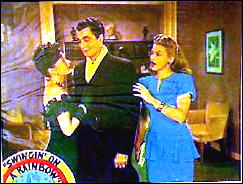
SWINGIN' ON A RAINBOW 1945

SWINGIN’ ON A RAINBOW. Republic, 1945. Jane Frazee, Brad Taylor (Stanley Brown), Harry Langdon, Minna Gombell, Amelita Ward,Tim Ryan, Paul Harvey, Holmes Herbert, Bert Roach. Director: William Beaudine. Shown at Cinevent 42, Columbus OH, May 2010.

   When radio star and songwriter Jimmy Rhodes Richard Davies) slips out of town without completing the songs for a program that could save a struggling radio station from bankruptcy, the desperate station manager (Paul Harvey) hires an aspiring song writer Lynn Ford (Jane Frazee) to complete the songs, believing her to be Rhodes’ partner.

SWINGIN' ON A RAINBOW 1945

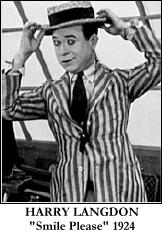
   Before this is all sorted out, Frazee’s attractive acting and singing, abetted by some artful comic ploys by Harry Langdon, made this a pleasant lead-in to the weekend’s screenings.

   The sixteen speaking parts listed in the credits end with “Drunk,” played by Bert Roach, who, in the late silent and early sound period, played leading and supporting comic roles, a dependable and amusing actor.

SWINGIN' ON A RAINBOW 1945

   And returning to Harry Langdon, a comedian for whom I never really cared, he was, for a time, a major silent player. He brings to the role of Chester Willouby, assistant to the station manager, an unassuming charm that surprised me and made me wonder if I shouldn’t revisit some of his silent film successes.

Editorial Comment:   Harry Langdon died on 22 December 1944 at the still young age of 60. Swingin’ on a Rainbow was the last movie in which he was to appear.

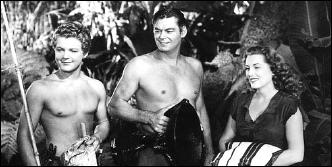
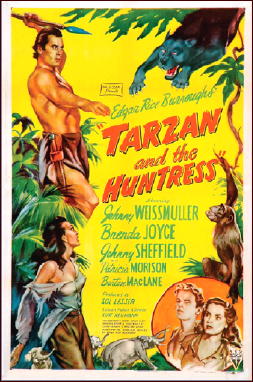
TARZAN AND THE HUNTRESS. RKO Radio Pictures, 1947. Johnny Weissmuller, Brenda Joyce, Johnny Sheffield, Patricia Morison, Barton MacLane, John Warburton, Charles Trowbridge. Based on characters created by Edgar Rice Burroughs. Director: Kurt Neumann.

   Based on the pages of TV Guide that I torn out and slipped inside the case, I taped this movie from a local station in September 1991, VHS of course. (I don’t know if DVDs were around then or not, but certainly not do-it-yourself recordable ones.) It’s been stored in the basement ever since, and it still plays fine.

TARZAN AND THE HUNTRESS

   Unfortunately the local station (WTXX in Waterbury) played this late at night and spiced it up every so often with colorful ads for adult services such as 1-900-HOTPINK. Those were the days, my friend.

   Johnny Weissmuller made only one more Tarzan movie, Tarzan and the Mermaids, before he morphed into Jungle Jim, but Brenda Joyce (who followed Maureen O’Sullivan) appeared twice more as Jane, appearing in Tarzan’s Magic Fountain with Lex Barker before calling it quits on her movie-making career. And Johnny Sheffield, growing up before the viewers’ eyes, became Bomba, the Jungle Boy soon after this one, in 1949.

   As “Boy,” though, he may have been getting taller and filling out more, but in Huntress he wasn’t smart enough to realize that trading two lion cubs to some hunters on safari for a flashlight was an altogether too bone-headed of a stunt for him to stay out of Tarzan’s doghouse for very long,

TARZAN AND THE HUNTRESS

   Of course the members of that same safari, picking up specimens for zoos in the US after the war, aren’t smart nor wise enough to realize that even though they’re not killing animals, crossing Tarzan’s wishes isn’t the smartest thing to do, especially on Tarzan’s home turf.

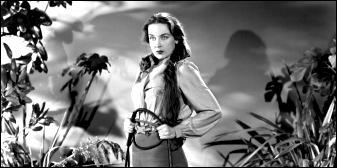
   The “huntress” in this movie is Tanya Rawlins, played by Patricia Morison, a beautiful brunette who’s nominally in charge of the expedition, but she’s too petite to overrule villain Barton MacLane, who plays her guide. In doing his job far too enthusiastically, for example, he finds it necessary to bump off the local native leader who stands in their way.

   The movie’s 72 minutes long, but it feels longer, even though there’s only about 30 minutes of actual plot to go with it – which probably goes a long way in explaining why it does feel as long as it does. There’s lots of stock animal footage, lots of neat shots of Tarzan swinging from vine to vine, one scene of synchronized swimming, and far too much monkey business. Way too much. I think Cheetah (the chimpanzee) has more screen time in this movie than any of the other actors.

TARZAN AND THE HUNTRESS

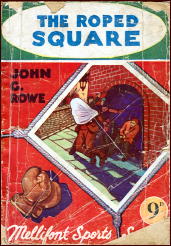
JOHN G. ROWE – The Roped Square. Mellifont Sports Series #36, UK, paperback original, no date stated [1941].

   Not my usual type of reading fare, but the book’s in the Revised Crime Fiction IV, by Allen J. Hubin, so when a copy came to hand, and being suspicious of its origin as part of a “sports” series, I thought I’d check it out, browsing my way through, and see exactly how “criminous” it actually was.

JOHN G. ROWE The Roped Square

   And before I knew it, nearly an hour had gone by, and I was well over half way through (128 pages of small print). Jim Ballard, a strapping young lad, is indeed a boxer, as you may have guessed from the title, or he would be, if his mother didn’t frown so upon his desire to become one.

   A small bout, though, in which he is not only the winner but also the recipient of the ten pounds of prize money, softens her opposition a bit. But the notoriety also arouses the interest of a certain criminal element, and Jim’s father is set upon by thieves, one of which, a man with a scar, promises to tell Jim something about his past if Jim were to let him go.

   It turns out that Jim’s parents are not his real ones, they reluctantly tell him. He was abandoned on their doorstep when he was tiny, and thus Jim’s world is turned upside down. In between further boxing matches he is kidnapped into an opium den (see the cover image), dropped off a barge into a river to drown, and is discovered to be the son of a local lord.

   Which between you and I, the latter’s story should not be believed for a minute. This reads like a Horatio Alger story to me, with new revelations and narrow escapes coming more and more quickly as the tale goes on. It’s all very interesting, although Jim, while quite the boxer, is far more naive than a young man of his years should be.

   Interesting until, that is, he is shanghaied and he finds himself in irons on a ship sailing for who knows where, which is one scrape too many. The author’s only out (if you don’t mind my revealing this to you) is to have half of the crew mutiny (it wasn’t too clear which half, nor why), and all of a sudden Jim is home, the villain revealed, and Jim is champion of the world.

A REVIEW BY GEORGE KELLEY:


JONATHAN GASH – Firefly Gadroon. St. Martin’s, hardcover, 1984. Paperback reprint: Penguin, 1985. UK editions include: Collins, hardcover, 1982; Arrow, paperback, 1986. Reprinted many times.

— From The Poisoned Pen, Vol. 6, No. 4, Fall 1986.

JONATHAN GASH Firely Gadroon

   Jonathan Gash is back with another Lovejoy adventure. Lovejoy is a rogue who would rob his blind grandmother in order to get an antique he wanted. Lovejoy puts antiques above everything else in life.

   This obsession is both Lovejoy’s most endearing quality and his greatest flaw. All of Lovejoy’s adventures revolve around antiques the way all Dick Francis books revolve around horse racing.

   In Firefly Gadroon Lovejoy gets involved in a case involving international smugglers of antiques and a mystery of where a fortune in antiques is hidden with the only clue being an antique firefly box.

   Along with the usual action in a Lovejoy thriller, Gash manages to add interesting aspects of antiques to the convoluted plot. This is one of the better books in the Lovejoy series and has just been released in paperback by Penguin. Recommended.

NOTE: For George’s current reviews (mysteries, SF, music, movies and more) visit his own blog at http://georgekelley.org/. It’s worth the trip.

IT IS PURELY MY OPINION
Reviews by L. J. Roberts


CHARLAINE HARRIS – Dead in the Family. Ace Books, hardcover, May 2010. Reprint paperback: March 2011.

Genre:   Paranormal suspense. Leading character:  Sookie Stackhouse; 10th in series. Setting:   Louisiana.

CHARLAINE HARRIS Dead in the Family

First Sentence: “I feel bad that I’m leaving you like this,” Amelia said.

   The Fae War is over and Sookie is recovering from her injuries. In spite of the door to the Fae World being closed, it seems not all the faeries have left. Her cousin, Claude, has decided to move in with her, she suspects her great-uncle Dermot may still be around and, perhaps, one other.

   Sookie’s vampire lover, Eric, is also still recovering. Although he is pleased when his “maker” appears, Sookie isn’t happy particularly with the vampire child of Russian nobility who is with him.

   As if that’s not enough, Sookie tries to help a human child who shares her telepathic abilities, is asked to act as Shaman for the Weres, and everyone is concerned about a government bill which would require all Weres and Shifters to register as such.

    It is interesting that, while many people didn’t like this book, I felt it was one of the better books in the series. The consistent thread was families, all types of families, and the relationships within them. For that reason, I felt there was more depth to this book than some.

   At the same time, it is not easy to take vampires, wares, faeries and humans and make the paranormal seem normal, realistic and logical. Harris does it with style, aplomb and humour. The book deals more with characters and less with edge-of-the-seat action. Most of the gang is here but there is just enough detail provided about each character for new readers.

   Harris makes you believe in these characters. More than that, she makes you cheer for the “good” characters and when Sookie says she wants one of the “bad” characters to die; so, too, do you.

   Harris’s descriptions provide such a strong sense of place that when she talks about Sookie sitting on the front porch, you can smell the coffee and hear the birds. Unfortunately, that also works for the less-than-pleasant descriptions as well so it is not a book for the easily queasy. To me, it’s that contrast that makes it work. This wasn’t as much of a graphic action or sex plot as some, although certainly enough to satisfy.

   This was a more introspective book for Sookie with the emotions conveyed being tangible. It also felt a transition book for Ms. Harris — the series growing up, if you will, and relationships developing.

   I know Ms. Harris has planned out where the series is going. There is no question but that I shall be going along with her.

Rating:   Very Good.

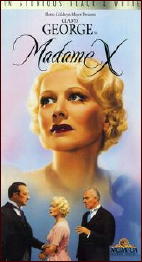
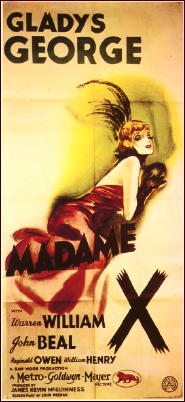
MADAME X. MGM, 1937. Gladys George, Warren William, John Beal, Reginald Owen, Henry Daniell, Phillip Reed, Jonathan Hale, George Zucco. Based on a play by Alexandre Bisson. Director: Sam Wood.

MADAME X Gladys George

   I don’t know which Lana Turner movie I was thinking of when I started to watch this one, but it obviously wasn’t Madame X (1966), which equally obviously I have never seen. What I was expecting to see was a murder mystery, but while there was a murder, and Jacqueline Fleuriot, a wayward wife played to perfection by Gladys George, is suspected of the crime, there is little or no effort onscreen to solve the crime.

   POSSIBLE PLOT ALERT: Some of what follows will tell you more than I knew when I started to watch this film, and to tell you the truth, more than I personally wanted to know, so take the next few paragraphs off, if you feel the same way.

   The shooting death of Mme Fleuriot’s lover by another rival is instead the first step in an nightmarish series of events in her life, leading her ever downward into poverty (pawning first her jewelry, then her clothes) and prostitution (all but assuredly, but the film of course never quite says so).

   It seems that while Mme Fleuriot was having her fling — out of boredom rather than real desire — her son unexpectedly fell seriously ill, and her husband (Warren William), a highly respected and influential attorney, throws her out of his house and his life.

MADAME X Gladys George

   When the husband relents, it is too late, and his wife cannot be found. This was Gladys George’s only starring role, and I do not pretend to understand why.

   She plays the world weary Mme Fleuriot perfectly — and more and more weary at each step of the way, on her downward path of self-inflicted destruction. Frowzy and embittered, and yet innately likable throughout the movie, she is no stranger to either men or the bottle – semi-adept in warding off the first but not the latter.

MADAME X Gladys George

   The final blow comes when a cheap con-man named Lerocle (Henry Daniell) comes to her rescue – a man to whom she inadvertently reveals her real identity, initialing a series of events that leads to a courtroom scene in which she is on trial for murder, an accusation for which she cannot defend herself, else it will ruin her reason for being accused in the first place.

   The histrionics run high in these final scenes, all but the calm and mostly controlled performance by Gladys George, who was relegated to small and bit parts for the rest of her career, and unfairly so. Warren William also allows his character’s stony facade to crumble in the end, to good effect. If this is pure soap opera, then so be it. It’s also highly effective, and I enjoyed the movie immensely.

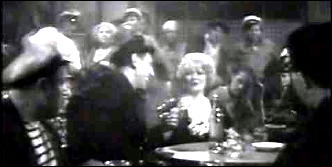
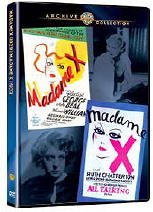
COMMENTS: This version of the movie is easily available on DVD. Warner Archives has, for example, released on a double bill with the 1929 version. For a clip on YouTube of the tavern scene shown above, go here.

MADAME X Gladys George

.

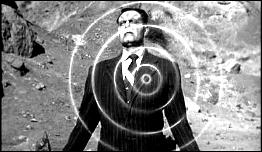
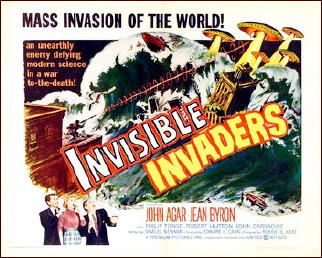
INVISIBLE INVADERS. United Artists, 1959. John Agar, Jean Byron, Philip Tonge, Robert Hutton, John Carradine. Director: Edward L. Cahn.

INVISIBLE INVADERS 1959

   As bad as second-rate sci-fi movies are today, in 1959 they were even worse. Even so, while this one is as ineptly written as they come, the solid earnestness of the cast makes it bearable to watch. It also doesn’t manage to turn you off with an excess of stomach-wrenching special effects, as opposed to what just about every other space-invasion monster-movie supplies us with, whether we wish so or not.

   Maybe that’s because the invaders from the moon, the self-proclaimed “masters of the universe”, are invisible. What is not really explained very well is why (1) they have been content to stay on the moon until now, and (2) why they need to possess the bodies of corpses while they’re on Earth.

   Add number (3): while they are in possession of the bodies of corpses, why must they walk in such a vacant-eyed, lurching fashion, and speak with the cavernous voice of John Carradine, the first dead man whose body they took over?

   And, well, while I’m at it, how about question (4): why do they bother “warning” Earth in the first place? If they’re so anxious to take over the place, now that mankind is on the verge of space travel and reaching the stars ourselves, why not just come in and wipe us out, without our even knowing?

   Put the answers to these questions down to the fact that there are certain things that Mankind is doomed to never know. (Nor, I am inclined to believe, are we meant to.)

— Reprinted from Mystery*File #35, November 1993, slightly revised.


[UPDATE] 09-02-10. I don’t remember this one at all. It’s available on DVD from Midnight Movies double-billed with another SF film called Journey to the Seventh Planet, which maybe I ought to buy, unless you can talk me out of it. (Some reviewers on IMDB call Invisible Invaders a minor classic, but I’d rather hear from people I trust.)

INVISIBLE INVADERS 1959

REVIEWED BY DAN STUMPF:         


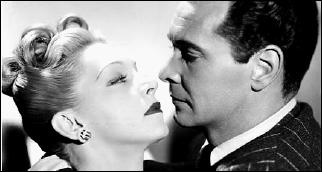
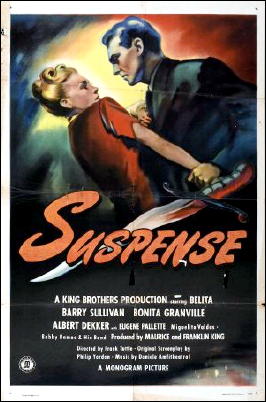
SUSPENSE. Monogram, 1946. Belita, Barry Sullivan, Bonita Granville, Albert Dekker, Eugene Pallette. Story & screenplay: Philip Yordan; director: Frank Tuttle.

   Back in 1946, Monogram Studios, home of Sam Katzman, the Bowery Boys and Bela Lugosi, made a bid for respectability with a couple of films noirs starring Barry Sullivan and skating star Belita.

SUSPENSE Barry Sullivan

   The Gangster bloats itself on pretension, but Suspense comes in right on the money, with a clever script by Philip Yordan and solid performances by a cast that includes Albert Dekker and Eugene Pallette.

   The story uses the framework of the rise-and-fall of a hustler, played by Sullivan with his usual assurance, who leeches onto a classy ice show run by Belita and her husband Dekker, playing a role he patented: the crook too smart for his own good.

   Things take off when Sullivan and Belita fall for each other, Dekker decides to kill at least one of them, and an old flame turns up from Sullivan’s past with romance and/or blackmail in mind.

   But that’s just the start of a clever, elliptical screenplay that implies more than it shows and keeps the viewer guessing for its entire length. The ice-dance numbers slow things down a bit — in fact they bring the whole story to a wheezing, protesting halt for minutes at a time — but they’re well-mounted and anyway that’s why God gave us the fast-forward button. Even with the interruptions, Suspense is a film to gladden all fans of gritty little B-movies.

SUSPENSE Barry Sullivan


   Editorial Comment:   The movie is available on DVD from Warner Archives.

H. PAUL JEFFERS – Murder on Mike. St. Martin’s Press, hardcover, 1984. Hardcover reprint, Detective Book Club, 3-in-1 edition, no date. Ballantine, paperback, 1988.

   A brief note on the author at the end of the book tells us that in the real world H. Paul Jeffers was the head of the news department at WCBS in New York, which perhaps explains why his mystery writing career seems to have been awfully sporadic.
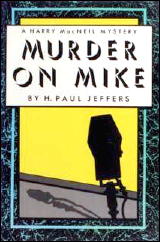
H. PAUL JEFFERS Murder on Mike

   It also says that he grew up listening to crime programs on the radio, which definitely explains where the idea for this particular case for private eye Harry MacNeil came from, and more on that in a minute.

   This is the middle of three cases that chronicle MacNeil’s adventures: The Rubout at the Onyx (Ticknor, 1981); Murder on Mike (St. Martin’s, 1984); and The Rag Doll Murder (Ballantine, paperback, 1987). It’s also the last of the three chronologically, as it takes place in 1939, while both of the other two are set in 1935. (Courtesy, as is often the case, to Hubin’s Crime Fiction IV.)

   MacNeil knows his way around Manhattan, and he’s known for also sitting in on late hour jazz sessions, but for hard-boiled fiction, you’d have to look elsewhere. When a good-looking girl asks him to look into the murder of radio’s most popular detective — well, the actor who played him, that is, and the creator of the Detective Fitzroy’s Casebook program — MacNeil is too soft-hearted to say that it’s an open-and-shut case, and that the lady’s boy friend, the show’s announcer, is sure to be convicted.

   He takes the case, he says, to be sure that Maggie Skeffington (Miss Molloy on the radio show) doesn’t waste her money with a more unscrupulous private detective.

   The accused, David Reed, already locked up and waiting trial, is the only person who could have done it and who does not have an alibi. By some fortuitous chance, the sound of a shot in the radio studio pinpoints the time of the murder exactly.

   Aha! You say, I’m one step ahead of you. That’s what I thought, too, and I’ll get back to that.

   Let me give you a feeling of Jeffers’ writing style, from pages 84-85 of the DBC edition. It’s a long quote, so jump in and out wherever you care to:

   As I crossed the street toward the plaza entrance of the RCA building, there was a crowd around the tree and and along the walls above the sunken ice rink where, even at that early hour, skaters were doing their stuff, every girl as pert and graceful as Sonja Henie and every boy as nimble as a Fred Astaire on skates.

   I paused a moment to watch as they performed and knew that in their minds they were stars, basking in the approval of the strangers surrounding the plaza. Whatever dreams of celebrity or affection or approval those skaters had in their heads were surely being fulfilled, if only for the brief moments they spent on the ice below Prometheus’ blank gaze.

   New York had always been a city for dreamers because it was a city that could make dreams come true. Which is why all those starry-eyed kids piled off trains at Grand Central or Penn Station or hopped off the buses at the Greyhound terminal on West Fifty-Third Steet and the All-American station just a short walk from the glittery promise of Times Square and Brodway, where dreams were a dime a dozen but where success was emblazoned in the lights of signs several stories high.

   There was the dream that David Reed had brought with him from Cleveland, the dream of being a star on a popular radio program that people listened to from coast to coast.

   Not a paragraph you’d find in the works of Hammett or Chandler, say. Maybe Woolrich, but as long as I’m making comparisons, the ending of this novel is pure Agatha Christie (see above) and very neatly done.

   And in closing, let me ask you this. Why in almost every retro-mystery like this, why is it that everyone who smokes, lights up a Lucky?

— August 2003


[UPDATE] 09-01-10.   This book was reviewed earlier on this blog by Bill Pronzini, in conjunction with an announcement of the author’s death in December 2009. There’s a complete crime fiction bibliography for him there also. It’s quite extensive, more than I realized when I wrote that first paragraph of my review above, once you add in the work he did under several pen names.
« Previous PageNext Page »