Reviews


A REVIEW BY MARY REED:
   

JOHN BUCHAN

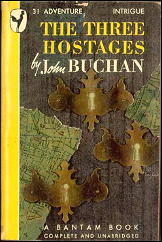
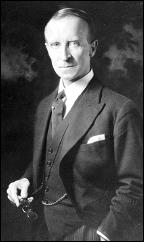
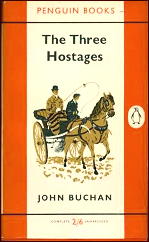
JOHN BUCHAN – The Three Hostages. Hodder & Stoughton, UK, hardcover, 1924. Houghton Mifflin, US, hc, 1924. Reprinted many times, in both hardcover and paperback, including Bantam #31, US, pb, April 1946; Penguin, UK, pb in dj, 1955 (both shown). TV movie: BBC, 1977, with Barry Foster & Diana Quick as Richard & Mary Hannay; director: Clive Donner.

   Having recently reread Greenmantle (reviewed here ), I’m now rereading some of the other Hannay novels. While some will certainly disagree, I view The Three Hostages as a mystery-thriller because there is a mystery to be solved: where are the three missing people and who is behind their abductions?

   The book opens a couple of years after WWI. Sir Richard Hannay and Mary Lamington are now married with a young son. They reside in Fosse Manor, a nice touch given they first met when she was staying with her aunts at the Manor while engaged in a bit of undercover work herself.

JOHN BUCHAN

   One evening the Hannays’ friend Dr Greenslade visits and their conversation turns to how to write a “shocker”. Dr Greenslade’s theory is the author should take three apparently unconnected things, invent a connection, and dream up a problem to solve involving the connection. His example: “an old blind woman spinning in the Western Highlands, a barn in a Norwegian sæter, and a little curiosity shop in North London kept by a Jew with a dyed beard.”

   In the real world ugly international doings are afoot and eventually they intrude into Hannay’s household. Members of the families of three great men — “the daughter of the richest man in the world, the heir of our greatest dukedom, the only child of a national hero” — have been kidnapped and are being held as hostages by a “combine” whose members are outwardly respectable but which is using the disaffected across Europe and elsewhere to further their own concerns, including fraud, profiteering, and even murder.

   Though known to the authorities, if members of this combine are captured too soon, the hostages will doubtless be executed and certain delicate political matters in the balance upset.

JOHN BUCHAN

   By a twist of fate Dr Greenslade’s literary example serves to aid Hannay and his friends get on the track of the villains in a race against a deadline at which they can only guess.

My verdict: Was Buchan following Dr Greenslade’s advice, I wonder? Hannay has quite a puzzle to solve and the first half of the book follows his attempts to make sense of the sole clue: six lines of doggerel sent to each of the three great men.

   There is more intelligence work and less physical action in this novel and the slow working-out of the mystery is convincing. Mary Hannay, while mostly off the page, plays a role near the end that is both gripping and believable and received a loud hurrah from here!

Etext: http://gutenberg.net.au/ebooks03/0301231.txt

         Mary R

http://home.earthlink.net/~maywrite/


Editorial Comment: Shown below is Stob Ban in the Mamores, one of the peaks that might have been used as a model by John Buchan. For more mountain scenes and commentary on where they might have shown up in Buchan’s work, go here.

   JOHN BUCHAN

A TV Review by MIKE TOONEY:


“The Trains of Silence.” An episode of Kraft Suspense Theatre (Season 2, Episode 28). First air date: 10 June 1965. Jeffrey Hunter, Tippi Hedren, Warren Stevens, Lloyd Bochner, Patrick Whyte, Francis DeSales, Dale Johnson. Teleplay: William Wood. Story: Ben Maddow. Story consultant: Anthony Boucher. Director: Douglas Heyes.

   Fred Girard (Jeffrey Hunter) storms into a hotel demanding to see the man who lives in the penthouse, his old college friend Wolfe Hastings (Lloyd Bochner).

   Fred is a Canadian geologist who has made a huge discovery: mineral deposits laced with titanium ore worth a cool three million dollars at current assay rates. He needs Wolfe, a reclusive multimillionaire, to finance development. All he wants is to see Wolfe, but he gets stonewalled from the get go, first by Wolfe’s alcoholic personal secretary Lee Anne (Tippi Hedren) and later by Wolfe’s righthand man, Mark Wilton (Warren Stevens).

   The D-Day invasion of Normandy proved easier than getting in to see Wolfe. Fred’s initial attempt to penetrate Wolfe’s lair nearly gets him killed. When that fails, Wilton tries to buy him off with a $3 million check — provided he leaves town to cash it. Fred accedes at first, but then has second thoughts. Now he wants to see Wolfe more than ever.

   With the unwilling assistance of an alley cat, at long last Fred breaks through the wall of security surrounding Humpty Dumpty and all the king’s men and discovers an ugly secret about his old college chum.

   Unfortunately for Fred, he’s the one — and not Humpty — who’s been chosen to take the fall — from a rooftop sixteen floors up ….

   This is Jeffrey Hunter’s show: He dominates every scene he’s in, and he’s in every scene. The script is already sharp, but Hunter improves on it. Tippi Hedren was a Hitchcock “discovery,” with The Birds (1963) being her first big starring role, followed by Marnie (1964).

   Warren Stevens has often played villains. A few of his crime drama credits: Phone Call from a Stranger (1952), Gorilla at Large (1954), Black Tuesday (1954), Women’s Prison (1955, reviewed here ), The Price of Fear (1956), Accused of Murder (1956), Intent to Kill (1958).

   TV credits for Stevens include two episodes of Checkmate, four appearances on Hawaiian Eye, three Kraft Suspense Theatre‘s (including “One Tiger to a Hill,” reviewed here ), Madigan (1968), and four episodes each of Mission: Impossible and Ironside.

Reviewed by DAVID L. VINEYARD:         


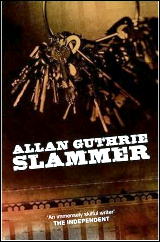
ALLAN GUTHRIE – Slammer. Houghton Mifflin Harcourt, US, hardcover, November 2009. Mariner Books, trade ppbk, September 2010. First Edition: Polygon, UK, softcover, March 2009 (shown).

ALLAN GUTHRIE

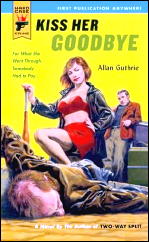
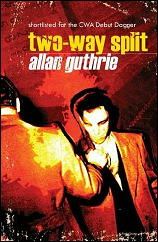
   This is a tough minded noirish thriller from British writer Allan Guthrie, who has previously been nominated for the Debut Dagger from the British Crime Writer’s Association and won Theakston’s Old Peculiar Crime Novel award for Two Way Split. His novel Kiss Her Goodbye was nominated for an Edgar and an Anthony.

   The man has some credentials for writing his particularly bleak version of the British crime novel. And bleak it is. Compared to Guthrie, Jim Thompson and David Goodies were cockeyed optimists. This one is the literary equivalent of those mad British crime films like Lock Stock and Still Smoking Barrel, but that sort of thing works better on screen than in print.

   Nick Glass is a prison guard at the ‘Hilton,’ a Scottish prison with a bad reputation, and between the inmates and his fellow officers he finds himself in a special hell caught between two equally brutal and dehumanizing forces.

   You might expect this to develop in classic noir form of a ‘hero’ who stands up to and defeats the forces on both sides after a brutal and bloody struggle, but that isn’t where Guthrie is going, though at times it seems so.

   Nick’s life takes an even worse turn when a group of cons in the prison uses outside pressure to threaten Nick’s wife and daughter to force him to do them a ‘favor’ on the outside.

ALLAN GUTHRIE

   I’d like to quote from the book, but frankly there isn’t much that could be quoted here without heavy editing, and even then it wouldn’t give the feel of the book.

   One problem I found with this is that I never cared what happened to Nick Glass. He’s an unappealing protagonist and it’s hard to care about his grim ironic fate. The novel takes a dark turn that I can’t discuss in fairness to Guthrie and anyone planning to read this, but I neither believed it nor felt he brought it off. I’m not sure any writer could bring it off.

   Frankly I haven’t decided whether I like this or not. I’ll have to put it aside and come back in a different mood to be sure. The writing is assured and strong, but there is something about this book that made me feel like I needed to stop an take a shower when I finished it.

   If the point of the book is that prison is a dehumanizing brutal place, I think most of us knew that going in. If it is that men break in strange ways I think we knew that too. And that’s the problem. I’m not sure exactly what Guthrie is trying to say, other than most of us would be better off to avoid a career in prison from either side of the law.

   I suppose there is a certain black humor is watching Nick Glass shatter (sorry, couldn’t resist — and neither does Guthrie or the publisher), but for the life of me I can’t say I cared. He’s a singularly weak and unattractive character, and his attraction to a femme fatale named Lorna only makes him less appealing.

   This type of book turns on the reader’s ability to identify with or at least emphasize with the protagonist’s grim predicament. In the case of Nick Glass I’m not sure his fate would have been much better if he had taken a job in the postal service or the mail room. He’s not merely a loser, but a high profile loser of the first order.

ALLAN GUTHRIE

   I don’t know where this book was supposed to take me. Where it did take me was to a depressing and bleakly unrelieved place with only a few grim moments of black humor to relieve the pressure — and I’m by no means certain they were even meant to.

   Guthrie can write. No question there. And if you want a strong, even stomach churning crime novel with no redeeming characters or features and an outlook as bleak as the gray walls of a Scottish prison, then this is the book for you.

   But I’ll have to be honest. I’m not sure if I would want to take this trip again, and when I do read a bleak novel of brutal crime I usually need some sort of cathartic release — even only a sort of grim irony or a satisfyingly operatic blood bath. I didn’t get that from this one, and that may be strictly me and where I am, but we all read books from that subjective point of view, and based on that, the most I can say is you’ll have to decide for yourself.

   Ted Lewis’s Get Carter and Gerald Kersh’s Night in the City both did this much better and Georges Simenon’s Stain on the Snow showed us even the most unappealing protagonist could hold out attention. For that matter I can think of a half dozen stunning little British crime films from the last decade that all would be a better investment in time and money.

   I wanted to like this one better. I went in expecting pretty much what I got, but I have to say that for me this one is an unappetizing and disappointing outing. That said, I’ll look up Guthrie’s previous novel and probably read his next. The talent is there if he can just tie it to some human element that we can identify with and care about.

   I’m not sure Guthrie failed at what he sat out to do, only that he failed to make me care.

Bibliography: ALLAN GUTHRIE.

      Two Way Split (2004)
      Kiss Her Goodbye (2005)
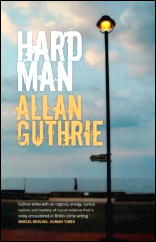
      Hard Man (2007)

ALLAN GUTHRIE

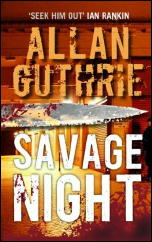
      Savage Night (2008)

ALLAN GUTHRIE

      Slammer (2009)
      Killing Mum (2009)

THE BACKWARD REVIEWER
William F. Deeck


BELTON COBB – Murder: Men Only. W. H. Allen, UK, hardcover, 1962. No US edition.

   Fearing that Detective Chief Inspector Cheviot Burmann is losing his grip on his job by not following up on information received, Woman Police Constable Kitty Palgrave takes it upon herself to investigate what might be going on at Mrs. Munro’s boardinghouse. This establishment is perhaps unique in that Mrs. Munro takes in only nonpaying male guests who she thinks might be lonely.

   Taking leave from the police department, Palgrave gets herself employed as housemaid at the boardinghouse. Her main discovery there is the corpse of Burmann’s informant, a new inmate at the boardinghouse. When he becomes aware of Palgrave’s presence at the crime scene, Burmann comments: “As usual, you have wandered into one of my cases — and everything is considerably more complicated in consequence.”

   Mrs. Munro is a dotty landlady, seldom finishing a sentence or a thought, and Burmann has trouble coping with her. Nonetheless, he clears up the crime in a tolerably amusing book.

   There apparently is no such thing as a bad boardinghouse novel.

– From The MYSTERY FANcier, Vol. 13, No. 3, Summer 1992.


Editorial Comment:   This is a scarce but not particularly valuable book. There are two copies in English (and two in French) to be found on abebooks, for example, and in neither case is the asking price over $20.

   Cheviot Burmann was Cobb’s most commonly used series character, beginning with either No Alibi or The Poisoner’s Mistake, both of which came out in 1936 . A fellow named Bryan Armitage shared the billing in a few novels (including Murder: Men Only, although Bill did not happen to have mentioned it) plus had a few solo adventures on his own. Supt. Manning was the leading character in several more books.

   She’s not mentioned in Al Hubin’s Revised Crime Fiction IV, but reading between the lines in Bill’s review, it’s all but certain that Constable Kitty Palgrave was in more than one of Inspector Burmann’s books as well.

REVIEWED BY WALTER ALBERT:         


LAWRENCE BLOCK Keller

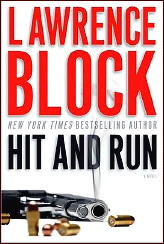
LAWRENCE BLOCK – Hit and Run. William Morrow, hardcover, June 2008. Harper, paperback, June 2009.

   Block’s sympathetic hitman Keller returns for a fourth outing. As he’s waiting for the go ahead to carry out a job in Des Moines, a charismatic African-American governor is assassinated and a photograph of Keller is widely disseminated as the face of the assassin.

   You might say that it’s poetic justice, but Keller’s been set up, and we always have the sense that the people who hire him are the real villains, with Keller the competent professional who’s just doing his job. His life in ruins, Keller goes on the run.

   With the help of a new person who comes into his life and the ever faithful Dot, he eventually recovers but the momentum of the series has been seriously damaged. Much of the novel finds him just marking time, and that new person seems nothing more than a plot device to rescue Keller from an almost impossible situation.

   As far as I’m concerned, this series has run its course, and if this is indeed meant to conclude Keller’s saga, it’s a lame resolution.

       The Keller series —

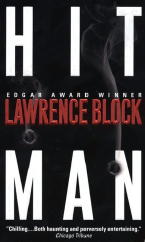
   1. Hit Man (1998)

LAWRENCE BLOCK Keller

   2. Hit List (2000)
   3. Hit Parade (2006)
   4. Hit and Run (2008)

REVIEWED BY DAN STUMPF:         


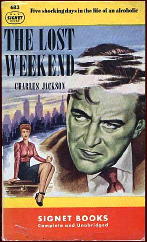
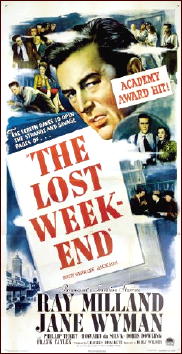
THE LOST WEEKEND

   ● CHARLES JACKSON – The Lost Weekend. Farrar & Rinehart, hardcover, 1944. Reprinted many times, in both hardcover and soft, including Signet #683, pb, 1948.

   ● THE LOST WEEKEND. Paramount Pictures, 1945. Ray Milland, Jane Wyman, Phillip Terry, Howard Da Silva, Doris Dowling, Frank Faylen. Screenplay: Charles Brackett, based on the novel by Charles R. Jackson. Director: Billy Wilder.

   Thinking of books and the films made from them, I recenly re-watched and reread The Lost Weekend. I first read Charles Jackson’s 1944 novel back in High School, five years before I took my own first serious drink. Coming back to it now, I found some bits rather labored, way too many pages of rambling introspection, and a disappointing conclusion.

THE LOST WEEKEND

   All that’s left is a gripping story that generates real suspense and painful pathos, a central character commanding the reader’s interest from the outset, and a heart-rending momentum that keeps the pages turning even through the more self-indulgent passages. That’s all.

   The film Billy Wilder made out of this in ’45 softens the ending, adds a love interest, and cuts away the fatty introspection that pervades Jackson’s book, to emerge as a typically tough, brilliant and rather showy Billy Wilder movie: fast-paced, well-developed, and fleshed out with performances — even in the bit parts — that come alive on the screen.

   Ray Milland’s break-out turn after a decade of shallow leads is the most famous, but there’s also memorable thesping from Howard DaSilva — and lovable Frank Faylen etches a part so evil it’ll make me dubious next time I see Wonderful Life.

   One other thing I noticed: the last shot in this movie is really the first shot run backwards. That means something but I don’t know what.

ROGER TORREY – The Bodyguard and Other Crime Dramas. Black Dog Books; trade paperback; 1st printing, 2009. Introduction by Ron Goulart.
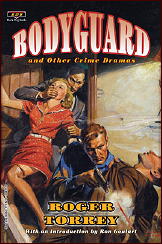
ROGER TORREY

   Roger Torrey is probably not the first name you’d come up with if you were to start listing some well-known writers who wrote for the detective pulp fiction magazines, but in his day, he was one of the more prolific ones, and he traveled in high circles, with a considerable amount of his output in the 1930s being for one of the most prestigious of them all, Black Mask.

   Torrey wrote nearly 50 or so stories for that particular magazine, beginning in 1934 and continuing on to 1943, and one wishes that some of those could have been included in this particular collection. But alas, no. Even though this is a strikingly handsome volume, small press operations such as Black Dog Books do not have large budgets, and from all appearances the stories herein are all in the public domain.

   The magazines these stories were reprinted from, such as Romantic Detective, Private Detective and Super Detective, were not even of the second rank, as far as pulp magazines went. More like third or even fourth level, counting downward. Prestigious publications they were not.
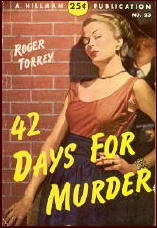
ROGER TORREY

   I am sorry to have to tell you this. But not all is lost. Bodyguard is a handsome volume, as I mentioned before, and the stories that are in it were certainly among the best of the magazines they were in.

   Most of Torrey’s leading characters were private eyes, also a great big plus as far as I am concerned, but only a few of them have well-heeled clients or work for a big agency and have a steady job. Most of them seem to be struggling along in life as well as everybody else who inhabit these tales, and sometimes their clients have less money on hand than they do.

   One gets the feeling that Torrey’s characters live in the other end of town, and the stories he tells are earthier and closer to the ground than some of those by his contemporaries. One of the stories has a scene that is more than slightly risque, but otherwise the leading characters and the women they meet in these stories do what ordinary people do, casually but behind closed doors. Lots of hints, in other words, but nothing more than that.
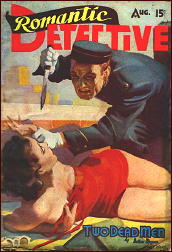
ROGER TORREY

   The detective in “Two Dead Men” (Romantic Detective, August 1938) is a fellow named John Linehan, who in the course in telling this story reveals, without quite saying so, for example, that he’s been stepping out with his secretary on more than one occasion. It also is telling that she’s quite jealous when Lineham seems to be spending too much time in close proximity to a lady friend of his client, as they travels from party to nightclub and back again with his client and her boy friend.

   It seems as though she’s being blackmailed (her boy friend already has a wife) by someone who knows far too much about her, including the fact that she and the aforementioned boy friend were sharing a hotel room right next to one that from which a dead man jumped, falling not feet from Lineham, not working for Miss Morrison at the time.
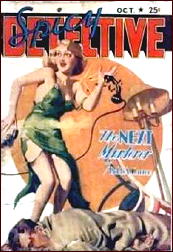
ROGER TORREY

   It is a wonder that Lineham can solve the case, what with all of the heavy drinking that goes on in this story, but solve it he does. I’m not as sure of the “why” as he is, but I agree with the “who.” But readers of Romantic Detective were not so much interested in the detective end of things, I presume, and Torrey delivers what it was they were looking for.

   Story number two is “Cook to Order” (Spicy Detective, October 1939), told by private eye George Andrews, who’s asked by a waitress in a place where he eats to find out what’s been bothering her roommate. Turns out that that’s just a ploy to get him over to her apartment, but as it turns out again, there actually is a case for “Andy” to solve.

   The plot is far too complicated for a story only ten pages long. The picture of tough living, dingy hash houses and bare-bones living quarters will stay with you a whole lot longer.
ROGER TORREY

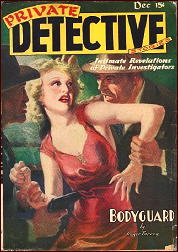
   The title story, “Bodyguard” (Private Detective, December 1938) is one of the longer tales in the collection, almost forty pages long. It doesn’t mean that it’s one of the better ones, I admit, but it has it moments.

   The bodyguard in question is William Dugan, who hired by a man of some wealth when some threats against his life have escalated into actual shots being taken at him. To my mind, Bill is not much of a bodyguard, although in all honesty the beating death of a gardener can’t be held against him, since the incident happened before he showed up.

   Nor can the shooting of a deputy sheriff, since the man was hardly one of the family. But when the throat of one of Miles’s two daughters is found with her throat slit, you’d think he might be fired on the spot, but he manages to keep his job until the case is solved.

   The dead girl was the pure in faith one; the other, a honey blonde with the morals of a tramp is the one who’s all over Bill — picture one guy with a stiff arm out to stave off her advances, and you’ve got our detective pictured to a T. And naturally Angela is more than jealous when Bill takes up with the other good-looking woman who’s recently come to town — a platinum blonde who claims to be a reporter, but her newspaper has never heard of her.

   Bill checked — one of the better moves he makes.
ROGER TORREY

   This is as far I’m going to go. I’m sure you have the idea. There are eight more stories in this book, and I enjoyed them about as much as I did these first three. None of them is as good as Dashiell Hammett or Raymond Chandler, and maybe they’re not even half as good. On the other hand, who is?

PostScript. Two more things. There is, first of all, a well-done checklist of all of Torrey’s pulp fiction that fills the last dozen pages of this book. (Torrey wrote only novel in his career — he died in early 1946 of acute alcoholism– that being 42 Days for Murder, published first by Hillman-Curl in 1938.)

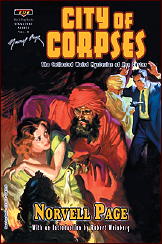
   Secondly, if you are a pulp fiction fan of any vintage, old or new, you should also go visit the Black Dog Books website. They have a large number of other collections like this one already out or coming soon, including the one just above and to the right, and I recommend all of them to you very highly.
REVIEWED BY DAN STUMPF:         


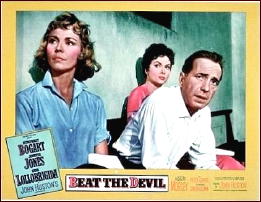
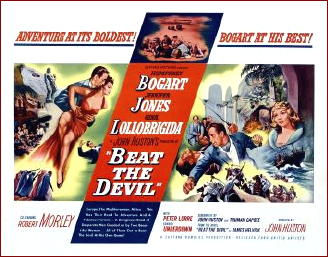
BEAT THE DEVIL

BEAT THE DEVIL. United Artists, 1954. Humphrey Bogart, Jennifer Jones, Gina Lollobrigida, Robert Morley, Peter Lorre, Edward Underdown, Ivor Barnard. Screenplay by Truman Capote and John Huston, based on the novel by James Helvick. Director: John Huston.

   A legendary mess. Scripted by Truman Capote, directed by John Huston, with a great cast that includes Humphrey Bogart, Jennifer Jones, Peter Lorre, Gina Lollobrigida and Robert Morley, and it’s still a dreadful muck-up time has not redeemed; something about a bunch of con men stuck in Italy trying to buy land in Africa, I think, but the plot doesn’t matter because it never really goes anywhere.

   There are some witty lines, but Huston always seems to be looking the other way when someone says them. Likewise the acting: some good turns by Morley, Lorre and Ivor Barnard as “the Galloping Major” but the characters are never defined well enough for us to be sure what the acting’s all about.

BEAT THE DEVIL

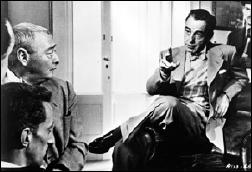
   Worst of all is Humphrey Bogart. It’s hard for a life-long Bogie-man like me to say it, but he’s dreadful here. Already cancer-stricken at 54, in ill-fitting wigs and gaudy clothes, he looks like an aging queen tarted up for one last night out with the boys.

   Bogie expressed some doubts about the project at the time, and it shows in his performance; at the heart of Devil we need the relaxed, self-assured leading man of Casablanca and The Big Sleep, but what we get is a nervous icon walking through the movie like an old man trying to cross a busy street.

   By the way, I’m always fond of reading the source books that notable movies were made from, so I looked up James Helvick’s novel Beat the Devil on the internet. The cheapest copy I found was $200, and if anyone wants to send me a copy, feel free.

BEAT THE DEVIL

REVIEWED BY WALTER ALBERT:         


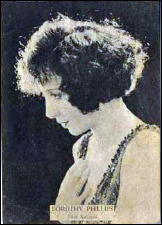
BROADWAY LOVE. Bluebird Photoplays, 1918. Dorothy Phillips, Juanita Hansen, William Stowell, Harry von Meter, Lon Chaney, Eve Southern, Gladys Tennyson. director and author of the screenplay: Ida May Park. Shown at Cinecon 45, Hollywood CA, September 2009.

DOROTHY PHILLIPS

   This was an unusual screening, a silent film directed by a woman. Ida May Parks, according to Wikipedia, directed some 14 films, and wrote at least 50 screenplays, in a career that lasted from 1914 to 1930.

   The star was the then popular Dorothy Phillips, who plays Midge O’Hara, a small-town girl who goes to New York where she gets a job as a chorus girl. She is befriended by Cherry Blow (Juanita Hansen) who attempts to introduce the virtuous Midge to the incidental pleasures of her new life at a riotous party in the apartment of Cherry’s sugar daddy.

   Midge is rescued by an Arizona millionaire, only to find that his intentions are dishonorable. She flees New York, pursued by the persistent Henry, as well as by Elmer Watkins (Lon Chaney), her loutish suitor from back home.

   Parks sets up her shots for the actresses with great care, and is particularly successful with the party sequence. Relatively few Universal silent films (Bluebird Photoplays was Universal’s prestige feature unit) survived the studio’s purge, and the survivors are often in poor condition.

   However, the print shown was in excellent condition, and the film was more than competently directed, making one hope that other films directed by Parks may have survived.

A TV Review by MIKE TOONEY:


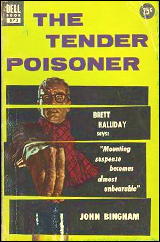
JOHN BINGHAM Tender Poisoner

“The Tender Poisoner.” An episode of The Alfred Hitchcock Hour (Season 1, Episode 14). First air date: 20 December 1962. Dan Dailey, Howard Duff, Jan Sterling, William Bramley, Philip Read, Richard Bull, Bettye Ackerman. Writer: Lukas Heller, based on the novel Five Roundabouts to Heaven (1953; aka The Tender Poisoner, US, 1953) by John Bingham. Director: Leonard Horn.

   Barney Bartel (Dan Dailey) is an unhappily married man who has fallen for a woman, Lorna (Bettye Ackerman), ten years younger than his wife Beatrice (Jan Sterling). Barney’s pal Peter Harding (Howard Duff) knows about the affair and seems anxious to discourage Barney — but things aren’t always what they seem, are they?

   For Peter the situation has its advantages, indeed it does; for Barney, though, the situation is becoming intolerable. The first step involves getting rid of Beatrice, in preparation for which Barney must do an experiment on his dog, one involving poison …

   Longtime hoofer Dan Dailey proves in this show that he could do serious crime drama. Most of us may have forgotten the TV series Dailey did in 1959-60, 39 episodes of The Four Just Men inspired by characters created by Edgar Wallace. His only other series was the comedy The Governor & J. J. (1969-70).

   Howard Duff’s character is almost identical to the shifty guy he played in Naked City (1948). He also appeared in Johnny Stool Pigeon (1949), Spy Hunt (1950), Shakedown (1950), Private Hell 36 (1954), Women’s Prison (1955), While the City Sleeps (1956).

JOHN BINGHAM Tender Poisoner

   On TV he was in Dante (26 episodes, 1960-61) and Felony Squad (73 installments, 1966-69), one Ellery Queen (1976), six appearances on Police Story, 37 episodes of Flamingo Road, and one as Thomas Magnum’s grandfather on Magnum, P.I.

   Jan Sterling was in a few crime dramas: Mystery Street (1950), Union Station (1950), Appointment with Danger (1951), Split Second (1953, reviewed here), The Human Jungle (1954), Female on the Beach (1955), and two episodes of The Name of the Game.

Hulu: http://www.imdb.com/video/hulu/vi869793817/

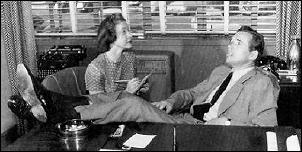
Editorial Comment:   The photo you see of Howard Duff is strictly a case of “None of the Above,” as far as the credits go as listed for him by Mike. If you know the part he’s playing, then you almost assuredly know who it is who’s in the scene with him.

« Previous PageNext Page »