Reviews


BLOCHMAN Death in Marble Halls

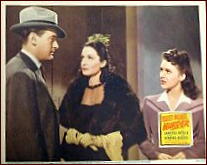
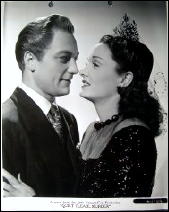
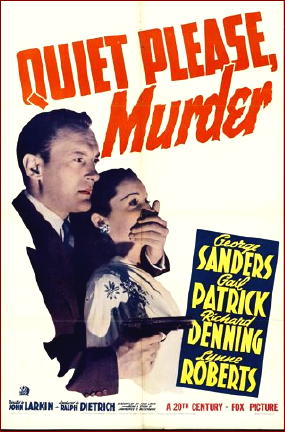
QUIET PLEASE: MURDER.   20th Century-Fox, 1942. George Sanders, Gail Patrick, Richard Denning, Lynne Roberts, Sidney Blackmer, Kurt Katch, Byron Foulger. Screenplay: John Larkin, based on the story “Death Walks in Marble Halls,” by Lawrence G. Blochman. Director: John Larkin.

   According to IMDB, the Blochman story that this 1940s crime and mystery film wass based on was one titled “Death From the Sanskrit,” but other than IMDB, neither David Vineyard nor I have found a reference to a Blochman tale anywhere else by that name.

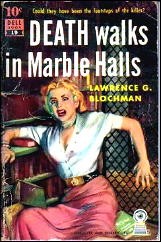
   We may be wrong about this, but we’re sure (say 99.99%) that Quiet Please: Murder was adapted instead (and loosely so) from “Death Walks in Marble Halls,” a short novel that first appeared in The American Magazine, September 1942. It appeared later in EQMM as “Murder Walks in Marble Halls,” and was reprinted under its original title in 1951 as #19 in Dell’s short-lived series of slim-sized 10-Cent paperbacks.

   Says David, who may be the only person to have both watched the movie and read the book:
    In Death Walks in Marble Halls, Phil Manning is the PR man for a major public library and plunged into a mystery when a trustee of the library is murdered, and shortly after a woman who was a witness dies too. The chief suspect is a crackpot called an “erudite screwball,” and the only clue a scrap of paper in what appears to be Sanskrit.

BLOCHMAN Death in Marble Halls

    The plot turns on a musical score that may or may not be original. Kilkenny is a local cop on the case, and Dr. Rosenkohl the medical examiner. The main similarity is they are all trapped in the library with a murderer while the police investigate, but in the novella it is the real police and the forgery business is mere plagiarism.

    As always with Blochman, it’s a well written mystery and moves rapidly, and while there isn’t a lot of it in the film you can see bits and pieces of it there. Some of the names from the novella are used in the film, and some of the details of library operation.
BLOCHMAN Death in Marble Halls

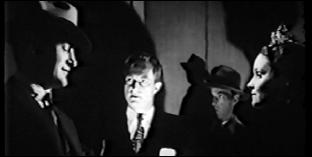
   Me again, Steve. I’ve watched only the movie, and what follows is the basic outline of the plot. As you’ll see, other than the basic library setting, there isn’t a lot in common, as David says. The forger in the film who isn’t in the book, as he mentions, is Jim Fleg (an oilier than usual George Sanders), who’s stolen a rare copy of Shakespeare’s Hamlet from a downtown library and who’s planning, with the able assistance of femme fatale Myra Blandy (Gail Patrick), to make multiple copies and sell them to equally unscrupulous collectors as a continuing source of income.
BLOCHMAN Death in Marble Halls

   Unfortunately Myra makes the mistake of selling one of the forged copies to a Nazi agent (Sidney Blackmer), who wants his money back. At which point enters PI Hal McByrne, a lanky womanizer played by Richard Denning, causing Myra (the femme fatale he falls for) to realize she can kill two birds (at least) with one stone.

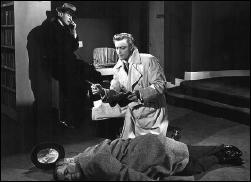
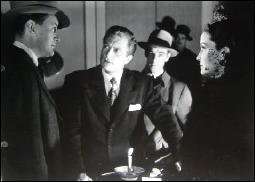
   At which point the rest of movie moves to the aforementioned library, where several murders do occur, as the title of the film suggests (I confess I lost track of how many), along with many well-constructed chases of one character by another between the stacks of books, plus a very timely blackout monitored by a comically excitable librarian cum war raid warden played to perfection by Byron Foulger, a name long-time old movie fans will certainly remember.
BLOCHMAN Death in Marble Halls

   Either the movie was actually filmed in a library — and believe it or not the Dewey Decimal System, carefully explained earlier on, is part of the plot — or the producers of this film raided the shelves of several nearby furniture stores. (The library is said to have two miles’ worth of books, but naturally we do not get to see them all.)

   The plot is a complicated one. You have to pay attention every minute of the way. (My usual technique of watching the movie a second time did not help, and in fact I only found myself confused in other ways.) In terms of production values, they’re probably only par for the course in terms of black and white mystery movies made in 1942, but the film itself is surely an entertaining one.

PostScript:   Mike Grost reviews the novella, not the movie, on his Classic Mystery and Detection website. He says of it, in part, and I quote:
BLOCHMAN Death in Marble Halls

    It is set at the New York Public Library, and is one of the few Blochman stories in which the floor plan and architecture of the setting plays a crucial role: one can follow the movements of the characters all over the Library, and the architectural orientation gives pleasure in the way typical of Golden Age mysteries. […]

    The characters in the story do not merely stand around and expound on their intellectual specialty. Each has a job, and each is busy producing something as part of it. This beehive of work is integrated into the mystery plot. Both the Library and the knowledge work are part out the main productive output of New York City, its work as an industrial center of the mind. […]

    The unfolding patterns of this tale make it a very satisfying reading experience. Blochman weaves them out of several different “colors”: the personal relationships of the characters, their professions; their physical positions in the library architecture; and their relationship to the murder plot.
BLOCHMAN Death in Marble Halls

Reviewed by DAVID L. VINEYARD:         


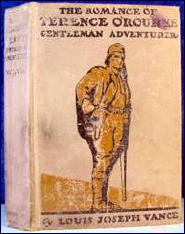
LOUIS JOSEPH VANCE – Terence O’Rourke, Gentleman Adventurer. A. Wessels Co., US, hardcover 1905. Reprinted as The Romance of Terence O’Rourke, Gentleman Adventurer: Bobbs-Merrill, US, hc, 1907; Grosset & Dunlap, no date (shown). Also: Grant Richards, UK, hc, 1906. Silent film: Universal, 1914. First appeared in The Popular Magazine, circa 1904-05. (See comments for additional information.)

   In 1904, ten years before he would pen the first adventure of Michael Lanyard, the Lone Wolf, Louis Joseph Vance was concerned with the adventures of another American in Paris, Colonel Terence O’Rourke, an American soldier of fortune, down on his luck and about to face a change of fortune.

   Now good reasons why a man may be out of sorts in a Paris springtime are few and far between; but they exist; O’Rourke had brought his with him … his supply of ready cash was not alarmingly low; it was nonexistent —

LOUIS JOSEPH VANCE Terence O'Rourke

   In short order he pawns a watch presented to him for bravery in a South American revolution, finds a casino, loses every penny, is challenged to a duel, pursued by a mob, and leaps into a carriage to escape — where he meets a beautiful woman, Beatrix, the Madame la Princess de Grandilieu, and by sheer luck — the kind of thing that was always happening to adventurers like ‘the O’Rourke’ — utters the secret password that leads her to believe he is the man she is supposed to meet.

   In the hands at a romancer like Vance, that’s all that is needed.

   O’Rourke learns her brother has plans to lead an army into the Sahara and make himself an emperor of the wastes… There is only one problem with his plan. The Emperor is a coward and a fool, known as ‘le petit Lemercier,’ the laughing stock of France for his foolish exploits.

    “Here,” he said, drawing O’Rourke’s attention to a spot on the west coast of the continent, “is Cape Bojador. Here again,” moving his finger a foot upon the coast line, “is Cape Juby. To the north lies Morocco; to the south lie the Spanish Rio de Oro possessions. But between the two capes is unclaimed land. There, messieurs, lies the land that shall become our Empire of the Sahara. There we shall establish and build up a country even greater than our France!”

   A grand scheme, one O’Rourke would likely by pass though if not for the beautiful Beatrix. He teams up with Daniel ‘Danny’ Mahone, once his batman, and takes command of the army of the Emperor of the Sahara. But no one asked the local nomadic bandits the Tawareks (Tuaregs).

    “They are the lords of the desert — inhabitants of the Sahara proper — a branch of the Berbers: perhaps the root-stock of the Berber family tree… They infest the caravan routes: in a word, they’re pirates, and rule the country with a rod of iron.

   Beatrix is kidnapped, and O’Rourke rides madly in the desert after her and her Tawarek captor…

    O’Rourke fired again, almost at random, risking everything, even the woman he loved, in the necessity of saving her from what was, if not death itself, worse than death.

   … her husband Prince Felix dies, and O’Rourke rescues the lady and leads a desperate battle, and bloody retreat.

   But he doesn’t get the girl. After all, she is a princess and he is a penniless adventurer — besides, his adventures were just beginning. Two sets of them flowed from Vance’s capable pen.

LOUIS JOSEPH VANCE Terence O'Rourke

   O’Rourke adventured in the pages of The Popular Magazine where he wielded his sword and Mauser with deadly skill. After “The Empire of Illusion,” the series of stories which make up the tale comprising the first half of the book, he finds himself in a Ruritainian adventure rescuing a kidnapped prince and dueling an evil prince. After that he is discovered preventing a revolt against the British in Egypt.

   Always his fist, his sword, and his gun are quick to be employed in a good cause; always he just fails to make enough to reclaim his true loves hand; always he finds a new adventure.

   Beatrix, bless her, would have him anyway, but O’Rourke will not impoverish her. He’ll have a fortune for her or die trying. And he frequently comes perilously close to doing just that. Not that he is averse to other beautiful women. He’s loyal, not dead.

    “‘Tis yourself that would be the squire of dames is it, O’Rourke?” he said. “Faith, but it seems that ye will not. Let us go out and think about this thing — for, if ever a woman stood in need of a man’s strong arm … ’tis this countess, and upon this very night — I’m thinking.”

   Eventually he inherits one of those convenient fortunes from one of those equally convenient relatives that die and leave such fortunes in tales of adventure and romance, battles a deadly Duke on a vertiginous stairway, and sends him to hell through a doorway that leads only to a precipitous plunge a la David Balfour’s near fate in Kidnapped. He wins his ladies hand and lives happily ever after.

    Once she told him: “The frontier is not far, sweetheart. Once over that, beyond immediate pursuit, we will stop at an inn and summon a surgeon. Can you bear, O my dearest, to wait so long?”

    “I — Ah, faith! I could endure a thousand deaths — and yet live on — in your arms …”

LOUIS JOSEPH VANCE Terence O'Rourke

   Rudolph Rassendyll couldn’t have said it better to Princess Flavia while freeing the prisoner in the castle of Zenda.

   Of course Vance couldn’t keep a good man down, and O’Rourke returned in a prequel detailing his adventures with Danny before his fateful meeting in Paris. This was 1905 and only the Scarlet Pimpernel managed to keep adventuring after marriage. At least Beatrix was spared all those kidnappings suffered by Bulldog Drummond’s wife.

   The pleasures of O’Rourke’s adventures are many. Vance was a novelist before he was a pulpster, and his characters are fully developed human beings with believable motives, actions, and consequences for their actions. O’Rourke may be a pulp superman, but he is a believable superman, and his feats of heroism are just within the bounds of probability, and he is never better than when the odds are impossible and the moment is desperate.

   Terence O’Rourke, Gentleman Adventurer can be downloaded for free or read on-line at Google Books in PDF or EUPB format. A more detailed account of his life and adventures can be found in Robert Sampson’s Yesterday’ Faces: Violent Lives, Vol. 6 (Bowling Green University Press).

    O’Rourke was without food or water, without protection from the sun; he had nothing to depend on but this camel, his Mauser, and the high, bold heart of him.

   For us and O’Rourke that is enough. A sword, a gun, and the ‘high, bold heart of him.’ What more can an adventurer ask, even the armchair kind?

Editorial Comment:   For anyone wishing to read a contemporaneous review of this book, there is one online at The New York Times website. (A subscription may be required.)

   I have not yet confirmed them, but it seems likely that these are some of the stories that were combined to create the overall novel:

      In Which O’Rourke Serves the King (nv) The Popular Magazine Aug 1904
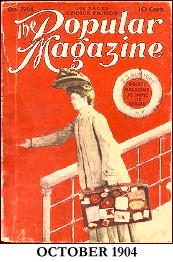
      In Which O’Rourke Saves a Throne (nv) The Popular Magazine Oct 1904
      In Which O’Rourke Pays a Debt (nv) The Popular Magazine Nov 1904
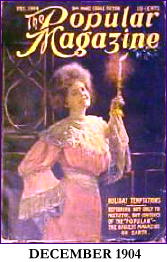
      In Which O’Rourke Sheathes His Sword (nv) The Popular Magazine Dec 1904

REVIEWED BY WALTER ALBERT:         


JAMES FRANCIS DWYER

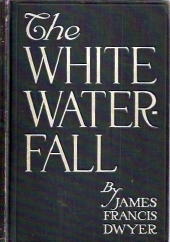
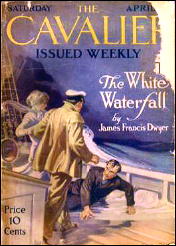
JAMES FRANCIS DWYER – The White Waterfall. Doubleday Page & Co., 1912; illustrated by Charles S.Chapman. W. R. Caldwell & Co., hc, International Adventure Library: Three Owls Edition. Serialized in The Cavalier in four parts, beginning 13 April 1912. Readily available in various Print on Demand editions and as an online etext.

   Australian writer Dwyer was a welcome regular in Blue Book Magazine in the 1930s, and this early South Seas adventure novel is a fine example of his robust, colorful narrative style.

   The remote, isolated island to which the characters travel, is thought to be uninhabited, but there are structures that pre-date the memory of any race that left written records, and a small group of natives perform ceremonies and make human sacrifices in the name of some savage God. This may remind some of a certain celebrated RKO film released in 1933, but the terrors are all too,human and no giant remnants of an earlier age live in the depths of the jungle.

JAMES FRANCIS DWYER

   The protagonist, and narrator, Jack Verslun, an itinerant seaman, is hired to serve on a ship chartered by Professor Herndon, an obsessive scientist who has brought along his two attractive daughters on what turns out to be an ill-advised and dangerous voyage to “The Isle of Tears,” which a rough-looking rogue named Leith has promised the Professor will yield scientific wonders that will make his reputation.

   The party, aside from a largely native crew, is completed by Will Holman, a feisty young American who — the son of the owner of the chartered boat they are traveling on — is along for the heck of it and for the love of the younger of the two Herndon girls, Barbara. An older daughter, Edith, is useful for completing a quartet that I needn’t spell out for you.

JAMES FRANCIS DWYER

   They reach the island after a terrific storm and when Jack is ordered to stay on the boat while Leith takes a small party to the island, concerned about Leith’s intentions, he jumps ship, catches up with the party and finds himself, Will, and the Professor and his daughters, in a situation that takes them to the brink of disaster.

   Dwyer is not, perhaps, as polished a stylist as John Russell, who wrote notable stories about adventures in the South Seas, but the slightly, pulpy cast of his story is perfectly pitched to drawn in a sympathetic reader, with the pace, once the horror of Leith’s intentions becomes clear, resembling the frantic drive of the flight through the jungle to the ship and escape of the earlier noted King Kong.

Editorial Comment: A brief biography of the author appears online at the Pulprack website, with another appearing here.

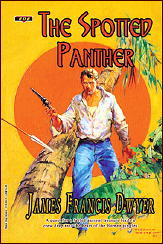
   And of special note to anyone reading this blog is The Spotted Panther, also by Dwyer, has recently been published in a handsome softcover edition by Black Dog Books. Highly recommended!

REVIEWED BY TINA KARELSON:         


DOROTHY B. HUGHES In a Lonely Place

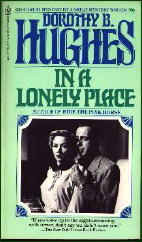
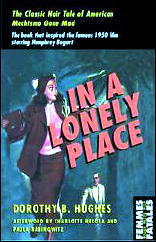
DOROTHY B. HUGHES – In A Lonely Place.   Duell Sloan and Pearce, hardcover, 1947. Paperback reprints include: Pocket #587, 1949; Bantam 1979, Carroll & Graf, 1984; Feminist Press, 2003.

Film: Columbia, 1950.   Humphrey Bogart (Dixon Steele), Gloria Grahame (Laurel Gray), Frank Lovejoy (Det. Sgt. Brub Nicolai).

   If you’ve seen the movie, which happens to be one of my favorites, know this: the book is completely different, but even better.

   Set in post-war L.A., the story is told in the third person, entirely from the point of view of Dix Steele. Dix is one of the lost men — someone who thrived in uniform, in danger, but who is now adrift, pretending to be a writer but living mostly on remittances from a wealthy uncle.

   When beautiful divorcee Laurel Gray comes into his life, he falls deeply in love and begins to heal, just a little. But Laurel begins to fear Dix, and she takes her concerns to Dix’s friend Brub Nicolai and his astute wife Sylvia. An old war chum of Dix’s, Brub is now an L.A. cop investigating a series of strangulation murders.

DOROTHY B. HUGHES In a Lonely Place

   As a crime story, this book starts out chillingly and compellingly, and becomes more so with each passing page.

   As a piece of social fiction, it paints a fascinating picture of post-war America, contrasting the disenchantment and isolation of some returning soldiers with the orderly, energetic, sociable world of recognizable “Greatest Generation” types like the Nicolai’s, who successfully fought a war and now want to build an orderly, peaceful world at home and also value having a good time — driving, dining, drinking and dancing.

   The prose is Hemingway-esque in its spareness. The integrity of the POV is scrupulous.

   This is one of the great American novels of the mid-20th century. If Hughes isn’t taught in colleges, she should be.

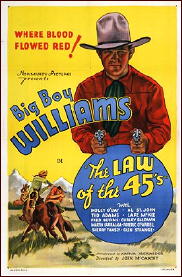
THE LAW OF THE 45’s. Normandy Pictures, 1935. Guinn ‘Big Boy’ Williams (Tucson ‘Two-Gun’ Smith), Molly O’Day, Al St. John (Stoney Martin), Ted Adams, Lafe McKee, Fred Burns. Screenplay: Robert Emmett Tansey, based on the novel by William Colt MacDonald (Law of the Forty-Fives, Covici Friede, 1933). Director: John P. McCarthy.

THE LAW OF THE .45s

   To start off, to put off the inevitable and to put it bluntly, there is absolutely no reason anyone should watch this Bottom of the Barrel B-Western movie except for historical reasons.

   To wit: although not officially part of the canon, and even though only two of them show up, and one of them has the wrong name, this is the first of the “Three Mesquiteers” movies, of which there were 51 more to come, beginning in 1936 and ending in 1943.

   Although many players played the three cowboys over the years, the ones I remember most are Robert Livingston as Stony Brooke, Ray Corrigan as Tucson Smith, and Max Terhune as Lullaby Joslin. You may have your own favorite threesome, but as much as I liked Bob Steele as a cowboy star (Tucson Smith in the last 13 of them), the ones above were mine.

   Some movies with a running time of 57 minutes have so much crammed into them that each and every scene has a crucial part of the story line in it. Not so with Law of the .45’s. It is the longest 57 minutes I can remember sitting through since grad school. The acting is a mixture of old-fashioned silent movie stars trying to figure out what the microphone is doing there, with pauses for emphasis that you could plow an 18-wheeler through, while other of the players seem to have taken nicely to the new technology, speaking in normal tones and normal rhythms.

   Story: a crooked lawyer is apparently behind the gang of outlaws terrorizing the valley where Tucson and Stoney are bringing their herd of cattle, and the latter agree to work for Joan Hayden (Molly O’Day) and her father (Lafe McKee) to bring peace and justice back to the land again.

   Other than that, there is little but cowboys riding here and there in the hills, ranches being burned to the ground and cattle stampeding (as cattle are wont to do) — all very exciting, or it would be if you care for watching cowboys riding here and there in the hills, sometimes at very high speeds. There is also a group of singing wranglers, unnamed as a group or individually in the movie’s credits, but their identities can be found on the know-all IMDB page for the film.

   As for Guinn ‘Big Boy’ Williams, he gets to grimace and squint a lot, but on the other hand, he also gets the girl.

A MOVIE REVIEW BY DAVID L. VINEYARD:         


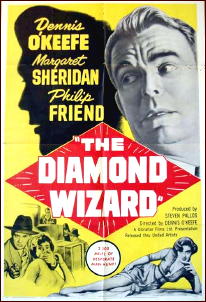
THE DIAMOND WIZARD. United Artists, US/UK, 1954. Released as The Diamond in the UK. Dennis O’Keefe, Philip Friend, Margaret Sheridan, Alan Wheatley, Francis De Wolff, Paul Hartmuth. Screenplay: John C. Higgins. Story Dennis O’Keefe, based on the novel Rich Is the Treasure (1952) by Maurice Procter. Directed by Dennis O’Keefe & Montgomery Tully.

THE DIAMOND WIZARD Dennis O'Keefe

   When a US Treasury agent is killed by British smugglers who have stolen a million dollars, a perfect diamond is found in his mouth. Perfect except for one thing — it’s artificial; and perfect artificial diamonds are a threat to both the British and American economies.

   So Treasury Man Joe Dennison (Dennis O’Keefe) is dispatched to England to team up with Special Branch’s Inspector Hector ‘Mac’ McClaren (Philip Friend) to track down the smuggler (Francis De Wolff) who is using a million dollars in stolen money to buy the artificial diamonds.

   The case gets more complex when lovely Marline Miller (Margaret Sheridan) shows up. She’s the niece of nuclear physicist Dr. Miller (Paul Hartmuth) who has gone missing — and once a romantic connection for Dennison.

   Following a handful of clues the police begin to tie the two cases together ending in an explosive climax somewhere between Edgar Wallace and Ian Fleming as they uncover something more sinister than flooding the diamond market afoot.

   This little film, directed by O’Keefe during a brief period when he fled to England like many other American actors of the period, is nothing new or great, but entertaining and loosely based on a novel by British mystery writer Maurice Procter, itself expanded from a novella “The Million Pound Note.” (Proctor is best known for his series of Inspector Harry Martineau police procedural novels.) The thrills are of the standard variety, but well enough done.

   There’s the usual master criminal, the usual mad scientists, some nasty thugs, and two tough honest cops. The difference between the American and British police style is played as complimentary rather than conflicting, and the scenes of the artificial diamonds being created have the nice SF touch of the kind that used to dominate German Expressionist cinema.

   This is an entertaining little film, not much more than a programmer, but coming in at 83 minutes it moves nicely and never really slows down for a breather. O’Keefe probably got the inspiration for this from his American film Walk a Crooked Mile (1948; Gordon Douglas, dir.) teaming him with Louis Hayward, with the latter the Scotland Yard man out of place in the US.

REVIEWED BY DAN STUMPF:         


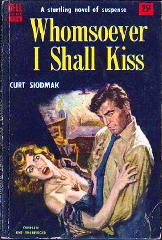
CURT SIODMAK – Whomsoever I Shall Kiss. Crown Publishers, hardcover, 1952. Paperback reprint: Dell 756, 1954.

CURT SIODMAK Whomsoever I Shall Kiss

   Quite without meaning to, I read two novels of Romantic Suspense last year. Curt Siodmak’s Whomsoever I Shall Kiss was the first, and it starts off well, with Royal Ludovici, a former small-time grifter and guy-with-a-funny-name, who lives by making himself useful to the very rich.

   In Italy to find proof of an heiress’s death (and thereby speed an inheritance to a distant relation), Royal finds the heiress very much alive and maybe suffering from amnesia … or maybe not.

   Well, Royal is suave, good-looking and unattached, the heiress is lovely, lonely and broken-hearted, so the only question for Royal is whether to get her to marry him, then tell her she’s wealthy, or to make sure that reports of her death weren’t so far wrong after all.

   It’s a nice set-up for a story, and I expected to see something interesting spun out of it by a hack with Siodmak’s credentials, but he doesn’t do much with it; in fact, he does practically nothing at all. Pages go by filled with sight-seeing, passionate embraces, tearful farewells, torrid embraces and even a bit from The Wolfman, all to very little effect. By the time Siodmak tacked an unsatisfactory ending on, I wasn’t even interested enough to be disappointed.

A REVIEW BY RAY O’LEARY:
   

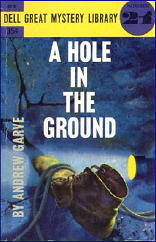
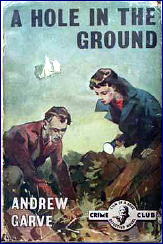
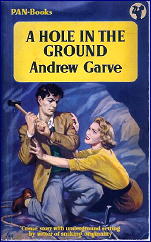
ANDREW GARVE – A Hole in the Ground. Dell, paperback reprint D275, 1959; Great Mystery Library #21. UK edition: Collins Crime club, hardcover, 1952. US First Edition: Harper & Brothers, 1952. Also: Pan #343, UK, pb, 1955; Lancer 72-730, US, pb, 1964.

ANDREW GARVE A Hole in the Ground

   I’d read quite a few of Andrew Garve’s novels, but I never heard of this one until I came across it on a sidewalk table at Barnes and Noble’s.

   Laurence Quilter is the Labour Party Member of Parliament for the area around the town of Blean in West Cumbria. He has a wealthy background and a wife named Jane. They have recently donated his family’s large house to the National trust and moved into a cottage on the estate and he is up for re-election. He is bitterly disappointed that he has never been given a position in the ruling Labour Party’s government.

   While looking through some old papers from his donated house, he comes across a crude map made by his great grandfather nearly a century before. It seems to indicate that somewhere on his land is the entrance to a large cave his ancestor discovered but didn’t make public.

ANDREW GARVE A Hole in the Ground

   While his wife is away visiting friends, he discovers the entrance to the cave and decides to contact a young School Master/ spelunker he knows named Peter Antsley. They explore the cave and find an underground river some 200+ feet below ground reached by going down rope ladders.

   On their second trip, Quilter takes a nap while Antsley does some exploring on his own. Outside, a storm rages which causes the underground river to flood and when Antsley’s foot gets caught and he calls for help, Quilter is too afraid to help him and Antsley drowns.

   Quilter decides to cover up his cowardice and tell no one. He takes his wife on vacation to France but when there is a mining accident in his district, he returns home leaving her. While in France they had meet Ben Traill, an American geologist who works for an oil company.

ANDREW GARVE A Hole in the Ground

   With Quilter in England, Jane and Ben spend so much time together that they fall in love. Finally, Jane decides to go home to confront her husband and from there, during the last 30 pages or so, the story takes a turn into left field.

   You might think that Quilter has been spending his time further covering up Antsley’s death, even though the dead man’s wallet has been found and the police know that Antsley had been in touch with Quilter shortly before he disappeared, but that isn’t the case at all.

   Let’s just say there’s an unnamed reference to a well-known British spy case that first hit the headlines circa 1950 and, though Garve didn’t know it at the time, the case would return two more times to the headlines in the ensuing decades.

   I don’t know if Garve wrote himself into a corner and came up with this lollapoloosa of an ending to get out or what. All I know is that this is the poorest book by Garve I’ve read. Fortunately, he went on to write much better stuff.

A TV Review by MIKE TOONEY:


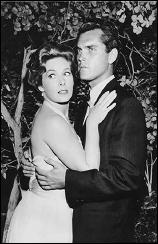
“Don’t Look Behind You.” An episode of The Alfred Hitchcock Hour (Season 1, Episode 2). First air date: 27 September 1962. Jeffrey Hunter, Vera Miles, Abraham Sofaer, Dick Sargent, Alf Kjellin, Ralph Roberts, Mary Scott, Madge Kennedy. Teleplay:
Barré Lyndon, based on a novel by Samuel Rogers. Director: John Brahm.

HITCHCOCK Don't Look Behind You

   Daphne (Vera Miles) is late for a dinner date and, like Little Red Riding Hood, decides to take a shortcut through the woods, which almost proves fatal because a serial killer is stalking her.

   She does make it unmolested, however. Within the next few minutes after her arrival, no fewer than four men show up at the party. She doesn’t know it at the time, but one of the four has already committed murder and another one will soon be making an attempt on her life…

   Maybe it’s just me, but this one doesn’t quite gel. True, the characters’ intentions are adequately foreshadowed, but the whole thing seems wonky and unconvincing.

   Vera Miles’ criminous credits include 23 Paces to Baker Street (1956), The Wrong Man (1956), Psycho (1960), three appearances on The Name of the Game, one on the Jim Hutton Ellery Queen, and three episodes of Murder, She Wrote.

   Jeffrey Hunter appeared in Fourteen Hours (1951), A Kiss Before Dying (1956), Key Witness (1960), Man-Trap (1960), and 26 episodes of the Temple Houston TV series (1963-64).

Hulu: http://www.imdb.com/video/hulu/vi685244441/

Editorial Comment: The pilot for the Temple Houston TV was titled The Man from Galveston (1963) and was considered so well done that it was released theatrically. David Vineyard reviewed it here on the blog last July.

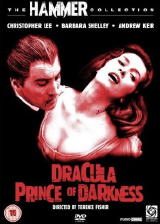
DRACULA PRINCE OF DARKNESS

DRACULA, PRINCE OF DARKNESS. Seven Arts / Hammer Films, 1966. Christopher Lee, Barbara Shelley, Andrew Keir, Francis Matthews, Suzan Farmer, Charles Tingwell, Thorley Walters, Philip Latham. Screenwriter: Jimmy Sangster. Director: Terence Fisher.

   Although there were, I believe, other Dracula films in between, Prince of Darkness is the one that’s a direct sequel to The Horror of Dracula (1958), also with Christopher Lee as Count Dracula, and one of the films that put Hammer Films on the map.

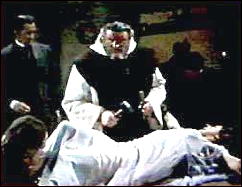
   The means by which Dracula is brought back to life is one of the key scenes in this second movie, and so while I of course will say no more about it, it is (no surprise) rather a gruesome one. There are two scenes which caused a shiver down my back, and one of them is the one that occurs soon afterward, as an unwary character in the story stumbles across the scene.

DRACULA PRINCE OF DARKNESS

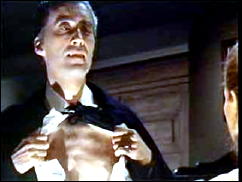
   And Dracula’s first appearance in the flesh (so to speak) was the other. Christopher Lee doesn’t get a lot a screen time himself, surprisingly enough, and no dialogue (only hissing, I believe), but seeing him quietly appear in the shadows as he does for the first time is enough to make anyone jump.

   Unfortunately, this is also one of movies in which the participants are warned, and explicitly so by the no-nonsense Father Sandor (Andrew Keir), to stay away from the castle, but do they listen? You needn’t ask. So that I found disappointing, and after his grand plan to rescue himself from oblivion succeeds in such fine fashion (and in this I am not exaggerating), he seems to flail around rather ineffectively thereafter.

   As a vampire hunter, Father Sandor is both a realist in terms of the evil he’s facing as well as an implacable foe, and I think this makes Andrew Keir, a giant of a man himself, the star of the movie.

DRACULA PRINCE OF DARKNESS

   Following immediately after the events chronicled in Prince of Darkness came Dracula Has Risen From The Grave (1968), a movie I saw about a year or so ago. For some reason, I do not seem to have written a review of it, but I recall it as having more plot to it than this one.

   This one, though, most reviewers seem to regard as a classic. It’s good but not that good, if you were to ask me, and there is of course no reason that you should. If you’re a fan of horror films, you’ll have seen this one already, and you’ll already have formed your own opinion.

« Previous PageNext Page »