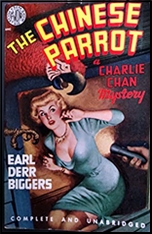
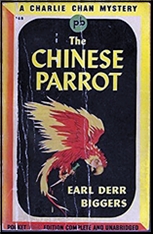
EARL DERR BIGGERS – The Chinese Parrot. Charlie Chan #2. Bobbs Merrill, hardcover, 1926. Reprinted many time, both in hardcover and paperback. Film: TCF, 1934, as Charlie Chan’s Courage,
The Charlie Chan stories are classics of detective fiction. However, classics of the past are not always to be read with enjoyment in the present. I reread The Chinese Parrot to see how well it holds its own with modern mysteries. My verdict is that it does so very well.
The many details which are of its own time add to the interest rather than detracting from it: the use of the telegraph, the “flivvers,” the ubiquitous Chinese “boys” as servants. The story is one of murder — surmised rather than known, an atmosphere of something wrong rather than a crime to be unraveled.
It progresses as theory after theory put forth by young Bob Eden is proven wrong by Charlie Chan’s detective work. It is most unbelievable when Bob continues to bend to Charlie’s plea not to hand over the pearl necklace which he is supposed to deliver.
Evidence of anything wrong at the Madden ranch is slim indeed; I have trouble believing that any impatient young man would procrastinate so on only the word of a Hawaiian detective he has never known before.
However, it is necessary to the story that he delay, so delay he does.And delay at last brings the story to a smashing conclusion. Dated? Yes, of course. Outdated? Never.
– Reprinted from The Poisoned Pen, Volume 4, Number 5/6 (December 1981).
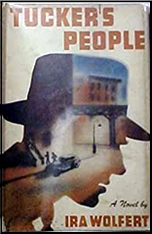
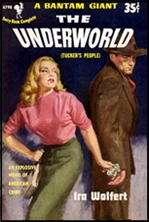
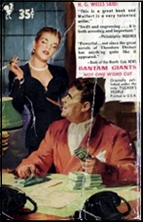
IRA WOLFERT – Tucker’s People. L.B. Fischer, hardcover, 1943. Bantam Giant A798, paperback 1950, as The Underworld. University of Illinois Press, softcover, 1997. Film: Basis for Force of Evil, directed by Abraham Polonsky and starring John Garfield.
Wolfert was a NYC reporter who covered Dutch Schultz. Schultz got big in bootlegging. After repeal he needed a new racket. Numbers seemed like a good bet. In the numbers racket, you pick three numbers. If your 3 number combo hits, you win 600 to 1 on your bet. In 1931, Thanksgiving landed on November 25. 2 + 5 = 7. As a result, numerous numbers players could be predicted to bet on some variation of 2/5/7 on Thanksgiving.
There were scores of independent numbers bankers in Harlem. Dutch figured out a way to fix the numbers coming out that Thanksgiving: 527. This bankrupted Harlem’s numbers bankers. Dutch came to the ‘rescue’ of the bankers, offering to pay off all the winners in exchange for the bankers joining Dutch’s Bank. In this manner Dutch was able to take over and consolidate the Harlem numbers racket, ‘earning’ upwards of $20 million a year.
With that kind of money rolling in, Dutch bought the boss at Tammany Hall: Jimmy Hines. Hines fixed the cops, raided the numbers banks that refused to cave, and looked the other way on the concomitant sleaze and violence accompanying the racket.
Then came along reformer DA Thomas E. Dewey. Dewey couldn’t be bought and he came after Dutch. This tied Dutch’s hands, giving opportunity to competing mobster Lucky Luciano to step up, step in, and take over. By force. And Dutch was slain.
Wolfert took this story, changed the names, and wove it into a fictionalized account: Tucker’s People.
It takes the major players: a numbers banker, an enforcer, a nerdy, nervy numbers accountant, and Dutch’s stand-in (Tucker), and attempts to weave a symphony out of these discordant instruments of the 30’s mobster soundscape.
My copy of the book ran over 500 pages. And it surely felt like it. The prose was leaden and preachy. While the idea for the book was grand, it felt like Wolfert let grand ideological purposes get in the way of a good story. Wolfert appears to have wanted to make the story of Dutch Schultz into a morality play about how monopolies destroy the little guy — first by taking him over financially, then taking his soul. And when the little guy is no longer useful, flushing him down the drain.
I have nothing against morality plays. But nothing destroys a good story like didacticism. If Wolfert was a better writer, he might’ve been able to make it work. Similar grand efforts have been successful. Like Robert Deane Pharr’s Book of Numbers and Vern E. Smith’s The Jones Men. Sadly, this one doesn’t join them.
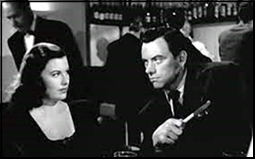
Made into the film Force of Evil in 1948, starring John Garfield:
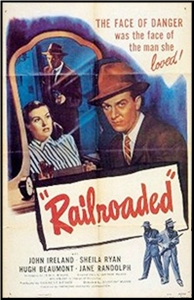
RAILROADED! PRC, 1947. John Ireland, Sheila Ryan, Hugh Beaumont, Jane Randolph. Screenplay by John C. Higgins, based on an original story by Gertrude Walker. Director: Anthony Mann.
A cop breaks in on a holdup in a beauty parlor, is killed for his trouble, and the murder is blamed on the kid who drives the truck used for the getaway. The boy has no alibi, and when the evidence builds up against him, only his sister and mother believe his story.
Not a bad beginning, but the plot jumps the track when John Ireland, who plays the killer, makes a play for the sister – why, I have no idea. (The slugfest fight scene between the sister and Ireland’s girl friend is worth the price of admission, though.)
– Reprinted from Movie.File.2, June 1980.
NOTE: For a longer and a much more insightful review of the film, check out Jonathan’s take on it here.
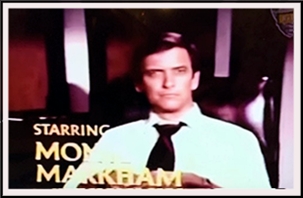
THE NEW PERRY MASON. “The Case of the Wistful Widower.†CBS, 07 October 1973 (Season 1, Episode 4.) Monte Markham (Perry Mason), Harry Guardino (Hamilton Burger), Sharon Acker (Della Street), Albert Stratton (Paul Drake), Dane Clark (Lt. Arthur Tragg). Guest Cast: Jacqueline Scott, Bruce Kirby, Donnelly Rhodes. Screenplay: Ernie Frankel & Orville H. Hampton), based on the characters created by Erle Stanley Gardner. Director: Leo Penn. Currently available on YouTube.
When a milquetoast of a middle-aged yacht broker discovers that the girl he is about to marry has apparently absconded with $30,000 in cash meant to complete a sales transaction, he is convinced by a fast talking new acquaintance to switch identities with him. Duh. What he doesn’t know is that a hit man is on the trail of this so-called friend, and wow, does the case take off from there.
There is a blown-up car with a body inside, a scattering of ashes over the sea, a stash of counterfeit money, or is it, a kidnapping at gun point, and yes, of course, a murder, and Perry’s client goes on trial for the deed.
Even Perry Mason, whom he finally goes to for help, calls this the most confusing case he’s ever had. I gave up about half way through and decided to simply go along for a ride. It may even be more complicated than any of Erle Stanley Gardner’s own, and that’s saying a lot.
This new series followed seven years after the original one ended, the one starring Raymond Burr, and it may have been a case of far too soon. These new upstarts couldn’t hope to compete with memories of the original cast, and the new series was cancelled halfway through a single season. Monte Markham was OK, but he was no Raymond Burr, and neither the new Della nor the all-but-invisible Paul Drake make any impression at all.
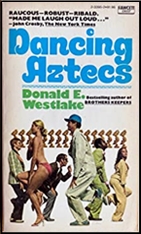
DONALD E. WESTLAKE – Dancing Aztecs. Evans, hardcover, 1976. Fawcett Crest, paperback, 1977. Mysterious Press, paperback,1989.
Good humorous crime stories ere very few and far between, and this has to be one of the best of them. The plot concerns a stolen golden statue (of a dancing Aztec) which somehow gets mixed in with a consignment of copies. The sixteen statues are given out to the members of a civil rig11ts group, and then various crooks and con men and gold diggers (some of them from within the ranks of the civil rights group itself) spend the rest of the book trying to find out which one is the real thing.
It’s witty and funny and beautifully observed. Ilf and Petrov did a similar thing with chairs but it couldn’t have been any better than this. Simply crying out for a movie version — but perhaps somebody’s already done (or doing) it!
– Reprinted from The Poisoned Pen, Volume 4, Number 4 (August 1981).
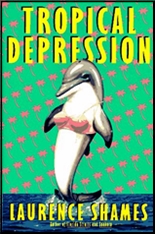
Shames ls one of the few down-and-dirty Florida writers I’ve enjoyed at all, and it took two books before I gave him even that much. The last two featured a family of gangsters named Goldman, but other than a walk-on by one of them at the beginning, they’re not in this one.
Murray Zemelman, a lingerie mogul from Jersey known as “the Bra King,” gets depressed, pops a Prozac, and heads for Key West, Florida-leaving behind the bra business and a mid-life-crisis second wife. Not so coincidentally, his first wife is in Florida. Murray .meets a retired Mafioso, a Native American who’s the last surviving member of his tribe, and a shady Florida politician (redundancy?), and before you know it is involved in a scheme to help the N. A. Old Murray’s decisions haven’t been so good beginning with the one to leave his first wife, though, and matters don’t go quite as he planned.
Take one thoroughly Jewish garment-maker, add a couple of Italian gangsters and a generic Florida politician, and then stir in a down-and-out Indian… Shames writes a brand of fiction that’s hard for me to describe. It certainly isn’t farce, though some of the strokes are broad; it’s occasionally amusing, but not really light-hearted; and it’s serious and rough-edged without being grim.
There — does that help? Well, maybe not, but I liked the book anyway. He does really good characters and ethic dialogue; some of the characters are small masterpieces, really. Maybe a little less manic Hiassen, or a bit softer Leonard?
Hell, I don’t know. Try it.
— Reprinted from Ah Sweet Mysteries #25, May 1996.
The “Key West Capers” —
1. Florida Straits (1992)
2. Scavenger Reef (1994)
3. Sunburn (1995)
4. Tropical Depression (1996)
5. Virgin Heat (1997)
6. Mangrove Squeeze (1998)
7. Welcome to Paradise (1999)
8. The Naked Detective (2000)
9. Shot on Location (2013)
10. Tropical Swap (2014)
10.5 Chickens (2015)
11. Key West Luck (2015)
12. One Strange Date (2017)
13. One Big Joke (2017)
14. Nacho Unleashed (2019)
15. The Paradise Gig (2020)
16. Key West Normal (2021)
17. Relative Humidity (2023)
SCARECROW AND MRS. KING “The First Time.” CBS, 03 October 1983 (Season 1, Episode 1). Kate Jackson (Mrs. Amanda King), Bruce Boxleitner (Lee Stetson, aka “Scarecrowâ€), Beverly Garland, Mel Stewart, Martha Smith. Creators & co-screenwriters: Eugenie Ross-Leming & Brad Buckner. Directed by Burt Brinckerhoff & Rod Holcomb.
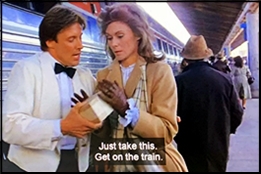
When a young divorced housewife and the mother or two boys drops off her semi-boy friend at a train station, she has no idea how soon her world is going to be turned upside down. A federal agent, code name “Scarecrow,†is on the run from a man with a gun, and in desperation, he hands off a small package to Mrs. King so as to keep it from the hands of a gang of thugs, terrorists and thieves.
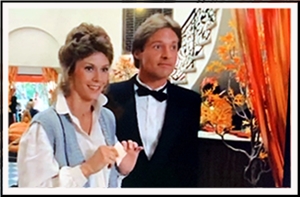
Well, sure enough, things do not go smoothly. Dire straits? Not particularly. On the contrary, this is precisely where the fun begins. And so the viewers agreed. The series lasted for four years, with Amanda King (the eternally cute and perky Kate Jackson) becoming more and more involved with the agency and (ahem) romantically with Bruce Boxleitner’s character.
Most of the time, Amanda’s secret had to be kept from her mother, played by Beverly Garland, who mostly stayed home and took care of the two boys while their mother was off playing spy games. I don’t think any of the stories that ensued had any more depth than in this, the first episode. Light and frothy, but the viewers loved it.
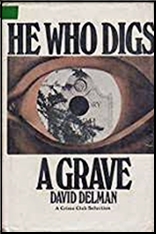
DAVID DELMAN – He Who Digs a Grave. Lt. Jacob Horowitz #2. Doubleday Crime Club, hardcover, 1973. No paperback edition.
The combination of protagonists David Delman has used in this engaging novel — that of a small-town female sheriff and a male cop from New York-is an inspired one. Sheriff Helen Bly and Lieutenant Jacob Horowitz are as different on the surface as two people can be.
She’s a country woman with strong roots in the area around Cedarstown, an elected official who’s never had to handle a murder before. He’s a tough city cop who’s seen more than enough violent death. And they hold opposing views about whether Horowitz’s old army acquaintance Ian Kirk (who has asked Horowitz to come to town and investigate in an unofficial capacity) murdered his wife and her lover. But Bly and Horowitz are both strong, fair, and sensitive people-characteristics that allow them to work together and also allow them to fall in love.
As Bly and Horowitz piece together such facts as a missing suicide note, an unwanted pregnancy, a vanished housekeeper, and a pair of thugs who have been paid to intimidate the outsider from New York, the author skillfully depicts small-town life through his characterization of the other residents. A well-plotted novel with a realistic and satisfying conclusion.
Delman’s other mysteries: A Week to Kill (1972), Sudden Death ( 1972), One Man’s Murder( 1975), and The Nice Murderers( 1977)-feature Jacob Horowitz. His most recent book, Murder in the Family, appeared in 1985.
TED ALLBEURY – The Lantern Network. Peter Davies, UK. hardcover, 1978. Mysterious Press, US, hardcover, 1989.
Another first class novel of espionage by one of my three favourite British spy writers {the other two are Deighton and le Carre). In this one Commander Nicholas Bailey of the Special .Branch is called upon to carry out a routine interrogation of a man not really suspected of anything concrete.
To his surprise and horror the man commits suicide, practically in front of him and the big question is why. Bailey eventually finds the reasons but only after a long flashback (more than half of the book) in which we learn in detail of the wartime career of Captain Charles Parker with the resistance in France. How Parker organizes the resistance teams against the Germans and how this all fits in with the suicide make fascinating reading.
Mr. Allbeury knows his stuff and certainly can write.
– Reprinted from The Poisoned Pen, Volume 4, Number 4 (August 1981).
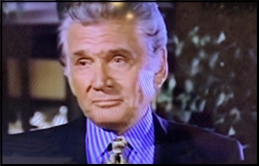
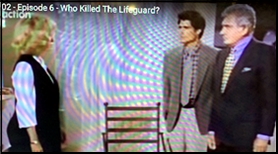
BURKE’S LAW “Who Killed the Lifeguard?†CBS, 25 May 1995 (New Season 2, Episode 6). Gene Barry (Chief Amos Burke), Peter Barton (Detective Peter Burke), Dom DeLuise. Guest Cast: Downtown Julie Brown, Samantha Eggar, Catherine Hicks. Director: Jefferson Kibbee. Currently available on YouTube.
This is an episode from the second incarnation of the popular TV mystery show Burke’s Law, or maybe the third. After a successful two years on ABC from 1963 to 1965, it changed focus nearly 180 degrees and retitled itself to become Amos Burke Secret Agent, which had viewers across the entire country yawning with disinterest. The series was revived, literally brought back from the dead, for two seasons on CBS (1994-1995), with Gene Barry once again playing the role of the millionaire homicide detective with a tendency for quoting various “laws†as the cases he is investigating moved along.
In this later version, a son played by Peter Barton was added. From the one episode I’ve seen, his presence was only minimally involved, but he was a young actor with a lot of “hunk†appeal, and maybe he helped boost the number of young teenyboppers watching the show.
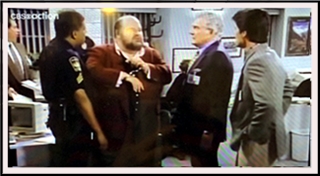
As this episode goes along, the number of suspects involved in the death of the titular lifeguard grows and grows. There are at least four, perhaps five. The Burkes’ method of investigation is to question each of them in turn, and each in turn accuses the next one, sometimes looping back to someone for another round of questions. This may be unique to only this episode, but perhaps it was a standard procedure for the entire series. This also may be true for the final scene in which all the suspects are gathered together, and … well, you know the drill.
And perhaps only incidentally, whenever the action takes the Burkes to the beach, which is often, there are also quite a few bikini-clad beauties strolling back and forth across the screen. It sometimes made it difficult to follow the actual story line.
Not essential viewing by any means, but still fun to watch. Quite a few episodes can be found currently on YouTube.