Reviews


REVIEWED BY DAN STUMPF:         


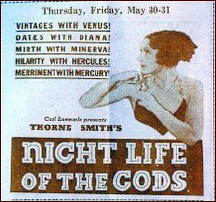
NIGHT LIFE OF THE GODS (1935)

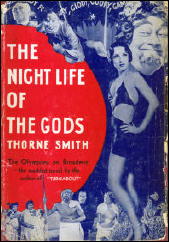
NIGHT LIFE OF THE GODS. Universal, 1935. Alan Mowbray, Florine McKinney, Peggy Shannon, Richard Carle, Theresa Maxwell Conover, Phillips Smalley , Wesley Barry. Based on the novel by Thorne Smith. Director: Lowell Sherman.

   Speaking of the Obscure and Bizarre, I had the good fortune to run across a tape of Night Life of the Gods, a long-lost comedy based on a book by Thorne Smith, from a studio that was never much good at comedy.

   Despite the typical Universal clumsiness — or maybe because of it — Night Life captures the flavor of Smith’s unique style quite nicely. The plot (something about a scientist who can turn people into statues and statues into people) lurches forward in typical Smith fashion towards nowhere in particular as our hero-scientist (Alan Mowbray) contends with insipid relatives, a loving secretary, a host of soliloquizing drop-ins and amorous women, all of whom, in typical Smith-fashion, seem to be pursuing plots in books of their own.

   The result is hardly Great Comedy (Thorne Smith was always more whimsical than humorous), but it’s an effective translation of Smith’s peculiar ethos from page to film.

NIGHT LIFE OF THE GODS (1935)

   As for the actor playing the lead — in a flattering wig with his chins taped up — Alan Mowbray was always one of my favorite Unknowns. He generally played pompous, rather dull Englishmen (no one who sees him in THE KING AND I will ever remember him), and if you recall him at all, it’s probably as the Shakespearean ham in a couple of John Ford Westerns, but he was by all accounts a witty and charming man off-screen — he was one of the loyal coterie of friends who looked after John Barrymore in his later years — and his film career included highlights like the rakehell Cpt. Crawley in Becky Sharp, a bizarre Butler in the Topper films, The Devil once and George Washington twice.

Capsule Reviews by ALLEN J. HUBIN:


   Commentary on books I’ve covered in the New York Times Book Review.   [Reprinted from The Armchair Detective, Vol. 1, No. 4, July 1968.]

    Previously on this blog:
Part 1
— Charlotte Armstrong through Jonathan Burke.

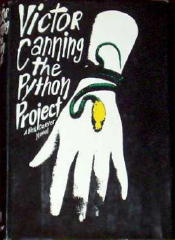
VICTOR CANNING – The Python Project. William Morrow, hardcover, 1968, $4.95. (UK hardcover edition: William Heinemann, 1967.) A canny old pro turns out a bewilderingly effective combination of a medium-boiled British private investigator tale and the spy story. [Series character: Rex Carver.]

VICTOR CANNING Python Project


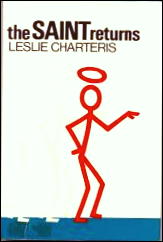
LESLIE CHARTERIS – The Saint Returns. Doubleday Crime Club, hardcover, 1968, $3.95. (UK hardcover edition: Hodder & Stoughton, 1969.) Two novelettes taken from the British TV series revive the zest of early Saint adventures. Read these tales for nostalgic pleasure.

LESLIE CHARTERIS Saint Returns


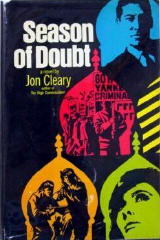
JON CLEARY – Season of Doubt. William Morrow, hardcover, $4.95. (UK hardcover edition: Collins, 1968; paperback reprint: Popular Library 75-1296, 1970.) A new twist to the spy story involves the dilemma of a career diplomat, posted to an incendiary and largely unfriendly country and assigned the impossible task of maintaining perfect neutrality and clinical detachment. Paul Tancred, undersecretary in the American embassy in Beirut, pays the price of involvement and friendship. Read this one.

JON CLEARY Season Doubt


MANNING COLES – The House at Pluck’s Gutter. Pyramid X-1782, paperback, 1968, $.60. (UK hardcover edition: Hodder & Stoughton, 1963.) Fanciers of Tommy Hambledon, circa 1940, will be disappointed in this one. It contains some amusing scenes and ingredients, but the Coles’ light, sure touch is absent.

Editorial Comment. The paperback edition of this last book is relatively hard to find. While I have a copy, I don’t have access to it, which leaves me without a cover image to show you, so far. To perhaps explain Al’s disappointment in this book as well as mine at the time, it’s now known that it was written by the twosome of Cyril Henry Coles & Tom Hammerton, rather than the original pairing of Coles & A. F. O. Manning.

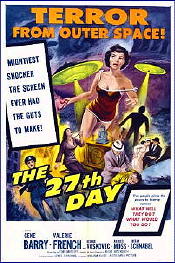
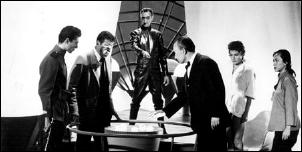
THE 27th DAY. Columbia, 1957. Gene Barry, Valerie French, George Voskovec, Prof. Klaus Bechner, Arnold Moss, Stefan Schnabel. Based on the novel by John Mantley, who also wrote the screenplay. Director: William Asher.

The 27th Day

   The novel this black-and-white sci-fi movie was based on was also one of the first selections I purchased when I joined up with the Science Fiction Book Club, and when I was 14, which I was at the time, I thought it was one of the best I’d ever read.

   Nor have I ever forgotten it in all of the years since, though what I have just now discovered is that I never watched the movie, even though for all of those very same years, I thought I had!

   I think what happened is that I created my own movie out of the images the book created in my head, and that’s what I remembered all this time. Two minutes into the movie and I knew I’d never seen it before.

   And this is true even though I have a feeling that the movie follows the book very closely. It’s just that it’s different than the one I’ve been remembering all along. It’s very strange (and humbling) to realize that your memories can be invalid and unsubstantial — and yet seemingly so solid! — as this

   The premise? Well, to begin with and right from the start, mankind is in trouble. An alien from another universe kidnaps five representative members of mankind and gives them the sole means of deciding whether humanity lives or dies: (1) A Russian solider. (2) A young English woman. (3) A European scientist. (4) A Chinese peasant girl. And (5) a Los Angeles newspaper reporter.

   Each is given a weapon that can destroy all human life on the planet Earth. If they can keep the leaders of the world from using any one of them in the next 27 days, we’ll be given a reprieve and they’ll quietly go away.

The 27th Day

   The primary protagonists are (2) and (5), played by Valerie French and Gene Barry respectively, whose characters immediately go into hiding together.

   But do the aliens play fair? No. They also immediately take over the TV sets around the world and name the five people who have been given the weapons. Instant paranoia and panic naturally run rampant.

   This is a pretty good example of what science fiction looked like in the movies during the cold war 1950s, with the added bonus of there being no ugly mutated monsters, only ourselves as our own worst enemy.

   Which is fitting, as the ending is this movie’s own worst enemy. It seems as though the aliens had the power all along, a rather miraculous one, one that can — well, that would be telling.

   I suppose the movie-makers’ intentions were good, and it fits in perfectly with the cold-war fantasies of the 1950s, but all in all, it makes for a pretty lame movie. Awkward and ham-handed are other words that come to mind — all in the interest of making us feel good about ourselves, disregarding the truth of the matter that in this film (a) the aliens did it, and (b) in the real world, there are no aliens.

   As for the book, I’m awfully curious and I’m very much tempted, but I don’t think I’ll read it again. The memories I have of it might be better off if left alone. Just maybe.

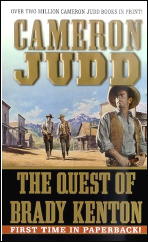
CAMERON JUDD – The Quest of Brady Kenton.   St. Martin’s, paperback original; 1st printing, January 2001.

CAMERON JUDD The Quest of Brady Kenton.

   A clue from an ongoing serial in a dime novel series is enough to convince famed western reporter Brady Kenton that his wife, whom he always believed had died in a railroad accident years ago, somehow survived, and she may even still be alive.

   Alex Gunnison, the son of Kenton’s publisher, is the man assigned to keep him on schedule and out of trouble, which is a full-time job on its own, even before a young woman claiming to be Kenton’s daughter appears. More? On her trail in turn is a former Texas Ranger and now, quite remarkably, one of the world’s first private eyes.

   Intentionally or not, this novel reads like a dime novel itself, with lots of dialogue and action and precise, pinpoint characterizations of the varied westerners whose paths cross those of Kenton and Gunnison. Lots of humor, too, with a dark side that never manages to stay hidden. This particular phase of the chase ends in a wild-and-wooly shootout, but in true pulp fashion, there’s a strong hint of more adventures yet to come.

— Reprinted from Durn Tootin’ #3, October 2003       (slightly revised).


[UPDATE] 09-09-09.  Or were there? Further adventures, that is — in the plural. There was at least one more, Kenton’s Challenge (St. Martin’s, November 2001), but whether or not that concluded Kenton’s hunt for his missing wife, I do not know.

   I seem to recall that these two books came out around the time that the western lines at several paperback companies were canceled, with a few ongoing series left hanging. I don’t know if that happened here or not. If anyone can say, please email me or leave a comment below.

THE THING IN THE NYMPH,
by David L. Vineyard


“The Wizard’s Belt” by T. P. HANSHEW, from Cleek, the Master Detective. Doubleday, US, hardcover, 1918. Originally published in the UK as The Man of the Forty Faces (Cassell, hc, 1910).

   In relation to Hanshew and Cleek I’ve previously mentioned [Comment #2] a story that I thought might have inspired one of Dorothy L. Sayers more bizarre and memorable Lord Peter Wimsey short stories: “The Abominable History of the Man with Copper Fingers” in Lord Peter Views the Body. “The Wizard’s Belt,” the sixth story in the twelve story collection Cleek, the Master Detective is that story.
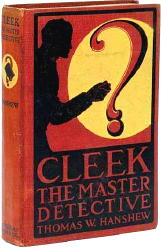
HANSHEW Cleek Master Detective

   As was common in that era, the book is what science fiction fans used to call a ‘fix-up,’ meaning related short stories that more or less form a novel narrative. This one features Hamilton Cleek, formerly the “Vanishing Cracksman,” and the one time king of Maurivania (he still lives of in fear of assassins and the agents of the French criminal underground known as the Apaches), a master of disguise (the Man of Forty Faces — apparently he was no Lon Chaney), and now a consulting detective for Scotland Yard, and his friend Mr. Maverick Narkom.

   Since there is no possible way to discuss this story without giving away major elements, here is a

*** SPOILER WARNING. ***

   As the story opens, Narkom has contacted Cleek about a curious mystery that has arisen and the plight of a young woman and her invalid father, a couple of modest means. It seems her beau has disappeared from his room at their house with no trace. During an evening’s entertainment attended by the young lady, Miss Mary Morrison and her father Captain Morrison, the fiance George Carboys, and an artist friend Van Nant, Carboys began to talk about his days in the far east and the fortune owed Carboys by a wealthy Easterner who never gave him anything but some worthless trinkets — among them a blue leather belt claimed to have the power of invisibility.

   Carboys then donned the belt, and still wearing it went to bed. The next morning he was not to be found. The belt lay on the floor in the locked room, and Carboys has vanished without a trace.

    “Necromancy — wizardry — fairy lore — all the stuff and nonsense that goes into the making of ‘The Arabian Nights’ … All your ‘Red Crawls’ and your ‘Sacred Sons’ and your ‘Nine-fingered skeletons’ are fools to it for wonder and mystery. Talk about witchcraft! Talk about wizards, and giants, and enchanters and the things that the witches did in MacBeth! God bless my soul they’re nothing to it …”

   Obviously Narkom is impressed. Cleek less so, to give him credit. But he takes the case and goes to investigate under the guise of George Headland. Once at the Morrisons he learns Carboys had an important meeting with a solicitor the next morning, and examines the man’s room.

   In rather good minor Holmes style he quickly dismisses the obvious. “Our wonderful wizard does not seem to have mastered the simple matter of making a man vanish out of the thing, without first unbuckling the belt,” Cleek opines, and then goes on to point out that the belt is English and American, not from the Middle East, that Carboys had shaved, but not undressed, and obviously went out again unseen.

   Still he has vanished. The sharp eyed Cleek also see Miss Morrison keeps pigeons, and notes some strange about one of the birds.

   His investigation then takes him to Van Nant’s studio where he discovers among other things a statue of a Roman Senator, and a large rather ugly and misshapen figure of a nymph recently carved, and showing no signs of Van Nant’s talents. “My touch seems to have deserted me. Temporarily I hope.”

   At this point Cleek announces he is baffled and can only hope to consult a clairvoyant. He arranges for Narkom to have the Morrisons and Van Nant meet at the Morrison’s house the next night, where no one less than the famous Hamilton Cleek will show up to solve the case.

   But when Cleek doesn’t show, Narkom tells the others that Cleek is going to visit Van Nant’s studio before coming to the Morrison home. Van Nant feels he should be at home to meet Cleek, even though Cleek wouldn’t need to key to get in, and leaves. He arrives at his studio, calls out for Cleek though there is no answer, and goes directly to the ugly half-formed figure of the nymph.

   At which point the statue of the Roman Senator pounces on him, wrestles him to the ground, and snaps on the cuffs. As Cleek, disguised as the statue, announces his arrest Narkom and the police burst in. They take the prisoner, and Cleek takes a hammer to the statue of the nymph — revealing the body of George Carboys inside.

   It seems Carboys’ old friend the Eastern potentate had died and left a considerable fortune to Carboys. Van Nant knew, and since there was an old will naming him Carboys heir, that would be invalid when Carboys married Miss Morrison, he lured Carboys to his studio by making him think Miss Morrison was his secret lover, murdered him, and encased the body in the modeling clay.

   He might have gotten away with it too if Cleek hadn’t seen a speck of clay on one Miss Morrison’s pigeons, the one Van Nant used to plant the note luring Carboys to his studio to be murdered… The note, allegedly from Miss Morrison, is found in Carboy’s pocket.

   Hanshew must have liked the idea because he used it before in one of the stories in Cleek of Scotland Yard (1914) in a story involving another locked room — this one made of glass — a missing boy, and a waxworks. Of course it was also the plot of the film Murder in the Wax Museum and its remake, House of Wax. I seem to recall it even happened in reality once, but that may be an urban myth like poodles and microwave ovens.

   You can see why John Dickson Carr was a fan of Cleek other than Hanshew being another American expatriate living and writing in England. For sheer melodrama and weird crime Cleek can be hard to beat. Quite a few locked rooms and impossible crimes occur, though they might be less mysterious if Maverick Narkom wasn’t prone to exaggeration, melodramatic statements, and hyperbole.

   But then what can you expect from someone who thinks it is the height of discretion to pick the mysterious and secretive Cleek up in a red limousine.

   Some of the stories are more preposterous than this, but almost all are fun, and Cleek has some of the true Holmes style as well as some of the traits of later pulp heroes like The Shadow or Phantom Detective. True, most of his big revelations are pretty obvious, and Holmes could have solved them with half a cigarette — no three pipe problems here — and some do fall into the category of Raymond Chandler’s famous critique of Agatha Christie’s Murder on the Orient Express — only a moron could have solved it.

   Hanshew mostly walks a fine line between genuine mystery stories and pure claptrap, but he does walk it, and even when he misses a step the result is interesting. The writing does suffer a bit from some of the flaws of the era — a touch of what American writer and critic John Gardner called the Pollyanna school of writing, but for the most part Hanshew and Cleek are entertaining — even when laying it on a bit thick.

   Of course there is no evidence Dorothy L. Sayers read this story or borrowed from it, but there are certain similarities. Her own story is better and builds to a nice chill at the end, but the Hanshew tale has its charms, and is accompanied by a nice illustration by Gordon Grant.

   And whether the story inspired Sayers or not, it is one of the better Cleek tales, pardoning the melodrama and high handedness. Overall a good tale in a fairly good collection of one of the more interesting writers and creations of the period.

   Still, I’ve always wondered why only forty faces? Maybe that was Hanshew-the-actor’s own limits. Surely he must have imagined himself playing his creation on stage. Even Conan Doyle never got to be Sherlock Holmes in the theater. Maybe forty faces was all he thought he could handle.

Editorial Comment: Besides David’s previous comments about Thomas Hanshew on this blog (follow the link in the first paragraph above), Mike Grost reviewed Cleek, Master Detective in its entirety in this followup post.
REVIEWED BY WALTER ALBERT:         


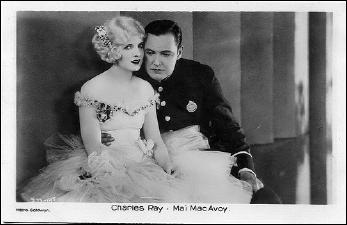
THE FIRE BRIGADE. MGM, 1926. May McAvoy, Charles Ray, Holmes Herbert, Tom O”Brien, Eugenie Besserer, Warner P. Richmond, Bert Woodruff. Director: William Nigh. Shown at Cinevent 41, Columbus OH, May 2009.

THE FIRE BRIGADE 1926

    I don’t know what the cast of FX’s Rescue Me would think of this fire-fighter drama, but I liked it just fine.

    Terry O’Neill (Charles Ray) is the youngest of three brothers in a family whose profession as firefighters goes back several generations. When one of Tom’s older brothers is killed in a fire that got out of control because of shoddy construction, the stage is set for a drama in which corrupt politicians and builders think nothing of constructing an orphanage that’s a potential firetrap.

    Mix in Terry’s developing relationship with Helen Corwin (Mac McAvoy), daughter of James Corwin, the crooked builder (Holmes Herbert), and you have all the ingredients for an edge-of-your-seat, burning building conclusion.

    And I want to add that the scene in which the young hero races the horse-drawn firewagon to the burning building caught my imagination in a way that the high powered technical marvels available to the contemporary firefighter never quite do.

REVIEWED BY GEOFF BRADLEY:         


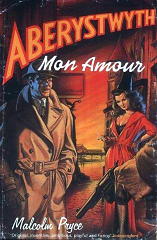
MALCOLM PRYCE – Aberystwyth Mon Amour. Bloomsbury, UK, 2001.

MALCOLM PRYCE Aberystwyth

    This has been on my must read list since it was first published and Maxim Jakubowski told me how funny it was. I have been looking forward to reading it for 8 years now and, in the meantime, acquired the three sequels (and a fourth has just been published).

    It is a private eye tale narrated by Louie Knight who operates in the eponymous Welsh town, though this is a sort of parallel universe version of it. Knight is approached by Myfanwy Montez, singer and night club entertainer, to investigate the disappearance of her cousin, the schoolboy Evans the Boot.

    The investigation uncovers the deaths of other schoolboys including Brainbocs [sic], the school swot. The investigation leads to a wholly unbelievable (to be fair it is not meant to be believable) conspiracy.

    Humour is subjective (as with most other qualities) but I’m afraid I didn’t find this to be funny in the slightest and, without that, there is absolutely nothing in the book to like. The good news is that I can now make the pile of books in the loft smaller by four volumes.

Bibliographic data — the Aberystwyth series:

      1. Aberystwyth Mon Amour (2001).
      2. Last Tango in Aberystwyth (2003.
      3. The Unbearable Lightness of Being in Aberystwyth (2005).
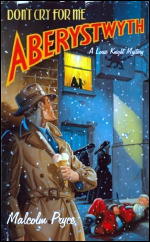
      4. Don’t Cry For Me Aberystwyth (2007).

MALCOLM PRYCE Aberystwyth

      5. From Aberystwyth with Love (2009).

REVIEWED BY DAN STUMPF:         


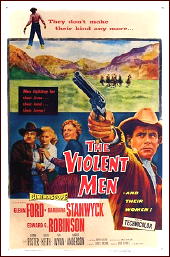
THE VIOLENT MEN. Columbia, 1955. Glenn Ford, Barbara Stanwyck, Edward G. Robinson, Dianne Foster, Brian Keith. Based on the novel Smoky Valley by Donald Hamilton. Director: Rudolph Maté.

THE VIOLENT MEN Glenn Ford

   The Violent Men, basically a B-western dressed up in A-western trappings, is based on a novel by Donald Hamilton and directed by Rudolph Maté, who distinguished himself with the photography on Vampyre, Lady from Shanghai and others, but made a rather routine director.

   This finds Maté working through the standard plot in star-studded fashion, with Edward G. Robinson as the grasping cattle baron, Barbara Stanwyck as his even-more-grasping wife, and Glenn Ford as the little rancher who gets in his way.

   Dianne Foster, an actress who never really got her due, stands out as Ford’s love interest, but it’s Brian Keith as the heavy who steals the show. Surprisingly lean, villainously mustached, he draws our attention first in a scene where everyone talks about how they want to settle this thing without violence while he sits in a corner quietly loading his gun, and caps things off near the end by publicly spurning his Mexican mistress in the middle of Main Street as he rides out to gun down Glenn Ford — an enterprise which, in movies like this, could be charitably termed ill-advised.

Rufus King’s Florida Short Stories,
by MIKE GROST.


   Rufus King’s last works were a series of short stories set among the rich in Miami and its environs; many of them were published by Ellery Queen in Ellery Queen’s Mystery Magazine.

RUFUS KING

   Although King’s use of Miami has been compared to John D. MacDonald, it also recalls the Florida stories of Philip Wylie. In addition to setting, other Wylie-like features include an emphasis on botany and Florida plant life, amateur detectives who discover sinister conspiracies, and the use of international intrigue.

   Three of the more interesting of these stories are discussed below.

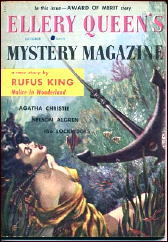
    “Malice in Wonderland” (EQMM, October 1957) contains some of King’s most magical atmosphere and mise-en-scéne. The tale is written as a sort of sinister fairy tale, full of events that can be given a supernatural interpretation.

   King used rich and brilliant color in these Miami stories, especially in his descriptions of deserts. In “Malice”, we see exotic ice cream dishes that are described in full color. By the way, “Malice in Wonderland” was originally the title of a 1940 novel by Nicholas Blake. When Ellery Queen first published King’s short story in EQMM, he thought the phrase would make a good title for the story, and he used it, with the permission of both Blake and King.

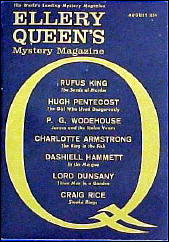
    “The Seeds of Murder” (EQMM, August 1959) is an impossible crime tale. There are clues that allow one to deduce who the killer is, at least after you have figured out how the crime was done.

RUFUS KING

   This is the paradigmatic detective situation in such Ellery Queen works as The Spanish Cape Mystery (1935). This story seems even closer to Queen than to Van Dine. It focuses on the sort of rich, eccentric, multi-talented extended family of adults that often pops up in Queen tales.

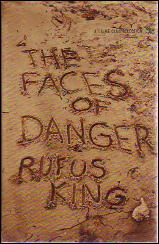
    “The Faces of Danger” (EQMM, November 1960) is written in a partly summarized style. This style recalls, to a degree, that used by Ellery Queen in his Q.B.I. stories and parts of his Calendar of Crime.

   However, King’s approach is less condensed than Queen’s. Queen used it to tell a whole story in less than ten pages, while King’s novella sprawls over forty. Both writers like to use the approach to invoke, and partially lampoon, the clichés of storytelling.

   In both, there is a certain sophistication of tone, a suggestion of sophisticated satire on conventional plotting. There is the feeling in both writers in which a game is being played by the author. In this game, the author tries to come up with the “best” response by the characters to each new situation.

   For example, a body might be discovered, and the next step in the story is tell what the characters are going to do. Sometimes this response is original, sometimes conventional. The more conventional responses are presented to the reader with irony, using a summarized statement to invoke the chief elements of the familiar situation.

RUFUS KING

   Less familiar responses are sometimes contrasted with the clichés of fiction, to underline the originality of the situation. So a description will contain both its true content, and its opposite.

   The whole effect is of a game the author is playing with the reader, challenging them to guess how the characters will behave in any new situation, suggesting a duel of wits between the writer and the reader over the most original response to any event in the plot.

   This is in keeping with, but further extends, the basic active reading approach of most mystery fiction. In most mystery tales, the reader is not supposed to sit back, and just let the events of the tale wash passively over them.

   Instead, the reader is challenged to deduce the true solution of the mystery at every turn. The reader, in turn, constantly monitors the author’s plot for logical consistency, and surprise. This sort of active readership is applied to every event in the mystery plot.

   In Queen and King, this approach is extended not just to the mystery puzzle plot itself, but every fictional development in the story: the characters’ attitudes, responses to events, social conditions and backgrounds, police procedure, the romance subplot, details of the social milieu such as butlers and mansions, in short, every aspect of the story. This allows active readership as a universal response to the tale.

   King always likes verbal fireworks in his tales; such an approach gives him many opportunities in that direction. It allows for an exuberant writing style, one filled with elaborate turns of phrase and much wit.

— Very slightly revised from A Guide to Classic Mystery and Detection, by Michael E. Grost, with permission.


Reviewed by MIKE GROST:

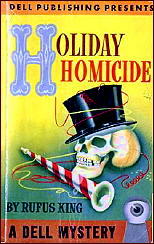
RUFUS KING – Holiday Homicide. Doubleday Crime Club, hardcover, 1940. Paperback reprint: Dell #22, mapback edition, 1943.

   Preceded by Murder Masks Miami (1939) the last Lt. Valcour novel, Rufus King’s Holiday Homicide introduces two new sleuths, high priced private detective Cotton Moon, and his secretary-assistant-narrator, Bert Stanley.

RUFUS KING Holiday Homicide

   The two are direct clones of Nero Wolfe and Archie Goodwin, and the novel as a whole is a pastiche of Rex Stout. Moon is a pleasant character; instead of raising orchids, like Wolfe, he collects rare nuts. The novel might be best read with a copy of Edwin A. Menninger’s Edible Nuts of the World (1977) on hand: a fun book, by the way. This zany hobby is typical of the book’s tongue in cheek approach: nothing is ever completely serious here.

   King’s pastiche of Archie Godwin is especially good. King has caught Archie’s bemused, intelligent, slightly smart-alecky tone of narration very closely.

   King has combined this tone with his own vivid writing style, to make a very interesting synthesis. The descriptions include King’s interest in rich concoctions, such as food, perfumes, and fluids.

   King also uses his typical examination of conventional story telling ideas here, constantly turning over stock phrases and situations, commenting on them all the while — this is an early use of a technique that will reach its apogee in King’s short story “The Faces of Danger” (1960).

   Since Archie is also a somewhat sardonic observer of the human scene, King can fuse his own meta-narrative approach with Archie’s “common man” take on the well to do world about him. Bert is a bit more bitchy than Archie usually is, in keeping with the campier tone of King’s fiction.

   While Holiday Homicide is well written, it has problems as a puzzle plot. There is no fair play: Moon identifies the killer because he discovers the killer’s fingerprints at a crime scene.

   This clue is not shared with the reader, and there is no logical way for the reader to deduce who the killer is. Nor is the mystery’s solution especially clever. It does succeed in making a logical story out of the book’s scramble of events and clues, and this shows a bit of ingenuity.

   Holiday Homicide has a similar status as Murder by Latitude in King’s career. Both books are 1) genuine whodunits, not suspense novels; 2) lack fair play in their solutions; 3) are well written, with special gifts of prose style and verbal adroitness; 4) show good storytelling.

— Very slightly revised from A Guide to Classic Mystery and Detection, by Michael E. Grost, with permission.


« Previous PageNext Page »