Reviews


BORDERTOWN. Warner Brothers, 1935. Paul Muni, Bette Davis, Margaret Lindsay, Eugene Pallette, Robert Barrat, Soledad Jiménez. Suggested by the book Border Town, by Carroll Graham. Director: Archie Mayo.

BORDERTOWN Paul Muni

   This was recently shown as part of TCM’s Latino Festival that’s been going on all month long, and if I may say so, there’s something of mixed message made by this movie. The focus of the films in this series is how Latinos, in this case Mexican-Americans, have been portrayed on the screen.

   How it works out in this case, I’ll get back to — with a small CAVEAT that more of the story line is going to be hinted at, if not revealed, than is customarily done on this blog.

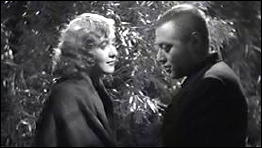
   Paul Muni, who was Jewish and a Hollywood superstar in the 1930s, plays Johnny Ramirez in Bordertown, a young resident of Los Angeles’s Mexican Quarter who after five years of hard work, earns his law degree from a small but apparently reputable night school. As in Crime and Punishment, reviewed here not too long ago, the opening scenes are of the graduating ceremony.

   And as with Raskolnikov in that other film, getting a degree is not the same thing as making a success of yourself. Johnny’s first appearance in court is a disaster. Summarily disbarred, he heads for Mexico and in a town just south of the border where he works his way up from a night club bouncer to a 25% partnership.

   And where the boss’s wife (a blonde and coolly calculating Bette Davis) has eyes for him, which is where the noir aspects kick in. Luckily for Johnny, he is unaware of what you’ve already probably gathered happens next.

BORDERTOWN Paul Muni

   His eyes are instead on Dale Elwell, the female socialite who was on the other side of his one and only courtroom case (Margaret Lindsay), but who comes slumming down to see Johnny’s new casino, built with you-know-who’s money.

   As I warned you earlier, I’ve already told you more of the plot that I should and normally would, but I think in this case, no matter how little I told, you’d fill in much of the details on your own anyway – and besides, you need the Big Picture.

   The black-and-white photography is fine — even in the silent era, cameramen at the major studios really knew their business — but as for the story itself, there is not a subtle line or scene in this movie. Once started, you will have the continual feeling that you know what exactly will happen next, and it does.

   Not that that’s a real complaint. I enjoy stories with romantic — and deadly — triangles like this, and if they hadn’t been filmed many times before this movie was made, they’ve certainly been made many times since.

   So, except for the ending, I enjoyed this film. In terms of Latino images, there’s nothing too preachy about the injustices that poorer Mexican-Americans faced in a elite world of wealthy WASPs in the 20s and 30s, or at least I didn’t find it so, but the ending? It can take the wind right out of your sails. It took quite a few more years, apparently, before interracial romances would be deemed fitting and proper subject matter for movie viewers to see.

   Whatever message may have been intended before the final scene, if there was one, is quickly whisked away, and very nearly without a trace.

PostScript. I’ve just discovered an almost three minute trailer for the film on the Amazon page offering the DVD for sale. I suspect that you hunt around, you may find more of the movie available online. Check YouTube and similar sites.

LAWRENCE BLOCK – The Specialists.

Foul Play Press, paperback reprint, 1985. First published as Gold Medal R2067: paperback original, 1969. Other reprint editions: Carroll & Graf, pb, 1993; James Cahill Publishing, Aliso Viejo, California, hc, 1996.

LAWRENCE BLOCK The Specialists

   Most of Block’s early crime thrillers, including the Tanner series, were paperbacks, almost all from Gold Medal. The first Matt Scudder book was published by Dell in 1976, and although Scudder’s career is still going today, and in hardcover, Block’s own writing career didn’t take off until 1977, when the first “Burglar” book came out in hardcover (Burglars Can’t Be Choosers, Random House).

   Which places The Specialists toward the end of the first stage of Block’s career, before he seems to have gone on a 4 or 5 year hiatus. While the book starts out sounding like a winner, its plot soon begins to hold together like a pile of yesterday’s oatmeal.

   Picture a group of returned Vietnam war veterans who decide to continue their commando tactics against the forces of crime and corruption. From page 26: “All over the country there were dirty men with dirty money, men the law could never get close to, but once you took their money away, it turned clean.”

   Villain: a New Jersey gangster who’s been laundering his ill-gotten gains by owning banks, and then robbing them (or at least one of them) for additional profit.

   Problem: the good guys play as nasty as the bad guys. There’s no one to root for. Which may have been Block’s idea all along — it’s certainly a valid approach to a crime story — but while there are flashes of good characterization and even better side commentaries about the state of the world, there’s nothing here that even hints at the idea of subtlety.

— March 2003


[UPDATE] 05-10-09. This brief review does not mention the many books that Block wrote under pen names, nor any of the “sleazy” paperback originals he wrote early on his career, many of them having criminous content. Some of the latter have been resurrected within the last year or so by Hard Card Crime. See my review of Lucky at Cards as a prime example.

   At the moment I cannot account for how negative this review was, and it was written only six years ago. The book really may be as bad I said it was, but reading my comments now, they wouldn’t persuade me against giving it another try.

   If you’re a Lawrence Block fan but haven’t read the book yet, please do so, and let me know how wrong I was, if I was. (This statement also applies, of course, if you’ve already read the book.)

   Other books by Lawrence Block which have been reviewed on this blog:  Mona (1961), by me; and The Girl with the Long Green Heart (1965), by Ted Fitzgerald.

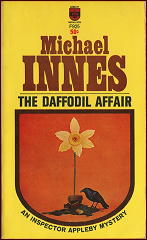
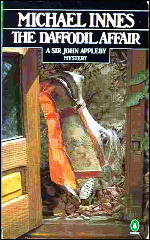
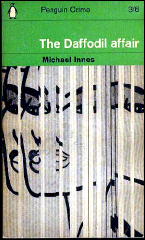
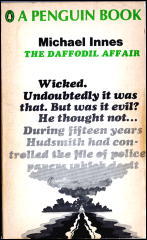
MICHAEL INNES – The Daffodil Affair.

Victor Gollancz, UK, hardcover 1942. Dodd Mead, US, hardcover, 1942. Reprinted several times, including the following: Berkley F925, June 1964; Penguin, several editions, both in the UK and the US.

MICHAEL INNES The Daffodil Affair

   You might want to go back and read my review of Innes’s Seven Suspects first, as I’m going to go out on a limb here, and say that that book is a lot more representative of both Michael Innes and Inspector John Appleby than The Daffodil Affair is, and by a long shot — by factor of, in fact, say several thousand times or so.

   I have to stop and tell you the truth right here, before going on any farther. I have never read a mystery or detective story that is ANYTHING like this one. In terms of being unique, this one’s the ultimate in uniqueness.

   Have I intrigued you? I hope not, because my intention at this point is NOT to convince you to read this book. I don’t intend to have you NOT read it either. You do need to know, perhaps, what’s in store for you if you read this book, and well, I’ll do my best.

   I’ll start, though, with a long passage from page 89 of the Penguin edition. The setting is both heading down a river [the Amazon?] to a secret encampment where a man named Wine is making a collection of animals, people and even inanimate objects with psychic powers:

MICHAEL INNES The Daffodil Affair

    The night was dark, and Appleby blinked into it. Hudspith [Appleby’s colleague, also from Scotland Yard] bubbling with the raffish idiom of the nineteen hundreds was a mildly surprising phenomenon. But then, so, and in an equally dated away, were a calculating horse [named Daffodil] and an Italian medium specializing in materializations.

    A witch and a girl possesed by demons [named Lucy, her demons being her multiple personalities] were exhibits more ‘period’ still.

    In fact — said Appleby to himself as he paced the blacked-out deck once more — this ship has the nineteen-forties dead astern and is heading for the past at its full economic speed of eighteen knots. The Time Ship: master, Emery Wine [the man who has kidnapped all of the above, all with psychic abilities, not including Appleby and Hudspith]. It sounded like H. G. Wells… He took several turns about the deck and returned to the smoke-room.

    Hudspith’s voice greeted him as he entered. […]

    Hudspith, though still talking defiantly, was looking at the silent Wine and Beaglehole [Wine’s assistant in crime] with an occasional furtive sideways glance — as a man may do who is presently going to realize that he has been making a fool of himself. ‘There was a girl in London,’ said Hudspith, raising his voice with a sort of desperate and fading arrogance. ‘Just a few months ago. Lucy, her name was…’

    Rather abruptly Appleby plumped down on a settee. Perhaps he had been dull. Certainly he had not realized it was all heading for this.

MICHAEL INNES The Daffodil Affair

   The book, written during the darkest days of World War II, is perhaps (I am not quite sure) a reaction to Science, which had at that time nearly brought England to its knees — very dark days indeed. Can the uncanny also move the world? Wine soon intends to try.

   Here’s another long quote, this time from page 177. Appleby and Hudspith are essentially prisoners somewhere on an island in South America. Hudspith speaks first. (I’ll leave out one key, essential part, but I think you may find the rest amusing)

    ‘How many people would you say have written detective stories?’

    Appleby yawned. ‘Hundreds, I should imagine.’

    ‘Quite so – and some of them have written scores of books. Folk with intelligences ranging from moderate through good to excellent. A couple of women are quite excellent; there’s no other word for them.’

    ‘Is that so? I say, Hudspith, it must be deuced late.’

    ‘And, what would you say those hundreds of folk are constantly after?’

    ‘Money.’ Appleby’s voice, if sleepy, was decided.

    ‘They’re constantly after a really original motive for murder. And here one is. […] It’s a genuinely new motive, and none of them has ever thought of it.’

    ‘Probably someone has. You just haven’t read that particular yarn. Good night.’

    ‘But I haven’t explained what I mean. About waste that is.’ Hudspith’s voice continued to come laboriously out of the night. ‘Here is a perfect detective-story motive, and yet we’re not in a detective story at all.’

    ‘My dear man, you’re talking like something in Pirandello. Go to sleep.’

    ‘We’re in a sort of hodge-podge of fantasy and harumscarum adventure that isn’t a proper detective story at all. We might be by Michael Innes.’

MICHAEL INNES The Daffodil Affair

    ‘Innes? I’ve never heard of him.’ Appleby spoke with decided exasperation. ‘You might employ your last hours more profitably than in chatter about the underworld of letters. Go to sleep. Go to sleep and dream of the nice boiled egg they send to the condemned cell on the fatal morning.’

    Hudspith sighed and for a time was silent. ‘It’s all very well rotting,’ he said at length. ‘But about this idea of Lucy’s — do you think it will work?’

    Silence answered him.

   Bear with me. Here’s the last of the quoting I’ll be doing. I’ll also let it be the end of this review. If at the end you still want to read the book, I’ll allow you, but keep in mind, the decision is yours. This passage comes from page 43, when Daffodil was still a key component of the story. Appleby has found Mr Gee at the livery stable from which the horse has been stolen:

    ‘Mr Gee,’ he parried, did it never occur to you that these peculiar powers made Daffodil an unusually valuable horse? Imagine the thing in a circus. Members of the audience are invited to come up, hold Daffodil by the bridle and think of a number. And then Daffodil taps it out. The trick would make any showman’s fortune.’

    ‘It so happens,’ said Mr Gee with dignity, that I’m not a showman. But if Daffodil is valuable the way you suggest, then you know something about them in whose hands he was before. They weren’t show people, or they wouldn’t have let him go.’

    Appleby got up. ‘Mr Gee, you ought to have taken to my profession.’

    There’s compliments you can return,’ said Mr Gee, ‘and there’s compliments you can’t.’

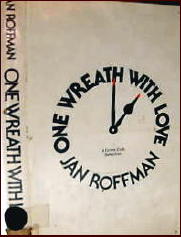
JAN ROFFMAN – One Wreath with Love.   Doubleday Crime Club, US, hardcover, 1978. Robert Hale, UK, hardcover, 1979. No paperback edition.

JAN ROFFMAN One Wreath with Love

   Jan Roffman has written nearly a dozen mystery novels by now, so it’s be exceedingly presumptuous of me to try to generalize anything about her writing from a sample of size only one, but (as I’m often resigned into doing) I will anyway:

   On the basis of this book, she has a tendency to overwrite, even badly, especially in the early chapters, but in the process of doing so, she creates a good many characters whose lives are as ingeniously intertwined as they are in the best of soap opera tragedy.

   I’m pleased to report that the overwriting begins to disappear as the characters become more familiar, or so it seems, and by the end, tears will come close to falling. Murder is involved, but we know who did it in chapter one, in which a particularly repugnant death scene is used to build an almost watertight alibi.

   Many of the characters in this book are afflicted with various stages of senility or insanity, and maybe that’s what I mistook for overwriting. Roffman is clearly adept in creating people out of touch with reality. The contrast is at its most effective when an under-disciplined seven-year-old named Tilly makes a friend of the dottering old lady who may have caught sight of the killer.

   There’s also the rapidly failing mind of the ex-wife with a not-so-reliable ghost haunting her, and so in turn Chief Superintendent Deacon is annoyed.

   This is not a detective story, but all the same, I think it can easily get under your skin.

– From The MYSTERY FANcier, Vol. 3, No. 3, May-June 1979, mildly revised.


      Bio-bibliographic data —

   Jan Roffman was a pen name of Margaret Summerton, who died in 1979, according to the Revised Crime Fiction IV, by Allen J. Hubin, but that’s about all the personal information I have about her. Even though the US edition of One Wreath with Love was published before the one in the UK, I’m sure she was British.

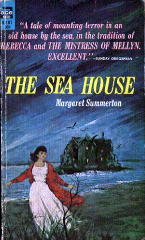
   Under her own name, Summerton wrote 14 novels, with 10 of them also appearing in the US in hardcover. When they were reprinted here in paperback, usually by Ace, they were invariably marketed as gothic romances. The Sea House, the cover of which is shown below, is a prime example.

JAN ROFFMAN

   She also wrote at least 10 books as by Jan Roffman. I can’t give you an exact count, because two books published under that byline in the US have as yet not been matched up with their UK counterparts — and it’s possible there aren’t any.

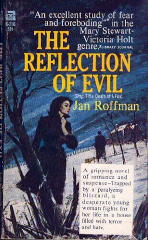
   One Wreath with Love was not published in paperback, but other Roffman books were, and once again, the marketing division at Ace assumed that they would sell best as gothics. They were probably right. Shown is the cover of The Reflection of Evil, aka Death of a Fox (US) and Winter of the Fox (UK).

JAN ROFFMAN

CRIME AND PUNISHMENT. Columbia, 1935. Peter Lorre, Edward Arnold, Marian Marsh, Tala Birell, Elisabeth Risdon, Robert Allen, Douglass Dumbrille, Gene Lockhart, Mrs. Patrick Campbell. Based on the novel by Fyodor Dostoyevsky. Director: Josef von Sternberg.

CRIME & PUNISHMENT Peter Lorre

   To begin with, the novel’s 600 to 800 pages long, depending on the size of font used and how wide the margins are. If a film adaptation is only 90 minutes long, as is this US version done in 1935, answer yourself this: how much of the book could be crammed in?

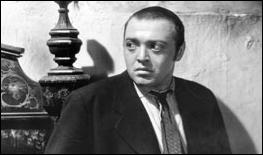
   So, OK, let’s let that go, and talk about the movie as a movie. It was one of the earliest films that Peter Lorre made in the US, and as a leading man yet, in the role of criminology student Roderick Raskolnikov, who commits a murder and almost, but not quite, gets away with it.

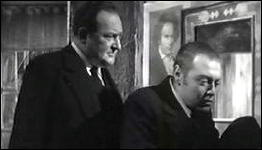
   Dogging his trail is Edward Arnold, as Inspector Porfiry Petrovich, not necessarily following the academic approach espoused by Raskolnikov, who as it becomes clear, is a rival in more ways than one.

CRIME & PUNISHMENT Peter Lorre

   In spite of first appearances, Porfiry is gradually seen as a student of human nature, allowing his prey to alternate between arrogance and fear by using only one simple method: by allowing him to remain free — and thereby trapping and convicting himself by his own hand.

   A role that was meant to be played by Peter Lorre, perhaps, who does both arrogance and fear very well, and yet, in Crime and Punishment, he shows he has a human side as well, committing the murder of the miserly lady pawnbroker (Mrs. Patrick Campbell) yes, but giving the young streetwalker Sonya (a radiant Marian Marsh) all of the money given him earlier in return for pawning his father’s watch. (It is interesting to note how Sonya’s means of earning a living manages to be very conveniently skipped over.)

CRIME & PUNISHMENT Peter Lorre

   The film came along far too early to be classified correctly as noir, perhaps, but there are a number of elements that could easily make it fit (one might argue) into the category.

    Not only the story itself, with Raskolnikov continually finding himself sliding into the abyss of his own mind — a quiet kind of desperation — but the black-and-white photography is also quite magnificent, showing the better parts of the unknown city (Moscow?) where the story takes place, as well as some of the worse, including Raskolnikov’s rather squalid apartment, for which, in spite of his brilliance, he cannot even pay the rent.

   So, my final comment and overall impression? A very entertaining film, a movie that when I started, I intended to see only the first ten minutes as a preview, but which I forgot myself and watched all the way through to the end instead.

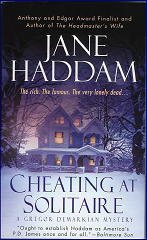
JANE HADDAM – Cheating at Solitaire.  St. Martin’s, paperback reprint; 1st printing, April 2009. Hardcover edition: St. Martin’s, April 2008

JANE HADDAM Cheating at Solitaire

   Upstairs as I’m typing this, I don’t have access to the Internet, so I don’t know how many books Jane Haddam has written in her series of ex-FBI agent Gregor Demarkian’s cases, but there have been quite a few of them. (According to Amazon.com, as I’ve discovered later, this is the 22nd.)

   I wish that I’ve read more of them — only one before this one — and that’s because of the question I’ve been trying to answer. I’m not trying to diminish Demarkian’s popularity by a single whit, but the strange thing is that I can’t quite explain why it is that he’s had the career he has.

   Are the books what are commonly referred to in the vernacular as cozies? Not really, although some of early parts of this particular adventure takes place in Demarkian’s boyhood Armenian neighborhood in Philadelphia (Cavanaugh Street) where his marriage to his long-time lover Bennis Hannaford is soon to take place. Check this off. Roots are important. Long time friends are important.

   But neither of the latter two items have anything to do with the case that Demarkian is called in on in Cheating at Solitaire, a fact for which I (admittedly) felt uncomfortably grateful, as the atmosphere felt a little too close for me. I suspect, however, that long time fans of the series might wish there were more!

   Dead is one of the crew of a film being made in Margaret’s Harbor, found shot to death in his car in a New England style Nor’easter on New Year’s Eve. The local police force, and very few in number, have chosen the most likely suspect, not realizing that (in Demarkian’s quick analysis of the case) simply do not add up. The bullet has not been found where it should be, and where the victim’s blood is found on the person arrested does not match the local authorities’ version of the events. (See page 135.)

   You might therefore check off great detective work as being part of the appeal, but Demarkian’s rebuttal of the prosecution’s facts is far from a work of genius. Anyone willing to let the facts guide the theory, rather than the other way around, could have done as well.

   Well before the end of the tale Demarkian also suggests that he knows who did it, too the surprise and amazement of all, but he later backs off suggesting that the he only knows the kind of person capable of doing it. By the story’s end, nor in the final wrapup, is his earlier claim mentioned.

   This may sound as though I was greatly disappointed in the mystery and how it develops and in the solution. No, not really. Only mildly. I do think, however, that Demarkian’s detective skills are more talked about than shown.

JANE HADDAM Cheating at Solitaire

   I have not mentioned, though, what this book is really about. In paperback the book is 388 pages long, which is far too long for the small amount of detective work that’s involved to be a major reason for its popularity.

   What the book is really about is a certain disdain for the existence of popular culture creatures such as Paris Hilton, Anna Nicole Smith and Brittany Spears. Three such women, key players in this book — two from out of town, one local and not exempt from the author’s indictment — reflect the same shallow values, at least outwardly. (A surprise or two may be in store here.)

   But by shallow values, I mean vapid, stupid behavior, including such actions as getting drunk in local bars and running about town in skimpy clothing and a noticeable lack of underwear. Not that they’re the only culprits and targets of Jane Haddam’s wrath. This book also includes one of the most vicious attacks by a gang of paparazzi on an extremely vulnerable celebrity that you will read anywhere, a statement that’s almost guaranteed.

   Time and time again the book stops while some rather effective moralizing takes place, sometimes in the minds of the players, sometimes as a general authorial voice. Such commentary on the modern world, if not modern society as a whole — or should that be the other way around? — is difficult to disagree with, but after a while it becomes as overbearing as the close-knit neighborhood that produced Gregor Demarkian into the world, along with his values.

   But do check off values. As overdone as the promotion may be, values are the key to Cheating at Soltaire — hometown values, small town values, I don’t believe it matters either way. Maybe they’re even universal values and and maybe this is why readers keep coming back for more.

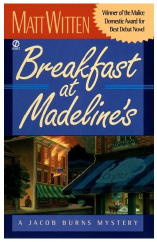
MATT WITTEN – Breakfast at Madeline’s.

Signet, paperback original; 1st printing, May 1999.

   I don’t what the following data signifies, probably nothing, since a book’s sales ranking on Amazon can fluctuate wildly. There are so many books listed there, all in competition with each other, and except for the top 100 or so, all so closely packed together, they should called tied. One sale and the ranking can go up by a million, just like that.

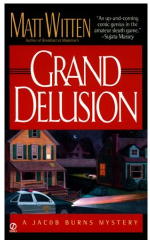
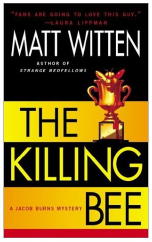
   In any case, as a writer of mystery novels, all of Matt Witten’s books are out of print, but as of tonight (01 May 2009) two of them are doing awfully well. (Relatively speaking, of course. Also note that rankings go down as far as the seven millions.) The fellow doing the sleuthing in all four is a struggling screenwriter living in Sarasota Springs NY named Jacob Burns:

         The Jacob Burns mysteries –

      Breakfast at Madeline’s. Signet, pbo, May 1999. Amazon.com Sales Rank: #172,411
      Grand Delusion. Signet, pbo, Jan 2000. Sales Rank: #1,700,960

MATT WITTEN

      Strange Bedfellows. Signet, pbo, Nov 2000. Sales Rank: #172,444
      The Killing Bee. Signet, pbo, Nov 2001. Sales Rank: #1,601,905

MATT WITTEN


   I’ve read only this first one, Breakfast at Madeline’s, so I don’t know what the future holds for Jacob Burns, but I’d better take back the “struggling” part of the description above. He’s struck oil, figuratively speaking, Hollywood style, having just earned a million dollars for doing the screen adaption for an “epic” called Gas, about “deadly fumes seeping out of the earth’s core after an earthquake and threatening to destroy the entire population of San Francisco.”

   One thing I do know, is that there are four books in the series, and there isn’t likely to be any more, not right away anyway. Matt Witten is not a big name on the tip of the general public’s collective tongue, but right now he’s certainly a big man in high-rise Hollywood circles, and that’s what counts. Writing mystery paperback originals is not anything he’s going to need to do for a long time to come:

MATT WITTEN

   Credits on IMDB since 2002: Producer or supervising producer for CSI: Miami, JAG, House M.D., Supernatural, Women’s Murder Club and Medium.

   If you see what I mean. Witten is probably still a nice guy, though, since Jacob Burns, his leading character certainly is, and guys who aren’t so nice would find it, I suspect, awfully hard to create characters who really are. Nice, that is. And still living in Sarasota Springs NY.

   Burns is also happily married, and even though he comes awfully close to straying in this book, he says no and walks away, just before the point of no return. Burns also has two lovable little boys named (well, nicknamed) Gretzy and Babe Ruth, with whom he has a lot of fun, and likewise the same.

   Dead is an old man who hung out at Madeline’s Espresso Bar, a loner who spent most of his time scribbling on paper but known to all of the usual habitues, artsy types all, most of them members of the Sarasota Council Arts Councils and whom seem to get all of the available grant money, but Donald Penn (the dead man), no.

   Just before he died, Penn gave Burns the key to a safety deposit box, and inside? That’s the story, and all of the aforementioned artsy types want to know, too.

   Told in a friendly but wise-ass sort of way, there are probably too many F-words used for this to properly be called a cozy, but it is anyway. At least there’s no graphic violence, as long as you don’t count all of Jacob Burns’ very narrow escapes. There’s only a small amount of actual detection involved, but (come to think of it) there’s enough to form the basis of a pretty good TV series out of Burns’ adventures.

   I wonder if Matt Witten knows anyone who might be interested.

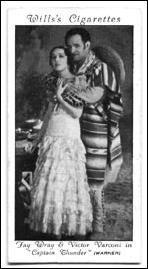
CAPTAIN THUNDER. Warner Brothers, 1930. Fay Wray, Victor Varconi, Charles Judels, Robert Elliott, Don Alvarado, Robert Emmett Keane. Director: Alan Crosland.

   It was “Captain’s Day” one day last week on TCM. This one followed Captain Applejack which I watched and commented on a couple of days ago, with several more taped and ready to be watched as soon as I’m able, including Captain Blood, which is first movie I remember watching as a kid, when I was perhaps six or seven years old.

CAPTAIN THUNDER Fay Wray

   Many of the other movies in this grouping, which were shown all day, seem to have been newly recovered from the vaults, but if so, this one may as well go back in. It does feature Fay Wray, whom I can watch in anything, as this movie has proven, but it has little else going for it that would prompt more than the slightest recommendation.

   Not only does Fay Wray have a leading role, but the very first time we see her, she’s in a very skimpy slip and little else, a fact worth both pointing out and explaining.

   Captain Thunder, a Mexican bandit raising havoc with the forces of the utterly inept and totally comical El Commandante Ruiz (Charles Judels), has previously robbed the stagecoach in which she was coming into town, and part of the tribute demanded was the outer clothing of all its passengers. (And perhaps the driver and the fellow riding shotgun as well. I should go back and look. I was distracted at the time.)

   El Capitan Thunder is played most boisterously by Victor Varconi, a Hungarian playing a Mexican in this movie. His career began in the silents back in his homeland, starting in 1913, and as is often the case with many early talking films, some actors did not at first understand that less is sometimes more.

CAPTAIN THUNDER Fay Wray

   Be that as it may, Captain Thunder’s credo is that he will keep all of the promises he makes, which puts him in a quandary when one he makes to the slim and supremely beautiful Ynez Dominguez (Fay Wray) runs headlong into one he makes to the evil Pete Morgan (Robert Elliott), a strutting gent with eyes on Ynez himself, although she is about to marry another. Much booing and hissing expected here.

   Fay Wray’s career survived this pre-King Kong film, I’m happy to say, and surprisingly enough, so did Victor Varconi’s, who had many small parts and supporting roles through the early 1950s. Director Alan Crosland died in 1936 at the age of only 41, but before that, he was at the helm of a couple of Perry Mason movies, and The White Cockatoo (1935), a film based on a pretty good mystery novel by Mignon G. Eberhart.

REVIEWED BY WALTER ALBERT:         


SUPER-SLEUTH.   RKO Radio Pictures, 1937. Jack Oakie, Ann Sothern, Eduardo Ciannelli, Alan Bruce, Edgar Kennedy, Joan Woodbury. Director: Benjamin Stoloff. Shown at Cinevent 20, Columbus OH, May 1988.

   Jack Oakie plays a popular film sleuth who tries to repeat his success on screen in an off-screen mystery, abetted by studio publicist Ann Sothern (trying to cover up his almost constant mishandling of his amateur sleuthing).

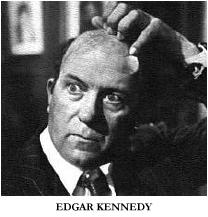
EDGAR KENNEDY

   Edgar Kennedy was good as James Gleason’s flat-footed assistant in the delightful Murder on the Blackboard, the second of the Hildegarde Withers/Inspector Piper collaborations with Edna Mae Oliver (1934), shown earlier in the day, but he was even better in Super-Sleuth.

   For once, Kennedy comes off as a sympathetic, even competent professional undone by an incompetent amateur, even though the bumbling “Edgar” character lurks somewhere not too far from the surface.

   The heavy is Eduardo Cianelli, the unforgettable “assassin” of Gunga Din, and the comic/suspenseful climax has a wax museum as the perfect setting for the conclusion of a film about on- and off-screen detecting.

– From The MYSTERY FANcier, Vol. 10, No. 3, Summer 1988, mildly revised.


[EDITORIAL COMMENT.]   My usual sources have come up dry as far as finding suitable images to show you. Even more unexpectedly, the movie itself has proven to be elusive, although not impossible to find in the usual collector-to-collector markets. The photo of Edgar Kennedy, a standard publicity shot, source unknown, is not from Super-Sleuth, or at least I’m fairly sure it’s not.        — Steve

A REVIEW BY BILL CRIDER:

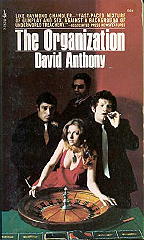
DAVID ANTHONY – The Organization. Coward McCann, hardcover, 1970. Paperback reprint: Pocket, 1972.

DAVID ANTHONY The Organization

    David Anthony’s Stud Game (reviewed by Steve Lewis in the previous post) was nominated for an Edgar as best paperback mystery of 1978. The Organization is an earlier episode in the life of the same main character, professional gambler and part-time private eye Stanley Bass.

   And it’s quite an episode. While reading it I was reminded very much of the 1950s paperbacks of Charles Williams, the ones in which a man becomes involved with a woman who in one way or another gets him into a situation from which there seems to be no escape.

   I don’t make this comparison to Williams lightly, because I really admire his work. The ending, while perhaps not as ironic as those achieved by Williams, still leaves Bass with very little.

   The story? A beautiful woman wants to kill Bass’s tennis friend, Jack Prince, a man with mob connections. Bass meets her and tries to dissuade her. He does so by coming up with a way to get Prince’s own bosses to do him in.

   But things go awry and Bass finds himself hunted by both the police and the organization for a number of things which he didn’t do. But who did do them? The answer isn’t as easy as it first seems, and Bass has the devil of a time getting out of the mess he’s gotten into. How he does so makes a fine hardboiled tale.

– From The MYSTERY FANcier, Vol. 3, No. 4, July-August 1979, very slightly revised.


      Bibliographic data. [Taken from the Revised Crime Fiction IV, by Allen J. Hubin]

ANTHONY, DAVID. Pseudonym of William Dale Smith, 1929-1986.

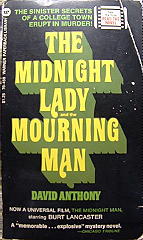
    The Midnight Lady and the Mourning Man. Bobbs-Merrill, hc, 1969; Warner, pb, 1973. [Morgan Butler] Film: Universal, 1974, as The Midnight Man.

DAVID ANTHONY The Organization

    The Organization. Coward McCann, hc, 1970; Pocket, pb, 1972. [Stanley Bass]
    Blood on a Harvest Moon. Coward McCann, hc, 1972; no pb edition. [Morgan Butler]
    Stud Game. Pocket Books, pbo, 1978 [Stanley Bass]
    The Long Hard Cure. Collins, UK, hc, 1979 [Morgan Butler]

« Previous PageNext Page »