Reviews


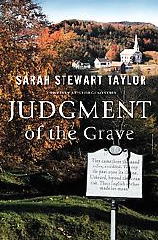
SARAH STEWART TAYLOR – Judgment of the Grave.

St. Martin’s; reprint paperback; 1st pr., Aug 2006. Hardcover edition: St. Martin’s; July 2005.

   It is impossible to keep up. When I go looking for whatever book to read next, I often pick one out at random, and invariably it’s the second or third in a series, almost never the first. (I used to teach college courses in probability, so I’m not complaining. I know exactly what the odds are, and they’re against me.)

   Judgment of the Grave is the third of four of the recorded adventures of Harvard-based art historian, Sweeney St. George. It’s early in this review, instead of at the end, where I often do it, but here’s a list of all four. All came out first from St. Martin’s in hardcover, then in paperback:

      O’ Artful Death. 2003 / June 2004.
SARAH STEWART TAYLOR

      Mansions of the Dead. July 2004 / May 2005.
      Judgment of the Grave. July 2005 / Aug 2006.
      Still As Death. Sept 2006 / Oct 2007.

   And in spite of excellent reviews and good sales rankings on Amazon, these four appear to be all there’s going to be. Sarah Stewart Taylor’s website does not seem to have been updated since October 2007 and the last entry in her blog is dated May 2, 2007.
SARAH STEWART TAYLOR

   That’s a shame. In spite of some quibbles which I’ll get to shortly, I enjoyed Judgment of the Grave quite thoroughly. So well, in fact, that if I knew where my copy was, I’d read Still As Death next, just to find out what happens to Sweeney and her romantic difficulties in her followup adventure. And failing that, go back and read one or both of the first two (see above), just to learn how all of her romantic difficulties began in the first place.

   Quibbles: These very same Sweeney’s romantic difficulties — and all of the problems the other characters have in Judgment of the Grave. They’re a major part of the story, and they tend to overpower the detective story involved.

   But what they also help create is a dark, atmospheric tale filled with angst, anxiety and sorrow, beginning with the opening scene (after a short prologue) in which Sweeney meets a young 12-year-old boy with leukemia while she’s researching gravestones in a Concord MA cemetery.

   Cambridge police detective Tim Quinn, whom Sweeney has met before and seems to have a history with, meets her again as he follows up on a missing person’s report — a professor having a similar interest in gravestones and the history of the Revolutionary War has disappeared after taking part in a battle re-enactment up near Concord. Quinn’s wife committed suicide, we learn, and he’s forced to take his 10-month-old daughter along with him. Sweeney is a multi-tasker. She babysits and helps solve the mystery at the same time.
SARAH STEWART TAYLOR

   Meanwhile Sweeney’s almost-but-not-quite-affair with Ian has been put on hold while he’s home in England. Phone calls every night. I don’t quite understand where Toby fits in, but he somehow seems to have overnight privileges.

   Also often crowding the mystery aside are long expository pages on the War of Independence, how it was conducted, how not all of the colonists were fighting for freedom, and how much the British depended on spies.

   The latter may be the reason for the present day killings, or perhaps not, because all of the other character’s marriages are either broken or on the verge, and jealousy or revenge are also excellent reasons for murder. A veritable Peyton Place, without the same degree of notoriety or sensationalism.

   I suppose you already know, having gotten this far, whether or not you will ever read any of the books in the series, but nonetheless, with a bit of pruning down and firming up, and filmed in black-and-white, or with dark, shadowy indoor scenes contrasted with the bright colors of an autumn New England sky, Judgment to the Grave would be as noirish as they come. It’s not Los Angeles, but there are a lot of dark secrets in Massachusetts too.

[COMMENT.]  Later the same day. I’m embarrassed to point this out, but while searching for some more information about the author on Google, I discovered that I’d totally forgotten that Walter Albert reviewed this same book here on Mystery*File, and not too long ago.

   He liked it too.
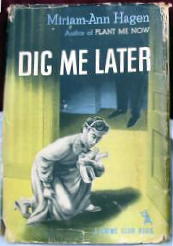
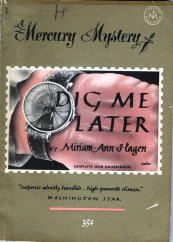
DIG ME LATER – Miriam-Ann Hagen.

Mercury Mystery 157; digest-sized paperback; no date stated, but generally accepted as being 1951. Hardcover edition: Doubleday/Crime Club; 1949. Hardcover reprint: Detective Book Club, 3-in-1 edition, August 1949.

MIRIAM-ANN HAGEN Dig Me Later

   I mean no offense to anyone named Hortense, or who knows anyone with the name Hortense, but it IS an old-fashioned name, I believe you have to admit, and a series of mysteries with a leading character named Hortense Clinton is going to be considered light-hearted from the outset, whether it is true or not.

   But true it is, or at the least, this second of three mysteries she was involved in certainly is. When a murder occurs across the hall to her in her Manhattan apartment, Hortense accidentally confronts the killer with her night clothes on, blemish cream on her face, chin strap on, and a band across her forehead.

   Of course squatting down on the floor as she was, all she could see before she was knocked unconscious was the killer’s pant legs and shoes. But if the killer was the dead man’s nephew making his getaway as she was putting her milk bottles out, why did he take the time to take her diamond watch?

   As it happens, the answer to that question is clear to any reader who’s been paying attention and has read Chapter One carefully, so anyone who reads detective stories for the detective work in them isn’t going to find much of any substance to mull over in this one.

   But the characters are what might keep you reading, as the did me, somewhat wacky and somewhat confusing, or confused themselves as to why so many of them end up with Hortense in a resort hotel in Nova Scotia where she flees when her notoriety in Manhattan proves to be too much for her.

   The killer is obvious enough in retrospect, but there are plenty of false trails to be followed and examined carefully before the final denouement. Most – but not all – the questions are answered, and Hortense Clinton survives to be involved in another murder another day. (See the bibliography below.)

   But before getting to that, I didn’t do any research on the author before beginning the book – I seldom do, as I prefer to let the book speak for the author, not his/her reputation or background. I almost never even read the blurbs on the jacket flaps or the back cover.

   So it took me a while to place Ms. Hagen’s style of writing, even though I have to admit that I should have known. It’s a style that feels itself necessary to explain the smallest detail, to spell out things so that the reader will fully understand, and yet is smooth enough, and clever enough to stay interesting. I am not denigrating it in any way. It’s a style of writing I most certainly and definitely admire.

MIRIAM-ANN HAGEN Dig Me Later

   I wish I could explain better what I mean, but here’s a sample, and maybe that will help. Picking a page and a selection at random from the first chapter, take this as an example. Hortense is being asked by the police to identify the nephew’s shoes:

    Although she wouldn’t raise her eyes above the feet she was asked to identify, she had a feeling that the simple monosyllable had been a blow to the young man and that he had stiffened under it. “Yes,” she repeated hastily, “like this man’s or like most men’s. You could go out in the street and within ten minutes bring in a hundred men, and I’d look at their feet and have to say yes, about that size.”

    “Sure, Miss Clinton,” said the detective. “Sure. We don’t expect you to say it was this man’s feet you saw. That would be asking too much. We just want you to tell us if it could have been this man’s feet, that the ones you saw weren’t so much bigger or smaller or anything that you’d know they couldn’t have been his or even that you’d think maybe they couldn’t be his.”

    They worked at it, trying to pin her down to some sort of statement, but Hortense refused to say more that what she could say with certainty, until finally, in a burst of frankness, they told her exactly what they wanted of her, and to that she had to give them the answer that satisfied them….

   Which was, to cut the story off short, that she wouldn’t later be able to testify in court that it couldn’t have been the man that the suspected of being the killer.

   I don’t know if that was enough of a sample for you to tell, and maybe you never heard of Aaron Marc Stein, also known as George Bagby and Hampton Stone, but the writing is identical. But if you have, then I’m sure you spotted the similarity, and probably even before I made the connection. And if you’ve been paying attention to this blog, as I should have been, or at least my only claim for ignorance was that I forgot, in one of Mike Nevins’s columns for M*F, he happened to have mentioned in passing that Miriam-Ann Hagen was Aaron Marc Stein’s sister.

   The title comes from a bit of jazzy jargon from the 1940s that I don’t think was used appropriately in the novel, but to expand the context a little, take a look at the three mystery novels that Miriam-Ann Hagen wrote, courtesy of Crime Fiction IV, by Allen J. Hubin:

HAGEN, MIRIAM-ANN (1903-1984)
       Plant Me Now (n.) Doubleday 1947 [Hortense Clinton; Train]
       Dig Me Later (n.) Doubleday 1949 [Hortense Clinton; Canada]
       Murder-But Natch (n.) Doubleday 1951 [Hortense Clinton; Ship]


[UPDATE] 09-28-08.  I asked Mike Nevins to read my comments and then to consider the possibility that Aaron Marc Stein might have written the Hortense Clinton books under his sister’s name. Here’s his reply. I’m sure he’s right, but the thought lingers on…

   Interesting review! Aaron and Miriam were exceptionally close siblings, and you’re absolutely right that she modeled her style and structure on his. He must have read those books before publication and may have edited them a bit, but I have no reason to think he ghosted them for her.

          Best,

             Mike

LEWIS B. PATTEN – Prodigal Gunfighter.

Berkley F1241; paperback original, 1966. Signet, 1976; Signet Double, 1979; Leisure Double, 1994.

LEWIS B. PATTEN

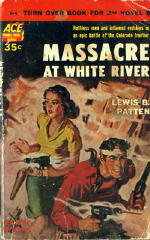
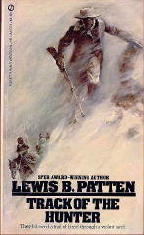
   Lewis B. Patten’s first book, Massacre at White River, came out from Ace in 1952, and his writing career continued right up until he died in 1981, when Track of the Hunter came out, also as a paperback original, this time from Signet.

   He was incredibly prolific. In a thirty-year span he produced something like 90 novels, including books as by Lewis Ford, Len Leighton (with Wayne D. Overholser) and Joseph Wayne (also in collaboration with Overholser).

   As one of the next generation of western writers, Patten’s all of novels came out very much in the post-pulp era but (as far as I know) also still all very much in the “code of the west” tradition. It’s certainly difficult to generalize on the basis of one book, and Prodigal Gunfighter is the only book of his that I’ve read in several years, and probably more than that.

   Not that Patten didn’t write for the pulps. Starting in 1950 he had a score or more shorter works that appeared in magazines like Mammoth Western, Thrilling Western, Frontier Stories and so on. His name is certainly more identified with novels, however, and in his heyday, he was cranking them out like almost nobody else.

   And he was published in hardcover as well. He may have begun in softcover only, but beginning with Guns at Gray Butte in 1963, more and more of books came out from Doubleday. Not all of them, but a high percentage of them, the easy explanation for this being that he probably wrote more books than Doubleday could publish.

   Take 1966 for example. He wrote No God in Saguaro and Death Waited at Rialto Creek for Doubleday; The Odds Against Circle L for Ace; and Prodigal Gunfighter for Berkley. Not that year, but in the same time period, he also wrote for Lancer and Signet, the latter eventually becoming his primary publisher in paperback, both for originals and reprints of the Doubleday novels.

LEWIS B. PATTEN

   If you want a slim and lean western to read, one that you will pick up and not put down until you’re done, then the 128 page Prodigal Gunfighter is the book for you. Taking place in the space of only a day in the small town of Cottonwood Springs, Patten certainly doesn’t leave the reader much time to breathe.

   The early morning finds the entire town down at the railroad station, waiting for the prodigal to return, in the person of the notorious home-grown gunfighter Slade Teplin. Included among them is a rather nervous deputy sheriff Johnny Yoder, who has been semi-courting Teplin’s wife, Molly, a school teacher who thought she could tame him, couldn’t, but who has not yet divorced him.

   Is he the reason for Slade’s return? Slade has had no contact with Molly since he left town. His father still lives in Cottonwood Springs, but there’s hardly any love lost between the two of them. Does he want revenge of some sort against the entire town? It is pure hatred? No one seems to know, and the sense of fear in the town is everywhere.

   And no one can do anything, including the law. In all but his first of many killings over the years, Slade has never drawn first. On page 91 Slade is briefly confronted by the sheriff:

    … Arch said finally, “So that makes it murder doesn’t it? It’s just like a rigged poker game where you know you’re going to win because you’ve stacked the cards.”

    “I always let the other guy draw first.”

    “Sure. Sure you do. You can afford to. Besides, it’s smart. It gives you immunity from prosecution. But you know, every time who it is that’s going to die. Like with Cal Reeder earlier today.”

LEWIS B. PATTEN

   Cal Reeder was a kid, the son of a wealthy local rancher, who thought he’d make a name for himself and failed. His father is part of the story, and so are the four drifters that Johnny notices having come quietly into town.

   Even at the short length the plot does not go exactly where it seems expected to do, and on pages 114-115 is one of the best choreographed fist-fights (not shoot-outs) I’ve read in quite a while, and it’s not even with Slade Teplin. He’s still on the loose, however – don’t worry about that – and with plans to cause even more havoc in Cottonwood Springs.

   To show you want I mean, though, here’s at least how the end of the fight reads:

    Johnny followed him over the desk-top and landed once more on top of him. The man was fighting with a silent desperation now, fighting for his life. Each blow he struck had a sodden, smacking sound both his fists and Johnny’s face were wet with blood. And he was tough. He was wiry and strong and no stranger to this kind of fight.

    But he lacked one thing, one thing that Johnny had – anger, righteous indignation and outraged fury. Johnny had those things in quantity. For every blow the stranger struck, Johnny retaliated with another, harder one.

    The man was weakening. They rolled against the glass-strewn floor to the window and back again. And at last Johnny felt the man go limp.

   After a few seconds taken to recover, Johnny knows he needs to make the man talk. From page 116:

    Johnny said softly, “You’re going to talk, you son-of-a-bitch, or I’m going to kick your head in. You understand what I said?”

LEWIS B. PATTEN

   He’s not bluffing. The west was a tough place to live, but Patten’s characters also seem to be tough enough themselves and equal to the challenge when they need to be. What’s more traditional than that?

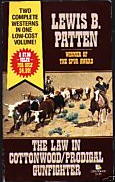
PostScript: Written later in Patten’s career is a book called The Law in Cottonwood (Doubleday, 1978). In paperback form from Signet and Leisure, it eventually appears packaged up in the same edition as Prodigal Gunfighter, two novels for the price of one. I don’t happen to have a copy readily at hand, so while I’m curious and it may not be very likely, I have no idea whether or not the later book has any of the same characters as this one.

— July 2005 (slightly revised)


[UPDATE] 09-06-08. First of all, my apologies for being unable to provide a cover image for the original Berkley edition of this book. I can’t get at my copy, and I can’t locate one anywhere else. There is only one copy for sale on abebooks at the moment, for example. Early Berkley paperbacks are often hard to find, more so than you might think, but their distribution through the 1960s was extremely erratic. (Believe it or not, I was looking for them then.)

   I posted this to fulfill a semi-promise I made in the previous post, in which Patten came up as an example of western noir writer. I didn’t write this review with that thought in mind, but at least from the quotes, I think you can gather that it’s a fairly tough-minded book. More than that I cannot tell you myself.

HERE'S FLASH CASEY

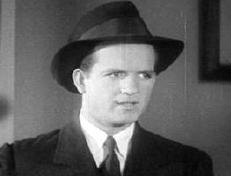
HERE’S FLASH CASEY. Grand National Pictures, 1938. Eric Linden, Boots Mallory, Cully Richards, Holmes Herbert, Joseph Crehan, Howard Lang. Based on the story “Return Engagement,” by George Harmon Coxe (Black Mask, March 1934). Director: Lynn Shores.

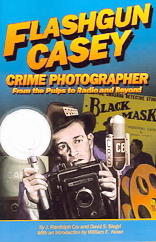
   A copy of Black Mask from 1934 with “Return Engagement” in it is going to be hard to find, if you don’t already own one, but you can also find it in a much more recent book about the leading character: Flashgun Casey, Crime Photographer: From the Pulps to Radio and Beyond, by J. Randolph Cox and David S. Siegel.

   I wish I had my copy at hand, because any resemblance of the Flash Casey in this movie and the Casey I remember reading other stories about is — to put it bluntly — none at all. Someone else is going to have to read it, the original story, that is, and be willing to tell us about it.

   I’ve also been hard-pressed to come up with posters or stills from the film. I have one of Eric Linden, who plays Casey, and some kind of trading card of Boots Mallory, who plays Casey’s girl friend of sorts, Kay Lanning, the society page editor of the newspaper where Casey, fresh out of college, lands his first paying job. (And at $18 a week, it is not much of a job. It is a wonder what Kay sees in him.)

GEORGE HARMON COXE

   What you can do, however, is watch the entire movie online. Go to www.archive.org, click on the right spot, and there it is. Marvelous!

   In a matter of speaking, of course. I’m talking about Internet technology, not the quality of the film. Eric Linden, whose career lasted about ten years through the 1930s, plays Casey as a naive college kid for all it’s worth, which is maybe the dime it would cost you to see it back in 1938. And if I haven’t happened to have mentioned it before, this is a comedy film all the way, so it’s not Linden who’s responsible for his actions.

HERE'S FLASH CASEY

   What might possibly qualify this as a crime film? Almost nothing, as long as you’ve asked, but Casey does take some candid photos at a society affair that an unscrupulous gang of blackmailers alters and tries to make a bundle on. Bungling that, they kidnap Kay, and Flash comes to the rescue by commandeering an ambulance…

   Besides being an actress for a short while, Patricia “Boots” Mallory was also a good-looking dancer and an actress. Her film career ended in 1938, but she had married film producer William Cagney, brother of actor James Cagney, back in 1932, well before then. She later married actor Herbert Marshall, to whom she was still wed when she died in 1958.

   So, as you can see, here’s my review. Two paragraphs about the movie itself, surrounded by a lot of fluff. Go watch the movie itself and see if it deserves more.

A 1001 MIDNIGHTS Review by Bill Pronzini:


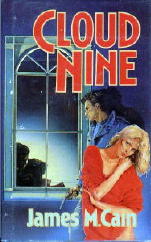
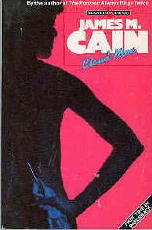
JAMES M. CAIN – Cloud Nine. Mysterious Press, hardcover, 1984; paperback, 1987. Robert Hale, UK, hardcover, 1985. J. M. Dent & Sons, Canada, trade ppbk, 1987 (shown).

   In the 1930s and 1940s, James M. Cain was the most talked-about writer in America. His novels of that period, like the detective novels of Dashiell Hammett, a few years earlier, broke new ground in crime fiction.

JAMES M. CAIN Cloud Nine

   Until the publication of The Postman Always Rings Twice in 1934, sex was a topic handled with kid gloves and almost always peripheral to the central story line; Cain made sex the primary motivating force of his fiction, and presented it to his readers frankly, at times steamily. (Some of the scenes in Postman are downright erotic even by today’s standards.)

   But Cain, of course, was much more than a purveyor of eroticism. His lean, hard-edged prose caused critics to label him a “hard-boiled” writer, but he is much more than that, too. His best works are masterful studies of average people caught up and often destroyed by passion (adultery, incest, hatred, greed, lust). They are also sharp, clear portraits of the times and places in which they were written, especially California in the depression era Thirties.

   Cain’s success began to wane in the Fifties and Sixties, however, partly because of a desire to write novels of a different sort from those that had brought him fame, and partly because of a clear erosion of his talents (a seminal fear of all writers) brought about by advancing age.

   Cloud Nine is one of those “different” novels, written in the late 1960s when Cain was seventy-five. It was rejected by his publisher at that time and shelved. Resurrected for publication in 1984, seven years after Cain’s death, it was puffed by its publisher as “an important addition in contemporary American literature” and by an advance reviewer as “a minor masterpeice and publishing event of some note.”

   It is none of those things. It is, simply and sadly, a flawed novel of mediocre quality – a pale shadow of his early triumphs.

   The novel’s basic premise is solid. A teenage girl, Sonya Lang, comes to Maryland real-estate agent Graham Kirby with the news that his nasty half brother, Burwell, has raped her and that she is pregnant as a result. Through a complicated set of circumstances, Graham agrees to marry Sonya, initially for charitable reasons; but he soon falls in love with her.

   He then discovers that Burwell may be a murderer as well as a rapist, and that another murder may be part of Burwell’s future plans. The conflict between Burwell and Graham forms the central tension here, with Sonya as one catalyst and a million dollars in prime real estate as another.

JAMES M. CAIN Cloud Nine

   All the elements are present for a classic Cain novel, ones that should combine to keep the reader on tenterhooks, “anxious to find out what happens,” as Cain biographer Roy Hoopes says in an Afterword, “but always dreading the ending because of the horror [he senses] would be waiting – ‘the wish that comes true’ that Cain said most of his novels were about.”

   But the elements simply don’t mesh. The bulk of the novel is taken up with the relationship (much of it sexual) between Graham and Sonya, to the exclusion of everything else; Burwell doesn’t even appear on stage until page 108, and other major plot points are introduced sketchily and/or not developed until the final fifty to sixty pages.

   Graham is a rather dull and unappealing narrator, not at all one of “those wonderful, seedy, lousy no-goods that you have always understood,” as one of Cain’s friends described the protagonists of Postman and Double Indemnity.

   And the prose is anything but lean and hard-edged. It reads as if Cain, late in life, discovered and became enamoured of commas and clauses, as witness the novel’s opening sentence: “I first met her, this girl that I married a few days later, and that the papers have crucified under the pretense of glorification, on a Friday morning in June, on the parking lot by the Patuxent Building, that my office is in.”

   Not everything about Cloud Nine is weak; there are some crisp passages of dialogue reminiscent of vintage Cain, the character of Sonya is well developed, and there is power in the climactic scenes (although none of the existential terror and tragedy of the early books). But on balance, and like the other suspense novels Cain wrote late in life – The Magician’s Wife (1965), Rainbow’s End (1975), The Institute (1976) – it is minor and disappointing.

         ———
   Reprinted with permission from 1001 Midnights, edited by Bill Pronzini & Marcia Muller and published by The Battered Silicon Dispatch Box, 2007.   Copyright © 1986, 2007 by the Pronzini-Muller Family Trust

WITCHCRAFT Lon Chaney

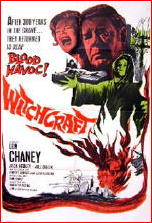
WITCHCRAFT. Lippert Films / 20th Century Fox, 1964. Lon Chaney Jr, Jack Hedley, Jill Dixon, David Weston, Diane Clare, Yvette Rees, Victor Brooks. Director: Don Sharp.

   The year, 1964, is the same as the previous movie reviewed here on the blog, Devils of Darkness, with which it was recently paired in a recent DVD release, and both were filmed in England, but nonetheless there’s an ocean of difference between them.

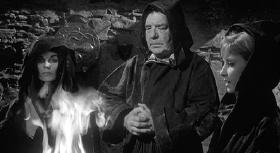
   I don’t mean geographically. Devils was filmed in glorious color; Witchcraft was filmed in even more glorious black-and-white. The story in Devils appeared to have been put together at the spur of the moment; Witchcraft has a single focus — that of a witch being resurrected from the dead — and seeking revenge. The latter in particular makes a good deal of sense to me, if I’d been buried alive as a witch some 300 years or so ago.

WITCHCRAFT Lon Chaney

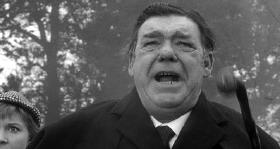
   Beginning with the first scene, we (the viewer) are caught up in the story, as a bulldozer makes its way through an ancient cemetery, uprooting underbrush, dirt and (of course) gravestones, making way for a new development. Then we see the outraged Morgan Whitlock, (played by Lon Chaney, Jr., and the only American actor in the film) shaking his cane in the air and saying that there will be the equivalent of hell to pay.

WITCHCRAFT Lon Chaney

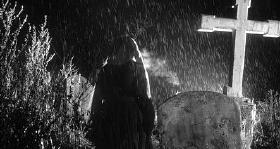
   He’s right. Later the same evening a gravestone is pushed aside and Vanessa Whitlock climbs her way out of the ground. She’s played by a skeletal-looking Yvette Rees, who manages to be authentically shivery scary without being actively icky repulsive, a fact you can perhaps agree on by seeing the photo located to the right.

WITCHCRAFT Lon Chaney

   It turns out that Vanessa’s wrath is not only directed toward the partner in the construction firm that desecrated the graveyard, but toward the family of the other partner, Bill Lanier (Jack Hadley). There has been a feud between the Whitlocks and the Laniers ever since Vanessa’s non-death, mostly fueled by resentment by the Whitlocks for being ousted from their family home.

   There’s also a Romeo and Juliet forbidden romance to keep the plot going — a return from the grave not being quite enough — so even without a whole lot of gore, there’s enough story to entertain us (the viewer) for the full 79 minutes of running time.

WITCHCRAFT Lon Chaney

   I included Victor Brooks in the list of credits, even though he doesn’t have much time on the screen. He plays essentially the same role as he did in the later Devils of Darkness, that of the local police inspector who’s called in when the deaths begin to pile up. This time he’s totally puzzled; by the time he appeared in Devils, he was a whole lot quicker in picking up on the fact that the supernatural was involved.

   Too bad the same can’t be said about the characters in Witchcraft, if fault be found anywhere in this film. As usual, they do the most stupid things, such as leaving themselves (or their wives, grandmothers and girl friends) totally alone and vulnerable while all of these strange events are going on. It’s par for the course, of course, but I mention it because perhaps seeing characters doing stupid things bothers you more than it did me, this time.

   One last thing. The director of Witchcraft was Don Sharp. I didn’t mention him in my review of The Devil-Ship Pirates, but he was also at the helm of that film, and as it happens, it was the very same year, 1964. A few years later (1968) he also directed a few TV episodes of The Avengers, of which in terms of all-around watchability, this movie reminded me of a lot.

A 1001 MIDNIGHTS Review by Max Allan Collins:


JAMES M. CAIN Serenade

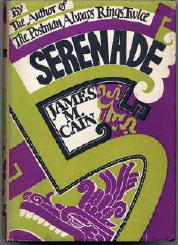
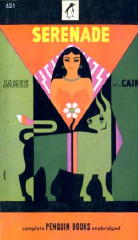
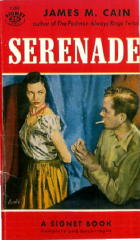
JAMES M. CAIN – Serenade. Alfred A. Knopf, hardcover, 1937. US Paperback editions include: Penguin Books #621, 1947; Signet 1153, 1954; Bantam S-3864, 1968; Vintage, 1978.

Film: 1956, with Mario Lanza and Joan Fontaine.

   Though lesser known than his more famous The Postman Always Rings Twice and Double Indemnity, Serenade is equally a masterpiece. Most of Cain’s best work is of novella length, but Serenade is an exception; a wider canvas is required for this more ambitious work with its subject matter that was daring even for Cain.

   The operatic undertone of Cain’s work comes to the fore here as an opera singer who loses his voice regains it by spending a night of lust and love with a Mexican whore in a deserted church during a thunderstorm.

JAMES M. CAIN Serenade

   When John Howard Sharp returns to New York City and his singing career, the healing prostitute, Juana, is at his side; but they are soon faced with a threat from the past, the man whose homosexual liaison with Sharp had caused the singer?s traumatic loss of voice. In James M. Cain, there can only be one solution to such a situation: murder.

   But murder in Serenade isn’t born of greed and petty self-interest as it is in other Cain novels. The man and woman who share this sexual adventure are admirable and self-sacrificing. Their love is noble, and their tragedy is the deepest, most affecting in all of Cain.

JAMES M. CAIN Serenade

   Cain wrote Serenade and his two other masterpieces in the 1930s; but his later, lesser (if interesting) works have tended to dilute his reputation. He is easily the peer of Hammett and Chandler, however, neither of whom wrote with Cain’s unabashed passion.

   Among his better later works are Past All Dishonor (1946) and The Butterfly (1947); they are, characteristically, in the first person. Mildred Pierce (1941) is the best of Cain?s third-person works. Several other completed novels are among Cain?s papers, and remain unpublished.

         ———
   Reprinted with permission from 1001 Midnights, edited by Bill Pronzini & Marcia Muller and published by The Battered Silicon Dispatch Box, 2007.   Copyright ? 1986, 2007 by the Pronzini-Muller Family Trust.

A 1001 MIDNIGHTS Review by Max Allan Collins:


JAMES M. CAIN – Double Indemnity.

JAMES CAIN Double Indemnity

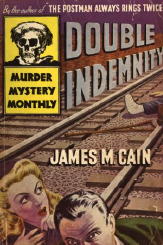
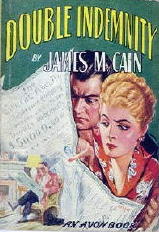
Avon Murder Mystery Monthly #16; paperback original, 1943. First published in Liberty magazine in 1936 as the eight-part serial “Three of a Kind.” First hardcover edition: included in Three of a Kind (Knopf, 1944) with “Career in C Major” and “The Embezzler.” Many other reprint editions, both hardcover and paperback, including Avon #60, 1945 (shown).

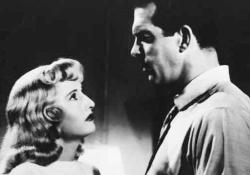
Film: 1944, with Barbara Stanwyck & Fred MacMurray; adapted for the screen by Raymond Chandler and Billy Wilder.

   James M. Cain wrote of “the wish that comes true … I think my stories have some quality of the opening of a forbidden box, and that it is this rather than violence, sex or any of the things usually cited by way of explanation that gives them the drive so often noted.”

   Double Indemnity employs this same technique, already displayed in The Postman Always Rings Twice, with dazzling ease. Cain, making a quick buck writing a magazine serial in 1936, did not realize it at the time, but he was at the top of his form. Employing skillful, scalpel-like first-person narration, Cain tells his tale of love and murder from the point of view of a lover and murderer.

JAMES CAIN Double Indemnity

   Insurance man Walter Huff becomes embroiled in a plot to kill a beautiful woman’s husband. In addition to the sexual and financial incentives, Phyllis Nirdlinger manages to play upon Huff’s boredom and his pride – he knows the insurance game inside and out, and figures with his expertise he can beat it.

   The husband is murdered, according to Huff’s plan, without a hitch. But Huff is dogged by Keyes, a claims agent who also knows the insurance game inside and out. Huff begins to realize Phyllis is untrustworthy and just possibly insane, and falls in love with Lola, the daughter of the murdered man by a previous wife, who had very probably been yet another murder victim of Phyllis’s.

   Double Indemnity is a murder mystery turned inside out: We are forced inside the murderer’s skin, only to find it uncomfortably easy to identify with him, and then share his paranoia as the world crumbles piece by piece around him.

   Huff is a white-collar worker and he’s smart – smart enough to sense early on just how major a mistake he’s made. His sense of his own frailty and wrongdoing makes him a truly tragic protagonist, as does his sense of loss: “I knew I couldn’t have her and never could have her. I couldn’t kiss the girl whose father I killed.”

JAMES CAIN Double Indemnity

   Cain liked to explore the workings of businesses, and he never did it better than in Double Indemnity, through the characters of Huff and Keyes. But he also gave the pair an understated shared understanding of humanity (an aspect broadened in the widely respected Billy Wilder-directed, Raymond Chandler-scripted film version of 1944).

   In their final confrontation, Keyes says to Huff (renamed Neff in the film), “This is an awful thing you’ve done, Neff,” and Huff/Neff only says, “I know it.” And when Keyes says, “I kind of liked you, Neff,” Huff/Neff says, “I know. Same here.”

         ———
   Reprinted with permission from 1001 Midnights, edited by Bill Pronzini & Marcia Muller and published by The Battered Silicon Dispatch Box, 2007.   Copyright © 1986, 2007 by the Pronzini-Muller Family Trust.

A 1001 MIDNIGHTS Review by Max Allan Collins:


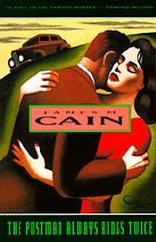
JAMES M. CAIN The Postman Always Rings Twice

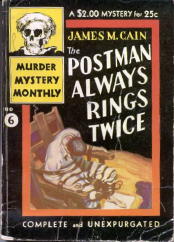
JAMES M. CAIN – The Postman Always Rings Twice.

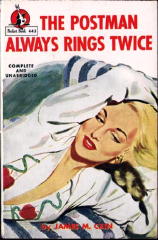
Alfred A. Knopf, hardcover, 1934. Paperback reprints include: Avon Murder Mystery Monthly #6, 1943; Pocket 443, 1947; Bantam, 1967; Vintage, 1978.

Films: 1946, with Lana Turner & John Garfield; 1981, with Jessica Lange & Jack Nicholson.

   This brutal little blue-collar love story was a shocking, sexy, “dirty” best seller and set the standard for tough, lean writing. It taught readers (and writers) that dialogue could propel a story by its own steam (and steaminess) with (as Cain himself put it) “a minimum of he-saids and she-replied-laughinglys.”

   From its famous first sentence (“They threw me off the hay truck at noon”) to its spellbinding final moments on death row, The Postman Always Rings Twice moves like a freight train, catching the reader up in a sleazy, unpleasant – and compelling – illicit love affair.

JAMES M. CAIN The Postman Always Rings Twice

   Drifter Frank Chambers. finds himself in a roadside eatery called Twin Oaks Tavern (the first of many double images). Nick Papadakis, the friendly Greek who runs the place, has a wife who “really wasn’t any raving beauty, but she had a sulky look to her.”

   Soon Chambers is running the tavern’s gas station for the Greek; and by the end of chapter two, Frank and Cora have made a cuckold of him; by chapter four they are attempting Nick’s murder. And these are short chapters.

   Incredibly, the adulterers engage not just our interest but our sympathy, our collusion. Their lust (“I sunk my teeth into her lips so deep I could feel the blood spurt into my mouth”) is contagious, and redeemed by the extravagance of their passion (“I kissed her … it was like being in church”).

JAMES M. CAIN The Postman Always Rings Twice

   Yet Cain pulls no punches: Their intended murder victim, Nick, is not unsympathetic; Frank genuinely likes Nick, and after Frank and Cora succeed on the second try and kill him, cries genuine tears at his funeral.

   Frank and Cora – particularly Frank – are so out of control, so much smaller than the web of circumstance and human frailty in which they are caught up, that a strange sort of supportive interest develops for them. Cain feels for these small lovers who are doomed in so big a way.

   And so do we. When in the aftermath of Nick’s murder and the faked auto accident that follows, Cora and Frank indulge in a manic orgy of sadomasochism and passion at the scene of the crime, we are caught up in the moment with them. As Frank says: “Hell could have opened up for me then, and it wouldn’t have made any difference. I had to have her, if I hung for it.”

JAMES M. CAIN The Postman Always Rings Twice

   Part of the enduring power of Postman is its evocation of the depression. Frank and Cora’s dream is the American one: They want a business of their own, a family of their own-simple goals that had been made so difficult in hard times. Their greed was small; their aspirations petty. Their love, and their crime, in James Cain’s tabloid opera, large.

         ———
   Reprinted with permission from 1001 Midnights, edited by Bill Pronzini & Marcia Muller and published by The Battered Silicon Dispatch Box, 2007.   Copyright © 1986, 2007 by the Pronzini-Muller Family Trust.

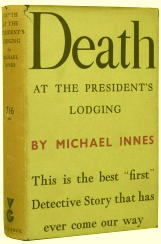
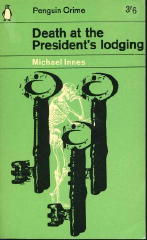
MICHAEL INNES – Seven Suspects. Berkley F1158, paperback reprint, November 1965. US hardcover edition: Dodd Mead, 1937. First published in the UK as Death at the President’s Lodging, Victor Gollancz, hardcover, 1936. [Other US paperback editions include: Dolphin, 1962; Penguin, 1984.]

MICHAEL INNES Seven Suspects

   Without a doubt, in terms of intelligence and general all-around erudition, Michael Innes has to be ranked in the top five mystery writers of all time. (I don’t know how you’d put this to a test, but I can think of only a handful I might start comparing him to, and the funny thing is, they’re all English.)

   In the beginning, though, he seems to have been too intellectual for his own good. Seven Suspects was his first mystery novel, and in spite of the great start and the fine setup, to get through the middle portion of the book involves some very tough slogging, to use the vernacular, at least by contemporary standards.

   The great start? Well, it’s not quite a locked room mystery, but it’s the next best thing. And speaking of which, what this (Berkley) edition of the novel needs, more than anything else, is a map, a map of St. Anthony’s College, where the President is found shot to death in his Lodging, with gardens and walls and locked doors all around, and only a limited number of keys with which to open them.

MICHAEL INNES Seven Suspects

   There could hardly be a greater contrast between the two officers of the law involved, deliberately so. The local copper is the prosaic Inspector Dodd, far more comfortable with tracking down a gang of burglars than a shrewd and wily killer who leaves a puzzling trail of enigmatic clues behind.

   On the other hand, the nimble-witted Inspector John Appleby, sent down quickly by Scotland Yard, is perfect for dealing with the retinue of eccentric academics who never seem to speak before thinking twice (or thrice) about the implications of what they are about to utter.

   Being a native Midwesterner by birth, American style, I have to confess that some of the doings in the aforementioned middle portion of the book, carried out by a small company of carefree undergraduates of the college, were intended to be funny, but not to me. To the average Londoner at the time, they probably were — and maybe even hilarious. (It took me a chapter or two of such antics, but I did finally get into the spirit of things.)

   What is also true, as I came to realize toward the end of the book, is that not a single female appears who has a speaking part, and only one who’s in the book at all has more than a servant’s role. (In all truthfulness, it took Innes’s own observation of this patricluar fact for me to notice. Sometimes I really am slow.)

   And so, this combination of dry academic humor and a decidedly noticeable lack of authorial interest in Appleby the person — that is to say his personal life, his worries and concerns — it all makes this Golden Age gem far out of the mainstream of the mystery world today.

   But gem it is. There are some flaws — it’s a wholly artificial staging, of course — but the comings and goings the night of the murder, who did what when, and who saw what and who didn’t, whose voice that was, and whose it wasn’t, it’s a eye-popper and a mind-blower, and my head is still spinning.

   A gem that needs some polishing, then, but for an academic exercise in the pure pleasure of plotting, very very few of the thousands of mysteries ever published come even close to topping this one.

— August 2002, slightly revised

« Previous PageNext Page »