Reviews


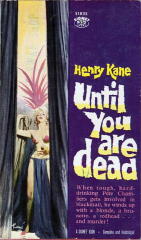
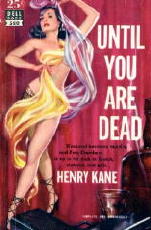
HENRY KANE – Until You Are Dead.

Signet S1835; paperback reprint, August 1960 (Barye Phillips cover). Hardcover edition: Simon & Schuster, 1951. UK editions: T. V. Boardman, hc, 1952; ppbk, 1953. Earlier US paperback edition: Dell 580, 1952, mapback (Victor Kalin cover).

HENRY KANE Until You Are Dead.

   In order of publication, Until You Are Dead was either the sixth or seventh of Henry Kane’s series of detective tales featuring a suave Manhattan private eye named Peter Chambers. (The reason I’m not more definitive on this is that there were two of Chambers’ adventures in 1951. With nothing else to go on, I’m going to suggest that this one is #6, since it was came out from Simon & Schuster, who published the first five, and A Corpse for Christmas appeared from Lippincott, suggesting a change in publisher. The Christmas aspect of the latter also suggests that it was published later in the year, once again making Until You Are Dead the earlier one.)

   Such is life in the fast armchair-detective lane.

   Also of note is that Kane’s first three short stores, one of which, “Kudos for the Kid” (May 1947) may have been the overall first appearance of Peter Chambers, were published in Esquire, which was a prestigious magazine to be in at the time.

   After 1951, though, all of Kane’s novel length fiction in the US, most but not all adventures of Peter Chambers, came out as paperback originals, first from Avon, then Dell and many of the others including Signet, before both Kane and Chambers ended up in a series of X-rated books from Lancer in 1970.

HENRY KANE Until You Are Dead.

   Oops. I see I erred in one thing I just said. There was a series of novels about Inspector MacGregor that appeared in hardcover from Macmillan between 1965 and 1968. These all took place in New York City, but I don’t know if I’ve ever seen any of them. (I no longer remember all of the books I’ve seen.)

   It’s not clear how sharp an operator Chambers is, and how close to the legal edges he usually runs, but he seems to know his way around and to know a lot of people who come close to running the town. Really running the town, that is. But either way, he draws the line at aiding and abetting a jazz musician turned blackmailer — the guy had seen a killing in a night spot men’s room, a guy high in the rackets who tossed Kermit Teshle (that’s his name) a hundred dollar bill and left.

   Teshle wants more. Chambers says no. Enter Ivy Teshle, his sister, a girl who dances for a living while trying to make it to Broadway. (See either of the two covers shown.) She meets him in his office, worried about her brother, on page 15, and on page 17 she is kissing him. Chambers says yes.

   It is that kind of book, and Chambers is that kind of private eye, and Henry Kane is that kind of writer.

   Kermit ends up dead, and Chambers is in it up to his neck.

HENRY KANE Until You Are Dead.

   As a writing stylist, Henry Kane is pretty good. Not in Raymond Chandler’s league, but he can rattle off the dialogue when he wants to, which is often, and he can go into philosophical matters with equal ease. Once in a while these discussions become what in the vernacular might be called full-fledged rants, or here in New England, “wig-outs.” Example, pages 85 and 86:

   I went to the cabinet and broke out a new bottle of Scotch (here he goes again). I peeled the cellophane off the top and clipped off the cork. I poured into a shot glass and swallowed it. I poured again and put the bottle away. I held up the glass and looked at amber glistening in the sunlight and mused. People say I drink too much. The hell with them. People say that nobody can drink that much. The hell with them, I know people who drink more. People say I’ll have no liver left when I’m old. The hell with then, who wants a liver when you’re old? Literary critics rant. The … (excuse me). Let them rant (between drinks). I like to drink. So far, it agrees with me. When it stops agreeing with me, I’ll listen to the literary critics, as I sorrow under the burden of cirrhosis. There are all kinds of people. It makes for an interesting world. There are people who smoke three packs of cigarettes before they really get going for the evening in the night clubs. There are prime ministers who smoke eighteen fat cigars a day. There are people who buy pornographic books which they read every day but Sunday. There people who push against people on subways. There are people who play footsie with strangers at movies. There are people who drink four ice cream sodas at a smack. There are secret eaters of constant pickles. There are people who go for smoked tongue with mustard by the heap. There are people who slush through a pound of cream candies during one chapter of a thick book with significance. There are pistachio nut eaters. There are marijuana smokers. There are opium addicts. There are movie goers (including matinees). There are people devote celibate lives to devising instruments of mass destruction. There are soda-pop drinkers. There are frankfurter nuts. There are sun-bathers, vegetable eaters, vitamin girls, hormone boys, sidewalk psychiatrists, neon hunters, nylon oglers, stamp collectors, headline readers, glass crunchers, five-mile hikers, deep breathers, left-handed pitchers, sweepstake winners, golf players, winter swimmers, and guys that make parachute jumps at the age of a hundred and nine. There are even philosophical detectives.

   Me. I like to drink (among other things). So what?


   Whew. He caught me there, but only twice, thank goodness. (How about you?)

   With a passage like that to recommend this book, I wish the mystery had an ending to match. It’s OK, don’t get me wrong. It just isn’t up to the one I’d been waiting for. (I don’t think it could have.)

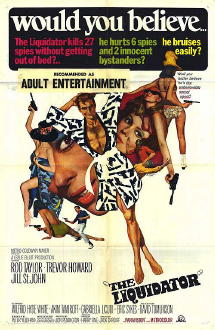
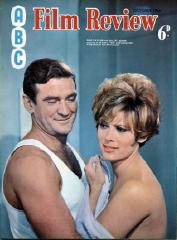
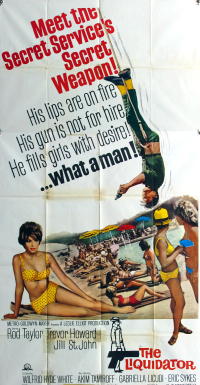
THE LIQUIDATOR. MGM, 1965. Rod Taylor, Jill St. John, Trevor Howard, Wilfred Hyde-White. Song over opening credits: sung by Shirley Bassey. Based on the novel of the same name by John Gardner. Director: Jack Cardiff.

THE LIQUIDATOR

   Anti-hero secret agent Boysie Oakes has come up before on this blog, back when I read and reviewed Understrike, a later book in the series. That’s when I also listed all of the books in the series, so I needn’t do it here.

   But I will repeat myself a bit by describing how I saw Mr. Oakes back then:

    “The gimmick in the Boysie Oakes books […] is that as a spy, he’s supposedly inept, a coward who’s wracked with fear and stomach cramps at the thought of confronting the enemy, and a consummate womanizer. Or in other words, the direct opposite of Bond, save maybe the last category, although Bond usually stuck to one girl per book (didn’t he?).”

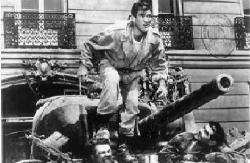
   I also wondered about how Mr. Oakes got into the spy business in the first place, if he’s that inept and that much of a coward. Well, wonder no more, Mr. Lewis. The opening scene of the movie version of The Liquidator, filmed in black-and-white (with the rest of the movie in color), tells us exactly that. In the closing days of World War II, during the liberation of Paris, Boysie Oakes (Rod Taylor) accidentally saved the life of a British agent named Mostyn. See below and to the right:

THE LIQUIDATOR

   Mostyn (Trevor Howard), never one to forget favors like that, but also not knowing how accidental his rescue was, calls on Boysie much later on to fill a new position in his Department, that of assassin, to eliminate those embarrassing people (double agents and the like) who would provide the press with more scandals, either by defecting or being arrested before they could defect.

   Tempted by the promises of a mid-60s Hugh Hefner life of luxury when not working, even before he knows what “working” actually means, Boysie accepts. Bad move. How does he get out of actually doing the work? In the most delightfully engaging way – assuming of course you agree that the victims actually need to be, um, liquidated.

THE LIQUIDATOR

   There is some satire involved here, as well as a slight touch of spoofery, and by this time half the movie is over. Of course there is another hour to fill, and with beautious Jill St. John (as Iris, Mostyn’s right-hand assistant) on hand to accompany Boysie on a strictly unauthorized trip for two to the Riviera, you’d think it would be filled most handsomely.

   Not so. The people who put out the film thought they needed a plot, but the plot they give us is pure pap. Things do not go nearly as well as Boysie had planned. First he’s kidnapped (amusingly before anything serious happens in the bedroom), then released and/or allowed to escape, then sent off on a fool’s mission to do some serious damage back in the UK.

THE LIQUIDATOR

   I’ve not read The Liquidator, the book, but at least one source says the movie people actually followed the book fairly closely. Perhaps they did, but they missed something, that something perhaps being that in spite of the movie being largely a spoof – which it definitely is until the shooting starts …

   That’s it. That’s exactly when things started going wrong. Right then, when the movie people began to make a straight (but still more than a little goofy) action picture out of what until then was a mild and gentle satirical poke at Mr. Bond.

   One other note. In the book I read, as you may recall from the review excerpt above, Boysie was described as being a coward.

   That’s hard to play on the screen, so that part was downplayed, or so it seems to me. Rod Taylor simply plays Boysie as a good-natured chap, a fellow who’s rather inept (as also previously described) and gets sick in airplanes (and you know where that will lead) but this is about as far into that direction the movie goes.

   This was the only film version of the character that was ever made.

REVIEWED BY WALTER ALBERT:         


MARY ANNA EVANS

      MARY ANNA EVANS —

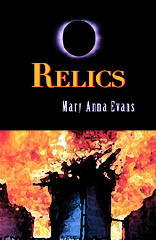
   Relics. Poisoned Pen Press; trade paperback, Feb 2007 trade paperback; hardcover edition, August 2005.

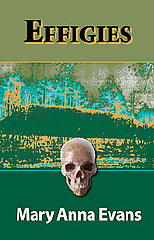
   Effigies. Poisoned Pen Press, hardcover, January 2007.

   These two novels, the second and third in a series, feature Faye Longchamp, an archaeological graduate student. In Relics, she’s directing a project on an ethnically isolated Alabama group, the Sujosa, who have shown an unusual resistance to diseases that include AIDs, while in Effigies, she’s part of a team excavating a site in Neshoba County, Mississippi, where the Choctaw nation is thought to have been born. When mysterious deaths occur in each case, it’s left to Faye to investigate.

MARY ANNA EVANS

   Evans’ style is a bit heavy at times, with the scientific data weighing somewhat heavily on the narrative, but Faye is talented and possessed of a strongly independent mind that, coupled with a natural empathy for the native cultures she is investigating, make her a most sympathetic protagonist. The interaction with other members of the team and with the local population are thorny in both novels, and I found these both emotionally and intellectually satisfying.

[COMMENT] There is one earlier book in the series, as Walter mentions: Artifacts (2003); and one more recent one: Findings (2008).    — Steve

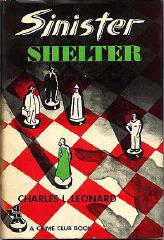
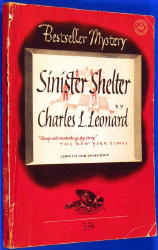
CHARLES L. LEONARD – Sinister Shelter.

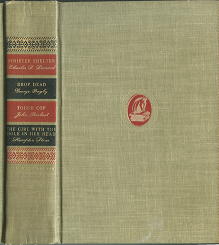
Unicorn Book Club; reprint edition. Originally published by Doubleday Crime Club, 1949. Digest paperback reprint: Bestseller Mystery B141. Pulp magazine reprint: Two Complete Detective Books, May 1950 (probably abridged).

   One way you can read mystery and detective novels from the late 1940s and early 50s, if you can’t come across them in any other way, is to find them in hardcover book club editions, either from the three-in-one Detective Book Club, or the four-in-one volumes that came from the Unicorn Mystery Book Club.

UNICORN MYSTERY BOOK CLUB

   Of the two, the Unicorn Books were classier in appearance, and they look very handsome on the bookshelf. They didn’t last nearly as long as their competitors, however, including of course the Dollar Mystery Guild, which eventually came along. (And still is going strong today, although you can certainly forget the dollar part of their name.)

   In any case, without going further into their history (for now), I just bought about 20 of the Unicorn books on eBay, and over the next few weeks I’m planning on using them for reading material. Whether I skip around or read whole volumes at a time, I haven’t decided, but if it makes any difference, I think I’ll try reading this particular grouping all the way through. Stay tuned.

   In real life Charles L. Leonard, author of eleven private eye Paul Kilgerrin novels, of which this one, was M. V. Heberden, who also wrote two other series of PI novels under that name, one featuring Desmond Shannon (17 books), the other being Rick Vanner, who appeared in three.

   I’m not sure when the secret came out, but I imagine some eyebrows were raised when the initials M. V. were revealed to stand for Mary Violet. It’s been a while since I read any of them, but what little bibliographic information is about her books on the Internet suggests that they were tough, rugged and a little hard-boiled, reminiscent not at all of “shrinking violets.”

   While nominally a private eye, in this particular book Kilgerrin given an assignment by the government to help stop a flood of illegal immigrants from coming into the US after World War II. And from the list of titles he appeared in, he seems have been an undercover spy much more often than he worked out of an office where good-looking women who came in were apt to be his clients.

   Here’s a list of the Kilgerrin books. I think you’ll come to the same conclusion as I did. (All of the books were first published in hardcover by Doubleday Crime Club.)

Deadline for Destruction (1942)
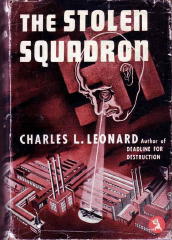
The Stolen Squadron (1942)

CHARLES L. LEONARD Stolen Squadron

The Fanatic of Fez (1943)
Secret of the Spa (1944)
Expert in Murder (1945)
Pursuit in Peru (1946)
Search for a Scientist (1947)
The Fourth Funeral (1948)
Sinister Shelter (1949)
Secrets for Sale (1950)
Treachery in Trieste (1951)

   Not that there aren’t good-looking women involved, at least in Sinister Shelter. While he is working undercover to get a line on the people smugglers, Kilgerrin befriends the members of a refugee family who are trying to make their way into the United States via Argentina.

CHARLES L. LEONARD Sinister Shelter

   Among them is a young widow and her young boy who are living with her husband’s parent, said husband having disappeared after being arrested by the Nazis some time before. Kilgerrin is kind and gentle with the family, especially with Irma, and if he is hard-boiled about some other things, with her he does not seem to be.

   The essence and general ambiance reminded me more of Hammett than it did Chandler, and for a long time, it was difficult to understand why. (I’ll return to this later.) Kilgerrin works with a firm goal in mind, but he has the capability of being able to improvise quickly, such as when the elderly father meets someone the family had known well back in Austria.

   Marie Louise, now Louise Ritter, is the other woman in the story, and while her strong, enigmatic presence shifts the story quickly into second gear, it will occur to more than one reader, I am sure, that while coincidences like this often happen in the real world, fiction is never quite that strange.

   In a way, there is a morality play going on. How does one comport oneself in the face of tyranny, the elderly father wonders on page 121, one man, acting alone, against evil? Kilgerrin himself tries to be understanding with Irma, but often finds himself frustrated when she cannot forget the past, when it stays with her and she cannot free herself from it.

CHARLES L. LEONARD Sinister Shelter

   The puzzle presented by the novel’s other lady of mystery gradually absorbs more and more of his attention. Kilgerrin has more in common with Louise Ritter, and he soon realizes it, making the question of how deeply she is involved with the smuggling gang all the more a matter of importance. (This could have been handled, unfortunately, somewhat more eptly.)

   They are two entirely different women, and to Kilgerrin each is a mystery in different ways. The scene in which he last sees Irma is when (for me) the Hammett-Chandler comparison suddenly snaps into focus.

   There is very little action, surprisingly enough, until the end. Character studies need some patience on the part of their readers, and that’s what, in large part, this story is comprised of. On the other hand, just to be sure that you know there is one, I’m going to quote the last few lines of the book, at which point in time the primary antagonist has been identified and is being discussed.

   I’ve tried to be very careful in setting this up properly. If I’ve done it correctly, this will demonstrate, more than anything else, that there’s more involved here than character studies.

    “… There are still gaps,” Morengo ended unhappily. “It is a pity […] is dead.”

    Kilgerrin shook his head. “When anyone with that much guts goes wrong, he or she has got to be killed,” he said.

— April 2005


[UPDATE] 07-04-08. Since I don’t imagine you can make them out in the small image shown, the other three books in the same Unicorn volume as this one are: Drop Dead, by George Bagby; Tough Cop, by John Roeburt; and The Girl with the Hole in Her Head, by Hampton Stone.

   In spite of the promise I made in the course of this review, I never did get around to reading any of these. On the other hand, the book is still here on the table next to the computer and keyboard where I’m typing away. That must mean something, mustn’t it?

   The other reason, of course, for retrieving this review from the archives, is the preceding post, the “mystery author” turning out to be Mary Heberden, aka M. V. Heberden, aka Charles L. Leonard. More on her shortly, I hope — what little is known about her so far.

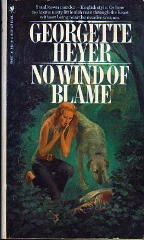
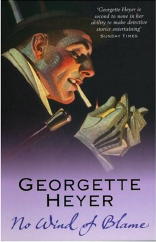
GEORGETTE HEYER – No Wind of Blame. Bantam; paperback reprint, September 1971. UK hardcover first edition: Hodder & Stoughton, 1939. US hardcover: Doubleday Crime Club 1939. Many other paperback reprint editions in both countries, including the bottommost one shown below (Arrow, UK, trade pb, 2006).
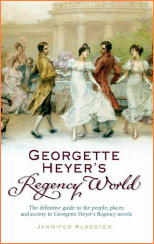
GEORGETTE HEYER

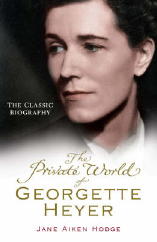
   This is one of those small village murder mysteries which the British are known so well for. Georgette Heyer, born in 1902 and died in 1974, is known today largely for her historical romances, most of them from the Regency era, and mostly still in print.

   Back in the 1930s, though, she also wrote a worthy amount of mystery fiction. (Of the 25 titles listed for her in Al Hubin’s Revised Crime Fiction IV, a rough reckoning is that 12 of them are detective novels; the rest appear to be historical fiction with some crime content.)

   Her primary detectives were Superintendent Hannasyde and Inspector Hemingway; No Wind of Blame is one of the latter’s cases, although Hannasyde, his superior, makes a one or two paragraph cameo appearance, not so noted in CFIV.

   The story begins with a visit to the Carter home of an Georgian (South Russian) prince, a gentleman forced from his homeland, and (quite obviously) in look of a good catch for a wife. That Ermyntrude Carter is already married seems to make no difference to him. Wallis Carter is rather worthless as a husband, quite dependent financially on his wife, who sighs and complains but sadly puts up with his profligate ways.
GEORGETTE HEYER

   And it is Wally who is shot by a rifle while crossing a bridge as he is making his way to a neighbor’s house, where another make-some-money-quick scheme is being hatched. There are clues and suspects galore, none of the latter glaringly obvious, with the alibis of each are equally suspect.

   The novel could be broken down in three parts, with the murder not occurring until page 78. The long opening section is devoted to introducing the players, and here is where Ms. Heyer excels. Each of the participants in the ensuing drama is individually drawn, stereotypes perhaps, in their way, but with mannerisms and behavior strikingly real and brought to life with dialogue and keen-eyed observations.

   Part two consists of the investigation, conducted first by the local inspector, and man named Cook, who soon finds himself in over his head, outmatched by the limited number of suspects in their own inimitable fashion (although not in collusion with one another). Called in soon enough is Inspector Hemingway of Scotland Yard, who manages, with a dash of humor, to a keep a lid on the proceedings, but barely.

   Most notable among the inhabitants of Palings, the Carter home, and those flitting in and out is Mrs. Carter’s teen-aged daughter Vicky, prone to poses and primed with outfits for each one. “Delightfully flaky” is a phrase that might be used to describe her, and she is a handful, but no slow thinker is she, by no means. (More later on this.)
GEORGETTE HEYER

   Part three, if you are still keeping track, is the solution, which is a disappointment. While the opening stanzas are slow to get started, at least in this reader’s opinion, once the investigation begins, the story begins at once to pick up speed and become what is called a rattlingly good read. But in spite of all the clues, pointing every which way, and all of the alibis, which turn out not to be so solid after all, all it takes is the right phone call, upon which the culprit is identified immediately, followed by some fairly rigorous reconstruction of the crime required to prove the case in court.

   How it was done surpasses the question at that point of who it was who did it, and it is not nearly (in this case) as interesting.

   The characters and dialogue are right on, however, and if the occasion arises to read another of Georgette Heyer’s detective stories, by all means, I will.

   In closing, though, here’s a long sample. Vicky, the dead man’s stepdaughter is trying her best to become a suspect, for reasons that become clear soon after. From pages 162-164, then, with one very important clue just happening to be included. (Mary is the dead man’s ward and cousin; Hugh is a gentleman friend of the family, who is becoming more and more attracted to Vicky, in spite of her spritely ways.)  [A tip of the topper to the assist from the Georgette Heyer website, where the folks responsible also thought this was a key passage.]

                EXCERPT —

    “Darling Mary, no one who’d ever seen you with a gun could possibly think you’d fired a shot in your life,” said Vicky, with lovely frankness.

    “It’s a funny thing, but it’s not often you’ll find a lady who won’t behave as though she thought a gun would bite her,” remarked the Inspector. “But I understand you’re not like that, miss?”

    Vicky’s seraphic blue eyes surveyed him for a moment. “Did the Prince tell you that?” she asked softly.

    “It doesn’t matter who told me, miss. Do you shoot?”

    “No! I mean, yes, in a way I do,” said Vicky, becoming flustered all at once. “But I practically never hit anything! Do I, Mary? Mary, you know it was only one of my acts, and I’m not really a good shot at all! If I hit anything, it’s quite by accident. Mary, why are you looking at me like that?”
GEORGETTE HEYER

    Mary, who had been taken by surprise by the sudden loss of poise in Vicky, stammered: “I wasn’t! I mean, I don’t know what you’re talking about!”

    “You think I did it!” Vicky cried, springing to her feet. “You’ve always thought so! Well, you can’t prove it, any of you! You’ll never be able to prove it!”

    “Vicky!” gasped Mary, quite horrified.

    Vicky brushed her aside, and rounded tempestuously upon the Inspector. “The dog isn’t evidence. He often doesn’t bark at people. I don’t wear hair-slides. I’d nothing to gain, nothing! Oh, leave me alone, leave me alone!”

    The Inspector’s bright, quick-glancing eyes, which had been fixed on her with a kind of bird-like interest, moved towards Mary, saw on her face a look of the blankest astonishment, and finally came to rest on Hugh, who seemed to be torn between anger and amusement.

    Vicky, who had cast herself down on the sofa, raised her face from her hands, and demanded: “Why don’t you say something?”

    “I haven’t had time to learn my part, miss,” replied the Inspector promptly.

    “Inspector, it’s a privilege to know you!” said Hugh.

    Vicky said fiercely, between her teeth: “If you ruin my act, I’ll murder you!”

    “Look here, miss, I haven’t come to play at amateur theatricals!” protested the Inspector. “Nor this isn’t the moment to be larking about!”

    Vicky flew up off the sofa. “Answer me, answer me! I was on the scene of the crime, wasn’t I?”

    “So I’ve been told, but if you were to ask me –”

    “My dog didn’t bark. That’s important. That other Inspector saw that, and you do too. Don’t you?”

    “I don’t deny it’s a point. It’s a very interesting point, what’s more, but it doesn’t necessarily mean –”

    “I can shoot. Anyone will tell you that! I’m not afraid of guns.”

    “You don’t seem to me to be afraid of anything,” said Hemingway with some asperity. “In fact, it’s a great pity you’re not, because the way you’re carrying on, trying to convict yourself of murder, is highly confusing, and will very likely land you in trouble!”

    “There is a case against me, isn’t there? You didn’t think so at first, but the Prince told you that I could shoot, and you began to wonder. Didn’t you?”

    “All right, we’ll say I did, and there is a case against you. Anything for a quiet life!”

    Vicky stamped her foot. “Don’t laugh! If I’m not a suspect, you must be mad! Quick, I can hear my mother coming! Am I a suspect or am I not?”

    “Very well, miss, since you will have it! You are a suspect!”

    “Angel!” breathed Vicky, with the most melting look through her lashes, and turned towards the door.

    Ermyntrude same in. Before anyone could speak, Vicky had cast herself upon the maternal bosom. “Oh, mother, mother, don’t let them!”

    The inspector opened his mouth, and shut it again. Mary said indignantly: “Vicky, it’s not fair! Stop it!”

    Ermyntrude clasped her daughter in her arms. Over Vicky’s golden head, she cast a flaming look at Hemingway. “What have you been saying to her?” she demanded, in a voice that would have made a braver man than Hemingway quail. “Tell me this instant!”
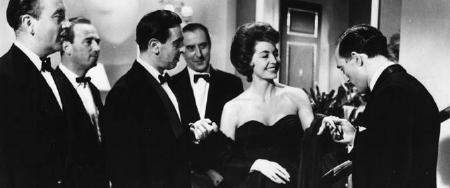
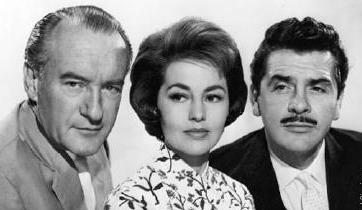
FIVE GOLDEN HOURS. 1961. Ernie Kovacs, Cyd Charisse, George Sanders. Director: Mario Zampi.

FIVE GOLDEN HOURS

   Even though American comedian Ernie Kovacs was a great favorite of mine, he’s not the primary reason for watching this very slight comedy caper of a film made by a largely British crew, and after him, you have no guesses left at all.

   Kovacs, of course, was much better known for his work on television, but who knows what sort of success in the movies he might have had, had it not been for his fatal automobile accident in January, 1962. He made only one additional film, a wacky comedy called Sail a Crooked Ship, which premiered just before his death and remains fondly in my memory as a Very Funny Movie.

   Perhaps I should leave it there — in my memory, that is — as perhaps I should find it not nearly as side-splitting today as when I was a mere lad barely out of my teens. His mugging in Five Golden Hours is exactly how I remember him, and yet — I barely cracked more than a smile. Subtle, I don’t imagine he ever was.

   He’s an assistant funeral director in Italy, you see, and what you might call a professional pallbearer, offering his abundant sympathies to bereaved widows for accommodation and reward: three of them — widows, that is — at the beginning of this movie.

FIVE GOLDEN HOURS

   Enter the Baroness Sandra (Cyd Charisse), having just lost her fifth husband, and about to be evicted from her small castle of her home. Enter Aldo Bondi, whose charm seems surprisingly (to him) ineffective. Until, that is, the Baroness decides that she may have a use for him after all.

   All is not what it seems. Her latest husband had had a scheme, something to do with the five hours difference in time between financial centers on the continent and New York City, but as the scheme did not work out according to plan, the aforementioned creditors are beginning to circle around.

FIVE GOLDEN HOURS

   Aldo gladly offers to help. The lady, that is, not the creditors. Enter the rich widows who have most recently been supporting him. Exit the Baroness.

   And then, at last, the twists in the plot begin, including an abortive (but funny) attempt at murder. Take George Sanders, for example, whom I have not mentioned before now, as there was no need to, as he does not show up until very nearly the next to the last reel, and then in only one room, the one in the mental institution where … just before one widow … and Bondi has to go off to the monastery where … I told you there were twists, didn’t I?

   Too bad that they’re not very interesting ones, and none of them bring Cyd Charisse back on the set for more than another small glimpse or two. What a waste of on-screen talent. They really should have filmed this movie in color, too. Who wants to see the grand Italian countryside in black-and-white?

FIVE GOLDEN HOURS

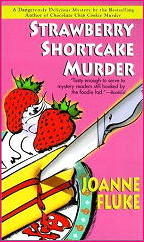
JOANNE FLUKE – Strawberry Shortcake Murder.

Kensington; paperback reprint, February 2002. Hardcover first edition: Kensington, March 2001.

   By sheer happenstance — a fluke of luck, you might say [*] — I discovered that Joanne Fluke has had quite a varied writing career. She seems to have started out writing horror novels, beginning in the early 1980s: books with titles like The Stepchild, Video Kill, and so on. Then as Jo Gibson she began writing young adult novels in much the same vein: Slay Bells, My Bloody Valentine and more.

JOANNE FLUKE

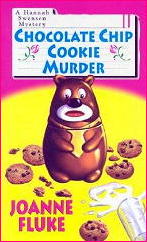
   As “Kathryn Kirkwood” in the late 1990s she began to branch out in an altogether different direction: regency romances. And two years ago she seems to found her forte with the first in her Hannah Swenson mystery series, The Chocolate Chip Cookie Murder.

   This is the second, with the third already out in hardcover, and if these books don’t at least make you hungry — recipes included — nothing will. Hannah runs a cookie shop in snowbound Lake Eden, Minnesota. Fluke makes it sound like a small town, and the way things are going, in a few more books, it will be even smaller. (Trend analysis at work.)

   When the local basketball coach is found murdered after his last-minute substitution as a judge for a TV cooking contest, Hannah and her non-lookalike sister go snooping after the killer, even though Hannah’s boy friend (a cop) and Andrea’s husband (also a cop) do their best to discourage them.

   A cozy sort of mystery novel, as comfortable as scarves and old shawls. Most of the appeal lies in the people, Hannah’s friends, relatives and neighbors, which constitutes 90% of the population of Lake Eden. The detective work is minor — there is an interval of time during which almost every reader will simply be screaming (non-verbally) for the obvious to dawn on Hannah and her sister.

   Even so, it’s a fun read, to coin a phrase, and I think Fluke has something good going for her.

— February 2002

[*]   I confess. Not luck at all. On page 181 of the paperback edition, the Lake Eden Regency Romance Club re-enacts a scene from one of Kathryn Kirkwood’s (unpublished?) regency romance novels. You can’t read this without at least cracking a smile.

[UPDATE] 07-02-08. I’m not very good at predicting track records of authors, but I was right this time. Just over six years later, there are now ten books and one novella in the series, and I don’t think Hannah Swenson will run out of recipes anything soon:

Chocolate Chip Cookie Murder (2000)

JOANNE FLUKE

Strawberry Shortcake Murder (2001)

Blueberry Muffin Murder (2002)

Lemon Meringue Pie Murder (2003)

Fudge Cupcake Murder (2004)

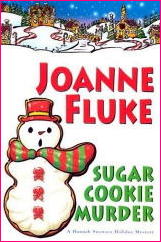
Sugar Cookie Murder (2004)

JOANNE FLUKE

Peach Cobbler Murder (2005)

Cherry Cheesecake Murder (2006)

Key Lime Pie Murder (2007)

Candy Cane Murder (2007) (a novella included in Candy Cane Murder;
   other authors: Laura Levine & Leslie Meier)

Carrot Cake Murder (2008)

A REVIEW BY MARY REED:
   

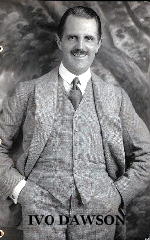
WADSWORTH CAMP – The Abandoned Room.  Doubleday Page & Co., US, hardcover, 1917.  Hardcover reprints: W. R. Caldwell: The International Adventure Library, Three Owls Edition, n.d. (this is the edition shown); A. L. Burt, n.d.   Jarrolds, UK, hardcover, 1919.  Silent film: Jans, 1920, as Love Without Question (scw: Violet Clark; dir: B. A. Rolfe; with Olive Tell as Katherine, James Morrison as Robert Blackburn, Mario Majeroni as Silas Blackburn, and Ivo Dawson as Carlos Paredes, the “Panamanian Sherlock Holmes”).

   How was the murder accomplished in a room with both doors locked on the inside and the windows too high for someone to climb in without warning the occupant? Were what one character firmly believed were psychic forces at work in The Abandoned Room?

   The Abandoned Room begins with an account of the discovery of the body of Silas Blackburn in that very bedroom, long shunned because of its history of family members dying there from various types of injury to the head. And this death was after Silas had been going around terrified out of his wits, but refusing to say why he was afraid or indeed who or what it was he feared.

WADSWORTH CAMP The Abandoned Room

   Silas is the grandfather of cousins Katherine (who lives with him) and Bobby, who has been having what Camp politely calls a “lively life” in New York and is thus about to be cut out of his grandfather’s will, which otherwise would have left him a million or so with which to be even livelier.

   As the story backtracks about 24 hours, Bobby and his good friend, the lawyer Hartley Graham, are talking at their club. Hartley is trying to persuade Bobby to give up his fast ways and go and see his grandfather at The Cedars, a lonely and eerie tumble-down country house.

   Bobby agrees to do so but is prevented from catching the vital 12.15 train by a dinner appointment with Carlos Paredes, who brings along theatrical dancer Maria. Lawyer Graham strongly disapproves of Carlos, that “damned Panamanian”, and after reminding Bobby he has to catch his train leaves in disgust.

   Next morning Bobby wakes up with his shoes off in a decrepit old house near The Cedars with no recollection of how he got there or indeed anything that happened after his dinner with Carlos and Maria the night before. Ashamed to be seen by his grandfather and cousin in crumpled evening dress and somewhat dazed condition he hoofs it for the railway station to return to New York.

   On his way to the station he is met by county detective Howells, who more or less accuses Bobby of doing away with his grandfather in order to prevent the threatened changing of the will. Told to go to The Cedars to await events, Bobby finds his friend Graham already there and not long after Carlos shows up and invites himself to stay. It is a testament to their good breeding they do not tell him to be off although at times the reader will do the job for them.

WADSWORTH CAMP The Abandoned Room

   What follows is a rich stew of events, including strange happenings in the candle-lit dwelling, haunting cries in the surrounding woods and outside the house, suggestions of ghostly presences infesting the decaying mansion, a woman in black glimpsed in the woods, and Bobby’s growing fear he somehow entered the locked room and murdered his grandfather in a drugged haze.

   A tightening net of suspicion seems sure to bring him to trial for the crime. When one of his monogrammed hankies is found under the bed in which his grandfather died and his evening shoes fit a footprint under the window, it looks really bad for him — and he cannot summon any memories of the missing hours to his own defence.

My verdict: I really enjoyed this novel and thought the descriptions of the unhappy house and its run down grounds were excellent. The suggested supernatural element is conveyed beautifully, making this a work that would have made a wonderful Hitchcock film, in particular because of a terrific shock near the end when the explanation begins to be revealed.

   If nothing else this old dark mansion mystery demonstrates that on the whole monogrammed hankies are probably best avoided. And how was the crime accomplished? The method is prosaic enough, but with a little twist from numerous similar explanations.

      Etext: http://www.munseys.com/disktwo/abroomdex.htm

         Mary R

http://home.epix.net/~maywrite/


BIBLIOGRAPHY:  Taken from Part 19 of the online Addenda to the Revised Crime Fiction IV, by Allen J. Hubin:

CAMP, (CHARLES) WADSWORTH. 1879-1936. Born in Philadelphia PA. A journalist, writer and foreign correspondent whose lungs were said to have been damaged by exposure to mustard gas during World War I. Father of writer Madeleine L’Engle, 1918-2007, q.v. Author of six titles included in the Revised Crime Fiction IV. See below. [Films based on these books are omitted from this entry.]

      The Abandoned Room. Doubleday, hc, 1917. Jarrolds, UK, hc, 1919.

      The Communicating Door. Doubleday, hc, 1923. Story collection (ghost tales).

      -The Forbidden Years. Doubleday, hc, 1930.

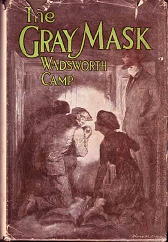
      The Gray Mask. Doubleday, hc, 1920. SC: Jim Garth. Setting: New York. Collection of seven connected novelets, untitled. “Mystery novel of a detective who falls in love with the chief of police’s daughter.”

WADSWORTH CAMP The Gray Mask

      The House of Fear. Doubleday, hc, 1916. Hodder, UK, hc, 1917. Setting: New York; theatre. Also published as: Last Warning (Readers Library, 1929).

      _The Last Warning. Readers Library, UK, hc, 1929. See: The House of Fear (Doubleday, 1916)

      Sinister Island. Dodd Mead, hc, 1915. Setting: Louisiana.

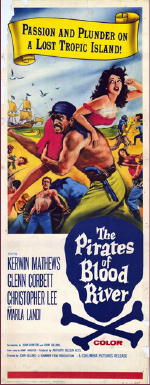
THE PIRATES OF BLOOD RIVER. Hammer Films, 1962. Kerwin Mathews, Christopher Lee, Andrew Keir, Glenn Corbett, Marla Landi, Michael Ripper, Peter Arne, Oliver Reed, Marie Devereux. Screenwriters: John Hunter & John Gilling, based on a story by Jimmy Sangster. Director: John Gilling.

The Pirates of Blood River

   Hammer is known mostly for their horror films, of course, but over the course of the years, they did many other kinds of movies, including noir — I have several on tap to watch, and you’ll see them reviewed here soon enough, I hope — and action-adventure films, such as this one. I even had to create a new category for it, as I’m sure you’ve already have noted.

   There’s no “crime” involved in pirate films, per se, except of course, piracy is a crime, and a rather glamorous one at that, movie style. Another small crime of sorts is that this is a pirate film without any boats in it, except stock footage at the beginning and the end, and hardly any water.

   Blame this on small, tight budgets that the production people at Hammer had to work under, but worked wonders, they did. There are basically only four sets: the exterior of the tropical village on an island where a group of 17th century Huguenots have settled, fleeing religious persecution; the interior of their primary meeting place; a small jungle surrounding the compound, complete with one river leading to the sea; and a gravel pit doing double duty as a site for a penal colony.

   And in spite of financial considerations, the movie is beautifully photographed in color, and populated as if with a cast of thousands, although in reality there may have been perhaps no more than 40 or 50 involved.

   Where this island actually is is not explicitly stated, although you (the viewer) are supposed to believe that it is somewhere in the Caribbean and one that has not been discovered by anyone else. Let me get back to river, though, for a minute. Whenever it’s convenient for plot line purposes, the river is filled with hungry, ferocious piranha fish. Piranha fish and quicksand, that’s what I remember of jungle epics when I was a kid. I thought there was going to be quicksand in one scene in this movie, but apparently I was wrong. Too bad. They missed one there.

The Pirates of Blood River

   On to the story line. If there’s a moral to the story, it’s that groups fleeing religious persecution quickly revert to the tactics of their enemies, and quickly become religious zealots themselves. Jonathon Standing (Kerwin Matthews) is the son of one of the village’s board of selectmen (you might say), but that does him no good when he’s convicted of adultery and sentenced to hard labor at the aforementioned penal colony.

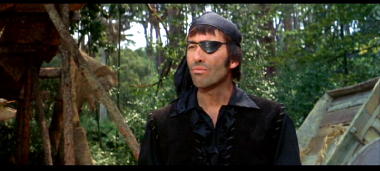
   From which he eventually escapes, only to land in the hands of Captain LaRoche (Christopher Lee) and his men. Here, taken from the audio commentary for the film, is author Jimmy Sangster‘s original description of the man:

    “A strange and fascinating creature, but the fascination is evil. At first glance, he might be called handsome, with his bone structure good. It’s the face of a man without a heart. He has wit and intelligence, and even a sense of humor — but his heart is nothing. The way he moves is so elegant that we may forget he’s a cripple; his hand held close to his body and his hand an upturned claw.”

The Pirates of Blood River

   Sangster, whose voice is one of those we hear, admits that he had Lee in mind for the part from the very beginning. Dressed all in black, with a patch over his left eye, Lee is one of those actors who commands the the viewer’s attention film from the moment we very most see him.

   Another moral of the story. Don’t make deals with pirates. They don’t keep their end of the bargain. Never have, never will. I’ve known that ever since I was eight years old. Too bad that Jonathan Standing doesn’t.

   The plot could have about as easily served for a good old-fashioned western melodrama, and I shall refrain from saying very much more about it. (Did Hammer Films ever make westerns? Probably not, but if you were to say yes, how surprised would I be? Not very much at all.)

The Pirates of Blood River

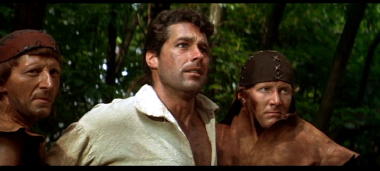
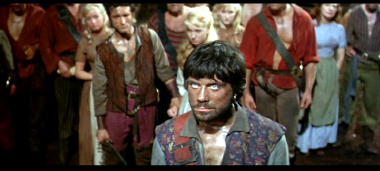
   But I do want to mention one highlight of the film for me — a blindfolded swordfight to the death between two of the pirates, played by Peter Arne and Oliver Reed (the latter, as intense as usual, seen above). Whether choreographed or ad lib, it’s completely over the top, and it was worth the price of admission to me right then and there. (Surprisingly enough, the commentators stop talking to watch, but they say nothing as to how it came to be done.)

   I’d also like to point out a job well done by Michael Ripper, who plays a henchman named Hench (a nice touch). Ripper usually played bartenders, innkeepers, coachmen and grave robbers in Hammer films. This time it was a much larger part, worthy of his talents, and more — he looks as though he’s enjoying himself immensely.

   But is the movie worthy of your time? I enjoyed it, and if you’ve read this far, you very well may too. Vince Keenan tells me that the second movie on this disk, The Devil-Ship Pirates, also with Christopher Lee, is the better of the two. I won’t dispute that, yet. As soon as I feel like watching another pirate movie, I know exactly which one it will be.

REVIEWED BY WALTER ALBERT:         


R. CHETWYND-HAYES – The Psychic Detective. London: Robert Hale, hardcover, 1993.

   The psychic detective is Frederica (“Fred”) Masters, a young woman both phenomenally endowed with looks and psychic powers, who hooks up with an occult specialist, who convinces her that he can help her “achieve her potential.” He does, with results that almost destroy both of them, as they venture into twilight zone realms where no sane person goes.

   The jacket sports the information that the book is to be a Hammer Film, a promise that was never fulfilled, to my knowledge. It’s just as well, since this is a far-fetched, pseudo-humorous caper that strains the imagination and collapses under its own weight. This won’t go on my short shelf of novels featuring psychic sleuths.

R. CHETWYTH-HAYES

[COMMENT] 06-29-08.    R. Chetwynd-Hayes, who was born in 1919 and died in 2001, was a British author and anthologist known best for his ghost stories and tales of “sedate” horror.

   Although the two are not identified as series characters in Al Hubin’s Revised Crime Fiction IV, I’ve discovered that Francis St. Clare and his assistant Frederica Masters appeared in eight short stories besides this novel. I’ve not yet been able to identify them all; any assistance would be welcome.    —Steve

[UPDATE] 07-13-08.   Thanks to Jerry House and the comment he left as a first step in putting a list together of the Francis St. Clare–Frederica Masters short stories.

   Doing a little more searching on the Internet, I’ve come up with the following list. John Llewellyn Probert is the person who did the research. All credit goes to him.

“Someone is Dead” in The Elemental
“The Fundamental Elemental” in Looking for Something to Suck: The Vampire Stories of RCH.
“The Wailing Waif of Battersea” in The Night Ghouls
“The Headless Footman of Hadleigh” in Tales of Fear & Fantasy
“The Gibbering Ghoul of Gomershal” in The Fantastic World of Kamtellar
“The Astral Invasion” in Tales from the Dark Lands
“The Phantom Axeman of Carleton Grange” in Tales from the Haunted House
“The Cringing Couple of Clavering” in Tales from the Hidden World

« Previous PageNext Page »