Reviews


REVIEWED BY WALTER ALBERT:         


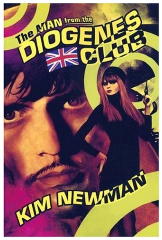
KIM NEWMAN – The Man from the Diogenes Club.

MonkeyBrain Books. Trade paperback original, June 2006.

KIM NEWMAN Diogenes

   Richard Jeperson, a member of the little-known Diogenes Club and investigator of peculiar crimes, often in collaboration with the exotically beautiful Vanessa and commonsensical former policeman Fred Regent, was created by Newman in his pre-professional days, then revived in the 1990s in a series of stories (often of novella length) that have now been collected by an enterprising American small press publisher.

   I would like to have been able to greet this bizarre collection with some warmth, but I must report that it took me several months to make my way through Newman’s elaborate prose that, at times, brought me to the point of tossing the book in a box of discards, unfinished and unloved. Or at least by me.

   I’ve a high tolerance for the outré, to which several shelves of occult fiction mutely testify, but Kim’s ornate descriptions tended to make my progress slower than that of the proverbial snail and undercut much of the pleasure I might have taken in the fanciful tales of mummies, zombies, and a wayward golem, all of them preserved in intractable amber-like prose.

   >>>

[EDITORIAL COMMENT.]   The book Walter reviews is now out of print, and commands a premium price on the secondary market. (I always wanted to say that.)

  Contents:

      End of the Pier Show
      You Don’t Have to Be Mad
      Tomorrow Town
      Egyptian Avenue
      Soho Golem
      The Serial Murders
      The Man Who Got Off the Ghost Train
      Swellhead

THE MAN I LOVE. Warner Brothers, 1947. Ida Lupino, Robert Alda, Andrea King, Martha Vickers, Bruce Bennett, Alan Hale, Dolores Moran. Based on the novel Night Shift, by Maritta Woolf. Screenplay by Jo Pagano, Catherine Turney & W. R. Burnett (the latter uncredited). Director: Raoul Walsh.

   Believe it or not, the book this movie is based on is still in print (Scribner, trade paperback, 2006). From the Amazon description:
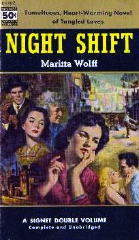
MARITTA WOOLF Night Shift

    “Originally published in 1942, Maritta Wolff ‘s Night Shift was an instant commercial success, receiving rave reviews and praise for her effortless grasp of human nature and stunning ear for dialogue. Now, it joins Wolff’s first novel, Whistle Stop, and her last, Sudden Rain, in a reissue that brings new readers to this riveting writer.

    “Sally Otis works herself to the bone as a waitress, supporting her three children and a jobless younger sister. With her bills mounting and no rest in sight, Sally’s resolve is beginning to crumble when her swaggering older sister, Petey Braun, appears on the scene. Petey, with her furs and jewels and exotic trips, is an American career woman — one who makes a career of men. But when Petey gets a gig at the glamorous, rowdy local nightclub, it will forever alter the world of the struggling Otis family.

    “A swift-paced tale full of tension, excitement, violence, and even bloodshed, Night Shift possesses the vividness of a documentary and the page-turning quality of the best commercial fiction — even decades after its first publication.”

   Night Shift is not included in Al Hubin’s Revised Crime Fiction IV, but Whistle Stop is, although only marginally:

WOLFF, MARITTA M(artin). 1918-2002.
      -Whistle Stop (Random, 1941, hc) [Michigan] Film: United Artists, 1946 (scw: Philip Yordan; dir: Leonide Moguy).

   Whistle Stop the movie starred Ava Gardner and George Raft – now there’s a combination, for you – and IMDB describes the plot thusly:

    “When beautiful Mary returns home to her ‘whistle stop’ home town, long-standing feelings of animosity between two of her old boyfriends leads to robbery and murder.”

   This latter film is available on DVD, most easily by means of one the various box sets of Noir Films that everybody seems to be packaging together these days.
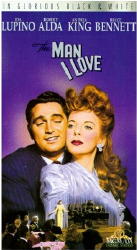
THE MAN I LOVE

   Both Jo Pagano and Catherine Turney have one book each in CFIV. For the former, it’s The Condemned, filmed in 1951 as Try and Get Me; for the latter, it’s The Other One, filmed in 1957 as Back from the Dead. Everybody reading this knows W. R. Burnett, or should, and of course in our circle director Raoul Walsh is even more well known, the circle being, of course, the extended realm of crime, mystery and adventure fiction.

   Which is a long, long introduction to convince myself, first of all, then maybe you, that The Man I Love actually belongs and should come up for discussion in a mystery-oriented blog.

   I’ll keep writing, and later on, I’ll ask what you think.

   The basic synopsis of the story as being the same as the book, as stated above. Ida Lupino is Petey Brown (not Braun; that was changed, for obvious reasons), the nightclub singer from New York who comes to visit her family in California and decides that their problems might as well be hers for a while. Robert Alda plays Nicky Toresca, the slick-talking nightclub owner she goes to work for, a man who’s hot for every woman he knows and meets, including Petey’s married sister, until the former puts an end to that.

   Not mentioned in the Amazon description is former jazz pianist San Thomas, played in solid if not stolid brooding fashion by Bruce Bennett (formerly Herman Brix, but who turned out to be an actor after all). Petey has been dallying around with her boss on a strictly hands-off basis – perhaps the only woman who’s been able to handle him that way – but when she meets San, it is lust at first sight, movie code or no.
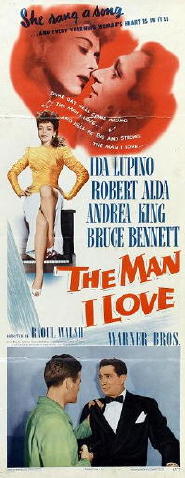
THE MAN I LOVE

   Turns out, though, that San has baggage of his own. He’s divorced but still loves his wife who dumped him, and he’s currently but only temporarily AWOL from the Merchant Marine. There’s more. The woman living across the hall from Petey’s sister is bored with her marriage and her small twin babies, and she’s cheating on her husband, who’s a naively nice guy that Petey’s younger sister has eyes for.

   I think you have the picture by now. There is way too much plot to be covered adequately in one ninety minute movie, but what this is is obviously drama of the soap opera variety, gussied up a bit for the night time audience. Is it also a crime movie, as IMDB says it is? Not a bit of it.

   But is it Noir, as IMDB also suggests? Yes, absolutely, not completely, but yes. It’s the lighting. It’s the location. (Outside of the drab apartment where the Otis family lives, nightclubs and after-hours jazz spots predominate, with the opening scene worth 100% of the price of admission. Even though Ida Lupino is only lip-synching the words, the music is terrific).

   It’s also the sense of quiet desperation that exists in these people’s existences. It’s the ray of hope that exists and blooms in one area of their lives, only to diminish in another.

   So noir, yes. A crime film, no. I wish I could find a longer clip, but this one will have to do. It’s about the only scene of almost actual violence in the movie, and in it Petey stops the husband next door from committing a real act of violence on Nicky, the nightclub owner. If you haven’t seen it, you’ve never seen anything like it, and even if you have, you still haven’t seen anything like it.

   Are you back? To get back to the question I told you I was going to ask later, what do you think?
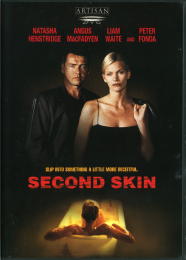
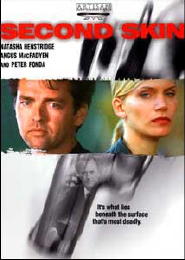
SECOND SKIN. 2000. Natasha Henstridge, Angus Macfadyen, Liam Waite, Peter Fonda. Directed by Darrell James Roodt.

   Opening scene: the front of a shabby-looking bookstore, in what is apparently a small Californian beach town. A stunning blonde approaches, enters. From inside, as the owner looks up, her thin white dress is nearly translucent in the sunlight.

SECOND SKIN

   She’s looking for a job, but he – a dissheveled-looking fellow not dissimilar to all of the semi-seedy bookstore owners of every shop you’ve ever been in, right? – he doesn’t know that yet. She browses the shelves. “You’ve got some original editions, here,” she says. “Hammett, Thompson, Cain. That’s a nice collection.

    “Some of the new ones are good, too,” she goes on, having waited in vain for a response more expressive than a shrug. “Ellroy, Block, Kent Harrington.” The bookstore guy doesn’t recognize the last one. “Who’s that?”

    “Dia de Los Muertos,” she murmurs. “The Day of the Dead.”

   What an opening! You won’t be able to see the whole scene without finding a copy of the movie on DVD – not difficult to do – but you can see part of it in the trailer for the film. Go here, but please come back.

   Why there is a trailer made for a movie that was never released to the theaters, I’m not sure, but maybe for cable TV? It’s a pretty good representation of the film, too, although most of the violence that’s in the film is shown in this short teaser – but not all.

   It seems that Crystal Ball – that’s her name, played to icy perfection by former model Natasha Henstridge – is new in town, has no friends, and business is so bad for Sam Kane – that’s his name, played to rumpled perfection by Irish actor Angus Macfadyen – that doesn’t need anybody to work for him. Intrigued, however, he takes her address and phone number …

   … and as she is standing outside his shop as she is leaving, she’s hit by a car, by a hit-and-run driver who doesn’t stop. When she wakes up in the hospital, Sam standing by, she does not remember him, does not remember anything. Amnesia.

SECOND SKIN

   It seems she has some secrets. Visiting her place on the beach, Sam finds a gun under her pillow. Someone is also following her trail, a nasty piece of work named Tommy G (Liam Waite) complete with tattoos and nifty knack with both guns and knives. Meanwhile, Sam has his own problems and his own secrets. Plagued by a blackmailer, he …

   Hold on, hold on. Too much story. If you’ve read this review this far, you’ll want to watch this movie yourself. Beautifully photographed, this neat little neo-noir tale of crime, secrets and surprises sometimes goes over the top, and in general may try just a little too much, but sometimes excesses with the right kind of intentions can be forgiven.

   I did, at least, and I do recommend the movie to you. Most of the people commenting on IMDB didn’t know what to make of the film. Too many cliches, they say, and they may be right, but for me, they’re the right kind of cliches. For me, I might say that the film is a little too violent – and there is one cliche it definitely does not include. Most crime thrillers like this make it seem all too easy to kill someone with only your bare hands and a belt. This one does not.

   Getting back to the people commenting on IMDB. They did not like the ending all that much. Obviously knowing the cliches of neo-noir films like this one sadly does not mean that they know what neo-noir films are all about – what on earth does noir mean? – and the ending of this one is a beauty.

SECOND SKIN

   Some of them also claim that the ending came from nowhere. Obviously they were not watching all the way through, as I certainly knew that something was happening that was not immediately explained – and I readily confess that I did not know exactly what – and the ending, a near perfect one, came as no surprise to me. (Well, just a little.)

   I do not know why films like this are not shown in theaters anymore – well, actually I do. Nobody would come to see them. There must be money to be made, though, in making them and releasing them only on DVD and cable TV, and relying on the fact that word of mouth will catch up to them and a profitable time will be had by all. I hope so.

   Using a line that I’ve closed many a movie review with before, if this sounds like your kind of movie, it is.

   I posted a review of Robert Crane’s The Sergeant and the Queen here on the Mystery*File blog not too long ago, and I kind of had the idea that it may have been the longest review ever written for either Crane or his real life persona, a writer by the name of Con Sellers. Authors of paperback originals didn’t get much coverage back in the 1960s, 70s and 80s, long before the Internet and blogs came along, that’s for sure.

   But if my review was the longest at the time, it certainly isn’t now. The people at the Conelrad website have just uploaded a review of a sleazy piece of cold war fiction called Red Rape, by Con Sellers, that has to be twice as long as the one I did of Crane’s book.

   Excerpted from the second paragraph of the review is the following:  

     “The testosterone-bursting speculative adventure begins – literally – with a Russian gang rape and submachine gun fire from the capitalist hero and rescuer of women, Danny Fare. Sellers’ immediately exposes the reader to the grim near-future realities of an America under the occupation of the ‘Reds’ or, as they are frequently referred to, ‘Ivans.'”

   You’ll have to read the rest of the review on the Conelrad frequency (follow the second link above) along with a huge image of the cover. Some additional details are given about Sellers’ life, along with a bibliography of some of the work he did that weren’t chronicled here.

   And, for those of you who may be wondering, here is part of the Conelrad mission statement:

Conelrad

   What is CONELRAD? CONELRAD is a site devoted to ATOMIC CULTURE past and present but without all the distracting and pedantic polemics.

   The end-all five-o-clock shadow CONELRAD is the creation of writers who grew up in the shadow of the BOMB and all its attendant pop culture fallout. We wish to share our collected interest, experience and obsession with this strange era and thereby provide as much information as possible to the public.

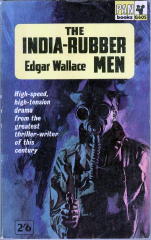
EDGAR WALLACE – The India-Rubber Men.

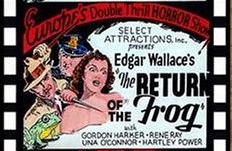
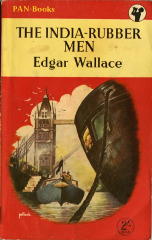
Hodder & Stoughton, UK. hc, 1929. Doubleday-Doran Crime Club, US, hc, 1930. UK reprint paperbacks include: Pan 204, UK, 1952; Pan G605, 1964; 3rd Pan printing, 1967. Film: Imperator, 1938, as The Return of the Frog.

EDGAR WALLACE

   Of the film, the New York Times had this to say: “Following a string of mysterious robberies, Scotland Yard assigns its best detective, Inspector Elk, to bring the crooks to justice. The only clue the villains leave at the crime scene is a rendering of a frog. Still that is enough for intrepid Elk to solve the case, but not after considerable danger, excitement and comedy. This is the sequel to 1937’s The Frog.”

   The latter, according to the Revised Crime Fiction IV, is a film based on:

   The Fellowship of the Frog Ward, UK, hc,1925; Small Maynard, US, hc, 1923. Silent film: Pathe, 1928, as Mark of the Frog. Sound film: Wilcox, 1937, as The Frog.

   But I digress. If the Times is correct in its description of the plot line of the film, it differed in several ways from the book, which I just finished reading. Inspector Elk is in the book, but he’s a relatively minor character, a colleague only of the major player, Inspector John Wade of the London Police, with his general jurisdiction being that of the waterfront area along the Thames.

EDGAR WALLACE

   See the first Pan cover image for an illustration of that.

   There are also no frogs in The India-Rubber Men, the book, only a powerful gang of burglars, bank-robbers, and thieves plaguing the river district, their distinctive m.o. being their garb: rubber masks, rubber gloves and crêpe rubber shoes.

   See the second Pan cover image (below) for an illustration of them.

   Nor is there much in the way of comedy, but movie-makers (as you know) have never hesitated for a moment to add funny stuff to their films.

   I enjoyed the first half of the book, which in the first Pan edition consists of nearly 200 pages of small print. The writing is picturesque, with the reader traveling with Wade as he makes his way up and down the river looking for clues, and stopping in every so often at the “Mecca,” a disreputable officers’ club and lodging house whose only attraction is the beautiful Lila Smith, a ward of some sort of the proprietress, Mum Oaks.

   The mysterious goings-on in and near the “Mecca” also suggest that a significant amount of criminal activity is going on there as well, as – without revealing anything to you of any great importance – it is.

EDGAR WALLACE

   But with no great progress ever being made in coming upon the trail of the India-Rubber Men, eventually the investigation becomes tedious, if not outright stagnant. The telling of the tale is episodic, with major small crises (my words are deliberately chosen here) followed by lulls in which the coppers regroup and head their investigation off in yet another direction, while the bad guys seem directionless – but still very dangerous and deadly – in return.

   It is as if the tale were originally told in serial installments, and perhaps it was, although I have no evidence in this regard, but the lack of any forward progress in the case, except in very small increments – three steps ahead to two back – is what contributes so greatly to the lack of thrills in the overall affair, at least from one reader’s point of view.

   Let me be more specific. In spite of Inspector Wade’s being gassed in his own home, nearly drowned in a secret cellar under the “Mecca,” and being shot at from ambush, there is never any great sense of urgency on his part – even, mind you, when Lila is kidnapped from under his very eyes, figuratively speaking. He doesn’t blink an eye. A milder reaction could hardly be imagined.

   Nor none on her part either. Nor, in fact, on the part of the titular gang of crooks and thieves, who are — when it comes down to it — little more than a squabbling bunch of incompetents, hardly worthy, as it turns out, of being called a gang.

   But here’s what it is that’s missing. It’s any sign of intellectual curiosity on the part of the characters. Except for mere sparkles here and there, they’re as dull as ditch water, even the villains. Nor is there any great ingenuity or cleverness in the twists and turns of the plot. This is a deadly combination. There’s nothing much left in the telling of The India-Rubber Men to grab or hook the reader’s interest, at least not this one’s.

   I no longer assign stars or letter grades to books anymore, but if I were to tell you that I skimmed the last third of the book, that may tell you all you need to know.

   But for the record, Edgar Wallace published on the order of 24 novels or story collections in the same year, 1929. While perhaps known today to only a small coterie of fans, his reading public at the time was enormous. On that basis, I’m willing to call his writing an acquired taste, one that I’ve haven’t acquired myself — or perhaps it’s one that I’ve lost and haven’t yet re-acquired. On the basis of the first half of this book, while not making promises I cannot keep, it’s possible — just maybe — there’s a chance that I’ll try again.

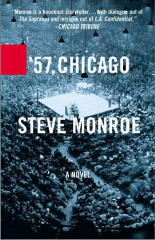
STEVE MONROE – ’57, Chicago

Miramax/Hyperion; hardcover; First Edition, 2001; trade paperback, August 2002.

STEVE MONROE 57 Chicago

   Boxing and organized crime, unfortunately, go hand in hand. And when you think of organized crime in this country, mid-20th century, you probably think of Chicago. (Unless you’re a born-and-bred New Jerseyite, of course, and then all bets are off.)

   There is very little detective work in this solidly constructed pulp novel — when there’s a murder done, and there’s big money involved, it’s the mob that did it, whether on the direct orders of Sam Giancana or not. Otherwise, the crimes are generally minor: illegal gambling, extortion, dope-peddling, prostitution and the like.

   Ex-convict Robert (The Lip) Lipranski is trying to work his way into big league fight promotion; he has a black heavyweight who could go all the way, but Junior (Hammer) Hamilton has a recent history of mental problems.

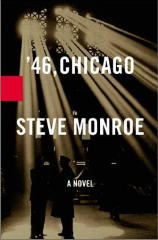
STEVE MONROE 46 Chicago

   And Al Kelly has been a successful bookie for nearly 30 years; why all of a sudden are things going wrong — unable to lay off bets, unable to access his safety deposit box?

   Their paths, not unexpectedly, converge and collide. The book starts slowly and builds to a crunching finale, led along the way by dialogue that takes both vulgarity and the internal workings of the mob for granted, and punctuated by moments of intense violence.

   Meant for the movies, you say? Absolutely. There is no doubt.

— Jan 2002


   [UPDATE] 06-06-08. In spite of that final upbeat statement, I was wrong. As far as I’ve been able to determine, no movie has ever been made of this book. Some Googling suggests that for a while one was in the works, but for whatever reason, it never happened.

   Steve Monroe has written but one other book, ’46, Chicago (Miramax, 2002), and I’ve never seen it. But posting this review has reminded me that I do want a copy, and I’ll be ordering one as soon as I sign off from here.

REVIEWED BY WALTER ALBERT:         


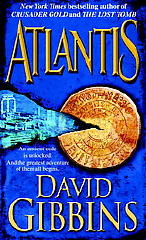
DAVID GIBBINS. Atlantis. Dell, paperback; 1st US printing, September 2006.

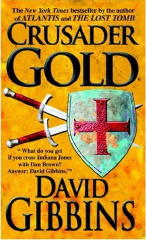
      —, Crusader Gold. Bantam, paperback; 1st US printing, September 2007.

DAVID GIBBINS

   Gibbins is described as a Canadian with a Ph.D. in archaeology from Cambridge, a university lecturer, a “world authority on ancient shipwrecks and sunken cities,” and “currently divid[ing] his time between fieldwork, England and Canada.” He’s also writing adventure novels, but I suppose that goes without saying.

   I have included Gibbins’ professional achievements, only because they are substantially reflected in his fiction as sometimes interminable descriptions of scientific and other data that lend the works some authority (I suppose) but also tend to weigh them down.

DAVID GIBBINS

   Marine archaeologist Jack Howard works with a team of experts to discover the site of Atlantis and the lost golden menorah of Jerusalem. He is of course up against powerful and unprincipled opponents, and there’s a great deal of derring-do in exotic locations, with Howard and his companions ultimately besting the dastardly villains who dog their every move.

   A more hard-science series than the more romantic adventure series by Paul Christopher, reviewed here not long ago.

   I could trace my affection for this stuff all the way back to my adolescent infatuation with Jack Armstrong and the Don Sturdy series, but that sounds too academic for my present non-academic role. It’s enough to say that, for the nonce, I can’t get enough of these adventure series that keep proliferating, and when you see me setting off on one of these treks, I wouldn’t blame you if you headed in another direction with all due haste.

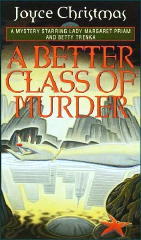
JOYCE CHRISTMAS – A Better Class of Murder.

Fawcett, paperback original; 1st printing, Dec 2000.

JOYCE CHRISTMAS

   Question. Did Hercule Poirot and Miss Marple ever appear in a story together? I don’t think so, but I might be wrong. I know that Perry Mason and the detective duo of Bertha Cool and Donald Lam never appeared in the same book. But think about it. Wouldn’t have either one been quite an event? Crossovers like this used to be rare in the comic book field, now it’s so common they do it all the time, even between DC and Marvel, two different publishers and direct competitors, if you will.

   But for mystery fiction, it’s not an everyday occurrence. (*) So to have the first appearance together of Joyce Christmas’s two main characters, Manhattan socialite Lady Margaret Priam (ten previous books) and retired office manager Betty Trenka (four earlier mysteries), well, when it first came out, her fans must have been grabbing the book right off the shelf.

   For me, though, this is the first of either series I’ve read, and it’s (in a word) disappointing. The two characters could not be from two more different worlds, but that’s not the problem. Poirot and Miss Marple are equally opposite in many ways, but just consider the puzzles they might have solved together — I think Agatha Christie could easily have come up with a couple of absolute knockouts. They would have been doozies.

JOYCE CHRISTMAS

   That’s not the case here. In fact, there’s very little case to be solved, and neither Lady Margaret or Miss Trenka get within 50 miles of the crime itself. Betty Trenka is asked by a neighboring suburbanite, a computer expert by trade, to do another job entirely, one that takes her into New York City, and thus into Lady Margaret’s social set, almost incidentally so. The connection turns out to be a dead woman whose body had been found earlier, back in (further) upstate Connecticut, involved somehow with a missing and essential computer disk.

   As crimes go, this is a rather mild one, and the solution is unravelled more or less perfunctorily, with no further ado or commotion. Lady Margaret has nothing to do but show Betty Trenka around the city, which the latter’s naiveté does make amusing, and perhaps even mildly interesting. All in all, though, what you should expect from this book is a lot more talk than there is action, of which there is none, neither physical nor mental.

— April 2001


COMMENT (*). 06-05-08. It wasn’t true then, and while it may be more true now, crossover appearances between mystery characters still happen only about .01 of 1% percent of the time. Of course in comic books it happens so often that it’s taken for granted, and it’s boring.

         JOYCE CHRISTMAS: A Checklist —

[Expanded upon from her entry in the Revised Crime Fiction IV, by Allen J. Hubin. All of her mysteries were published as paperback originals by Fawcett, or in the case of the earlier ones, Fawcett Gold Medal.]

   Lady Margaret Priam

1. Suddenly in Her Sorbet (1988)
2. Simply to Die for (1989)
3. A Fete Worse Than Death (1990)
4. A Stunning Way to Die (1991)
5. Friend or Faux (1991)
6. It’s Her Funeral (1992)
7. A Perfect Day for Dying (1993)
8. Mourning Gloria (1996)
9. Going Out in Style (1998)
10. Dying Well (2000)

   Betty Trenka

1. This Business Is Murder (1993)
2. Death at Face Value (1995)
3. Downsized to Death (1997)
4. Mood to Murder (1999)

   Lady Margaret Priam & Betty Trenka in tandem

1. A Better Class of Murder (2000)
2. Forged in Blood (2002)

IT’S ABOUT CRIME
by Marvin Lachman

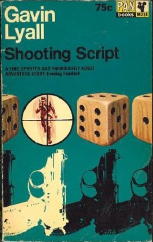
GAVIN LYALL Shooting Script

   I suspect that the spy-adventure thriller will always be with us. That’s fine when books of this type are as good as Gavin Lyall’s Shooting Script (1966). Using a commercial flier as protagonist, Lyall makes a Caribbean setting and a “banana boat” revolution seem new. He provides the kind of crisp, funny first person narration many authors attempt but at which they seldom succeed.

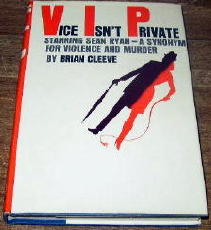
   On the other hand, I found Dark Blood, Dark Terror (1965) and Vice Isn’t Private (1966) in Brian Cleeve’s spy series re Sean Ryan to be over-rated. However, the former does provide some insights into the dilemma of modern-day South Africa. It also gives us one hilarious “Typo” when in one of the many violent scenes we read: “Sean … finished the swing of his body with his right fist hooking hard and very low into his groan.”

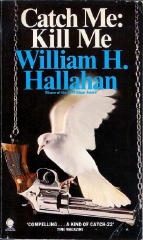
HALLAHAN Catch Me: Kill Me

   I enjoyed William H. Hallahan’s Catch Me: Kill Me (1977), a thriller which won the Edgar as best novel. Still, if this is the best book of any year, we’re in trouble. Though this story of the kidnapping of a defecting Soviet poet “grabs” the reader, it contains gratuitous violence, a lot of padding which reduces the suspense, and a weak, albeit action-filled ending.

   However, Hallahan is one writer who, while using many metaphors, uses them well. Thus, one character says: “Life plays a game – like tennis… And until you die, it just keeps playing to your backhand.”

– To be continued.


    Books reviewed or discussed in this installment:

GAVIN LYALL – Shooting Script. Hodder & Stoughton, UK, hc, 1966. Charles Scribner’s Sons, US, hc, 1966. Paperback reprints: Pan, UK, 1968, plus several later printings; Avon V2309, US, 1969.

BRIAN CLEEVE – Dark Blood, Dark Terror. Series character: Sean Ryan. Hammond, UK, hc, 1966. Random House, US, hc, 1965. Paperback reprints: Mayflower, UK, 1968. Lancer 73-543, US, 1967.

—, Vice Isn’t Private. Series character: Sean Ryan. Hammond, UK, hc, 1966; Corgi, UK, pb, 1969, as The Judas Goat. Random House, US, hc, 1966; Lancer 73-621, US, pb, 1967.

BRIAN CLEEVE

WILLIAM H. HALLAHAN – Catch Me: Kill Me. Bobbs-Merrill, US, hc, 1977. Victor Gollancz, UK, hc, 1978. Paperback reprints: Avon, US, 1978; Sphere, UK, 1980.

Reprinted from the The MYSTERY FANcier, Mar-Apr 1979.

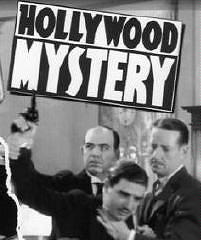
HOLLYWOOD MYSTERY

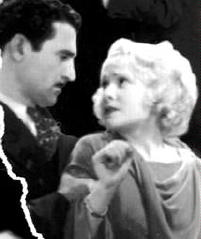
HOLLYWOOD MYSTERY. Fanchon Royal Pictures, 1934. Originally released as Hollywood Hoodlum. June Clyde, Frank Albertson, José Crespo, Tenen Holtz, John Davidson. Directed by B. Reeves “Breezy” Eason.

   It is a mystery – if for the sake of the review, for this and nothing else – why bottom of the barrel movies like this exist and are distributed on DVD, and films that people really want to see are either available only through collector-to-collector conditions or cannot be found at all.

   At least it’s short, just over 50 minutes long, and at least the people making it seemed to be having a good time doing so. As hinted at above, there is very little mystery to this strictly Grade D movie, only the fact that the head of publicity for a small time movie outfit (Frank Albertson) gets the grand idea of persuading a director of a gangster film (John Davidson) to hire a real gangster as its star.

   Only thing is, the gangster (José Crespo) is no gangster, but the guy he socks in a nightclub really is. Much hilarity results, or it was supposed to have, and even so, it might have, if the plot really made any sense.

HOLLYWOOD MYSTERY

   I should of course mention June Clyde, who plays the leading lady in the film within the film. Like Frank Albertson and some of the other players, she had a long career in movies and TV, but as a bright spot on any of their careers, this wasn’t it.

   One additional warning: On the DVD you can easily find of this movie, the picture is so poorly cropped that in one scene with two people at either end of a table, you see the table but neither party to the right or left of the screen. It made me smile as much as anything I saw, and I’m almost embarrassed to say I saw any of it. Or that I’m writing this review of it.

« Previous PageNext Page »