Reviews


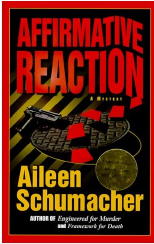
AILEEN SCHUMACHER – Affirmative Reaction.
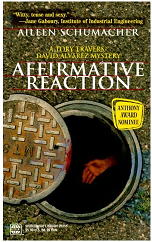
AILEEN SCHUMACHER Affirmative Reaction.

Worldwide, paperback reprint, July 2000. Hardcover edition: Write Way, 1999.

   Over the course of years, many things change, and the ingredients that make up mystery stories are no exception. It’s quite a jump from 1946 to 1999, and there’s an quantum jump of difference between this book and the one just preceding.

   [Note: Referred to in the paragraph above is my review of The Case of the Fan-Dancer’s Horse, by Erle Stanley Gardner, posted here on the M*F blog several weeks back. Fan-Dancer was published in 1946.]

   Let’s get to the story first. Tory Travers is a working engineer. (I’d better add that she’s female.) Trying to uncover the problem the storm drains are having in an abandoned housing development, she discovers a body. The woman worked for the city, as it happens, and she was a notorious opponent of affirmative action. Her past record also includes some political dealings with the project, and immediately popping into everyone’s mind is the fact that the contractor (Hispanic) committed suicide soon after his contract was canceled.

   Detective David Alvarez has run into Tory before. This is not the first body she has found — apparently she has been making a habit of it. This is their third case together. And they are romantically involved, or at least that’s what David Alvarez is hoping. Tory is resisting.

   So. While the sparks between the two fly, they’re also solving the mystery — and the twists and turns their love life takes them is more of a tangle than the trail they follow in uncovering the culprit. There are very few suspects, and the finger soon points to one of them only.
AILEEN SCHUMACHER Affirmative Reaction.

   In the Perry Mason stories, the focus is on whodunit, and nothing else. Where Perry Mason lives, no one knows. Who he’s dating — besides the occasional steak dinner with Della — no one has a clue. If his contrary father comes to visit, as Tory’s does, we never hear of it. Perry with teen-agers underfoot, such as Tory has? Not a chance in the world.

   Things change. And Schumacher’s book is fun to read. More, she sets it up beautifully for the reader to quiver in anticipation while waiting for what’s next in store for these sometimes-yes-sometimes-no lovers — and that’s no small success.

   You’ll notice that I didn’t say much about the detective work, though.

— August 2000


The Tory Travers mysteries. The link leads to Aileen Schumacher’s website, where the information below was obtained:

      Engineered for Murder. Write Way, hc, August 1996; trade ppbk, January 1997.
      Framework for Death. Write Way, hc, 1998; Worldwide, pb, May 2000. 1999 Anthony Award nominee.
      Affirmative Reaction. Write Way, hc, 1999; Worldwide, pb, July 2000.
      Rosewood’s Ashes. Intrigue Press, hc, May 2001; Worldwide, pb, May 2001.
REVIEWS BY WALTER ALBERT:         


VICTORIA LAURIE – What’s A Ghoul To Do? “A Ghost Hunter Mystery.”

Signet, paperback original, April 2007.

VICTORIA LAURIE

   Victoria Laurie is described in the inner back-cover copy as a “real-life psychic,” author of the Psychic Eye series that features Abby Cooper. She’s apparently branching out with a new series in which medium M. J. Holliday and her sidekick Gilley Gillespie help souls stuck on this “side” cross over.

   This is psychic lite as M. J. and Gilley (who functions as her manager, and has a notable aversion to spooky manifestations) attempt to help the grandfather of Dr. Steven Sable cross over, a job that’s more difficult than they expect and involves some real-life characters with larceny on their mind and no objection to murder.

   And, to complicate matters, M. J. has to break one of her prime rules, which is that nobody accompanies her on her ghost-busting for a very attractive doctor, grandson of the dead – and possibly murdered – ghost.

   The psychic lite elements pretty much drain the novel of any suspense, but the characters are appealing, and there’s enough ghostly business to keep a ghost fancier like me reasonably entertained.

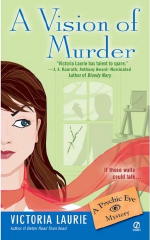
VICTORIA LAURIE – A Vision of Murder “A Psychic Eye Mystery.”

Signet, paperback original, December 2005.

VICTORIA LAURIE

   I was looking for another M. J. Holliday Ghost Hunter mystery, but all I found on the shelf at the Mystery Lovers Bookshop was the third in an earlier series whose protagonist is Abby Cooper. Abby’s a professional psychic who’s taking some time off from her psychic readings to enter into a real-estate venture with her sister (“Cat”) and handyman (“Dave”) that involves fixing-up a very run down house.

   (I liked this hook since my wife and I entered into a similar agreement some years ago with a handyman to a house in our neighborhood that was up for a sheriff’s sale.)

   Unfortunately, the house seems to have two very active spooks, and a mysterious intruder whose intentions are just as threatening as those of the resident haunts, and a good deal more deadly.

   These two books constitute a pleasant addition to my meager supply of contemporary conventional supernatural fiction (somewhat overloaded, I’ve concluded, with vampire novels). I like the author’s carefree but committed approach to the dark side and hope to visit her spectral world again.

      Psychic Eye Mysteries:

1. Abby Cooper, Psychic Eye (Signet, December 2004)
2. Better Read Than Dead (Signet, June 2005)
3. A Vision of Murder (Signet, December 2005)
4. Killer Insight (Signet, September 2006)
5. Crime Seen (Obsidian, September 2007).     [Reviewed earlier by Steve here.]
6. Death Perception (Obsidian, September 2008)

      Ghost Hunter Mysteries:

1. What’s a Ghoul to Do? (Signet, April 2007)
2. Demons Are a Ghoul’s Best Friend (Signet, March 2008)

IT’S ABOUT CRIME
by Marvin Lachman

CARR Doyle

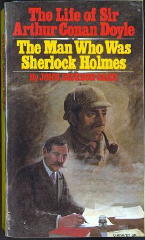
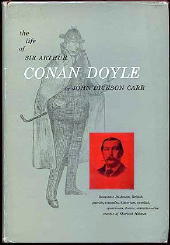
   One of the beneficiaries of the [recent] Sherlock Holmes “boom” was John Dickson Carr’s excellent 1949 biography of Sir Arthur Conan Doyle which was reprinted by Vintage in paperback in 1975. “Renaissance man” is a term too frequently used nowadays and applied to anyone who can both read and write. There are some people to whom it applies. Anthony Boucher was one. Doyle was certainly another with his knowledge and ability in such diverse fields as medicine, literature, politics, sports, medieval history, and military tactics. Furthermore, as Carr clearly shows, Doyle was a “‘doer,” a man who accomplished an incredible amount in his lifetime.

   Carr gives most of his attention to the non-Holmesian Doyle, and there is much to be learned on many non-mystery subjects – e.g., South Africa. Without saying so, Carr clearly shows how today’s apartheid problems had their roots in the Boer rebellion at the turn of the 20th Century. Doyle went to South Africa, in charge of a field hospital, and published a history of the war on his return.

Valley of Fear

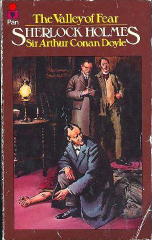
   Though he is generally objective, Carr occasionally intrudes, getting in a few digs at Socialist Britain which he left at about the time he was writing this book. He also, I am glad to say, doesn’t entirely forget that he was one of the best Holmesian scholars around. He especially enjoyed The Valley of Fear which, unlike most critics, he considered Doyle’s best mystery novel.

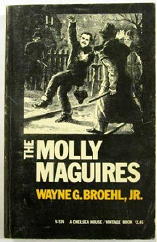
   The Valley of Fear is based on the 19th Century violence in the Pennsylvania coal fields. Doyle became familiar with this through his friendship with William Pinkerton, son of the famous detective. An engrossing non-fiction account of this strife is Wayne G. Broehl’s The Molly Maguires (1964), originally written as a dissertation at Harvard and reprinted in paperback, as part of a series on American violence, by Chelsea House/Vintage.

Molly Maguires

   This is a book which, in addition to being a fine history, offers many bonuses to the reader. For example, there is the origin and correct usage of the much mis-used expression “reading the riot act.” Also, for students of perhaps the smallest sub-genre within the mystery (“exchanged murders” as used by Patricia Highsmith, Nicholas Blake, and Evelyn Berckman), there is a historical example of this. In Ireland, rebels, in various counties, would mutually import strangers to commit murders against landholders, thus permitting alibis and suspects who had no apparent motive.

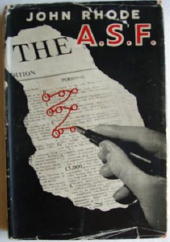
   Though it was the “Golden Age” of detection, thrillers were also popular about the time that Doyle stopped writing of Holmes. Furthermore, lest you believe that the drug problems of the 1960’s and 1970’s are either new or unique, you should consult English thrillers of this time. A.S.F. The Story of a Great Conspiracy (1924) by John Rhode is a good example, a fast-moving book about the drug traffic in England and Europe and how it affects members of the British upper classes.

   This is a book with enough coincidences to choke a horse, or at least a reader. I wouldn’t dream of detailing them because part of the fun in this book is reading them and saying “WHAT!” as they occur. One of Rhode’s characters sums up the situation nicely when he refers to “just one of those malicious strokes of Fate which endows men’s actions with a grim humour.”

RHODE A.S.F.

   However, in case you never get closer to this book than my review, I suppose I should quote Rhode’s last paragraph:

    “What does all that distant past matter?” he said eagerly. “Let us begin again from now, let us forget the clouds that have hung over us, and go out together, you and I, to meet the morning. Let all the long wasted years pass with the night to leave us nothing but the sunshine of happiness.”

   And, yet, with all that is corny, there is a vitality of writing here that is very apparent in this, Rhode’s first book. It would lead to a grand, prolific career with well over one hundred mysteries for this author who gave pleasure to many but whom Julian Symons derided and whom hardly anyone reads today.

   Just as much fun is Gerard Fairlie’s The Muster of the Vultures (1929), a thriller in which Robin Murdoch does battle against “the best brains of the criminal profession … joined together under one genius of organizations.” I frankly loved such other examples of comic book dialogue in this book as:

      1. “I am much too powerful for the police of any country to suppress.”

      2. “We meet again, Robin Murdoch!”

      3. “Curse him, I say, for the foul fiend that he is!”

      4. “Take that, you hound!” he cried. “Take that! and that! and that!”

– To be continued.

   Books reviewed or discussed in this installment:

CARR Doyle

JOHN DICKSON CARR The Life of Sir Arthur Conan Doyle: The Man Who Was Sherlock Holmes. Harper & Row, hardcover, 1949. Vintage Books, paperback, 1975. Carroll & Graf, trade paperback, 1987. Da Capo Press, trade paperback, November 2003

ARTHUR CONAN DOYLEThe Valley of Fear. Smith-Elder, UK, hc, 1915. George H. Doran, 1915. Reprinted many times and the basis for several films.

WAYNE G. BROEHL, JR.The Molly Maguires. Harvard University Press, hardcover, 1964. Vintage/Chelsea House Book, softover, 1968.

JOHN RHODEA.S.F.: The Story of a Great Conspiracy. Geoffrey Bles, UK, hardcover, 1924. US title: The White Menace. McBride, hc, 1926.

GERARD FAIRLIE The Muster of the Vultures. Hodder & Stoughton, UK, hardcover, 1929. Little-Brown & Co, US, hc, 1929.

Reprinted from the The MYSTERY FANcier, Mar-Apr 1979.

REGINALD DAVIS – The Crowing Hen.

Doubleday Crime Club, hardcover, 1936. UK edition: Gordon Bles, hc, 1936.

REGINALD DAvIS The Crowing Hen

   The first thing you notice about Davis’s writing is his nicely wry sense of humor, you know, the kind that sort of sneaks up on you. Consider, for example, the superstitious reaction of the villagers of Hayes Coombe to the crowing of hens – wholesale slaughter in the feathered world! – and what one of a pair of real estate agents fears that this will do for the price of poultry….

   Precipitating this crisis is the impending sale of the mansion Danes Priory, said by some to be haunted, to a young couple about to be married. Warnings like footprints of blood and a dead Buff Orpington – or was it a Speckled Wyandotte? – are ignored, and mysterious death strikes, not once, but twice.

   Complicating matters is a fortune in unfenced stolen diamonds, but what Davis is more concerned with is his mystery-horror show that in no way is as intellectually gripping as a solid detective puzzle would have been. With facts as fragile as these, and a story that seems always to be heading off in the wrong direction, atmosphere just isn’t enough.

   The early promise of a reading treat in store is not kept. This was Davis’s first mystery novel. He wrote only one other.   [D]

– From The MYSTERY FANcier, Vol. 3, No. 2, Mar-Apr 1979.


[UPDATE] 05-20-08.  I knew this day was coming, and to tell you the truth, I’ve been putting it off for quite a while now. I wrote this review nearly 30 years ago, and I have the strongest feeling that if I were to read this book again, I’d have a strong quarrel with myself on the merits of this book.

   To me now, and from what little I remember of this book, it sounds exactly like something I’d love to read, little emphasis on the detective end of things or not. If only I could locate my copy, I’d let you know for sure.

   But since I haven’t – located my copy, that is – I’ve decided to let my younger self have his say, with only this one small hint to suggest that I may have been wrong.

   There’s one thing that I was definitely wrong on, and that’s how many mysteries Reginald Davis wrote. It must be that reference books back in 1979 hadn’t caught up with one of them, since in Crime Fiction IV now, here’s what Al Hubin lists for him:

  DAVIS, REGINALD

      * The Crowing Hen. Bles, UK, hc, 1936. Doubleday Crime Club, US, hc, 1936.
      * Nine Days’ Panic. Bles, UK, hc, 1937. Doubleday Crime Club, US, hc, 1938.

REGINALD DAvIS Nine Days Panic

      * Twelve Midnight Street. Bles, UK, hc, 1938.

   The latter is a scarce book. I found no copies offered for sale on the Internet when I searched just now.

   There’s no biographical information about Davis I can tell you about, neither from CFIV nor the Crime Club jackets, so says Bill Pronzini about the latter. It was he who provided both of the covers you see here in this post.

   Here’s Bill’s opinion on The Crowing Hen, cobbled together from a couple of emails as we were discussing the book. (This is just his end of the conversation, you understand.)

   “I read Hen a few years ago and liked it a lot; all sorts of wild, wonderful, and horrific happenings rather neatly wrapped up, I thought. […]

   “I wasn’t sure I liked The Crowing Hen at first, either. Farfetched to the point of absurdity in places. But the macabre atmospherics kept me reading, and I thought Davis did an admirable job of explaining the various weird happenings.”

   So there you have it. Two opinions, one of which the author is only partially standing behind. If you’ve read the book, why not add yours? I’d love to hear from you.

THE D.A. TV mini-series. ABC, 2004. Cast listed below. James Duff, executive producer; Gil Garcetti, consulting producer.

   This was one of the best shows about the inner workings of the legal system of a large US city (Los Angeles) that viewers, for whatever reason, never saw. The ratings were bad, and any hope that this short term, pre-summer series would come back in the fall was nipped at once in the bud.

   Only four episodes were made, and all four were telecast. Thank goodness for small favors:

         19 March 2004. Episode 1: The People vs. Sergius Kovinsky

         26 March 2004. Episode 2: The People vs. Patricia Henry

         2 April 2004. Episode 3: The People vs. Oliver C. Handley

         9 April 2004. Episode 4: The People vs. Achmed Abbas

                  Cast:

The D. A.

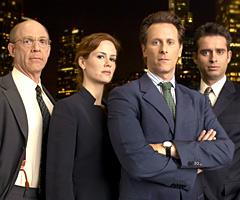
         Steven Weber … Distrist Atty. David Franks

         Bruno Campos … Deputy Dist. Atty. Mark Camacho

         Sarah Paulson … Chief Deputy Dist. Atty. Lisa Patterson

         J. K. Simmons … Deputy Dist. Atty. for Major Crimes Joe Carter

         Peter Outerbridge … Deputy Mayor Jerry Weicker

         Felicity Huffman … Charlotte Ellis, noted defense attorney, formerly of the D.A.’s office

         Michaela Conlin … Jinette McMahon, Mr. Franks’ media and campaign assistant

         Cheryl White … Kathy Franks, the D.A.’s wife

   I’ve not burdened you before now by commenting on the television shows I’ve watched while this blog has been active, but in this case, I thought I’d make an exception. The show came and went very quickly, so I’m willing to wager that most of you did not see it when it was broadcast, including myself. Before last week, I’d never even heard of it.

   I happened to come across someone who had all four episodes on DVD, and I obtained them from him. And the last four nights I’ve spent watching them, one after the other. Time well spent, in my mind.

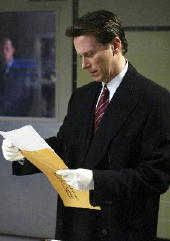
   I’ve found only two images to show you. The first is the one above of the major players in the cast, the second that of David Franks below as he opens a suicide note in episode 3, and immediately recuses himself from the case and refuses to talk about it, to the consternation of his staff. It turns out that the dead woman’s husband had died of leukemia because their HMO had refused to pay for a bone marrow transplant, part of a pattern of similar denials.

The D. A.

   In episode 4, a case of terrorism is reopened when the suspected killer’s body is found under a parking lot — one that had been paved over two days before the killing. The only problem? He can’t be conclusively identified.

   Episode 2: A well-known comedy entertainer is gunned down as he enters his home. His wife pleads spousal abuse. Defending her is Charlotte Ellis (Felicity Huffman), one of two possible contenders for Franks’ job in an upcoming election. The deputy mayor is the other.

   Episode 1 [and I seem to have done this wrong] centers on the shooting of a prosecution witness while in seclusion. Question: Where did the leak come from?

   While the detective work conducted by young Mark Camacho (Bruno Campos) is extremely well conceived — and I do not say that lightly — what makes this series of cases all the more watchable is the peek it provides into the power politics that goes on behind the scenes in the offices of a most highly politically motivated district attorney’s office and his staff, some of whom dislike him very much. Camacho, who’s new on the job, walks right into the midst of it. Who’s loyal to who? That’s what he needs to know, and soon.

   One of the few reviews I found of the show called it dull. A typical TV-beat hack reporter at work here. Because there is little actual gunplay (well, now that I think about it, there was once a fairly graphic scene, but all of the other deaths were well after the fact) nor car chases in any of the four episodes, it is therefore dull? Not on your life. The total combined intellectual level is as high or higher here than in any other full-season series I have ever watched. (Admittedly there are very few that fall into that category, but the statement is still true.)

   Steven Weber as D. A. David Franks is man of contradictions. Derided by his staff as a hack, he also has a bent for justice, the word “bent” used deliberately, as bending the rules sometimes is exactly what is needed to make the wheels of justice go around. Gil Garcetti, mentioned in the credits, was himself the D.A. for Los Angeles County at one time, as some of you may remember. I’ll bet he wishes some of his cases could be finished in 45 minutes at a time, that’s what I bet.

   Note to self: Both Garcetti and James Duff have been involved with another television series, The Closer, shown on TNT. I’ve not been watching it, and perhaps I should have been.

   Perhaps the limitation of only four shows was a Good Thing, as certainly there was not enough time in the few episodes The D. A. was on to have the stories to become predictable in any way, for they were not. I was caught leaning the wrong way more than once.

   Don’t you just love it when that happens? I do.

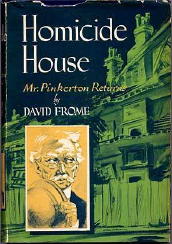
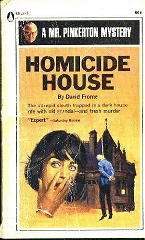
DAVID FROME – Homicide House. Popular Library; paperback reprint. No date stated, but circa 1969. First edition: Rinehart, 1950. British title: Murder on the Square. Robert Hale, 1951. US hardcover reprint: Detective Book Club (3-in-1 edition), July 1950. Previously serialized in The Saturday Evening Post in seven parts between September 24 and November 5, 1949.

   Since the subtitle of the hardcover edition is “Mr. Pinkerton Returns,” I’ll begin by listing all of the Evan Pinkerton books. While David Frome was byline listed on all of the books, you might better know “him” as Leslie Ford, author of the Grace Latham and Colonel John Primrose mysteries. Taken from Crime Fiction IV, by Allen J. Hubin:

The Hammersmith Murders (n.) Doubleday 1930 [England]
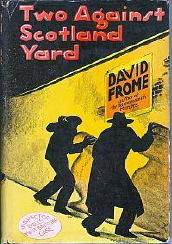
Two Against Scotland Yard (n.) Farrar 1931 [England]

DAVID FROME Homicide House

The Man from Scotland Yard (n.) Farrar 1932 [England]
The Eel Pie Murders (n.) Farrar 1933 [England]
Mr. Pinkerton Finds a Body (n.) Farrar 1934 [Oxford]
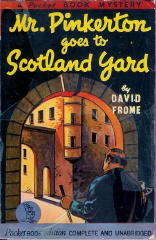
Mr. Pinkerton Goes to Scotland Yard (n.) Farrar 1934 [England]

DAVID FROME Homicide House

Mr. Pinkerton Grows a Beard (n.) Farrar 1935 [England]
Mr. Pinkerton Has the Clue (n.) Farrar 1936 [England]
The Black Envelope (n.) Farrar 1937 [Brighton]
Mr. Pinkerton at the Old Angel (n.) Farrar 1939 [England]
Homicide House (n.) Rinehart 1950 [England]

   As you see, there was a gap well over ten years long between this, the last book in the series and the preceding one. There were 10 or 11 Grace Latham books that appeared in the interim. It wasn’t as though the author, whose real name was Zenith Jones Brown, 1898-1983, wasn’t doing any writing in the meantime. As Leslie Ford, her last book appeared in 1962 (Trial by Ambush) a non-series book.

   My review of Ford’s The Woman in Black appeared here on the M*F blog a while back, in case you’d like to go back and take a look.

DAVID FROME Homicide House

   There are a couple of ways I could continue from here, and by flipping a mental coin, I’ll say something first about Mr. Pinkerton, whose adventures in murder mysteries I’ve now read the first I ever have. I’d assumed he was a stalwart sort of fellow, confidently solving crimes by the dozens as a friend and chief confidant of Chief Inspector Bull of Scotland Yard.

   Wrong, all the way around. Evan Pinkerton is the meekest, most afraid-of-his-own shadow detective sleuth there has to be ever been. Now a widower and owner of an small apartment building in Godolphin Square, he is afraid to tell the landlady that he is indeed the owner, disbelieving as he does that he is himself. Perhaps his penny-pinching wife will come back from the grave and take it away from him, he fears. (This is being hen-pecked to the extreme, one thinks, and rightly so.)

   And so he is stuck in a miserable room on the third floor, sharing a bath with the cook, who fortunately enough, is very seldom seen. The crimes he has solved, they must have been more or less by accident, as Bull has forcefully demanded that he quite positively stay away from any futures brushes with murder cases that need looking into.

   Which leaves the current one at hand to tell you about. What struck me most, from the very first page, is that here is a mystery that is centered about a building that has been damaged by the bombing during the war. It’s now a few years after the war, and about all that is standing in the home across the square from Mr. Pinkerton’s are a few walls and the charred remains of a stone staircase. Nerves are often still shattered and decent food is still a problem.

Anthony Gilbert: Death Blackout

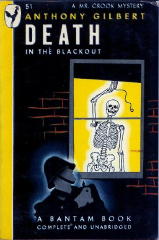
   I may be wrong about this, but I am pointing this out because I do not believe that very many British mysteries written during or just after the war actually dwell on how difficult a time it really was for the general population. This is one of the few exceptions I can actually think of at the moment, the other being Anthony Gilbert’s Death in the Blackout (1942). I’m sure there are more, but if there were many, it would seem that the opening scenes of this book would not have struck me as being so unusual.

   What I also found very striking is that how strong a Woolrich-ian sense of the sudden infatuation, coincidence and/or disorientation there is in the first few chapters. On page 7 Mr. Pinkerton meets Daniel McGrath hunting for the house that was damaged, seeking for the girl who had once lived there and whom he had met in a bomb shelter during the war, and here he is, six years later, having just come from America and planning to ask her to marry him, not even knowing her name.

   Of course she now lives in the same building as Mr. Pinkerton, and of course she is not yet married, and of course she recognizes him immediately, but of course she slaps his face when she learns his name, his name being the same as a noted detective she assumes has come to find and arrest her father.

   Whew. This makes for terrific reading, to be sure.

   Here from page 43 is a passage that I hope illustrates exactly what I am saying. It describes their first meeting in six years, from McGrath’s point of view, as she is getting off a train:

    She raised her head and pushed her dark hair from her forehead with a quick nervous gesture before she stooped to gather up her bags. For Dan McGrath standing outside on the damp murky platform it was as vivid an instant as he had ever lived. He was back in the Underground shelter on the dark, chilling stairs, the reek of fear and antiseptics in his nostrils, all hell loose in the invisible world above them, his arms tight around her, feeling her pounding heart against him, her breath in staccato tempo cool against his burning cheek. It was the instant he had lived six years to feel again. It was a sharp renascence, an affirmation of a dream that was no star-dusted illusion but brilliant reality, swelling his heart, melting it with sudden warmth and glowing tenderness. He had had a vision, and he had doubted it. There on the platform in the instant his doubts had been swept away.


DAVID FROME Homicide House

   No mere mystery story could top a passage like this, and while Homicide House tries, it is doomed to failure. True love prevails — is it OK if I tell you that? — but with difficulty, some by purely natural causes, and some by authorial hand only — or if not the latter, then the wonderfully funny fickleness of fate.

   Mary Winship’s father has disappeared, many years before — she now lives with her sickly mother and a truly formidable aunt in Mr. Pinkerton’s building — and vanishing at the same time was a valuable painting. And with Daniel McGrath unwittingly stirring things up, dead bodies begin to accumulate in Mr. Pinkerton’s abode.

   The latter’s not much of a detective, or at least he’s not in this book, but his activities toward that end also initiate worry and concern on the part of a blackmailer and a killer, not (it is eventually discerned) one and the same. It all works out in the end, but the first seven chapters are what I’ll remember from this book, and not the last two (with a connecting bridge of largely filler material in between).

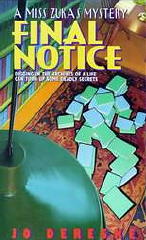
JO DERESKE – Final Notice.

Avon, paperback original. First printing, November 1998.

JO DERESKE Death's Shadow

   This is the sixth in Dereske’s “Miss Zukas” series, and as usual in my random, non-systematic way of doing things, the only one of them that I’ve read before this one is the one that follows this one.

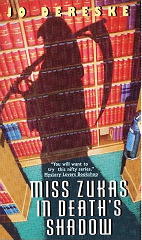
   And in fact, the incident that initiates that very same next one, Miss Zukas in Death’s Shadow, occurs on pages 18 and 19 of this one – she’s given a traffic ticket on the way to the airport to pick up her elderly aunt who’s coming in from Michigan for a visit.

   Being a reference librarian either reinforces Helma’s sense of what is correct and proper, or it is what caused her to become a librarian in the first place. And being given a summons for turning right on a yellow light definitely does not fit her sense of what is correct and proper. Allow me to quote:

    “I can’t sign this,” she told [the policeman].

    “It’s not an admission of guilt, ma’am.” His voice grew louder, higher pitched. “You’re only acknowledging receipt of the ticket.”

    “Then you’ll have to make it readable. You’ve spelled Wilhelmina incorrectly. I believe the time noted here is three minutes into the future. I can see your badge number is 087 but I’m unable to read your name: Olsen? Carolson? Camden? This document is too illegible for me to sign my name to. I’d like a rewritten ticket, please.”


   Sure enough, at the beginning of the next book, the only one before this one that I’ve read, Miss Zukas is doing community service at a homeless shelter. I hope you don’t get the wrong idea, though. Miss Zukas is in her 30s, I believe, perhaps almost 40, but unfortunately I didn’t make a note of where I saw a reference to her age. If I have it wrong, I’ll change this small piece of data, and unless you remember, you’ll never know I had it wrong.

   But the point is, she’s not a dottering old lady librarian, and while she’s not married, she does have a sort of boy friend in Bellehaven’s chief of police, Wayne Gallant. (Bellehaven is a fictional town, I believe, in Washington state.) This romance, if indeed that is what it is, is the strangest romance I’ve ever read about, as they are both rather reticent to speak about their relationship, even to each other.

JO DERESKE Final Notice

   When Wayne Gallant’s ex-wife comes to town in Final Notice to reclaim her former husband, though, things between them (Helma and Wayne Gallant) begin to come to a boil. If a relationship can boil at less than room temperature, this one does. (He is always referred to Wayne Gallant, by the way, and when he calls Helma on the telephone, he says, “Helma, this is Wayne Gallant.” I found that … strange. In a nice sense, mind you.)

   The dotty old lady in Final Notice is actually Helma’s Aunt Em, who back in Michigan (where she has lived her entire life, so far, or so Helma believes but soon discovers that it was not so) she had a “brain incident” and has become in behavior rather, shall we say, eccentric. And talkative. About her past. A past that Helma’s family had never talked about. Especially the time Aunt Em spent in Chicago during the rum-running days of Al Capone.

   Dead in Helma’s apartment building parking lot is the same man who tried to steal Aunt Em’s purse at the airport. The identification is clinched by the three stab wounds in his arm produced by Aunt Em’s hat pin. Coincidence? Not very likely, but who? And why?

   I enjoyed this, indeed I did. The detective work is minor, but it’s not dislodged, disrupted and disposed of completely. The characters are only mildly wacky and perhaps just as normal as any other group of people, including Miss Zukas’s fellow librarians, especially the director, a lady who believes that psychological color testing is a good way to maintain staff morale. Miss Zukas refuses. Naturally.

   Here’s a list of all of Jo Dereske’s novel-length mystery fiction. Ruby Crane is a graphologist by profession, a forgery expert at a California detective agency. I’ve not read any of her adventures, but I’m sure that I read somewhere that she may be a cousin of Miss Zukas. If so, I imagine the cases she solves may be as much of a sneaky pleasure to read as this one.

    Miss Zukas. All are Avon paperback originals.

1. Miss Zukas and the Library Murders (1994)
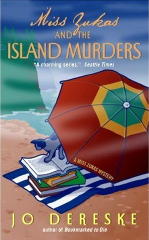
2. Miss Zukas and the Island Murders (1995)

JO DERESKE Island Murders

3. Miss Zukas and the Stroke of Death (1995)
4. Miss Zukas and the Raven’s Dance (1996)
5. Out of Circulation (1997)
6. Final Notice (1998)
7. Miss Zukas in Death’s Shadow (1999)
8. Miss Zukas Shelves the Evidence (2001)
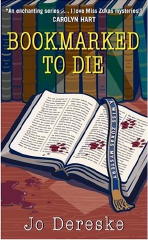
9. Bookmarked to Die (2006)

JO DERESKE Bookmarked

10. Catalogue of Death (2007)
11. Index to Murder (2008)


    Ruby Crane. All are Dell paperback originals.

1. Savage Cut (1996)
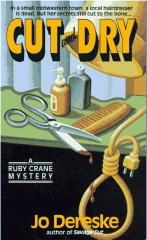
2. Cut and Dry (1997)

JO DERESKE Cut and Dry

3. Short Cut (1998)

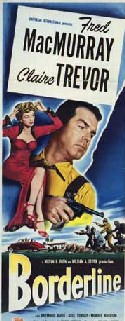
Borderline. Claire Trevor

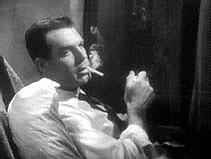
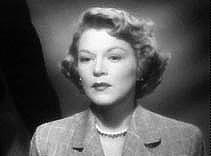
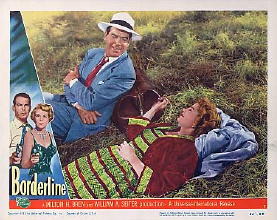
BORDERLINE. Universal Pictures, 1950. Claire Trevor, Fred MacMurray, Raymond Burr, Jose Torvay, Roy Roberts, Charles Lane. Directed by William A. Seiter.

   I was sold a bill of goods by Oldies.com when I bought this DVD. The last line of the promotional copy on the back cover says, and I quote: “MacMurray’s icy cool performance and Trevor’s jittery energy create a chemistry that ignites this classic film noir.”

   Film noir? It is to laugh, and believe it or not, even with another bravura performance by Raymond Burr as a thuggish dealer of dope in Mexico, you (the audience) were supposed to.

   What a strange combination. Is this a noir film disguised as a comedy romance, or a comedy romance disguised as a noir film? My vote’s on the latter.

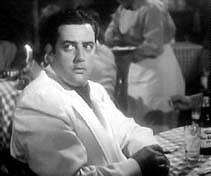
   The only problem is – well, I’ll get back to that. Here’s the basic story line. Claire Trevor plays Madeleine Haley, aka Gladys LaRue, a Los Angeles policewoman in Mexico to see if she, as a woman under cover as a dancer and/or gang moll, can get some evidence on a slick crook named Pete Ritchie (that’s Raymond Burr, in fine form, as always). Fred MacMurray enters the film as Johnny Macklin, aka Johnny McEvoy, a henchman of an opposing gangster intent on taking over Ritchie’s trade.

Borderline. Claire Trevor

   And the two of them, Trevor and MacMurray, take a trip up north together with a bird cage, complete with parrot, a music box, both filled in hidden compartments with packages of unspecified contraband. Both think the other is crooked, but somehow seeing beyond that, both begin to fall in love with each other. (Even so, Clare Trevor modestly sleeps with a gun in her hand in the room they stay in overnight together.)

   Which is the way the movie goes, as well as the prevailing wind, until they reach the border, which is where the question becomes, does duty take over? I’ll not answer that, as I may have revealed too much already, but what I will say is that whatever type of movie this, it falls apart completely from this moment on. (And maybe I have a larger tolerance for misguided ventures like this than you do.)

Borderline. Claire Trevor      Borderline. Claire Trevor

   The problem is, for a romantic comedy, there are too many shootings and dead bodies to be completely funny, and for a film noir, there is simply too much silly nonsense going on. Pete Ritchie gives a good chase, but even that end of things fizzles out without so much as a bang.

Borderline. Claire Trevor

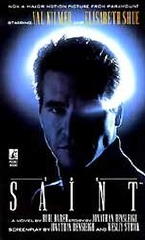
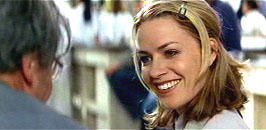
THE SAINT. 1997. Val Kilmer, Elizabeth Shue, Rade Serbedzija, Valery Nikolaev, Alun Armstrong (as Inspector Teal), Roger Moore (voice only). Based on the character created by Leslie Charteris. Directed by Philip Noyce. [Novelization by Burl Barer; Pocket, 1997.]

THE SAINT Kilmer Shue

   My first reaction? Beware of movies about fictional characters whose creators are not included in the on-screen credits. That’s what the common wisdom says, or if it doesn’t, it should.

   Be also wary – this is my own advice – of movies that begin by telling the childhood origins of the character. Especially when said character’s exploits extended for well over a fifty year period (1928-1983) – under the control of said creator if not always written – without the creator ever finding the need to chronicle the characters origins, which are always (perhaps) best left to the reader’s imagination.

   The reviews of this movie were almost universally bad, although in some cases as if reluctantly so, but – and this is a big but – the reaction of ordinary civilian reviewers (on IMDB, for example) have been almost universally positive. Some call it their favorite movie of all time, others while not going that far, admit to having watched it over and over again many times.

   Why the great disconnect? I’ve thought it over for a couple of days now, and I’ve listened to the director’s voice-over commentary, which (as usual) pointed out any number of items I missed the first time through, and I think the division of opinion comes down to this.

   Those who liked the movie did not know anything about Charteris’s character – a devil-may-care adventurer with an ever-present twinkle in his eye as he swindled the bad guys’ loot right from under their eyes – nor did they know anything of Roger Moore’s TV version of the character (much less George Sanders in the movie versions).

THE SAINT Kilmer Shue

   Roger Moore, I personally liked in the role, although (as I remember) he was a little stiff and not quite as rakishly (more impishly, perhaps) devil-may-care as I would have liked.

   But Moore stopped playing the Saint in 1969, which (I’m guessing) is well before most of the viewing audience for this new version was born, and Val Kilmer is all they know (and all they got). Which may sound snarky, and if so, I mean only 30 to 40 percent of it.

   For in fact, if you take the character he plays – he is not even Simon Templar yet, as this revisionist story would have it – without an idea of who he is to become – I think you might even enjoy watching this tormented loner, unsure of his true identity, a thief with undated Internet gimmicks and capabilities – not to mention his many disguises which are as varied and clever as they are numerous – and seeing him grow into someone whom the director refers to as “worthy of Sainthood.”

THE SAINT Kilmer Shue

   Thanks, of course, to the love of a beautiful woman, Dr. Emma Russell, played by Elizabeth Shue, an expert on cold fusion, the formulas for which some scummy post-Communist Russians would love to get their hands on.

   That Emma Russell acts like she is sixteen years old and has never been within two feet of a man before is very nearly beside the point. She is innocent and vulnerable, and she is what Val Kilmer’s character needs to shake up his life and start him over again. (He certainly needs it.)

   It also does not seem to matter that cold fusion does not seem to work, then or now, even though when a miracle is desperately needed in the movie – and in the middle of Red Square yet! – a miracle is certainly what indeed does happen.

THE SAINT Kilmer Shue

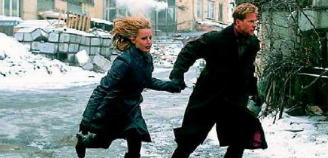
   Emma Russell’s heart condition also seems improve greatly as the movie goes on. Perhaps it is all the running she does, or edging her way with Simon along the icy flank of the Moscow River, or escaping with him through the city’s underground tunnels. Exercise like this is just what the doctor ordered. Or needed.

THE SAINT Kilmer Shue

   An earlier version in which she dies in the end was wisely, wisely reconsidered. The ending is a bit of a muddle anyway, but if her cheery optimism had been squashed in the end like a bug, the audience would have roundly booed. I would have, at least, and loudly.

   My second reaction, then, ignoring the fact that movie is about a character I think I should know — but as the film goes on, I realize in frustration (if not something akin to anger) that I do not — with my expectations suitably altered, I enjoyed the movie considerably more the second time through than I did the first.

   But will I ever watch it again? The future is hazy on that, but the possibility is higher than the chance that I will ever watch a version with George Sanders in it more than once. One with Roger Moore in it, from TV? Yes.

TONY DUNBAR – The Crime Czar.

Dell, paperback original; first printing, November 1998.

   My first reaction, when starting to read this fifth recorded New Orleans adventure of only slightly sleazy attorney Tubby Dubonnet, is that it takes place before hurricane Katrina came along. What a sorrowful scab on this country’s face that city is now. There’s a lot of atmosphere in this book, more or less a continuation of the preceding one, and I’ll get back to that aspect of it in a minute.

   The background of eccentric native inhabitants and local cuisine is combined with a hand-brewed melange of hoodlums, crooked politicians and judges, and the laissez faire approach to life of Tubby himself to produce a potpourri of wackiness and Southern charm. (Well, I concede that crooked politicians are not charming, nor is the occasional violence that rips its way into the tale that Tony Dunbar has to tell in The Crime Czar, but there you are.)

   The Tony Dunbar novels so far, as expanded upon from the listing in Crime Fiction IV, by Allen J. Hubin. All take place in New Orleans, Louisiana.

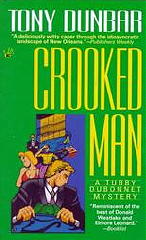
         # Crooked Man. Putnam, hc, 1994. Berkley, pb, 1996

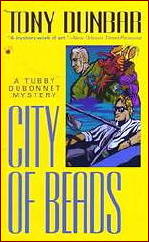
TONY DUNBAR City of Beads

         # City of Beads. Putnam, hc, 1995. Berkley, pb, 1996.

TONY DUNBAR City of Beads

         # Trick Question. Putnam, hc, 1996. Berkley, pb, 1997.
         # Shelter from the Storm. Putnam, hc, 1997. Berkley, pb,1998.
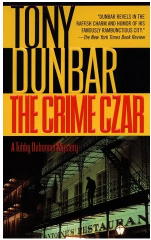
         # The Crime Czar. Dell, pb, 1998.
         # Lucky Man. Dell, pb, 1999.
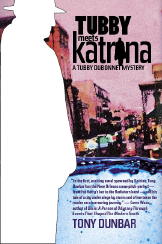
         # Tubby Meets Katrina. NewSouth, hc, 2006.

TONY DUNBAR Tubby Meets Katrina

   And of course I have a couple of comments. The story in The Crime Czar seems to pick up right after Shelter from the Storm ends, leaving some open, unanswered questions as it does so. It is strange, then, to see the series switch not only from hardcover to paperback in the transition, but from one publisher to another as well.

   The other obvious comment is that I did not know about this most recent book in the series until about five minutes ago, and I want to read it. Mr. Dunbar is obviously in love with the town where he lives – even with my having read only the one book in the series so far, I know this – and I need to know what he has felt and presumably still feels about the destruction (if not the rebuilding) of the city that was New Orleans.

   I’ve ordered it online today.

TONY DUNBAR Crime Czar

   As for The Crime Czar, as mentioned up above, the story reads like a Chapter Two, and I’m sure it would have helped to have read Shelter from The Storm before it. The ongoing crime-tinged saga that is Tubby Dubonnet’s life does not seem to come in pre-packaged segments. It is, instead, continuous.

   Tubby’s target in the book at hand: the man who seems to be behind all of the crooked wheelings and dealings in New Orleans, and for one instance in particular, the death of his friend Dan, left severely wounded in the earlier book.

   Add to the tale a hooker named Daisy, boiling mad at the death of her new boy friend; a gang of Vietnamese gunmen, aiming to avenge the shooting of three of their countrymen; and Marguerite, upon whom Tubby is sweet, and another leftover from the previous book, having managed to flee with a fortune in jewelry. Don’t ask. I didn’t, and the story still went down swell.

   It — the story — isn’t a major one, mind you. A minor caper, that is all. When one judge with his hand out goes down, another one pops up immediately. When one crooked cop is caught with his pants down, another one comes along with no delay. The fun is in the reading, though — a joyous, fun-loving affair for the most part, Big Easy style.

    NOTE:  No crawfish were harmed in the writing of this review.

« Previous PageNext Page »