Reviews


DESPERATE. RKO Radio Pictures, 1947. Steve Brodie, Audrey Long, Raymond Burr, Douglas Fowley, Jason Robards (Sr.). Directed by Anthony Mann.

   An early film noir, back before directors knew that that’s what they were filming, back when a low budget on a crime film was the impetus for creative lighting and innovative camera techniques, and not because they realized that they were creating a movie genre.

   I reviewed Anthony Mann’s The Great Flamarion (Republic, 1945) earlier this year, a movie considered by some to be in the noir genre, so Desperate is far from being the first that he directed in the category, but to me, both seem flawed. Neither seems to me to epitomize in their entireties what a noir film truly is (or was).
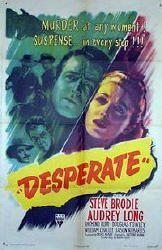
Poster

   But there are some moments in Desperate that, once seen, will always be remembered. When trucker Steve Randall (Steve Brodie) is being thoroughly beaten off camera in the hideout of gangster Walt Radak (Raymond Burr), someone bumps the overhead light fixture with a single light bulb in it, starting it to swing back and forth in the otherwise darkened room. The alternating light and shadowy darkness combines with the sounds of punches and groans off to the side in an epiphany of mind-cringing delight.

   Toward the end of the movie, as Radak has caught up with Randall again, as Radak’s brother is about to die in the electric chair, for which Radak blames Randall, the two men sit opposite each other across the kitchen table in a cheap apartment flat, Radak with a gun in his hand, Randall about to die at exactly the same moment as Radak’s brother — their eyes, their sweat — it is as if that moment will stay fixed in time forever, but it does not, as the clock ticks slowly onward.
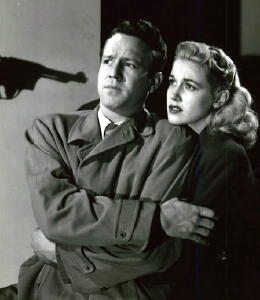
Scene

   One could wish, then, and fervently so, that the overall story would hold together more cohesively than it does. Why Randall’s wish to escape Radak is clear. He’s an innocent joe caught up in a foiled warehouse robbery, but when Radak threatens his wife of four months (Audrey Long), he becomes irrational with his thoughts of saving her — but his actions, setting them both off on the run without telling the police, just don’t make sense. Randall doesn’t ever appear quite irrational enough, nor is he supposed to be. His wife Anne simply does as she’s told — questioning but always obeying — and yet she wouldn’t if he were.

   This was Raymond Burr’s second or third credited appearance, and as a moody almost insane criminal thug, which is what he often played in B-movies like these in the 1940s, his eyes seem to glower whenever he’s filled with anger or hatred. In this movie this is 95% of the time.
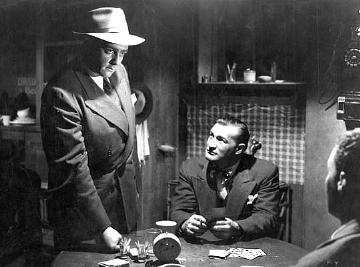
Burr

   One other problem this movie faces, however, is that Mr. and Mrs. Randall, no matter how dire their situation, when they’re together, it’s never quite dire enough. There is no question that they will survive, and in a noir film, that’s always a fatal flaw. But so that I can’t be accused of giving away an ending: I just lied, and they don’t.

   Here’s one connection with crime fiction in printed form that I didn’t know before now. Audrey Long’s film career, which began in 1942, ended in 1952 when she married Leslie Charteris, creator of the Saint. Their marriage lasted until 1993, when he died.
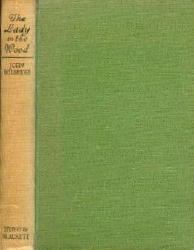
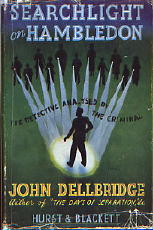
JOHN DELLBRIDGE – The Lady in the Wood

Hurst & Blackett Ltd., hardcover; no date stated [1950]. No US publication.

   As readers of this blog will know full well, it has recently been discovered that “John Dellbridge” was the pen name of Frederick Joseph De Verteuil (1887-1963). A native of Trinidad, he became a barrister and practiced law in India and England before becoming a novelist.

    I’ll forego the usual bibliography, as the previous entry already includes one, as well as a small amount of other information that has been learned about the author. There are six mysteries to his credit in all, however, the last three having as their lead character one Rupert Hambledon, about whom more in a minute. The Lady in the Wood is the last of the three, which were published in a short span between 1947 and 1950. Dellbridge’s earlier crime-writing career spanned a much earlier 1927 to 1929.

Lady

    The story is told in quasi-documentary style, in the beginning as if in the form of local Inspector Kemsing’s report to some superior officer, starting with Chapter One, page 7:

   At 6:30 p.m. yesterday, Friday, and August, Mrs. Martineau of Sharpes Cottage, Checksworth, reported by telephone that she and her husband had found the naked body of Lady Charlotte Barnet in a larch plantation in Checksam Park. There seemed to be a bullet wound in the head. Her husband was standing by the body. She described the exact spot. I telephoned the police surgeon and the St. John Ambulance and at once proceeded to the scene by car with Sergeant Streeter and Constables Neve, Avis and Ayling, with a camera. Mrs. Martineau was waiting for us at the junction of a bridle path and the Diddlehurst-Midworth road: Sharpes Cottage is about fifty yards East of the junction of the path and road and invisible from the path as the road bends there.

   The dead woman had been a heroine in World War II, having parachuted into France and done great deeds undercover with the Resistance. Some Vichy French and some members of the Gestapo are immediately suspected. On the other hand, this is England, and the world is in the process of becoming civilized again. Lady Barnet had come down from London to be one of the guests at nearby Schlatts Hall, the home of Mr. and Mrs. Arthur Bonteve.

   So a manor house mystery is what this is, no more and no less, replete with constant and subsequent misbehavior and strange actions on the part of the many participants, many clues, another death – that of a maid who perhaps knew too much and who turned to blackmail as a result? – and endless timetabling, more than I can remember in any mystery I’ve read in many years.

   Sir Rupert Hambledon is called in early on by one of the suspects. That he has a title means that he travels in the same circles as the class of people who live in or are guests at manor homes. He is not from Scotland Yard, however, but a very expensive inquiry agent. (One hesitates in referring to him as a mere private detective.) Being the “best known detective in England” and “the smartest” (page 111), in no time at all he is in charge of the case, Inspector Kemsing more than willing to defer to him.

   One of Sir Rupert’s other traits is that “he commits irregularities that no official policeman would dare to try” and “these irregularities get results.” (Also page 111.) By the way, the inspector does not narrate the entire book. He alternates telling the story of the investigation with Mr. Perceval Hadlow-Down, a solicitor of one of the guests, who often plays Watson to Sir Rupert. Says Hadlow-Down early in his own narrative, when it is his turn;

   I am a thriller ‘fan’. Many of them are very good, though they have lost some of the savour since Lord Peter Wimsey went out of business and Dr. Fortune was replaced by a colleague of mine called Clunk who should have been struck off years ago.

Sir Rupert may outdo either of those two gentlemen by stating on page 70:

    “I’ve known who the murderer was since this morning,” he asserted with a stort of Olympian impatience.

   Of course there is not a shred of legal evidence at this point, and if the murderer were to be charged, the inspector would be “laughed out of court.”

Lady

   Does Sir Rupert indeed know? In the end, after the killer is indeed caught and charged, there are indications that he did, but to my mind, the strongest point in his final summary of the case was based on an flimsy (and even erroneous) insight into human nature. He was exaggerating, were you to ask me. It was a good guess, perhaps more, but that it took the remaining two-thirds of the book to name the killer for keeps strongly suggests that a good guess is all that it was.

   The purpose of the alternating narration – not too common in detective novels? – serves the author in this case well. That is to say, it keeps the reader off-balance, preventing her or him of being aware of what each narrator knew and when while the story was being told by the other.

   In short, however, if you are the kind of mystery reader who likes lots of clues, time tables, and exhaustive interrogations of the parties involved, you will find a lot to like, if not love, in this book. If not, then most definitely not.

— February 2007

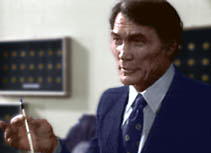
MISTER SCARFACE, a.k.a. I Padroni della città. (Italy / West Germany). USA: PRO International Pictures, 1977; dubbed. Jack Palance, Harry Baer, Al Cliver, Edmund Purdom, Vittorio Caprioli. Director: Fernando Di Lio.

   Sometimes you get exactly what you pay for. In my case I paid 99c plus shipping for both halves of a Jack Palance double feature on DVD, of which this is one. Half, that is. If you call it a dollar for this one, it’s worth about half of that, plus 85 minutes of viewing time.

   Which I wouldn’t have spent it weren’t worth viewing, but I’m certainly glad I didn’t spend three bucks. The transfer to DVD was terrible. Color bursts and scenes shot in darkness coming out muddy and shadowy where shadows are not supposed to be can really spoil your mood for a movie. (The other half, The Four Deuces (1975, with Carol Lynley), may make the deal come out a steal, and as always, I will let you know.)

Palance

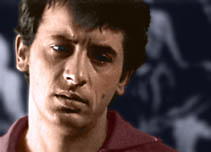
   The movie was filmed in the slums of Rome, or so I’m told, as I didn’t recognize anything anywhere at any time, but truthfully I’ve seen worse slums. The Italian ambiance must make all the difference in the world. “Scarface” Manzari (Jack Palance) is the head of one gang of crooks and thieves, and young, overly brash Tony (Harry Baer) is a bag man for another. Determined to rise in his own gang of crooks and thieves, headed by Luigi Cherico (transplanted British actor Edmund Purdom), Tony takes Scarface for ten million lira, of which he hands only three million back to Luigi.

Baer

   Does Scarface take this lying down? No, of course not, you know what I mean? Jack Palance glowers a lot and handles his long cigarette holder with consummate ease, but he looks far, far away from what a few IMDB viewers variously call a powerful and exciting Italian gangster film, with an “imposing” performance by Palance. None of the above is precisely true, but beyond that, we are only arguing matters of taste.

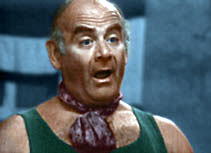
Purdom

   Comic relief is provided by Vittorio Caprioli, as an aging gangster who, after being dumped by Tony’s gang, casts his lot with the brash young lad. Both of their performances are worth watching. The long shootout at the end would have been boring and utterly without redemption without the former’s humorous ineptitude, for example.

   Even so, the long shootout at the end manages to come awfully close to that inscrutable, indefinable boundary between good and just plain awful. Or depending on your mood at the time, perhaps the line is crossed not only once, but several times, in this last burst of highly choreographed diorama (or low drama) of cars, motorcycles, guns, guns and more guns.

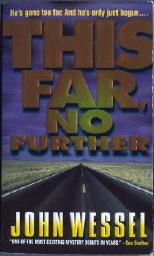
JOHN WESSEL – This Far, No Further

Island/Dell; paperback reprint, November 1997. Hardcover, first edition: Simon & Schuster, October 1996.

    Here’s an even better example of what I was rambling on about just before this when I was reviewing Dreamboat, the Jack Flippo PI novel by Doug J. Swanson, although I don’t think this first book by John Wessel, also a private eye novel, caught anyone’s eye for an Edgar nomination.

   Wessel’s detective is named Harding, an unlicensed PI working in the Chicago area. Both he and the author seem to have had a three-novel run, and that was all that it appears there will ever be:

         This Far, No Further. Simon & Schuster, 1996; Island/Dell, 1997
         Pretty Ballerina. Simon & Schuster, June 1998. No US paperback edition.
         Kiss It Goodbye. Simon & Schuster, January 2001. No US paperback edition.

   The fact that only the first one came out in paperback certainly says something, but of course it is never easy to interpret these things correctly. One obvious explanation is that for the last ten years (or more?) private eye novels no longer rule the roost as they did, once upon a time. Either Wessel’s writing never caught on, starting with his very first book, or perhaps even more likely, Island/Dell didn’t give him (or the books) the chance they needed.

   And there are not too many series with continuing characters which beat the odds and succeed in hardcover only. Without the paperback reprint coming out a year later, just about the time the next one in hardcover shows up, a series almost always seems to lose steam, then is forced to pack up and leave, never to be seen again.

   Should the Harding books have succeeded? Were they wrongly done in? I have mixed feelings about this. There is a lot to like in This Far, No Further, and there is a lot, well, let’s say that I had problems with, and maybe other readers did too.

Wessel

   First to like: Harding tells his own story, first person (uh-oh) present tense. Present tense? I can live with that, even though it fought me a little. The telling is spirited and enthusiastic, even though Harding has been badly wronged in his life, so far, and the less-travelled (grittier) paths and neighborhoods in Chicago are described with the panache and style of a long-time inhabitant.

   Second to like: Harding’s lady friend Allison, a commercial photographer and (evidently) one-time girl friend who assists him on this case. The banter between them is relaxed, pointed, trenchant and (all at the same time) far more cutting than Spenser ever has had with Susan, as enjoyable as the Robert B. Parker books are and always have been. Nor has much of the past between Alison and Harding been made clear by the end of the book. Allison, who is also very good at the martial arts, seems as well to have close lady friends of her own.

   Not to like very much: The utter sleaziness of the dead girl’s death in a rundown motel outside of Chicago, the victim of what appears to have been a sex tryst that went way too far. Harding was following the male in the party, a noted plastic surgeon whose wife hired the lawyer who hired Harding. Much is made later of videotapes and other paraphernalia.

    Not to like even more: The plot itself eventually becomes verbal sludge and next to impossible to follow. You may take this as an overstatement born out of frustration, and you would be right, but nonetheless, it is true. Harding’s own past – the reason behind the loss of his license – eventually becomes entangled with the doc and his problems, and Harding’s attraction to his wife (and his client, twice removed), and I confess that by that time, I was only skimming the pages.

   As fast as I could. Was I about to about to quit? No.

   Absolutely not. Did I go online and buy the next two books in the series? Yes.

   Can there be more to be said than that? Probably, but I hope I don’t need to.

— November 2006

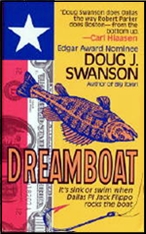
DOUG J. SWANSON – Dreamboat. Jack Flippo #2. HarperCollins, hardcover, February 1995. Harper, paperback, January 1996.

   The mystery shelves of used bookstores are filled with any number of series of detective fiction that appeared out of nowhere, flamed brightly for a short while, then just as suddenly disappeared. If there were still used bookstores, that is. They are, alas, an endangered species, are they not?

   I’m not going to digress off in that direction, though. Not this time. I’m going to stay focused and on track, even if I have to force myself. Private eye novels, which this one is, or cozies, which this one isn’t, it makes no difference. If they don’t catch on, in spite of critical acclaim, they gone, they’re history, and how many of the Jack Flippo PI novels can you name? Do you know what major city he worked out of? Had you heard of Jack Flippo before you began reading this review?

   One of the reasons I began this review the way that I did is that on the front cover Doug J. Swanson is described as an “Edgar Award Nominee.” Given all of the questions I just asked you, this is a fact I did not know myself — but it’s why my mind went poetic on me, re the fire “that flamed briefly brightly” and all, and I hope you’ll forgive me.

    Here’s the list of all of Swanson’s mystery fiction. The detective in each of them is Jack Flippo.

       Big Town. Harpercollins, hc, February 1994.
         Harper, pb, February 1995
      Dreamboat. Harpercollins, hc, February 1995
         Harper, pb, January 1996.
      96 Tears. Harpercollins, November 1996.
         No paperback edition.
      Umbrella Man. Putnam, hc, July 1999.
         Berkley, pb, May 2000.
      House of Corrections. Putnam, hc, August 2000.
         Berkley, pb, May 2001.

   That’s it. That’s all there were. Viewing it from the outside, and given the three year gap around then, it looks very much as though Flippo’s career was all but over after the first three. The Edgar nomination came in 1995 for Big Town in the category of Best First Novel of the Year. (It did not win. The award went to The Caveman’s Valentine by George Dawes Green, as I am sure you will recall.)

   Swanson himself was a long-time reporter for the Dallas Morning News, or so I’ve discovered, and at the age of only 53, there’s a good chance he still is. Luckily he’s had a day job to fall back upon. But what this also means is that he knows the Dallas area, and the people that live there, all kinds of them: the small-town hicks, the semi-slimy big-city entrepreneurs, the ladies of the evening, high and low, good folk and bad. He also has a sense of humor about his approach to mystery fiction (and probably life as well) that tickles my funny bone, and who knows, maybe yours as well.

   Jack Flippo used to be an Assistant D.A. in Dallas. At the beginning of this book, he’s a non-practicing lawyer, a newly licensed investigator, and he’s in jail for simple assault. The victim: his ex-wife’s boyfriend. (This turns out to be important.)

   The case he’s asked to work on, by the insurance exec who bails him out, is to look into the death by drowning of a gent with a half-million dollar policy on him Off he goes, therefore, to a small town called Baggett, somewhere in East Texas, where he meets a small town justice of the peace and an even smaller (five foot six) hick sheriff by the name of Loyce Slapp. You can bet that Flippo doesn’t get anywhere, and fast, even if he suspects foul play, and you would win.

   He also meets a girl named Sally, good-looking, of course, and who works for the dead man’s partner in an exotic-type night club in Dallas. This is important, too, since a friend of hers named Bobby has gone missing, and she’s starting to get worried. Apparently he is (or was) in on whatever business went on in Baggett, and is in hiding (or worse). Thieves do fall out, and in Texas everything does grow taller, including tales like this one.

   While Jack is quick with the quip and talks with a basket full of confidence, I have to say (reluctantly) that it would be nice if he had a small modicum of competence to go with the confidence. Things do not always go smoothly for Mr. Flippo, in other words. Spenser he is not, not to mention that he does not have a Hawk for a back-up. Nor even back-up plans for every contingency, for that matter either. On the other hand, not all of his various problems and ill-times mini-disasters are entirely his fault, exactly.

   So a somewhat warped sense of humor (like mine) is what you need as a reader, and if that is what you have, you will have a rattling good time. On the other hand, and you may be certain that there is one, the story also goes off into some dark and dangerous directions now and then as well. It isn’t all funny-named characters who are in over their head in matters criminous. Some of the bad guys are rather competent, as a matter of fact. The ending — if I may now at this juncture skip over some of the story lines which you are better off reading yourself anyway — is better than average, even in comparison with PI novels which take themselves a lot more seriously.

    I would imagine that the five Jack Flippo novels are all there are going to be. If you were ever to spot one in a used bookshop shelf someday, may I suggest that you don’t pass it by. If the description of this one hasn’t sent you running in the other direction already, which of course I realize that it very well may, do yourself a favor and give it a new home. You’ll thank me, I?m sure, and maybe as early as the very same evening.
   

— September 2006

SUED FOR LIBEL. RKO Radio Pictures, 1939. Kent Taylor, Linda Hayes, Lilian Bond, Morgan Conway, Richard Lane. Based on a story by Wolfe Kaufman. Director: Leslie Goodwins.

   I don’t know about you, but while watching the cast credits go by at the beginning of this movie, Kent Taylor was the only one I recognized right away. Morgan Conway I knew played Dick Tracy in a couple of films later on, but the others, including the two ladies, were only names to me, and more about them later.

   But whenever the star appeal is as low as this, as it was to me, I start thinking “low budget.” And on occasion, starting with low expectations is not all that bad, as this rather generic detective film met or surpassed those low expectations, and then some. Not by a mile, I grant you, but at least by a hair. It’s built around a radio program put on by a newspaper to dramatize the day’s events live. Being an Old Time Radio fan myself, that was a plus right there.

   Thanks to a practical joke one reporter (Linda Hayes) plays on another (Richard Lane), the program directed by a third (Kent Taylor) gets the jury’s verdict in a murder case backwards, “guilty” instead of “innocent.”

   Hence the title of the movie. To win the resulting lawsuit, it is up to the threesome above to solve the murder themselves, and with degrees of trepidation and humor, they do. Morgan Conway is the accused murderer, and Lilian Bond is the wife of the murdered man who’s also a close friend of the defendant. Maybe you could write your own scenario from this.

Bond

Lilian Bond

   Wolfe Kaufman, who did write the story, which holds water only as long as you don’t watch too closely, has one title listed in Al Hubin’s Crime Fiction IV: an Inner Sanctum Mystery entitled I Hate Blondes, published by Simon & Schuster in 1946. Kent Taylor, an actor in the Clark Gable vein, but nowhere near as successful, later played Boston Blackie on TV, and Clark Gable didn’t.

   Lilian Bond plays her role in the courtroom strictly on the straight and narrow, but later on when the hairpins start flying, she becomes quite a looker, even though her career never went anywhere. I think it should have. That’s her photo up above, but (truth in advertising) she never looked like that in this film, no matter what I just said.

Hayes

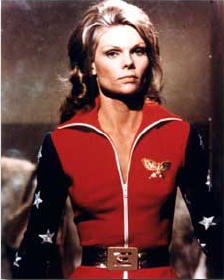
   As for Linda Hayes, the snappy gal reporter lady, her career lasted only for 17 movies, all filmed between 1939 and 1942. She may be more famous as the mother of Cathy Lee Crosby, who later briefly played the super-powered crimefighter Wonder Woman on television. Perhaps you can see the resemblance.

Crosby

GILLIAN LINSCOTT – Widow’s Peak

Warner Futura, UK, pb. Hardcover editions: Little Brown, UK, 1994; St. Martin’s Press, US, 1995, as An Easy Day for a Lady.

   Over her career Gillian Linscott’s sizable list of mystery fiction has featured two different series characters. Nell Bray, who is in this one, first appeared in print in Sister Beneath the Sheet, which was published in 1991. Timewise, that book took place in 1909, or very early on in her life as a militant London-based suffragette. Her adventures have appeared more or less chronologically ever since, except for the last two, at least one of which has jumped back in time to her earlier, more formative years.

   In Linscott’s first four books, the detective of record was Birdie Linnet, a divorced former policeman trying to maintain contact with his daughter. Not having read any of them, I know little more than that. Nor I have come across any reason why Linscott abandoned him as a character, though the most likely one, of course, is that it happened at the publisher’s wishes, not hers. There are also three non-series books in her bibliography, which I’ve expanded below from the one found in Allen J. Hubin’s Crime Fiction IV:

      British editions only:

# A Healthy Body (n.) Macmillan 1984 [Birdie Linnet; France]
# Murder Makes Tracks (n.) Macmillan 1985 [Birdie Linnet; Italy]
# Knightfall (n.) Macmillan 1986 [Birdie Linnet; England]
# A Whiff of Sulphur (n.) Macmillan 1987 [Birdie Linnet; Caribbean]
# Unknown Hand (n.) Macmillan 1988 [Oxford]
# Murder, I Presume (n.) Macmillan 1990 [London; 1874]
# Sister Beneath the Sheet (n.) Scribner 1991 [Nell Bray; France; 1909]
# Hanging on the Wire (n.) Scribner 1992 [Nell Bray; Wales; Hospital; 1917]
# Stage Fright (n.) Little 1993 [Nell Bray; London; 1909]
# Widow’s Peak (n.) Little 1994 [Nell Bray; France; 1910]
# Crown Witness (n.) Little 1995 [Nell Bray; London; 1910]
# Dead Man’s Music (n.) Little 1996 [Nell Bray; England; 1910 ca.]
# Dance on Blood (n.) Virago 1998 [Nell Bray; London; 1912]
# Absent Friends (n.) Virago 1999 [Nell Bray; England; 1918]
# The Perfect Daughter (n.) Virago 2000 [Nell Bray; England; 1914]
# Dead Man Riding (n.) Virago 2002 [Nell Bray; England; 1900]
# The Garden (n.) Allison & Busby 2003
# Blood on the Wood (n.) Virago 2003 [Nell Bray; England; early 20th century]

   Many of these have been published in the US by St. Martin’s, so Linscott is far from an unknown author on this side of the Atlantic. On the other hand, none of them have been published over here in a mass market paperback edition, so I could easily be wrong about how recognizable her byline might really be.

   There are several websites devoted to her and her fiction, but none of them seems to answer the question whether or not she is still writing. If you know more, you might pass the word along to me.

   The primary factor in knowing Nell Bray as a character is her passionate devotion to the Right of Women to Vote, ironically making the one book of hers that I have happened to read, Widow’s Peak, perhaps the least typical in the series. Nell is on vacation in France from her brick-throwing proclivities in this one – in Chamonix, to be exact, at the foot of Mont Blanc, where very early on in the book a dead man is found in the ice, having known to have been killed in an “accident” which occurred thirty years earlier. The only early feminist items on the agenda are subtle, and they appear only in context, but (strangely enough) they manage to be all the more noticeable when they do.

Peak

   You will, of course, have noticed that I placed the word “accident” in quotes. Any self-respecting mystery reader will know immediately that there no accident is involved, and there never had been. Nell, who is also a skilled translator by profession, is hired by the dead man’s brother and his family to help facilitate their taking the dead man’s body back to England. This gives her an immediate, insider’s view of their various activities – which I’ve deliberately phrased this way, since for a good portion of the book, there is no investigation into a murder, per se.

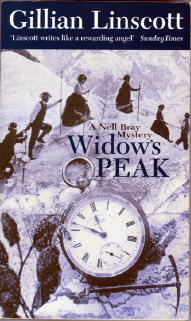
   But the dead man’s journal, found in the ice near his body, contains several entries with sobering implications, and soon enough Nell finds herself in the thick of things, as seems to be the usual case for her. As a historical novel, Widow’s Peak is quite delightful, picturing as it does the Bohemian way of life in the village in some detail, not to mention (if you take a good look at the cover) sharp images of pre-war hiking expeditions up the mountain. Both men and women were in these co-educational parties, as if they were on larks of some magnitude, which indeed they were.

   While keeping me up far past my bedtime, the detective story unfortunately concludes in more post-Victorian melodrama than I’d have preferred. The twists and turns of the plot along the way, however – some foreseeable, others thankfully not – certainly made up for it in spades (and ropes and axes and all other shapes and forms of primitive mountaineering equipment).

— January 2007


PostScript: For an excellent overview of other mysteries taking place in the days of women’s rights movements, check out this recent post in Elizabeth Foxwell’s blog, The Bunburyist.

      Excerpted from his Wikipedia entry:

    “R(ichard) Austin Freeman (April 11, 1862 – September 28, 1943) was a British writer of detective stories, mostly featuring the medico-legal forensic investigator Dr Thorndyke. He invented the inverted detective story, in which the identity of the criminal is shown from the beginning: some of these were collected in The Singing Bone in 1912.

    “[Using] some of his early experiences as a colonial surgeon in his novels … a large proportion of the Dr Thorndyke stories involve genuine, but often quite arcane, points of scientific knowledge, from areas such as tropical medicine, metallurgy and toxicology.”


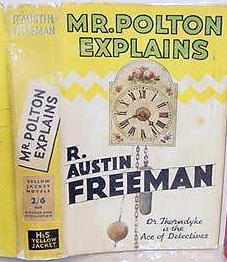
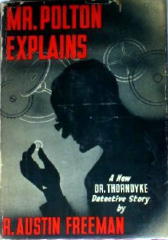
R. AUSTIN FREEMAN – Mr Polton Explains

Hodder & Stoughton, UK, 1940. Dodd Mead, US, 1940. Popular Library #70, pb, 1946.

   We’ve probably all played “what if,” going further and further back in our lives to establish the chain of circumstances which led to playing the very game itself, and in this case to your reading this review.

Polton-UK

   Mr Polton Speaks, written in two parts, begins in this fashion. Nathaniel Polton, orphaned as a toddler, relates the various stages of his somewhat Dickensian life up to his making Dr Thorndyke’s acquaintance, the circumstances of which explain his devotion to the good doctor. He also tells how he learnt certain skills, some of which will be very useful to his employer when he becomes servant/assistant to Dr Thorndyke.

   Much detail is given about Mr Polton’s interest in a particular profession and a specific invention of his which, years later, provides a vital clue to unraveling a mysterious death, the circumstances of which form the second part of the book, narrated by Dr Jervis. To my surprise Mr Polton actually states which particular knowledge contributed to the solution of the crime, though this revelation was not really needed because between autobiographical comments and the description of the scene of the crime it is obvious how the murder was accomplished, if not the person responsible.

   In brief, a fire completely guts a house where Mr Haire has taken rooms. Fortunately for him, he was in Ireland at the time, but unfortunately his cousin, Cecil Moxdale, was staying in the flat. The building is completely burnt out and the body is found more or less charred out of recognition although items found in the debris establish its identity.

   And yet … certain aspects of the death suggest it was not accidental or even suicide and so Thorndyke and Jervis become involved. Although the resolution hinges on a whacking great coincidence which stretches the long arm of coincidence so much it’s amazing it didn’t fall off, on rereading Mr Polton’s section I found circumstances described there (in a more subtle manner than the statement mentioned above) do in fact provide a fair clue or two to the alert reader.

Polton-US

   My verdict:  Alas, this is the most disappointing of this author’s works read so far. In fact, it gives the distinct impression Mr Polton’s autobiography was grafted onto a short story to form a novel. The necessary information could, I believe, have been provided within the section penned by Dr Jervis easily enough and in a far less obvious manner. Shocking to relate, I found Mr Polton’s life story more interesting than the mystery and its resolution, though the latter did have an unexpected twist.

            Mary R
http://home.epix.net/~maywrite/


   E-text link: http://gutenberg.net.au/ebooks05/0500371.txt

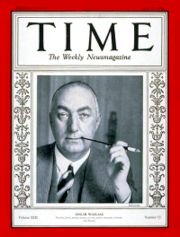
   From the online Wikipedia: Richard Horatio Edgar Wallace (April 1, 1875 – February 10, 1932) was a prolific British crime writer, journalist and playwright, who wrote 175 novels, 24 plays, and countless articles in newspapers and journals. Over 160 films have been made of his novels, more than any other author. In the 1920s, one of Wallace’s publishers claimed that a quarter of all books read in England were written by him.

E Wallace

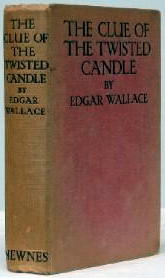
EDGAR WALLACE – The Clue of the Twisted Candle

George Newnes, London, hc, 1917. Small Maynard & Co.,Boston, hc, 1916. Numerous reprints in both hardcover and paperback. TV Film: An episode of The Edgar Wallace Mystery Theatre, 15 August 1960, with Bernard Lee as “Superintendent Meredith.”

   Assistant Commissioner of Police T. X. Meredith, a man of unorthodox though successful methods of detection and best friend of mystery writer John Lexman, has been investigating Remington Kara, an extremely rich Greek with something of a turbulent history and a former suitor for the hand of Lexman’s wife.

   Kara was almost murdered years ago, and such is his fear of another attempt being made his bedroom is “practically a safe.” It features burglar-proof walls, reinforced concrete roof and floor, an unreachable window, and its sole door has in addition to a lock “a sort of steel latch which he lets down when he retires for the night and which he opens himself personally in the morning”.

Hardcover

   Of course Kara is eventually found dead, locked in this safe-like room. How was Kara’s murder accomplished, why did his secretary disappear and his manservant run away, and for that matter who killed the dog in the basement of his house? Was Kara killed by the men he has feared for years or someone else, and if so, who was it and why?

   Answers to these conundrums are revealed at a gathering at the end of the book in which All Is Explained, including how the challenge presented by the locked room was overcome.

   My verdict: On the negative side I felt there were perhaps one too many coincidences and the identity of the murderer was not as well hidden as it might have been. On the other hand, the locked room explanation is ingenious, clues to how it was accomplished are revealed in a fair fashion in the narrative, and I confess I did not foresee one of the final twists. I would sum it up as a diverting, light read.

            Mary R
http://home.epix.net/~maywrite/

   Etext available online.

FLY AWAY GIRL. Warner Brothers, 1937. Glenda Farrell, Barton MacLane, Gordon Oliver, Hugh O’Connell, Tom Kennedy.

   It must have been Glenda Farrell Day sometime last year at Turner Classic Movies, or at a minimum, Torchy Blane Day, since I’ve just discovered that I taped a complete sequence of the Torchy films that day, all eight of them. I watched a few of them last year, decided I didn’t want to overdose on them, put them aside – and promptly forgot about them until a couple of days ago when I came across them again.

Torchy

   This one’s number two in the series, in case you’re counting. I can’t exactly tell you what the appeal is with these movies, since the mystery plots are kind of sappy and so are the characters, to tell you the truth. It’s been a while since I watched the first one, Smart Blonde (1937), so I’d rather you didn’t quote me on this, but I have the feeling that the detective element was the strongest in that one, before the comedy became more and more significant. Since it’s also the only one that was based on a Frederick Nebel pulp fiction story, I think I’m safe enough in saying so.

   Torchy Blane is an ace newspaper reporter, and she must have been quite a model for plenty of young girls in the late 30s and early 40s, because she is an ace, female or not. Her boy friend (or fiancé, more or less) is Lt. Steve McBride (Barton MacLane), who has an ordinary mind for police work and who (therefore) is no match for Torchy. You might consider him lunk-headed, but I think that is why Tom Kennedy is in these movies, as Sgt. Orville Gahagan, a poor poetry-spouting sap who lives for nothing more to use the siren whenever he’s whisking McBride off to the next scene of the crime. Gahagan makes McBride look positively Holmesian in comparison.

   The plot in this particular episode in their lives centers around the murder of diamond merchant in his office, but Torchy’s choice for the killer, a reporter with a rich father, seems to have an iron-clad alibi. When her candidate for a killer takes an around-the-world tour as a newspaper stunt, Torchy talks her editor into allowing her to tag along, hence the title.

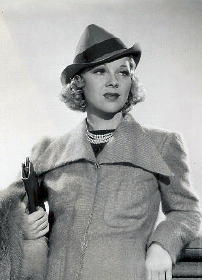
   Actually, I do know what the appeal is for these movies. It’s Torchy herself, or rather Glenda Farrell who plays her: fast-talking and fast-thinking, brassy without being bold, funny and wisecracking, but her mind on only one thing, her story. The photo of her that you see above didn’t come from this movie. I couldn’t find any, I’m sorry to say, but I thought this publicity still would do fairly well in its place.

« Previous PageNext Page »