Reviews


KENDALL FOSTER CROSSEN – The Tortured Path

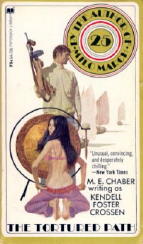
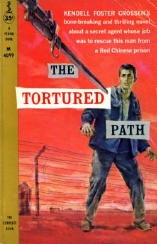
Permabook M4099; paperback reprint, June 1958. Hardcover edition: E. P. Dutton, June 1957. One chapter appeared earlier in Stag Magazine under the title “The Treatment.” Later paperback edition: Paperback Library 64-706, 1971, as by “M. E. Chaber writing as Kendall Foster Crossen.”

   That last byline is rather strange, if you think about it. Kendall Foster Crossen was the author’s real name, and M. E. Chaber was the name he used to write his “Milo March” novels. Paperback Library had been publishing these in uniform editions, all with hugely attractive covers by Robert McGinnis. They must have done well with them, because they when they ran out of Milo March’s adventures to print, to capitalize on Chaber’s popularity, they started doing some of Crossen’s other work in the same numbered format, including this one and several he wrote as by Christopher Monig.
Tortured1

   Milo March was basically an insurance investigator, but he also had connections with the CIA, and his adventures took him all over the world. [For more on March, check out his page on the Thrilling Detective website.]

   Major Kim Locke, the primary protagonist in The Tortured Path, had even more direct connections with the CIA, and I’ll go into the details in a minute. First, though, here’s a list of the books he appeared in, taken from Crime Fiction IV, by Allen J. Hubin:

LOCKE, MAJOR KIM
      * Kendell Foster Crossen:
         o The Tortured Path (n.) Dutton 1957 [China]
         o The Big Dive (n.) Dutton 1959 [England]
      * Clay Richards:
         o The Gentle Assassin (n.) Bobbs-Merrill 1964 [Cuba]

   Why the switch in bylines, I don’t know, but it may have had something to do with the switch in publishers. The Big Dive is scarce; it was never reprinted in paperback, and at the moment, there are only two copies of the hardcover edition offered for sale on the Internet. While The Gentle Assassin never had a paperback edition either, it is fairly common in hardcover. It’s also easily available in a three-in-one Detective Book Club edition.

   Here are the first couple of paragraphs from The Tortured Path, which will give you more information about Major Locke’s background. It will also supply you with a glimpse of the author’s writing style, or so it’s my intention:

    “It started out like any other day in Washington. I’d been cooling my heels there for three months. I was theoretically on duty but I hadn’t anything to do for that length of time. The first month was fine, but then I began to get a little tired of it. I didn’t have an assignment, but I was supposed to check in three times a day. After three months, just checking in was beginning to interfere with my drinking. One thing you can say about Washington – the hunting in the cocktail bars was fine.

    “The name is Kim Locke. Major, U. S. Army, permanently attached to the Central Intelligence Agency. Cloak and dagger stuff. But the only cloak I’d ever seen was worn by a blond adagio dancer and the only time I’d been near a dagger was when I was in the OSS during World War Two. There’d been a Yugoslavian partisan who had a dagger; we’d used it to slice the chickens we caught at night and roasted in coals. So it wasn’t like in the books; no willing broads willing to do anything to get your secrets. But it was a living – if you can call being in the Army living.”
Tortured2

   His assignment? To get himself caught by the Chinese Communists, be brainwashed and undergo any other form of torture they might devise for him, and then rescue an American officer who has secrets that mustn’t fall into enemy hands.

   Which he does. End of book. Well, not quite, but almost. Getting in is far too easy, getting out is another matter, sort of the scorched-earth approach, if you ask me, crude but effective. Crossen has a quiet, breezy style of story-telling, beginning (as you will have seen) with page one onward. The resulting adventure is readable in about a night or two. It is also largely forgettable in about the same length of time.
January 2007

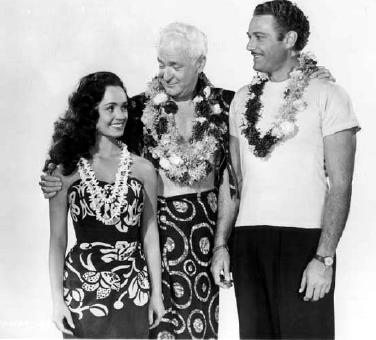
ON THE ISLE OF SAMOA. Columbia, 1950. Jon Hall, Susan Cabot, Raymond Greenleaf, Al Kikume. Directed by William A. Berke.

   Jon Hall made a career out of making movies (and television shows) taking place in jungles, deserts, and South Seas islands, and obviously this is one of them. Checking out his biography on IMDB, among other items of interest I learned that he was of Swiss/Tahitian descent, and that his mother was a Tahitian princess, and I believe that explains a lot.

   And which makes a movie like this one right up his alley, except that as a B-movie it rated a sub-B budget and (as the old saying goes) it probably escaped rather than being released. Hall is also a villain, which is hard to take, given that I remember him most as the star (and hero) of Ramar of the Jungle on TV, episodes of which I believe are available on DVD. I’ve hesitated in picking them up, however, as I’ve been disappointed before in watching what was wonderful when I was ten or twelve and might not be quite so wonderful today.

   As badly-tempered Kenneth Crandall in this short film, barely over 60 minutes long, he flees the successful burglary of a nightclub in Australia in a stolen plane, only to crash on an uncharted island during a hurricane (which was more likely a typhoon, if anyone had taken the time to check). The island is inhabited by beautiful women, strong men and one aged missionary (Raymond Greenleaf), who does his best to convince Crandall to renounce his evil ways. But even with the beautifully vacuous Moana (Susan Clarke) as a love interest, Crandall stays remarkably thuggish and unpersuaded.

Samoa

   The only suspense in this film is how long he will resist. To avoid giving away the ending, let me suggest to you that he may never see the error of his ways, and he dies before his heart (and mind) ever softens at all.

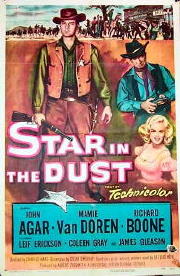
STAR IN THE DUST. Universal, 1956. John Agar, Mamie Van Doren, Richard Boone, Leif Erickson, Colleen Gray, James Gleason, Terry Gilkyson, Harry Morgan. Based on the novel Law Man (Ballantine #51, 1953) by Lee Leighton (Wayne Overholser). Directed by Charles F. Haas.

Poster

   A “B” western, perhaps, but it packs a lot of drama into its 80 minutes. Folksinger Terry Gilkyson, soloing on his guitar, frames the story from time to time, the tale of a bad man named Sam Hall (Richard Boone), who is to be hanged at sundown at the end of the single day in which the this film takes place.

   But why is a review of a western movie here in the first place, on a website dedicated to crime and mystery fiction, you may ask. And I reply, in almost every western, whether in print or on film, there is a crime, and as a bonus, there is often a crime to be solved.

   The mystery in this case is, who hired Sam Hall to kill three farmers who (the ranchers say) crossed over the creek into their lands? The sheriff (John Agar), who’s been staying neutral and keeping the peace, has his own battles to fight, trying to live up to his father’s reputation on the job, for one, and salvaging his wedding to the sister (Mamie Van Doren) of the banker (Leif Erikson) who’s the head of the cattleman’s association (see below).

Mamie

   And (as fate would have it) this would-be brother-in-law is his leading suspect as well. It’s a tough job, but Sheriff Jorden seems up to it. You might think that Mamie Van Doren would be out of place in a western drama, but I certainly didn’t mind. It also seems to me that throughout his career James Gleason always played skinny old men, and at the age of 74, when he made this one, he’d finally grown into the part. Richard Boone may have made a better western villain than he did a western hero (Paladin), and even if you may not agree, he’s at his best (that is to say, his nastiest) in this one.

Agar

   There are a few twists and turns in the tale, more than I expected, but as far as the identity of the man who hired the killer is concerned, unfortunately there is no twist at all. There’s plenty of full color action, though, for those who look for that in their westerns, including one sprawling fight between two ladies who are no ladies at the time at all, neither of whom is played by Mamie Van Doren, who is always very definitely a lady.

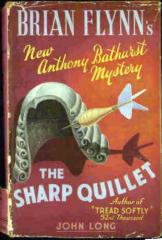
BRIAN FLYNN – The Sharp Quillet. John Long, hardcover, no date stated (1947). No US edition.

   You’ll have to fasten your seatbelts, because I’m going to begin this review with a list of Brian Flynn’s mysteries, and it’s going to be a long one. Taken from Crime Fiction IV, by Allen J. Hubin, these are the British titles only. Most of these were published only in England, but those preceded by (**) did have US editions.

   The detective in every one of these works of crime fiction is a chap named Anthony Bathurst, and since he’s in the book at hand, there will be more about him in a minute. At the present time, there’s no year of death given for his author, Brian Flynn, and I’ll ask a couple of people what they might know about that. First, though, the list of titles:

FLYNN, BRIAN (1885- ) An accountant in government service, a lecturer in Elocution and Speech, an amateur actor.

** The Billiard-Room Mystery (n.) Hamilton 1927.
** The Case of the Black Twenty-Two (n.) Hamilton 1928.
** The Mystery of the Peacock’s Eye (n.) Hamilton 1928.
** The Five Red Fingers (n.) Long 1929.
* Invisible Death (n.) Hamilton 1929.
** The Murders Near Mapleton (n.) Hamilton 1929.
** The Creeping Jenny Mystery (n.) Long 1930.
** Murder En Route (n.) Long 1930.
* The Orange Axe (n.) Long 1931.
* The Triple Bite (n.) Long 1931.
* The Edge of Terror (n.) Long 1932.
* The Padded Door (n.) Long 1932.
* The Spiked Lion (n.) Long 1933.
** The Case of the Purple Calf (n.) Long 1934.
* The Horn (n.) Long 1934.
* The League of Matthias (n.) Long 1934.
* Tragedy at Trinket (n.) Nelson 1934.
* The Sussex Cuckoo (n.) Long 1935.
** Fear and Trembling (n.) Long 1936.
* The Fortescue Candle (n.) Long 1936.
** Tread Softly (n.) Long 1937.
* Cold Evil (n.) Long 1938.
* The Ebony Stag (n.) Long 1938.
** Black Edged (n.) Long 1939.
* The Case of the Faithful Heart (n.) Long 1939.
* The Case of the Painted Ladies (n.) Long 1940.
* They Never Came Back (n.) Long 1940.
* Such Bright Disguises (n.) Long 1941.
* Glittering Prizes (n.) Long 1942.
* Reverse the Charges (n.) Long 1943.
* The Grim Maiden (n.) Long 1944.
* The Case of Elymas the Sorcerer (n.) Long 1945.
* Conspiracy at Angel (n.) Long 1947.
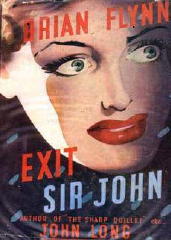
* Exit Sir John (n.) Long 1947.


* The Sharp Quillet (n.) Long 1947.
* The Swinging Death (n.) Long 1948.
* Men for Pieces (n.) Long 1949.
* Black Agent (n.) Long 1950.
* And Cauldron Bubble (n.) Long 1951.
* Where There Was Smoke (n.) Long 1951.
* The Ring of Innocent (n.) Long 1952.
* The Running Nun (n.) Long 1952.
* The Seventh Sign (n.) Long 1952.
* Out of the Dusk (n.) Long 1953.
* The Doll’s Done Dancing (n.) Long 1954.
* The Feet of Death (n.) Long 1954.
* The Mirador Collection (n.) Long 1955.
* The Shaking Spear (n.) Long 1955.
* The Dice Are Dark (n.) Long 1956.
* The Toy Lamb (n.) Long 1956.
* The Hands of Justice (n.) Long 1957.
* The Wife Who Disappeared (n.) Long 1957.
* The Nine Cuts (n.) Long 1958.
* The Saints Are Sinister (n.) Long 1958.

   It certainly isn’t likely to mean anything, but Mr. Flynn didn’t do anything like slow down toward the end of his writing career, did he? Sixteen books between 1951 and 1958, after reaching the age of 66. One might guess that he’d retired from his day job (see above).

   Heading off to see what Google says, with the author having such a common name, it was quickly discovered that any kind of effective search was going to have to be done on Bathurst the character, rather than Brian Flynn the author. And — there’s nothing to be found. All that comes up are books by Flynn for sale from various dealers’ catalogues. Other than what Al Hubin has provided for him in his entry in CFIV, there’s not a single website providing information on either author or character to be found, not one citation, nothing. (That’s about to change, however, isn’t it?)

   Obviously Brian Flynn was no rival to Agatha Christie, but why has he so drastically dropped out of sight? Were his books so indifferently or badly written? On the basis of one example, I’d say no, but on the basis of the very same example, I’d have to agree (if asked) that the style of story is outdated, or at least its ending is. The detective work is essentially sound, although the reader is not made privy to all that Anthony Bathurst knows.

   And I see that I’m writing this review wrong end to, and so to right this wrong, let me jump back to the prologue, in which a defendant in court is sentenced to die (and does), but so does the entire jury, all twelve individuals, wiped out in a rocket bomb attack and preceding the defendant to death. I don’t think I’ve ever read that in a book before!

   At some length of time later, more deaths begin occurring, the first being that of Nicholas Flagon, a justice on the panel that denied the appeal of the defendant in the prologue. Which is why I so strongly dislike prologues, if I may bring this small rant out into the open one more time. I hate knowing facts and information that the detectives on the case do not have. I don’t enjoy it, I don’t like watching bright policeman and even brighter private detectives work their way through investigations on a case that doesn’t really begin (for me) until they’ve caught up to where I already am, due to the wisdom imparted to me when I didn’t really want it.

   End of rant. Dr. Harradine and the local Inspector, a man named Catchpole, are the first on the scene. Tied around the shaft of the dart that has just killed its victim is a slip of paper that says, “A nice sharp quillet. Ay!”

   Off to the dictionary go I, and wouldn’t you? A quillet is not a small pen, as suggested on page 30, but: “An evasion. In French ‘pleadings’ each separate allegation in the plaintiff’s charge, and every distinct plea in the defendant’s answer used to begin with qu’il est; whence our quillet, to signify a false charge, or an evasive answer.” Emphasis on “a false charge.”

   The policemen on the case, and Anthony Bathurst, do not get back to this point until page 111, so OK, I did some investigating on my own and learned something before they did. I’m not contradicting myself, in terms of what I said about prologues just moments before. I think that this is acceptable, isn’t it?

   As for Anthony Lotherington Bathurst, he enters the scene on page 50, when he’s asked by Commissioner Kemble of Scotland Yard to add his expertise to the men on the ground (so to speak) where the victim was killed, their efforts seemingly going nowhere. Bathurst agrees — there’s nothing like a good solid case of mystery to work on — and together with Chief Detective-Inspector MacMorran he makes his way to the otherwise sleepy village of Quiddington St. Phillip, just in time for another death to have occurred.

   From this you may thinking that Bathurst is just another policeman highly regarded for solving crimes, but he is not. He’s a private detective. PI’s in the US have seldom had this kind of respect for their abilities as those who plied their trade in England. Perhaps Bathurst should be called a private inquiry agent, along the lines of a Sherlock Holmes. The name of the profession makes all of the difference in the world.

   By page 113 Bathurst has decided that he knows who the killer is, but (of course) he has no proof. On page 174 he explains, but he fudges a little, in my opinion, for back on page 113, as he relates it later, all he had were the same four suspects that the reader had, with only a high probability as to which of the four it was likely to be.

   Coming in between is a matter of filling in of the details, plus a long stretch of about 25 pages’ worth of unadulterated thriller-like behavior in which the next projected victim of the killer must be protected and the reader (literally) comes along only for the ride. Which is to say that if the reader were kept informed of what is happening, he (or she) would also know who it was the victim is being protected against.

   If that makes any sense at all. In any case, everything works out fine, and handshakes all around are the order of day. While Flynn was no rival to Christie or any of the other names you’re a lot more familiar with, in my opinion neither does he deserve to be forgotten. There are some scenes in this book, well-described, that will linger in memory for a while, including the prologue, and yes, I’d read another adventure of Mr. Bathurst at any place and time that you say, other than the break of dawn.

— January 2007

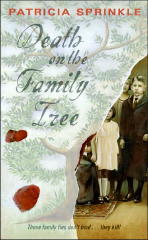
PATRICIA SPRINKLE – Death on a Family Tree

Avon, paperback original; 1st printing, January 2007.

   Here’s an author who’s been writing mysteries for quite a while, and (this may come as no surprise) this is the first one of hers that I’ve read. From the author’s website and a few other sources, including Crime Fiction IV, by Allen J. Hubin, I’ve come up with what I believe is a list of the books she’s done. Note that in some cases her byline is Patricia Houck Sprinkle.

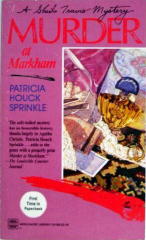
Sheila Travis Series: In Murder at Markham Sheila has been recently widowed and is working for a diplomatic training center in Chicago. Assisting her in solving crimes is her Aunt Mary, who hails from Atlanta, where Sheila frequently goes back to visit. In the third book in the series, Sheila moves back there permanently.

Markham

     Murder at Markham. St. Martin’s, hc, October 1988. Worldwide, pb, October 1992. Silver Dagger Mysteries, trade pb, revised, December 2001.
     Murder in the Charleston Manner. St. Martin’s, hc, May 1990. Worldwide, pb, April 1993. Silver Dagger Mysteries, trade pb, August 2003.
     Murder on Peachtree Street. St. Martin’s, hc, April 1991. Worldwide, pb, October 1993.
     Somebody’s Dead in Snellville. St. Martin’s, hc, August 1992. Worldwide, pb, July 1994.
     Death of a Dunwoody Matron. Doubleday, hc, April 1993. Bantam, pb, August 1994. Bella Rosa Books, trade pb, December 2005.
   A Mystery Bred in Buckham. Bantam, pbo, October 1994. Bella Rosa Books, trade pb, January 2007.
     Deadly Secrets on the St. Johns. Bantam, pbo, August 1995. [Note: This book is extremely scarce. There are only five copies offered for sale on Amazon, for example, with the lowest price being $44.50 for a copy in “good” condition.]

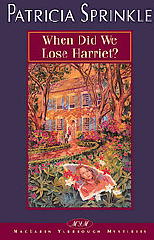
MacLaren Yarbrough Series: In the first book in the series, MacLaren is a wife of Judge Joe Riddley Yarbrough, a magistrate for the state of Georgia. In the second book, after her husband is shot, and two other people are murdered, MacLaren not only solves the crimes, but she takes over his position on the bench as well. After the first two novels were published by a Christian press, the rest of the series were published as mass-market paperback originals.

Harriet

When Did We Lose Harriet? Zondervan, pbo, November 1997.
But Why Shoot the Magistrate? Zondervan, pbo, September 1998.
Who Invited the Dead Man? Signet, pbo, July 2002.
Who Left That Body in the Rain? Signet, pbo, December 2002.
Who Let That Killer in the House? Signet, pbo, October 2003.
When Will the Dead Lady Sing? Signet, pb, June 2004.
Who Killed the Queen of Clubs? Signet, pbo, March 2005.
Did You Declare the Corpse? Signet, pbo, February 2006.
Guess Who’s Coming to Die? Signet, pbo, February 2007.

The Family Tree Series:

Death on the Family Tree. Avon, pbo, Jan 2007.
Sins of the Fathers. Coming in October 2007.

   From Ms. Sprinkle’s website she says about her work in progress: “Now I am deep in the tenth, and probably last, MacLaren Yarbrough mystery, What Are You Wearing To Die?” Which strongly suggests, of course, that she’s in the midst of shifting gears. Future mystery adventures will be concentrating Katharine Murray, a middle-aged Atlanta housewife who’s well-off and somewhat pampered, and whose first brush with crime in any form Death on the Family Tree is.

   The book begins on her 46th birthday, which she’s spending alone and which, unbeknownst to her, is her last day in her old comfortable life. Her children have moved out, and her husband Tom is out of town. Opening a box left to her by her recently departed Aunt Lucy, she finds two unusual items in among the junk: an ugly bronze necklace dating from the mid-1800s from Halstatt, Austria, and a diary, written in German and dating from a far more recent 1937.

   As she begins some genealogical researching she soon discovers relatives that she never knew she had, that there are secrets in her family she had never been told about, and that the diary means something to someone who will stop at nothing to possess it. You may have guessed that about the latter.

Family

   Also re-entering her life is a former boy friend, one she’d unceremoniously dumped before she married Tom, who is blissfully unaware that his absence in this crucially important time is his wife’s life is as serious as it is. Make that totally oblivious. (Speaking from a man’s point of view, he is a blithering idiot, and if he doesn’t watch out, he will deserve what he will most certainly get in the next book in the series.)

   Forgive me. I had to get that out of my system. It takes a while for all of Katharine’s family, her friends, and her friends’ families straightened out in the reader’s mind, and there surely are a lot of them, family, friends and relatives, that is. Katharine herself is prone to talking too much to all of them about her finds, and almost everyone else she meets. This was a tendency that this reader found almost intolerable, especially when all of this excessive talking leads to her being chased by cars, break-ins at her home, and eventually worse: several murders.

   It is soon clear (or it was to this reader) who is responsible for all of this nefarious activity, but Katharine, who even toward the end of the book still has not learned much about this Brand New World she is in, walks straight into the hands of the enemy, as if without a thought in her head.

   I don’t usually start yelling at characters in the mystery fiction I am reading, but I did this time. Perhaps that means that I cared? Perhaps so.

— January 2007

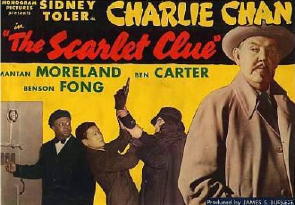
THE SCARLET CLUE. Monogram, 1945. Sidney Toler, Mantan Moreland, Benson Fong, Virginia Brissac, Ben Carter, Janet Shaw, I. Stanford Jolley [uncredited]. Director: Phil Rosen.

Tommy Chan: You know Pop, I’ve got an idea about this case.
Charlie Chan: Yes, well?
Tommy Chan: Well, I had an idea, but it’s gone now.
Charlie Chan: Possibly could not stand solitary confinement.

   My brother and I used to watch these Monogram entries in the Charlie Chan series on television every Friday night when we were kids, and we sure got a hoot out of them — even, I’m sure, the earlier ones with Warner Oland as well. We had to keep the sound down, since our parents were sleeping in the downstairs bedroom then, so we sat as close to the screen as we could, and enjoyed the heck out of staying up late, because it didn’t happen often.

   The funny thing is, I don’t remember any of them, only some general impressions. The crimes, the oddly stiff Sidney Toler, the interchangeable actors who played the number two or number three sons, and we wondered why Birmingham Brown (Mantan Moreland) wasn’t in all of them.

Poster

   A major clue in this one is a bloody footprint found at the murder that occurs in the opening scene. The plot has something to do some radar plans that foreign agents want to steal, but because the scientific laboratory is in the same building, most of the action centers around a radio station where a relatively bad soap opera production has their on-the-air studio. (When Charlie visits the lab and is shown a wind tunnel with temperature and wind effects, we know immediately that the this same wind tunnel is going to play a large part of what happens later on. We are correct.)

    The detection is minimal. I was steered to the most obvious guilty suspect as being the killer, but I didn’t have my head screwed on too carefully, I’m afraid. There are spies, stooges, blackmailers, and people in funny masks, enough to keep your eye off the fact that, as one obvious question among others, how was the elevator with its deadly surprise constructed? It must have been quite a feat, especially with nobody noticing.

   I mentioned Mantan Moreland, the black comedian who later on got a bad rap, or so I’m told, for playing such broad comic relief in movies like this one. Actually, I think that he and Tommy Chan have more screen time than does Mr. Chan himself, and never a serious part of the investigation are they ever. (One wonders why a great detective like Mr. Chan would put up with … but, oh well, never mind.)

    Moreland and fellow comedian Ben Carter do a couple of great turns in an old vaudeville bit called the “infinite” routine, wherein both men carry on a conversation something like this, with neither one ever quite completing all of their sentences:

    “Why if it isn’t …”

    “Yes, and I haven’t seen you since …”

    “No, it was longer than that. Last time I saw you, you were …”

    “Well, I’ve lost weight! And you lived in …”

    “No, I’ve moved to …”

    “That’s a bad neighborhood. How can you live there?”

      and so on, and so on …

   Afterward, a thoroughly befuddled Tommy Chan asks, “Who was that?”

   Birmingham’s answer: “He didn’t say.”

   Well, my brother and I thought it was funny. We also woke our parents up and we were sent to bed.

WILLIAM MAGNAY – The Hunt Ball Mystery.

Ward Lock, UK, hc, 1918. Brentano’s, US, hc, 1918. Other later printings exist, including Aldine Mystery Novels #22, UK, 1927. Etext at the Gutenberg Project.

   Give me a novel opening with a fellow arriving for a social gathering at a country house, and I’m as happy as the proverbial clam.

   The Hunt Ball Mystery begins in just this fashion, and right away we are in crisis mode. Hugh Gifford discovers he is without evening clothes due to a mistake made by the guard unloading luggage. Gifford and his friend Harry Kelson are going to a Hunt Ball to be held that evening at Wynford Place.

   The station master arranges for Gifford’s traps to be transferred to a down train at the next stop, although Gifford won’t get them until about ten. However, this still leaves time for him to attend the ball.

   The two men share a fly to the Golden Lion Hotel with a stranger who mentions he is also staying there and will be going to the ball. Gifford sniffily decides the man is not of their class, a conclusion based largely on the other’s looks and manner. The man is Clement Henshaw, brother of Gervase, whom Gifford knows by repute as a fellow legal eagle.

   Gifford insists Kelson goes on to the ball ahead of him, and Kelson and Henshaw depart. While waiting for his missing luggage, Gifford decides to stroll over to Wynford Place to take a look at its exterior. He returns two hours later, obviously having had a shock. Even so, he dons his now retrieved evening clothes and tootles off to the jamboree, where he makes the acquaintance of Dick Morriston, owner of Wynford Place, and Dick’s sister Edith.

   Not long before four next morning the hotel landlord pops in to ask if the Hunt Ball is over as Henshaw has not returned. After encouraging the landlord to lock the doors against his missing guest, Kelson pours himself a drink and suddenly notices blood on his shirt cuff.

   Then the missing Henshaw is found dead in a locked room with the key on the inside and an 80 feet drop from its window. The general consensus is Henshaw committed suicide. Gervase Henshaw, the dead man’s brother, disagrees, and so does the doctor who gives evidence at the inquest.

   At this point the mystery gallops off in full cry after the fox of whodunnit, how, and why. Revelations follow concerning what upset Gifford on his nocturnal walkabout, whence came the blood on Kelson’s cuff, the solution to the locked room matter, and so on.

   My verdict: I have long been a fan of the Country House Mystery and so was disposed to like The Hunt Ball. Alas, this particular visit to a rural estate was not too successful. The locked room solution is pedestrian and most readers will guess it. I found the characters unsympathetic and the police presented as inept, not least in overlooking a couple of clues — including one of a particularly glaring nature. Then too the introduction of an important witness was without previous hints of this person’s existence.

   It may be this novel was intended as a spoof of the Country House Mystery, but all in all, I found The Hunt Ball Mystery something of a disappointment.


   From Crime Fiction IV, by Allen J. Hubin, a chronological listing of Sir William Magnay’s other mystery fiction:

MAGNAY, [Sir] WILLIAM, 2nd baronet (1855-1917)

* The Fall of a Star (n.) Macmillan 1897.
* The Heiress of the Season (n.) Smith, Elder 1899. Appleton, US, 1899.
* The Pride of Life (n.) Smith, Elder 1899.
* The Man-Trap (n.) Smith, Elder 1900.
* The Red Chancellor (n.) Ward 1901. Brentano’s, US, 1901.
* The Man of the Hour (n.) Ward 1902.
* Count Zarka (n.) Ward 1903.
* -Fauconberg (n.) Ward 1905.
* -A Prince of Lovers (n.) Ward 1905.
* The Duke’s Dilemma (n.) Long 1906.
* The Master Spirit (n.) Ward 1906. Little, US, 1906.
* -The Amazing Duke (n.) Unwin 1907.
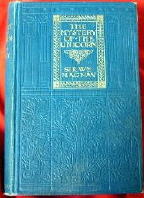
* The Mystery of the Unicorn (n.) Ward 1907. Street & Smith, US, 1910.

Unicorn

* The Pitfall (n.) Ward 1908.
* The Red Stain (n.) Ward 1908.
* A Poached Peerage (n.) Ward 1909.
* The Powers of Mischief (n.) Ward 1909.
* The Long Hand (n.) Paul 1912.
* Paul Burdon (n.) Paul 1912.
* Rogues in Arcady (n.) Ward 1912.
* The Fruit of Indiscretion (n.) Paul 1913.
* The Players (n.) Hodder 1913.
* The Price of Delusion (n.) Paul 1914.
* The Black Lake (n.) Paul 1915.
* The Cloak of Darkness (n.) Ward 1915.
* The Hunt Ball Mystery (n.) Ward 1918.
* The Flamards Mystery (n.) Pemberton 1942.
* The Eleventh Hour (n.) Odhams n.d.

   The following conversation between Peter Rozovsky and myself previously appeared as a series of comments after my review of the 1974 movie version of Murder on the Orient Express, which you should go back and read, or even re-read, before continuing on with what we had to say. Peter goes first:


   This will not be an easy comment to make, since my one quibble with the movie involves a plot point, and I want to avoid giving vital information away to anyone who has not yet seen the movie. As Poirot did, I prefer the easier solution. So, first, for the simple matters.
   I agree completely with your assessment of Albert Finney’s performance. He is almost demonic at times, almost scary, which is the last thing one expects of a Poirot. His performance was a most pleasant surprise.

   Lauren Bacall’s performance was enjoyable, but I liked Ingrid Bergman’s better. And I had never realized until now not just how beautiful Vanessa Redgrave’s face was, but how wonderfully she could use it. I also enjoyed John Gielgud’s and Richard WIdmark’s performances as well as several of the others.

   If the movie reflects the novel faithfully, I can see which aspect would have troubled censors. It’s a sobering question that such a matter could keep the story off the screen for so long.

   Finally, the plot point: the resolution, as presented on screen had a ritualistic aspect that I found far-fetched. I can say no more until everyone in the world has seen the movie or read the novel. When that happens, we can discuss my objection openly.

         Peter

      Detectives Beyond Borders
       “Because Murder Is More Fun Away From Home”

      ========================

Peter

   Or should I call you “Artful Dodger.” Thanks for being so skillful in saying what has to be said about the movie without actually revealing what it is that can’t be talked about.

   Why is it, I wonder, why so many otherwise intelligent people can’t resist giving the solutions away to detective story plots? Only this morning I read an op-ed column in the Hartford Courant which, to make another point, gave away for nothing the ending of Murder on the Orient Express.

   And as for The Murder of Roger Ackroyd, the mystery that Christie is even more famous for, you can forget it. Even people who are trying to recommend the novel to others do so by saying, “You’ll never guess who did it. It was …” And every kind of variation on blab, blab, blab comes spouting forth.

   In any case, however, I certainly agree with you about the way the crime itself was committed, as shown on the screen. It seemed to me to be borderline distasteful. But more than that, because of the sensationalistic nature of this aspect of the film, the point that (I think) was intended to be conveyed was lost.

   One other thing. While I enjoyed Lauren Bacall’s performance more, in more ways than one, I would not have considered it worthy of an Oscar. Ingrid Bergman’s, yes, even if I quibbled about it.

      – Steve

      ========================

   I thought it was less distasteful that it was slightly ridiculous. I’ll have to go read the novel to see how Christie made the same point and if she did so any differently.

   Regarding people who give away plots, they are selfish, stupid, or simply unable to distinguish between contemporary crime stories, in which who did it tends to be less important, and older ones, in which the mystery aspect is paramount. They add obtuseness and lack of taste to their selfishness or stupidity.

   I realize now that one aspect of Ingrid Bergman’s performance may have especially endeared it to Oscar voters. She was a beautiful woman playing an unbeautiful character. It’s been noted that Oscar voters tend to reward that sort of thing.

          — Peter

      ========================

   I responded by describing what I cannot divulge here, but I mentioned Ingrid Bergman’s performance in a way that *might* disclose plot points that I shouldn’t, and Peter agreed with me about her. I also spoke in detail about what I saw behind the way the murder was committed. Peter replied that he hadn’t noticed or realized that, and that in retrospect the clues were fairly planted, a nice touch.

   Now of course you may be wishing you had a rolling pin to throw at me, and if I were in your shoes, I think I might be wishing the same. To that end I have uploaded the continuation of our conversation here. Please note that the ending will be discussed in detail, and it is up to you to decide whether it is safe for you to go read it or not.

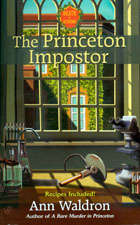
ANN WALDRON – The Princeton Imposter

Berkley, paperback original. First printing, January 2007

   This is the fifth mystery novel from Ann Waldron’s pen, all of them in her McLeod Dulaney series. According to her website, she’s also the author of a number of well-regarded biographies and a number of children’s books, both fiction and non.

   Like her fictional character – who’s female, by the way, which I’d better add in case you’re seeing her name for the first time and you’re not sure – Ann Waldron has been a journalist and writer her entire working career. For the record, here’s the list of all five of her mysteries, each of them taking place in and around Princeton University:

The Princeton Murders. Berkley, pbo; January 2003.
Death of a Princeton President. Berkley, pbo; February 2004.
Unholy Death in Princeton. Berkley, pbo; March 2005.
A Rare Murder in Princeton. Berkley, pbo; April 2006.
The Princeton Imposter. Berkley, pbo; January 2007.

   I imagine you see the pattern here as well as I do. Whenever McLeod Dulaney is on campus, that’s the semester you should be heading abroad or taking a sabbatical. McLeod herself is not a full-time faculty member; she’s an award-winning journalist and a visiting professor from Florida who teaches one course in journalism a year at Princeton University. Not so coincidentally, that is precisely where the author herself began working more than 30 years ago.

Imposter

   Which is why the love of the school and campus – the students, the staff and the professors, the legend and the lore – is as much of a key ingredient of the story as it is. The “imposter” in the title is Greg Pierre, one of McLeod’s better students, an older student who managed to gain admission to the university under an assumed name and falsified credentials. It seems that he’d previously been arrested in Wyoming – on false charges he says – and in order to come to New Jersey, he had to break parole.

   And soon after his arrest the fellow who turned him in is found murdered, a grad student in the chemistry department who (as it turns out) was highly unliked for a number of reasons, which makes for a long list of suspects. But when McLeod’s good friend in the police department, Lt. Nick Perry, seems to settle in on Pierre as the most likely of them – no surprise there – she thinks otherwise, and she sets out to prove it.

   Waldron writes in short, crisp, no-nonsense sentences, and McLeod Dulaney, in a number of ways her fictional alter ego, perhaps, conducts her investigation in very much the same style. Investigative journalists, by the nature of their profession, soon acquire the knack of asking questions in a way that people answering them sometimes reveal more than they intended, or if not, they quickly find another line of work. McLeod doesn’t need to worry on that account.

   On the other hand, while she does a whole lot of detecting, she does not do a whole lot of deducting. (One does not necessarily imply the other.) First she decides that this student is the guilty party, then that professor, and as a result, she always seems to be one step behind – she doesn’t ever seem to catch up. Which of course leads to the ending. In my book, it comes as a letdown, leaving the reader (me) feel caught standing on the wrong foot at the wrong time, or should that be the right time? It also feels cluttered — more for dramatic effect, I thought, than for any other reason.

   Overall, then? Here’s a book that’s well worth reading for anyone who’s fond of mysteries which either take place in academic locales or rank well above average in the writing department, or both. You can take my other caveat for whatever it might be worth.

— January 2007

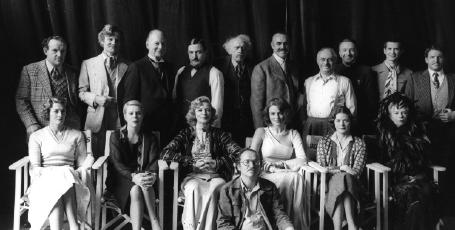
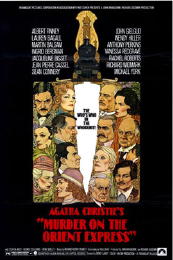
MURDER ON THE ORIENT EXPRESS. Paramount, 1974. Albert Finney, Lauren Bacall, Martin Balsam, Ingrid Bergman, Jacqueline Bisset, Jean-Pierre Cassel, Sean Connery, John Gielgud, Wendy Hiller, Anthony Perkins, Denis Quilley, Vanessa Redgrave, Rachel Roberts, Richard Widmark, Michael York, George Coulouris. Directed by Sidney Lumet.

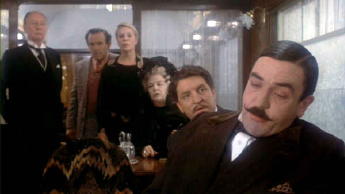
Group

   They don’t make movies with all-star casts like this anymore, and maybe for a couple of good reasons. First of all, I don’t think you can convince me that in this modern, contemporary era of movie-making there are enough stars with the on-screen magnitude to match the ones you see above to make a film like this today.

   And secondly — and here’s a point in favor of the small-scale modern day casting — having too many stars can sometimes detract from the story and divert the audience’s attention away from it.

   Your eye sees the star, in other words, and you don’t see the character. The actors play roles rather than disappearing into parts. It probably can’t be helped in extravaganzas like this, but — and this is a rather subtle “but” — in thinking it over afterward, in terms of this grand, elaborate production of one of Agatha Christie’s masterpieces of deductive detective fiction, it may have even helped.

Still

   I’m sorry if I’m being cryptic here, but if you’ve seen the movie, it’s possible that you very well know what I mean.

   Before going on, and perhaps I shouldn’t admit it, but last night was the first time I’ve seen the film. I don’t know how I missed it when it first came out, or if I did, I’ve forgotten it completely, and I hardly believe I could have done that.

   So in what follows, you’re getting my opinion as it’s just been formed, with a “mature” eye, and not by the eye of a 30-something. (Notice that I put “mature” in quotes, keeping in mind that being old enough to collect Social Security does not necessarily imply mature.)

   Albert Finney as Poirot. Other than the later BBC productions with David Suchet, and I regret to say that I have seen only one of them, I think too many actors play Poirot as a comic character, what with his large assortment of eccentric mannerisms and sometimes faulty English.

   In the opening minutes of Orient Express, I could feel myself cringing at the anticipation of yet another performance played for laughs, but when Poirot gets down the business of solving the murder of a notorious crime figure traveling incognito on the train heading from Istanbul to England, he is exactly that. Down to business.

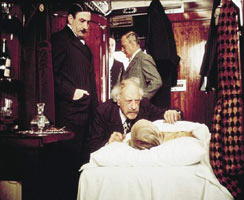
   The final scene, confronting the group of passengers who are the only suspects on the snowbound Express, takes at least 20 minutes of intense revelation, going over the clues and the deductions the Belgian detective made from them.

   I should have timed how long the scene actually takes. I know that I’ve read somewhere that filming the scene, in the restricted confines of the dining car, took several days. I can believe it.

Still2

   Luckily the flashback scenes, with the crime being reconstructed, piece by piece, break up the sequence of talking heads in a rhythm that slowly builds and builds upon itself.

   Even so, the lack of action that this approach entails means that there’s hardly action enough to suit modern day audiences, or am I only being cynical again?

   Finney is probably the only actor to play a detective concerned with clues and not the third-degree in back rooms to have been nominated for an Oscar, but on second thought, without going to check on it, there’s a finite chance that I’m wrong about that.

   But as for his performance, as regarded by others, according to IMDB: “An 84-year-old Agatha Christie attended the movie premiere in November of 1974. It was the only film adaptation in her lifetime that she was completely satisfied with. In particular, she felt that Albert Finney’s performance came closest to her idea of Poirot. She died fourteen months later, on January 12, 1976.”

   If she was pleased, then how I dare say anything otherwise? I can’t, and I don’t. As for the rest of the cast, while I enjoyed Lauren Bacall’s role as the the outspoken (and never stopping) American tourist more, it was Ingrid Bergman who actually won an Oscar, for her much briefer part as a semi-demented Swedish missionary lady. A good performance, even a very good one, but I have a feeling it may have been a slow year for the Academy.

   Should I say something about the plot, more than I have so far? Perhaps not, but this is a tour de force of some magnitude, based as it was on the kidnapping and murder of the Lindbergh baby. The book was first published in England in 1934, and as Murder in the Calais Coach in the US later the same year.

Poster

   Before the movie was shown on Turner Classic Movies, which is where I taped it from, the host, Robert Osbourne, pointed out that it took 40 years before the movie could pass the Movie Code. If you know the story, you will know why, and once again, that is all I am able to say about that.

   In terms of the detective work — well, let me tell you a story. Back when I was young, and maybe even younger than that, I decided that the next Agatha Christie novel I read, by golly I was going to take detailed notes and actually solve the murder myself. Well I did, and I didn’t.

   I was so upset at how the crime was committed and who did it that I literally threw the book across the room. Carefully, of course.

   The movie was extremely successful. Albert Finney was asked, but he turned down the opportunity to play Poirot again. Peter Ustinov, chosen in his place, played the part in Death on the Nile (1978), Evil Under the Sun (1982), and Appointment with Death (1988).

   He also appeared in three made-for-TV films: Thirteen at Dinner (1985), Dead Man’s Folly (1986), and Murder in Three Acts (1986). From what I remember — I haven’t seen any of these films in a while — I mostly regretted Ustinov in the role. Albert Finney, I think I could have gotten used to, now that I’ve had some time to think it over, and even more so as time goes on.

[UPDATE] 03-11-07. Looking back on my comments above, I regret not saying more about the opening terminal scene with the passengers boarding the train in the Istanbul station. Beautifully photographed, highly choreographed, and true to the period, it is nearly worth the price of admission in itself.

   Before I say anything more about it, though, I’m going to have to go back and watch it again. It was far too “visual” the first time, but for me, opening scenes often are. I find myself trying to make sure I’m not missing anything of the story while, at the same time, I’m struggling to take in everything there is to see. Delightful!

[A little bit later.] It was too hard to resist. I’ve just ordered the DVD from Amazon, the version with director Sidney Lumet’s commentary on “The Making of the Movie,” and who should know more how the movie was made than he?

« Previous PageNext Page »