Thu 8 Mar 2007
Review by Mary Reed: MARY ROBERTS RINEHART – When a Man Marries
Posted by Steve under Authors , Crime Fiction IV , ReviewsNo Comments
When a Man Marries is available online in etext form at the Gutenberg Project. Mary also points out that some additional biographical information on Mrs. Rinehart can be found online, including this website as a prime example.
Mary Reed has her own website, shared with her co-author Eric Mayer; you are cordially invited to stop by. Mary and Eric also did a Pro-File interview for the original Mystery*File website before it went on its current long hiatus.
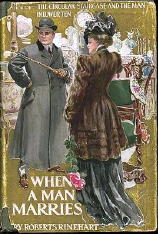
MARY ROBERTS RINEHART – When a Man Marries (Bobbs-Merrill; hc, 1909. Hardcover reprint: Grossett & Dunlap, no date. Wildside Press, trade ppbk, 2004)
Being excessively fond of locked room mysteries, imagine my delight once I began reading When A Man Marries to find it based on a twist on same. Set in a house full of Bright Young Things (sent up mercilessly by the author, Mary Roberts Rinehart, whose The Circular Staircase is occasionally mentioned within these walls) the plot unspools as several BYT’s suddenly find themselves sequestered in a large house under quarantine because the butler has just been stricken with smallpox.
Meantime, the protagonist has agreed to pretend to be the wife of the house owner. This came about because the BYTs are attending a dinner party at the house, during which their host learns his dragon of an aunt — who holds the purse strings — is coming for an unexpected visit. This rich aunt has not been told he is now divorced because then the flow of money would end (fortunately she hasn’t met the now ex-wife). Complications of course ensue including the rest of the servants decamping before the Board of Health quarantines the house, leaving in such haste they do not even bother to tell the master why they are leaving, the ungrateful things.
There’s a policeman imprisoned in the furnace room, and no sooner is the house and its inhabitants securely locked down for the duration when valuable items such as jewelry start going missing … meanwhile, the ex-wife having arrived just before quarantine was declared is now concealed from the aunt’s eyes in the kitchen below stairs, Rich Aunt is also locked in the house with the entire bunch, and one of other Bright Young (Male) Things foolishly wagers a large sum the entire crew will get out of quarantine within 24 hours — quite illegally of course and talk about chronic lack of social conscience — plus there are newspapers reporters and photographers camping around the house as well as on the roof of the house next door to keep an interested public fully informed.
It struck me as I read that it would have made a wonderful screwball comedy/mystery with Cary Grant playing the fellow imprisoned engineer from South America, who is most emphatically *not* a BYT. How could you not laugh out loud at the whole frothy affair?
And I did, Oscar, I did.
[UPDATE] 03-09-07. When I asked Mary to say some more about the criminous content of When a Man Marries, this was her reply:
Thinking that Al Hubin might like to know this, I sent Mary’s comments on to him. Here’s what his response was, which was pretty much what I suspected it would be:
If anything I guess I err on the side of over-inclusion, and I think I’ll add this with a dash (Addenda #12).
Wed 7 Mar 2007
MARY ROBERTS RINEHART – The Yellow Room
Dell 9790; paperback reprint, later printing, April 1971. Hardcover, first edition: Farrar & Rinehart, 1945. Previously (?) published as an eight-part serial in The Saturday Evening Post, September 28 through October 27, 1945. Cassell & Co., UK hardcover, 1949; Thriller Book Club, UK hardcover, 1950.
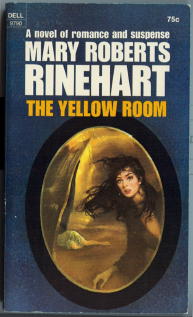
Bestseller B95, digest pb, 1947. Bantam 314, pb, April 1949. Other Dell paperback editions include: Dell D179, 1956; Dell 9790, October 1962; Dell 9790, 1967. Also: Zebra (Kensington), pb, 1973, 1988, 1990 (3rd pr.), 1991, 1996 (5th pr.). Included in Mary Roberts Rinehart: Three Complete Novels by America’s Mistress of Mystery [contents: The Bat, The Haunted Lady, and The Yellow Room] Zebra, pb, 1995.
It is quite possible that I’ve missed a few editions of this book. In particular, there are at least nine listings on ABE of a hardcover edition from 1955 (Farrar & Rinehart), but whether that’s a misprint or no, I do not presently know. There may also have been a US hardcover book club edition, but with no definitive information to back this statement up, I have not included it. Suffice it to say, however, if you’d like to locate a copy of this book to read, even a hardcover edition, you shouldn’t have any trouble.
Rinehart’s writing career, as least as far as her novels and collections are concerned, began with The Man in Lower Ten from Bobbs-Merrill in 1909, but the story’s even earlier appearance was in serialized form, in All-Story Magazine for January through April, 1906.
According to various online sources which I haven’t attempted to verify, Rinehart suffered a severe heart attack in 1938 while living in Maine, and apparently was a semi-invalid for much of her later life. In any case, from that time on there were only four more novels to come from her pen – she never used a typewriter, according to one source – and of those, The Yellow Room is next to last. Only The Swimming Pool (1952) came later. (This statement excludes several collections of novelettes and short stories.) Still perhaps one of the most famous mystery writers of all time, Mary Roberts Rinehart died in 1958.
Appearing after a three-year gap, following Haunted Lady in 1942, The Yellow Room was written when the author was 67, which may go a long way in explaining some apparent slippage in the her writing ability, or perhaps the flaws I saw were always present. I will have to rely on someone more familiar with her earlier work than I am to be able to say more.
The book itself takes place in 1944, and the opening chapters go far in describing the general difficulties of life at home in wartime, what with rationing, limited travel opportunities, the absence of men except for the oldest and/or the feeblest, and the hardest of all – waiting for news of loved ones fighting (or reported missing) on the front lines. When Carol Spencer’s invalid mother wishes to move from New York City to the family’s summer home in Maine, it is up to Carol, with only three female servants to assist, to tackle the work involved in doing so.
Little did she suspect or know – and yes, that’s the kind of book that Mrs. Rinehart is famous for writing – that she would find the house still shut up and not opened. Lucy, a local woman who is the housekeeper, she learns the next day, is in the hospital with a broken leg. Lights have been seen in the house, Carol is told, shining from the room where Lucy says she never was before her accident.
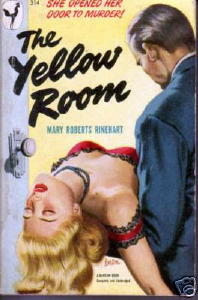
Another discovery occurs on page 27: Another woman is found dead in a linen closet, partially burned as if someone had been hoping to dispose of her body. When asked, Lucy’s story does not ring true; there is something she is not telling. And it is precisely here that the reader’s frustration begins, or at least they did with at least one reader: me. There are many, many questions that if asked are not answered, and there other questions that seem never to be asked, and if they were answered, at the right time and the right place, the mystery – one has the uncomfortable feeling – would, at that time and that place, simply cease to exist.
Coming to Carol’s aid is her next-door neighbor, the worldly but still young Major Dane, who has been injured from work for US Intelligence, or so it seems. He has been recuperating in the area until deemed fit to go back to duty. The police, generally speaking, are of little or no help. Truth be said, they seem far more antagonistic toward Carol than any evidence seems to say they should be.
By page 126 – I jotted a note to myself to this effect at this exact spot, so I am indeed able to be this precise – the facts, what there are of them, are so far muddled that the average reader, it seems to me, will either (A) have given up or (B) have shrugged their shoulders and allowed themselves to follow along, no more and no less, just to see where the author may be headed. There are 256 pages of small print, so at page 126, it is an important decision that must be made whether or not to stop or plunge on, keep going, and rely on the author’s name and reputation that the story may yet be salvaged.
I often exaggerate, and the previous paragraph is one of those times, but not by much. Considering Major Dame, who by proximity feels himself becoming closer and closer to Carol, to be the primary detective, there are too many times when we (the reader) are not given total access to his thoughts, and too many other times when the point of view has shifted, and we (the still faithful reader) are shown scenes that Dane knows nothing about.
Frustration, yes, but please (if you are ever the reader) keep the faith. The ending, with all of its revelations, is worth waiting for. Mrs. Rinehart has some nifty tricks up her sleeve for you. Even though the buildup to the final couple of chapters might have been more capably accomplished, and whether the end result is realistic or not, I think that even at this late stage in her career, in terms of pulling off the (almost) totally unexpected, she still had the right stuff. I feel quite justified in myself in sticking with Plan B.
[UPDATE] 03-10-07. For more about Mary Roberts Rinehart, see Michael Grost’s informative article about her career as a writer on his extremely comprehensive Guide to Classical Mystery and Detection website.
Tue 6 Mar 2007
Bill Pronzini on VALERIE SHORE and MICHAEL KNERR.
Posted by Steve under Authors , Collecting , ReviewsNo Comments
Reason: I’d begun to suspect the book didn’t exist, despite the listing in Hubin, because it has been on my paperback want list for maybe a dozen years and yours is the first copy I’ve ever seen. So happens I collect Major Books — in general, they were the Phoenix Press of 70s paperbacks, more than 50% qualifying as “alternative classics” — and Final Payment is one of only two MB mysteries that I don’t have. And judging by your review, it’s one of the few good ones MB published.
Also noted your piece on Michael Knerr. I don’t have Travis, the book you reviewed, but do have and have read the Monarch, The Violent Lady. Pretty good adventure/mystery tale set mainly on a 49-foot yawl on a long Caribbean treasure cruise.
>> I almost hated to tell Bill that I paid either a dollar for the copy of Final Payment that I found, plus shipping — or was it a pound, since I bought it on eBay from a seller in England — but sometimes collectors tell each other stories like that. As I did so, I asked him about his overall interests in Major Books, and I guess he’s still talking to me, since he replied:
>> Just in case you were wondering: I collect the Gothics and westerns from Major Books too. That makes at least three of us, since my good friend Dan Roberts collects everything that Major Books published, the straight romances and the non-fiction as well. (To the people we meet in the ordinary world, the three of us look as normal as anyone else.)
Sun 4 Mar 2007
Review: DAVID HUME – Requiem for Rogues
Posted by Steve under Authors , Characters , Crime Fiction IV , Reviews[5] Comments
DAVID HUME – Requiem for Rogues
Collins, UK, hc, 1942. Reprints: 1946?, 1952. Collins White Circle #380, Canada, pb, 1949.
The author, first of all, is NOT David Hume (April 26, 1711 – August 25, 1776), who was a Scottish philosopher, economist, and historian, and according to at least one source, one of the most important figures in the history of Western philosophy and of the Scottish Enlightenment.
Nor is it his real name, for which see below. One does idly wonder why Mr. Turner chose it as a working by-line, though. It also makes it difficult to come up with information about him on Google, most of the searches picking up the wrong man, obviously.
On one website, I did come across the following, however:

From Crime Fiction IV, by Allen J. Hubin, which of course I turned to next, if not first, comes the following list of titles by Mr. Hume. These are the British editions only:
* Bullets Bite Deep (n.) Putnam 1932 [Mick Cardby; England]
* Crime Unlimited (n.) Collins 1933 [Mick Cardby; England]
* Murders Form Fours (n.) Putnam 1933 [Mick Cardby; England]
* Below the Belt (n.) Collins 1934 [Mick Cardby; England]
* They Called Him Death (n.) Collins 1934 [Mick Cardby; England]
* Too Dangerous to Live (n.) Collins 1934 [Mick Cardby; England]
* Call in the Yard (co) Collins 1935 [Det. Insp. Sanderson; England]
• Call in the Yard • na The Thriller Mar 2 1935
• The Murder Trap • na The Thriller Apr 13 1935
• The Secret of the Strong Room • na The Thriller Dec 1 1934
* Dangerous Mr. Dell (n.) Collins 1935 [Mick Cardby; England]
* The Gaol Gates Are Open (n.) Collins 1935 [Mick Cardby; England]
* Bring ’Em Back Dead! (n.) Collins 1936 [Mick Cardby; France]
* The Crime Combine (co) Collins 1936 [Det. Insp. Sanderson; England]
• The Crime Combine • na The Thriller May 2 1936
• Midnight’s Last Bow • na [unknown]
• The Murder Rap • na The Thriller Jul 25 1936
* Meet the Dragon (n.) Collins 1936 [Mick Cardby; England]
* Cemetery First Stop! (n.) Collins 1937 [Mick Cardby; England]
* Halfway to Horror (n.) Collins 1937 [Mick Cardby; England]
* Corpses Never Argue (n.) Collins 1938 [Mick Cardby; England]
* Good-Bye to Life (n.) Collins 1938 [Mick Cardby; England]
* Death Before Honour (n.) Collins 1939 [Mick Cardby; England]
* Heads You Live (n.) Collins 1939 [Mick Cardby; England]
* Make Way for the Mourners (n.) Collins 1939 [Mick Cardby; England]
* Eternity, Here I Come! (n.) Collins 1940 [Mick Cardby; England]
* Five Aces (n.) Collins 1940 [Mick Cardby; England]
* Invitation to the Grave (n.) Collins 1940 [England]
* You’ll Catch Your Death (n.) Collins 1940 [Tony Carter; England]
* The Return of Mick Cardby (n.) Collins 1941 [Mick Cardby; England]
* Stand Up and Fight (n.) Collins 1941 [England]
* Destiny Is My Name (n.) Collins 1942 [Mick Cardby; England]
* Never Say Live! (n.) Collins 1942 [Tony Carter; England]
* Requiem for Rogues (n.) Collins 1942 [Tony Carter; England]
* Dishonour Among Thieves (n.) Collins 1943 [Mick Cardby; England]
* Get Out the Cuffs (n.) Collins 1943 [Mick Cardby; England]
* Mick Cardby Works Overtime (n.) Collins 1944 [Mick Cardby; England]
* Toast to a Corpse (n.) Collins 1944 [Mick Cardby; England]
* Come Back for the Body (n.) Collins 1945 [Mick Cardby; England]
* They Never Came Back (n.) Collins 1945 [Mick Cardby; England]
* Heading for a Wreath (n.) Collins 1946 [Mick Cardby; England]
TURNER, J(ohn) V(ictor)
* Death Must Have Laughed (n.) London: Putnam 1932 [Amos Petrie; England]
* Who Spoke Last? (n.) London: Putnam 1932 [Amos Petrie; England]
* Amos Petrie’s Puzzle (n.) Bles 1933 [Amos Petrie; England]
* Murder-Nine and Out (n.) Bles 1934 [Amos Petrie; England]
* Death Joins the Party (n.) Bles 1935 [Amos Petrie; England]
* Homicide Haven (n.) Collins 1935 [Amos Petrie; England]
* Below the Clock (n.) Collins 1936 [Amos Petrie; London]
BRADY, NICHOLAS
* The House of Strange Guests (n.) Bles 1932 [Rev. Ebenezer Buckle; London]
* The Fair Murder (n.) Bles 1933 [Rev. Ebenezer Buckle; England]
* Week-End Murder (n.) Bles 1933 [England]
* Ebenezer Investigates (n.) Bles 1934 [Rev. Ebenezer Buckle; England]
* Coupons for Death (n.) Hale 1944 [England]
I don’t know about you but these are all new names to me, both that of the author (and his pen names) and his characters. Back to Google, it seems. Here’s a snippet of a review from The Bookman, 1933, of the US Holt edition of Nicolas Brady’s The House of Strange Guests:
Another snippet of a review, this one from The Librarian and Book World, date?, of Brady’s The Fair Murder:
Seeing a few shorter works of fiction collected under David Hume’s byline, I checked out the online Fictionmags Index, with the following results. [* = included in CFIV list above, either as a novel serialized earlier in magazine form, or as a story collected later in book form]
* The Secret of the Strong Room (na) The Thriller Dec 1 1934 [Det. Insp. Sanderson]
* Call in the Yard (na) The Thriller Mar 2 1935 [Det. Insp. Sanderson]
* The Murder Trap (na) The Thriller Apr 13 1935 [Det. Insp. Sanderson]
A Basin of Trouble (ss) The Thriller Jun 29 1935
The Crook’s Day Off (ss) The Thriller Aug 31 1935
He Was Pinched for Nothing (ss) The Thriller Oct 19 1935
* Meet the Dragon (sl) Detective Weekly Jan 4, Jan 11, Jan 18, Jan 25, Feb 1, Feb 8, Feb 15, Feb 22, Feb 29, Mar 7 1936 [Mick Cardby]
Anything to Say (ss) The Thriller Feb 15 1936
The Wrong Bottle (ss) The Thriller Mar 7 1936
Times Were Bad (ss) The Thriller Mar 28 1936
* The Crime Combine (na) The Thriller May 2 1936 [Det. Insp. Sanderson]
* The Murder Rap (na) The Thriller Jul 25 1936 [Det. Insp. Sanderson]
Who is Midnight? (na) The Thriller Sep 5 1936
More googling, this time on Hume’s detective Mick Cardy. At this point I still knew nothing about him. On a website devoted to Inspector Maigret I discovered the following piece of art:

1. 2. 3. 4. 5. 6. 7. 8.
Maigret is the second gentleman on the left. Although they don’t have the original art, this cartoon came from the Storm-P museum in Copenhagen, and the curator, Jens Bing, identifies it as first appearing on the cover of the Danish pulp crime magazine Stjernehæftet in 1946. Bing sent a a copy to the Danish branch of the Sherlock Holmes Society, and here are the results they came up with for the others in the scene:
2. Maigret
3. G.K. Chesterton’s Father Brown
4. Sherlock Holmes
5. Agatha Christie’s Poirot
6. David Hume’s Inspector Cardby
7. Edgar Allan Poe’s Dupin
8. H.C. Bailey’s Reggie Fortune (?)
I don’t think I would gotten many of those, assuming that these are the right answers. How would you have done? But no matter, it would seem that Mick Cardby was actually Inspector Cardby, but this is not so, as we shall see in a minute. I didn’t include them in the CFIV listings, but two of Hume’s books were indicated as being the sources of films based upon them. So off I went to www.imdb.com, where I found the following useful information:
Plot summary for The Patient Vanishes (1941) aka They Called Him Death [The latter being the title of a 1934 book by Hume.]
Aha. Mick Cardby is a PI, not a gent from the Yard at all. We’ve learned something. (And you who knew already can stop the knowing looks at each other.) One more movie from the IMDB:
Too Dangerous to Live (1939) aka Crime Unlimited. [The latter being the David Hume title from 1933.] With Edward Lexy as Inspector Cardby, but no Mick Cardy listed in the credits, and no synopsis of the story.
But from the All Movie Guide comes the following Plot Description:
And from BFI, apparently there is a PI involved, after all:
I am sure that if you were to find a copy to watch, all of this confusion may be very easily straightened out. But a question remains: Who was the more important of the two characters, Inspector Cardby or his son Mick? Should both of them be included in CFIV as significant Series Characters?
And as you can easily see, Hume under his many aliases was extremely prolific. I’m sure you thought the same thing when you read through that list of mysteries up above. Could anyone who wrote so many detective novels so quickly be any good at it? Hold that thought. We’ll get back to it in a minute.
Hume also died young, at only 45. Could war injuries have had anything to do with his death? Having no answers, only these questions and more, unless you can enlighten me, I’ll move on to the major business at hand, which is a review of Requiem for Rogues.
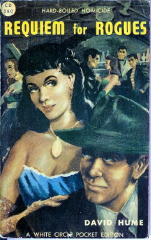
In which the leading character in is neither Cardy, father or son, but rather Tony Carter, a wisecracking crime reporter who appeared in three of Hume’s adventures, of which this is the third. He’s rather full of himself as well, as one might put it. Here’s a piece of a conversation that takes place on page 22 between Carter and his immediate superior at the Echo:
“To commence,” announced Cartwright, your methods are so unconventional that one day you will land this paper into most serious trouble. So far the luck has been with you. That cannot last for much longer. Then you’ll be in jail, and the
Echo will be faced with a heavy libel action. In the future follow a more conservative line of conduct, be more orthodox. See?”“Surely. You don’t want any more exclusive stories. The paper really wants the official news handed out in the Press room at the Yard – and nothing else. If that is so you’re wasting your money, and my time. Get a fourteen-year-old office boy, pay him ten shillings a week, let make the Yard call three or four times a day. And he’ll be a howling success.”
Cartwright wriggled. This interview was not what he had anticipated – not by a long, long way.
Suffice it say that Carter convinces Cartwright to give him a free hand in this case of the drive-by killing of one Percival East, dead by means of a bullet between the eyes on page eight, and right before the eyes of a later berated Detective Spriggs.
By page 69, the police are confused enough – and well they should be – to give Carter a free hand as well, as the case is seemingly awash with far too many clues and then again, far too few. But the more Carter digs into the case, the more deeply Percival East is discovered to have roots in the world of crime: the rackets, blackmail, the works.
Incidentally, totally relevant to nothing, I don’t know why everyone in this book refers to members of the police force as “splits.” It’s a new one on me, but the rest of the slang I managed to decipher with no particular difficulty. Conversations, though, which should have taken a page at the most to start and end invariably took four or five, which means that Hume was either a master of dialogue or he needed these long dialogues to fill the novel to a proper length. As for myself, I will not say padding, as I found these conversations to be rather imaginative, at the least.
There is no detection in this mystery novel, per se. Carter runs around London a lot, meets with his crew of regular informers a lot, and in so doing irritates the killer a lot, and enough so to make him (or her) make moves and counterattacks he (or she) really shouldn’t have done. If Carter had only been left alone, one might think, the case would never have been solved. One might very easily be right.
This probably also answers the question I asked up above but didn’t answer until now.
Sun 4 Mar 2007
HAVING WONDERFUL CRIME. RKO, 1945. Patrick O’Brien, George Murphy, Carole Landis, George Zucco. Co-screenwriter: Stewart Sterling; directed by A. Edward Sutherland.
Based on the novel of the same name by Craig Rice, which I haven’t read, but all the sources which I have read say that the movie is nothing at all like the book. Murphy and Landis play the newly wed Jake and Helene Justus, while O’Brien is their long-suffering buddy in crime-solving, lawyer Michael J. Malone. (It was John J. Malone in the books. That much I do know.)
The story has something to do with a magician who disappears in the middle of his stage act, then reappears in a trunk brought to a lakeside resort by his female assistant – or does he? In spite of the trio’s suspicions, he’s not in the trunk, but not to worry – he eventually turns up dead and there really is a case to be solved.
I couldn’t tell you one way or another if the plot (the motive and where the body is when) makes any sense, and truthfully I don’t think that anyone involved in this madcap sort of affair, near slapstick at times, really cared.
Pat O’Brien doesn’t nearly match the image of Malone I have in my head – for some reason, I see him as a shorter, more somber sort of fellow – but George Murphy is right on as Jake Justus, and Carole Landis is even more perfect as Helene. Her beautiful, smiling face, her lithesome figure and (as Helene) her slightly scatterbrained approach to life and solving murder mysteries, makes me wonder why her career in the movies never went any further than it did. (Due to illness, among other factors, she committed suicide only three years after this movie was released.)

Even though from a murder mystery point of view there is much to be desired from this particular film, the performances of the three main characters make this a must-see, especially to watch Miss Landis in such high form, high spirits and in high fashion.
THE GREAT FLAMARION. Republic, 1945. Erich von Stroheim, Mary Beth Hughes, Dan Duryea, Stephen Barclay. Directed by Anthony Mann.
A curiously flat film noir with oft-time director Erich von Stroheim as Flamarian, a vaudevillian headliner who falls for the wiles of femme fatale Mary Beth Hughes, an assistant in his pistol markmanship act. Her husband, Dan Duryea, is the other assistant in the act, a man driven to jealousy and as a consequence, given heavily to drink.
Flamarion is a stolid, impassive, lonely man, once thrown over in love by a double-crossing woman, who’s vowed to never allow it to happen again. Contemptuous, however, of the weakness he sees in Al Wallace and tempted by the flirtatious Connie Wallace, he at length lets his guard down, to his own disaster – and as it happens, to the others in this ill-fated triangle.

The long scene during which Flamarion waits for Connie in a hotel bridal suite in buoyant anticipation, only to realize the inevitable, is as painful to watch as anything I’ve seen in a film in some time. Duryea is perfectly cast in his role, slickly conniving yet weak-kneed and a somewhat pitiful excuse for a man – a fact that the viewer is quickly made aware of. It’s a part made just for him.
I don’t believe I’ve seen Mary Beth Hughes in a movie before, although she was around throughout the 1940s in B-movies like this, though often in uncredited performances. Her body language in the role was as crucial as her spoken dialogue, and she made the best of both.
But the reason I called the film flat? The main story is presented in the form of a long, uncomplicated flashback. When you know the fate of two of the characters from the beginning, and you can soon guess that of the third, it’s just about impossible for any movie or any director or any cast to generate a feeling of suspense, and The Great Flamarion is no exception.
On the other hand, if it had been filmed linearly, which would have been the only alternative, there simply aren’t enough twists and turns in the plot for the otherwise lightweight tale to have gone anywhere at all. Mann made the best of two choices, in my opinion, but in spite of some more better than average performances from the players, the movie didn’t ring any bells for me.
ROAR OF THE PRESS. Monogram, 1941. Wallace Ford, Jean Parker, Jed Prouty, Paul Fix. Directed by Phil Rosen.
What this Grade B murder mystery movie is more than it is a murder mystery is a comedy about crime beat newspapermen and their wives who never see them. Wallace Ford is the reporter (Wally Williams) who spots a body falling from the top of a Manhattan skyscraper on the day and his bride of one day come to the city to spend a few days honeymooning. Jean Parker, of Detective Kitty O’Day fame (in certain circles), is his bride Alice, who hails from a small town in New England and who quickly joins the club – that of the long-suffering wives of the other reporters on her husband’s newspaper.
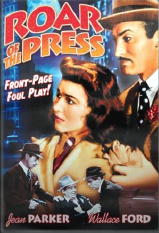
Dead is the head of a pacifist league, in case it matters, and it doesn’t much, which turns out to be a front for fifth columnists and saboteurs. When Wally finds yet another body before the cops do, the cops get sore, and rightfully so, as all of the clues are in the pockets of Wally. Jed Prouty plays Wally’s editor, who cleverly keeps him on the case, even with the lure of a dinner of corned beef and cabbage waiting for him at home. One would think that the slim and decidedly pretty Mrs. Williams would be lure enough, but not so.
Paul Fix is the head of a numbers racket with a heart of gold, and thereby saves the bacon of both Mr. and Mrs. Williams when the gang of bad guys start to get overly worried about what Wally knows, which truthfully is very little, even with the clues he obtained before the police did.
As for director Phil Rosen, who later directed a number of Charlie Chan films, he makes the best of also truthfully very little, and the result is surprisingly entertaining.
Thu 1 Mar 2007
Review: VALERY SHORE – Final Payment
Posted by Steve under Authors , Crime Fiction IV , Reviews[5] Comments
VALERY SHORE – Final Payment
Major Books 3236, paperback original; copyright 1978; no other date stated.
Next on the agenda, and the final book I read in 2006, is the only mystery written by the pseudonymous Valery Shore. Al Hubin in Crime Fiction IV says that Shore was the pen name of Lon Viser, born in 1932. All I’ve been able to come up with regarding Mr. Viser is that he had something to do with the American Art Agency, a publisher based in North Hollywood in 1965.
From the small print inside Atualidades Globo Controle Da Natalidade, written in Portuguese and illustrated throughout, aka The Complete Book of Birth Control:
It’s not a common name. Maybe it’s the same man. All that comes up for Valery Shore, in case you were wondering, are a few dealers offering this book for sale on eBay, or maybe it’s the same book offered at different times. I didn’t check.
The dedication reads as follows: “To Yvonne, Rhoda, and Lon, without whose help this book could not have been written,” so I assume that Al is correct – not that there’s any reason to doubt him.
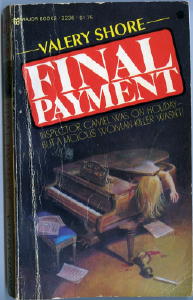
The primary detective in Final Payment is a former Scotland Yard inspector by the name of Christopher Camel, still young, who’d recently been left a fortune by an aunt, in her day a sex symbol of the silver screen. Staying with Camel in his aunt’s Tudor-style Hollywood mansion is “his beautiful Eurasian companion, Kim Lee Chance.” I’m quoting from the back cover.
In attendance upon them both is Potter Goodleigh, his aunt’s former lover and a long ago movie director who’d been exiled to the guest cottage, but who is now cook, butler and father figure to the two young people who are now “livening up the old museum,” as he puts it.
It is Potter’s daughter Felicia who’s murdered, her body found in the piano in her living room. Unfortunately Felicia was also a blackmailer, and there are thirteen suspects that Camel, Kim Lee, and the local lieutenant of police named Davidson have to deal with. In spite of his new-found money and all of his resultant leisure time, there is no way Camel can be kept off the case, as you can well imagine if it had happened to you and sunny fortune had smiled your way in such a fashion.
The story, as I’ve relayed to you so far, may also sound to you as the basis for a made-for-TV mystery movie. If so, you share my feelings exactly, and I have the advantage of having actually read the book. If you also were to suspect that on page 177 there would be a gathering of the suspects in the dead woman’s living room, in an attempt to recreate the crime, I would certainly begin to wonder about you. How could you possibly know that it was on page 177?
As entertaining as made-for-TV mystery movies may be, and some more than others, in general I’ve always had a relatively low opinion of them. This one, I’ll conclude by saying, is better than most of them. If there had ever been a second book in the series, I’d make sure that I had it in my collection too.
UPDATE [03-01-07] Victor Berch has done some preliminary spadework on Lon Viser, and so far he’s come up with the following: His full name as Lorenzo Ludwick Viser, born February 26, 1932 in FL, died August 9, 1994 in LA. There was a Lorenzo M. Viser living with him in the 90s, probably a son. More later, if and when!
Mon 26 Feb 2007
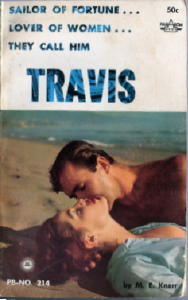
M. E. KNERR – Travis
Pike Book #214; paperback original. First printing, April 1962.
I seem to be specializing in obscure books this month, and this one is about as obscure as you can get. Even though it is a private eye novel – and I’ll get back to that in a minute – it was published by one of those small sleazy paperback outfits in the early 1960s that promised more than they could possibly deliver at the time. And even so, if you happened to have purchased this one in 1962 for its sexy parts, you’d be sadly disappointed, since in that regard, it’s really rather tame. If sexy passages were what you were looking for back then, you’d have been far better off buying a copy of Peyton Place than this.
This book does not even appear in Al Hubin’s Crime Fiction IV, but it will, or at least in the Addenda. The author does appear, however, and to show you something of his track record, here’s his present entry:
* Operation: Lust (Epic, 1962, hc) as by M. E. Knerr.
* The Violent Lady (Monarch, 1963, pb)
Listed below are other titles by Knerr (under either byline) which I found listed for sale at various places on the Internet, but not included in CFIV, and probably for good reason. I do not have descriptions of the story lines for any of these first three, so your guess is as good as mine:
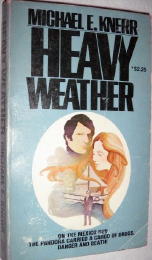
* Heavy Weather (Belmont/Tower, pbo, 1979) [** -See UPDATE below.]
* Port of Passion (Imperial #737, pbo, n.d.)
These I found descriptions for:
* Sasquatch: Monster of the Northwest Woods (Belmont/Tower, pbo, 1977) Quoting from the cover: “Though based upon factual research, this is a fictional tale of what could conceivably happen in the Pacific Northwest: a chain of events that could create a monster out of a normally timid and gentle giant.”
* The Sex Life of the Gods (Uptown Books #703, pbo, 1962) “Science Fiction erotica.”
[** UPDATE 02-27-07] At first I was doubtful, but now that I’ve found a cover scan of Heavy Weather, I’d say that it’s also a prime candidate for inclusion in Crime Fiction IV. If you can’t make out the small print on the bottom of the cover, it says, and I quote: “On the Mexico run the Pandora carried a cargo of drugs, danger and death!” LATER THE SAME DAY: Al Hubin agrees. In it goes. (The book pictured below is described as a Horwitz edition published in Hong Kong.)
But let’s get on with things and to the book Travis itself. There’s only one copy offered for sale on the Internet, making it not only obscure but scarce. I mention this even though I’m sure you know that the two are usually, but not always, one and the same.
Telling the story, though, in his debut and probably his only appearance in print, is Mike Travis, a “sailor of fortune, who loves life, and woman, especially women.” It is not difficult to deduce what other reasonably well-known character was the inspiration for Mike Travis. Travis in this book had previously been in the charter boat business in Florida, but when times went bad, he went to California to accept an offer made by one of his former customers, a multi-millionaire named Del Houston, to look him up if and when Travis headed out that way.
And Del does indeed have a job for him. After some quick string-pulling and the greasing of certain political hands, Del hands Travis a PI license and a gun, and a three-fold request: to find his son; get him off narcotics; and break up the gang who’s been supplying them.
It’s not a bad opening for a PI yarn, and the story maintains its way reasonably well for about half of its just under 160 pages: the usual PI stuff, the things that PI’s do, and the usual bad things happen to some of the people who just happen to get in the way, with all of the coincidences that make one or more aspects of one PI investigation dovetail nicely into another.
Even though it goes without saying, I’ll say it anyway. Travis himself is one of those guys who is irresistible to beautiful women. In this book that includes both his employer’s foster daughter, from page 20 …
… and a stripper who the first time they met, tripped him into a pool at Houston’s house. From page 68:
I think you can tell a lot of about a story by looking closely at how the author describes his characters, don’t you? With an ending that doesn’t directly address the clues that have been set up for it, though, the tale does two things simultaneously and hence the apparent impossible. The action-packed finale (a) goes all but out of control, and (b) withers away from lack of interest, as if there were a deadline set that had to be met, and it didn’t matter precisely how.
Although overall not without flashes of acceptable writing, and every once in a while better than acceptable, the overall impact of this novel is still rather like a third-rate Carter Brown or a tenth-rate John D. MacDonald, either of whom, if you’re a fan, you know what I’m talking about and whom you’re far better off pursuing.
Or let’s put it this way. One of the reasons for collecting and reading unknown and long-neglected works of mystery fiction is the hope that never dies of discovering an unknown and long-neglected classic of mystery fiction. Sometimes you have to settle for unknown and long-neglected.
UPDATE [02-26-07] If you were to google “M. E. Knerr” on the Internet, you would find, as I did, that there was a Michael E. Knerr who was a friend of SF and (occasional) mystery writer H. Beam Piper, who committed suicide in 1964 when he ran into financial troubles. I’ve not been able to confirm that the two Knerr’s are one and same, nor have the birth and death years for either one been verified. Accounts vary on the latter. Knerr may have also written under the name of “Brent Hart,” but that’s another loose end not yet tied down.
But the Knerr who was a friend of Piper apparently wrote a hitherto unpublished biography of him, and upon Piper’s death, went through his manuscripts and salvaged, among other things, the “lost” third Fuzzy novel, Fuzzies and Other People.
If and when I know more, I will as always, let you know.
[UPDATE #3] Postdated 03-29-07 on 08-16-07. Thanks to Google, I discovered that SF writer John F. Carr knew Mike Knerr, and after a small amount of effort, I was able to get in touch with him by email. As a consequence of this contact, John has posted a long article about his friendship with him here on the M*F blog. I should pointed this out more clearly before now, instead of leaving it hidden as one of the comments.
In this article about Mike Knerr, Carr has his correct date of birth, along with the year he died, plus a lot more about him on both a professional and a personal level.
Sun 25 Feb 2007
That there’s not enough time in the world to read everything you want to is something I am sure that every non-casual reader of this blog knows full well, even if you restrict yourself to mystery, crime and detective fiction –- or even only a small nook and cranny of the genre, which maybe you do but I try not do. I like to keep my horizons are wide open as possible, although there are some topics and/or themes at which I draw the line (and about which I will tell you some other time).
And when you discover a blog dedicated to one of those small nooks and crannies of the genre, chock full of books you never knew about before, much less you’ve ever read any of them, why, it’s enough to make a grown man (or woman) cry. Figuratively speaking, of course.
This is what happened to me this evening. The particular nook is International Noir Fiction, and the link will take you there immediately, if you’re so inclined.
I’m not sure if Glenn Harper does all of the reviews and commentary, but at a first go-through on my part, it appears that he does. He does one or two posts a week, and going down through the current page, here are the recent objects of his attention:
JAMES CHURCH – A Corpse in the Koryo [North Korea]
MANUEL VÁZQUEZ MONTALBÁN – The Buenos Aires Quintet [Spanish detective in Argentina]
GENE KERRIGAN – Little Criminals [Ireland]
ÅSA LARSSON – The Blood Split [Sweden]
QIU XIAOLONG – A Case of Two Cities [China: Inspector Chen]
PACO IGNACIO TAIBO – The Uncomfortable Dead [Barcelona detective Pepe Carvalho]
PERNILLE RYGG – The Butterfly Effect [Scandinavian sort-of private detective Igi Heitmann]
All worthy, I’m convinced, of hunting down and reading, if only my bank account didn’t have this huge and near-permanent dent in it. I won’t comment on the books themselves, as Glenn’s read them and I haven’t, and he’s already done a super job of it. This list essentially covers the month of February, and the month’s not yet over. Oh, as the man said, my.
A big thanks to the post on The Rap Sheet that J. Kingston Pierce just did along these same lines and which pointed me in Glenn’s direction. At least I think I should thank him. Maybe he’s not forgiven me for confusing his name with that of western fiction writer Frank Richardson Pierce in a recent blog entry of mine, since corrected, and he’s getting even. (He also points out Wade Wright, the subject of the preceding entry here on M*F, as an author whose books he’s newly found as worthy of the chase. You and me both, Jeff.)
Mon 19 Feb 2007
Review: MORTON WOLSON – The Nightmare Blonde
Posted by Steve under Authors , Pulp Fiction , Reviews[6] Comments
MORTON WOLSON – The Nightmare Blonde
Pocket, paperback original; 1st printing, April 1988.
This book escaped a lot of notice when it came out, or at least that’s what I strongly suspect. Reading just the cover and the blurb at the top – “It was murder. A Hatchet Job.” – I think the average reader would have thought that this was just another horror novel of the blood and gore variety, both of which were very popular at the time. Nor would the name of the author have meant anything to anybody.
But what if I told you that Morton Wolson was the real name of 1940s pulp writer Peter Paige, creator of the private detective Cash Wale? Or at least I think that Wale was a PI, but I may be wrong and someone will have to tell me.
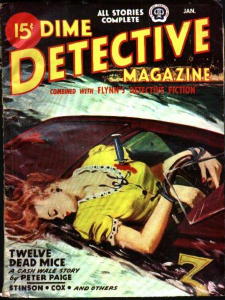
In any case, Peter Paige wrote a slew of detective stories for magazines like Black Mask, Detective Fiction Weekly and Dime Detective – mostly the latter, I believe – until disappearing from sight about the same time as most of the pulps died, in the early 1950s. Most of them were, by all accounts, fairly ordinary. Paige is a not a name which comes to many people’s mind when it comes to pulp detective fiction. Myself, I know the name, and I know Cash Wale, his primary series character, but as far as any single story is concerned, I can’t think of a single plot line, I have to say, and reluctantly so as I do.
When I asked veteran researcher Victor Berch to see what he could come up with as far as either Paige or Wolson was concerned, he did his usual amazing sleight-of-hand and came up with a couple of interesting items. In the Los Angeles Times of January 7, 1946, there was a short item with the following headline: Writer, Held for Beating Wife, Says She Beat Him:
Accompanying the article, not much longer than the excerpt above, are separate photos of both Wolson and his wife, who is shown feeding their baby with a bottle. (The headline of the item that follows on the same page is: Jeanne Crain and Mother Reconciled.)
Besides the work he did for the pulps as Peter Paige, Wolson had two stories published under his own name. The first one appeared in the January 1954 issue of EQMM, a tale entitled “The Attacker,” and a little bit later, “The Glass Room,” was published in the September 1957 issue.
Wolson’s output may have been small under his own name, but “The Attacker” was good enough to be selected in David C. Cooke’s annual Best Detective Stories of the Year anthology for 1954, and more than that, to be picked up again by Allen J. Hubin’s Best of the Best Detective Stories: 25th Anniversary Collection in 1971. (Al did not remember this fact while he and I were corresponding a short while ago about Wolson, until I pointed it out to him.)
There is one entry for Wolson on www.imdb.com. A story he wrote was the basis for “Prime Suspect,” an episode of Jane Wyman Presents the Fireside Theater, telecast on 27 February 1958. A gent named Steve Fisher did the adaptation, and an actress named Nita Talbot appeared in it, whom I thought was tremendously good-looking at the time; the leading role was played by William Bendix, whom hardly anybody thought was good-looking at any time. Where the story may have been published earlier remains unknown.
The next time Victor came across Wolson’s name in a newspaper was in the New York Times for March 29, 1970, in an advertisement for a special “Manager’s” sale being held by Furniture-in-the-Raw, an outfit with five stores in the New York City area. I’ll quote the relevant detail:
Nothing more seems to have put Wolson in the news or in any sort of spotlight until the publication of The Nightmare Blonde in 1988, and then, as I alluded to earlier, the book seems to have come and gone without much notice. At the moment there seems to be two copies available on the Internet, one from Alibris in the $3.00 range, and one from England in the $30 range. It is dedicated to his wife Gaye, so it is clear that the earlier one did not last.
But before getting to the main event, perhaps you’ve started to wonder. Wolson was born in 1913 (making his age as reported in the LA Times correct), and he died in 2003. You also may be beginning to wonder about this book he wrote in 1988, when he was 75, and whether it is any good or not.
My answer, in a word, is “yes,” but if I may, I’d also have to say that it’s a qualified response, and I’ll get to that soon. Remember now that it was marketed as a horror novel, which in a strong but not overpowering sense it is, as the murder to be solved is that of a family of four, killed by someone with a very sharp axe.
But what it really, really is, when you really get down to it, is a detective novel in a very traditional sense. It’s also a tough, middle-class sort of novel, and hard-boiled at about the same level as, for example, a Ross Macdonald novel, not to forget to mention that it’s quite definitely noirish in a way as well.
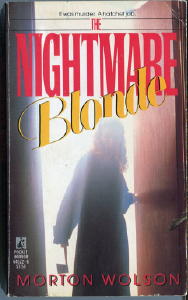
Let me explain that last sentence right away. Dan Warden, the leading character, is the former chief of police in Oregon City, a town somewhere along the Pacific Ocean where the story takes place, who had recently been fired for beating up a newspaper columnist’s nephew and being chewed out in print by that very same newspaper columnist. After coming out of a 24-hour drinking binge, about which he remembers nothing, he discovers that it is (no surprise here) the newspaper columnist who has been murdered, along with the three remaining members of his family.
Which makes Dan Warden the number one suspect, no matter how close his friendship with the police commissioner is. At the same time as Warden is discovering how badly his life has been suddenly turned upside down and inside out, he makes a friend – saving her life, to be precise, as she (a blonde) tries jumping off the end of Fisherman’s Wharf, but miscalculating badly as she does so. Allow me to insert a long quote right about here, taken from pages 17 and 18:
“Sure,” Dan said, his arm around her waist, urging her along. For the first time he realized that she had a slender, almost lithe, waist, and he felt a tug of sexual excitement, followed by a flush of shame that he should even note such a thing in this vulnerable woman. “I know,” he said. “It’s like you couldn’t get out of the mirror.”
They were moving very slowly. She put her face against his chest and through the fabric said, “Do you know what it’s like to be two people? I mean two separate people — and one doesn’t know what the other is thinking or doing except in dreams now and then, and you don’t understand the dreams?”
“I know all about it,” he told the droplets in her blond hair.
Her eyes probed his.
“Don’t joke with me, please!”
“Scout’s honor,” he said, urging her toward Bayfront Street. “Me, I just had a twenty-four hour memory gap. And while I can remember staring at myself in a lot of bar mirrors, and awakening once on a strange back porch the other side of town, and seeing a sudden blinding flash of light, and walking several hundred miles through this rain, I have no idea where I left my hat or coat or parked my Chevy, or who I punched, or who punched and scratched me. I have not even the dimmest idea of even seeing the man I’m supposed to have either punched to death or killed with a hatchet.”
Kay Mullins (that’s her name) has had psychological problems dealing with children in the past, and now two of them are dead, and the reason for emphasizing that she is a blonde, as I did a just a moment ago, is that several blonde hairs have been found at the scene of the murders.
It takes Dan most of the rest of the book to investigate the crimes while trying to stay ahead of the new police chief, who still considers him to be his primary suspect, while keeping Kay stable and discovering just how many blondes just happened to be in and around the area of the victims’ home, including Kay herself.
Part of the investigation includes visiting a camp of the local branch of the White Knights of America and at least three brothels of increasing degrees of sophistication, and some low spots as well. It’s a tough, rough story at times, and while it tends to start rambling a little, it still provides about four hours of pure entertainment, or at least it did for me, flawed only – here comes a qualifier – by the inescapable unlikelihood of one too many fairly uncommon events, all happening at the same time and in the same place.
But while the laws of probabilities, still enforced in every state in the union, say that the juxtaposition of so many blondes in one focal point of chaos, could not and should not have happened, what Wolson does is not easy. He makes the book flow well enough, and smoothly enough, that you (the reader) don’t (and can’t) stop to think about it while you’re in the process of reading, and read it you will.
As the identity of the killer becomes increasingly clear, and Wolson does a more than creditable job in disguising the solution to the murders for as long as he can – and even longer than he had a right to, truth be said – the chills begin as well, intellectually as well as (without trying to give anything away) deep down inside the reader’s bones somewhere.
Nor is the book over even then. For noir fans everywhere, lift a glass to a pulp writer past. This one’s for you.
UPDATE: Victor Berch has come up with some more information on Wolson’s life. Why don’t I simply let him have the floor:
Tue 13 Feb 2007
A. S. FLEISCHMAN – Look Behind You Lady
Gold Medal 223; paperback original. First printing, February 1952; 2nd printing, Gold Medal 572, 1956. Hardcover reprint: Herbert Jenkins, UK, 1962, as Chinese Crimson. To be published by Stark House Press in late 2006 as a trade paperback combined with The Venetian Blonde.
Albert Sidney Fleischman, known to his friends and colleagues as Sid, was born in 1920, and at 86, thankfully he’s still around to see publisher Greg Shepard bring a couple of his old Gold Medal paperbacks back into print.
His career in the adult mystery field was relatively short, beginning with a couple of Phoenix Press mysteries in 1948 and 1949, then shifting to Gold Medal for five paperback originals between 1951 and 1963, with one from Ace making an appearance in 1954.
After that he became an author of children’s books, winning the Newberry Medal for The Whipping Boy (1987), and the creator of Bullwhip Griffin – the movie about his adventures was based on the book By The Great Horn Spoon (1963).
Greg always does a great job in adding material to his books about the authors he publishes, so I won’t try to come up with any more background like this on my own. Nor will I say anything about The Venetian Blonde, one of my favorite mystery titles of all time, and I love the cover as well – they go hand-in-hand together as one truly great match-up.
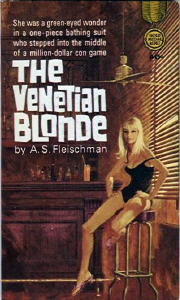
To introduce you to Look Behind You Lady (no comma, and I’m not sure why), you might pretend that you’re at the newsstand in 1952, or the drug-store spinner rack, and you’d see the cover, designed to catch anyone’s eye, 100% guaranteed. (Truth be told, I was 10 at the time, so it had to have been the 1956 reprint that snagged my attention.)
Then once in the would-be purchaser’s hand, he would have looked inside the front cover to read the following blurb:
“I was mad at you when you walked out,” she whispered, “but I like the way you walked back in.”
I turned her around and kissed her lips.
“You’re getting wet,” she said.
“Stop talking,” I said.
Not a word wasted, and if you could pass this up, you’re a better person than I, or your tastes are so different from mine that you should be reading another review anyway.
But just in case a quarter was all that you had in your pocket, back in 1952, and you needed just that one extra nudge to tip the balance toward paying the storekeeper and on your way with the book, all you would have had to do was to turn two more pages and start reading from the top of Chapter One:
I looked up from my vinho e licores at the girl standing beside my table. I was on the marble terrace of the Hotel China Seas in Macao, killing time between shows, and feeling a little surly. Along the hotel wall a Filipino swing band was giving the week-enders from Hong Kong something to dance to.
“Talking to me?” I muttered.
“Talking to you,” she said.
She was wearing a smart white dress, and her dark hair was cut short, with bangs. I didn’t like the bangs. The dress had a mandarin collar, which was a shame, because a plunging neckline would have been something worth plunging for.
“You can sit down,” I said. “I was just leaving.”
“Please –”
I looked at her and smiled only to myself. Sure, I thought, there’s not much paradise left in the Orient, but there’s Macao. Don’t bring your wife unless you’re just interested in the view from the old Portuguese fort on the hill. Macao attracts the finest tramps in the world, its streets are paved with gold, and gambling is a way of life. If you can’t enjoy yourself in Macao, there’s something wrong with you – not Macao. Or you brought your life.
“Look,” I said. “Is every woman in Macao on the make? Every time I buy myself a drink some girl comes along and wants to muscle in on the act.”
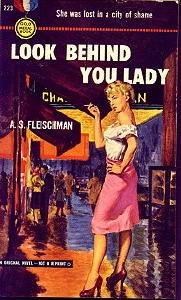
Ka-ching! Sold, am I right, or am I right? If you can’t read this story and hear the voices of Humphrey Bogart as rather world-weary stage magician Bruce Flemish and Lauren Bacall as Donna Van Deerlin, the lady above who has both a room number and a proposition for him, you haven’t been watching as many of the movies of the 1940s and early 1950s as is good for you. Something’s been missing from your video diet that you ought to remedy as soon as possible.
More. The owner of the Hotel China Seas is Senhor Gonsalves, a gentleman who is missing both his thumbs, and he also has a small task for Flemish to perform as part of his act, a task involving the not-so-small sum of $10,000 Hong Kong dollars. Sydney Greenstreet.
One of Senhor Gonsalves’ many assistants is a mousy sort of fellow named Josef Nakov, who is handy with a gun. Peter Lorre.
From page 144:
“We can find another word,” Gonsalves said, his hands stuck in his pockets. “Eliminate. Murder is for your Chicago gangsters. In politics, we eliminate. It is death on a higher social level.”
“We’ll appreciate the difference,” I said, “but why bother? We’re not very clear on what the hell your game is. You must be getting damned scared to want to murder everyone in sight.”
Nakov says something about the intelligence of Donna, who had walked back into Gonsalves’ hands after a brief escape.
You can cast Gilberto, young punk working for Gonsalves, and Phebe, a somewhat shopworn stripper whose act follows that of Flemish on stage, yourself.
The plot has something to do with the Communist Reds and/or the opium trade, and it matters not very much in the long run. But there are twists to be had, and thrills of the nature above, and what more could you want of a book of exotic Oriental danger and intrigue like this?