Reviews


F. G. PARKE – First Night Murder A. L. Burt & Co.; hardcover reprint; no date. First Edition: Dial Press, hc, 1931.

   The bad news first, perhaps, if you happen to read this review and if I happen to convince you that you might want to read the book for yourself. There are three copies on ABE at the present time, one the Dial Press edition for $35, one in French for under $20, and one the British hardcover (Stanley Paul, 1932) for over $40. (The one from Dial Press has a jacket, and I think it’s worth the money.)

   But what the heck, keep reading. I may not convince you anyway. And who is F. G. Parke, you ask, and well you may. No one seems to know, and it’s not even his (or as it has suddenly occurred to me) her name. It’s a pseudonym. I think the author is male, however, thinking about it even as I sit at the keyboard. It’s not a woman’s tale, what with the many-faceted male point of view which so generally obvious if not blatant — and maybe so obvious that I could very well be wrong.

   But as I was reading this — and enjoying it, for the most part — and don’t worry, I will be sure to let you know at which point I stopped enjoying it — I pretended in my mind (and where else) that this was an unknown work of the cousins known as Ellery Queen, who needed some money at this point of their career, which would have been, roughly, between The French Powder Mystery (Stokes, 1930) and The Dutch Shoe Mystery (Stokes, 1931), perhaps.

   Or perhaps not, but it was fun to pretend — and who knows, I could very well be wrong, and they actually did write it. What got me thinking this way, though, was the locale where the first murder was committed: in a theater during the actual performance of a play, the New York City Police Commissioner in attendance, among many other notables, it being first night, of course. A mystery drama is about to reach its denouement, the lights go out, a woman’s wild scream rings out, the lights come back on, the villain (of the play) is in handcuffs — and a noted Broadway producer is found stabbed to death in his seat near the front of the theater, the space next to him unused.

   Fifteen seconds of darkness — hardly time enough for the killer to make a getaway — but no knife is found (everyone is searched) and no one heard anything, no one saw anything. There is no lack of potential murderers, for as if by pre-arrangement, motives for everyone seated in seats within a small vicinity are soon revealed. But once again, no one heard, saw or felt anyone move or pass by them, and — this is the key — there is no murder weapon anywhere in the theater.

   Doing the honors as the detective at hand is Martin Ellis, the author of the play, the first step of what he had hoped to be a long career as a playwright. The inner flap of the dust jacket (the only piece of the jacket I happen to have) compares him favorably with Philo Vance, but on the other hand, you know how the people who write story descriptions on the flaps of dust jackets often seem to exaggerate.

   No, it was Ellery Queen I kept thinking of (Ellis = Ellery?). The Roman Hat Mystery? And yes, I know that it was death by poison in that first novel the Queens wrote, but still, it was a during a play that the victim in that book, an unliked/unlikable lawyer, was killed.

   But Martin Ellis on his own, and as a writer of mystery fiction himself, seems to be amiable enough and competent enough to solve this case, even though he is in love with the girl, the actress on stage, whom the dead man married earlier the same day, which in most books would make him the number one suspect. (I did suggest that there are motives galore — what’s lacking are means and opportunity.) Both Lt. John B. Gradey of Homicide and District Attorney Moore eliminate him quickly as a suspect, however, as he was seen by two witnesses just before and after the lights went out, and nowhere near the scene of the crime.

   To help demonstrate Ellis’s prowess as a detective, along either Queenian lines, or Vancian, you choose, here’s a quote from page 98:

   Considering that he [Ellis] had during the past few years conducted theoretical investigations strictly along scientific lines, it would do him no harm, he thought, to borrow a leaf out of one of his own books. All the best detectives sported a fine flair for calm, unbiased reasoning. They analyzed. They synthesized. They equipped themselves with a supply of cold, hard facts and from these they made unfailing deductions with mathematical precision. The hundred per cent sleuth of fiction, in short, did everything but beat his breast passionately with both fists and gather himself for a leap at the most obvious conclusion in his maiden chapter.

   As I say, you choose. More deaths occur, with plenty of influence on the thinking processes of Martin Ellis, but as it occurred to me, with very little emotional impact. As for the solution, as I skip over in this short essay anything more about all of the suspects and the all of the suspicious activity that goes on in this book, it is the solution that tells the tale, and to tell you the truth, while I was ready for it, already having made a note to myself about the paragraph I quoted to you above, I really wasn’t ready for it. Don’t know as I still am, as a matter of fact, but I guess that means that I should take my hat off to Mr. Parke, whoever he was.

   The gentlemen behind Ellery Queen could never have been quite this melodramatic — could they?

UPDATE [02-10-07]   I emailed the seller of the Dial first edition of this book a couple of days ago, asking if there was anything helpful that was said about the author on either the back panel of the dust jacket or its flaps. Perhaps asking for too much, I also inquired if a scan of the cover might be possible. I’m still hoping, but to this date, I have not heard back.

UPDATE [02-24-09]    Over two years later — have I been doing this that long? — and I finally have a cover image to show you. A big thank you goes to Luca Conti, who emailed me with it as an attachment a couple of days ago:
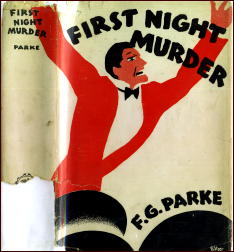
F. G. PARKE First Night Murder

    I’m not sure how well this additional scan of the blurb from inside the dust jacket will show up, but I since I mentioned it in my review, Luca sent it along. I think it’s worth the try:
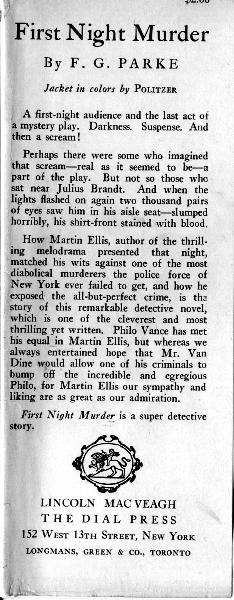
F. G. PARKE First Night Murder

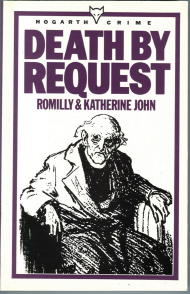
ROMILLY & KATHERINE JOHN – Death by Request. Hogarth Crime; trade paperback. 1984. Also published as a Hogarth hardcover. Offset from the original [hardcover] Faber & Faber edition, 1933. Vintage/Ebury, US, hardcover and paperback, 1984.

   Quite surprisingly, given the fact that it’s been reprinted several times, this is the only mystery that the married couple of Romilly and Katherine John wrote. Who were they, is one question, and how did it happen that Hogarth reprinted it some 50 years later?

   For at least a partial answer, one must read the new introduction to the Hogarth edition, written by Patricia Craig and Mary Cadogan, as part a series of Hogarth Crime reprints of classic detective fiction. Romilly, born in 1906, was in the RAF, was briefly a civil servant, then a poet and an amateur physicist before dying in 1986. Katherine was a reviewer as well as a translator of Scandinavian books. She died two years before her husband, in 1984.

   The gap between 1933 and 1984 between editions may be one of the longest on record for any mystery novel. The fact remains that Hogarth Press considered it significant enough to reprint in a series of classic crime fiction. In that regard, the book is a locked-room mystery; and in its own inimitable way, a minor tour de force of one form or another, the details of which I most sincerely will do my best to avoid telling or revealing to you.

   The dead man is found in his bedroom at one of those old English manor residences so commonly found in works of mystery fiction, especially the English ones. He is found gassed to death in a heap on the floor, still dressed as he was the evening before, the window shut tightly, and (of course) the door was locked. It had to be broken down in order to enter in the morning. Could it have been suicide? No, Lord Malvern seems to have been well enough off, and he was off to visit his fiancée in London on the very same day as his death.

   Telling the story is the local vicar, an elderly man by the name of John Colchester, a long-time friend of Matthew Barry, the master of the house. Also staying over are various friends and relatives, including a comic-relief colonel who harrumphs all over the place; a weepy young girl; a recent widow only slightly older; the slightly deaf sister of Matthew; assorted staff, mostly female, save for a slightly villainous butler named Frampton.

   And to tell the truth Frampton is more than only slightly villainous. He’s a socialist, a seducer of young maids in the area, and — as the truth comes out — a blackmailer. Many letters which threaten to reveal secrets which others might wish kept unrevealed are found, some sent by Frampton, others perhaps not. Obviously, as these have a great deal to do with the plot, the letters — their contents, who received them, who sent them, and who may have intercepted them — must be given, as the book goes on, a exhaustive and thorough going over.

   And to tell you another truth, the going-over of the letters is probably too thorough and exhaustive. One is tempted, I must admit, to throw up one’s hands whenever another letter appears and must be discussed and put into the context of the previous ones.

   I see that I have neglected to mention the detective on the case. Nominally that would be Inspector Lockitt, but that particular gentleman seems content to do his work off-camera, as it were. Almost all of his activity is related to the vicar second-hand, and then of course the vicar must relay his impressions of the good Inspector Lockitt on to us, the reader. It seems a strange way to tell a mystery, but one must always get accustomed, eventually, to things we expect to occur in the usual way, but which do not, do we not?

   The bulk of the detective work is rather more accomplished, in fact, by an unusual twosome: (a) Mr. Nicholas Hatton, a friend of the dead man’s fiancée, one of those amateur detectives who are as common in British mystery fiction in the 1930s as damp old manor houses with murders committed within them, and (b) the aforementioned widow, Mrs. Fairfax, who proves to be a most tenacious (and efficacious) individual when it comes to solving mysteries.

   There are secrets galore that must come out before the solving is done, including at least two that should correctly be considered “bombshells” when they are revealed. There is, of course another secret at the end, which I promised not to tell or reveal to you, and looking back at what I have written, I do not believe that I have.

   So, is the book a classic? You may well ask, and you should. No, I say, but with a small hedge in the back of my mind. For today’s audiences, large portions of this exercise in murder-solving will be dreary and dull to the extreme. For those of you who like puzzles, well, the puzzle is there, and without a doubt, a double delight it is. The problem is that it’s, well, unskillfully told, when measured by more modern standards, say of five or so years later.

   That the door was locked on the inside, for example, is not revealed until page 50, whereas the body itself was found on page 24. Nor, surprisingly enough, is the locked room aspect very much — if at all — the focus of the tale. This may in part be due to the telling (see above) or the fact that (as is often the case) the solution (to the locked room aspect) is rather simple when explained, and therefore not very worthy of much dwelling upon.

   If you were to read this book — and if you are still with me, I would at least suggest that you should, for this must be the kind of mystery you prefer to read, not so? — you will also need to know what a geyser is, at least a geyser that one would find in the bathroom of a country house in England in the early 1930s. Readers of Dorothy L. Sayers’ Unnatural Death, for example, will have already come across one, I believe, if they were to think back upon it.

MARI ULMER – Cart of Death

Worldwide; paperback reprint, September 2006. Hardcover edition, as Carreta de la Muerte (Cart of Death): Poisoned Pen Press, April 2001.

    Subtitled “A Taos Festival Mystery,” this second adventure in which Christina Garcia y Grant finds herself involved takes place shortly before and during the celebration of the local Las Fiestas holiday. The first book in which Christy appeared was Midnight at the Camposanto (April 2000), which took place on a previous Good Friday through the following Easter Sunday.

    According to the Poisoned Pen website, the latter was to have been “the first novel in a series planned to follow the sacred and secular calendar through its annual cycle,” but thus far, only the two books have been published. (Also on the PP website is an announcement that “Mari is now working on More than Mischief at San Geronimo,” but since on that same page is a link to her 2002 author’s tour, along with the fact Ms. Ulmer is now 74 years old, I have a feeling that the chances that it will appear are diminishing quickly.)

Cart

    Which is shame, for I rather enjoyed this book, in spite of some rather uncomplimentary comments some readers have left on Amazon. Christy is a former lawyer who now runs a bed-and-breakfast in a small town south of Taos while she attempts to begin a writing career. This means that there are numerous tenants whose humorous antics keep her hopping while she is trying to keep them happy. Her mother lives by, and when the festival begins, the guests are displaced by all of her relatives who come swarming in.

    One particular tenant is a permanent resident, a retired surgeon from Florida named McCloud, or Mac for short, and an attraction between Mac and Christy seems to be growing. At least enough so that when other men look at Christy longer than he thinks they should, Mac feels the pangs of jealousy.

    Especially gnawing at Mac is that the suave Evelyn Bottoms (male) would make such an ideal candidate for the murder of a young worker at a local art gallery. Missing is Bobby’s female assistant, Cindy, a close friend of Christy’s mournful friend Iggy (short for Ignacio), a young lawyer she has been mentoring.

    The mystery is strangely gruesome, with at point (page 140-141) three more deaths occurring within the span of two pages. The detective work? Well, it’s as satisfying as it is in most present-day cozies. The star attraction for this book, though, overshadowing everything else, is the locale, its history, its inhabitants, and the overall spirit of enthusiasm and joy that’s on continuous display for all of the above.

    Not quite so satisfying, given the lack of another tale to continue the series, is that the semi-romance between Christy and Mac, which is left badly hanging. All readers are would-be authors, though, are we not? Anyone who reads this rather charming look at contemporary New Mexico culture (plus mystery) will know exactly how that will come out, or already has.

UPDATE: This review was written in November of 2006. A representative of Poisoned Pen Press promised to pass on to Ms. Ulmer an email of inquiry I’d sent them, suggesting that perhaps she would respond to me directly. That was several weeks ago, and she has not. More, the information I quoted from the PP website is no longer there, or at least I am unable to find it again. I wish I had better news than this.

« Previous Page