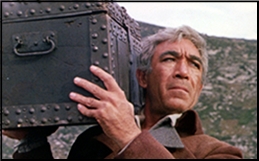
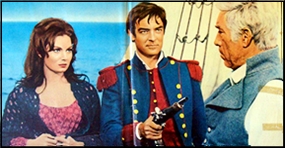
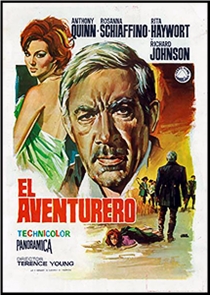
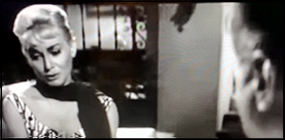
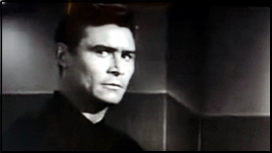
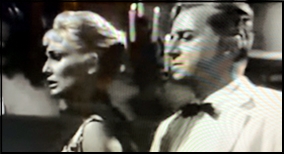
THE ROVER. United Artists, 1967. Released first in Italy as L’avventuriero. Anthony Quinn, Rosanna Schiaffino, Rita Hayworth, Richard Johnson, Ivo Garrani, Luciano Rossi, Anthony Dawson. Based on the novel by Joseph Conrad. Director: Terence Young.
It was with some bemusement I watched The Rover, a film based on Joseph Conrad’s novel, a cheap-jack multinational production/tax write-off which captures nothing at all of Conrad’s ethos and even less of the brooding excitement of his writing at its best.
What we’re left with is Anthony Quinn — that charismatic actor whose career had more bad steps than a derelict lighthouse — as a Napoleonic-era trench privateer returned to his country with all too little to show his head-hunting bosses. He falls in love with a mysterious young woman, tries to refit a derelict ship and slip past a British blockade, but by that time, everyone’s pretty much lost interest in this shabby show.
How tacky is it? Well, aside from the perfunctory photography and poor dubbing, it’s set in a rather sparsely-populated France (well, maybe everyone was off fighting the wars) with few buildings, one or two streets, and maybe four horses. And the scene of a British ship chasing the privateer was very obviously filmed with One ship photographed from different angles, edited to try and make it look like Two — which don’t work.
Sad to see talents that once showed some promise stuck in this movie-mire: The Rover was directed by Terence Young, who made movie history a few years earlier launching the James Bond series; aside from Quinn, it features Rita Hayworth and Richard Johnson (who at various times embodied Bulldog Drummond and Lord Nelson) and, in a teeny-tiny part, tucked off in a corner somewhere, movie-goers with long memories will spot Anthony Dawson and wonder what became of the promising actor so memorable as the unlucky Cpt. Lesgate in Hitchcock’s Dial M for Murder.
— Reprinted from The Hound of Dr. Johnson #7, May 2000.
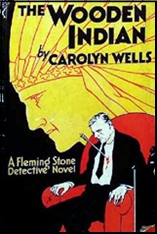
CAROLYN WELLS – The Wooden Indian. Fleming Stone #41. J. B. Lippincott, hardcover, US, 1935.
While obviously a mystery novel, maybe even a work of detective fiction, The Wooden Indian is very nearly a fantasy, simply because its resemblance to reality is so razor slim.
At least, I *think* it’s slim. It takes place in the Connecticut of the 1930s (New London County), and the country club set is very much a part of it. It’s not a world which I was ever a part of, then or now, and maybe it’s my fault. Maybe I just don’t recognize how close to reality it really is (or was).
At any rate, David and Camilla Corbin are valued members of the Pequot Club, but they are not very happily married. He is wealthy, a stamp collector, and an amateur historian specializing in local Indian legends. She is serenely beautiful, subject to scathing comments from her husband, and every other unattached male in the neighborhood is attracted to her like moths to a flame.
Wait. There’s more. Legend has it that a curse is upon the Corbin family, and every 100 years one of them will die at the hands of the spirit of a vengeful Indian chief, with bow and arrow. This is the year — and this the stuff of which detective stories are made. It’s no wonder that a friend of Fleming Stone, noted criminologist, calls him in, even before the first murder occurs. As stated on pp.26-27: “Bob’s wire didn’t promise a case exactly, but it held out interesting hopes …”
In other words, what we are playing here is a game. The rules are fixed. The victim has no say in the matter, even though his identity is known 80 pages in advance. [WARNING: Major Plot Alerts in the Paragraphs ahead.] There is a ghost at hand, there is even what is described on p.191 as a “locked room”, even though the murder took place 80 pages before that and this is the first (and last) time it’s mentioned.
The solution, by the way, describes (in some detail) the trick the killer used to get in, and yet the only thing blocking the doorway was the red cord used by the dead man to signal that he was listening to the radio and did not want to be disturbed. When Stone came upon the scene earlier, he “lifted one end of the red cord from its hook and went in,” (p.109)
While the book is listed in Bob Adey’s book on Locked Room mysteries, I must have missed something.
The killer is not the secretary, as Fleming Stone first surmises. (Apparently the last mystery Stone has read was The Leavenworth Case, and evidently, in that one the secretary *was* the killer.) Instead it’s a trivial variation on the “person most likely” — in other words, a person so obvious that I thought that that was the gimmick. Sorry. No such luck.
— Reprinted from Mystery*File 31, May 1991, considerably revised.
NOTE: Obviously forgetting I first read this book back in 1991, as above, I read and reviewed it again on this blog here in 2009. These comments followed Bill Pronzini’s take on it here, a 1001 Midnights review.
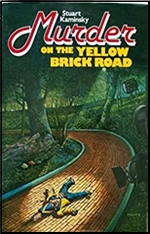
STUART KAMINSKY – Murder on the Yellow Brick Road. Toby Peters #2. St. Martin’s Press, hardcover, 1977. Penguin, paperback, 1979.
This is the second in Stuart Kam1nsky’s historical series starring his 1940’s Hollywood private investigator, Toby Peters (a.k.a. Tobias Leo Pevsner), who made his own debut last year in Bullet for a Star. This second entry is far superior to the first. Once again, Hollywood stars join the fun in both major and minor roles.
In this vehicle Toby is summoned from the Warner Brothers lot (where he helped Errol Flynn in Bullet) to M.G.M by an urgent call from Judy Garland, who has just discovered the body of a murdered Munchkin on the still-standing publicity set of Munchkin City from The Wizard of Oz, released more than a year earlier. Peters is hired by Louis B. Mayer himself to keep the investigation quiet and protect Judy, whose own safety seems at stake. Toby’s interview with the “little” suspect arrested in connection with the murder convinces him of his innocence.
Peters, of course, whose wife has already walked out on him and who shares office space with a dentist, is a progeny of the classic Hammett/Chandler tradition:
“My nose is mashed against my dark face from two punches too many. At 44 I’ve a few grey hairs in my short sideburns, and my smile looks 1ike a cynical sneer even when I’m having a good time, but there are a lot around town just as tough and just as cheap. I fit a type, and in my business I was willing to play it up rather than try to cover.”
And again:
“I was doing what private detectives are supposed to do. I was walking the mean streets. I was acting like a damn fool.”
Indeed, Raymond Chandler also has a bit part as himself in the novel. He spots Toby while doing research on flophouses and decides to shadow him, but is waylaid for his efforts. Since Toby is the first real detective he has ever met, our investigator lets him tag along on the case so he can drink in some local color and dialogue first hand.
A second fatal stabbing, a defenestration., and two attempts on Toby’s life all ensue before the climax, in which even Judy has a hand (or an elbow, to be more exact).
Murder on the Yellow Brick Road is a well-paced and very neat yarn, indeed, even if it doesn’t require a wizard to spot the culprit. The dialogue is crisp and lively, especially between Toby and his antagonistic brother, LAPD Lieutenant Philip Pevsner, whose boiling point is nil whenever he runs up against his younger brother.
Add Clark Gable in a minor role as a prospective witness and several other M.G.M. stars in walk-through parts and it all adds up to quite a pleasant stroll down memory lane as well. Unfortunately, there was a very careless printing job by St. Martin’s Press on the first edition which will hopefully be corrected in subsequent printings, including that scheduled for the Mystery Guild.
Kaminsky’s third work is already in progress and will involve Toby Peters with the Marx Brothers.
– Reprinted from The Poison Pen, Volume 1, Number 3 (May 1978).
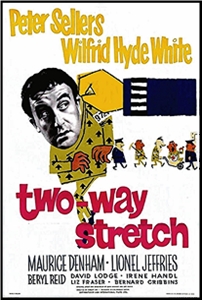
TWO WAY STRETCH British Lion Films, UK, 1960. Peter Sellers, David Lodge, Bernard Cribbins, Wilfrid Hyde White, Maurice Denham, Lionel Jeffries, Irene Handl, Liz Fraser. Director: Robert Day.
I don’t often review comedies on this blog – though I do love ’em – but I’m making an exception for this as it is both old and involves a crime. It’s basically Porridge fifteen years earlier, with Peter Sellers as crafty, cockney career criminal (and guest of Her Majesty’s) ‘Dodger’ Lane. He and his cell-mates ‘Jelly’ Knight (David Lodge) and Lenny the Dip (Bernard Cribbins) treat the prison like a hotel, with a newspaper and fry-up every morning.
The staff, meanwhile, are gullible and good-natured, with the governor (Maurice Denham) more interested in growing prize-winning vegetable marrows than keeping his convicts under control. Unsurprisingly, with such an easy life, Dodger and co have no wish to escape.
This, however, is just what their old conspirator ‘Soapy’ Stevens (Wilfred Hyde-White) asks them to do. Disguised as a gentlemanly prison chaplain, he recognises that the trio’s imprisonment affords them the perfect alibi and enlists their help in a diamond heist. All they have to do is break out of prison, carry out the theft and break back in again.
With the prison’s security almost non-existent, the plan is bound to succeed. However, a problem arrives in the shape of Dodger’s old nemesis, the irascible and sadistic prison warder ‘Sour’ Crout (Lionel Jeffries). With this guy around, there’s no way our trio can figure out a way to escape … surely?
Caper comedies were popular at this time with The Big Job(1965), Too Many Crooks (1959) and Make Mine Mink (1960) showing that we Brits may be rubbish criminals but do make pretty good comedies. This was one of the most popular British films on the year of release, and it’s easy to see why. Schoolboys, in particular, must have loved the silly fun found here, and Jeffries makes for a terrific pantomime villain as the gestapo-like Crout, screaming his lines (“Silence when you’re talking to me!â€) and sadistically determined to make every inmate suffer. There’s excellent support too from Liz Fraser and Irene Handl, the latter urging her son Lenny to escape jail like everyone else in their family.
The break-out attempts in the middle of the film tip the hat to both The Wooden Horse (1950) and Danger Within (1959), spoofing another popular genre of the time, though both are episodic and unsurprisingly focus more on comedy than logistical analysis. The eventual theft of the diamonds from an army vehicle is a little underwhelming, however, though Thorley Walters shows how he could have played Captain Mainwaring in Dad’s Army (a role in which he was considered).
This was probably the most casual performance Sellers ever gave, lacking as it does the multi-character revue of The Mouse That Roared (1959), Dr Strangelove (1964) and Soft Beds, Hard Battles (1974) or the intensity of I’m Alright, Jack(1959) and Being There (1979). It is also one of his most charming and accessible films, proving that not only Ealing could do Ealing.
Fans should also check out The Wrong Arm of the Law (1962) (another Sellers caper and something of a spiritual successor to this), POW spoof Very Important Person (1961) and, more recently, the starry but sadly neglected prison comedy Lucky Break (2001).
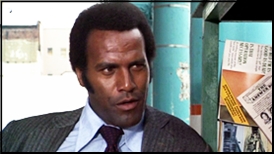
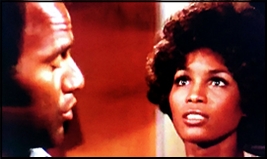
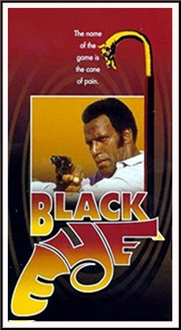
BLACK EYE. Warners, 1974. Fred Williamson (PI Shep Stone), Marie Cheatham, Rosemary Forsyth, Teresa Graves, Floy Dean, Richard Anderson, Richard X. Slattery, Bret Morrison. Based on the novel Murder on the Wild Side (Gold Medal, paperback original, 1972). Director Jack Arnold. Available for rental at Vudu/Fandango.
The nicest thing you can say about Black Eye is that it will probably do no lasting harm to Jack Arnold’s reputation. In his hey-day, Arnold directed solid-if-minor classics like Creature from the Black Lagoon, The Incredible Shrinking Man, Tarantula, and The Tattered Dress. He directed Orson Welles in Man in the Shadow and some sources credit him with parts of Touch of Evil. Sad to see him, twenty years after, wasting his time and ours on a lackluster “blaxploitation” pie like this.
Not that Black Eye is terrible — it’s just not very interesting. In fact, it has some pretty good credentials: based on a Gold Medal Original by Jeff Jacks; starring ethnic auteur Fred Williamson, with help from Teresa (Get Christie Love) Graves as his sexually ambivalent girlfriend and Brett Morrison (Radio’s The Shadow) as a sleazy suspect.
There are one or two passable fight scenes, and a car chase of flickering interest, but by and large this story of… of … what’s it about? … oh yeah, something about drug dealers and a fancy cane stolen from a dead movie star. Well, it leaves one wondering why they bothered.
— Reprinted from The Hound of Dr. Johnson #7, May 2000.
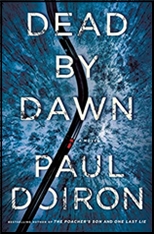
PAUL DOIRON – Dead by Dawn. Game Warden Mike Bowditch #12. Minotaur Books, hardcover, June 2021. Setting: Contemporary Maine.
First Sentence: The hill is steep here, and there is no guardrail above the river.
Some love books and take great care of them: don’t write in them, or bend down corners. Hardcovers are put in mylar archival covers as soon as they arrive, and the spines are not broken. But not this one. With a print, rather than an e-copy of this book, one would be tempted to rip out the pages out with abandon so they could be reordered in chronological order.
You see, the author decided to write the story alternating between the present, and the very recent past; truly a gap of an hour, perhaps. The story is jumping back and forth like the ball in the championship ping-pong tournament and tends to drive one crazy.
One assumes at some point, the past will with meetup with the present, but one may not wait that long before becoming screamingly frustrated. Not only does the style make the story nearly impossible to read, but it also removes most of the suspense which would have been otherwise palpable. Perhaps if one had a paper copy, they’d skip to the end just to see how it comes out. Frankly, however, no reader should feel the need to do that.
For pity’s sake, what happened to the idea of starting the story at the beginning and carrying it straight through to the end; no prologue, no flashing back and forth, no portents: just tell the bleeding story!
One could nearly conclude that many books written in 2020 were subject to the pandemic rendering too many authors incapable of editing, not rambling, including far more extraneous information than remotely needed, muddling the plot, including every character they can imagine, and falling prey to using devices that drive some readers mad with frustration. Sadly, this is one of those.
Dead by Dawn is heartbreaking. Paul Doiron’s other books with his great characters, information about Maine and being a game warden there, are wonderful to read. Others will love this book and it well may win awards. However, others may find it gimmicky and annoying, and hope his next book returns to telling a cracking story in a straight timeline fashion.
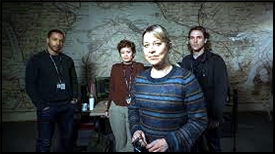
ANNIKA “Captain Ahab’s Wife.†Alibi, UK, 17 August 17 2021 (series 1, episode 1). Nicola Walker as DI Annika Strandhed, Jamie Sives as DS Michael McAndrews, Katie Leung as DC Blair Ferguson, Ukweli Roach as DS Tyrone Clarke, Kate Dickie as DCI Diane Oban, Silvie Furneaux as Morgan, Annika’s teenage daughter. Based on the BBC Radio 4 drama Annika Strandhed, created by Nick Walker, who also developed it for TV and wrote this episode. Currently streaming on PBS.
This episode begins with Annika beginning a new position as the lead detective for a new Marine Homicide Unit in Glasgow, and as usual, she as a single mother, has her teenage daughter in tow and starting at a new school.
If the word “truculent†didn’t exist, it would have to be created just for the daughter. Or maybe “sullen,†but who can blame her? Dragged off to a new city with no friends, just like so many shows just like this one.
What makes this one different is the “breaking of the fourth wall†aspect, as every so often Annika turns to the camera and starts telling the audience what she’s thinking at the time. This is while action is still going on, not by having her step off to the side to do so. Many of the reviewers on IMDb hate this.
I admit being taken by surprise the first time it happened, but I think it’s, well, almost charming and (in my opinion) certainly well done.
LOREN D. ESTLEMAN – Stress. Detroit #5, hardcover, Mysterious Press, 1996; paperback, 1997.
Estleman is one of those writers who writes well enough that I generally enjoy whatever he cares to write, but I was damned glad to hear that he’s going to get back to Amos Walker. I liked the first book in the Detroit series, Whiskey River, pretty well, but it’s seemed to me that each succeeding volume has been anywhere from a little to a lot weaker than the one before it.
Detroit is crumbling by 1972, and has richly earned the title of Murder Capital of America. As a black militant and his minions plot to kidnap the daughter of one of Detroit’s richest white families, a young black policeman finds himself caught between the demands of his conscience and his job — -and between armed Black Power and a police department that may be even more violent,
Surely Estleman had something better to do with his time than this. Surely. I’ve said in the past that he was a born storyteller and couldn’t write anything I wouldn’t like, but he has now. I didn’t hate it, mind you, but it sure didn’t hold my interest.
None of the characters came to life, and the newsreel technique he’s employed for the Detroit series, just didn’t get it done this time. I don’t know what else to say about it, other than it was just a blah job to me, and that’s something I never thought I’d say about one of his.
— Reprinted from Ah Sweet Mysteries #24, March 1996.
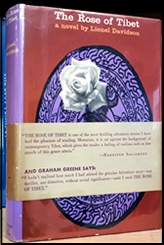
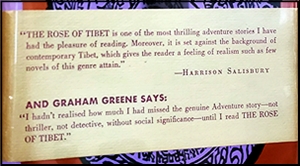
LIONEL DAVIDSON – The Rose of Tibet. Gollancz, UK, hardcover, 1962. Harper & Row, hardcover, 1962. Reprinted many times (and still in print).
Like Mark McShane, Lionel Davidson is one of those talented writers who possess a knack for seldom if ever repeating themselves from book to book. His first novel, The Night of Wenceslas (1960), is a tale of espionage set in Czechoslovakia (which won a CWA Golden Dagger, the first of three garnered by Davidson); The Menorah Men (1966) is a thriller with political overtones that takes place in Jerusalem; Murder Games (1978) is a whodunit laid in London’s bohemian art world; and The Rose of Tibet is a magnificent “quest” novel of suspense and high adventure reminiscent of the work of H. Rider Haggard.
Set in 1950-51, The Rose of Tibet covers the perilous seventeen-month odyssey of Charles Houston. It begins in England, where Houston learns that his brother and other members of a group sent to northern India to film mountain climbing have mysteriously disappeared. At the request of the film company, he travels to India to search for information about his brother, alive or dead.
In Calcutta, where his quest is apparently at an end, he hears talk of a Tibetan monastery that might hold the key — but the Chinese Communists have only recently seized control of Tibet, and no foreigners are being allowed into the country. Houston is not to be thwarted; he travels to Kalimpong and soon hires a Sherpa guide named Ringling, who leads him through Sikkim and Nepal, across the mighty Himalayas, and into the fabled Tibetan capital of Lhasa.
Danger after danger plagues them en route and after they arrive at the temple of the Monkey God. But Houston survives “to enjoy the love of a goddess and to live through adventures so bizarre that almost no other man-perhaps no other man at all-has equaled them.”
This is superb entertainment, utterly mesmerizing from first page to last. It is difficult to imagine any novelist more vividly evoking the awesome splendor of the Himalayas or the exotic people and landscapes of Tibet. High adventure as only the British can write it, and not to be missed.
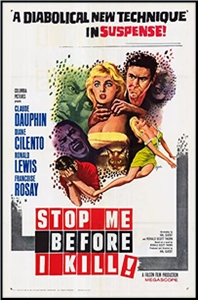
THE FULL TREATMENT. Hammer Films/Columbia Pictures, UK, 1960. Also released as Stop Me Before I Kill. Claude Dauphin, Diane Cilento, Ronald Lewis, Francoise Rosnay. Screenplay by Ronald Scott Thorn based on his novel, with Val Guest, who also directed.
Dr. David Prade: You know only the unsuccessful murderers disclose their crimes.
Alan Colby: And the successful ones?
Prade: Well, they derive their reward from a feeling of personal power.
On their honeymoon Alan (Ronald Lewis) and Denise Colby (Diane Cilento) are involved in a terrible car wreck. Alan, a race car driver, is terribly injured and takes a long time to recover, and even when he comes out of the hospital he is still weak and suffering from nerves, tension, paranoia, and the psychological after effects of the traumatic event.
He also fears he may be dangerous after he briefly tightens his hands around her neck during a passionate moment.
On the Riviera to rest up they meet Dr. David Prade (Claude Dauphin … “He’s too elegant to be an aristocrat. Most aristocrats look like peasants.â€) who takes an interest in them both despite Alan’s distrust and aggressive behavior (“…you’re refreshingly rude.â€).
Told by Denise about the accident, Prade reveals he is a psychiatrist, and that he fears Alan may suffer from repressed emotions that could make him dangerous to her and himself, but he overplays his hand and Alan and Denise decide to go back to London and try to start over.
But things are no better in London, and Denise becomes increasingly concerned as she and Alan argue and he becomes more violent. When she learns Prade has followed them to London in his concern for Alan, she finally persuades Alan to see him in his Harley Street offices.
Under intense therapy, he slowly begins to convince Alan to trust him and reveals the trauma that is causing all the problems. Alan is cured and sent home to Denise before they fly out the next day for the start of the racing season.
But when Prade visits the next morning Denise is gone and there are signs of a violent struggle and bloody second hand medical instruments like the ones Alan described under hypnosis as the kind he would use if he was disposing of Denise’s body having killed her.
Prade persuades Alan to let him institutionalize him before going to the police, but on the way to the asylum they are in a wreck, Prade is knocked unconscious and Alan flees.
Hiding out on the Riviera Alan watches the London papers expecting to read about Denise’s body being found, and that he is wanted by the police, but then sitting at an outdoor bistro he sees a woman that looks suspiciously like Denise and watches as she climbs on a yacht, owned by Prade…
The Full Treatment based on a novel by fine British suspense novelist and humorist Ronald Scott Thorn (Second Opinion, Twin Serpents, Upstairs Downstairs — the Michael Craig movie, not the Masterpiece series) was directed and co-written by director Val Guest (Penny Princess, The Runaway Bus, The Quatermass Experience, The Day the Earth Caught Fire, Where the Spies Are) for Hammer Studios.
Though this isn’t the only suspense film made by Hammer in this period, it is closer to the Hitchcockian model than films like Maniac, Sudden Fear, and The Snorkel that all had more shocker and borderline horror elements. It’s very much a psychological suspense film and not a shocker.
The cast is excellent: Lewis’s well controlled and believably dangerous protagonist; Cilento’s sexy (there is a brief but distant nude scene) and concerned French wife; and Dauphin’s enigmatic Prade, by turns a bit creepy and yet believably solicitous and professional, all hit their marks perfectly. The suspense is genuine and the black and white photography gorgeous and the script intelligent.
Admittedly the movie runs a little long, and perhaps some of the early scenes before they reach London could be tightened or even eliminated, but overall it’s an effective suspense film that ties what seems like loose ends up in the final moments. What holes there are in the plot are no worse than the ones in most Hitchcock films as far as that goes.
I don’t want to oversell this, and I am a fan of Thorn, a suspense novelist in the tradition of Winston Graham, but it is a solid entertaining and attractive suspense film done on a decent budget and well handled all around.