Collecting


Con Report: PulpFest 2009
by Walker Martin.

   Just back from PulpFest after a tiring 500 mile drive and discovered that Trenton, NJ had been hit by a big storm on Sunday which caused some damage to the airport which is near my house. Fortunately my pulp collection survived, but my wife’s car had to be towed to the repair shop.

   Upon arriving in Columbus on Thursday, I met fellow early birds for dinner and we all started to unload our pulps in the dealer’s room at 7:00 PM. This lasted until around 12:00 midnight and was a nice way to start the convention. We all missed the usual old Pulpcon rules of “no talking, no dealing, and no looking at other tables!”

   Friday the fun officially began and I noticed a vast improvement over the previous Pulpcons in Dayton. For example the attendance was over 350 which is more than Pulpcon ever had and I’ve been keeping track since 1972. This figure put PulpFest near the great level achieved by Windy City’s 400.

   During the three days the dealer’s room never looked empty and I saw several important and rare deals being made. For example I sold 17 bound volumes of Weird Tales, numbering 97 issues, mostly in the 1930’s, for only $1000. That’s like $10 an issue. Also sold from my table were many canceled checks from the Munsey and Popular Publication files.

   I bought my usual mound of pulps like Western Story, Dime Mystery, Dime Detective, Detective Story. There was a lot of original art for sale and I bought a framed, signed Edd Cartier drawing which illustrated a Harry Whittington story.

   I also obtained a Detective Fiction Weekly painting from 1931 and a strange bondage cover that was supposed to be used for Fred Cook’s 1960’s pulp fanzine, Bronze Shadows. I say “supposed” because the magazine died before the cover could be printed.

   Also sold from my table were such odd items as a Charles Russell bronze and a pulp painting cover from Fifteen Western Tales. Across the aisle I was witness to the five issues of Black Mask containing the “Maltese Falcon” serial being sold for $4,000.

   What made this deal so strange was the fact that the buyer wanted the issues not because they were from Black Mask or contained Hammett, but because he is an Erle Stanley Gardner fan.

   For those collectors who went broke buying pulp magazines, there were plenty of panels, slide shows, and auctions during the evening hours. The panels were all interesting and covered such pulpish topics as collecting pulps (I was so excited about being on this panel, that I almost tripped and fell on my face), Frederick C. Davis, Edmond Hamilton, The Shadow, and H. P. Lovecraft.

   The guest of honor was Otto Penzler, book dealer, editor, expert on mystery first editions. He was the perfect guest and appeared to be enjoying himself.

   However I was stunned by his announcement that his big book of Black Mask stories had been rescheduled for publication and would appear in late 2010, about a year beyond the date we were hoping for.

   Why? Because since vampires are so popular, they decided to publish a big book of vampire stories first. This of course was sad news for all pulp and mystery fans, but to offset the disappointment, Otto announced that he would also be editing a big book of adventure stories.

   In addition to thousands of pulps there were also quite a few reprints making their debut, such as new Edmund Hamilton collections and several new collections from Black Dog Books, including a stunning collection of Roger Torrey stories. Torrey died an early death but was quite prolific in the detective pulps. For some reason he has been unjustly forgotten and this is the first big collection of his work.

   Also being introduced was the new and enormous issue of Blood ‘n’ Thunder with a ground breaking article by Ed Hulse on Popular Magazine.

   After the panels and auction ended many of us gathered in the Hospitality room for snacks, soda and thank god, beer. More that one collector contributed to the free food and drink, and I’m not sure of their names but I believe Rusty Burke deserves my thanks for supplying the beer, and not just the usual watery American beers, but imported beers.

   I was glad to see such women collectors as Laurie Powers and Karen Cunningham. I caught a glimpse of Clare MacDonald from Australia but Curt Phillips quickly escorted her from my view.

   The Sunday morning Munsey breakfast was a rousing success with far more collectors being willing to rise up early on Sunday morning than I expected. The new Munsey award was a stunning image by David Saunders. I thought about stealing it but it was always under guard. I asked Mike Chomko if I could trade my Lamont award for the Munsey but he was not at all receptive to this reasonable request.

   The first winner of this award is Bill Thom, who administers the Coming Attractions website. This site is new every Friday evening and announces all sorts of pulp related news.

   I would like to thank the PulpFest committee for a great job on their very first attempt. Soon Mike Chomko, Jack Cullers, Barry Traylor, and Ed Hulse will be busy planning the 2010 convention. Fellow Pulp Collectors, this is an event that you must attend, so start making plans!

Editorial Comments: I echo everything that Walker has to say. By any standard you can think of, the convention was a resounding success. The dealers room was constantly busy with none of the lulls that has afflicted the past few PulpCons in recent years. I didn’t buy much myself, but there seems to have been lots of activity at and around Walker’s table.

   I’ve looked carefully, but I have not spotted myself in a short YouTube video of the event, but you can see Walter Albert’s brother Jim in the process of covering their table with a white cloth, probably just before one of our joint ventures out for food and/or local bookhunting.

   I won’t mention any of the names of the people I met there, some for the first time, even though I’ve known many of them for a long time. I spent most my time walking up and down the aisles, but not getting very far any time that I did. It was far too easy to find someone to stop and talk to for large chunks of time, and more than anything else, that’s what I did and why I go.

   For me the convention was compact, intense, and all too short. It was hard to believe it when Paul Herman and I got off the plane together and he dropped me off at home thirty minutes later. Many thanks for all of the effort put into this year’s event by the organizers of PulpFest 2009, and as Walker says, it’s time to start thinking about next year!

I’ll be leaving tomorrow morning for Columbus OH and this weekend’s 2009 PulpFest convention, the first under the new name and new management. They’ve done a tremendous amount of advertising and stirred up a lot of excitement about their show, more than there’s been in a long time. The fellows running the old PulpCon had done a good job over the years, but attendance had been dropping and they didn’t appear to be very receptive to new ideas.

PulpFest is primarily a venue for collectors of old pulp magazines to get together and talk about their recent acquisitions as well as those that got away, and of course to look for more. The center of the show is the dealers’ room, but in the evening are various panels and presentations, all in a very relaxed atmosphere. Many of the attendees have been coming for years, but anyone coming for the first time should feel welcome right away.

Some of you reading this I expect to see there, including several whose names should be familiar if you’ve been reading this blog for a while, such as Walter Albert, Walker Martin, Mike Nevins and Dan Stumpf. Stop by and introduce yourself if you’re there and I don’t see you first!

I’ll be back home on Sunday, but it may be a few days into August before the blog is very active again. Whenever I go away I pretty much stay off the computer, so no reports on the big bash until I get back. See you then!

MICHAEL DIBDIN – Blood Rain.

Detective Book Club [3-in-1 edition]; hardcover reprint (*). First edition: Faber & Faber, UK, hardcover, 1999; trade ppbk, 1999 (*); paperback, April 2000. Pantheon, US, hc, March 2000 (*); Vintage, trade pb, May 2001. (* = shown, in this order)

   One question to which I’ve never been able to come up with a definitive answer is how long did the Detective Book Club last? What was the last selection?

MICHAEL DIBDIN - Blood Rain.

   There must have been subscribers all the way through to the end, but I’ve never been able to find one of them who’d be willing to say with any authority that here’s the one that was the last.

   (I’d also like to obtain more of the selection booklets sent to members over the years. I have a few, but it’s nearly a hopeless cause, since of things ephemeral, I can thing of very few things more so, except serviettes at McDonalds.)

   In the last few years of their existence, though, the DBC put volumes numbers on the spine. The one for this book, for example, is D655, which is the highest I’ve ever had in my possession. The other two books in the same volume are copyright 2000, which puts this awfully close to the end, whenever it was.

   And for the record, if you can’t make them out on the cover shown, the other two books are The Hard Detective, by H. R. F. Keating, and Manifesto for the Dead, by Domenic Stansberry.

   As for Blood Rain, it’s a book in Michael Dibdin’s Aurelio Zen series, about which you can read more in an obituary for the author which I posted here on the blog early in 2007.

MICHAEL DIBDIN - Blood Rain.

   Zen is a Venetian-born police detective whose successive posts have sent him on a guided tour of Italy today. Other observers have suggested reading the books in order, which is a good idea, as in each of them, the situations he finds himself in are as much about him personally as they are about the crimes he is forced to confront.

   Unfortunately I did not take this advice. To tell you the truth, I didn’t take the time to see what advice these other observers had already given, so I plunged right in. And it took me a while to sort out why he has been relegated to Sicily in this book, and why he seems to have a daughter he never knew about and who really isn’t his daughter according to DNA data.

   And to tell you the truth again, I never did completely sort any of either of the above. It’s that kind of book. Very well written, very literary, and very vague on details that depend on either previous books or exactly who is doing what to who in the midst of a Mafia war that seems to have broken out in Sicily at about the same time as Zen’s arrival.

   Zen’s new daughter Carla is in the middle of it, as she is there too, working on installing a new computer system for the police, and so is Corinna Nunziatella, an anti-Mafia judge who has taken a liking to Carla.

MICHAEL DIBDIN - Blood Rain.

   Basically, this is what it is. There are Mafia families against Mafia families in this book, some on the way up, others on the way down. Some are up-to-date regarding new technologies and new sources of income, and some are old-fashioned and designed to stay in the backwaters of the new commerce.

   Dibdin’s prose is witty, clever, introspective and descriptive. His is the type of novel that literary critics go head over heels for, as it typifies the term, “transcending the genre.” Those of us who are old-fashioned and are relegated to the junk heap of wishing to read about old-fashioned detection in our detective fiction may not be as enthusiastic about the story itself as those previously mentioned literary critics have been.

   Please don’t get me wrong. I meant what I said when I referred to Dibdin’s prose as witty and clever. Unfortunately Zen, in this book at least, is a leading character who reacts to events, instead of being pro-active in tackling them head-on, which makes all the difference in the world. Not that he’s any kind of slouch about what he does, but his forte is thinking, when he has a well-defined need to, and not so much doing. And there’s nothing wrong with that.

   And oh, yes, before I go. I understand there was quite a reactive uproar about the ending of this book when it first came out. It’s far enough along in time now, after the fact, to say that the cliffhanger of an ending seems to have worked out in Zen’s favor, but nobody knew that at the time, not until the next book came out, Medusa, four years later, in 2003.

   If you check back, it was a year ago yesterday that I announced here on the blog that I’d uploaded an article by John Pugmire about one of his favorite subgenres of mystery fiction, Locked Room Mysteries. (Mine, too, of course.)

   It’s largely a list of such stories considered to be the best by a couple of noted panels of experts — I’ll leave the details to the article itself — along (and here is where I came in) with cover images of as many of them as John and I could come up with — or nearly 100 or so.

   Some time ago — and longer ago than I’d rather admit — John sent me images of five more covers, one an improvement over one that we’d used to fill a gap, plus four that are brand new. I’ve finally gotten around to doing what I do, and that’s get them online at last.

   The page is on the primary M*F website, and even if you’ve seen it before, I think it’s worth a look. Here’s the URL: https://mysteryfile.com/Locked_Rooms/Library.html, and here are a couple of the newly added covers:

Locked Room Mystery      Locked Room Mysteries

   The time went by very quickly, as it always does. Paul Herman and I arrived in Dayton soon after 2 pm on Wednesday and he dropped me off at home yesterday around 5 pm. In between were many many hours of visiting with people I hadn’t seen since last year (except of course people I’d seen at the Windy City show only a few months before).

   No matter. Being able to talk at length with with people with the same nutty (um, specialized) interests as you do is always a pleasure. That and a special nod to Randy Cox and Walter & Jim Albert, whom whom Paul and I spent a lot of time outside the convention center (meals and bookhunting) as well as inside, it seemed all too soon before it was over and it was time to leave.

   Only the absence of my long-time friend Jim Goodrich, who was unexpectedly hospitalized the weekend before, took any luster off the proceedings. Get well soon, Jim!

   While the dealers room was full of pulp magazines, I managed an all time low in the purchasing any, and in fact it’s a number that’s impossible to surpass: none (after buying only one last year). The selection was fine, but as I perhaps explained earlier, my funds were low. Attendance was also low, but (in my opinion) not dangerously so, as the enthusiasm around the room seemed high.

   What I did obtain consisted largely of various reprints of pulp stories and novels in trade paperback. Print-on-demand is getting easier and easier to do all the time, and the results, more often than not, are very impressive.

   Without intending to slight other publishers whose efforts I intend to review and talk about later, as time goes on, here are two such examples:

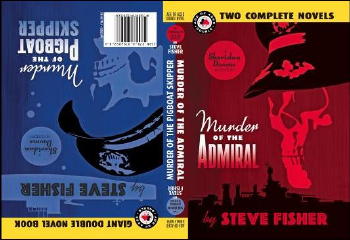
   From Age of Aces Press: A flip book with two early mystery novels by Steve Fisher: Murder of the Admiral (Macauley, 1936, as by Stephen Gould) and Murder of the Pigboat Skipper (Hillman-Curl, 1937). Both are cases for a chief detective for U.S. Naval Intelligence named Lieutenant Commander Sheridan Doome. (Follow the link for more information.)

STEVE FISHER

   Age of Aces Press specializes in air fiction stories that largely take place during World War I and soon thereafter, but I’m told that if there’s a military connection, they’d be interested in reprinting any kind of vintage detective or spy fiction as well. If you have any suggestions along these lines, I’d certainly be happy to pass them along to editor Bill Mann and art director Chris Kalb.

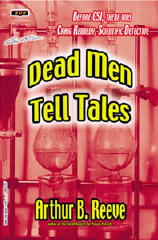
   From Black Dog Books: Dead Men Tell Tales, by Arthur B. Reeve, a collection of stories about Craig Kennedy, a scientific detective who was on the job long before either Patricia Cornwell or CSI came along.

CRAIG KENNEDY

   Much of Black Dog’s output consists of tales of high adventure, a la Talbot Mundy — whose body of work not so coincidentally they’ll be reprinting in total over the next few months, they being Tom Roberts and Gene Christie.

   Tom, by the way, and not so incidentally, was awarded this year’s Lamont award for his outstanding contributions to the hobby of pulp collecting. Another very popular choice!

   Guest of honor was SF writer Larry Niven, who never wrote for the pulps, since he began his career in the mid-1960s for the digest magazines, but whose work has always had (to me) the same sense of wonder the the SF in the pulp era had (and so seldom seems to have today). I had a short opportunity to talk to him, talking about mathematics, a field which we have in common, as well as his days writing for If, Galaxy and Worlds of Tomorrow. A fine gentleman.

   Back to pulps for a moment, if I may. Ed Kessell, a long time pulp fan and the one who put on the very first Pulpcon, back in 1972, died earlier this year. His sons brought a good portion of his collection to sell at their table and to put up for auction. Their table, before the doors were opened and sales could begin, was a sight to behold: stacks and stacks of rare and obscure pulps like Thrilling Adventure, All Star Detective, Clues, Dime Detective and many more. I wish I’d had a camera. They sold very quickly.

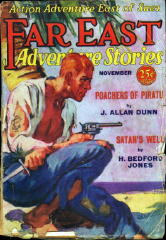
   The cream of the cream was reserved for the first night’s auction, however: a scattered run of Far East Adventure Stories which sold individually for quite remarkable prices, but not to me.

FAR EAST ADVENTURE

   Ah yes, the stuff dreams are made of.

    Keith has very kindly expanded on his remarks of the previous post.

— Steve

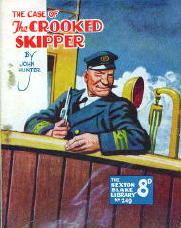
SEXTON BLAKE Crooked Skipper.

I was a reader of the Sexton Blake Library from the age of eight or nine. The first title I read was The Case of the Crooked Skipper by John Hunter. [3rd series, Issue 249, October 1951]

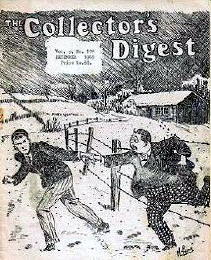
I liked the changes made by editor Bill Baker in 1956 and became an advocate in fan circles, making contributions while still at school to Herbert Leckenby’s Collector’s Digest.

Mid-1961, on the departure of Mike Moorcock from Fleetway, I was offered the chance to become the SBL’s editorial assistant. I jumped at it and enjoyed the first year or so of my working life reading manuscripts and proofs, creating book and chapter titles and blurbs, running the readers’ letters section, keeping editorial ledgers and liaising with the accounts department over payments to contributors. It was an eye-opening experience that quickly gave me a firm grounding for a career in editing and writing.

By the time Fleetway had abandoned the SBL, I was established at Micron Publications Ltd of Mitcham, Surrey, as the editor for a wide range of 64-page comic books of the type popularly known in Britain as picture libraries. In between these duties and writing scripts for the war and western titles, I persuaded the company’s principals that a market existed for a new British text magazine in the mystery field.

Collectors Digest.

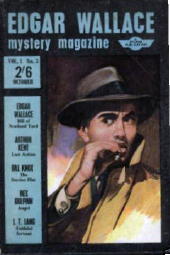
This allowed me to approach the Wallace family and their UK literary agents, A. P. Watt, for permission to use the Edgar Wallace name, then still prominently associated with thriller fiction, particularly through the Anglo-Amalgamated B-movie series.

The rights were granted for a fairly nominal sum, and each monthly issue contained a reprint of an otherwise unavailable Wallace novelette or story, backed up with other, all-new fiction by contemporary crime writers, true crime articles, book reviews and readers’ letters. Many of the contributors were ex-SBL. One of the several who wasn’t was Nigel Morland, who professed to be a friend of the Wallace family.

In hindsight, it was a mistake to have involved the Micron company. The firm was in financial difficulties with its publications, stemming largely from a failure to secure adequate distribution and possibly to have re-invested more of their earlier profits. In debt to its printers, Micron handed over the comics business to them on the basis that various series should continue, but only as English-rights reprints of material from a Spanish publisher.

This terminated my employment, but I was to continue to run EWMM for them as a freelance editor. Responding to sudden employment separation, I quickly adapted to the new circumstances and focused on preserving the magazine’s future. In a very short time, Micron decided to axe the magazine altogether and I began a battle to save it, negotiating alternative distribution, while Edgar Wallace Ltd stepped into the breach to act as publishers and meet printing and editorial costs.

Edgar Wallace Mystery Magazine.

I have letters on file from Nigel Morland ostensibly offering me support, telling me how “impressed” he was, how it was “first-class” and “excellent”. But many were written at a time when he must at least have had an eye on taking over my role.

“Dear Keith, I had the new issue, and really do think you are doing it well. You’ve set a standard, and that is a high one. So far you seem to better it a little with each issue, which, after all, is the heart of all really good editing. Congratulations. Every good wish, Yours, Nigel.”

Two months later, in late 1964, after expending a huge amount of time and energy on what had been “my baby” from the outset, I was bluntly informed by agent Peter Watt that Messrs. Edgar Wallace Ltd had appointed a new editor for the magazine and that after issue number six I should no longer be connected with its publication. I should receive an “ex gratia payment of ?50 when the final corrected proofs of No. 6 go to the printer.”

The new editor was to be Morland, whom I was told by Penelope Wallace and her husband, George Halcrow, was older and more experienced than me, and therefore would make a better job of the magazine.

In a reaction typical of the many I received, T.C.H. Jacobs (Jacques Pendower), then a recent chairman of the Crime Writers’ Association, wrote to me: “Their choice of an editor astonishes me. I have known Morland for many years and am unaware he has ever had editorial experience. But I do know that he has always claimed some connection with the Wallace family. Maybe it is true. I don’t know. He is certainly older than you, sixty.”

I was then aged 21, had done a heap of work in the three and a half years since I’d left school and acquired something of a track record in Fleet-street and backstreet offices. Nevertheless, I was very disillusioned and deeply disappointed. Morland took the magazine in what I suppose was intended to be a more literary direction, eschewing the thriller, slightly pulpish tradition that I felt was truer to the Wallace oeuvre.

And it didn’t last.

   I don’t know if you’ve noticed, but I’ve jammed the last five posts into a span of two days. Ordinarily they’d have been spread out over a week or more, but by the time you read this, I’ll be on my way to Chicago and the Windy City Pulp & Paper Convention.

   And I won’t be back until Sunday, with my satchels full of books and magazines and my checkbook empty. Heck, if I plan it right, my checkbook will be empty several hours before the doors to the dealers’ room is open on Friday. It isn’t hard to do at all, especially when you’re traveling in economy mode, as I will.

   Some of you I will see there, I am sure. If not, so long until next week.

   It’s been a while since I’ve done one of these “maps in mysteries” posts, since last October, as a matter of fact, unless my records are off. British mystery fan and bookseller Jamie Sturgeon has been saving these for me, patiently waiting till I did something useful. Like get them online, as I’m finally doing now.

   The first comes from an author I’d frankly never heard of until now. I imagine that his books are scarce, too, but Jamie had one for sale last November:

Laurence Geogeghan

LAURENCE GEOGHEGAN The Brackenbridge Enigma. Methuen, UK, 1929.


   The next two are from books by Herbert Adams, a writer best known for his golfing mysteries:

Herbert Adams

HERBERT ADAMS The Nineteenth Hole Mystery. Collins, UK, 1939. [Roger Bennion]


Herbert Adams

HERBERT ADAMS The Body in the Bunker. Collins, UK, 1935. Lippincott, US, 1935. [The map is from the Collins edition, but it may have also appeared in the Lippincott.]


— Bibliographic information taken from Crime Fiction IV, by Allen J. Hubin.


   Additional installments of the online Addenda to Allen J. Hubin’s Revised Crime Fiction IV don’t usually occur as quickly as this, but I uploaded Part 24 to the website this afternoon.

   A primary source of much of the new data this time came from Kenneth R. Johnson’s new online index of digest paperbacks of the 1940s.

   As Ken says in the first two lines of his introduction, “The digest-sized paperbacks are very much the forgotten step-children of the American paperback revolution. The earliest series predate the advent of Pocket Books by two years. They were published in parallel with the smaller mass-market paperbacks, flourishing even amid the paper rationing of World War II.”

   Later on he states: “The largest genre published was detective fiction (almost 1100 books); western fiction was much less prolific (circa 325 books), and science fiction was marginally on the radar. Almost as prolific as the mysteries was a long-defunct genre called ‘love novels,’ with circa 925 books.”

   If Ken’s bibliography is not complete, it certainly comes close. At present it includes, he says, 2688 books, but he’s very anxious to add any that he’s missed, if you have information about them.

   But as I said up toward the top, from Ken’s index so far, Al Hubin has already discovered pages of information now incorporated into Part 24 of the Revised CFIV Addenda. This consists largely of dates and settings, but many alternate titles as well and a stray pen name or two, previously unknown to Al.

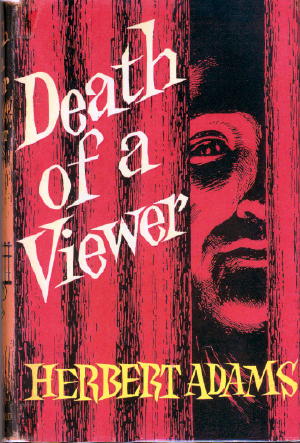
   Tom Taylor is a Herbert Adams collector as well as the author of The Golf Murders (Golf Mystery Press, 1997), a bibliography of golfing mysteries, and yesterday he sent me the cover image below. It’s for Death of a Viewer (Macdonald, 1958), a book that Mary Reed reviewed back in August. I couldn’t come up with a copy on my own, so he sent me one. (The cover image, not the book.) Tom also says that he’s working on an Adams bibliography and has a complete collection except one title, Black Death (Collins, 1938).

Herbert Adams: Death of a Viewer

   A partially illustrated checklist of Adams’s Roger Bennion novels, of which this is one, appeared along with Mary’s review. Follow the link above.

« Previous PageNext Page »