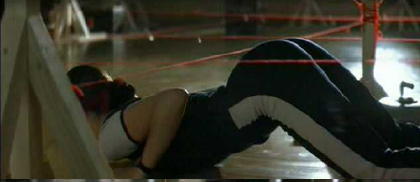
Crime Films


FIRST YOU READ, THEN YOU WRITE
by Francis M. Nevins

   Richard Wright (1908-1960) was perhaps the best-known and most written-about black novelist of the 20th century, but as far as I know no one except myself has ever pointed out the debt he owes to Cornell Woolrich. During the late Thirties when Wright was working on his first and finest novel, Native Son (1940), he is known to have been a voracious reader of the pulp mystery magazines like Black Mask to which Woolrich contributed dozens of stories.
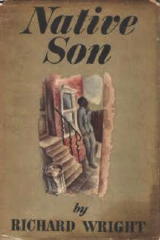
WRIGHT Native Son

   Native Son’s basic storyline of a young man wrongly accused of murder and running headlong through “streets dark with something more than night” was clearly inspired by Woolrich’s powerful suspense thriller “Dusk to Dawn” (Black Mask, December 1937; collected in Nightwebs, 1971).

   During the last months of his life Wright was working on another crime novel, recently published in unfinished form as A Father’s Law, and it seems equally clear that here too he took his point of departure from Woolrich. In “Charlie Won’t Be Home Tonight” (Dime Detective, July 1939; collected in Eyes That Watch You, 1952) a middle-aged cop slowly becomes convinced that the criminal he’s seeking is his son. Woolrich’s cop of course is white. A Father’s Law deals with a middle-aged black cop who also becomes convinced that his son is a criminal.

   If this is simply a double coincidence, it’s one that even Woolrich (who was prone to stretch coincidence to the outer limits) would have rejected. Any student of African-American literature who’s in need of an unexplored topic could do worse than to investigate the Woolrich-Wright interface in depth.

***

   Silly mistakes in mystery fiction are not confined to nonentities like John B. Ethan, whose fond delusion that Zen Buddha was a person I discussed in my last column. Some of the biggest names have perpetrated howlers no less ridiculous.
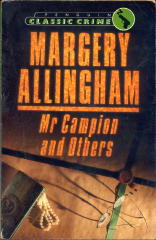
ALLINGHAM Mr. Campion and Others

   Take, for instance, Margery Allingham. “The Definite Article” (The Strand, October 1937; collected in Mr. Campion and Others, 1950) finds Albert Campion called in by his friend Superintendent Oates when Scotland Yard is asked by the “Federal Police” of the U.S. (by which I presume she means the FBI) to arrest and deport a “society blackmailer” whose extortion drove a young woman in New York to suicide.

   Excuse me? Where’s the Federal crime? Where’s the Federal jurisdiction? Any doubts that Allingham knew nothing about the American legal system should be allayed a little further in the story when Campion asks Oates why the Feds got in touch with Scotland Yard instead of, say, “the Sheriff of Nevada.” Since when do states have sheriffs?

***

   Richard Fleischer (1916-2006) directed some of the worst big-budget movies ever to issue from Hollywood but started out helming several excellent little specimens of film noir, perhaps the best known being The Narrow Margin (1952) and Violent Saturday (1955).
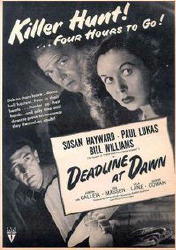
DEADLINE AT DAWN

   His memoir Just Tell Me When to Cry (1993) says very little about most of his noirs but includes a neat anecdote about a similar film he had nothing to do with. In 1946, as a novice at RKO, he sat in on a production meeting with tough-as-nails executive producer Sid Rogell and the well-known theatrical director Harold Clurman, who was helming his first movie. Fleischer doesn’t name the picture but, since Clurman made only one movie in his life, it has to be Deadline at Dawn, loosely based on Cornell Woolrich’s novel of the same name.

   As Fleischer remembered the meeting, the first thing Rogell told Clurman was: “You don’t have forty days to shoot the picture. You’ve got thirty.” Then Rogell picked up the script, noticed that the first scene took place at night and called for rain (in film noir, what else?) and asked Clurman: “Rain? You know how much fucking rain costs?….What do you want rain for?” “For the mood,” Clurman told him. “Fuck the mood. No rain.”

   Rogell was about to order Clurman to cut back on the number of people who appeared in the scene when the director interrupted: “How about dust? Lots of dust blowing everywhere. Can we afford dust?”

   In the finished film the first scene takes place indoors – the confrontation between the blind pianist (Marvin Miller) and his predatory ex (Lola Lane) – and neither rain nor dust appears in the second scene, which is set outdoors but was clearly shot on a soundstage.

***

   So many people have told me that I absolutely must see Infernal Affairs (2002), the Hong Kong movie which Martin Scorsese remade with Leonardo di Caprio and Matt Damon as The Departed, that I finally did it earlier this month.
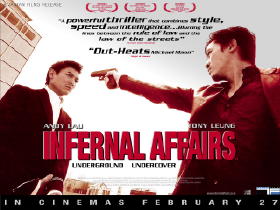
INFERNAL AFFAIRS

   The Asian film tells the same story as its U.S. counterpart – the duel between two moles, one planted in the mob years ago by the PD, the other planted in the PD by the mob – but much more tightly and cynically and without the graphic in-your-face violence that seems to have become a Scorsese trademark.

If    you’ve hesitated because you’re unfamiliar with Asian action films and are afraid you won’t be able to tell the characters apart, I can assure you that this is not a problem. The wispy-mustached police mole in the mob (Tony Leung) could never be confused with the clean-shaven mob mole on the force (Andy Lau), and the only cop whose knows his mole’s identity (Anthony Wong) could no more be mistaken for the only mobster who knows his mole’s identity (Eric Tsang) than could Martin Sheen for Jack Nicholson in Scorsese’s version.

   I do recommend, however, that Infernal Affairs be seen in letterbox. The panned-and-scanned version I got from Netflix eliminates far too much of each image from an intensely visual film – and one that goes far towards proving that noir has become a universal language.
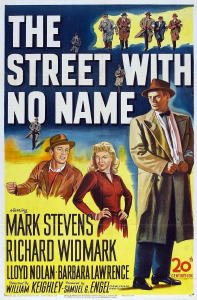
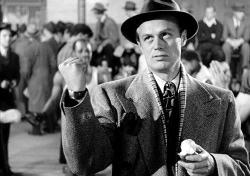
THE STREET WITH NO NAME. 1948, 20th Century Fox. Mark Stevens, Richard Widmark, Lloyd Nolan, Barbara Lawrence, John McIntire, Donald Buka, Joseph Pevney. Directed by William Keighley.

The Street with No Name

   As a sequel to The House on 92nd Street (Fox, 1945), this film repeats both the semi-documentary style and Lloyd Nolan as FBI agent George Briggs. Immediately after the film’s credit, the following notice appears on the screen:

    “The street on which crime flourishes is the street extending across America. It is the street with no name. Organized gangsterism is once again returning. If permitted to go unchecked three out of every four Americans will eventually become its victims. Wherever law and order break down there you will find public indifference. An alert and vigilant America will make for a secure America.”     J. EDGAR HOOVER

   To obtain Mr. Hoover’s approval for the film, one supposes, the first fifteen minutes are dreadfully and drearily slow. With loud, stentorian music in the background, the audience is dramatically shown the technical advances and training background that agents of the FBI had at their disposal in their new post-war battle against crime.

   Mark Stevens, perhaps too good-looking for the role, plays undercover agent Gene Cordell as he tries to gain acceptance into the Alec Stiles gang. It is not until Alec Stiles makes an appearance that the movie begins to gain some footing – and you know who plays Stiles don’t you? You’ve seen the credits, if not the movie. Straight from his major debut in his star-making role as Tommy Udo in Kiss of Death, Richard Widmark.

The Street with No Name

   As the woman-hating, narcissistic and germophobic gang leader Alec Stiles, Widmark tones his portrayal down so that he is only a mere two hairs from lunacy, but they are thick hairs. Lloyd Nolan, whom we think from the beginning is going to be the star, has next to no part at all.

   It is on the streets of “Central City” where the action is, with John McIntire as Cordell’s mentor and backup agent Cy Gordon in the rooming house across the street, getting scruffier and shabbier by the minute, but providing Cordell his only protection.

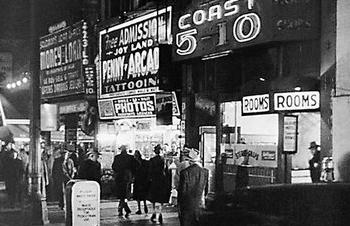
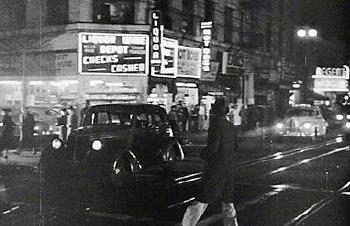
   Playing nearly as important a role as Widmark is the aforementioned “street,” actually downtown Los Angeles at the time the movie was filmed, crammed with flop houses, pool halls, penny arcades, cheap restaurants, boxing emporiums, and dives of all sorts and kinds. Filmed largely at night, beginning as the bus rolls in with Cordell on it and getting off, it triggers a sense of 1940s big city sleaze as overpowering and as authentic as you can imagine. Deep down inside, you know that this is (was) as real as it gets.

The Street with No Name

   Noir? Yes, definitely, once the movie’s rid of its documentary trappings. Filmed with a superb sense of black and white, inventive camera angles and taking superb advantage of on-location shooting, this is one of the best views of how the inhabitants of Skid Row managed to exist, if not live, immediately after World War II.

   Surprisingly enough, the members of Styles’s gang still wear coats, ties and hats to most of their functions, including poker games, boxing matches, stick-ups, robberies and murders. There is also only one woman in the movie, Barbara Lawrence as Styles’s wife Judy, a cheap, sarcastic moll (even to Styles) if there ever was one and convincingly so, even if, as an actress, she was only 18 or 19 at the time.

The Street with No Name

   I think that there was a little too much violence in the ending, in the manufacturing warehouse filled with all sorts of strange-looking machinery, making for all sorts of terrific shots from a cinemaphotographer’s point of view. I don’t have the technical expertise to describe the latter. Take a look at Mike Grost’s website for that. If you’re interested in reading an in-depth analysis of the movie-making (and movie-watching) aspects of The Street with No Name, there is definitely the place to go.

   But, as I began to say, my opinion is that the police were a little too trigger-happy than they should have been. A little? A lot! There is more gunfire in this nifty low budget film noir than I can remember in any of the others I’ve ever seen, but of course there are many I haven’t. Nonetheless, if only the first fifteen minutes could be skipped: you’d have one of the best of them all.

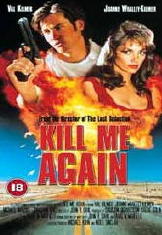
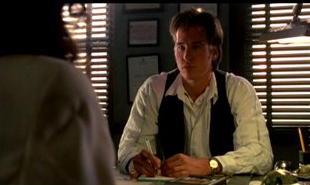
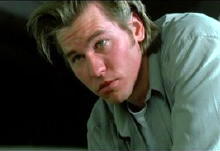
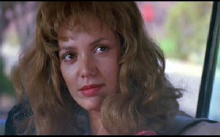
KILL ME AGAIN. 1989. Val Kilmer, Joanne Whalley-Kilmer, Michael Madsen. Screenwriters: John Dahl & David W. Warfield. Director: John Dahl.

KILL ME AGAIN

   Whee-oooh! For fans of modern noir drama, this movie will take you for quite a ride. Flawed though it may be, there are scenes in this movie that seem to come straight from those beloved yellowed old Gold Medal paperbacks from the 1950s, updated only a little – and thinking back, perhaps not even at all.

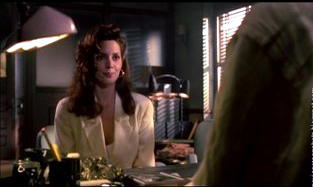
   Jack Andrews, played by Val Kilmer, is one of those down-at-the-heels Reno private eyes who exist only in fiction, who’s hired by a beautiful client to take on a slightly illegal job for her. The client, Fay Forrester (Joanne Whalley-Kilmer), claims that she is on the run from a former boy friend who’s stalking her and that police cannot do anything about it with no solid evidence that he means her harm.

   Her solution? To have Jack create a murder scene, with herself as the victim, so that she can take on a new identity and start a new life. She does not mention that she has a small suitcase in her possession filled with hundred dollar bills, and the “boy friend” is her former partner in crime, Vince Miller, played to perfect psychopathic perfection by Michael Madsen.

KILL ME AGAIN

   As it so happens, Jack has some seriously due gambling debts – so seriously that he has a broken little finger to show for it – and after thinking over for all of a minute and a half – not to mention that Faye is seriously beautiful – he agrees to take the job.

KILL ME AGAIN

   I forgot to mention the mob from whom Vince and Fay have stolen the money, nor have I said anything about the rock that Fay bashed over Vince’s head when she made her departure from him. Neither one will take their losses sitting down – neither the mob, nor Vince.

   The murder scene that Jack creates is only moderately successful, and when he catches up with Fay again – yes, figure that out – they both find that their trail has not been terribly difficult to follow. Hence the title, and I wouldn’t have told you quite so much about the story if I hadn’t have thought that the title needed an explanation.

KILL ME AGAIN

   Beautifully photographed in color rather than black and white, the movie still manages to demonstrate its noir roots in shadows and shading and even broad daylight. Nicely done, and there are some nice twists to the tale that I have not been even close to telling you about.

   Flaws? There may be a twist or two too many for some, but they worked for me, all but perhaps the very last one. (I’m still thinking that one over.) Michael Madsen plays lunatic madmen as well as anybody, and Joanne Whalley-Kilmer is not only savagely beautiful, with curves galore, but she is (or her character is) also seriously loopy in the head. You can almost hear the wheels moving in her mind, with a lusty gleam in her eyes, whenever she’s contemplating her next course of action.

KILL ME AGAIN

   Val Kilmer, on the other hand, seems to be the only one not seriously up to his part. His face is too innocent, too much of choir boy’s, to be first of all, a down-at-the-heels Reno private eye who exist only in fiction. That he’d get caught up in the grip of lust for Fay Forrester goes without saying – or is only interested in the money – or is he trying for both? His facial expressions do not give it away, which in some sense is good, but after a while you begin to wonder as you start to realize that he only has two or three facial expressions to give.

   An almost forgettable flaw, perhaps, but perhaps not, and I thought I’d better warn you. All in all, I thought the movie was terrific, or mostly so, but there are others who don’t. My recommendation: Don’t listen to them.

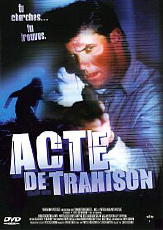
Acts of Betrayal

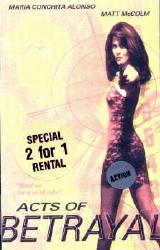
ACTS OF BETRAYAL. 1997, Conquistador Entertainment. Maria Conchita Alonso, Matt McColm, Muse Watson, David Groh, Susan Lee Hoffman. Director: Jack Ersgard.

   If you were to ask, I’d say that as a rough guess maybe 80% of this 90 minute action film is exactly that: non-stop action. There are more bullets flying in this picture than in many small revolutions, and at the end there are only two people left standing: star corruption witness Eva Ramirez (Maria Conchita Alonso) and stalwart, straight-as-an arrow FBI agent Lance Cooper (Matt McColm), whose thankless job it is to get her before the investigating jury.

   Opposing them is a veritable army of thugs, soldiers of fortune, outlaws, bikers and miscellaneous gunmen, organized and fortified by two individuals (one man with a tall, strikingly beautiful female assistant) in a well-equipped communications van, complete with state-of-the-art computers and backup plans and mercenary forces far beyond anything Al Capone ever dreamed of.

   Did I say that agent Cooper is straight-laced? What I didn’t say is that the lady he is escorting is uninhibited, a non-stop talker, an incessant chatterer, often suggestively and R-rated, and of course, as they most often do, opposites attract. Eventually. I love it. And of course they save each others’ lives more than once.

Acts of Betrayal

   For the kind of movie this is, on a scale of one to five, I would give this one a five. The acting is far above average, the dialogue witty, and while realism has no basis in the story line, realism is not exactly what people who watch movies like this are watching for.

   For the kind of movie this also is, there is no scale from one to ten. I do concede that movies like this do not deserve a scale that goes that high.

   I’ve not been able to find this movie on DVD in English — only in Spanish, or as a beat-up former video rental. I guess you’ve have to explain the economics of movie-making to me. I’m sure this never played in theaters, only on cable. Even a cheap five dollar DVD would recoup some of the production costs, wouldn’t it?

THE BIG COMBO. Allied Artists, 1955. Cornel Wilde, Richard Conte, Brian Donlevy, Jean Wallace, Lee Van Cleef, Earl Holliman, Helen Walker, Helene Stanton. Director: Joseph H. Lewis. Original music by David Raksin.

   This one’s the real deal. In the last week or so I’ve been telling you about bits and pieces of various movies that were noirish in nature, but by 1955 directors and cinematographers (John Alton, in this case, of Raw Deal and I, the Jury fame) who worked with noir films knew exactly what they were doing, and they did it well.

   Mike Grost has done a superbly in-depth online analysis of the films of Joseph H. Lewis (no relation), and you should go read it. The Big Combo is one of his films that comes in for a lot of attention, including a good many things that didn’t register for me on my first time through. (Mike admits that he has watched many of Lewis’s films more than once.)

The Big Combo

   I’ll not repeat any of Mike’s thoughts and facts about the film. I don’t mind repeating myself by saying that you should go read it for yourself. I’ll be content to relay to you my impressions and not rely on any of his.

   And impression number one is the reason I included David Raksin’s musical score in the credits. The loud jazzy opening scene, with a good-looking blonde running frantically from two thugs in the shadowy depths of a boxing arena is one of the finest in recent memory. Made me think the movie was about a jazz band (The Big Combo), in fact, but no, not so.

   No, the Big Combo is essentially Mr. Big’s gang, Mr. Big being Mr. Brown (Richard Conte); the girl on the run is his girl (Susan Lowell, played by Jean Wallace); and the job the two thugs are doing (Fante and Mingo, aka Lee Van Cleef and Earl Holliman) is to make sure she doesn’t get away from him.

   Cornel Wilde as Lt. Diamond is the detective obsessed with bringing Mr. Brown to justice. That he is also obsessed with Susan Lowell, and in fact in love with her from afar — she does not even know of his existence — is getting him in trouble with the people who pay the bills. He has gone far beyond his department’s allotment of funds, and so far to no avail.

   (That Jean Wallace was also Mrs. Cornel Wilde I did not know while watching the film. She is worthy of obsessing over, and so she fits the role perfectly, but her acting is only slightly above the ability of usual female model who goes to Hollywood.)

The Big Combo

   Better, I thought, was Helene Stanton as Rita, a showgirl of Diamond’s long acquaintance to whom he turns for solace when things begin to look their darkest. It is hinted at that perhaps she is more than a showgirl, for the place where she works is not the most upscale of joints.

   This movie also hints at several other things, including the relationship between Fante and Mungo, which could be debated, as hints are all you are going to get.

   Taunted by Mr. Brown into a fury, Diamond aches to find some hold or some charge he can get him on. That he makes only $96.50 a week only adds to the resentment. Mr. Brown does not hesitate to rub it in. The name “Alicia” means something to Mr. Brown, however, and it takes a nice bit of detective work to track down who she is and what she means to him.

   I have not mentioned Brian Donlevy, who plays Joe McClure, a broken-down and not too intelligent assistant to Mr. Brown, outwardly always in his place, but inwardly frustrated at having been passed over when the position at the top of the gang became available. He wears a hearing aid, a fact ordinarily not worth mentioning, but in this case it is, and twice, both in scenes crucial to the story.

The Big Combo

   I did not care for the ending as much as most reviewers seem to have. Mr. Brown’s fall came too quickly to suit me, although it certainly came as no surprise that it happened, and that there was a way out that he didn’t take advantage of — well, it was a disappointment to me.

   A minor quibble, perhaps. Otherwise, as I said at the beginning, this is the real thing. Fine acting, fine directing, and fine movie-making, all on a low B-movie budget. I dare not ask for more, nor should you.

PORT OF NEW YORK. Samba Films, 1949. Scott Brady, Robert Rober, K. T. Stevens, Yul Brynner, Arthur Blake, Lynne Carter; narrated by Chet Huntley. Director: László Benedek.

Port of New York

   Filmed as a semi-documentary on behalf of US Customs and the Treasury Department, with narration throughout by (uncredited) Chet Huntley, there’s enough solid drama stuck in between the various drop-in chunks of stock footage — suitable for PTA meetings and 4H clubs, not that there’s anything wrong with that — to make this a rather respectable (and enjoyable) crime thriller.

   Unlike the film Dangerous Lady, which I reviewed here not so very long ago, Port of New York takes its crime seriously. When a load of dangerous narcotics is smuggled into New York City from the sea, an entire contingent of federal men are summoned to work on the case, led by Jimmy Flannery (Richard Rober) as a treasury agent, assisted by “Mickey” Waters (Scott Brady) on customs detail. (Unless of course I have their job assignments switched around. In the context of the movie, it didn’t seem to matter.)

Port of New York

   Their roles pale in comparison with that of the villain of the piece, though, a suave but nasty piece of work named Paul Vicola (Yul Brynner, in his film debut, and with hair, as I think every retro-reviewer of this movie is going to say, so why shouldn’t I?). When his girl friend Toni Cardell (lovely brunette K. T. Stevens) discovers that murder is involved, she begins to have second thoughts.

   Her fate is sealed from that point on. It will not take much experience as a crime movie buff to know exactly what I mean: Says Yul Brynner’s character: “You are most ungrateful, Toni.” [See Footnote.]

   Arthur Blake’s role is small but hardly insignificant. As a weak, somewhat effeminate nightclub entertainer named Dolly Carney (specializing in imitations of Charles Laughton) who is nabbed as go-between in the dope-peddling business, he’s caught between the cops and big guys and with no way out.

Port of New York

   Some other impressions: The film was shot in Manhattan, along the port, in the harbor, and on the streets Even if filmed in only black and white, the city makes a impressive setting. Of course it is that the movie is filmed in black-and-white, with the dark contrasting shadows at night and in the interrogation room, that makes this film a noir, lessened of course by the story itself, with its naturally positive ending. (I probably shouldn’t give this away — that this movie has a happy ending, that is — and in fact, for some of the players, rest assured that it is simply just not true.)

   And oh, one more thing, without trying to go political. I was wholly on the side of the federal guys, but their tactics were at times — to use a new word I just looked up — rather cringeworthy. As the single most egregious example, breaking and entering one of the bad guys’ offices at night might have helped break the case, but there was no mention of warrants, and the evidence itself was worthless.

   Take my advice anyway. If you’re a fan of black-and-white crime movies with more than a touch of noir, you could a lot worse than watching this minor but still suspenseful and well-plotted example. You could do worse, without even trying.

FOOTNOTE. Thanks to a commenter on IMDB for providing the exact phrasing, which I think is pitch-perfect in every way.

   This is the movie tie-in edition, with a photo of Elizabeth Montgomery taken from the film. The film was in black-and-white, though, and this cover is in color:

McPartland- The Kingdom of Johnny Cool

   From the front cover:

A raw, renegade kid with enough guts to take on the whole damned underworld — A beautiful girl with enough innocence to believe in him.

   From the back cover:

They picked their man, and taught him well.

All the right names.

All the right tricks.

All the ways to kill a man and never leave a trace.

And when they had a fine, smooth precision tool for death, they gave him the name of a gangland titan and turned him loose in the underworld empire the mobster had once owned. And they said: Take it, Johnny. Get it back. It’s yours.

McPartland- The Kingdom of Johnny Cool


GOLD MEDAL k1343. Second printing, September 1963. [above] First printing: Gold Medal 881, 1959. I don’t happen to have at hand my copy of the first printing, but I found a cover elsewhere on the Internet. Both editions are scarce. On ABE when I checked just now, there were 9 copies of the first printing, and two of the second.

McPartland- The Kingdom of Johnny Cool


   The movie was simply titled Johnny Cool (United Artists, 1963). Henry Silva played the title role.

   To read Gold Medal aficionado Bill Crider’s take on both the book and the movie, go here.

FIRST YOU READ, THEN YOU WRITE
by Francis M. Nevins

   In the first edition of Cornell Woolrich’s The Bride Wore Black (1940), each of the novel’s five parts opens with a motto, whose respective sources are Rodgers & Hart, Guy de Maupassant, Cole Porter, and de Maupassant twice more. In the first paperback edition (Pocket Books #271, 1945), the first and third of these are dropped and replaced by lines attributed respectively to Poe and the social philosopher Herbert Spencer. The Poe couplet at the beginning of Part One reads as follows:

The Black Angel         How silent is the night — how clear and bright!
         I nothing hear, nor aught there is to hear me.

   Not long ago an Italian author who is preparing an anthology of essays on Woolrich emailed me to ask if I knew the source of that couplet, which doesn’t appear in any known poem of Poe’s.

   Splitting the first line into its component parts and calling on trusty Google produced one and only one hit. According to www.authspot.com, the quoted matter comes from the first verse of The Murderer, which is billed as an unpublished poem by Edger (sic) Allen (sic) Poe, rewritten (with many other misspellings) by one coyote103 and posted last March. But lines I quoted above must have been published before 1945 or whatever copyright-paranoid munchkin at Pocket Books substituted them for Woolrich’s Rodgers & Hart quotation couldn’t have known about them.

   A later email from my Italian correspondent solved the problem. The quoted couplet is part of a 70-line fragment first published almost forty years after Poe’s death in George W. Conklin’s Handy Manual (Chicago, 1887). No scholar today believes they were written by Poe but the first three lines ( “Ye glittering stars! How fair ye shine tonight/And O, thou beauteous moon! Thy fairy light/Is peeping thro those iron bars so near me”) are quoted in Thomas Ollive Mabbott’s definitive edition of Poe’s poetry (Harvard University Press, 1969).

   How Pocket Books came across them more than a quarter century earlier remains a mystery.

***

Let Us Live   The year The Bride Wore Black first came out is commonly considered the year when film noir came into being. But the more movies I see from the years immediately preceding 1940, the more I tend to question that consensus. Turner Classic Movies recently and for the first time ran Let Us Live (Columbia, 1939), directed by John Brahm and starring Henry Fonda and Maureen O’Sullivan.

   The storyline is pure Woolrich — perverse coincidence and police pressure on witnesses lead to two guys down on their luck being falsely convicted for bank robbery and murder and precipitate a race by the desperate fiancee of one of them to find the real criminals before it’s too late — and the visuals are as shadowy and menacing as anything in the downbeat classics of the Forties. If this isn’t film noir, toads fly.

***

The Dark Page   Devotees of films noir and their fictional sources will want to check out Kevin Johnson’s The Dark Page: Books That Inspired American Film Noir, 1940-1949. In this coffee-table book, recently published by Oak Knoll Press, each right-hand page is devoted to a lush full-color reproduction of the dust-jacket from one of the novels or story collections which was the source, sometimes very remotely, for a film noir from the Forties. Each left-hand page contains a technical description of the jacket and brief comments on the relevant book and film.

   Mr. Johnson, the owner of Baltimore’s Royal Books — whose website, www.royalbooks.com, is worth checking out — is working on a companion volume which will deal with the literary sources of various films noir released between 1950 and 1965. I understand he ll be present at NoirCon, which will be held in Philadelphia early in April. That website (www.noircon.com) is worth checking out too.

***

   Our Poetry Corner guest star for today is A. H. Z. Carr. Anyone remember him? He was born in 1902 and his early stories appeared in Harper’s, Saturday Evening Post and other top general fiction magazines of the Thirties, but he first registered on mystery readers’ radar when his “The Trial of John Nobody” was published in Ellery Queen’s Mystery Magazine (November 1950).

The Mighty Quinn   His fourth EQMM original, “Tyger! Tyger!” (October 1952), is perhaps the finest short crime story to deal centrally with poets and poetry. Malcolm Ridge, struggling to express his feelings about the Atomic Age, becomes prime suspect in the murder of the owner of a Russian restaurant in Greenwich Village and uses his skills as a poet not only to clear himself and identify the real killer but also to use the experience in conjuring up the exact words his poem-in-progress needed.
   Carr died in October 1971, about six months after his Finding Maubee won the Edgar for best first novel of 1970. Starring in the much later film version, 1989’s The Mighty Quinn, was the young Denzel Washington.

A BUCKET OF BLOOD. American International, 1959. Dick Miller, Barboura Morris, Antony Carbone, Julian Burton, Judy Bamber, Ed Nelson, Bert Convy. Producer/director: Roger Corbin.

   I went to the local library sale twice last weekend. On Friday night it cost $5 to get in, and I spend $70. On Sunday afternoon they charged $5 a bag, and I bought four bags. Do you know how many paperbacks you can get into an ordinary plastic shopping bag? Even more amazing, do you know how many DVDs you can get into one? DVDs that sat there at four dollars apiece for two days and nobody wanted them until I came along on Sunday and took four shelves full in one swell foop? Well, four foops.

   This is one of them, and more than that, this the second half of a double feature DVD, the prime attraction being George Romero’s Night of the Living Dead (1968), which I saw once and probably never again. Though perhaps I shouldn’t be too hasty. The version I saw I am sure was colorized, the worst idea that the ladies and gents in Hollywood ever had. The lighting is always wrong and the computers don’t really get it right anyway, what with swatches of color hovering over everything on the screen trying to match what the ladies and gents think is the right color, but (in my opinion) probably almost never is.

   But I digress. A Bucket of Blood was also filmed in black-and-white, and the DVD version is also in black-and-white, and very sharp black-and-white it was also. It was also filmed, or so I’m told, in five days. A small budget film, and of course it shows. It is also quietly hilarious, and somewhat to my relief, intentionally so, since one of the posters I’ve seen for this film says at the top: “You’ll be sick, sick, sick – from LAUGHING!”

   Unless they took a look at the film when they were done filming and decided to accept the inevitable: a bad movie that they could market only if they made everyone believe that that is the way it was done on purpose. But I don’t think so.

   Dick Miller, in probably the only starring role he ever had, but not the only one he played a fellow named Walter Paisley, is a busboy in a beatnik hangout who has a social problem. He’s laughed at, which of course is even worse than being ignored. He’s not only inept but two or three magazines short of a rack, and Dick Miller nails the role perfectly.

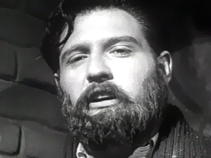
Maxwell

   The Yellow Door, where Paisley works, is one those places, by the way, where poets recite their wares to the sound of a single saxophone (uncredited jazz artist Paul Horn) along the lines of “Life is an obscure hobo, bumming a ride on the omnibus of art,” to quote Maxwell Brock (Julian Burton), or “Where are John, Joe, Jake, Jim, jerk? Dead, dead, dead! They were not born, before they were born, they were not born. Where are Leonardo, Rembrandt, Ludwig? Alive! Alive! Alive! They were born!”

Maxwell

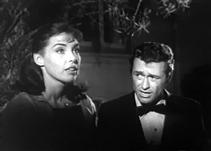
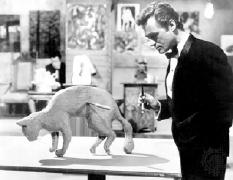
Maxwell Brock is perfect in the part. So is Barboura Morris as Carla, the girl that Walter loves but doesn’t have a chance with until he becomes an acclaimed artist. By mistake. After accidentally killing his landlady’s cat, hiding in a wall, Walter covers the dead animal with clay. A masterpiece, it is praised. One must only smile.

Bucket of Blood

   And of course Walter is not content to be a one-shot wonder. Perhaps you can picture what comes next. If you remember The House of Wax with Vincent Price (1953), I am sure you will. There is, of course, a gag like this (literally) can last much more than an hour, and no, it doesn’t, clocking in at a mere 66 minutes. Just about perfect.

Cat

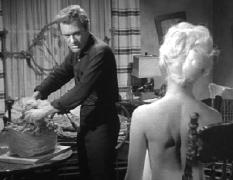
   Not to mention the other starring attraction, besides Alice the model’s nude back (Judy Bamber), that being, of course, an (uncredited) stage appearance of guitarist-folksinger Alex Hassilev at just about the same time he was becoming one of the founding members of The Limeliters. A good career move, that.

Nude

ENTRAPMENT. 20th Century-Fox, 1999. Sean Connery, Catherine Zeta-Jones, Ving Rhames, Will Patton. Rating: PG-13. Director: Jon Amiel.

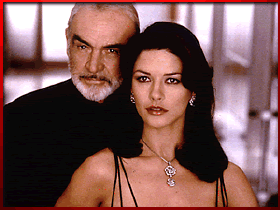
   I have listed four actors in this movie, and while the last two of the four have small but significant roles to play, the fact of the matter is that this is a two-star picture — Sean Connery and Catherine Zeta-Jones — and no one else matters very much at all. One or the other is on the screen, let’s say about 99% of the time, and often both. If for some reason you have an aversion to either one, and I don’t see possibly how, but OK, I’ll concede it, then this is not the movie for you.

Connery Zeta-Jones

   Storyline: Virginia Baker (Catherine Zeta-Jones) works for an insurance company specializing in security. Robert MacDougal (Sean Connery) is an art thief.

   Um. Do you need more than that? Of course there’s more. This is a caper movie, one with many, many intricate plans for stealing things, and getting away with it, and yes, they are working together on almost all of them, for reasons that are complicated and you don’t want to know about them before you watch this movie anyway.

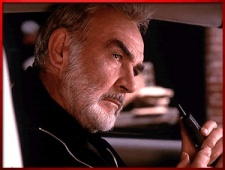
Connery

   A question though: If you are forced to go along with a theft — you know, incriminating photos or the like — is that entrapment or blackmail? I thought so.

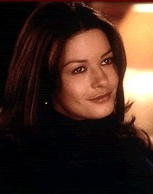
Zeta-Jones

   Many of those leaving comments on IMDB mention the lack of chemistry between Gin and Mac, or the actors who play them. Nonsense, I say. Utter nonsense. One of Mac’s rules is that there be no romantic involvement between partners in the crimes he commits, and he is sorely if not wistfully tempted to break it; and it is clear — well, as clear as anything is clear in this small masterpiece of role-playing, we know she is playing a role, but what role is not so clear — that she returns the feeling. Those IMDB viewers must have been very young.

Zeta-Jones

   At the age of 30, Catherine Zeta-Jones may have been at the peak of her youthful beauty — slim and lithesome and fair of face — when she made this movie. At the age of 69, Sean Connery is as handsome as ever, mismatched in terms of age, perhaps, but most definitely not in terms of the fire within.

« Previous PageNext Page »