1001 Midnights


A 1001 MIDNIGHTS Review
by Bill Pronzini & George Kelley

   
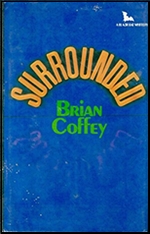
BRIAN COFFEY – Surrounded. Mike Tucker #2. Bobbs-Merrill, hardcover, 1974. No paperback edition.

   Brian Coffey is one of several pseudonyms used by prolific writer Dean R. Koontz. During the early 1970s, Koontz wrote a series of three caper novels featuring professional thief Mike Tucker – a more genteel version of Richard Stark’s Parker.

   Tucker’s straight job is as an art dealer, but in order to live the wealthy life-style he’s accustomed to, he and various other professionals plan and execute occasional big-money heists. Tucker has his principles: He steals only from institutions – banks, insurance companies, department stores – whose losses are fully covered by insurance. And he is good enough so that after fourteen operations in three years, he has never failed.

   Surrounded is the middle book in the series, and easily the best of the three. Tucker, along with two men, Frank Meyers and Edgar Bates, plan to rob the posh Oceanview Plaza shopping mall in southern California; the mall includes a bank. a jewelry store, and eighteen other business establishments. The plan is to hit the mall at night, get in and out as quickly as possible, and Tucker has it all worked out perfectly. Except for one thing – a vital. piece of information that Meyers, for reasons of his own, has withheld from Tucker.

   The result is that an alarm is sounded during the robbery, the police arrive, and Tucker and the others are trapped inside the mall, completely surrounded, with no way out. In a clever variation on the classic locked-room gambit, they manage to hide themselves so that the police aren’t able to find them and assume they somehow must have escaped. (The reader isn’t told their hiding place until some time afterward, so that you may either match wits with Tucker or share the cops’ frustration.)

   This is a well-written novel, ingenious and suspenseful. Tucker is no Parker when it comes to toughness, hut in the brotherhood of crooks he holds his own. His first caper, Blood Risk (1973), is also nicely done: It features another heist that goes sour, that of the biweekly take of a Mafia cell. Here, too, Tucker must improvise to save his own life and those of his partners. The last Tucker novel, The Wall of Masks (1975), is less successful: It has a convoluted and rather implausible plot involving Tucker’s specialty, art treasures (the Mayan variety), plus some strained humor.
   
———
Reprinted with permission from 1001 Midnights, edited by Bill Pronzini & Marcia Muller and published by The Battered Silicon Dispatch Box, 2007.   Copyright © 1986, 2007 by the Pronzini-Muller Family Trust
   

A 1001 MIDNIGHTS Review
by Bill Pronzini


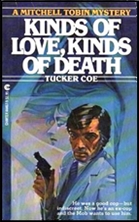
TUCKER COE – Don’t Lie to Me. Mitch Tobin #5. Random House, hardcover, 1972. Charter, paperback, [date?]. Five Star, hardcover, 2001.

   “Tucker Coe” is one of several pseudonyms used by Donald E. Westlake. And Mitchell Tobin, the narrator of Don’t Lie to Me and of four other novels published under the Coe name, is in many ways Westlake’s most fascinating creation.

   Tobin is an ex-New York City cop who was thrown off the force in disgrace when his partner was shot down while covering for him: Tobin at the time was in bed with a woman named Linda Campbell, another man’s wife. Unable to reconcile his guilt, Tobin has withdrawn to the point where little matters in his life except the high wall he is building in the back yard of his Queens home – a continuing project that symbolizes his self-imposed prison and isolation. His forgiving wife Kate and his teen-age son are unable to penetrate those internal walls: no one can, it seems.

   Occasionally, however, someone from his past or his present manages to persuade him to do this or that “simple” job, thus creating circumstances which force Tobin to utilize his detective’s training. The combined result of these cases, as critic Francis M. Nevins has noted, is that Tobin “builds up a store of therapeutic experiences from which he slowly comes to realize that he is not unique in his isolation and guilt, and slowly begins to accept himself and return to the real world.”

   Don’t Lie to Me is the last of the five Tobin novels, the final stage of his mental rehabilitation. He has been given a private investigator’s license and is working as a night watchman in Manhattan’s Museum of American Graphic Art, and before long Linda Campbell, his former lover, about whom he has ambivalent feelings, reappears in his life. Tobin then discovers the naked body of an unidentified murder victim in one of the museum rooms. Further complications include pressure from hostile cops and from a group of small-time hoodlums with a grudge against Tobin.

   Against his will, he is forced to pursue his own investigation into the murder and eventually to reconcile his feeling, toward Linda Campbell – and toward himself. The ending is violent, powerful, ironic, and appropriate.

   The other four Tobin novels are Kinds of Love. Kinds of Death (1966), Murder Among Children (1968), Wax Apple (1970), and A Jade in Aries (1971). It is tempting to say that more Tobin novels would have been welcome, but this is not really the case. Westlake said everything there is to say about Mitch Tobin in these live books, what amounts to a perfect quintology; any additional novels would have seem contrived to capitalize on an established series character.

———
Reprinted with permission from 1001 Midnights, edited by Bill Pronzini & Marcia Muller and published by The Battered Silicon Dispatch Box, 2007.   Copyright © 1986, 2007 by the Pronzini-Muller Family Trust
   

A 1001 MIDNIGHTS Review
by Marcia Muller


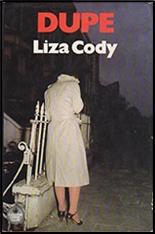
LIZA CODY – Dupe. PI Anna Lee #1. Collins, UK, hardcover, 1980. Scribner’s, US, hardcover, 1981. Warner, US, paperback, 1983; Bantam, US, paperback, 1992. TV adaptation: Season 1, Episode 1 of Anna Lee, 27 February 1994, with Imogen Stubbs as Anna Lee.

   To say that the biggest fault with Liza Cody’s first novel is that we don’t get to know private eye Anna Lee well enough is testimony to the attractiveness and likableness of her heroine. Anna is a former policewoman in her late twenties, employed by the London private inquiry firm Brierly Security. In a welcome relief from her usual assignments – hunting for missing minors or “scent-counter security” – Anna is assigned to dig into the past of an apparent fatal accident victim, Dierdre Jackson.

   Dierdre had been estranged from her parents for three years, and her mother wants to know if she was happy in those last years, while her father wants information because he suspects Dierdre’s car crash was no accident. Representing herself as a friend of the family, Anna traces Dierdre’s friends and employers, most or them on the fringes or the film world; and soon she, too, begins to suspect there is more to the young woman’s death than a crash on an icy road.

   Anna’s low-key approach to investigation is refreshing, and she proves herself tough enough when the case requires it. The glimpses we are allowed into Anna’s private life – especially those scenes involving her zany and endearing neighbors, Bea and Selwyn Price – are tantalizing. So much so, in fact, that any reader will want to know more about her background, such as what her family was like and why she joined and then left the police force.

   An engaging novel with a strong plot, Dupe won the John Creasey Award for Britain’s Best First Mystery Novel. Cody’s second and third novels, also featuring Anna Lee, are Bad Company (1982) and Stalker (1984).

———
Reprinted with permission from 1001 Midnights, edited by Bill Pronzini & Marcia Muller and published by The Battered Silicon Dispatch Box, 2007.   Copyright © 1986, 2007 by the Pronzini-Muller Family Trust
   

      The complete Anna Lee series –

Dupe (n.) Collins 1980
Bad Company (n.) Collins 1982
Stalker (n.) Collins 1984
Head Case (n.) Collins 1985
Under Contract (n.) Collins 1986
Backhand (n.) Chatto 1991
Bucket Nut (n.) Chatto 1992 [with Eva Wylie]


A 1001 MIDNIGHTS Review
by Susan Dunlap


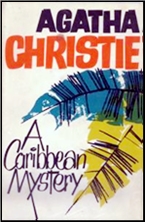
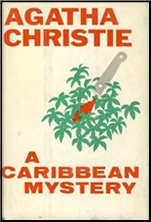
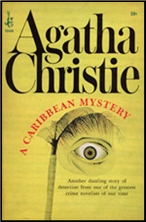
AGATHA CHRISTIE – A Caribbean Mystery. Miss Marple #9. Collins Crime Club, UK, hardcover, 1964. Dodd Mead, US, hardcover, 1965. Pocket Book #50449, US, paperback, 1966. Reprinted many times in both hardcover and paperback. TV adaptations: (1) A Caribbean Mystery, US, TV movie, 1983 with Helen Hayes as Miss Marple. (2) Agatha Christie’s Miss Marple. BBC (Series 1, Episode 10), 1989 starring Joan Hickson as Miss Marple. (3) Agatha Christie’s Marple, BBC (Series 6, Episode 1) with Julia McKenzie as Miss Marple.

   The appeal of Christie’s Miss Jane Marple books is their deceptive simplicity. They are quiet, full of thought and conversation. which is seldom interrupted by action. Miss Marple, elderly maiden lady of the village of St. Mary’s Mead, is considered an “old dear” or “old pussy” by the other characters. But in her many years of village life she has observed character, and pondered over the failings of her fellow villagers. “So many interesting human problems-giving rise to endless pleasurable speculation.” St. Mary’s Mead is a microcosm of the larger world outside; and her years of watching events there have honed Miss Marple’s perceptive faculties to a fine point.

   This novel proves Miss Marple to be as acute while on holiday in the Caribbean as on her own turf. The manager of the Golden Palm Hotel where she is staying resembles a headwaiter from St. Mary’s Mead; another guest reminds her of a village barmaid; yet another is like Lady Caroline Wolfe, a local who committed suicide. Thus Miss Marple is able to relate the principles she has evolved in her native village to these new acquaintances.

   In this tropical setting, Major Palgrave (you can cell by his name he’s not long for this world) chatters to Miss Marple, retelling his repertoire of tedious tales, including one of a man who killed two wives and escaped. “Do you want to see the picture of a murderer’?” he asks.

   But as he is extracting it from his wallet, he sees someone over Miss Marple’s shoulder, turns purple, stuffs the picture back in his wallet – and is dead before the day is over. Only Miss Marple suspects murder. Far from St. Mary’s Mead, unaided by her usual friends, but armed with the discovery of similarities to her own villagers and their own – albeit simpler – intrigues, Miss Marple must unearth the truth.

   Miss Marple sees her fellow characters as stereotypes – which indeed they are. Christie is as up front about that as she is in laying her clues, reminding her readers they are there, and daring them to outguess her which, after all, is the fun of a Christie novel.

———
Reprinted with permission from 1001 Midnights, edited by Bill Pronzini & Marcia Muller and published by The Battered Silicon Dispatch Box, 2007.   Copyright © 1986, 2007 by the Pronzini-Muller Family Trust

A 1001 MIDNIGHTS Review
by Bill Pronzini


FRANCIS CLIFFORD – Amigo, Amigo. Coward Mccann, US, hardcover, 1973. Pocket, US, paperback, 1975. Academy Chicago, US, paperback. First published in the UK: Hodder & Stoughton, 1973.

   Few writers of suspense/adventure novels, British or American, can match Francis Clifford for sheer elemental tension, depth of characterization, and prose of rare smoothness and creative imagery. Clifford’s novels are edge-of-the-chair thrillers with global settings – Mexico. Guatemala, England, Ireland, the Eastern Bloc states — and up-to-the-minute plots involving the IRA, espionage activities, the cold war, and random terrorism.

   But more than that, they are psychological studies of considerable power that adhere to a common theme, as stated by Clifford himself in an interview: “Only during strain – a moral, a physical, or a psychological strain – do you get to know your own character … it is only under such circumstances that the right character of a man emerges.”

   The personal trial by fire of Anthony Lorrimer, a cynical, self-involved, “cold fish” British journalist. begins in Mexico City. About to return to England, he is approached by a man with something to sell – a manuscript purportedly written by Peter Riemeck, a former high-ranking Nazi who was once Heydrich’ s deputy. This manuscript, according to the salesman, tells not only what happened to those Nazis who fled to South America after the collapse of the Third Reich, but which of them are still alive, their cover identities, and their present whereabouts.

   Lorrimer isn’t about to buy a pig in a poke; he demands proof – and gets it: one name, SS-Oberführer Lutz Kröhl, a former Auschwitz administrator now calling himself Karl Stemmle and living the purgatorial existence of a curandero – a dentist and healer –in an isolated village on the rim of a Guatemalan volcano.

   Lorrimcr goes to Guatemala to meet Kröhl/Stemmle face to-face: the final proof, After an exhaustive trip by plane, bus, and on- foot he arrives in the. village of Navalosa, where he finds Sternmle gone for the day and the German’s young, bored, and promiscuous native woman, Mercedes, a willing sexual partner. All along Lorrirner has been wondering: What kind of man is Sternmle? Why would he choose to lead the kind of life he does? When he finally meets the ex-Nazi, he realizes there are no easy answers. It isn’t until he and Stemmle and Mercedes find themselves captives of mountain bandits that Lorrimer begins asking those same questions of himself and learns who the real Anthony Lorrimer is.

   Clifford makes the reader feel the heat, the thin air, the frightening desolation of the Guatemalan wilderness; he also makes the reader care about his characters, even the most incidental of them. The Chicago Tribune said that Amigo, Amigo “takes all superlatives,” and that it “will keep you mesmerized.” Indeed it will. If you enjoy literate thrillers that really are thrillers, don’t miss this one.

   And don’t miss any of Clifford’s other suspense novels, especially The Naked Runner (1966), a tale of intrigue behind the Iron Curtain that was made into a rather poor 1967 film with Frank Sinatra; A Wild Justice (1972), a tale of strife in Ireland told against the backdrop of a bleak Irish winter; and Goodbye and Amen (1974), which Ross Macdonald lauded as “an extraordinary thriller about several people of importance who are sequestered with an armed killer in a room of a first-class London hotel. It is intricately and brilliantly constructed, and written with tremendous drive and flair. Not only the ending surprises. There are surprises on nearly every page.”

———
Reprinted with permission from 1001 Midnights, edited by Bill Pronzini & Marcia Muller and published by The Battered Silicon Dispatch Box, 2007.   Copyright © 1986, 2007 by the Pronzini-Muller Family Trust

A 1001 MIDNIGHTS Review
by Susan Dunlap & Marcia Muller


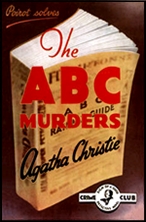
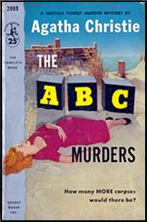
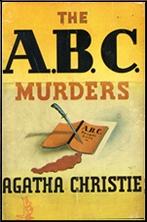
AGATHA CHRISTIE – The ABC Murders. Dodd Mead, US, hardcover, 1936. First published in the UK by Collins, hardcover, 1936. Reprinted many many times, in both hardcover and soft, including an edition published by Pocket in paperback entitled The Alphabet Murders in 1966. Film: MGM, 1966, also as The Alphabet Murders, with Tony Randall as Poirot. TV adaptions: (1) An episode of Agatha Christie’s Poirot, ITV, UK, 5 January 1992., with David Suchet as Poirot (2) A three part mini-series on BBC One, UK, 2018, as The ABC Murders with John Malkovich as Poirot.

   Agatha Christie has long been acknowledged as the grande dame of the Golden Age detective-story writers, Beginning with her moderately successful The Mysterious Affair at Styles (1920), Christie built a huge following both in her native England and abroad, and eventually became a household name throughout the literate world. When a reader – be he in London or Buenos Aires – picks up a Christie novel, he knows exactly what he is getting and has full confidence that he is sitting down to a tricky, entertaining, and satisfying mystery.

   This enormous reader confidence stems from an effective combination of intricate, ingenious plots and typical, familiar characters and settings. Christie’s plots always follow the rules of detective fiction; she plays completely fair with the reader. But Christie was a master al planting clues in unlikely places, dragging red herrings thither and yon, and, like a magician, misdirecting the reader’s attention at the exact crucial moment. Her murderers – for all the Christie novels deal with nothing less important than this cardinal sin – are the Least Likely Suspect, the Second Least Likely Suspect, the Person with the Perfect Alibi. the Person with No Apparent Motive. And they are unmasked in marvelous gathering-of-all-suspects scenes where each clue is explained, all loose ends are tied up.

   As a counterpoint to these plots, Christie’s style is simple (even undistinguished). She relies heavily upon dialogue, and has a good ear for it when dealing with the “upstairs” people who are generally the main characters in her stories: the “downstairs” people fare less well a1 her hands, and their speech is often stilted or stereotyped.

   Christie, however, seldom ventures into the “downstairs” world. Her milieu is the drawing room, the country manor house, the book-lined study, the cozy parlor with a log blazing on the hearth. Like these settings, her characters arc refined and tame, comfortable as the slippers in front of the fire – until violent passion rears its ugly head. Not that violence is ever messy or repugnant. though; when murder intrudes, it does so in as bloodless a manner as possible, and its investigation is always conducted as coolly and rationally as circumstances permit. One reason that Christie’s works are so immensely satisfying is that we know we will be confronted by nothing really disturbing, frightening, or grim. In short, her books arc the ultimate escape reading with a guaranteed surprise at the end.

   Christie’s best-known sleuths are Hercule Poirot. the Belgian detective who relies on his “little grey cells” to solve the most intricate of crimes; and Miss .lane Marple, the old lady who receives her greatest inspiration while knitting. However, she created a number of other notable characters, among them Tuppence and Tommy Beresford, an amusing pair of detective-agency owners, who appear in such titles as The Secret Adversary ( 1922) and Postern of Fate (1973); Superintendent Battle of Scotland Yard, who is featured in The Secret of Chimneys ( 1925), The Seven Dials Murder ( 1929), and others; and the mysterious Harley Quin.

   The member of this distinguished cast who stars in The ABC Murders is Hercule Poirot. Poirot is considered by many to be Christie’s most versatile and appealing detective. The dapper Belgian confesses gleefully to dying his hair, but sees no humor in banter about his prized “pair of moustaches.” And yet he has the ability to see himself as others see him and use their misconceptions to make them reveal themselves and their crimes.

   A series of alphabetically linked letters are sent to Poirot, taunting him with information about where and when murders will be committed unless he is clever enough to stop them. The aging detective comes out of retirement, he admits, “like a prima donna who makes positively the farewell performance … an infinite number of times.” Is the murderer a madman who randomly chooses the victim’s town by the letter of the alphabet, or is he an extremely clever killer with a master plan? And why has he chosen to force Poirot out of retirement?

   These questions plague Poirot’s “little grey cells” as the plot thrusts forward and then winds back on itself time and time again. Well into the novel, Christie teases the horrified reader by introducing a coincidence that looks as if it will solve the cases, then snatches it back, dangles another possibility, snatches that one back, too. And so on, until the innovative and surprising conclusion is reached. Poirot is at his most appealing here, and Christie’s plotting is at its finest.

———
Reprinted with permission from 1001 Midnights, edited by Bill Pronzini & Marcia Muller and published by The Battered Silicon Dispatch Box, 2007.   Copyright © 1986, 2007 by the Pronzini-Muller Family Trust

A 1001 MIDNIGHTS Review
by Bill Pronzini


CLYDE B. CLASON – Blind Drifts. Theocritus Lucius Westborough #3 or 4 (two book appearances in 1937). Doubleday Crime Club, hardcover, 1937. Rue Morgue Press, trade paperback, 2012.

   Mild-mannered Professor Theocritus Lucius Westborough, an expert on the Roman emperor Heliogabalus, is an amateur sleuth in the classic mold of the Twenties and Thirties: He solves convoluted puzzles through the time-tested Sherlockian methods of keen observation, a storehouse of esoteric knowledge, and deductive reasoning. Westborough – and his creator specializes in locked-room “miracle problems.” Even the best of these offers no challenge to John Dickson Carr, but for the most pan they are cleverly constructed and well clued. The one in Blind Drifts offers a particularly neat and satisfying variation on the theme.

   Westborough’s home base is Chicago, but here he travels to Colorado to visit a gold mine in which he has inherited 70,000 shares. Not long after his arrival, he finds himself investigating, first, the disappearance or one of the mine’s directors, and then the murder of its owner, Mrs. Coranlue Edmonds, known far and wide as a “bearcat on wheels” – a murder by shooting that takes place in front of seven witnesses, in a “blind drift” deep inside the Virgin Queen mine. by a seemingly nonexistent gun.

   The plot is twisty and complex, the clues numerous and fairly presented, the motive for Mrs. Edrnonds’ murder plausible, and the method likewise. The Colorado setting is well depicted, as are the details of the operation and physical makeup of a large gold mine. It is Clason’s attention to such detail, more than anything else, that lifts his work above the average puzzle story or the period; you can’t read a Westborough novel without learning something, and something interesting at that.

   The one drawback to this and the eight other entries in the series is Clason’s sometimes florid, often prolix style. Blind Drifts is the only book of his that would not benefit greatly from the excision of ten or fifteen thousand words, and at that it could stand to lose five or six thousand here and there.

   The most appealing of Wcstborough ‘s other cases are The Death Angel ( 1936), set on a Wisconsin country estate called Rumpelstiltskin, where a murder happens in spite of 1542-to-l odds against it. and a murderer is twice guilty of killing the same man; The Man from Tibet (1939), which features a locked-room murder and contains some fascinating background material on the strange customs and rites of Tibet; and Green Shiver (1941), which has a Los Angeles setting and another “impossible” plot, the solution to which depends on Westborough’s knowledge of Chinese jade.

———
Reprinted with permission from 1001 Midnights, edited by Bill Pronzini & Marcia Muller and published by The Battered Silicon Dispatch Box, 2007.   Copyright © 1986, 2007 by the Pronzini-Muller Family Trust

A 1001 MIDNIGHTS Review
by John Lutz


JOHN GARDNER – License Renewed. Rochard Marek, US, hardcover, 1981. Berkley, US, paperback, 1982. Published first in the UK by Jonathan Cape, hardcover, 1981.

   After the death of Ian Fleming, the holders of the James Bond copyright bestowed upon John Gardner the honor and responsibility of moving the British master spy, along with his galaxy of gadgets and arch-villains, into the 1980s. This established thriller writer has responded admirably.

   Here Bond is assigned to infiltrate the castle of the Laird of Murcaldy, a renowned nuclear scientist who has had meetings with an international terrorist known as Franco. Bond manages to deftly extract an invitation to Gold Cup Day at Ascot. Very English. He is off to the castle in the highlands, where he meets people with names like Mary Jane Mashkins and Lavender Peacock and affects the courses of nations with names like England, France, and America.

   If this novel isn’t a Fleming original, it is still great fun. Everything Bond fans would expect is here: the eccentric, larger-than-life villain with his sexy and thoroughly evil female companion and preternaturally tough henchman; the seductive and seduced beautiful woman of questionable allegiance; the slyly sexual double entendre; the infusion of ultramodern technology; and the name-dropping of expensive quality brands of everything from perfume to handguns.

   So artfully has Gardner penetrated and captured Fleming’s style that one can only wonder if Bond’s old nemesis, SPECTER, might somehow be involved. No doubt Bond’s boss, the enigmatic M, could tell us; but. as usual, he is tight-lipped.

   Another recommended title in the new Bond series by Gardner is Role of Honor (1984).

———
Reprinted with permission from 1001 Midnights, edited by Bill Pronzini & Marcia Muller and published by The Battered Silicon Dispatch Box, 2007.   Copyright © 1986, 2007 by the Pronzini-Muller Family Trust

A 1001 MIDNIGHTS Review
by George Kelley & Bill Pronzini
   

JOHN GARDNER – The Garden of Weapons. McGraw-Hill, US. hardcover, 1981. Mysterious Press, US, paperback, 1984. Published earlier in the UK by Hodder, hardcover, 1980.

   John Gardner is one of the most versatile British writers in the espionage genre. He gained early recognition for his Boysie Oakes series – The Liquidators (1964), Amber Nine (1966), and five others which he created in the hope they would be an “amusing counterirritant to the excesses” of James Bond; these were written in the black-humor style characteristic of the Sixties. In the Seventies, Gardner scored additional critical and sales triumphs with a much different type of series – one featuring Sherlock Holmes’s archenemy, Professor Moriarity, in The Retum of Moriarity (1974) and The Revenge of Moriarity (1975). And in the Eighties, Gardner returned to the frantic world of Bondian spies — literally — when he began a series of new 007 adventures.

   But Gardner’s best book to date is not one featuring a series character; it is the realistic espionage thriller The Garden of Weapons, which begins when a KGB defector walks into the British Consulate in West Berlin and demands to speak with Big Herbie Kruger, a legendary figure in intelligence circles. Kruger’s interrogation of the defector reveals that the greatest of Kruger’s intelligence coups — a group of six informants known as the Telegraph Boys — has been penetrated by a Soviet spy. Kruger decides to go undercover and eliminate the double agent himself. without the knowledge or consent of British Intelligence.

   Posing as an American tourist, Kruger enters East Berlin to carry out his deadly self-appointed miss1on. But the task is hardly a simple one; and Gardner’s plot is full of Byzantine twists and turns involving the East Germans, the KGB, and British Intelligence. Any reader who enjoys espionage fiction will find The Garden of Weapons a small masterpiece of its type.

   Another non-series Gardner thriller in the same vein is The Werewolf Trace (1977), which has been called “a compulsively readable thriller with delicately handled paranormal undertones and a bitter ending.”
   ———
Reprinted with permission from 1001 Midnights, edited by Bill Pronzini & Marcia Muller and published by The Battered Silicon Dispatch Box, 2007.   Copyright © 1986, 2007 by the Pronzini-Muller Family Trust.
   

Bibliographic Update: As it so happens, The Garden of Weapons was not a standalone. There were seven in all, all but one published after this one:

      The Herbie Kruger series —

The Nostradamus Traitor (n.) Hodder 1979.
The Garden of Weapons (n.) Hodder 1980.
The Quiet Dogs (n.) Hodder 1982.
The Secret Houses (n.) Bantam 1988.
The Secret Families (n.) Bantam 1989.
Maestro (n.) Bantam 1993.
Confessor (n.) Bantam 1995.

A 1001 MIDNIGHTS Review
by Marcia Muller


ERLE STANLEY GARDNER – The Case of the Sleepwalker’s Niece. Morrow, hardcover, 1936. Pocket #277, paperback, 1944. Reprinted many times since. TV Adaptation: Perry Mason, 28 September 1957 (Season 1 Episode 2), with Raymond Burr as Perry Mason.

   Perry Mason is approached by a “peculiar” client – Edna Hammer. who seeks help for her uncle, Peter Kent. Kent has a bad habit of sleepwalking. and when he does, he heads for (he carving knives and curls up in bed with one. Edna is afraid Uncle Peter will kill someone, and she wants Mason to prevent this.

   Kent has other troubles: a wife who instituted divorce proceedings on account of the sleepwalking but now wishes to reconcile; a fiancee whom he wishes to marry but can’t unless the divorce goes through: a complicated business arrangement with a “cracked-brained inventor”; a hypochondriac half brother; and a woman tailing him in a green Packard roadster. Mason spends a night at the Kent home, and by the next morning there is a bloodstained knife under Peter Kent’s pillow, a corpse in the guest room, and a client in very hot water.

   The writing in this early novel is taut and lean — reflective of Gardner’s hard-boiled work for such pulp magazines as Black Mask. The dialogue is terse and packs a good impact. and there are none of the long-winded conversations and introspections that characterize the later Perry Masons. A first-rate example of Gardner’s work in the Thirties and early Forties.

   Some other notable titles in the series are The Case of the Black-Eyed Blond (l944), The Case of the Lazy Lover (1947), The Case of the Green-Eyed Sister (1953), and The Case of1he Daring Decoy (1957). After the late Fifties, the novels seem to lose something, possibly as a result of Gardner’s work on the Perry Mason TV series. Mason is less flamboyant. and the plots are not as intricate or well tied off as in the earlier novels.

   Gardner created other series characters, writing under both his own name and the pseudonym A. A. Fair. The best of these under the Gardner name arc small-1own prosecutor Doug Selhy (The D.A. Calls It Murder, 1937; The D.A. Cooks a Goose, 1942). whose role as a hero is a reverse of Hamilton Burger’s; and Gramps Wiggins (The Case of the Turning Tide, 1941; The Case of he Smoking Chimney, 1943), an iconoclastic old prospector whose experiences reflect Gardner’s childhood travels with his mining-engineer father.

   In addition to his novels, Gardner wrote hundreds of mystery and western stories under various names for such magazines as Argosy, Black Mask, SunsetWest, and Outdoor Stories.

———
Reprinted with permission from 1001 Midnights, edited by Bill Pronzini & Marcia Muller and published by The Battered Silicon Dispatch Box, 2007.   Copyright © 1986, 2007 by the Pronzini-Muller Family Trust.
« Previous PageNext Page »